
A Delphi and Meteora 2 day tour joins the Delphi oracle site with the Meteora monasteries over two days. Browse more routes in our list of tours in Greece.
This page covers the overnight stay near Kalambaka, the Delphi site and museum, the Meteora monasteries, the drive times, the walking and the return to Athens.
What is a Delphi and Meteora 2 day tour, and how does it work?
Picture a Delphi and Meteora 2 day tour as a coach trip from Athens that lasts two days. It includes one night in a hotel at Kalambaka. Day one visits the ancient sanctuary of Delphi. Day two visits the Meteora monasteries and then returns to Athens. Both sites hold UNESCO World Heritage status.
On day one of a Delphi and Meteora 2 day tour, an air-conditioned coach leaves Athens in the morning. It reaches Delphi around noon. The group explores the archaeological site, where the Temple of Apollo stands. The ruins climb a slope of Mount Parnassus. After lunch, the coach drives north across the Thessalian plain and reaches Kalambaka by evening.
The coach tours include a licensed guide. They book a three-star or four-star hotel in Kalambaka. The small town lies next to the rock towers of Meteora. Dinner and breakfast at the hotel belong to the booking. One operator page lists English plus one more language, French or Italian.
Day two of a Delphi and Meteora 2 day tour starts with breakfast at the hotel. The coach takes the group to Meteora to visit two Byzantine monasteries on top of rock towers. On the way back, it pauses at Thermopylae, where a monument stands for King Leonidas of Sparta. Athens follows in the early evening.
Not every Delphi and Meteora 2 day tour follows this order. One semi-independent version reaches Kalambaka on day one and joins a four-hour minibus tour of the Meteora viewpoints. Delphi comes on day two, after a stop at Thermopylae. Only the Meteora visits are guided, and the group explores Delphi on its own.
Check four things before you pick a Delphi and Meteora 2 day tour. They are the order of the sites, the guiding at each site, the hotel, and the return. A coach tour covers the return in the coach. The semi-independent version ends with a public bus from Delphi. One page lets guests book their own hotel.
How long is a Delphi and Meteora 2 day tour, and where does it start?
A Delphi and Meteora 2 day tour lasts two days and one night. The coach tours depart Athens at about a quarter to nine in the morning. They return around seven in the evening on day two. A semi-independent version starts at eight o’clock at the railway station.
Pick-up points shape the start of a Delphi and Meteora 2 day tour. One operator page collects guests from chosen spots in Athens and nearby areas. Gathering everyone can take up to one hour, so each guest gets an exact time before the trip. Another page names the nearest pick-up point for a hotel that is not a pick-up spot.
A semi-independent Delphi and Meteora 2 day tour has a fixed meeting point instead. The bus leaves the Athens railway station at eight o’clock. The operator asks guests to be there by a quarter to eight. The group is small, with up to nineteen people. The bus ride to Kalambaka takes four and a quarter hours.
On a coach tour, day one has three blocks. These are the morning drive, the visit at Delphi around noon, and the afternoon drive to Kalambaka. Arrival is in the evening. On the station version, hotel check-in comes near a quarter to one. A transfer links Kalambaka train station and the hotel, and a four-hour minibus tour of Meteora follows.
Day two of the station version starts at nine in the morning. A shuttle takes the group to Delphi to explore the site. A public bus leaves Delphi at four in the afternoon. It reaches Athens after about three hours, around seven. That makes this Delphi and Meteora 2 day tour end at the same hour as the coach tours.
Departure days are fixed. Two operator pages run a Delphi and Meteora 2 day tour on Mondays, Wednesdays and Thursdays from April to October. Saturdays are added on set dates. From November to March, one page runs it on Wednesdays. Guests who stay on the coast are driven to their hotels around half past seven in the evening.
What does day one of a Delphi and Meteora 2 day tour look like, hour by hour?
Day one of a Delphi and Meteora 2 day tour starts around 8:45 in Athens. The coach reaches Delphi near noon. After the site visit and lunch, it drives north through Lamia and Trikala to Kalambaka for dinner and the night.
The first hour belongs to the pick-ups. One itinerary gives the departure as about 8:45 and says collecting the group from hotels takes up to an hour. A second page agrees on 8:45. The coach then rolls across Boeotia, through Thebes and Livadeia, towns that mattered in antiquity. A leg-stretching stop follows in Arachova, at the foot of Mount Parnassus.
Delphi comes not long after. One itinerary puts the arrival around noon. The climb starts at the treasuries. Next come the Temple of Apollo and, higher up, the theatre and the stadium. A travel wiki says classes and package groups fill the site from 10:00. A noon arrival on a Delphi and Meteora 2 day tour falls inside those hours.
Lunch comes after the ruins. Three itineraries list the Delphi museum as not included in the programme. One moves the Meteora guests onto a second bus here. A travel wiki says the open-air site has no restrooms, while the museum nearby has food and restrooms. Plan the break around that on a Delphi and Meteora 2 day tour.
After lunch the coach drives through Central Greece. It passes Lamia, with a short stop on one itinerary, and Trikala, then crosses the Thessalian Plain. Another page calls that plain the granary of Greece. The Delphi and Meteora 2 day tour reaches Kalambaka by evening. A short souvenir stop comes before dinner and the night at the hotel.
A second format turns the days around. The semi-independent version of a Delphi and Meteora 2 day tour leaves Athens at 8:00. The bus ride takes four and a quarter hours. The group reaches Kalambaka near 12:45 for hotel check-in. A four-hour sunset tour by minibus follows. Groups hold up to 19 people. Delphi waits for day two.
What does day two of a Delphi and Meteora 2 day tour look like, hour by hour?
Day two of a Delphi and Meteora 2 day tour begins with breakfast at the hotel in Kalambaka. The group visits two monasteries, pauses at Thermopylae on the road home, and is back in Athens by early evening.
Breakfast comes first, and the monasteries follow. A travel wiki gives 9:00 as the normal opening time and puts the closing times between 15:00 and 17:30. Two itineraries visit two monasteries. The wiki counts six that are open to visitors. It advises an early visit in high season, when groups crowd the chapels.
One itinerary pairs Saint Stephen with the Great Meteoron. On Tuesdays it swaps the Great Meteoron for Varlaam. It adds that the plan can change with each monastery’s schedule. So a Delphi and Meteora 2 day tour follows the monastery calendar. Another page says visitors see how monks and nuns live and can buy mementos they made by hand.
On the Delphi and Meteora 2 day tour, the return leg runs south through Trikala and Lamia. Thermopylae is the narrow coastal pass where a battle took place in 480 BC. Two itineraries make a short stop there, so passengers can see the monument of Leonidas across the road. A third says this stop can fall on day one instead.
The Delphi and Meteora 2 day tour ends in Athens early in the evening. Three itineraries give that time of day, and two name about 19:00. Two add that guests staying on the Athens coast leave the coach terminal for their hotels around 19:30. A travel wiki says a direct car journey from Athens to Meteora takes about four hours.
In the semi-independent format, Delphi takes day two. The shuttle leaves Kalambaka at 9:00 and stops at Thermopylae on the way. Guests then have free time at Delphi. A public bus leaves Delphi at 4:00 pm and reaches Athens near 7:00 pm. That Delphi and Meteora 2 day tour ends at about the same hour as the coach version.
Which towns and landmarks do you pass between Athens and Delphi?
A Delphi and Meteora 2 day tour starts in Athens, runs over the Boeotian plains and passes Thebes and Livadeia. Then it climbs Mount Parnassus through the village of Arachova. The coach reaches the sanctuary of Delphi on the first day.
Thebes is the first landmark on a Delphi and Meteora 2 day tour. Wikipedia counts it among the longest-inhabited cities in the world and names it the largest city of Boeotia. Greek myth places Cadmus and Oedipus here. One itinerary calls Thebes and Livadeia towns that played a significant role in antiquity.
Livadeia comes next, and tour pages also spell it Levadia. Wikipedia measures 90 km from Athens to Livadeia, heading north-west. The ancient town, Lebadeia, rose to importance through its oracle of Trophonius. Both Croesus and Mardonius asked it for advice. So a Delphi and Meteora 2 day tour passes one oracle town before the oracle of Apollo.
Arachova is the mountain village on the route of a Delphi and Meteora 2 day tour. Wikipedia calls it a popular day or weekend trip from Attica. The village is known for black wine and for colourful textiles, carpets and rugs. Georgios Karaiskakis and his Greek rebels won the Battle of Arachova against the Ottomans.
On a Delphi and Meteora 2 day tour, Mount Parnassus rises above the final stretch. Its highest peak, Liakoura, stands at 2,457 metres, and olive trees cover the foothills. Delphi sits on the southern flank, in a rift valley with the Gulf of Corinth to its south. In ancient Greek religion the range belonged to Apollo and Dionysus.
Operators differ on the stops. One itinerary pauses in Arachova so guests can stretch their legs. Another drives through Levadia and Arachova and simply names them. A third page has the coach reach Delphi around noon. The morning of that Delphi and Meteora 2 day tour belongs to the road.
What do you pass on the drive from Delphi to Kalambaka?
After Delphi, a Delphi and Meteora 2 day tour heads north through Central Greece. The coach passes Lamia and Trikala and crosses the fertile Thessalian plain. It reaches Kalambaka by evening, ready for the overnight stay at the foot of Meteora.
One itinerary for a Delphi and Meteora 2 day tour names Lamia with a short stop. Wikipedia says the city dates back to antiquity and is the administrative seat of Phthiotis and Central Greece. Mount Othrys carries the city on its slopes, and the river Spercheios flows near it. Farms and livestock fill the land around it.
Thermopylae lies in the Lamia area. The name means hot gates, and comes from the hot sulphur springs close to the hill. In 480 BC an outnumbered Greek force held the pass against the Persians for three days. The stop on a Delphi and Meteora 2 day tour shows the monument to King Leonidas, east of the highway.
Wikivoyage puts Thermopylae 80 km north of Delphi along the E65 and then the E75. Itineraries place the stop on day two, on the drive back to Athens through Trikala and Lamia. Another page adds that the visit sometimes falls on day one. So a Delphi and Meteora 2 day tour meets the pass on one day or the other.
Next comes the Thessalian plain, which one operator page calls the granary of Greece. The river Pineios flows from the Pindus mountains across it and is 205 km long. Kalambaka is one of the towns along that river. In the afternoon of day one, a Delphi and Meteora 2 day tour crosses this plain.
The city of Trikala, in northwestern Thessaly, lies astride the Lithaios, a river that flows into the Pineios. Meteora is close by. The name comes from ancient Trikka, which the Iliad lists with thirty ships in the Trojan War. A Delphi and Meteora 2 day tour passes through Trikala on the way to the rocks.
Kalambaka comes last, beneath the Meteora rocks. Itineraries list a short visit of the village or a brief souvenir stop. Wikipedia says remains of an ancient temple, probably to Apollo, are built into a wall of the town’s oldest church. So a Delphi and Meteora 2 day tour ends day one near Apollo stones.
Where do you stay overnight on a Delphi and Meteora 2 day tour?
On a Delphi and Meteora 2 day tour you sleep in Kalambaka, the town below the clifftop monasteries. Operator pages list hotels of three or four stars for the one night of the trip.
Kalambaka is also spelled Kalabaka and Kalampaka. Wikipedia says it is the administrative centre of a municipality that now carries the name Meteora. Every operator page places the night of a Delphi and Meteora 2 day tour at Kalambaka, never at Delphi.
The pages name the hotel level by stars or by class. One pairs first class with four stars and tourist class with three. Another labels the same levels A class and T class. A booking form asks you to choose first class or tourist class.
Hotel names carry a warning. One operator page names a hotel for each level and adds “or similar”. A hotel on a Delphi and Meteora 2 day tour can therefore differ from the listing. Another page says the operator picks its hotels by hand. A third lists only selected hotel categories in Kalambaka.
Another version leaves the choice to you. One semi-independent page sorts hotels into three levels. Standard rooms in three-star hotels come first, then premium rooms in three-star hotels or guesthouses. Four-star rooms and superior boutique rooms sit at the top. This Delphi and Meteora 2 day tour lets you book your own hotel.
The semi-independent page adds a pick-up from Kalampaka train station to the hotel. A coach page says the group reaches Kalambaka by evening on its Delphi and Meteora 2 day tour. Another page says the group stays overnight and leaves in the morning.
One listing says a Delphi and Meteora 2 day tour lets you choose a single room or a double room. One booking form also lists children under twelve in the parents’ room. Wikivoyage lists Kalambaka hotels with check-in at noon or at two in the afternoon, and check-out at noon.
If you book your own hotel, Wikivoyage adds detail. One Kalambaka hotel has a tour desk and a safe deposit box. A 3-star hotel there has air conditioning in every room and a rooftop bar with views over Meteora. The village of Kastraki, with guesthouses and campgrounds, is the quieter place to sleep.
How do dinner and breakfast work during the overnight stay?
The coach versions of a Delphi and Meteora 2 day tour run on half board. Dinner is at the hotel on night one, and breakfast comes before the monasteries on day two. Lunch and drinks sit outside it.
One listing spells out the term: half board means that breakfast and dinner are included. Two pages list lunch as not included. So lunch on day one is its own meal on a Delphi and Meteora 2 day tour. One page also excludes every meal its itinerary does not name.
Dinner happens in Kalambaka. One page says it is followed by the overnight stay in the town at the base of the mountains. Another puts the dinner at the hotel and counts the meals: one dinner and one breakfast.
Operators word the meal in different ways. A third page calls it a local dinner and describes breakfast and dinner as buffets. A fourth words half board as breakfast and dinner or lunch. Read each page’s inclusions before you book your Delphi and Meteora 2 day tour.
Four operator pages list drinks as not included, and two of them add tips to that list. Plan for drinks at dinner as an extra. Special diets need a request: one operator page offers a vegetarian meal when you ask. Tell the operator at booking.
Four pages open day two with breakfast, and two of them follow it with a visit to two monasteries. Three name the hotel as the place for the meal. On a Delphi and Meteora 2 day tour, each coach page lists breakfast as part of the stay.
The semi-independent version differs. Its room comes with breakfast, and the page does not list dinner. Its express transfer to Delphi leaves at 9:00 am on day two, so breakfast comes first. That Delphi and Meteora 2 day tour leaves the evening meal to you.
If you book your own hotel for a Delphi and Meteora 2 day tour, breakfast depends on the room. Wikivoyage lists a 3-star hotel in Kalambaka with breakfast included, and a Kastraki hotel that serves breakfast in its garden.
Why did the ancient Greeks call Delphi the centre of the world?
The ancient Greeks located the world’s centre at Delphi. A sacred stone there, the omphalos, marked the navel of the earth. Operator pages for a Delphi and Meteora 2 day tour repeat that nickname for the sanctuary.
The first myth involves Zeus and two eagles. He sent them flying from opposite ends of the world, one east and one west, at equal speed. Their paths crossed above Delphi, which made it the middle of the earth. One operator page for a Delphi and Meteora 2 day tour retells this story in its route notes.
Hesiod tells a second tale in the Theogony. Rhea once gave Kronos a stone to swallow in place of her newborn son Zeus. Hesiod says Zeus later set that stone up on Mount Parnassus for worship. The Temple of Apollo held the omphalos. Route notes for a Delphi and Meteora 2 day tour name that temple.
Pausanias described the stone in the second century AD. Wool cloth was wound around it, and two gilded eagles were fixed on top. The stone seems to have been oval. It stood in the adyton, the inner sanctum. A simplified copy stands where it was found, for visitors on a Delphi and Meteora 2 day tour.
Delphi was also the centre of Greek religion. UNESCO calls it a pan-Hellenic sanctuary. In the sixth century BC, Delphi served as a symbol of Greek unity. Kings and city-states sent offerings, and four sacred wars were fought over the oracle. Each operator page for a Delphi and Meteora 2 day tour names the Delphi site.
Fire shows the same role. An eternal flame burned on the inner hearth of the Temple of Apollo. After the battle of Plataea, the cities of Greece extinguished their flames and fetched fresh fire from Delphi’s hearth. Founders of certain colonies were first dedicated there. A Delphi and Meteora 2 day tour visits that Parnassus hillside.
How did the Pythia and the oracle of Apollo work?
The Pythia, Apollo’s priestess, sat on a tripod in the temple’s inner room and answered questions once a month. Priests and officials ran the rest. The Temple of Apollo stands on the route of a Delphi and Meteora 2 day tour.
Pythias were probably chosen from a guild of priestesses, all natives of Delphi. Each needed a sober life and good character. On taking the role, she gave up family duties and marital life. Her story belongs to the sanctuary that a Delphi and Meteora 2 day tour visits.
On the seventh day, two priests led the veiled Pythia to wash at the Castalian Spring. Each visitor brought a young goat. If the goat did not shake off sprinkled water, the god refused the visitor. Smoke from the altar of Chios showed the oracle was open. A Delphi and Meteora 2 day tour reaches the same sanctuary.
The Pythia then entered the adyton, a Greek word meaning inaccessible. She sat on her tripod with laurel leaves in hand and gazed into a bowl of Kassotis spring water. A draw set the order, but city-state delegates moved higher in line. One operator page for a Delphi and Meteora 2 day tour calls Delphi renowned for its oracle.
Apollo had two priests at once after 200 BC. They came from the main citizens of Delphi and ran the sanctuary for life. Without her, priests answered yes-or-no questions by tossing coloured beans. Plutarch, a priest there, wrote that the work shortened her life. One operator lists a licensed guide for its Delphi and Meteora 2 day tour.
Modern analysis explains the oracle’s record. Staff asked visitors who they were, and travellers brought news from far-off places. In one story, the people of Siphnos, hit by drought, set out for Delphi. Gold was found at home, the oracle heard first, and told them to stay. Remember this in the ruins of a Delphi and Meteora 2 day tour.
Vapours remain a debate. Plutarch noted a sweet smell in the adyton. French digs found no chasm in the late nineteenth century. Geologists later found two fault lines under the ruined temple and traces of ethylene in the spring water. The chamber was lost to the faults. A Delphi and Meteora 2 day tour reaches the ruined temple instead.
What do you see on the Sacred Way and at the Temple of Apollo?
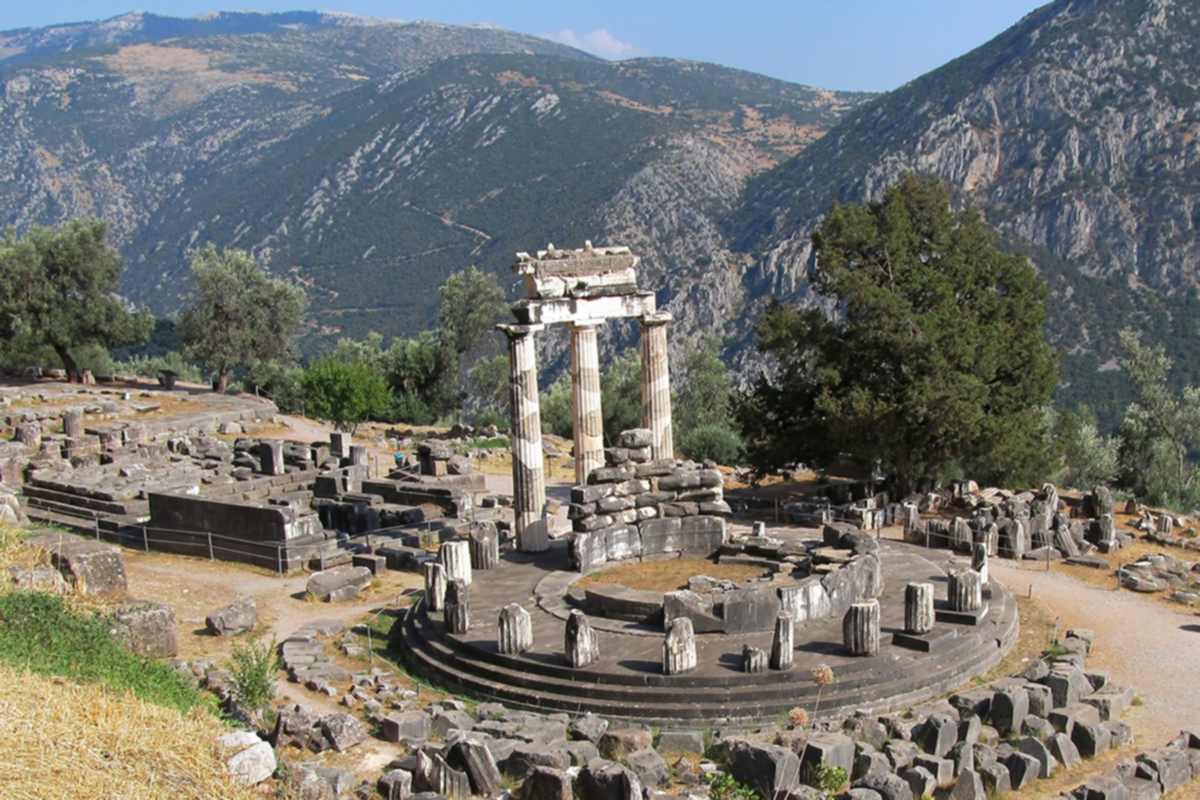
A Delphi and Meteora 2 day tour climbs the Sacred Way, a processional route in Apollo’s sanctuary. Stone treasuries of Greek city-states line it. At its top lies the Temple of Apollo, a ruined Doric building from the fourth century BC.
Treasuries line the path that a Delphi and Meteora 2 day tour follows uphill, each holding one city-state’s gifts. The Siphnian Treasury was the earliest sacred building made wholly of marble. Its builders used a tithe of the island’s mining income. Argos finished one of the largest in 380 BC. Other treasuries belonged to Sicyon, Boeotia, Massalia and Thebes.
Operator pages differ. One page for a Delphi and Meteora 2 day tour has the coach arrive around noon on day one. It lists entry to the site and the Stoa of the Athenians. Another page puts Delphi on day two and calls the visit self-explored. A tour guide at the site is an extra on request.
Greek tradition names five temples on this spot. The oldest was a hut made from laurel, the sacred tree of Apollo. The fourth, built of stone, burned down in 548 BC. A Delphi and Meteora 2 day tour reaches the fifth temple. It rose around the end of the sixth century BC and was raised again in the fourth.
On a Delphi and Meteora 2 day tour, picture a Doric temple with a ring of columns, six by fifteen. Apollo, Artemis and Leto stood on the east pediment, and Dionysus with the Thyiades on the west. Persian shields taken at Marathon hung on the outside. So did Gallic shields, after the Gauls were driven back in 279 BC.
Ancient writers place three sayings on a porch column. One read Know thyself, one read Nothing in excess, and one read Surety brings ruin. Pilgrims waited in the main hall. Only priests entered the inner room. The exact layout is unknown. What a Delphi and Meteora 2 day tour tells you about the rooms comes from ancient writers.
What stands on the upper slope of Delphi, from the theatre to the stadium?
The ancient theatre sits farther up the hill than the Temple of Apollo. Higher still, at the top of the site, lies the stadium. One page for a Delphi and Meteora 2 day tour lists both. The stadium held about six and a half thousand spectators.
The theatre goes back to the fourth century BC. It leans on the natural slope. Its seats give a Delphi and Meteora 2 day tour a view of the whole sanctuary and the valley. King Eumenes II of Pergamon funded a rebuild in the second century BC. Emperor Nero’s visit to Greece brought more changes in AD 67.
A walkway called the diazoma split the seats into two zones. On a Delphi and Meteora 2 day tour, count the rows: 27 in the lower zone, eight in the upper. Six stairs divided the lower zone. The theatre held about four and a half thousand spectators. Wall inscriptions by the side entrances record slaves freed through pretend sales.
The Pythian Games used the theatre for song and music contests in late Hellenistic and Roman times. Plays returned in the early twentieth century, at the Delphic Festivals of Angelos Sikelianos and Eva Palmer. The stage building’s two arched openings survive as foundations. Landslides threatened it for decades, so a Delphi and Meteora 2 day tour finds it restored.
The stadium looks down on the sanctuary of Apollo. In Greece, no stadium from antiquity is in finer condition. Its track was about 177 metres long and 25 and a half metres wide. A Delphi and Meteora 2 day tour that reaches the top shows the stone starting line. Slabs beside it carry cuts for the runners’ feet.
The stadium held the track and field sports of the Pythian Games. One operator page for a Delphi and Meteora 2 day tour ranks the Games second in Greece, after the Olympics. They were held every four years. The stone seats and the arched entrance date from the remodelling under Herodes Atticus in the second century AD.
What does the Delphi Archaeological Museum hold?
Its rooms show finds from the Delphi sanctuary, from eighth-century BC bronze offerings to Roman statues. Three operator pages list the visit as not included in a Delphi and Meteora 2 day tour. Check before you book.
Time decides whether the museum fits a Delphi and Meteora 2 day tour. One itinerary lists the arrival at Delphi around noon and the departure after lunch. The museum stands close to the ruins. Unlike the open-air site, it has food and restrooms.
A small museum rose at Delphi soon after the French Great Excavation, early in the twentieth century. The architect A. Tournaire designed it, and the benefactor Andreas Syngros set up its trust. In the Second World War, the authorities moved the Charioteer to Athens. The gold and ivory finds went to a bank vault.
If your Delphi and Meteora 2 day tour includes the museum, ask for the gold and ivory finds. Two pits under the Sacred Way slabs held partly burnt offerings from the eighth to fifth centuries BC. A fire in the mid fifth century BC destroyed them. The ministry calls three statues a possible Apollonian triad: Apollo, Artemis and Leto.
Museum time on a Delphi and Meteora 2 day tour brings you to the Dancers of Delphi. Three young women stand on a marble acanthus column and are over two metres tall. The ministry puts the whole column at about eleven metres. Debussy’s piano prelude Danseuses de Delphes takes its title from them.
The Daochos monument tells a story from Thessaly, the region the coach crosses on the way to Kalambaka. Daochos II of Pharsalus set it up. Eight statues of his family stood on a pedestal. Agias, the second, won the pankration at three Panhellenic Games. Meteora lies in Thessaly too, so the story fits a Delphi and Meteora 2 day tour.
Two hymns to Apollo, carved on the south wall of the Athenian Treasury, are also in the museum. Athenaeus wrote the first and Limenius the second. Both date to about 128 BC. The first uses vocal notation, and the second uses signs for instrument players. These stones add sound to a Delphi and Meteora 2 day tour.
What are the Marmaria sanctuary, the Tholos and the Castalian Spring?
Marmaria is the terrace of the Athena Pronaia sanctuary, the first shrine visitors reached on the road from the east. It holds the round Tholos, and the Castalian Spring lies further along. Together they form the old approach to the sanctuary that a Delphi and Meteora 2 day tour visits.
Pronaia means “in front of the temple”, and the name fits the position. The terrace lies to the east, less than a mile from the main ruins. It sits just south of the road from Arachova. Three itineraries for a Delphi and Meteora 2 day tour route the coach through Arachova, so it drives that road.
The oldest temple here was a small Doric building of grey porous stone from the seventh century BC. A later temple of the same stone replaced it. A rock fall in the early twentieth century destroyed fifteen columns of that later temple, which were still standing. A limestone temple of the fourth century BC stood beside it.
The Tholos is a round building by the architect Theodore the Phocaean, built in 380-370 BC. The ministry gives it a width of 13.5 metres. Forty metopes on its outer frieze showed Amazons and Centaurs in battle. If your Delphi and Meteora 2 day tour reaches the terrace, three rebuilt columns are the sight.
Inside, a stone bench ran round the wall, and ten Corinthian pilasters stood on it. Eleusinian stone and Pentelic marble gave the walls a natural play of colour. A Delphi and Meteora 2 day tour that adds the museum can link building and sculpture. An Amazon torso there probably comes from the Tholos.
The Castalian Spring runs in a ravine between the two Phaedriades rocks. Competitors of the Pythian Games and pilgrims washed and drank there. Before the oracle spoke, the Pythia and the priests also purified themselves at the spring. A Delphi and Meteora 2 day tour tells the oracle story at the temple. The spring shows where a visit began.
The archaic fountain house of the sixth century BC has a basin lined with marble. Its water left through lion-headed spouts. The Roman fountain stands about fifty metres higher, with seven bronze spouts. The operator pages for a Delphi and Meteora 2 day tour name the site and the Temple of Apollo. They skip the Tholos and the spring.
How did the Meteora rock towers form above the Thessaly plain?
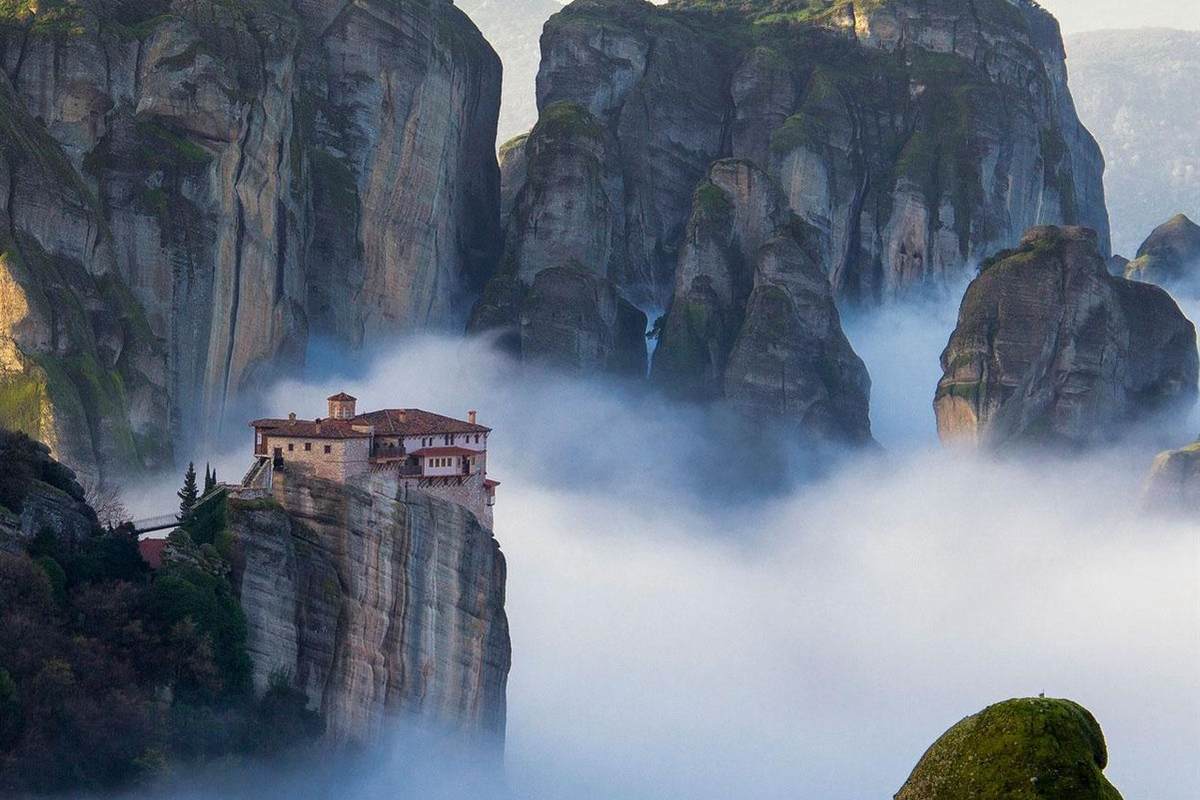
UNESCO says the sandstone peaks of Meteora were created sixty million years ago from river deposits in a delta. Earthquakes then reshaped the rock, and rain and wind sculpted the pillars. A Delphi and Meteora 2 day tour spends its night at their foot.
Kastraki village lies on one side of the towers and Kalabaka town on the other. Here the Thessaly plain reaches its northwest corner. A river, the Pineios, runs close by, and the Pindus range is near. Every operator page places the night in Kalambaka. So a Delphi and Meteora 2 day tour ends day one beside the grey rock.
Around Kalabaka, the rock was once a river delta draining into the Pineios valley. The sediment set hard and was lifted during mountain building, leaving it full of faults. Weather then cut along the crossing faults in the Chasia Mountains foothills. Day two of a Delphi and Meteora 2 day tour starts with breakfast, then the drive to these rocks.
The rocks carry names such as Adrachti, Badovas, Dupiani, Pyxari and Holy Spirit. The full rock mass runs further northwest, through the Gavros and Agios Dimitrios districts. Yet the name Meteora is generally applied to the cluster beside Kalabaka and Kastraki. One Delphi and Meteora 2 day tour page lists Kastraki village and Kalabaka town as sights.
UNESCO gives the Greek meaning of Meteora as “suspended in the air”. It values the natural setting as well as the monasteries. Under criterion seven, it cites sandstone peaks that rise over four hundred metres above the ground. A Delphi and Meteora 2 day tour therefore visits a site valued for its rock as well as its faith.
The rocks have more than one protection label. The Greek Ministry of Environment declared the Meteora-Antichassia region a Natura zone for rare birds and flowers. The area also holds the protected Trikala Aesthetic Forest. UNESCO later added a Global Geopark title. These labels cover the rocks, not just the buildings that a Delphi and Meteora 2 day tour visits.
Who built the first hermitages and monasteries in the Meteora rocks?
Hermit monks lived in the Meteora rocks from the eleventh century onwards. Athanasius came from Mount Athos and founded the Great Meteoron in the middle of the fourteenth century. A Delphi and Meteora 2 day tour visits what grew from his work.
A Delphi and Meteora 2 day tour shows monasteries on the summits. The first hermitages, though, stood at the foot of the cliffs. UNESCO says a small church, the Panaghia Doupiani, was built at one column’s base in the late twelfth century. Monks already lived there.
Politics pushed the monks upward. UNESCO calls the fourteenth century a fearsome time of political instability in Thessaly. Monasteries were then built on the inaccessible peaks. Turkish raiders wanted the fertile plain and took full control of it after the middle of the fifteenth century. Day one of a Delphi and Meteora 2 day tour crosses that plain.
Born Andronikos in New Patras, now the village of Ypati, he became the monk Athanasius on Mount Athos at thirty. Turkish pirates regularly attacked Athos, so the monks scattered. Athanasius left with two other monks, and a bishop advised them to go to Thessaly. Day two of a Delphi and Meteora 2 day tour visits those rocks.
They settled on top of a rock that already held a chapel carved into the stone. Hermits had lived in the area since the eleventh century. A monk named Gregory led the small group, and other monks soon joined. One Delphi and Meteora 2 day tour page calls the rock community Greece’s biggest monastery group after Mount Athos.
Athanasius moved to the highest rock, called the Meteor. He took in only monks able to live a very austere life. In the middle of the fourteenth century, he gave them a shared rule based on Mount Athos. The Great Meteoron is among the oldest monasteries of Meteora. A Delphi and Meteora 2 day tour can include it.
Towards the close of the fifteenth century, twenty-four monasteries stood on the rocks. UNESCO calls the sixteenth century a time of prosperity, with new building and renovation. Six survive and welcome visitors, while ruins stand on rocks such as Pyxari and Badovas. The coach version of a Delphi and Meteora 2 day tour visits two of the six.
What does the Great Meteoron monastery show a visitor?
The Great Meteoron stands on the tallest rock of Meteora. A visit inside on a Delphi and Meteora 2 day tour shows the main church with the founder’s tomb. It also shows a long refectory, an old kitchen and a museum of sacred treasures.
Day two of a Delphi and Meteora 2 day tour starts with breakfast at the hotel in Kalambaka. The Great Meteoron opens at nine in the morning, and a carved stair leads up to the complex. Athanasios founded it just before the middle of the fourteenth century and gave the rock its name, Meteoro.
Wikipedia counts the Great Meteoron among the oldest of the Meteora monasteries still standing. It lists the style as Byzantine, of the Athonite type, and the denomination as Greek Orthodox.
The monastery’s own website calls the main church a four-columned cross-in-square church. Visitors on a Delphi and Meteora 2 day tour find the tomb of Saint Athanasios inside. Relics of the founders are kept with it. The newer part of the church has mid-sixteenth-century wall paintings. They follow the Cretan School.
Next comes the refectory, a long, narrow hall with an apse at its east end. It keeps the abbot’s table, carved from one stone, with rounded edges. The kitchen beside it is built in the conventional monastic style, with a large trivet in the middle. These rooms on a Delphi and Meteora 2 day tour show how the monks ate.
The museum fills the old infirmary on a Delphi and Meteora 2 day tour. This two-storey building was raised in the late sixteenth century. Around the mid-nineteenth century it became a storeroom. Today the ground floor and the first floor show sacred treasures, manuscripts and icons.
According to Wikivoyage and a Greek religious-tourism site, the Great Meteoron is closed on Tuesdays. In summer it keeps hours from nine to five. Two operator pages list Monday departures, which puts day two on a Tuesday. So the Great Meteoron is not a fixed stop on every Delphi and Meteora 2 day tour.
What do Varlaam and Rousanou add on a Delphi and Meteora 2 day tour?
Varlaam adds a church painted in two periods and a museum in its old refectory. Rousanou adds a convent with a north-facing sanctuary. Neither is a fixed stop on a Delphi and Meteora 2 day tour, because opening days decide the plan.
Varlaam stands on a slightly lower rock, across from the Great Meteoron. It sits 595 metres above sea level, says Wikipedia. On a Delphi and Meteora 2 day tour, its main church shows paintings from two periods. The main church was painted around the mid-sixteenth century, and the narthex, or entrance porch, later.
The old refectory is now a sacristy and museum. It holds icons, manuscripts, old books, robes of the clergy and vessels used in services. Wikivoyage rates the Varlaam museum and the Great Meteoron’s as the largest at Meteora. A Delphi and Meteora 2 day tour that enters both sees the two fullest displays.
Varlaam opens at nine and shuts on Fridays in summer. In winter it shuts on Thursdays too. A Thursday departure puts day two on a Friday. The single winter departure, on Wednesday, puts day two on a Thursday. On those dates a Delphi and Meteora 2 day tour cannot enter Varlaam.
On a Delphi and Meteora 2 day tour, Rousanou stands out as a convent. Its sanctuary faces north instead of east, because of the shape of the rock. The vaulted narthex is covered in well-kept Byzantine frescoes. One operator page adds that travellers can buy mementos made by the monks and nuns themselves.
Rousanou closes on Wednesdays, and no day two on the operator calendars falls on a Wednesday. A Delphi and Meteora 2 day tour can therefore enter the convent on every date those pages list. Coach pages promise two monastery visits on day two, while a rail-based package covers all six over two days.
Both monasteries have sights close by. Wikipedia names the Dragon Cave, to the south and below Varlaam. It also places the Psaropetra viewpoint beside a main road, southeast of Rousanou. One operator page puts a visit to Rousanou at thirty to forty-five minutes, including the walk and photo stops.
How did monks reach the monasteries before the rock steps were cut?
Monks used removable ladders and hoisting ropes until the nineteen-twenties, when steps were carved into the rock, says Wikipedia. That is why a Delphi and Meteora 2 day tour climbs stairs, where pilgrims once rode in a net.
Wikivoyage says the first hermits climbed with ropes and ladders alone. Wikipedia says their hollows sat up to 550 metres above the valley floor. The cliffs were so sheer that only the determined got near. Long ladders were tied together, and nets hauled up goods and people. A Delphi and Meteora 2 day tour reaches the same rocks by coach.
One page for a Delphi and Meteora 2 day tour describes the net method. A net was hitched over a hook. A rope and a hand-cranked windlass hoisted it to winch towers that overhung the chasm. Monks went down in nets or on retractable wooden ladders, up to 40 metres long. Down there they farmed grapes, corn and potatoes.
Wikipedia says baskets and ropes carried goods and people until the seventeenth century. It also describes a net in which intrepid pilgrims were hoisted up beside a cliff of 373 metres. Day two of a Delphi and Meteora 2 day tour trades that net for a staircase.
Wikipedia dates the rock steps to the nineteen-twenties. It adds a bridge from the nearby plateau. Wikivoyage says the carved steps let visitors explore and admire the monasteries today. Two pages for a Delphi and Meteora 2 day tour list two monastery visits on day two.
The old lifting habit survives in a small way. Wikivoyage says tiny cable cars at the rocks carry food and other supplies, and tourists cannot use them. A travel blog adds that a network of old monk paths predates the road. The coach of a Delphi and Meteora 2 day tour takes the road.
What does Meteora look like at sunrise and sunset, and does a 2 day tour include it?
A travel blog says the rocks become a wall of warm sandstone above the Thessaly plain at sunset. Two small-group pages list a sunset tour. The coach pages for a Delphi and Meteora 2 day tour do not. No page lists a sunrise stop.
The blog calls sunset light more dramatic than any other in the area. It says the usual tour ends around two or three in the afternoon, the wrong time for golden light. A night in Kalambaka on a Delphi and Meteora 2 day tour keeps you near the rocks longer.
From a viewpoint facing south-west, Great Meteoron and Varlaam stand on your right and Holy Trinity on your left. On a clear afternoon you can count five of the six monasteries from one spot. The blog rates the viewpoints between the monasteries above three of the six monasteries themselves. It advises arriving 30 minutes before sunset.
A map listing calls a roadside viewpoint enchanting at sunrise and sunset. Reviewers say sunset gets crowded, while sunrise brings fewer people and longer-lasting views. Wikivoyage lists opening at 9:00 and closing between 15:00 and 17:30. A Delphi and Meteora 2 day tour enters monasteries by day, so dawn and dusk belong to viewpoints.
Coach pages place the rocks on day two. One says the group reaches Kalambaka by evening, shops for souvenirs and settles in for the night. Another page lists dinner and overnight. On day two the pages list the monasteries and the road back to Athens. None lists a sunset stop on its Delphi and Meteora 2 day tour.
Both small-group pages list a four-hour sunset tour by minibus on day one, after hotel check-in. One is a Delphi and Meteora 2 day tour that spends day two at Delphi. The other stays at Meteora. It promises golden-hour photos and monastery views, then a hiking tour or a half-day tour on day two.
Wikipedia says Meteora lies between Kastraki village and Kalabaka town, so the overnight stay is close to the rocks. Wikivoyage advises visiting early in the day, because large groups fill the chapels in high season. Check the day-two start time of your Delphi and Meteora 2 day tour before you plan a sunrise outing.
How much walking, climbing and coach time does a Delphi and Meteora 2 day tour involve?
Coach time dominates a Delphi and Meteora 2 day tour. Two bursts of climbing break it up. Day one climbs the Delphi hillside, and day two climbs the monastery steps at Meteora. One operator rates the walking level as moderate and cites uneven ground and steps.
The coach hours come first on a Delphi and Meteora 2 day tour. A travel wiki puts the public bus from Athens to Delphi at about three hours. A coach tour reaches the site around noon. The afternoon drive then crosses the Thessalian plain to Kalambaka by evening. A short souvenir stop comes before the hotel.
Day two repeats the long drive in the other direction. Two operator pages put the return to Athens at about seven in the evening. A travel wiki says the direct drive from Athens to Meteora takes about four hours by car. The Thermopylae stop is short, and one page says you see the monument across the road.
Reviews show how the hours feel on a Delphi and Meteora 2 day tour. One reviewer calls the ride very long and says the coach seats leave minimal legroom. Another reviewer accepts breaks but says the road stops ran too long and cut time at the sites. Ask the operator how long each road stop lasts.
Day one of a Delphi and Meteora 2 day tour brings an uphill walk at Delphi. One itinerary says the group climbs the hill, with the stadium at the top. A Delphi visit page describes steep paths and uneven ancient stones. It calls comfortable walking shoes essential. Another itinerary allows ninety minutes at the site.
Day two adds steps. A travel wiki says every monastery except Saint Stephen needs hundreds of steep steps. Saint Stephen needs only a small bridge. A Delphi and Meteora 2 day tour enters two monasteries. One coach page pairs the Great Meteoron with Saint Stephen, and it swaps in Varlaam on Tuesdays. The page warns that the pair can change.
The effort comes in blocks. Day one gives a morning drive, the climb at Delphi and an afternoon drive. Day two gives the monastery steps and then the long ride south to Athens.
Who suits a Delphi and Meteora 2 day tour: families, seniors or first-time visitors?
First-time visitors fit a Delphi and Meteora 2 day tour well. One overnight stay covers two UNESCO World Heritage sites. Families and seniors fit too, if they handle long coach days, an uphill walk and steep steps.
A Delphi and Meteora 2 day tour hands first-timers the transport, the hotel and the itinerary. One page calls the trip a journey from antiquity to Byzantium in just two days. A reviewer on a first holiday worried that a day of travel was a poor use of limited time. The reviewer and a partner found it worth it.
History lovers get a clear split. Delphi gives the ancient world on day one, and Meteora gives the Byzantine world on day two. A coach version of a Delphi and Meteora 2 day tour lists a licensed guide. A semi-independent version suits travellers who want structure plus freedom, and its page names culture, history and photography lovers.
Families need to check the child age band before they book a Delphi and Meteora 2 day tour. One page limits its child category to ages five to twelve. Another lists children up to eleven. A third asks parents to carry proof of a child’s age. A family reviewer learned about Greek culture and enjoyed the ride.
Seniors and slow walkers have two tools. At Delphi, a visit page says a special vehicle takes visitors with mobility impairments up to the Temple of Apollo. It asks for notice at least seven days ahead. At Meteora, Saint Stephen is reached by a bridge, not steps. Ask the operator whether the group can use them.
Crowds slow everyone down. A travel wiki advises an early visit in high season, because large groups can fill the chapels. One reviewer found Saint Stephen too crowded to admire or enter. Day two of a Delphi and Meteora 2 day tour starts with breakfast at the hotel. The coach then heads to Meteora. Ask for the arrival time.
In short, a Delphi and Meteora 2 day tour suits travellers who accept long coach days and two climbs. Travellers with limited mobility ask about the Delphi vehicle and the Saint Stephen bridge before booking.
Which season and weather suit a Delphi and Meteora 2 day tour?
Spring and autumn fit a Delphi and Meteora 2 day tour well. Trikala, a city on the route, has mild spring and autumn weather and very hot summers. The tour also runs in winter, on fewer days, so the calendar matters as much as the temperature.
Operators run a Delphi and Meteora 2 day tour on two timetables. From April to October, their pages list Monday, Wednesday, Thursday and Saturday departures, with Saturdays on set dates only. From November to March, two pages name Wednesday alone. One page splits the year between early November and the end of March.
Summer is the hard season. Trikala has very hot summers, and in August the daily high averages 34.5 degrees Celsius. At Delphi, a travel wiki cautions that the summer months bring hot sun and crowds. It says classes and package groups fill the site from ten in the morning. One operator page has the coach arriving around noon.
Mild months suit a Delphi and Meteora 2 day tour because the ruins stand in the open air. Trikala’s spring and autumn are quite mild, without extreme highs or lows. A travel wiki names spring and autumn for hiking around Delphi, since summer there is really hot.
A winter Delphi and Meteora 2 day tour meets cold, wet weather on the plains. Lamia, a stop on the road, is cold and wet from the end of October to the middle of April. The warmer, drier months fill the rest of the year. Winter nights in Trikala drop below freezing only now and then, and snow is occasional.
Day one climbs Mount Parnassus. Arachova, eight kilometres from Delphi, sees snow in winter, though less than the north side of the mountain gets. A ski centre on Parnassus sits north of the town. Summer days there are warm, and the nights are pleasant. A Delphi and Meteora 2 day tour passes through that temperate climate on day one.
Day two sits on the plain of Thessaly. The Meteora rocks stand in the plain’s far north-west corner, close to the Pindus range. Administratively the area falls under the regional unit of Trikala. The tour therefore crosses a mountain slope on day one and a plain on day two. Check both places when you pick a month.
How does a Delphi and Meteora 2 day tour compare with two single day trips or a rail tour?
A Delphi and Meteora 2 day tour makes one loop with one night in Kalambaka. Two single day trips make two loops from Athens, and the Meteora day ends near half past ten at night. The rail tour page names Meteora only.
Take the day trips first. One operator page starts the Meteora day at 8:00 and reaches the rocks around 12:30. The day lasts about thirteen and a half hours and enters three active monasteries, depending on the opening schedule.
The Delphi day trip is shorter. Its page starts the day at quarter past eight. The page puts the drive from Athens at two hours and thirty minutes, and the full day at ten hours. Both day trips end in Athens, so two single trips mean two nights in the city.
A Delphi and Meteora 2 day tour starts around 8:45 on day one. Two operator pages put the return to Athens near seven in the evening of day two. The night is spent in Kalambaka, and day two begins with breakfast before the monasteries. No second trip from Athens is needed.
On a Delphi and Meteora 2 day tour, day one holds the Delphi site. Day two holds two monasteries, say two operator pages. Three pages state that the Delphi museum is not included. The Delphi day trip page names the museum in its guided tour.
Set a Delphi and Meteora 2 day tour beside a rail tour and the first leg changes. One two-day rail page has the train leave Athens at 6:58 and stop at Palaiofarsalos around 9:45. It reaches Meteora at 12:05. A second page says buses cover the last ninety kilometres from Palaiofarsalos. Delphi is not named on the rail page.
A third version of a Delphi and Meteora 2 day tour reverses the order. One semi-independent plan puts Meteora and its sunset on day one, then an express transfer to Delphi on day two. A public bus returns to Athens at 4:00 in the afternoon. Only the Meteora monastery visits are guided; Delphi is explored alone.
What else do travellers ask about a Delphi and Meteora 2 day tour?
What do you pack in one overnight bag for a Delphi and Meteora 2 day tour?
Pack one overnight bag and a small day bag. One operator page says passengers can bring carry-on bags or larger luggage, and the buses have storage space. A Delphi and Meteora 2 day tour then needs one outfit for each day, plus sleepwear and washing gear.
Footwear and sun matter more than fashion. An operator page asks for comfortable walking shoes for the archaeological sites and the monasteries. Add a hat and sunscreen, and carry a water bottle you can refill. Day two calls for covered shoulders and knees, because the monasteries ask for them.
One operator wants a passport or ID card at check-in. Pages list the room as twin or triple, and a single room is a separate option. A semi-independent version of this Delphi and Meteora 2 day tour has its own rule. The driver directs you to luggage storage at the Delphi bus station.
Can young children or slower walkers manage your Delphi and Meteora 2 day tour?
Families are welcome on each Delphi and Meteora 2 day tour. Limits apply on the ground. One operator page says the trip is designed to accommodate all ages. The monasteries involve stair climbing and uneven ground, it warns. Another page rates the walking level as moderate, with steps at the monasteries.
Children must travel with an adult, and a listing asks you to tell the operator in advance when minors join. Infants sit on laps. One page names ages 5 through 12 as its child group. Another asks parents to carry proof of each child’s age.
Wheelchair users face a hard route on a Delphi and Meteora 2 day tour. Two listings rule out wheelchair use, citing uneven ground at the sites. Service animals are allowed when you tell the operator ahead of time. Ask about any mobility need before you book, since stairs and uneven paths appear on both days.
Where and when does a Delphi and Meteora 2 day tour start in Athens?
The start of a Delphi and Meteora 2 day tour depends on how you join. One page leaves Athens at about 8:45 and collects guests from select spots. The gathering takes up to about an hour, so each guest gets a different pick-up time. Another page puts hotel pick-up about an hour before departure.
A hotel missing from the pick-up list gets another meeting point by email, says one listing. A second page offers the closest point to your hotel, and says drop-off points can differ from pick-up points. Without a pick-up, a listing asks you to reach the operator’s office 15 minutes before departure.
Each Delphi and Meteora 2 day tour ends back in Athens as evening begins, and one page names about 19:00. Clients staying at the coast leave the operator’s terminal for their hotels around 19:30, says the same page. A semi-independent version departs at 8:00 in the morning from Larissis railway station.
What dress code and closing days apply to the monasteries on a Delphi and Meteora 2 day tour?
Operator pages ask for covered shoulders and knees on a Delphi and Meteora 2 day tour. One bars shorts for men and short skirts for women, who need long sleeves. Another bars trousers on women, and two pages ask men for long trousers. Sleeveless clothing is prohibited, and the wrong clothes mean denied access.
Skirts are on hand if you forget one. One page says the monasteries lend long skirts before every entrance. Women wear them over their own clothes and hand them back before leaving. A second page says skirts and shawls can be borrowed at the entrances.
Each monastery sets its own days and hours, and the monks can alter them with no warning. One operator swaps Great Meteoron for Varlaam every Tuesday. A second page lists Roussanou as shut on Wednesdays and Saint Stephen on Mondays. So the weekday of your Delphi and Meteora 2 day tour shapes the pair you enter.
When can you enter the archaeological site and museum at Delphi on your Delphi and Meteora 2 day tour?
Two seasons apply at the Archaeological Museum of Delphi, says the Hellenic Ministry of Culture. In winter, from 1 November through 31 March, the doors open at 8:30 and shut at 15:30. In summer, from 1 April through 31 October, they open at 8:00 and shut at 20:00. On Tuesday the summer hours run from 10:00 to 17:00.
The final entry comes 20 minutes ahead of closing time. Orthodox Easter Sunday, 25 March and 1 January close the museum. So do 25 and 26 December, and the day after April ends. Good Friday and Holy Saturday have different hours. Check these dates before you book this Delphi and Meteora 2 day tour.
On 28 October, 15 August, Holy Spirit Monday, Easter Monday, Clean Monday and 6 January the museum stays open. One ministry ticket admits you to both the ruins and the museum. Operator pages put the group at Delphi around noon on day one. That slot fits the winter and summer hours of each Delphi and Meteora 2 day tour.