
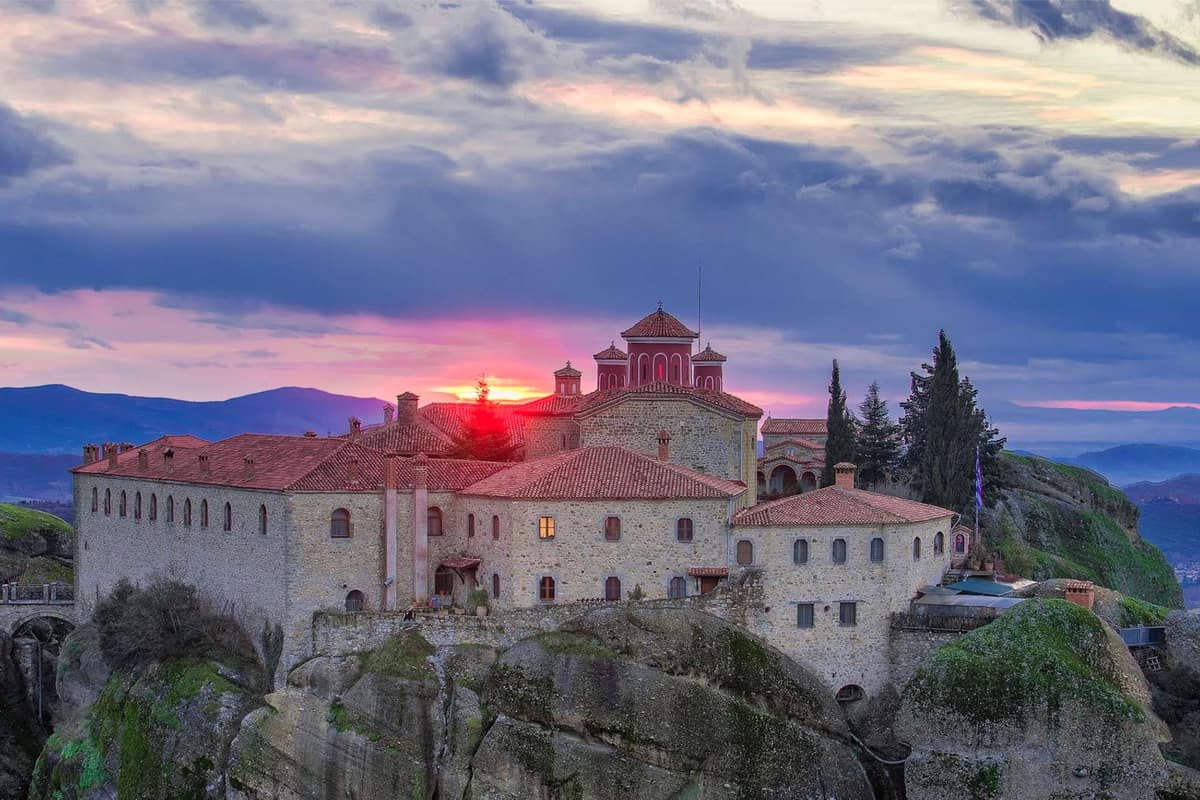
A Meteora sunset tour starts in the late afternoon from Kalambaka or Kastraki and returns after dusk, so one trip covers the rock pillars in daylight and in the last light. Compare the kinds of trip, then browse tours in Greece for more ideas.
This page covers how the tour runs, when it starts and how long it lasts through the seasons, the viewpoints and monasteries it reaches, the hermit caves, the kinds of sunset tour from a van to an e-bike or a horse, the way to Meteora, what to bring, and the questions travellers ask.
What is a Meteora sunset tour, and how does it run?
A Meteora sunset tour is a late-afternoon minibus outing from Kalambaka or Kastraki. It joins a monastery visit, a Byzantine church and the hermit caves of Badovas. The day ends at a cliff-top viewpoint for the sunset, then the minibus returns you to your accommodation.
Meteora sits in northwestern Greece, where tall rock pillars rise in Thessaly. The name means lofty or elevated. UNESCO has inscribed the monasteries on its World Heritage List. Wikipedia adds that only Mount Athos outranks them in local importance.
The town of Kalabaka lies below the pillars, and the village of Kastraki sits on their west side. Both places serve as bases for a Meteora sunset tour. Pick-up covers hotels and holiday rentals in each one.
The group is small, and two operator pages set the limit at 19 people. A local, English-speaking expert guide leads the day. Audio guides come in eleven languages, as two operator pages list them. A map and bottled water travel on board.
The operator pages list the stops in a steady order. A Meteora sunset tour first enters one monastery. Next comes the Virgin Mary’s Byzantine church in the old town of Kalambaka. The hermit caves of Badovas follow, with panoramic stops for photos. The tour combines the minibus with short walks.
Wikipedia calls that church the oldest in the town. It says relics of an ancient Greek temple sit in its wall. Another operator page speaks of marble from the Temple of Apollo inside the church walls.
The last stop is the sunset viewpoint, which faces the Pindos mountains. One operator page describes sitting on the edges of the cliffs. You watch the light fade as the sun sinks behind the mountains. A Meteora sunset tour ends with the minibus ride back to your accommodation.
When does a Meteora sunset tour start, and how long does it take?
A Meteora sunset tour leaves in the afternoon. The start time moves with the season, because it follows the sunset hours. The tour lasts about four hours, and your booking voucher shows the exact departure time.
Sunset times at Meteora change widely through the year. A sunrise and sunset table for Kalambaka shows the earliest sunset in early December. It falls at about ten past five in the afternoon. The latest comes in late June, at about nine in the evening.
The change shows within one month. Through November, the sunset slides from about 5:34 to about 5:12 in the afternoon. A Meteora sunset tour follows that clock, so the start is earlier in winter than in summer.
One operator page says the start of a Meteora sunset tour varies with the season and the sunset hours. A booking page says only that the start depends on the period. Operators print no single fixed time, and the exact departure time appears on your booking voucher.
One listing shows a daily start at half past four, but it does not tie that time to a season. Check the voucher first, then plan your afternoon around it.
The operator page that ties the start to sunset says last-minute booking works, but seats can run out. It advises booking at least a week ahead. That keeps your choice of day open.
Four separate pages give one length for a Meteora sunset tour: four hours. One operator page wants guests ready ten minutes early. It adds that pick-up times can shift by five to ten minutes, so plan for a short wait.
A Meteora sunset tour runs all year, as an operator page states. That page adds that the schedule is fullest from late spring to October and lighter from November to March. The monastery you enter can change from day to day.
In summer the monasteries shut well before the sun goes down. Wikivoyage gives 9:00 as the opening hour, with closing times from 15:00 up to 17:30. Late June sunset falls over three hours after the latest closing. Saint Stephen also takes a two-hour closure early in the afternoon.
One operator page says sunset favors outside viewpoints, because interiors close earlier in the afternoon. A Meteora sunset tour therefore enters its monastery first.
Which viewpoints and monasteries does a Meteora sunset tour reach?
A Meteora sunset tour reaches the panoramic stops under the rocks, one monastery and a cliff-top spot for the sunset. All six monasteries in use come into view. The group enters only one of them, as the operator pages describe it.
A Meteora sunset tour uses the mountain road for its photo stops. Wikivoyage says the six monasteries in use can be seen from that road. It lies north of both Kalambaka town and Kastraki village. One operator page calls them spots with panoramic views and joins the bus ride with short walks.
Wikipedia says the cliffs climb past 400 metres. It places Saint Stephen and Holy Trinity further south, apart from the main group of monasteries. All of them stand in the Pineios Valley, close to Kalambaka. A Meteora sunset tour covers the whole group in one area.
Two operator pages name the monastery you enter. One names Saint Stephen or Saint Nicholas Anapausas. The other names Saint Stephen or Holy Trinity, depending on which one is open that day. A Meteora sunset tour keeps the other five for the viewpoints.
Each of the six has one fact worth knowing before you look up at it:
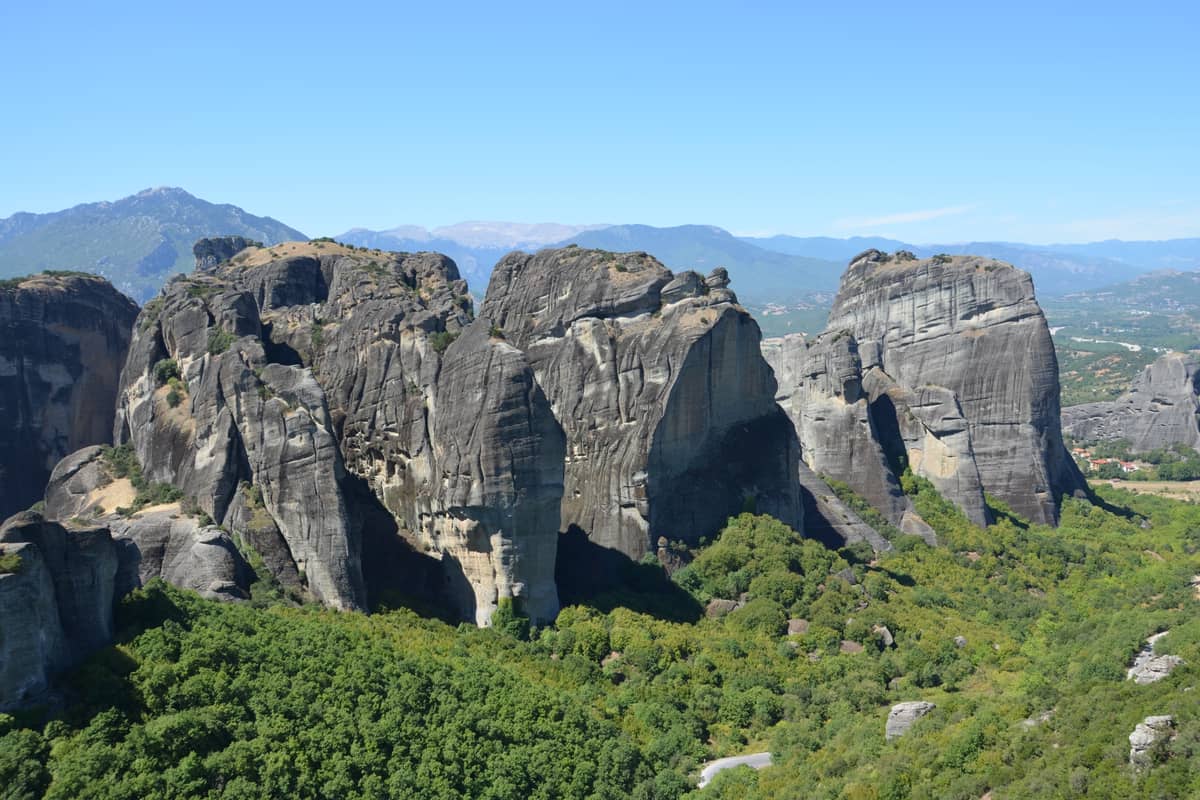
- Great Meteoron: Wikivoyage says a monk from Mount Athos built it just ahead of the mid fourteenth century. Its rock climbs more than 415 metres out of the Pineios valley.
- Varlaam: the precipice under it measures 373 metres from the valley floor. Wikivoyage says two brothers began to rebuild Varlaam in the early sixteenth century.
- Rousanou: it is now a convent, and its rock climbs the same 415 metres and more.
- Saint Nicholas Anapausas: Wikivoyage dates its foundation to the end of the fourteenth century.
- Holy Trinity: Wikipedia credits a monk called Dometius with starting it, after he reached the site in the fifteenth century.
- Saint Stephen: it sits 575 metres above sea level and has been a convent of nuns since the twentieth century.
The last stop of a Meteora sunset tour is on high ground. One operator page says an uphill drive leads to the top of the rocks. The same page gives the route as 10 kilometres, at an altitude of 600 metres.
What are the hermit caves, and are they part of a Meteora sunset tour?
The hermit caves are hollows in the rock where monks once lived alone, before the monasteries stood. A Meteora sunset tour includes the Hermit Caves of Badovas, as the operator pages list them. The pages call the walks there short.
Wikipedia says hermit monks settled in rock hollows and cracks in the pillars. The highest of them lay 550 metres over the plain. At first they lived alone. To pray together they gathered in a chapel under the Dupiani rock, but only on Sunday and other special days.
Wikipedia also describes the hermit’s life. A hermit lives in seclusion. The eremitic life is an early form of monastic living, and it came before life in a community. Hermits lived in isolated cells, either a natural cave or a built dwelling. People sought them out for spiritual advice. A Meteora sunset tour shows where such hermits lived.
Operator pages spell the name three ways: Badovas, Badova and Bandovas. One calls them the thousand-year-old hermitages of Bandovas. Another places the hermitages in Kastraki and calls them impressive. No page gives the walk in minutes. A Meteora sunset tour reaches them on the short walks that the pages mention.
Wikipedia lists a Badovas rock, with a historic site that was founded in a rock cave and has not survived. The operator pages call the Badovas stop of a Meteora sunset tour a set of hermitages, not a monastery.
Hermits came first. Wikipedia says religious communities set up hermitages at the base of the cliffs in the eleventh century. Wikivoyage says shared needs and strong faith drew the hermits into the first monastic communities. The monasteries came after the caves, and a Meteora sunset tour shows both.
Do not mix the hermit caves with Theopetra Cave. Wikipedia places it 4 kilometres from Kalambaka. It says caves near Meteora housed people without a break, from about 50,000 years back to 5,000 years back. The operator pages list no stop there.
Which Meteora sunset tour suits you: a van tour, an e-bike ride, a hike or a horse ride?
Choose a Meteora sunset tour by effort. A van tour needs only short walks. An e-bike ride needs basic cycling skill, and a hike needs moderate fitness. A horse ride is the shortest. Every kind in this section ends at a sunset viewpoint.
The van version of the Meteora sunset tour combines a bus tour with short walks, as one page puts it. A small van collects you from a hotel in Kalambaka or Kastraki. One page lists a nine-seat van and four hours. The stops are a monastery, the old Byzantine church of Kalambaka, the Badovas hermitages and a sunset viewpoint.
A private Meteora sunset tour runs four hours on both pages. One page allows up to nineteen people and lets you change the itinerary. The other allows up to six people and picks lookout points for composition and light. Both pick you up from a hotel in Kalambaka or Kastraki, and both vary the start time by season.
The e-bike Meteora sunset tour takes three hours on both pages that list it. It starts at an e-bike office in Kalambaka, and the bike comes with a helmet. Groups are small: up to eight or nine riders. One page accepts children over twelve. The motor handles the climbs, but you still need basic comfort on a bicycle.
A hiking Meteora sunset tour asks for moderate fitness on rocky ground. Two pages list three hours, a start in Kastraki and children from seven years old. A third page lists four hours, a minibus from your hotel and children from six. Pick the hike if you want to reach the sunset viewpoint on foot.
A horse ride is the shortest Meteora sunset tour. The two pages that list it give one hour and ninety minutes. One page names a weight limit of ninety-five kilograms, and the other an age of ten and up. Buggy trips last about four hours. Two guests share each buggy, and a short hike leads to a cave monastery.
How do you reach Meteora for a sunset tour, and what do you bring?
Sleep in Kalambaka or Kastraki, because operator pages place the start of each Meteora sunset tour in one of them. Bring covered shoulders and knees for the monastery. Pack a warm layer for the viewpoint and sturdy closed shoes for the rocks.
Meteora belongs to Thessaly, in northwest Greece, as Wikipedia states. The rocks lie between Kastraki village and Kalabaka town. A local operator page says staying in either village lets you see sunrise, sunset and quieter monastery visits. That suits a Meteora sunset tour, since van and private trips pick you up at your hotel.
Athens lies about 350 km away, and one operator page puts the journey at four to five hours each way. The same page calls a one-day trip possible, but a long day. A Meteora sunset tour finishes near dusk, so a night in town makes sense. From Thessaloniki, buses run to Trikala, then a local bus runs on to Kalambaka.
The travel wiki says storm damage closed the train line to Kalambaka, so check it first. In town, a local bus serves Kastraki and the six monasteries on a timetable that is not published online. A local operator page calls public transport to the monasteries limited or seasonal. The tourist information centre in Kalambaka offers maps and tour recommendations.
Dress for the monastery first on any Meteora sunset tour that goes inside one. Pages differ on men: one asks for long trousers, another accepts shorts that cover the knee. Women cover the shoulders and choose a skirt falling past the knee. Sleeveless tops are not allowed. A small backpack lets you change on site.
The viewpoint is cooler, so pack for the evening. One e-bike page asks for a light jacket against the evening breeze, even in summer. A buggy page suggests a light jacket or windbreaker. Closed shoes suit the e-bike and buggy rides. The hike pages ask for sturdy shoes on rocky ground. Add water for any Meteora sunset tour.
What else do travellers ask about a Meteora sunset tour?
What happens on a Meteora sunset tour when clouds, fog or rain hide the sun?
One operator page says its bus tours run whatever the weather. When harsh conditions stop an activity, the page lists three options. You can change the date, switch to another activity, or cancel and receive a refund.
A cloudy Meteora sunset tour runs on, but the view changes. A photography page warns that fog is frequent and that clear skies are needed at sunrise and sunset. A visitor page says winter brings dramatic cloud layers and mist hugging the rocks. It calls summer hot, sunny and bright.
Can you use a camera, a tripod or a drone on a Meteora sunset tour?
On a Meteora sunset tour, photos are allowed in the monastery courtyards and at the viewpoints. The monks do not allow photos of church interiors, the murals or the museums. Two pages add one more rule: no pictures of monks or nuns unless they say otherwise.
Drones need written permission from the authorities, and one page names a flight restriction zone around the site. It adds a plain rule: do not fly one inside or outside a monastery. Another page says drones are prohibited without special permission. On tripods, one page only says to be informed before you set one up.
How much walking does a Meteora sunset tour involve, and who can join?
Operator pages describe a bus tour with short walks. One page lists about 140 steps at Rousanou, Varlaam and Saint Nicholas. It lists over 300 at Holy Trinity and Great Meteoron. Saint Stephen has no stairs, only a small bridge to cross.
Two pages say the monasteries do not offer easy access for visitors with disabilities. One adds that Meteora is not wheelchair accessible, because every monastery has steps or sloped paths. Children up to twelve years old do not have to follow the dress code. One operator page calls the Meteora sunset tour suited to small groups and families.
Can you go inside a monastery on a Meteora sunset tour, and when are they closed?
Operator pages say a Meteora sunset tour goes inside one monastery and shows the other five from outside. One page names Saint Stephen. Another names Saint Stephen or Saint Nicholas. It says the tour does not visit the same monastery every day, because each one closes on a set day.
As the timetable pages state it, Saint Stephen is shut on Monday and Great Meteoron on Tuesday. Rousanou is shut on Wednesday. Holy Trinity is shut on Thursday, while Saint Nicholas Anapausas and Varlaam are shut on Friday. Winter adds closed days at Great Meteoron and Varlaam. The monasteries set their hours and can change them without notice.
Why pick a Meteora sunset tour over a sunrise visit?
Two pages compare the two lights. One calls sunrise the quiet window, with trails and viewpoints nearly empty from 6:30 to 8:30 in the morning. It says the sun turns the cliffs rose-gold for a short quiet spell. It adds that day-trippers thin out from 3:30 in the afternoon.
The other page comes from a photographer. The author found the light strongest in the golden hour before sunset, when golden tones flood the valley. It names Sunset Rock for the evening. For the morning it names a spot behind the next car park, nicknamed Sunrise Rock. A Meteora sunset tour follows the evening choice.