
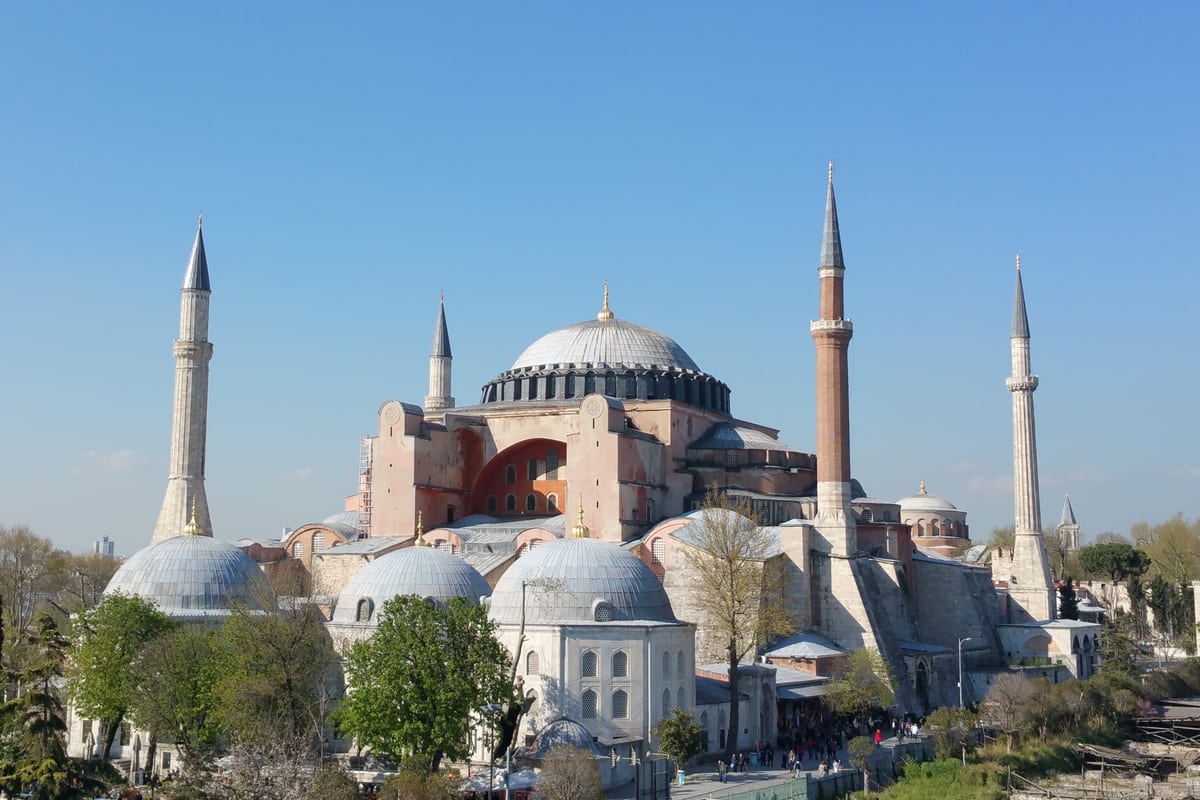
A Hagia Sophia tour starts in the Sultanahmet old city of Istanbul, at the domed building that Emperor Justinian had built in the sixth century. The walk runs from the entry gate through the nave to the upper gallery, with a tour guide or an audio guide to explain each room. For trips beyond Istanbul, see the tours in Greece page.
This page covers how a Hagia Sophia tour runs and how long it lasts, the building and its builders, the dome, the gates, the nave and the columns, the mosaics and the gallery, the Ottoman parts and the periods, the rules and the dress, and the sights close by: the square, the Hippodrome, the Blue Mosque, the cistern, Topkapi and the bazaars. It closes with the kinds of tour, the seasons, the food and the questions travellers ask.
What is a Hagia Sophia tour, and how does it run?
A Hagia Sophia tour is a walk through the building in Sultanahmet, led by a licensed tour guide. At the start the group meets near the entrance, then passes the security check and follows the visitor route. It ends with time on its own, as operator pages describe it.
The talk of a Hagia Sophia tour begins outside, before anyone steps through the door. One operator page says the tour guide gives a short introduction to the history of the building. That meeting point is on Sultanahmet Square, across from Hagia Sophia. Another page says the group gathers near the building and meets the licensed guide there.
Entry is the second step. Two operator pages say the tour guide leads the group past the ticket line. One adds that the skip applies to the ticket line alone, and security screening is the same for all visitors. A third page calls the security checks mandatory. A Hagia Sophia tour includes the same check as a visit alone.
At the door, one page says visitors show a mobile code at the entrance. A second page says the tour guide waits at the meeting point and walks the group to the entrance. Inside, the group follows the visitor route. Three operator pages say the ground floor is for prayer and the visitor area is the upper floor.
From the upper floor the group looks down into the room. One page lists what the tour guide points out: the mosaics, the columns and the great dome. Another page says the upper gallery shows the Byzantine mosaics. A 45-minute Hagia Sophia tour fits these three sights and the short talk into one visit.
The end of a Hagia Sophia tour comes in one of two ways. On one page, the tour guide shares the background and then visitors wander through the rooms alone. On another page, visitors carry on with an audio guide after the talk. In both cases the last part of the visit is your own time in the building.
A longer Hagia Sophia tour adds the Blue Mosque. Two operator pages put the Blue Mosque first, with Hagia Sophia as the second part of the visit. One of them says the group wanders the neighbourhood and the mosque first, then walks across to Hagia Sophia. A private version sets its own pace, as one page states it.
How long is a Hagia Sophia tour, and where does it start?
A Hagia Sophia tour lasts 45 minutes on four operator pages, with shorter and longer versions elsewhere. The meeting point lies on or near Sultanahmet Square, across from the building. The pages ask guests to come ten to fifteen minutes ahead of the departure.
The shortest Hagia Sophia tour on the operator pages runs 30 minutes. That page calls it a short, focused introduction, and then each visitor goes on at a personal speed. The 45-minute tour comes next. One page lists a one-hour tour, and its listing gives a range of one to two hours.
Trips that join other sights take longer. A walk through the Blue Mosque and Hagia Sophia lasts 2.5 hours on two operator pages. One page lists a 3-hour small-group tour that adds the Basilica Cistern. A Hagia Sophia tour with these stops is a half day, as one page calls it.
The language of the tour guide is part of every listing. Two operator pages describe the 45-minute tour as led in English. A page for the one-hour tour lists English, Italian, German, French, Portuguese and Spanish, depending on the option chosen. A Hagia Sophia tour is booked in one language.
Two operator pages give the same three departures: 9:00 and 11:45 in the morning, then 3:15 in the afternoon. Both say the guided tour runs every day except Fridays. One says there is no guided tour on Fridays, although visitors can still enter on their own. That Hagia Sophia tour is booked for one of three slots.
One page for the combined walk lists a summer and a winter timetable. Summer tours leave at 9:00, then again at half past one, with a 3:00 start on Fridays only. Winter tours leave at 9:00 and 1:30. So a morning Hagia Sophia tour and an afternoon one both exist.
The meeting point is a spot on Sultanahmet Square. One page puts it across from the German Fountain. Another uses a bus stop sign across from Hagia Sophia. A third names the fountain between the ticket booths. Two pages say the voucher gives the exact spot. Each Hagia Sophia tour starts with a look at the voucher.
Visitors reach Sultanahmet on the T1 tram line and leave at the Sultanahmet stop. Wikivoyage places Hagia Sophia 300 metres from that stop, and one operator page counts a five-minute walk. The tram stop is the easiest start for a Hagia Sophia tour, because the square lies right beside it.
What is Hagia Sophia, and where does it stand in Istanbul on a Hagia Sophia tour?
Hagia Sophia is a mosque and a major historic site in the Fatih district of Istanbul. It stands in the old city, on a peninsula. The Golden Horn lies to its north and the Sea of Marmara to its south. A Hagia Sophia tour centres on the Sultanahmet quarter.
Wikipedia calls Hagia Sophia the epitome of Byzantine architecture. It adds that the building is said to have changed the history of architecture. Wikipedia says the finished building held the record for the largest interior space on earth.
Two tour pages call it the symbol of Sultanahmet and the iconic landmark of Istanbul. A Hagia Sophia tour is built around that one building.
Fatih holds the historical peninsula, the same ground as old Constantinople. Its area is 15 square kilometres. The Golden Horn runs along its northern edge, and the Sea of Marmara runs along its southern edge. The Bosphorus lies to the east. The ground of a Hagia Sophia tour is a peninsula with water on three sides.
Fatih contains the quarter of Sultanahmet, which takes its name from Sultan Ahmed. Wikipedia says the Sultan Ahmed Mosque gave its name to the quarter. Sultanahmet Square beside the mosque covers the ground of the old Hippodrome. One page for a Hagia Sophia tour puts the meeting point on that square, across from the building.
The name is Greek. Hagia Sophia means Holy Wisdom, and the Turkish name, Ayasofya, carries the same meaning, as Wikipedia states it. A tour page adds that sophia is the Greek word for wisdom. Wikipedia gives the formal Greek name as the Temple of God’s Holy Wisdom. The present official name is the Hagia Sophia Grand Mosque.
The UNESCO listing called Historic Areas of Istanbul includes Hagia Sophia, under cultural criteria i, ii, iii and iv. The Blue Mosque, Topkapi Palace and the Basilica Cistern sit under the same listing, as their Wikipedia pages state. A Hagia Sophia tour that adds one of these neighbours stays among sites with one UNESCO listing.
A Hagia Sophia tour has close neighbours. The Sultan Ahmed Mosque, called the Blue Mosque, stands across from Hagia Sophia and has six minarets. Topkapi Palace occupies Seraglio Point, a promontory overlooking the Golden Horn. The Basilica Cistern lies 150 metres to the southwest of Hagia Sophia, on the same historical peninsula.
For Wikivoyage, the oldest quarter of Istanbul is the Historical Peninsula. It describes a ridge said to hold the seven hills of Constantinople. It names Sultanahmet the geographical and visitor high point of the peninsula, close to its tip. So a Hagia Sophia tour takes place at the high point of the old city, with water at its edges.
Who built Hagia Sophia, and what does a Hagia Sophia tour tell about it?
Emperor Justinian I of Byzantium built today’s Hagia Sophia in the sixth century. Two Greek geometers designed it: Anthemius, from Tralles, and Isidore, from Miletus. Operator pages say a Hagia Sophia tour tells the story of the building and its dome.
Justinian I ordered the church, and Wikipedia counts it among the works of his building programme. He started the building work on 23 February, only weeks after the earlier church burned down. One tour page lists Justinian’s dome among the topics of its Hagia Sophia tour.
Anthemius of Tralles worked as a geometer and architect in Constantinople, as Wikipedia states it. He also wrote On Burning Mirrors, a treatise on shaping surfaces that reflect light to a single point. The same page says he died early in the project. The church he helped to design is the one a Hagia Sophia tour walks through today.
Isidore of Miletus taught stereometry and physics at the universities of Alexandria and Constantinople before Justinian hired him. A compilation of the works of Archimedes is attributed to him. He also wrote a commentary on On Vaulting by Hero of Alexandria, now lost. Remember both names on a Hagia Sophia tour: together they drew the plan.
Wikipedia describes the two designers as scientists without a formal education in architecture. They organised thousands of labourers and large loads of rare material. More than ten thousand people were employed during the construction. Wikipedia reports the belief that Isidore did much of the work on the domes, because of his study of vaults.
Wikipedia describes the masonry as brick and mortar with iron cramps and ties. Procopius, quoted on the Isidore page, says the builders made no use of wood, after fire destroyed the earlier church. Wikipedia lists the materials as ashlar and Roman brick, so a Hagia Sophia tour looks at stone and brick.
Wikipedia gives the building time as five years and ten months, ending with the inauguration on 27 December. It counts Hagia Sophia as the third church with that name on the site. The first, the Great Church, belongs to the fourth century, and the second opened in the fifth. A Hagia Sophia tour visits the third.
What does the great dome show on a Hagia Sophia tour?
A Hagia Sophia tour looks up at a great dome. Wikipedia gives it a diameter of 32.6 metres and a thickness of only 0.61 metres. Forty windows ring its base, and the light makes the dome look as if it hovers.
The dome rests on a square. Wikipedia says each side of the great square under it measures about 31 metres. Repairs have left the dome somewhat elliptical, so its outline is not a true circle. Two operator pages name the dome in their Hagia Sophia tour talks. One calls it monumental. The other speaks of its engineering.
A round dome over a square room needs a link: four pendentives. Wikipedia describes them as curved triangles of a sphere that taper downward and widen upward. They gather the weight of the dome at the four corners, where the piers beneath receive it. A Hagia Sophia tour sees them under the dome.
The page on Byzantine architecture calls the pendentive one of the great breakthroughs in Western architecture. It says Justinian’s architects invented the system that turns a square room into a base for a round dome. The pendentive page adds that the form reached full development in this building. A Hagia Sophia tour looks at the result.
Half-domes at the east and west ends, carried on smaller semi-domes, step up to the main dome. Wikipedia calls this a hierarchy of dome-headed elements. It also says no other dome of such a large diameter has so low a height. A Hagia Sophia tour takes in a dome that is wide and shallow.
Wikipedia says light reflects everywhere in the nave and gives the dome the look of hovering. Forty windows around the base create the effect and also reduced the weight. The page on Byzantine architecture adds that high domes open the centre of a church and heighten the light. A Hagia Sophia tour shows both effects together.
The dome of a Hagia Sophia tour is ribbed. Wikipedia compares its inside to a scalloped shell or an umbrella. Ribs run from the top down to the base. They let the weight flow between the windows, down the pendentives and into the foundation. Wikipedia adds that the pendentives restrain the sideways push of the dome.
Four six-winged angels decorate the pendentives, as Wikipedia describes the dome mosaic. The two on the east side are mosaic, and the two on the west side were renewed in paint. Wikipedia adds that their faces were uncovered again in a later restoration. A Hagia Sophia tour looks up to these corners for the art as well as the structure.
What do the Imperial Gate and the narthex show on a Hagia Sophia tour?
A Hagia Sophia tour shows the entrance first. The narthex is built in two parts. Its main door, the Imperial Gate, is the largest door in the building at 7 metres. Wikipedia says the emperor and his retinue used it solely.
Wikipedia’s page on the narthex says the area behind a church door can be split in two. At Hagia Sophia these are the outer narthex, called the exonarthex, and the inner narthex, called the esonarthex. The Imperial Gate stands between them. Seen on a Hagia Sophia tour, the entrance is two halls in a row.
Wikipedia dates the Imperial Gate to the sixth century. It names the emperor, his personal bodyguard and his retinue as its users. An art-history page gives the same date for the bronze doors. It adds that processions entered here and that huge hooks above the door once held curtains. A Hagia Sophia tour stops at this door.
Above the gate, in the tympanum, sits a mosaic. Christ is seated on a jewelled throne, giving a blessing and holding an open book in his left hand. A crowned emperor bows before him. Wikipedia dates the work by its style to the late ninth or early tenth century. A Hagia Sophia tour looks up at it from below.
Two roundels frame Christ, with Mary in one and an archangel in the other, as the art-history page sees it. On a Hagia Sophia tour the emperor lies low before him in the pose called proskynesis. Only Christ is named, so pages differ on the emperor. Wikipedia names Leo VI the Wise or his son Constantine VII.
The Nice Door, in the south exit of the inner narthex, is the oldest architectural element in the building. It comes from the second century BC, as Wikipedia states it. Emperor Theophilos placed it there in the ninth century. He also had two-winged bronze doors with his monograms installed at the southern entrance. A Hagia Sophia tour meets both.
Over the southwestern entrance, a tympanum mosaic shows the Virgin on a throne with the Christ Child on her lap. Emperor Constantine stands on her left and presents a model of the city. Emperor Justinian stands on her right and offers a model of Hagia Sophia. A Hagia Sophia tour reads it as a picture of two gifts.
What does the nave show on a Hagia Sophia tour?
The nave is the vast hall under the dome, and a Hagia Sophia tour views it from the upper gallery. Wikipedia measures the whole building at 82 by 73 metres, with a clear span of 76.2 metres.
Wikipedia states that a central dome covers the nave and rises 55.6 metres above the floor. A Hagia Sophia tour begins with this sense of size. A visitor page gives the same 82 metres by 73 metres for the whole building, so the two sources agree. The numbers describe the full plan, with the nave at its centre.
A travel-book page says each corner of the nave holds a semicircular niche, called an exedra. Four massive piers take the main weight of the dome, and rows of columns support the galleries. A visitor page adds that north and south aisles run along both sides of the nave. A Hagia Sophia tour looks across those aisles.
Wikipedia states that the stone floor dates from the sixth century. It is made mostly of Proconnesian marble from Marmara Island. Bands of green Thessalian stone cross it, and writers likened them to rivers. A visitor page describes large round panels with green borders. A Hagia Sophia tour looks down on a floor that writers compared to a sea.
Wikipedia says the walls and floors first carried abstract designs on marble slabs, with mosaics on the curved vaults. It says the interior was sheathed in polychrome marble, green and white with purple porphyry. The page on Byzantine architecture adds that the richest interiors used thin plates of marble. A Hagia Sophia tour reads them as the first layer.
Eight huge round medallions hang from the cornice, as Wikipedia states it. They sit on each of the four piers and at either side of the apse and the west doors. An operator page calls them giant roundels that visitors read from the rail. A Hagia Sophia tour points them out from the gallery.
Two operator pages describe the visit in the same way. The ground floor is kept for worship. A Hagia Sophia tour walks the upper gallery and looks down into the nave over the rail. One page adds that the route can change with prayer times, events, security measures or restoration work.
What do the columns and the Omphalion show on a Hagia Sophia tour?
The columns carry carved capitals. The Omphalion is a round marble panel in the floor, where Wikipedia says Byzantine emperors were crowned. A Hagia Sophia tour also points out the weeping column, a pillar with a small hole.
The page on Byzantine architecture says Composite columns line the principal space of the nave. Ionic columns stand behind them in the side spaces. The leaves on the capitals vary in all sorts of ways. Wikipedia adds that the basket capitals are carved with monograms for Justinian and Theodora. A Hagia Sophia tour looks for those names.
Pages tell the origin of the columns in different ways. A visitor page says they came from ancient temples, including the Temple of Artemis at Ephesus. Wikipedia says they were once thought to be spoils from Rome and Ephesus. Only the porphyry from Egypt was reused, it adds. On a Hagia Sophia tour, ask the tour guide which version applies.
The Omphalion lies in the south-east quarter of the space under the dome, as Wikipedia states it. It sits in the middle of its own square, and each side of that square measures 5.65 metres. Thirty circles of marble fill it. A travel-book page places it diagonally opposite the weeping column. A Hagia Sophia tour looks at this pattern.
Wikipedia describes one large circle in the middle and four equal circles at the corners. It calls the marble brilliant, in types and colours that differ from circle to circle. One reading sees the middle circle as the Sun. The Greek word omphalion means navel, as Wikipedia explains.
Wikipedia and a visitor page agree that Byzantine emperors were crowned on this spot. Wikipedia quotes an early thirteenth-century traveller, who saw a red marble stone with a golden throne. It adds that Byzantine writers say little about the panel, so the view has been questioned. A Hagia Sophia tour can mention that doubt.
The weeping column sits at the north-west of the building, as Wikipedia states it. A hole in its middle is covered by bronze plates. Pages call it the perspiring, crying, sweating or wishing column. A visitor page calls the hole thumb-sized. The column is one of the small details that a Hagia Sophia tour names.
A news page says visitors have put a thumb in the hole and turned it in a full circle. A visitor page says the hole is worn smooth. Wikipedia and a travel-book page tell a legend of moisture that begins with Saint Gregory near the column. As a legend, it adds a story to a Hagia Sophia tour.
Which mosaics does a Hagia Sophia tour show?
A Hagia Sophia tour shows mosaics made of gold, silver, glass, terracotta and coloured stone, as the official page states. The main panels are the Virgin and Child in the apse, the Deesis and the imperial portraits of the gallery.
The apse mosaic fills the half-dome at the east end. It shows Mary on a jewelled throne with the Christ Child on her lap, as Wikipedia describes it. The child’s garment is made with golden tesserae, the small pieces of a mosaic. The official page lists this panel first among the figure mosaics on a Hagia Sophia tour.
The oldest mosaics, from the sixth century, show plant and geometric patterns, as the official page states. Gold sets the mood of the whole room. One operator page says the windows sit close together and carry golden mosaics. Daylight meets the gold, and the page calls the effect heavenly. Visitors on a Hagia Sophia tour walk through this light.
The portraits of the archangels Gabriel and Michael in the bema date from the ninth century, as Wikipedia states. Large parts of both portraits are lost. The official page lists them among the panels worth seeing on a Hagia Sophia tour. On the north wall, two patriarchs, John Chrysostom and Ignatios, wear white robes and hold jewelled books.
In the south gallery, a Hagia Sophia tour meets the Zoe panel from the eleventh century. Christ sits in the centre against a gold background. Emperor Constantine IX Monomachus stands on one side and Empress Zoe on the other. Both hold objects that stand for their gifts to the church, as Wikipedia and the official page state.
The Comnenus panel from the early twelfth century has Mary standing in the middle, holding the Christ Child. At her sides are Emperor John II Comnenus and Empress Irene of Hungary. Their son Alexius appears on an adjacent pilaster. Wikipedia finds the faces more lifelike than in the older Zoe panel. A Hagia Sophia tour compares the two.
A Hagia Sophia tour reaches the Deesis, the third panel of the imperial enclosure in the upper gallery. Christ is in the middle, with Mary and John the Baptist turned towards him, hands raised. Wikipedia and the official page date it to the thirteenth century. Wikipedia says it is widely considered the finest, for its soft features and tones.
What does the upper gallery show on a Hagia Sophia tour?
The upper gallery is a horseshoe-shaped floor around the nave. A Hagia Sophia tour reaches it by a ramp, as Wikipedia and the official page describe it. From there visitors look down on the nave and examine the Byzantine mosaics.
A Hagia Sophia tour walks a floor shaped like a horseshoe. Wikipedia calls the gallery the matroneum. It runs along three sides of the nave, and the apse breaks its line. The empress and her court traditionally used it. Her loggia sits in the centre, above the Imperial Gate. A green stone disc marks where her throne stood.
As Wikipedia tells it, a long ramp climbs to the gallery. It begins at the north end of the outer narthex. The official page states that visitors today are taken up to the gallery floor by a ramp. They leave by another ramp in the north-east. A Hagia Sophia tour follows that same visitor route.
The official page says visitors view the main floor of the mosque and the Ottoman-period rooms from above. One operator page says they look down on the interior. A Hagia Sophia tour takes in that view. The same operator page says the route can change with prayer times, religious events, security measures or restoration work.
The Marble Door stands in the south gallery. Wikipedia and the official page say that officials of the patriarchate held meetings in the room behind it. The official page repeats a saying about its two faces: heaven on one, hell on the other. It names the door the Heaven and Hell gate. A Hagia Sophia tour passes through it.
A line of Viking graffiti is cut into a marble parapet in the south gallery. It reads “Halvdan was here”. Both sources date it to the ninth century. They say a Viking soldier serving as a mercenary is thought to have carved it. The official page invites visitors on a Hagia Sophia tour to look for more runes.
The southern part of the gallery holds the mosaics in the finest condition, Wikipedia states. The Deesis, the Zoe panel and the Comnenus panel sit there, as the official page also notes. A Hagia Sophia tour sees them together in that part of the gallery. The gallery spandrels add flowers and birds in white marble set on black marble.
A Hagia Sophia tour can look up to one more mosaic. The Emperor Alexander mosaic sits in a dark corner of the gallery ceiling. Wikipedia says it shows the emperor in full regalia. He holds a scroll in his right hand and a globe topped by a cross in his left. It is hard for a first-time visitor to find.
What do the minarets, the mihrab and the calligraphy show on a Hagia Sophia tour?
A Hagia Sophia tour shows four minarets outside, plus a mihrab niche and a minbar pulpit inside. It also shows eight large round panels of Ottoman calligraphy. Wikipedia calls the minarets an Ottoman addition, not part of the original Byzantine design.
Stand in the square and count the towers on a Hagia Sophia tour. One minaret is made of red brick and stands at the southeast corner. Wikipedia dates it to Mehmed II or his successor Bayezid II. The other three are white limestone and sandstone, and the slender one at the northeast was raised by Bayezid II.
Mimar Sinan designed the two identical minarets at the western end, in the reign of Selim II. Wikipedia gives each a height of 60 metres. An operator page also credits Sinan with this pair in the sixteenth century. Later repairs added ornament, so each tower on a Hagia Sophia tour shows the taste of its own period.
Look at the walls as well as the towers. Wikipedia states that a total of 24 buttresses were added over the centuries. Mimar Sinan strengthened the exterior with new supports in the time of Selim II. You see these heavy supports from the square on a Hagia Sophia tour. An operator page says they belong to different periods.
The mihrab is a wall niche that points to Mecca, the direction of prayer, as Wikipedia explains it. In Hagia Sophia it sits in the apse. Two huge candlesticks flank it, brought from Hungary by Sultan Suleiman in the sixteenth century. An operator page lists the mihrab among the Ottoman features seen from the gallery on a Hagia Sophia tour.
The minbar is the pulpit where the imam stands to deliver the sermon. Wikipedia places it to the right of the mihrab. It describes a small tower with a seat on top and a staircase. The same page lists the minbar and the muezzin’s platform among the features seen from the gallery. Find them on a Hagia Sophia tour.
The sultan’s lodge is an Ottoman feature. Wikipedia says Sinan built the first lodge, and a new lodge was built in the eighteenth century. The Fossati brothers built another one in the nineteenth century, at the east end of the north aisle. An operator page lists the lodge among the features seen from the gallery on a Hagia Sophia tour.
Eight giant round panels hang from the cornice. Four hang on the piers, and four sit beside the apse and the doors at the west end. Kazasker Mustafa Izzet Efendi, a calligrapher, designed them in the nineteenth century. They carry the names Allah, Muhammad, Abu Bakr, Umar, Uthman, Ali, Hasan and Husayn. Look up on a Hagia Sophia tour.
How did Hagia Sophia change over the centuries, as a Hagia Sophia tour tells it?
A Hagia Sophia tour tells the building in four periods. These are a Byzantine church, an Ottoman mosque, a museum, and today a mosque open to visitors outside prayer times. Wikipedia lists the same periods, and each one left marks you can still see.
The first period is the Byzantine church. Wikipedia says the Byzantine church was the cathedral of Constantinople until the fifteenth century. It was the largest church on earth for over five hundred years. That lasted until the abbey church at Cluny was finished. On a Hagia Sophia tour the sixth-century structure is the base of all later periods.
Earthquakes changed the building too. The first dome fell in the sixth century. The new dome of Isidore the Younger had 40 ribs and stood 6.1 metres higher. Today only the north and south sections of the dome come from that rebuild, as Wikipedia states it. A Hagia Sophia tour looks up at a dome of more than one age.
The second period begins in the fifteenth century, when the building became a mosque. Wikipedia calls it the city’s principal mosque until the seventeenth century, when the Sultan Ahmed Mosque arrived. Later sultans added a library, a soup kitchen and a fountain for ritual washing. A Hagia Sophia tour meets this period in the minarets and mihrab.
In the nineteenth century Sultan Abdulmejid I ordered a restoration. The Swiss-Italian architects Gaspare and Giuseppe Fossati led it with eight hundred workers. They consolidated the dome with an iron chain, strengthened the vaults and straightened the columns. They also exposed and cleaned the mosaics of the upper gallery. An operator page names the same restoration and its two architects.
The third period is the museum. Wikipedia states that the ministry for culture and tourism took part in a dome project. The first stage repaired the cracked roof. The second preserved the dome’s interior and trained young conservators. An operator page adds that conservation work uncovered important mosaics. A Hagia Sophia tour tells this care too.
Today Hagia Sophia is a mosque again. Wikipedia states that visitors can enter parts of the building between prayers, the upper gallery among them. An operator page says the ground floor is reserved for worship. It adds that the route can change with prayer times, events or restoration work. A Hagia Sophia tour follows the route that is open.
What are the visiting rules for a Hagia Sophia tour?
A Hagia Sophia tour follows the rules of an active mosque, as the official and tour pages state them. Every visitor passes a security check, entry pauses at prayer times, and the visitor route runs through the upper gallery.
Every Hagia Sophia tour starts with the security check. One tour page states that skip-the-line access applies to the ticket line only. All visitors pass the mandatory check. A second page agrees and says part of the security wait stands outdoors. It advises mornings, since that line cannot be skipped.
Large bags and luggage are not permitted inside, as one page states it. A second page asks visitors to leave large bags and sharp objects behind to avoid delays at the entry. A small bag is the simple choice for a Hagia Sophia tour, and it keeps the check short.
Prayer times shape every Hagia Sophia tour. Turkey’s Directorate of Communications states that at prayer times visitors cannot pass to the front section of the mosque. Another page answers a plain no to the question of a visit during prayer times. Look up the prayer times for the day before you go.
The Ministry of National Education’s place page lists the mosque as open every day outside prayer times. It lists Fridays from 12:30 to 14:30 as closed for the Friday prayer. Two tour pages give the same Friday window.
A third page differs. It puts the Friday closing from half an hour before the noon prayer until 90 minutes after it. Hours differ between pages, so check the official page before your Hagia Sophia tour starts.
Guided tours follow the same calendar. One pass page lists its guided tours every day except Friday. A second page states that guided tours do not run on Fridays. On Fridays, the first page adds, visitors can still enter on their own. Plan a Hagia Sophia tour with a tour guide for another day of the week.
The visit has two parts, as the pages state it. The ground floor is kept for worship and is not part of the visitor route. Visitors walk the upper gallery instead and look down on the interior. That upper floor is the core of a Hagia Sophia tour, as two pages describe it.
Etiquette is part of the rules too. The Ministry of National Education’s page says general rules of etiquette apply to all visitors. Behaviour that disturbs worshippers must be avoided. Three tour pages allow photos without flash, so a Hagia Sophia tour keeps the camera flash switched off.
What do you wear to a Hagia Sophia tour?
For a Hagia Sophia tour, everyone covers shoulders and knees. Women also cover their hair, as four pages state it. Shoes stay on along the gallery route and come off only at the carpeted prayer area.
The dress page of one tour site is detailed. It lists long sleeves and three-quarter sleeves as allowed for women. It lists sleeveless tops and tank tops as not allowed, for women and for men alike. A shirt with sleeves is the safe pick for a Hagia Sophia tour.
For the legs, the same page lists shorts above the knee as not allowed for men. For women it lists shorts and miniskirts as not allowed. Its answer is plain: both men and women must cover their knees. Long trousers, a long skirt or a long dress all cover the knee. Any of them suits a Hagia Sophia tour.
Women cover their hair on a Hagia Sophia tour. The pages agree that scarves and wraps are on offer near the entrance. They differ on the terms, so one page advises bringing your own and calls that the easier way. A scarf in your bag settles the question before you reach the door.
On a Hagia Sophia tour, shoes follow the route. One page says shoes come off only in the carpeted prayer hall and that gallery visitors keep them on. A second page says there is no need to take off shoes during the visit. A third says shoes come off before the prayer area, with shoe racks near the entrance.
A small bag for shoes sits on the dress page’s list of things to bring. The page adds that plastic bags for shoes are provided. Either way, a bag keeps your shoes in hand and your socks clean while you walk.
Manners complete the outfit. The Ministry of National Education’s page asks every visitor to avoid behaviour that disturbs worshippers. Another page asks for low voices during prayer times. A Hagia Sophia tour is a walk at a quiet pace, with the group close to the tour guide.
Dress for the weather too. One page says part of the security wait is outdoors. A layer with long sleeves covers the shoulders and the arms, and the dress page lists long sleeves as allowed. So one layer does both jobs on a Hagia Sophia tour, in a cool morning or a warm afternoon.
What does Sultanahmet Square add to a Hagia Sophia tour?
Sultanahmet Square gives a Hagia Sophia tour an open-air pause between two domes. This public park lies between the Blue Mosque and Hagia Sophia, which frame it on either side. The old Hippodrome of Constantinople lies beneath its paths and flower beds.
Sultanahmet is a neighbourhood in the Fatih district, which covers the old peninsula. Fatih has the Sea of Marmara to the south and the Golden Horn to the north. The Blue Mosque gave the neighbourhood its name. The square’s Turkish name is Sultanahmet Meydani. A Hagia Sophia tour that crosses the square stays inside one small corner of old Istanbul.
The Blue Mosque stands across from Hagia Sophia, and Wikipedia says it was built next to the former Hippodrome. The square therefore sits between the two great buildings. From the middle of the park, a Hagia Sophia tour sees both domes in one view.
The T1 tram calls at Sultanahmet. An operator page gives a short five-minute walk from that stop to Hagia Sophia. A city page says the same stop drops visitors at the edge of the square. A Hagia Sophia tour needs no long approach, as these two pages describe the walk.
The sights around the square lie close together. The Basilica Cistern is across the road. Topkapi Palace is five minutes north through the gate, as the city page states it. A Hagia Sophia tour can add either one with a short walk on foot.
At the northern end stands the German Fountain, an octagonal domed fountain in neo-Byzantine style. The German government had it made for a visit by Kaiser Wilhelm II. Its parts were made in Germany and assembled on the spot. The inside of the dome is covered with golden mosaics. The square a Hagia Sophia tour crosses holds this small landmark.
Operator pages show how a Hagia Sophia tour uses the square. One page describes a small-group stroll that starts with the Blue Mosque and then crosses to Hagia Sophia. Another lists a small-group walking tour that adds the Blue Mosque and the Hippodrome to Hagia Sophia. Both treat the square as the link between the sights.
One city page puts the walk past the monuments at 30 to 45 minutes with reading time. A walking page gives one kilometre and about 30 minutes. The first page says the square stays open day and night. Early morning gives the obelisks a low light, and the lamps catch the fountain mosaics in the evening.
What does the Hippodrome add to a Hagia Sophia tour?
The Hippodrome adds the ancient racecourse of Constantinople to a Hagia Sophia tour. Wikipedia estimates the track at 130 metres across and about 450 metres from end to end. The stands had room for around 100,000 spectators. Three ancient monuments still stand where it lay.
The track was shaped like a U. The carceres, the starting gates, lay at the north end of the track. The sphendone, a curved tribune, closed the track in the south. The emperor watched from the Kathisma, a lodge on the eastern side. A passage from the Great Palace led to the lodge.
Wikipedia counts up to eight chariots on the track at one time, two for each team. Each chariot ran with four horses. The Hippodrome was the centre of social life in Byzantine times. A Hagia Sophia tour can set that sporting life against the calm of the park today.
Today the park hides the old stadium. Wikipedia puts the real level of the track roughly two metres under today’s ground. Paving marks the course of the old racetrack, so a Hagia Sophia tour can follow the line on foot. The Blue Mosque rose on the south-east side, where the bleachers and the imperial box once stood.
The Obelisk of Theodosius comes from ancient Egypt. It stood first at Karnak for Thutmose III and is cut from red granite from Aswan. Once about 30 metres tall, it lost its lower part in antiquity and is 18.54 metres high today. Four bronze cubes sit under its corners. A Hagia Sophia tour meets nearly 3,500 years of age here.
The Serpent Column came from Delphi, where it stood beside the altar of Apollo. Constantine the Great brought it to Constantinople in the early fourth century. The column is a bronze shaft of three intertwined snakes, 8 metres high while the heads were whole. One head now rests in the Istanbul Archaeology Museums, close to a Hagia Sophia tour.
The Walled Obelisk closes the central barrier in the south. This masonry tower is 32 metres high, so Turkish calls it Orme Dikilitas. Wikipedia links it to Theodosian times. Constantine VII restored it in the tenth century with gilt bronze plates. Without the plates, a Hagia Sophia tour sees bare stone.
Three of the ancient monuments remain in modern Istanbul, as Wikipedia states it. The bronze statues of horses and drivers that lined the track do not survive. The site was never built over, though the site served as a source of building stone. A Hagia Sophia tour therefore reads the Hippodrome through what stayed behind.
What does the Blue Mosque add to a Hagia Sophia tour?
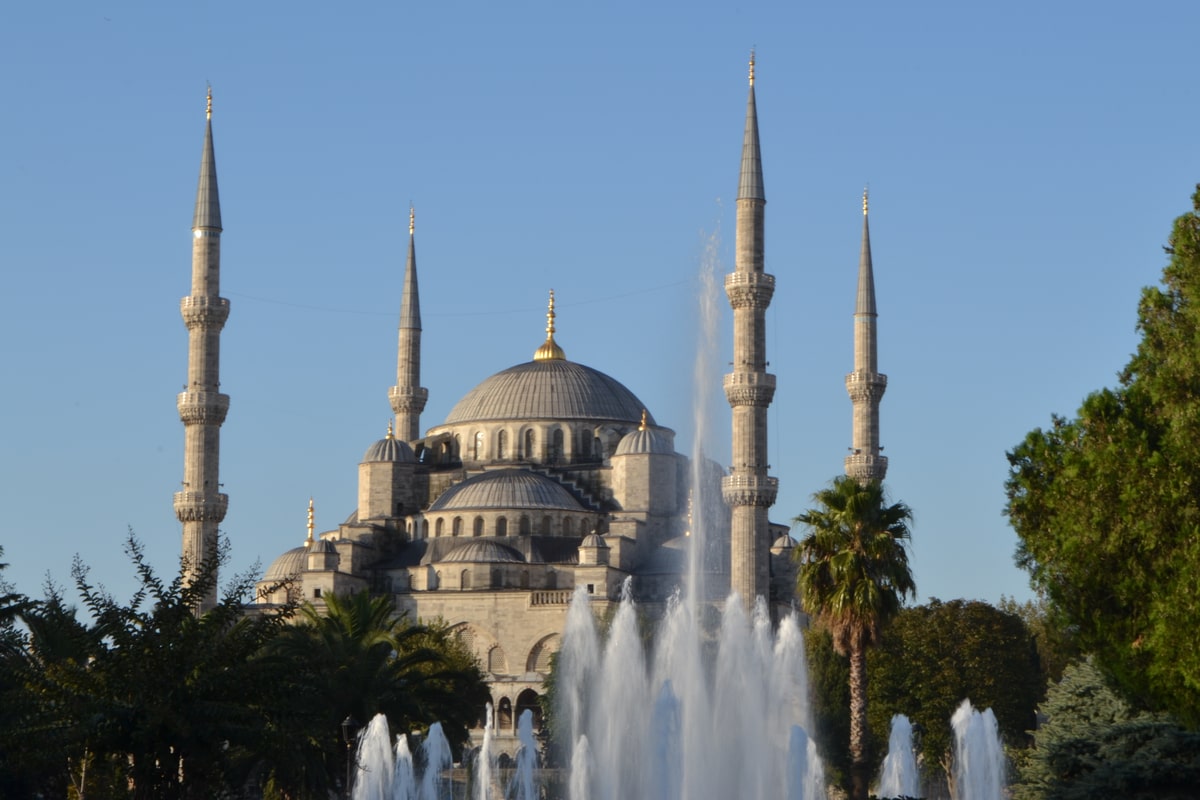
The Blue Mosque adds a second great dome across Sultanahmet Square from the first. On a Hagia Sophia tour it brings six minarets, a wide courtyard and blue Iznik tiles. All of it sits close to the main stop.
Its formal name is the Sultan Ahmed Mosque, in Turkish Sultanahmet Camii, as Wikipedia states it. Building took about eight years in the early seventeenth century. A Hagia Sophia tour that crosses the square moves from a very old building to a younger one.
The architect, Sedefkar Mehmed Agha, learned from his master Sinan and built on his designs. Wikipedia says the neighbouring Hagia Sophia inspired the Ottoman architects of the new mosque. So a Hagia Sophia tour lets you compare the older dome with the one raised after it.
The roofline rises in steps. A central dome sits on four semi-domes, and three smaller domes flank each semi-dome, as Wikipedia describes it. Inside, the main dome spans 23.5 metres and rises 43 metres above the floor. Across the square from Hagia Sophia, this cascade of domes comes into view.
Six slender minarets stand around the prayer hall and the courtyard. The four at the hall corners carry three balconies apiece. The pair at the courtyard corners carry two apiece, as Wikipedia and a visitor page state it. Counting all six makes a short game on a Hagia Sophia tour.
Inside, Iznik tiles cover the lower walls. Two pages count more than twenty thousand of them. Wikipedia adds more than fifty designs, among them cypress trees, fruit and flowers. Painted patterns, mainly blue, cover nearly three-quarters of the wall above the tiles. Here a Hagia Sophia tour trades gold mosaics for blue.
The courtyard comes before the prayer hall. Arcades line it, with 26 columns holding up the porticoes and 30 domes above them, as Wikipedia states it. An octagonal kiosk with a fountain stands at the centre. An iron chain hangs at the Hippodrome entrance. Only the sultan rode in on horseback, so the chain made him bow his head.
The mosque opens to visitors outside prayer times, as two visitor pages state it. One gives the hours as about half past eight until dusk, with each prayer closing it for roughly an hour. The north door is kept for worshippers, so visitors use the side facing the square. Plan the Hagia Sophia tour around the prayer breaks.
One visitor page says the two buildings stand minutes apart on foot. A four-minute walk from the Sultanahmet tram stop reaches the Blue Mosque. Five minutes reaches Hagia Sophia, as two pages state it. Another page plans thirty to forty-five minutes inside the mosque. That is the time the Blue Mosque adds to a Hagia Sophia tour.
How does the Basilica Cistern fit a Hagia Sophia tour?
The Basilica Cistern fits a Hagia Sophia tour as a cool underground stop. Wikipedia places it 150 metres from Hagia Sophia. A forest of 336 marble columns stands in shallow water, with raised walkways between them.
The cistern is an underground water store from the sixth century. Wikipedia names it the biggest of the old cisterns under Istanbul. The underground hall covers an area of about 138 by 65 metres. A Hagia Sophia tour reaches it by crossing the square, and the entrance lies across from Hagia Sophia.
The water supply began in the Belgrad Forest, 19 kilometres away to the north. It travelled along the Valens Aqueduct and the Maglova Aqueduct, as Wikipedia states it. On a Hagia Sophia tour, this stop shows how Constantinople stored its water.
The 336 columns form 12 rows with 28 columns each, and every column is 9 metres high. Their capitals follow the Ionic and Corinthian styles. Wikipedia says the larger share of the columns look recycled from older buildings. That is why they are carved from different marbles and granite. Wikipedia links them to the columns brought for Hagia Sophia.
One column carries raised pictures of a hen’s eye, slanted branches and tears. In the north-west corner, two column bases reuse blocks carved with the face of Medusa. A visitor page notes that one lies sideways and the other upside down. Wikipedia says the origin of the two heads is unknown.
Visitors walk down stone steps into the chamber. The air is noticeably cooler than the street all year. Sound drops to drips and footsteps, as one visitor page puts it. After the street, a Hagia Sophia tour changes pace down here.
The recent restoration added a steel walkway, kept apart from the old stonework, and new LED lighting. Wikipedia says the lighting supports an atmospheric mood. An operator page describes the ancient columns standing in dark water. The walkways keep a Hagia Sophia tour above the water the whole way.
Visitors once toured the cistern by boat. A French traveller in the sixteenth century was rowed between the columns and saw fish in the water. Wikipedia records his account. Platforms later replaced the boats. Today the water is shallow, and visitors walk above it.
One visitor page plans forty-five to sixty minutes for the cistern. It times the walkway loop at a slow twenty minutes. One tour listing pairs the cistern with the two great domes in a three-hour small-group walk. Another page offers a combined entry for a visit at your own pace. A Hagia Sophia tour adapts to both.
How does Topkapi Palace fit next to a Hagia Sophia tour?
Topkapi Palace fits next to a Hagia Sophia tour because both lie in Fatih, a district of old Istanbul. Two operator pages list Hagia Sophia before the palace in a full-day plan. The palace becomes the second chapter of the day.
Wikipedia’s panorama of Istanbul from the Galata Tower shows Topkapi Palace beside Hagia Sophia and the Blue Mosque. A Hagia Sophia tour and the palace therefore belong to the same stretch of the old city. Wikipedia adds that the palace stands at one of the highest points close to the sea.
Wikipedia describes Topkapi as a museum with a library, in the eastern part of Fatih. Ottoman sultans lived and governed here from the fifteenth century. The official page says it is a series of pavilions, kitchens, barracks and kiosks around a central enclosure. A Hagia Sophia tour shows one building, while the palace is a set of smaller ones.
Wikipedia gives the palace a size of 59,260 to 70,000 square metres. Illuminated manuscripts, miniatures, Ottoman clothing and armour fill part of its collection, as Wikipedia lists it. One operator page says the Treasury and the Harem are not in its program. A day with a Hagia Sophia tour therefore sets aside separate time for the palace.
A private full-day page moves from Hagia Sophia to the palace courtyards. Then it goes to the Grand Bazaar and the Blue Mosque. An eight-hour page meets at Sultanahmet. It lists the Hippodrome, Hagia Sophia, the Blue Mosque, the Grand Bazaar and the palace. In both plans the Hagia Sophia tour comes before the palace.
Gulhane Park lies beside the palace. Wikipedia says it covers 9.7 hectares and adds that the ground was once the outer garden of the palace. It calls the park the oldest public park in Istanbul. One of the larger palace gates stands at the southern entrance of the park. After a Hagia Sophia tour, the park gives a green pause.
The Istanbul Archaeology Museums are the third neighbour of a Hagia Sophia tour. Wikipedia and the official museum page both describe three museums. One sits in the main building. One shows works of the ancient Orient. One fills the Tiled Kiosk. The official page puts the complex on a slope that joins Gulhane Park to the palace.
What do the Grand Bazaar and the Spice Bazaar add to a Hagia Sophia tour?
Two bazaars add two covered markets to a Hagia Sophia tour. Trams link Sultanahmet with the Grand Bazaar, as Wikipedia states it. The Spice Bazaar stands in the Eminonu quarter on the waterfront.
Kapalicarsi, the Turkish name of the Grand Bazaar, means Covered Market. Wikipedia calls it very large and very old, and gives it 61 covered streets. More than 4,000 shops stand along them. The market lies in the walled city of Fatih. Wikipedia reports 18 gates in an old survey, and one visitor page counts 22 today.
One visitor page gives the way from Sultanahmet as one tram stop or a ten-minute walk along Divan Yolu. It names Nuruosmaniye Gate for visitors from Sultanahmet and Beyazit Gate for the tram side. It plans one to two hours for a first walk. A Hagia Sophia tour day needs that time set aside.
The Old Bedesten is the oldest part of the market, a stone hall under brick domes. Wikipedia names its four gates after the Jewellers, the Skullcap Sellers, the Second-hand Book Sellers and the Women’s Clothiers. Wikipedia and a visitor page both tie the hall to Hagia Sophia as an endowment. A Hagia Sophia tour shares that link.
Streets carry the names of trades. Wikipedia says traders of one kind of goods gathered along one road. The road took its name from their work. A visitor page lists the fez makers, the mirror makers and the kerchief sellers. After a Hagia Sophia tour, the street signs read like an old map of trades.
The Spice Bazaar, Misir Carsisi in Turkish, means the Egyptian Bazaar. Wikipedia places it in the Eminonu quarter of Fatih. It counts 85 shops with spices, Turkish delight and other sweets, dried fruit and nuts. Shop rents paid for the upkeep of the New Mosque. A Hagia Sophia tour finds the food side of the old city here.
A Hagia Sophia tour day can reach the Spice Bazaar by tram. One visitor page puts it two minutes on foot from the Eminonu tram stop. The same page says the tram beats walking from Sultanahmet in summer heat. It gives fifteen minutes on foot between the two bazaars, downhill from the Grand Bazaar.
Wikipedia and a visitor page agree that the Grand Bazaar closes on Sundays and shuts at seven in the evening. The visitor page adds the religious holidays as closing days. It says the Spice Bazaar opens on Sundays too. A Hagia Sophia tour on a Sunday therefore pairs better with the Spice Bazaar.
Which Hagia Sophia tour suits you: a small group, a private tour or a combined visit?
A small group suits questions. A private tour suits a slow pace. A combined visit suits a longer walk through Sultanahmet. Operator pages describe each kind of Hagia Sophia tour by its length, its group size and its stops.
A small-group Hagia Sophia tour keeps the party small enough for questions. One operator page caps the group at 15 to 20 people and gives the length as one to two hours. Another page says a small group leaves room to ask the tour guide questions. The tour guide takes the group on into the visitor area.
A short Hagia Sophia tour gives a focused introduction, as one page puts it, and then leaves you to explore. Operator pages describe a 30-minute guided tour and a 45-minute guided tour. Both lead to the upper gallery that is open to visitors, as the pages state it. Afterwards you walk on at your own pace.
A private Hagia Sophia tour gives your party the full attention of the tour guide. One listing offers a private visit of one hour. Another page says private tours run up to three hours, depending on your interests. The same page lists a flexible schedule and a custom route. You can linger at the dome or the mosaics.
A combined Hagia Sophia tour adds the neighbours. Operator pages pair the building with the Blue Mosque, the Basilica Cistern or the Hippodrome. One page lists these pairings at two hours, two and a half hours and three hours. Another gives two to three hours. Page titles call the pairings walking tours, so the route runs on foot through Sultanahmet.
A skip-the-line Hagia Sophia tour skips the ticket line only. One operator page says the security check applies to all visitors, even with skip-the-line access. Another page says priority access saves up to one hour of waiting. The group enters together with the tour guide. Check the meeting point and the time on your voucher, as that page asks.
A longer Hagia Sophia tour stretches the same idea across the old city. One listing calls the small-group walk with the Blue Mosque a half day. A full private day on another listing adds Topkapi Palace, the Grand Bazaar, the Hippodrome and the Basilica Cistern. It runs at your own pace.
The language of the tour depends on the listing. One page offers tours in English, Turkish, Spanish, German, French and Italian. Another lists a licensed guide who leads in English only. Check the language before you pick a kind of Hagia Sophia tour.
What does a Hagia Sophia tour with a tour guide add over an audio guide?
A Hagia Sophia tour with a tour guide adds stories, answers and a route. An audio guide adds your own pace and your own language. A self-guided visit with entry only is a third way, as the operator pages describe it.
One operator page says a licensed guide on a Hagia Sophia tour explains the mosaics, the inscriptions and the architecture. Another page adds that the licensed guide tells how the building changed over the centuries. A sign names an object, but a tour guide answers the question behind it. The talk starts outside the building, as one page describes it.
On a Hagia Sophia tour, the tour guide also points out details that visitors walk past on their own. The group stays small, so everyone can hear and ask questions, as two listings put it. One page says the tour guide shares stories that are not in the guidebooks.
A guided Hagia Sophia tour can carry an audio guide as well. One tour page pairs a 45-minute talk by a licensed guide in English with an audio guide in 25 languages. After the talk, you walk on alone. A combined listing also offers an audio guide for the Blue Mosque tiles and courtyard.
A Hagia Sophia tour with an audio guide runs on your phone. One page describes a 45-minute self-guided tour with 15 stops. It comes in 10 languages, from English and German to Arabic, Chinese and Turkish. It works offline after the download, so bring headphones. You can linger at the mosaics or skip ahead.
The language list depends on the page, because another page says 10 or more. One page says QR panels in front of the mosaics open an audio guide on the phone. No extra app is needed. That makes a Hagia Sophia tour on your own simple to start.
A self-guided Hagia Sophia tour needs entry alone and no tour guide. One operator page calls it a simple skip-the-line entry. A combo entry on the same page lets you visit at any time during opening hours. You set the pace, with no fixed group schedule. Add an audio guide and you have a tour without a group.
Choose your Hagia Sophia tour by what you want from the visit. A tour guide answers questions and tells the stories. An audio guide leaves the pace to you. The pairing gives a talk first and your own pace after. One page says an audio guide suits a solo traveller, friends or a family.
How do the seasons and the time of day change a Hagia Sophia tour?
A Hagia Sophia tour changes with the season and the hour. Wikipedia describes warm to hot summers in Istanbul and winter daytime temperatures of 5 to 10 °C. Tour pages place the shortest queues at opening time, around 9:00.
Wikipedia calls the summer warm, even hot, and moderately dry, with about 28 °C in the daytime. Mid-summer feels moderately uncomfortable because of high dew points and humidity. Wikivoyage lists July and August at 26 °C in the daytime and 17 °C after dark. A summer Hagia Sophia tour suits an early start, before the heat builds.
Winters bring daytime temperatures of 5 to 10 °C and frequent rain, says Wikipedia. Wikivoyage calls the season chilly and notes snowfall between December and March. Another page points to winter, when the summer visitors are back home, for a quieter Hagia Sophia tour. One page says part of the security queue waits outdoors, so a warm layer helps.
Spring and autumn are mild, in the words of Wikivoyage, with rain and sunshine in balance. It rates late spring and early autumn as pleasant. One tour page calls March the quietest month, with more visitors from April on, at 15 to 24 °C. A Hagia Sophia tour then suits the 9:00 opening or a late afternoon, says that page.
Two pages describe the same daily pattern. One found the gallery ramp without a queue before 9:30 and slow-moving by noon. Another calls 11:00 to 3:00 the busiest window and says lines shorten after 2:30. So a Hagia Sophia tour at opening or after 2:30 meets the shortest queues.
Light changes with the hour too. Two pages point to the morning daylight on the dome and the mosaics for a Hagia Sophia tour. One page adds softer sunset light through the windows once the day-trippers leave. Another page puts closing time between late afternoon in winter and early evening in summer.
Prayer times pause the visit. One page says the gallery closes at each of the five daily prayers, for 30 to 60 minutes. Two pages place the Friday break around midday and end it near 2:30. Prayer times move through the year, so look up the schedule for your day before a Hagia Sophia tour.
Packing follows the season. For a summer Hagia Sophia tour, wear light clothes that cover shoulders and knees, as two pages require. In winter, add a warm layer for the outdoor part of the queue. In spring and autumn, a thin layer covers the mix of rain and shine.
What can you eat and drink near a Hagia Sophia tour?
Near a Hagia Sophia tour you find tea in tulip glasses, strong coffee and simit rings. Baklava and Turkish delight bring the sweets, and street carts sell roasted chestnuts and corn. Wikipedia and Wikivoyage describe each one.
Turkish tea is poured into a small tulip-shaped glass named ince belli, as Wikipedia states it. Wikivoyage says strong tea is poured into the glass and cut to taste with hot water. Wikipedia adds that the glass is held by the rim, because the tea is served boiling hot. A tea break fits after a Hagia Sophia tour.
Wikipedia says Turkish coffee is very finely ground, heated in a cezve, and taken off the heat as it froths. It is served in small cups, and the grounds stay in the drink. As Wikipedia states it, tea or coffee, with or without sugar, follows dinner. A small cup of coffee suits a pause near a Hagia Sophia tour.
Simit, says Wikivoyage, is a ring of bread with a sesame crust, close to a bagel yet lighter and crunchier. A tourism page calls it an everyday food and places it on bright red carts and in bakeries. Another page times fresh batches from 6:30 to 9:00 each morning, before a Hagia Sophia tour.
Baklava, says Wikipedia, is a pastry of layered filo filled with chopped nuts and sweetened by honey or syrup. Turkish delight, or lokum, is a family of sweets whose base is a gel made from starch and sugar. Both sweets pair with the tea break after a Hagia Sophia tour.
Lunch near a Hagia Sophia tour comes as a kebab or a borek. Wikipedia says kebab names a great variety of meat dishes. Wikivoyage describes durum kebap as a wrap of grilled meat. Wikipedia describes borek as thin flaky dough such as filo, filled with meat, cheese, spinach or potatoes. A tour page lists a lunch stop in Sultanahmet.
Roasted chestnuts and corn on the cob come from carts near a Hagia Sophia tour. Wikivoyage says the carts stand around the city, and chestnuts suit cold weather. Another page places chestnut vendors in Sultanahmet, with their scent in the streets as winter approaches. A third page says corn is sold boiled or grilled near squares and gardens.
Wikipedia says the monuments of Sultanahmet Square sit in a landscaped garden. A glass of tea there fits between stops on a Hagia Sophia tour. One page notes that the visitor route has no cafe, so tea comes before or after the visit.
What else do travellers ask about a Hagia Sophia tour?
Travellers ask about children, photos, weather and access on a Hagia Sophia tour. The pages give plain answers. A long ramp leads up to the gallery. Tripods and flash stay at home, and part of the wait is outdoors. The visit takes an hour or so.
Is a Hagia Sophia tour suitable for young children, teenagers and slower walkers?
A Hagia Sophia tour works for young children, older teens and slower walkers who can climb a long ramp. Wikipedia states that a long ramp leads up to the upper gallery. One visitor page adds that the ramp is historic and the surface is uneven.
Plan on an hour or so. One page gives 45 to 90 minutes for the visit, plus the security line. Another says independent visitors spend 60 to 90 minutes in the upper gallery. A third page asks for one to two hours.
A visit with a licensed guide takes longer. One page says to allow about two hours with a licensed guide. Another page puts the main highlights at 45 to 60 minutes. Children and slow walkers can stay with the highlights and leave the details.
Young children have their own entry rule on a Hagia Sophia tour. One page names a separate rule for children under seven and asks for ID at the gate. Ask the operator for the current rule before the day.
Can you take photos on a Hagia Sophia tour, and which gear is allowed?
Photography is allowed on a Hagia Sophia tour, with limits. One page says photos are permitted except during prayer times and in designated areas. Another page asks visitors to avoid any equipment that disturbs the quiet atmosphere.
A phone is the simple choice. One photography page says modern smartphones perform remarkably well inside the building. Four pages state that tripods are not allowed, and one says security keeps a tripod at the checkpoint. One page adds that drones are not permitted.
A Hagia Sophia tour gives two spots for wide photos. From the upper gallery, one page notes, wide-angle shots show scaffolding from the restoration work. Outside, another page advises standing in the park between Hagia Sophia and the Blue Mosque for a clean front view.
On a Hagia Sophia tour, keep voices low and do not photograph worshippers. One page asks visitors to avoid speaking loudly, using flash or photographing people during prayer. Another page lists the mosaics and the artwork inside among the sights to photograph.
What if it rains or turns hot on a Hagia Sophia tour, and what is indoors?
Two stages of a Hagia Sophia tour sit outdoors. The meeting point lies on Sultanahmet Square, across from the building, as one page states. Part of the security queue waits outdoors, as another page states. A third page describes tour groups queuing in front of the building.
A summer Hagia Sophia tour needs a sun plan. Wikipedia states that summers get 60 to 70 percent of possible sunshine. It also notes high humidity in mid-summer. Bring a sun hat and a drink for the outdoor wait, and pick light clothes that still cover the shoulders.
A winter Hagia Sophia tour needs a rain plan. Wikipedia states that winter brings double the precipitation of summer or more. One visitor page expects a day or two of rain in April. A light rain layer folds into a small bag.
Once the security check is done, the visit moves indoors. Visitors walk the upper gallery and look down on the interior, as one page describes it. The ground floor stays restricted to worshippers, as Wikipedia states it. So weather matters mainly at the start.
What facilities and access does a Hagia Sophia tour offer?
A Hagia Sophia tour has no facilities on the visitor route, as one page states. That page lists no restrooms, no cafe and no cloakroom. It advises using the facilities around Sultanahmet Square before entering.
Ask the operator about a wheelchair or a stroller before booking. The upper gallery has limited access. One page calls it not fully wheelchair or stroller friendly, and another cites limited accessibility. The pages name a ramp as the way up and do not mention a lift.
Wheelchair access runs through the main entrance, with ramps at the door, as one visitor site states on two pages. A Hagia Sophia tour on the gallery route still climbs the long ramp. The prayer area on the ground floor is not part of that route.
The official Hagia Sophia Mosque website offers a 360-degree virtual tour from 19 points. It also works with virtual reality devices. That is one way to see the building without the climb, before or after a Hagia Sophia tour.