
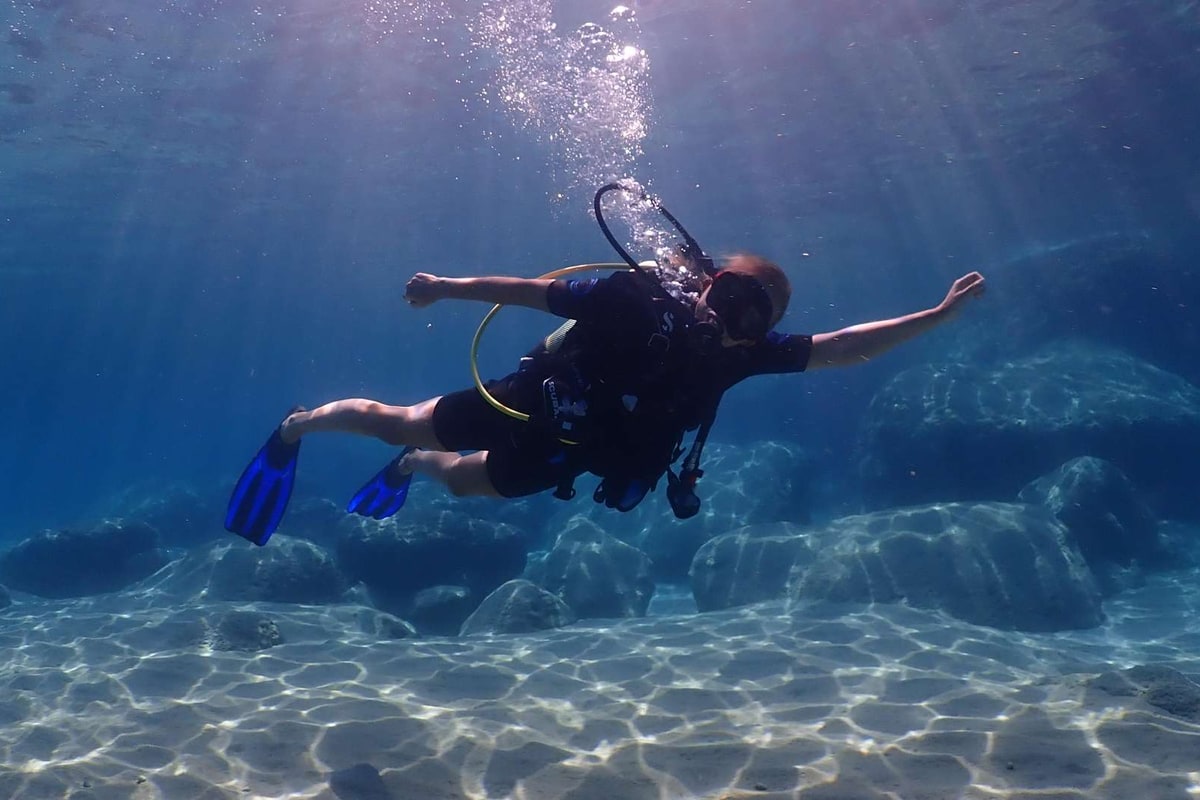
Rhodes scuba diving starts at a dive centre on the island, with a briefing, a gear fitting and a dive led by an instructor from the shore or from a boat. The sites lie along the east coast, from Pefkos and Lindos to Kallithea and Faliraki, and the dives suit a first try in shallow water as well as certified divers. When the plan is clear, browse the tours in Greece that match your week on the island.
This page covers how a dive day runs from the meeting point to the return, which sites the dives reach and what lies under the water there, the kinds of dive and course from a first try to a certified fun dive, the rules, the gear and the seasons, and the questions travellers ask.
What is Rhodes scuba diving, and how does a dive day run?
Rhodes scuba diving means breathing from a tank under water with an instructor. It takes place around Rhodes, the biggest island in the Dodecanese group of Greece. A dive day runs in steps: meeting, lesson, gear, travel to the water, the dive and the return.
Scuba gear works without a gas supply from the surface, as Wikipedia explains. The diver carries the gas in a cylinder, which gives more independence and movement. Rhodes scuba diving uses this kit in the sea around an island that PADI calls the largest of the Dodecanese.
A Rhodes scuba diving day begins at a meeting point. One centre page says guests meet at its base at 9 in the morning for registration. Another page lists a transfer from a prearranged meeting point. The first page runs its dives on Monday, Wednesday, Thursday and Saturday mornings, as it states.
A first dive starts with a theory lesson. Two centre pages describe a lesson of 30 minutes at the dive centre that covers the basics of diving. Both pages say the equipment for the dive is supplied. After that, the Rhodes scuba diving group goes to the water.
The first dive of a Rhodes scuba diving day stays shallow. Both pages give a maximum depth of about 6 metres. One page places the dive in Saint Paul’s Bay at Lindos. The other places it at a beach in the Kallithea area. The dive lasts about 30 minutes and includes the underwater skills.
Certified divers follow a longer plan. One centre lists two shallow dives in its qualified programme and one dive in its try diving programme. It starts its programmes from the beach beside its base. It also lists hotel pickups for guests in the south. Another centre lists a drop-off after the daily diving programme.
How long does the whole day last? One page lists a try dive as a full day at Kallithea or a half day at Pefkos. A second page calls an excursion to a beach and a ship wreck a half day. So the pages put the length of Rhodes scuba diving at one morning, one afternoon or a full outing.
Which dive sites does Rhodes scuba diving cover?
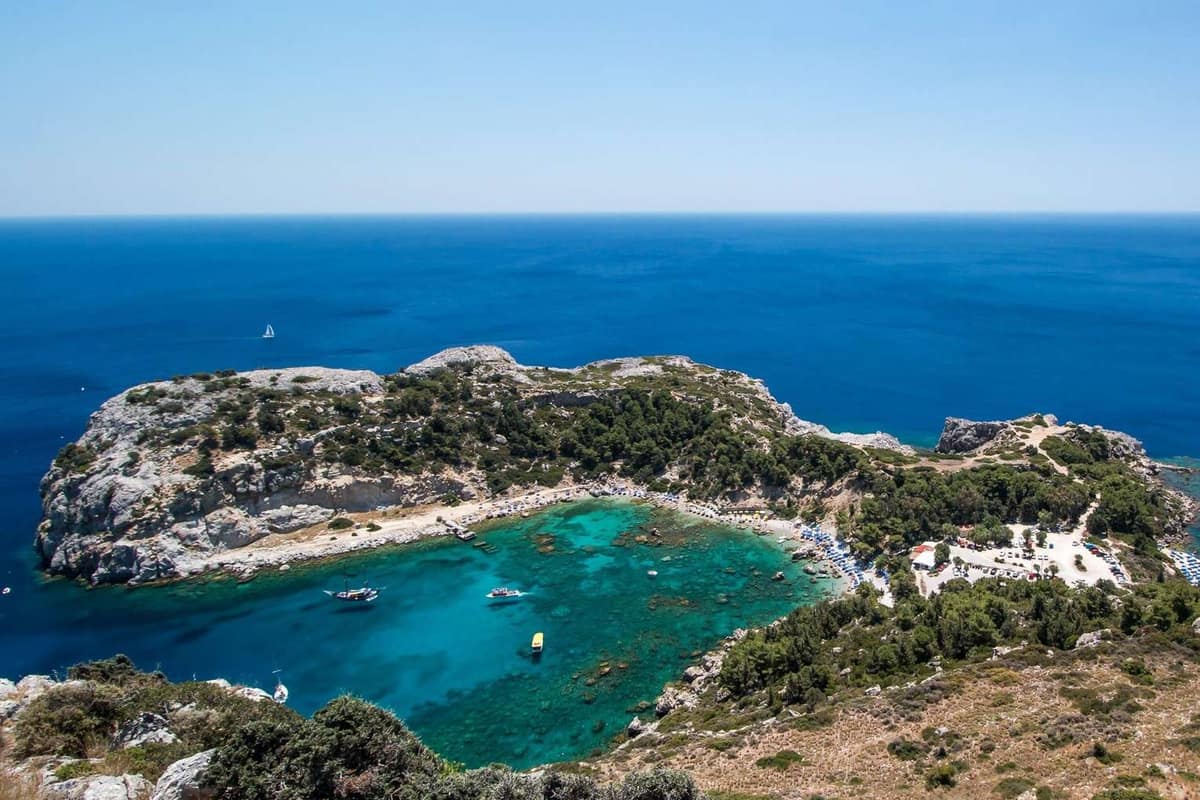
Rhodes scuba diving covers the east coast around Lindos and Pefkos. It reaches the north near Rhodes Town, Kallithea and Faliraki, and the south tip at Prasonisi. PADI names Lindos, Anthony Quinn Bay and Rhodes Town as dive areas.
PADI calls Rhodes Town, Lindos and Faliraki the main hubs for dive centres. From these hubs, centres run boat trips and shore dives to the sites. So Rhodes scuba diving comes in two kinds of access. One centre page marks Ladiko Wall as a shore dive and Pentanissos Islet as a boat dive.
Lindos sits on the east coast, and Wikipedia gives its distance from Rhodes city as 40 kilometres. Two pages describe caves, caverns and walls near Lindos. One page lists caverns and swim-throughs at 18 metres and a wall under the Lindos Acropolis at 22 metres. That makes Rhodes scuba diving near Lindos a matter of rock, caves and walls.
Pefkos lies 4 kilometres southwest of Lindos, as Wikipedia states. A centre page there lists a large rocky reef, sandy areas and a small swim-through. Another page names caves, walls and rock formations at Pefkos. The first page calls the water calm, with great visibility. Rhodes scuba diving at Pefkos happens in that calm sea.
Two pages list Ladiko as a wall dive. One gives the wall as 6 to 32 metres, the other 10 to 30 metres for the bay. For Anthony Quinn Bay, two pages describe caves. One of them adds ancient amphorae scattered in the bay and lists the same at Ladiko. That adds history to Rhodes scuba diving.
Rhodes scuba diving in the north centres on Faliraki and Kallithea. Wikipedia places Faliraki 14 kilometres south of Rhodes town. A centre page puts its base on a quiet Kallithea beach next to Rhodes city. One site list gives Rhodes Town an average depth of 10 metres and Kallithea Bay 10 to 22 metres.
Rhodes scuba diving at the south tip meets two seas. Wikipedia says the Aegean Sea touches one side of Prasonisi and the Mediterranean Sea the other. One article lists sandy and rocky areas there, with seahorses. Near Plimiri lies a ship wreck, which one page gives at 20 metres and another at 22.
Under water, PADI lists reefs, caves and wrecks. It names groupers, octopus, moray eels and barracuda, and sandy seabeds. Wikipedia describes Posidonia as a sea grass that forms large meadows under water. The Pefkos page lists sea grass too. That mix of walls, caves, sand, sea grass and fish gives Rhodes scuba diving its look.
Which kinds of Rhodes scuba diving and courses exist?
Rhodes scuba diving has two entry points: a discover dive for beginners and a guided fun dive for certified divers. PADI courses lead to a certification. Private options serve small groups, and snorkelling is there for non-divers.
The discover dive is the Rhodes scuba diving choice for a person who has never dived. Two pages start it with theory, then skills in shallow water. One gives the whole programme as 2 hours, with the paperwork at the start.
On another page, the first dive reaches about 6 metres, and a second dive to 12 metres is optional. Two pages open the discover dive at age 10 and give children from 8 a separate programme. One Rhodes scuba diving trial takes up to 4 people, with one dive leader for every 2.
A guided fun dive is for certified divers. One page opens the day with a briefing and plans 1 or 2 dives around their experience. The PADI page for the island names boat trips and shore dives. In Rhodes scuba diving, close sites start from the beach and remote ones need a boat, as one page explains.
Courses in Rhodes scuba diving end with a certification, and operator pages list them under PADI. The scuba diver course takes 2 days, with 2 open water dives to 12 metres. The open water course has 4 such dives to 18 metres. Pages give 3 to 4 days for it.
The advanced course suits an open water diver who wants to learn more. Of its 5 adventure dives, deep and navigation are compulsory, and adults qualify to 30 metres. One page gives 2 days, another 3. A night dive added to a Rhodes scuba diving package needs Advanced level, as one page states.
A refresher suits a certified diver who has been away from the water for a while. Two pages build it from a theory review, a skills review and 2 dives, and one calls those dives optional. Both end with a new certification card, so it is the way back into Rhodes scuba diving.
Private courses and private dives serve single divers, families and other small groups. One page lets a private group choose its own time and site. Snorkelling is an extra kind: one beach tour lasts 2 hours. Another page takes no non-swimmers, and parents go into the water with their children.
What are the rules, the gear and the seasons for Rhodes scuba diving?
Rhodes scuba diving courses set a minimum age and ask for good health and swimming skill, as operator pages state. Beginners get equipment from the dive centre. The PADI page puts the prime season from late spring to October.
Two pages set the course age at 10 for juniors and 15 for the adult certification. A Rhodes scuba diving student also needs adequate swimming skills and good physical health. Below the age of 18, one operator page asks for written consent from a parent or guardian.
Paperwork comes first, and one page includes a medical questionnaire on physical and mental health. Another says chronic conditions, certain medications or recent surgery can mean a doctor must approve in writing. The first page also asks certified divers on a guided Rhodes scuba diving trip for a certificate or valid proof.
A flight home needs a gap after diving, and one operator page sets at least 18 hours. A health network for divers gives a minimum of 12 hours after a single dive without decompression stops. After repeated diving over more than one day, it gives 18 hours. Plan the end of your Rhodes scuba diving around that wait.
For a Rhodes scuba diving trial or course, two pages say the dive centre supplies the equipment. On Wikipedia, scuba gear covers fins, a mask, exposure protection from a suit, ballast and buoyancy equipment. The diver also carries a cylinder of breathing gas, which reaches the diver through a regulator.
Certified divers on one page choose between a tank with weights only and hired equipment. Another page wants all breathing equipment serviced, your own included, and asks for a written certificate. If personal gear used for Rhodes scuba diving shows a fault there, the team supplies a replacement item.
Summer water for Rhodes scuba diving measures 22 to 28 degrees Celsius on the PADI page. A climate page lists sea averages of 16.5 degrees in February and March and 26.5 in August. Another page advises a full wetsuit below 15 metres in the diving season.
Two pages put Rhodes scuba diving visibility at 15 to 20 metres, and another says it can exceed 30 metres. The PADI page calls the Aegean warm and calm in its prime season, with quieter dive sites in early autumn. Wikivoyage counts 300 or more days of sun a year.
The meltemi, a north-west wind, is blowing by late spring and cools the air, as a climate page states. Two operator pages say a schedule can change with the weather. On a Rhodes scuba diving day, a third page leaves the group and site choice to its dive leaders.
What else do travellers ask about Rhodes scuba diving?
Which kind of Rhodes scuba diving suits which traveller?
Rhodes scuba diving offers a first try for anyone who has never dived. One operator page says the programme lasts about two hours. It starts with paperwork, a theory lesson and skills practice from a beach.
Another page says a half-hour lesson comes first, then a dive of about 30 minutes to 6 metres. A third page lists the try dive as a full day at Kallithea and a half day at Pefkos.
A course suits a traveller who wants a certification card. One operator lists a minimum of two days for its entry-level programme. Its Open Water Diver course takes three to four days. Its page adds that training dives last at least 20 minutes underwater.
What does a first-time diver do during Rhodes scuba diving?
A first-time diver starts on land. One operator page lists the lesson topics: what each part of the gear does, equalising techniques and what pressure is. Wikipedia describes ear clearing as a set of moves that equalise pressure in the middle ear. The same page limits a session to four divers, with one dive leader for every two.
Rhodes scuba diving for beginners then moves to shallow water from the beach. The page names two skills: clearing water from the mask, and taking out and replacing the regulator. Wikipedia calls hand signals the main way recreational divers talk underwater and says students learn them early.
A third page calls the theory lesson simple and says almost anyone can enjoy diving.
What does a diver pack for the dive day?
For Rhodes scuba diving courses, pack a swimsuit and a towel. Two course pages of one operator also ask for a phone, tablet or computer for the theory lesson. Both pages say the operator supplies all the diving gear for the course.
A certified diver brings a diving certificate or valid proof of it. One operator page warns that a worn-out card can be a problem. It also says emails and digital proofs of unfinished courses are not accepted.
Another page says a beginner needs to be comfortable in the sea. It lists fresh water and a snack for the first dives. Its FAQ also welcomes divers who bring their own refreshments.
Which sea life does Rhodes scuba diving show?
Rhodes scuba diving shows groupers, octopus, moray eels and schools of barracuda, as the PADI page lists them. A second operator page adds sponges, soft corals and a bright purple nudibranch. The PADI page adds rays and colourful reef fish in early autumn.
That page says the Mediterranean is a different ecosystem from the tropics. It names the trumpetfish and the lionfish as invading species. Its list of dive sites gives groupers at two sites and lionfish at three, so Rhodes scuba diving offers both.