
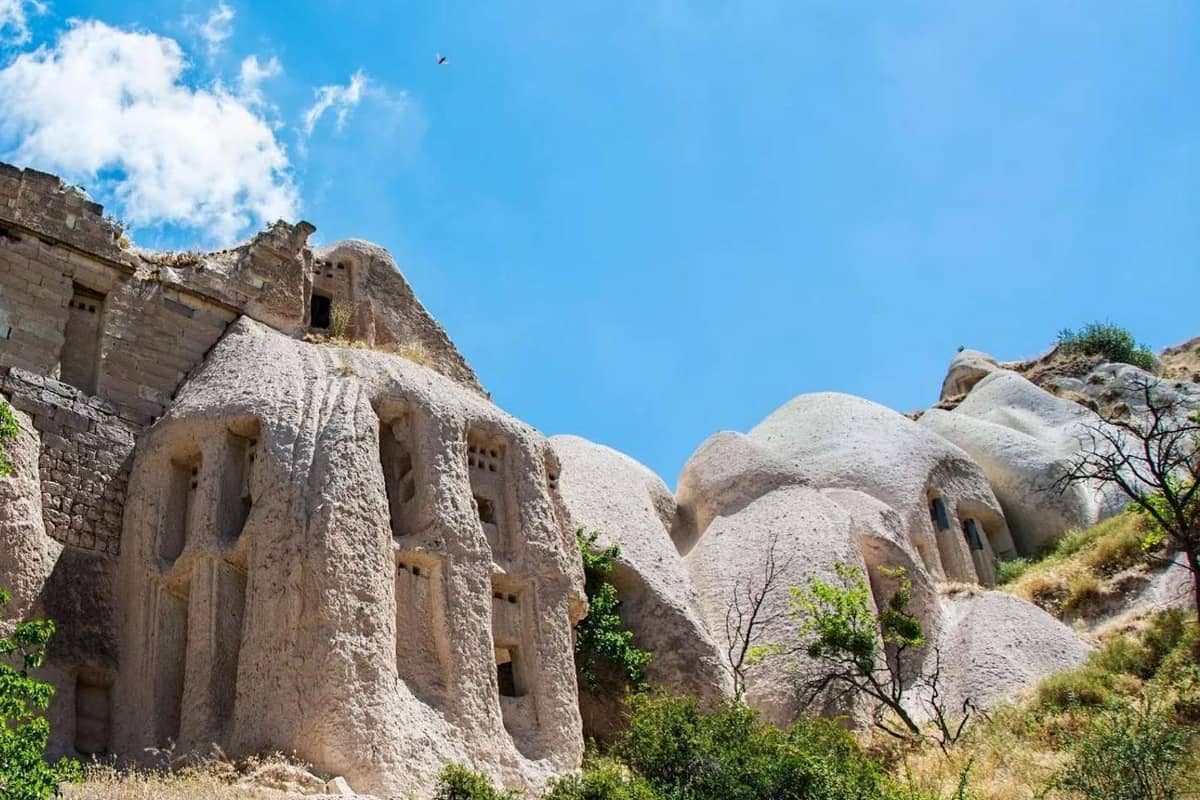
A Cappadocia green tour starts with a morning pickup, as the operator pages describe it, and then turns south toward the underground city at Derinkuyu, the river gorge of Ihlara and the rock monastery at Selime. The day moves by road between the stops, with lunch along the way. Once your Cappadocia days are settled, you can compare our tours in Greece for a second leg across the Aegean.
Below, you can follow the shape and length of a Cappadocia green tour, trace the south route and the story of its underground cities, step into Derinkuyu and the Ihlara Valley walk, meet Selime, Pigeon Valley and the kinds of tour, check roads, lunch, rules and seasons, and finish with other traveller questions.
What is a Cappadocia green tour, and how does it run?
A Cappadocia green tour is a guided day trip through the south of Cappadocia in Turkey. A minibus collects travellers at the hotel. Then come a viewpoint, an underground city, the Ihlara Valley, a rock-cut monastery and a riverside lunch. The evening drop-off ends the day.
Travel pages call the Cappadocia green tour the South Tour. It leaves the towns around Goreme and drives out to the southern part of the region. One page says that part is much harder to reach without a rental car, so travellers book a guided trip.
The idea is simple. One page lists four kinds of stop on the route: an underground city, a gorge, rock-cut monasteries and viewpoints. Short walks join them. One vehicle links sights that sit too far apart to reach on foot. The tour guide explains each place on the way, as operator pages describe it.
On a Cappadocia green tour the day starts at the hotel. One page lists pickup in Goreme, Uchisar, Urgup or a nearby town, and a second page names central Cappadocia. The group rides in a van or minibus. Operator pages set the group limit at 14, 15 or 16 people.
Two operator pages give almost the same order for the Cappadocia green tour. The stops run like this.
- The Goreme Panorama viewpoint opens the day, a short drive from a hotel in Goreme.
- An underground city comes next, and one page names Derinkuyu.
- The Ihlara Valley walk follows, along the Melendiz River.
- Lunch is at Belisirma, in a restaurant on the river bank.
- The afternoon holds Selime Monastery on one page and Nar Lake on the other.
- A stone workshop and Pigeon Valley close the day.
Operators differ, as the pages show. One page puts Pigeon Valley second, as the first short walk of the Cappadocia green tour. Another page leaves the underground city for the late afternoon. A third page says an operator can reverse the route on a busy day to avoid crowds.
Pages explain the name of the Cappadocia green tour through the Ihlara Valley. One page says the lush green river canyon gives the trip its name. A second page calls the valley a green gorge with a river and rock-cut churches. A third page notes that the colour-coded tours each serve a separate area.
How long is a Cappadocia green tour, and when does it start?
A Cappadocia green tour starts in the morning and fills a full day. Operator pages give a start between 8:30 and 10:00. They give the length as seven hours, seven to nine hours, or nine hours. The van returns to the hotel between 5:15 and 6:30 in the evening.
Start times differ a little between pages. One timetable gives 9:30 to 9:50 for the Cappadocia green tour. Another gives 9:30 to 10:00, and a third lists 8:30 to 9:30 for hotels in Goreme, Uchisar and Urgup. One page says other towns are collected slightly earlier than Goreme.
The length of the day differs too. One page lists seven hours, a second lists seven to nine hours, and a third says about nine hours. One timetable of the Cappadocia green tour runs from the 9:30 pickup to the 17:30 drop-off. Operator pages say the plan changes with conditions on the day.
The first drives are short. One operator page states 5 minutes from a Goreme hotel to the first viewpoint. It then gives a 40-minute drive to Derinkuyu. A route planner puts Derinkuyu 34.7 km from Goreme, a drive of about 35 minutes. So the underground city sits near the opening stops of the Cappadocia green tour.
The long leg is the road west to Ihlara. One page puts Ihlara town about 80 km from Goreme. A route planner gives 79 km to Guzelyurt, a drive of 1 hour 23 minutes. One operator page adds a 15-minute drive from lunch to Selime Monastery on the Cappadocia green tour.
Pages also give the time at each stop. One timetable allows the following.
- Goreme Panorama: 20 minutes.
- Pigeon Valley: 30 minutes.
- Underground city: 1 hour.
- Ihlara Valley: 2 hours.
- Lunch: 1 hour.
- Stone workshop: 1 hour.
A second timetable is shorter at the early stops. It gives 15 minutes at the panorama and 20 minutes in Pigeon Valley. Lunch takes 45 minutes, and the underground city 40 minutes. Two other pages list about an hour for the Ihlara trail itself. These slots show why the Cappadocia green tour needs a whole day.
The road back is the second long drive. One operator page states a 1.5-hour drive back to the Uchisar area, with arrival at the hotel around 17:30. Other pages give a drop-off between 5:15 and 6:30 in the evening.
The Cappadocia green tour runs all year, as one page states, and another page says departures run every day. One operator page adds that routes and timings change with conditions on the day. It also says routes vary slightly by season. Another page tells travellers to ask the operator for the exact itinerary.
Where does the south route lie on a Cappadocia green tour?
A Cappadocia green tour covers the south of Cappadocia, which Wikipedia places in the Central Anatolia region of Turkey. Wikivoyage puts the underground cities south of Nevsehir and Guzelyurt, home of the Ihlara Valley, to the southwest. The day links these two areas.
Wikipedia spreads Cappadocia over six provinces, three of them Nevsehir, Aksaray and Nigde. Today the tourist region sits in Nevsehir province. A Cappadocia green tour that includes the gorge enters Aksaray Province, where the Ihlara Valley lies. That province borders Nevsehir to the east and Nigde to the southeast.
Wikivoyage names Goreme as the base for visitors to the region and Nevsehir as its transport hub. South of Nevsehir it places two underground cities, Kaymakli and Derinkuyu. One travel page calls the Cappadocia green tour the south tour, because it explores the southern part of the region.
Wikipedia puts Kaymakli village 19 km out of Nevsehir, along the Nigde road. Derinkuyu stands near the modern town of Derinkuyu, also in Nevsehir Province. The pages differ on the city. One trip walks through Derinkuyu, and another trip walks through Kaymakli. Both names appear for a Cappadocia green tour.
Guzelyurt, a town of Aksaray Province, lies 45 km from Aksaray city, says Wikipedia. It was formerly named Gelveri. Wikipedia places it near the Ihlara Valley. It credits the area with three underground cities and over 50 churches cut into the rock. A Cappadocia green tour reaches this area for the gorge.
Wikipedia also puts Monastery Valley on its list of sights at Guzelyurt, with a group of fairy chimneys. It names the churches of Sivisli and Analipsis, the second one on a hill. Check the stop list of your own Cappadocia green tour before you expect any of these places.
The area has a place in early Christian history too. Wikipedia says Gregory of Nazianzus lived there. It also names the Kizil Kilise, or Red Church, in Sivrihisar village. The page dates it to the fifth or sixth century. Ask about it before you book a Cappadocia green tour.
Nearby villages add further names. Wikipedia places the Ziga thermal springs in Yaprakhisar, very close to the Ihlara Valley. It lists a Linseed House, called Bezirhane, in the village of Belisirma. In Gaziemir, another village of the Guzelyurt area, it records one more underground city.
The Melendiz River formed the Ihlara Valley. The canyon stretches from Ihlara village in the southeast to Selime village in the northwest. The river rises on Melendiz Mountain, near Mount Hasan. It later crosses the city of Aksaray and ends in Tuz Lake. A Cappadocia green tour meets this river inside the gorge.
Mount Hasan, a volcano, belongs to Aksaray Province. It stands between Aksaray and Nigde and rises about 1 km above the land around it. Wikipedia adds that its outline, with that of Mount Erciyes, dominates the landscape. The south route of a Cappadocia green tour lies on the high plateau around these peaks.
Wikipedia gives Mount Hasan two summits and calls it a stratovolcano. The eastern peak, Small Hasandag, reaches 3,069 metres. Big Hasandag, the higher one, reaches 3,253 metres. On your Cappadocia green tour, ask the tour guide which shape on the skyline is this mountain.
Pages agree that the southern sites lie far apart. One writer says a visitor needs a car to get there alone. Another notes more time on the bus. Wikipedia gives the town of Guzelyurt an elevation of 1,485 m. A Cappadocia green tour covers these distances in one day, with the driving done for you.
What story of the underground cities does a Cappadocia green tour tell?
The story on a Cappadocia green tour starts with soft rock. Wikivoyage says volcanic ash packed down into tuff, and people hollowed it into dwellings, cellars and stables. Wikivoyage counts 40 known underground cities in Cappadocia.
Mount Hasan and Mount Erciyes erupted, says Wikivoyage, from nine to three million years ago. They covered the area in fine ash. The ash welded together into a deep layer of tuff, a soft rock. An operator itinerary says the tour guide explains the geology at the first stop of a Cappadocia green tour.
Wikivoyage calls tuff a workable building stone that is also far easier to hollow out. People cut dwellings, storage cellars and stables into it. In places these spaces linked up into whole underground cities. A travel writer on a Cappadocia green tour gives the same count of about 40.
Wikipedia explains how rock-cut builders worked. In general, they started at the roof of the planned space. Then they worked downward, which kept falling stone off the workers below. Wikipedia names dwellings, as in Cappadocia, among the three main uses of rock-cut building. The rock rooms that a Cappadocia green tour visits belong to this tradition.
Wikipedia links the first tunnels and rooms at Derinkuyu to the Phrygians of the eighth to seventh century BC. It says the city took its full form in the Byzantine era. The Kaymakli page describes a city expanded and deepened in that same era. A Cappadocia green tour tells this long story in short stops.
Wikipedia lists what the Cappadocian complexes held: wine and oil presses, stables, cellars, storage rooms, dining rooms and chapels. Ventilation shafts linked the rooms to wider central shafts. Rolling stone doors let each floor of Derinkuyu close from the inside. On a Cappadocia green tour the tour guide names these rooms as the group passes.
Wikipedia says the houses of Kaymakli village stand around nearly 100 tunnels. The tunnels still serve as storage areas, stables and cellars. Beneath the town of Derinkuyu, more than 600 separate entrances have been found. These include entrances under the basements of private houses. A Cappadocia green tour shows this living village above old rooms.
The gorge adds a second story in stone. Wikipedia says Byzantine monks cut their houses and churches into the Ihlara Valley tuff from the seventh century. Wikivoyage says church paintings grow richer from the ninth century. Wikipedia calls Cappadocia a centre of early Christian learning, and a Cappadocia green tour visits that heritage.
UNESCO lists Derinkuyu and Kaymakli in its World Heritage entry for Goreme National Park. That entry adds the rock sites of Cappadocia. The listing is mixed, with cultural and natural criteria. Either city on a Cappadocia green tour belongs to it. Travellers walk through a World Heritage Site below ground.
What does Derinkuyu show on a Cappadocia green tour?
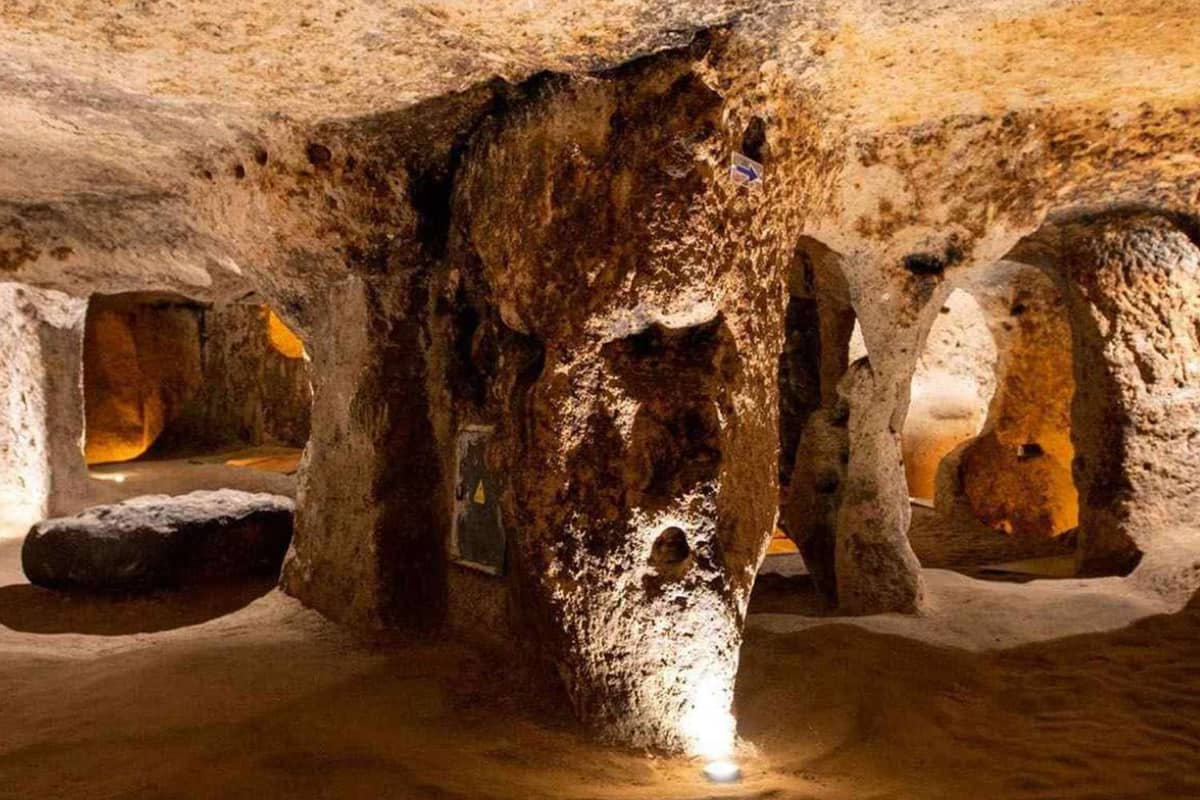
On a Cappadocia green tour, Derinkuyu shows a maze of rooms and tunnels cut into soft rock below ground. Wikipedia gives the city a depth of about 85 metres and a capacity of up to 20,000 people.
You find it in Nevsehir Province, close to a present-day town that shares its name. Derinkuyu means deep well. Wikipedia traces the name to deep shafts that watered both the old settlement and the town on top. A Cappadocia green tour walks only the opened part.
Two pages state that eight levels are open to visitors. One gives 50 metres as the depth of those opened levels. A writer on the other page crawled through a tunnel of 105 steps, about 55 metres below ground. So 85 metres describes the whole city, not the visitor walk.
The way through is tight. That writer calls the passages narrow, low and dark, and reports a bumped head. A second page says certain corridors are very narrow with low ceilings. A third warns of little signage and small areas where visitors hunch down. Expect to bend on a Cappadocia green tour.
Look for the kitchen. One account of a Cappadocia green tour reports black soot on its walls from old fires. It also lists a winery for crushing grapes, food stores and a barn for animals. Wikipedia adds that the kitchens had tandoor ovens, a type still used in Cappadocia villages.
Air reaches the rooms through shafts. Wikipedia puts the main central shaft at roughly 3 m by 2.8 m. There, openings from different levels never overlap, in a layout that appears built to boost airflow. Another page lists air shafts and water wells among the sights, so watch for both on a Cappadocia green tour.
The round stone door is another part of the story. One page describes heavy wheels of solid stone, half a metre thick. People rolled them into a slot across an entrance, and Wikipedia says such doors closed the city from inside. Once shut, an entrance was as solid as the walls beside it.
Wikipedia calls a roomy hall with a barrel-shaped ceiling, on the second floor, unique to Derinkuyu. By report, it served as a religious school. One Cappadocia green tour traveller also saw a church and a well. Two other pages say the air underground stays cool, even in summer.
A history site puts a visit to Derinkuyu at around 90 minutes. Certain trips swap in Kaymakli, the other large underground city, so check which name your Cappadocia green tour lists.
What does the Ihlara Valley walk show on a Cappadocia green tour?
The Ihlara Valley walk on a Cappadocia green tour follows the Melendiz River along a canyon floor. Wikipedia gives the gorge 15 km of length and up to 150 m of depth. It counts around 50 rock-cut churches there.
Visitor pages quote a shorter 14 km, and one adds a depth of about 100 m. A tour covers only part of that. One trip page lists a stretch of 4 km, while another lists a gentle hike of 3 km. Check the length on your Cappadocia green tour.
The way down is a long flight of stairs. Wikipedia describes close to 400 steps on the northern side of Ihlara village, dropping more than 100 m. A travel planner counts 360 steps down from the visitor centre. A visitor page adds natural paths and uneven ground below.
One page says the valley trail begins with a 25-minute walk downhill. It then joins a path beside the river and leads to lunch. A review of another Cappadocia green tour adds one detail. The bus drops walkers in a parking lot at one end and collects them at the other.
On a Cappadocia green tour, you meet churches carved into the canyon walls. Wikipedia sorts them into two groups, one near Ihlara village and one near Belisirma. The first has paintings with influence from Persia and Syria. The second has a Byzantine style that belongs to the tenth and eleventh centuries.
Two travel sources name the Church under the Tree and the Snake Church. The planner places the first near the foot of its 360 steps. Wikipedia describes paintings in both, with an Ascension scene in the dome of the first. Ask whether your Cappadocia green tour stops at that church.
Down at river level the scenery changes. One operator page puts cave churches along the banks of a calm river trail. A tour listing also mentions riverside trees. Another page says the canyon feels greener and more enclosed than the dry volcanic country elsewhere.
The sound of the water matters too. One traveller on a Cappadocia green tour said that sound made the walk relaxing, unlike the dusty land above. Wikipedia says the Melendiz rises with spring rains and runs lower in summer. Springs feed it, so summer does not leave it fully dry.
Lunch comes beside the water. Wikipedia sets the village of Belisirma at roughly the midpoint of the route from Ihlara to Selime. Two travellers ate at a restaurant on the river there, with soup, salad and a main course. On your Cappadocia green tour, treat this meal as the midday pause.
What do Selime Monastery and Pigeon Valley add to a Cappadocia green tour?
Selime Monastery and Pigeon Valley give a Cappadocia green tour two sides of rock-cut life. Selime is a huge carved complex at the end of the Ihlara gorge. Pigeon Valley is the canyon of carved bird houses between Uchisar and Goreme.
Wikipedia places Selime where the Ihlara Valley ends in the northwest, with the Melendiz River flowing past. Two operator pages place it about 28 km from Aksaray. Two travel pages list Selime on the classic Cappadocia green tour, next to the gorge walk and the underground city.
Wikipedia ranks Selime with the biggest rock-cut houses of prayer in Cappadocia. Its page on rock-cut architecture shows Selime Cathedral as a ninth-century example. Operator pages date the complex to the eighth or ninth century. One page adds that the frescoes are later, from the late tenth and early eleventh century.
The main church is cut into the cliff. Two rows of rock columns split it into sections, and the columns stay part of the living rock. Nearby rooms include monks’ quarters, a large kitchen with a smoke-stained ceiling and a stable for mules. So a Cappadocia green tour meets a full monastery here, not only a church.
On a Cappadocia green tour the climb is short but steep. One page describes a tunnel-like corridor, twisting rock stairways and a fortress-like top section. Another notes smooth rock, irregular steps and narrow passages between the levels. Two travel pages call the climb worth it.
Pigeon Valley, Guvercinlik Vadisi in Turkish, runs between Uchisar and Goreme. Thousands of pigeon houses are carved into its soft tuff. Two travel pages explain that locals bred pigeons for food and for droppings that fed thin soil. One adds that the droppings went to the vineyards, and another reports flocks of pigeons everywhere in the valley.
On a Cappadocia green tour the valley is a lookout stop, not a long hike. One operator page gives it 20 minutes and another gives 30. One traveller halted at a roadside lookout just past Uchisar Castle, with the valley falling away toward Goreme.
Below the cliffs, the village of Selime holds one more sight: Wikipedia lists the tomb of Selime Sultan there. A Cappadocia green tour stops at the rock monastery. Ask whether your day also leaves time for the tomb.
- Goreme panorama: Esentepe in Turkish, a view of fairy chimneys, cave homes and rock-cut churches. Two itineraries open the day here, for 15 or 20 minutes.
- Uchisar viewpoint: a short photo stop for the hilltop castle from afar, as one travel page lists it.
- Nar Lake: a volcanic crater lake about 21 m deep. One page calls it a quick photo stop and says the sulfurous, salty water holds no fish. The classic, longer Cappadocia green tour lists it.
Which kinds of Cappadocia green tour exist?
A Cappadocia green tour runs as a small-group trip, a private trip or a route with its own stops. The routes swap Ihlara and Selime for Keslik and Soganli, so the finishing hour shifts too.
A small-group Cappadocia green tour shares one van or minibus. One operator page limits its shared bus to 16 people. Another caps its groups at 14 and lists a guaranteed departure every day. One traveller rode in a group of 10. On two pages the tour guide speaks English.
A private tour uses a private car and a tour guide for one party, as one operator page describes it. Another page lists a private green tour of 7 hours. A travel page says a private Cappadocia green tour gives more flexibility in timing, stops and pacing.
- Ihlara and Selime route: the river walk, lunch by the water and the monastery climb. It suits walkers and visitors who like rock-cut rooms.
- Keslik and Soganli route: a rock-cut monastery with frescoed chapels, a valley trail past rock-cut churches and an underground city. One itinerary gives Keslik 45 minutes and Soganli 40.
- Private variant: a second itinerary adds Mustafapasa and the Sobessos excavation, books parties of 2 to 14 people and takes about 8 hours.
- Shorter route: viewpoints and other historical stops replace the valley, as one travel page states. It skips the valley walk.
The classic Cappadocia green tour is the longer day. One page puts it at around 9 hours and another lists 7 hours. One page lets walkers skip the valley path and ride the tour bus. One page adds that tours can run in reverse order on busy days to avoid crowds.
One travel page calls the green tour a convenient first look at the south. Another says the south is much harder to reach without a rental car. So any kind of Cappadocia green tour covers the long distances for a visitor without a car.
Operators also split the Cappadocia green tour by what the day adds. Two pages describe group trips that cover the entry tickets and the lunch. One page lists a private tour that leaves both to the visitor.
Two more kinds of Cappadocia green tour mix days. Two pages mention a combined red and green day for visitors with little time. The red tour runs north near Goreme, and the green tour runs south. A balloon sunrise is a separate early start. One page says to keep the morning after a flight clear, since both start early.
How do the roads and the lunch stop fit a Cappadocia green tour?
A Cappadocia green tour runs by road in a minibus or van. Long drives link Derinkuyu, the Ihlara gorge and Pigeon Valley. Lunch breaks up the day, and two travel pages place it beside the river.
Expect a small vehicle with cooled air. Review writers call it a van or a minibus, and one private version switches to a minivan. One review notes that a rider spends hours seated during a Cappadocia green tour.
The first leg depends on the pickup round. One travel page allows 30 to 45 minutes from a hotel to the first stop. Later pickups and distance change that time. Guests outside the pickup area must travel to Goreme to join the Cappadocia green tour, the page says.
The same page measures the longer legs. Derinkuyu to the Ihlara Valley is 55 km, a drive of 50 minutes. Belisirma to Selime Monastery is 10 km, or 10 minutes. Selime to Pigeon Valley is 81 km and takes an hour on that Cappadocia green tour.
Other routes add their own halts. A shorter version stops at an Ortahisar Castle panorama before lunch. One private itinerary drives about an hour to Nar Lake for a photo break. Its Cappadocia green tour then continues to the Ihlara canyon.
Flyers arrive through Nevsehir Kapadokya or Kayseri Erkilet airport, and Wikivoyage says both have Istanbul flights. It advises booking a rental car early, because the Nevsehir fleet is small. On the Cappadocia green tour itself, one reviewer says a driver and a tour guide travel with the group.
Overland, Wikivoyage sends bus riders from the north or west through Nevsehir, where they change to a dolmus. Riders coming from the east via Kayseri change at Avanos instead. From there, dolmus rides run frequently between all the local towns.
The lunch order differs by trip. One reviewer walked first and ate at the end of the hike. Another page serves lunch in Ihlara town before the walk. The reviewer’s Cappadocia green tour paused halfway at cafe tables by the water, with a toilet, snacks and tea.
The food is simple Turkish cooking. One reviewer had lentil soup and beef kofte. Another chose trout, a local dish, and the meal brought fruit. A third page lists chicken, meat or vegetarian mains. A shorter Cappadocia green tour on one page used a large roadside buffet instead.
Shop stops fill gaps between sights. One timetable books an onyx demonstration of 30 minutes before noon. Two pages describe a gem showroom with a colour-changing stone. Other trips stop for Turkish delight, spices, dried fruit and pistachio coffee. Ask about shopping before your Cappadocia green tour, one page advises.
What are the visiting rules, the dress and the seasons for a Cappadocia green tour?
A Cappadocia green tour follows official opening hours, which differ between summer and winter. Walking shoes and layers suit the day. Wikipedia says the region’s summers are hot and dry, while its winters are cold with snow.
The official Turkish Museums site lists Derinkuyu from 8:00 to 19:00 between 1 April and 1 October. Winter closing is 17:00. The ticket window shuts at 18:15 in summer and 16:15 in winter. The official page states these hours, so a Cappadocia green tour visits Derinkuyu within them.
For the Ihlara Valley, the same site gives 8:30 to 19:00 in summer. Winter hours end at 17:00. It names a ticket office at Belisirma as one way in. Check the official page again before your Cappadocia green tour, because hours change.
One operator page sets out conduct rules. Flash photos are banned inside painted churches and monasteries, to protect the old art. Visitors must not touch or climb rock shapes, cave walls or old buildings. Littering and pets are also not allowed on its Cappadocia green tour.
Shoe advice runs from sneakers to good hiking shoes. The valley has uneven ground, and one page mentions slippery surfaces and steps. Pack a light jacket or raincoat and sunscreen as the season demands. Layers help too, since the underground rooms and shaded valleys feel cooler.
For the tunnels, one reviewer suggests stretchy clothing, since walkers bend and squat. A second page advises light, loose clothes. The reviewer adds that tight jeans feel uncomfortable underground on a Cappadocia green tour.
A Cappadocia green tour shows its leafy side in the gorge. One travel page ties April to June to clear skies and fresh green scenery. Poplar and willow trees shade the trail there, and another page adds wildflowers. On hot days, a reviewer expects a crowd at the waterside tables.
For July and August, one page expects very hot, dry weather and tiring walks. It asks travellers to carry water. For December to February, it lists short daylight and paths that turn icy at times. Weigh both points before booking a Cappadocia green tour.
One winter group skipped Selime Monastery, because its tour guide advised against a visit in that season. The classic route normally lists the monastery. Confirm that it stays on your winter Cappadocia green tour before the day.
As for crowds, a November visitor found the Goreme panorama the one busy stop, yet not overcrowded. A travel writer calls the spring and autumn months peak time, when trips can sell out fast. It also calls September and October a mild window for a Cappadocia green tour.
What else do travellers ask about a Cappadocia green tour?
Shared, small or private: which Cappadocia green tour fits you?
A shared day suits travellers who like a set plan. One small-group timetable, capped at 14 people, gives the underground city one hour and the Ihlara Valley two. A Keslik and Soganli group day allows 40 minutes in Kaymakli Underground City. It lists no Ihlara walk.
A private day fits your own party when you want to choose where to go. One travel page says you can hire a van and tour guide through local companies. Agree the minutes for the gorge and the underground city before your Cappadocia green tour.
A small group can feel personal. One traveller in a group of 10 said it felt more like a private tour than a big bus trip. Before you pick a Cappadocia green tour, one page advises a clear itinerary and a smaller group. It also points to reviews that report little time at sales stops.
How hard is a Cappadocia green tour for families and slower walkers?
One travel page expects a moderate amount of walking and no extreme hikes. It does list uneven valley paths, rocky steps and steep climbs. Longer walks and rough ground can tire people, it adds.
One listing says a pram or stroller works for small children. Babies have to sit on a grown-up’s lap, it adds. The same listing says the trip suits all fitness levels.
One writer asks people with claustrophobia to think again about the day. The same writer says the gorge hike and the Derinkuyu tunnels need decent fitness. An operator page lists severe claustrophobia among the cases its Cappadocia green tour does not suit.
Selime Monastery sits about 50 metres above the road, one writer says. On that Cappadocia green tour, the tour guide led the group halfway up the slope. Visitors then had half an hour to explore. At Kaymakli, the same writer duck-waddled through the hardest tunnel, while shorter people simply bent down.
Another writer says the walk down to lunch lasts no longer than half an hour and needs no great fitness. One operator asks guests with mobility limits to get in touch ahead. The two sides can then discuss access at each stop of the Cappadocia green tour.
How does a Cappadocia green tour compare with the north route and a balloon morning?
The north route is the red tour. One traveller found that nearly every agency in Goreme offered the same green and red pair. A writer who compared the two rates the red day less strenuous and suited to all ages. She gives it about seven hours, against about nine for green.
A second writer picks the red day for a relaxed outing near the centre. For adventure, hiking, nature and history, that writer picks the Cappadocia green tour. With two days to spare, the pair complement each other well.
A balloon flight is a sunrise outing of about an hour in the air. If you skip it, the Goreme viewpoint still helps. One writer calls this Cappadocia green tour stop ideal for wide photos that show the scale of the land.
Which sights suit your camera on a Cappadocia green tour, and what if the weather turns?
On one Cappadocia green tour, a traveller saw a tree hung with blue Nazar charms at the Goreme viewpoint. Coffee and souvenir stalls stood nearby. Another writer saw a camel at Pigeon Valley, there for photos. Wikivoyage describes cliffside pigeon coops with doors under 10 cm high. Their droppings also served as whitewash.
In the Ihlara gorge, study the rock walls. One writer saw churches cut both low and high, and reports monks’ homes among them. At the foot of the stairs, a church held painted walls and ceilings, with large gaps in the artwork. Fallen rocks lie along the trail, and the biggest match houses in size.
Monasteries and underground cities are dimly lit. For these spaces, one travel page says a small tripod or phone stabiliser makes a big difference. Read each site’s photo rules before you set up either one on a Cappadocia green tour.
The viewpoints, Nar Lake and the gorge path lie under open sky. Wikipedia says the plain of Aksaray Province turns hot and dry in summer. In spring, flowers cover the green area as water streams off the mountainside. Pick your season for a Cappadocia green tour with both pictures in mind.
Below ground, the picture changes. A Wikipedia page on underground cities says they suit very hot or very cold climates. People can use them all year, whatever the weather. On a rainy or snowy Cappadocia green tour, the underground city and carved churches give you a roof.