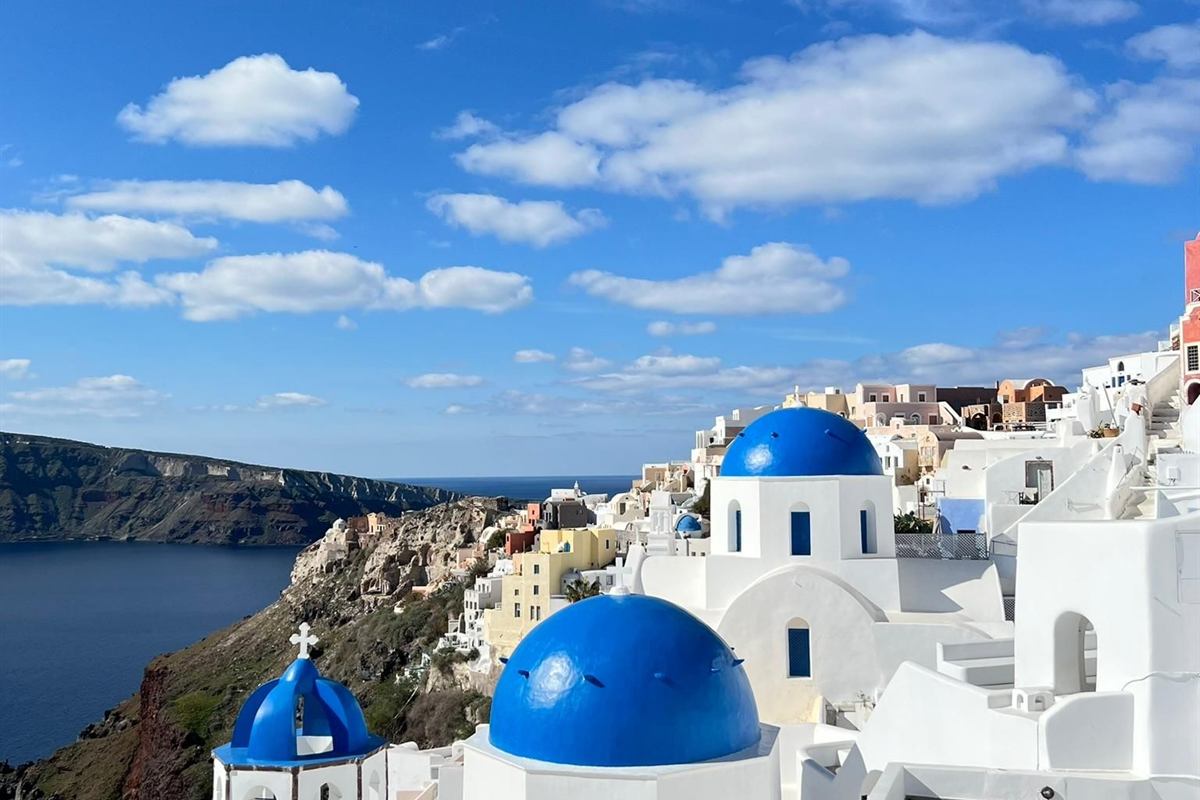
Santorini tours take you across the flooded crater of a volcano, past white villages on tall cliffs and onto dark volcanic beaches. Browse more tours in Greece once you know which kind of day suits your plans.
This page covers the boat and land trips on offer, the wine and food, the villages and ancient sites, the beaches, the seasons, how to reach the island and the questions travellers ask.
What are Santorini tours, and which kinds can you book?
Santorini tours are planned outings that show you the island by boat or by minibus. Each one fixes the stops and the timing, so you only choose the kind you like.
The island is small. Wikivoyage puts the road trip between its two far ends, Exomytis and Oia, at about an hour. That short distance lets Santorini tours fit a full programme into one outing. It adds that the island has no water parks, theme parks or zoos. So the attractions are the villages, the volcano, the wine and the sea.
The first kind is the boat trip. Among Santorini tours, a catamaran cruise lasts five hours. Listings add lunch from the grill, plus white wine, beer and soft drinks at the bar. Snorkelling gear and towels come aboard. Guests get three swimming stops, plus photo stops by the white and red beaches. One listing caps the group at twenty guests.
The second kind is the minibus tour by land. In five hours it walks the narrow streets of Megalochori. Then it climbs to the Profitis Ilias monastery for a wide view. A winery above the caldera follows, with a tasting of three local wines. The day ends at Oia for the sunset. An English-speaking host leads the group.
The third kind is the full-day private tour in an air-conditioned minibus. Your choice of start is morning or afternoon. The route is long: Imerovigli, Oia, Firostefani, Pyrgos, Megalochori, the Akrotiri site, Red Beach and Perivolos black beach. Santorini tours of this kind move at your own pace.
How does one of the Santorini tours work from pickup to return?
A day with one of the Santorini tours starts with a minibus stopping at your hotel or close by. It ends where it began, and the operator sends the exact place and time after you book.
For the catamaran cruise, a message arrives after booking with the pickup spot and the hour. The minibus comes at least one hour before the cruise starts. That gap gives the driver time to reach the harbour. The boat then sails for five hours in all, and the minibus brings you back.
The land-based Santorini tours follow the same pattern. The five-hour minibus tour takes you from your hotel, or from a nearby point, and returns you there. In high season the pickup falls between three and four in the afternoon, because the time moves with the sunset. After about five hours, the host takes you back to the pickup point.
The full-day private tour differs a little. Your host waits at the hotel entrance door. The pickup covers hotels and villas across the whole island. The tour finishes at the place where it began. Only your own party rides in the minibus with a local host.
Cruise ship passengers get one extra step. For that full-day tour, the meeting point is the exit of the cable car in Fira. The start is set about one hour after the scheduled arrival of the ship. Santorini tours built for passengers keep this gap on purpose, so you can step ashore first.
What is a Santorini catamaran cruise?
A catamaran cruise is a boat trip among the Santorini tours, built around a twin-hulled sailing boat. It lasts about five hours and joins a sail through the caldera, swim stops and a meal cooked on board.
A catamaran rides on two long hulls set side by side. Wikipedia says the wide gap between them resists rolling and overturning. The same article adds that catamarans draw less water than a monohull. Santorini tours on this kind of boat feel steady during the swim stops.
The cruise runs for five hours on the operator pages we read. One day cruise sets off from Vlychada Marina at half past ten. The sunset cruise leaves at half past three in the afternoon. Another cruise starts at half past nine with a pickup at a hotel or at a local meeting spot.
On the semi-private cruise, a minibus collects guests from their accommodation. That cruise starts at Vlychada Marina, the same port as the private catamaran. The private catamaran of these Santorini tours returns to the same marina.
Routes differ between boats. One cruise stops first at the volcanic islet of Palea Kameni. Guests get thirty minutes to swim in the hot springs, and then the boat continues south.
Another cruise sails south first to Red Beach for swimming and photos. It then passes White Beach, Mesa Pigadia Beach and the Akrotiri lighthouse before it enters the caldera. These Santorini tours differ in order, yet the same beaches and islets come up again and again.
Groups stay small. One listing allows up to twenty-two guests. A private boat takes up to seventeen guests, so you share the deck with your own party. The semi-private cruise takes ten. On such Santorini tours the crew cooks the meal while guests swim at the hot springs.
What food and drink come with a catamaran cruise?
Catamaran Santorini tours serve a barbecue meal grilled by the crew. Local wine, beer and soft drinks come with it, as does water. The boat stops for the meal, so lunch comes with a view of the caldera.
The menu changes from boat to boat, but every one of them cooks on board. One cruise serves a Greek-style barbecue lunch of souvlaki, salads and sides. Another cooks shrimp or chicken fillet and serves pasta in red sauce. Its starters are Greek salad, fava dip and tzatziki dip. Dessert is a fruit salad with seasonal fruits.
A smaller, semi-private cruise grills fresh seafood on board. Its menu lists barbecue prawns, risotto with mussels, pasta in red sauce and potatoes au gratin. Greek salad and green peppers stuffed with feta come alongside. The page offers a lunch or a dinner, depending on the departure time.
Drinks are included on the Santorini tours we read about. One listing names wine, soft drinks, water and appetizers. A second lists free local wine, beers and soft drinks, plus bottled water. A third lists unlimited white wine from the island, beer and soft drinks.
Special diets are covered on at least one boat. Its page says a vegan meal is available on request. If you eat no meat or fish, ask the operator before booking. The menus above lean on shrimp, chicken, prawns and mussels. Santorini tours like these give you a proper sit-down meal at sea, not a snack.
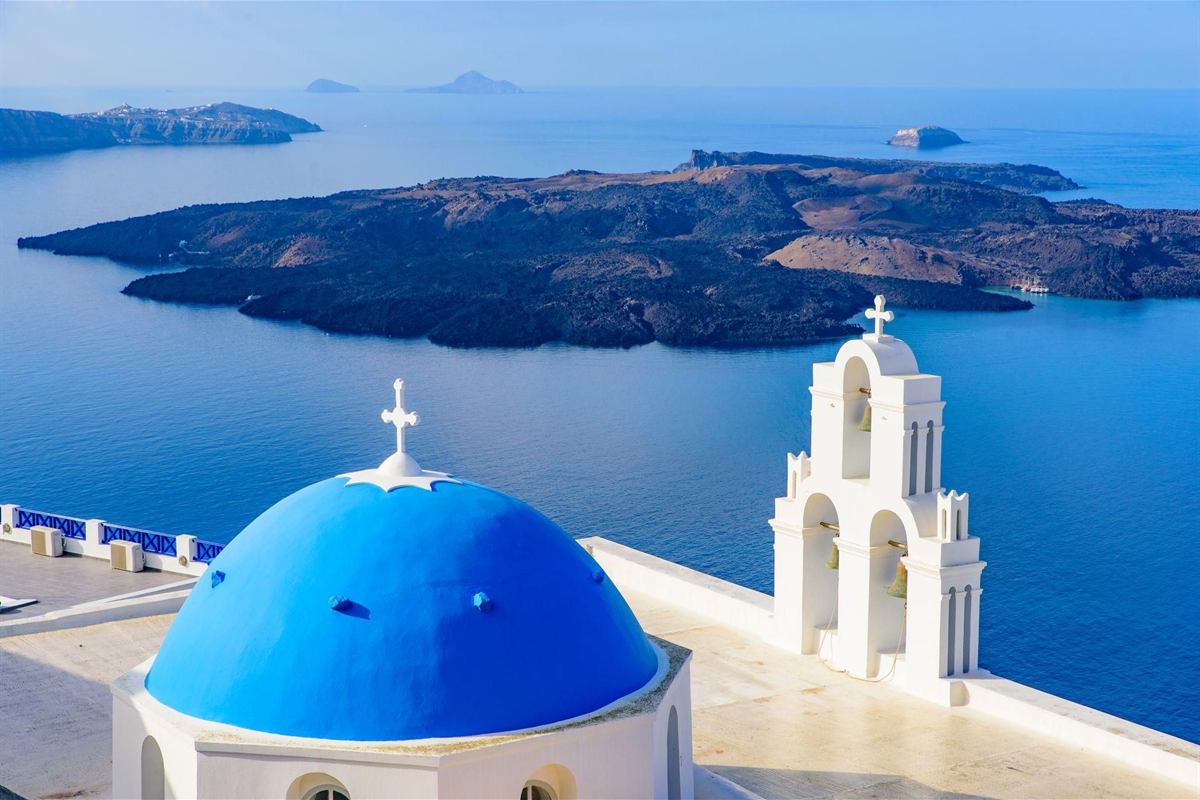
What happens on a sunset cruise around the caldera?
A sunset cruise is the evening kind of Santorini tours. A boat casts off late in the day, follows the caldera edge, stops for swims, and anchors at dusk.
The boat passes Red Beach and White Beach. It then continues toward the Venetian Lighthouse of Akrotiri. Near Indian Rock the crew slows down, so passengers can take photos and video. Operators give a length of 4.5 to 5 hours for the whole trip.
The swim stops come before the sunset. One itinerary gives about 30 minutes at Red Beach for swimming and snorkelling. At White Beach it gives about 60 minutes, while the barbecue is prepared on board. Santorini tours of this type also stop at the hot springs for about 30 minutes in the warm water.
Another itinerary adds a stop at Thirasia, a fishermen’s island that suits swimming. The route then turns back along the caldera rim. Boats pass the small islets of Saint Nicolas and Saint Eftapedes before they reach the sunset spot.
Just before sunset the boat anchors. Dinner is served on deck with wine and dessert, and the bar offers Santorini wine, ouzo, beer and juice. Santorini tours like these end with the sky turning to colour. One operator says the caldera is bathed in golden light.
Other boats sail to a viewpoint beneath the cliffs of Oia, and others go into Ammoudi Bay instead. Either way, passengers see the sun go down into the Aegean.
The operators supply towels, blankets, snorkelling gear and free Wi-Fi. A shuttle bus with air conditioning collects guests from their hotels. Weather and the exact sunset hour shift the schedule, so Santorini tours list their times as approximate.
Where do the Santorini cruise boats leave from?
Santorini tours by boat leave from four places: Vlychada, Ammoudi, Oia and Athinios Port. The sunset catamaran cruises in this text start at the Vlychada marina, and the trip can end in Ammoudi Bay.
Vlychada lies on the south coast. It holds the largest marina of the Santorini archipelago, and the boats moored there are small fishing vessels. A black sand beach with wind-eroded cliffs sits beside it.
No direct bus runs to Vlychada from Fira or Perissa. Walkers take a bus to Emporio and then walk 2.5 km downhill. That is why the hotel pickup matters for Santorini tours that start here.
Below Oia sits Ammoudi, an old fishing port. The harbour sits west of the town centre. Steep stairs connect it to the village, and the walk from Oia is 300 steps.
A ferry link to Thirasia also runs from this harbour village. Boats that sail from Vlychada can end the day here, so the sunset happens in sight of Oia.
Athinios is the port for the larger ferries, about 10 km south of Fira. It sits at the foot of steep, multi-coloured volcanic cliffs. A road zigzags backward and forward up to the top.
One listing describes a longer cruise from Athinios that spans around ten hours. A sunset cruise from Vlychada is far shorter. Santorini tours from this port suit travellers with a full day free.
Check the departure point when you pick a boat trip. Ask for the hotel pickup too, because the meeting point decides how far you travel before the boat even moves. Santorini tours on the water differ first of all in this one detail.
What is a volcano and hot springs boat tour?
This is one of the classic Santorini tours. A boat sails from the Old Port of Fira to two young lava islands. You walk up to a crater on one, then swim at the hot springs of the other. The whole trip takes about three hours.
Santorini tours of this type start at the Old Port, which lies at the foot of the cliffs below Fira. The boat sails from there for fifteen to twenty minutes. It then drops anchor in a small bay on Nea Kameni. You can stay on deck or take the stone path to the active crater.
Next the boat follows the shore to Palea Kameni. It stays there for a swim of twenty to thirty minutes. Then it heads back to the port.
In high season, Santorini tours of this kind leave twice a day. The first trip sails across the late morning and ends in early afternoon. The later trip leaves in the mid-afternoon and runs from late spring until September. On a boat that swaps the two stops, the swim comes first and the climb follows.
Longer trips add a stop at Thirasia and take about six hours. The path has no shade, so walkers need sturdy shoes, water and a hat. A small entry ticket for the volcano is bought on the spot and is not part of the boat fare.
Santorini tours like this suit anyone who wants a short walk and a swim in one outing. The climb itself takes thirty to sixty minutes, depending on your pace,. The heat makes it harder than it looks.
What is Nea Kameni, the island you can walk on?
Nea Kameni is an empty lava island in the middle of the flooded caldera. Its name means “new burnt”. It is the stop on Santorini tours where you leave the boat. You climb a gravel path to a crater and stand on real volcanic ground.
The island is almost round, about two kilometres across, and it covers 3.4 square kilometres. Together with its neighbour Palea Kameni (“old burnt”), it grew from the sea during the last two thousand years. Each new eruption added dacite lava and ash.
The first of the Kameni islands broke the surface about two hundred years before the common era. Nine eruptions above the waterline are recorded since then. In the early eighteenth century a volcano under the water rose here. Nea Kameni has been the centre of activity ever since.
Boats leave from the Old Port of Fira, and dozens call at the island every day in summer. The huge Minoan eruption happened about thirty-six hundred years ago. Its centre lay on a little island north of Nea Kameni.
On Santorini tours the crater is the goal of the walk. It stands 130 metres above the sea, and a gravel path leads up to it. You can walk all the way round the rim. The ground is almost bare. In summer red, grassy succulents cover the thin soil.
One vent here still gives off sulfur. Islanders call it Jorgo, a Greek form of George, and the nickname recalls King George I of Greece.
Scientists track the island that Santorini tours visit, and it is protected for science. The volcano is asleep for now, yet steam and carbon dioxide keep escaping from the crater. The last small eruption came in the nineteen fifties, when a lava dome pushed up.
What are the hot springs at Palea Kameni like?
Santorini tours with a hot springs stop let you swim into warm, orange-brown water off Palea Kameni. The heat comes from the volcano, which is still active under the sea. Its western shore holds the springs.
Palea Kameni means “Old Burnt Island”. Eruptions that began more than two thousand years ago built it from pumice and lava. Today the rocks hold a chapel, goats and hardy succulent plants. Without a good harbour, boats anchor offshore.
On Santorini tours of this type, the swim stop lasts about thirty minutes. The boat stays thirty to fifty metres from the shore, depending on the operator, so you swim the last stretch. Operators ask for strong swimmers, because this is open water.
The water carries sulphur, iron and other minerals from the volcano. These turn it murky orange-brown and give it a sulphur smell. One source gives thirty to thirty-five degrees Celsius for the warm spots. They feel clearly hotter than the open sea.
Pack for the stains. Santorini tours advise dark swimwear, because iron and sulphur mark light cloth. Operators also ask you to leave silver jewellery on the boat, as sulphur tarnishes it. There are no changing rooms or showers at the springs, so bring a towel.
No public ferry runs to Palea Kameni, so Santorini tours are the only way in. Tour boats arrive between eleven in the morning and two in the afternoon. The springs are busiest then. Morning trips are quieter, according to one travel writer.
What is Thirasia, and why do boats stop there?
Thirasia is the runner-up in size among the caldera islands. Full-day Santorini tours stop at Korfos, its small harbour, for a break of one to two hours.
Thera dwarfs every other island here. Nea Kameni, the young volcanic island, faces Thirasia across the water. It once joined Thera, until the great eruption split the two apart. Its land area is just over nine square kilometres, and the latest census counted 249 residents.
On Santorini tours that include it, the boat ties up at Korfos. This small harbour has a black pebble beach and clear water. The island has about seven tavernas. Two are in Manolas, one is in Agia Irini, and the rest are at Korfos.
Manolas is the main village, also called Chora. It sits on the cliff above the harbour. A path of 270 steps links the two. The village has a doctor, a grocery store and places to eat. From the edge you look back across the caldera at Santorini.
Not every one of the Santorini tours stops here, so read the itinerary before you book. Small boats also sail from Ammoudi Bay, which is the shortest crossing. The trip takes from ten to forty-five minutes, depending on the boat. Confirm the return time before you go.
Santorini tours keep the stop short. A break of one to two hours covers the harbour, a quick climb to Manolas and lunch.
Walkers who stay longer can follow a trail to the highest point, about thirty to forty-five minutes each way. Another path leads to Agrilia, the oldest village on Thirasia, now abandoned, with cave houses and a church.
What is a Santorini caldera cruise?
A caldera cruise is one of the Santorini tours that sails inside the flooded crater of the island. The boat stays in calm water between the tall cliffs and the dark volcanic islands in the middle.
Santorini tours start from this idea: a caldera is a wide bowl left by a volcano. Here the bowl is twelve kilometres long and seven wide. It sits in the Aegean Sea, north of Crete. Sea water fills the middle. Land forms a ring around it: Santorini, Thirasia and tiny Aspronisi, plus the Kameni islands at the centre.
Santorini tours on the water follow one pattern. One operator page describes a wooden sailboat that glides to the volcanic islands. Guests hike a crater, swim in warm mineral springs and then sail along the coast. Trip lengths on the operator pages range from four to eight hours, and one day cruise takes six.
Check the details before you pick from the Santorini tours on offer. One tour states that entry to the volcano costs extra and asks for comfy shoes on the crater path. Another page warns that you must swim extremely well to reach one small beach.
The bowl has a long story. Geologists find at least four partly overlapping calderas here. The southern bowl is the oldest, dated to roughly 180,000 years back. Next came the Skaros caldera, around 70,000 years back, and then Cape Riva, around 21,000 years back. Boats on Santorini tours sail in the newest bowl.
The setting explains the interest. The present caldera took shape in the Minoan eruption, about thirty-six hundred years ago. Scientists count it among the sixteen Decade Volcanoes. The International Union of Geological Sciences also placed it on a list of one hundred world geological heritage sites.
What do you see from the water along the caldera cliffs?
On Santorini tours by boat, you see steep cliffs up to 300 metres high. White villages line the rim, and dark lava islands sit in the centre. One operator page sums it up as rugged cliffs, volcanic craters and whitewashed villages seen from the water.
Walls rise on three sides of the bowl, and the sea floor below drops down to 385 metres. The inner walls are steep, so a boat shows them better than any path does. Houses stand right on the edge, and one cruise page speaks of homes perched high above the northern edges.
Santorini tours along this coast pass three big villages. Oia stands on the lip of cliffs about 150 metres tall. Fira clings to the rim, 275 metres above its port. Imerovigli, between the two, is the loftiest point on the caldera cliffs. Its houses look down on the whole bay.
The rock changes as the boat moves along, and Santorini tours show it up close. Dark lava forms the central islands. Older, non-volcanic rock shows on the inner wall between Cape Plaka and Athinios. Aspronisi is only 650 metres long. The Greek name means “white island” because of its pale pumice. Steep cliffs make landing there difficult and hazardous.
The cruise also shows how two-sided the island is. The inner caldera side holds villages built on the cliff. The outer side looks like the rest of the Cyclades. Because of this split, Santorini tours by sea give a view that a road trip cannot match.
What is a Santorini day trip to the main sights?
A Santorini day trip to the main sights is one long day by coach. It stops in villages, at ruins, on a black sand beach and at the sunset. Santorini tours of this type run eight to ten hours, depending on the time of the sunset.
The day starts at a central meeting point close to your hotel. After you book, the operator names the nearest one. On one tour, the approximate pickups run from Oia at 9:45 in the morning to Fira at 10:30. Another tour leaves Ancient Thira at 11:00. Both end in Oia, and one brings you back thirty minutes after sunset.
The stops fill the hours in between. On one full-day route, Santorini tours reach the Akrotiri ruins and the village of Emporio for 40 minutes. Perissa beach gets one and a half hours for lunch and a swim. Profitis Ilias, the highest peak, takes 20 minutes. Another tour gives about 40 minutes of free time at Red Beach.
Wine and walking are part of the plan. One full-day tour includes a tasting of three local wine varieties in a private area of a winery. Expect to walk. That operator says the tour does not suit babies, children under five or people with reduced mobility. Santorini tours like this run in English, French, German and Spanish.
The season changes the route. During March and November, that tour skips the Akrotiri site and stops in the village of Pyrgos instead. On the other dates, the tour includes a guided visit at Akrotiri.
Which villages do the bus and minibus tours cover?
Bus and minibus Santorini tours link the hill villages of Pyrgos and Emporio with Fira and Oia. Megalochori, the wine village, lies in the heart of the island. One operator lists its bus and minivan tours in one group.
Pyrgos Kallistis rises on a hill about 7 km from Fira, in the shape of an amphitheatre. Its streets are narrow and twisting, and walls once protected it. At the top lie the remains of a Venetian fort named Kasteli. Santorini tours stop here, and one route walks you through its alleys and chapels.
Pyrgos has 1,078 residents. Travel writers note that tourism has changed it less than other villages here.
Emporio lies about 12 km from Fira, close to Profitis Ilias, and has 3,704 permanent inhabitants. Its sights include the old Goulas Castle and a church of Saint Nicholas Marmaritis. On Santorini tours, one stop gives 40 minutes in its alleys, which resemble a labyrinth.
Megalochori is a quiet village on a hill that faces east, with old white Cycladic churches. A travel page calls it the heart of the island’s wine industry. Wine tasting places stand all round the village, and the vines grow coiled in the local style. Ask which village your Santorini tours use for the tasting.
Fira is the capital, on the edge of the caldera. Buses on the island fan out from its bus station. One tour starts there at 10:30.
Oia is the village at the north western side of Santorini, and the Santorini tours of this kind end there. Watching the sunset is a popular pastime. The ruined castle on the high point once housed the Argyri family, under Venetian rule.
What is a Santorini wine tasting tour?
A wine tasting tour is one of the Santorini tours that visits three wineries in about four hours. A wine expert leads a small group, and you taste twelve wines with local cheese and snacks.
Among all the Santorini tours, this is the one built around the vineyards. You walk around a volcanic vineyard, explore the cellars, and see where the wine is bottled and matured. The expert also shares advice on Greek wines, food pairing and wine tasting. The tour suits anyone who enjoys wine, whatever their knowledge.
On Santorini tours like this, a van collects you at your hotel or rental and brings you back. Parts of the island are steep. If a car cannot reach your door, you meet the van nearby. One shared tour caps its group at ten people. A private version takes larger groups on request.
Santorini tours of this kind run in two time slots. The morning tour starts at ten and ends at half past two. The sunset tour leaves in the late afternoon. Its last stop is a hill-top winery above the volcanic cliffs, so the final tasting happens at sunset. One operator runs it from April to November.
The snacks on Santorini tours are a platter of cheese from small Greek producers, not a full lunch or dinner. Entry and tasting fees at the wineries are part of the tour. Operators can shift the start time with the weather and the free tables at the tasting rooms.
The pours on Santorini tours are mainly whites and dessert wines, because those are the wines the island makes. Guests who only drink red wine get a gentle note about this before they book.
Which grape varieties grow on Santorini?
Three white grapes carry the island: Assyrtiko, Athiri and Aidani. You taste all three on Santorini tours. Two red grapes, Mandilaria and Mavrotragano, grow in smaller amounts.
Assyrtiko is the flagship grape of the island. Its home is the volcanic ash soil of Santorini, and other plantings exist on Paros and in Chalkidiki. The grape is high in acid and full of citrus and mineral notes. The wine goes well with grilled fish and meat.
Athiri is a white Greek grape noted for its lemon character, and growers blend it with Assyrtiko. Aidani, also spelled Aidini, grows mainly on Santorini with a floral aroma. Winemakers pair it with Athiri for dry wines. A tasting on Santorini tours is an easy way to tell lemon from flower.
The label Santorini on a bottle means at least seventy-five percent Assyrtiko, and the rest is Athiri or Aidani. The wine called Nykteri follows the same seventy-five percent rule. The Greek name means working through the night, as the pickers once harvested in the dark against the heat. Night harvests continue today, and day harvests are also used.
Varieties are frequently grown together on small plots. At harvest time in mid-August, growers learn only then which grape is which.
The island has about twelve hundred hectares under vine, a small area for the wines that fill Santorini tours. The tourism trade is a threat to this small acreage.
Why is Assyrtiko wine from Santorini so special?
Assyrtiko is special because the grape was born on Santorini. It thrives in poor volcanic ground and stays sharp and fresh when fully ripe. Santorini tours that stop at a winery put it first on the list of wines to try.
Assyrtiko is a white grape that belongs to the island. Growers plant it in dry soil full of volcanic ash. The vine also grows on Paros and other Aegean islands, and in Chalkidiki on the Greek mainland. Santorini tours that cross the island pass the vineyards where it grows.
Phylloxera, a tiny pest, has wrecked vineyards elsewhere. The island is safe from it, because the pest cannot live in soil without clay. So the old vineyards stand on roots centuries old. In the dry summer the roots dig deep into the ash for water. That keeps alive the vines Santorini tours pass.
Ripe grapes normally turn soft, but Assyrtiko holds on to its acidity. Decanter calls the style savoury, stony and citrusy. Wines from the island are concentrated, with a salty freshness and a very sharp edge. Santorini tours with a tasting let you check this on your own tongue.
Writers call it a white grape in red’s clothing. The wine is full-bodied, at 13.5% alcohol on average. It is a natural partner for grilled fish and meats, a match to try on Santorini tours. The label Santorini needs at least three quarters Assyrtiko. Athiri, Aidani or both fill the rest. It tastes dry, with lemon and stone fruit.
What is Vinsanto, the sweet wine of the island?
Vinsanto is a dessert wine with a golden glow. Growers dry ripe Santorini grapes in the sun, then age the wine in oak barrels for at least twenty-four months. Santorini tours that visit wineries can introduce you to this old taste of the island.
The recipe starts with grapes picked late in the season. They lie in the sun for twelve to fourteen days, which concentrates the sugar. After that the growers crush the fruit, ferment it and store the wine in oak. By the rules, at least fifty-one percent must be Assyrtiko. Athiri, Aidani and a little local white fruit fill the rest.
No extra sugar goes in. The sweetness comes only from the grapes themselves. The finished wine must reach nine percent alcohol at the least. In the glass it looks golden orange or deep amber. Tasters pick out dried apricot, golden raisin and warm spice.
Because the acidity stays high, the wine feels balanced instead of heavy. Santorini tours that end with a dessert glass let you judge the balance yourself.
The story reaches back to Venetian rule. Santorini wine travelled by ship across the Mediterranean and into Europe. Buyers liked it because it survived sea trips lasting a month, thanks partly to its sweetness and its strength. One theory links the name to crates marked Santo, with the Italian word vin for wine added in front.
Today the European Union treats Santorini as the home of Vinsanto. Only the island can sell its sweet wine under that exact name. Italy keeps the words vin santo for its own style. A close cousin called Mezzo means less sweet. Ask for it on one of your Santorini tours with a tasting.
Why are Santorini vines grown in the shape of baskets?
Santorini tours that stop at a vineyard show vines coiled into low baskets, called kouloura. The shape protects the grapes from the strong wind and the hot sun. It is a farming answer to the weather of the island.
On Santorini tours, growers do not tie the vines to wires or posts. They coil the long shoots round and round on the ground. The result is a low ring, with the grapes growing on the inside. From a distance, a vineyard looks like a field of scattered wreaths, or of rough wild bushes.
The wind is the main problem. Summers are long and dry, and strong northerly winds called the meltemi sweep across the island. They can strip the leaves and damage young fruit. Visitors on Santorini tours see how low the baskets sit, close to the ground, where the leaves shelter the grapes.
A study compared basket vines with vines on trellises. It found the basket vines were less stressed by lack of water and better protected in heatwaves and high winds. The soil helps as well. It is volcanic ash, pumice and sand with almost no clay. The pumice soaks up moisture from the morning mist.
The work is hard. Pruning and picking are done by hand, bent over the baskets, and the harvest takes place in mid-August. The soil has no clay, so the root louse phylloxera never took hold. Santorini tours therefore pass vines with roots that are centuries old.
At about seventy-five years, a vine has grown into thick layers and gives less fruit. Growers then cut it at the root and graft in a new vine. The deep old roots stay, because they reach moisture far below the surface.
What is a winery visit on Santorini like?
A winery visit on Santorini tours means a look at the vines and the cellar, then a guided tasting. At one winery on the east coast, a tasting of four to seven wines lasts about one hour.
The visit starts in the vineyard. Visitors walk the rows, look at the pale volcanic soil and learn how the baskets are grown and pruned. Then they move to the cellar or the tasting room. A small taste of each wine is enough to show how the island shapes the flavour.
Wine tasting on Santorini tours follows a simple order. First, notice the acidity, the fresh feeling on the sides of the tongue. Then look for a salty, savoury edge. The glasses come with local bites such as cheese, olives and breadsticks. One winery serves them under a pergola by the sea.
Nobody has to be an expert, and nobody has to drink much. A small sip of each wine is enough. Visitors who prefer not to taste can still enjoy the vineyard itself. At a wine museum, a glass of juice or another refreshment can be offered instead.
A wine museum is a different stop on Santorini tours. Wikipedia places one in a cave on the grounds of a winery near the village of Messaria. The cave lies 8 metres below the ground and runs 300 metres. An audio guide in a choice of languages explains the island’s wine history.
A tasting ends the museum visit. For the summer, book ahead. One winery on the east coast is open from April to October. It recommends booking in advance for the peak months. Santorini tours that include wine can also combine more than one winery in a single trip.
What is a private Santorini tour?
A private tour on Santorini is a ride that only your own group shares. Santorini tours of this type run in a minivan or car with a driver. Nobody outside your party joins you.
Private Santorini tours come in set lengths. One listing offers a six-hour day for a maximum of eight people. It runs in English and starts at quarter past nine in the morning. Other listings run from three hours up to eight hours. You can pick a short loop or a full day.
On private Santorini tours the driver comes to you. The vehicle collects you from your stay. If cars cannot enter the street, it meets you at the nearest point they can reach. Travellers who arrive by cruise ship are met in Fira, by the upper station of the cable car.
The plan is yours to shape on a private day. Since the tour is private, you can change the itinerary with your host. Add a stop you like, or drop one you do not. A listing for a private day also names an air-conditioned vehicle, which suits a hot afternoon in summer.
Check the extras before you book your own Santorini tours. Museum tickets, meals, drinks and wine tastings are listed outside the tour on one page. Tips are left to your own choice. A quick read of that list means no surprise at the first stop.
How do you choose between a group tour and a private tour?
Pick a private tour for your own schedule and a fixed party. Pick a group tour if you are happy to share the vehicle with other travellers. Both kinds of Santorini tours visit the same island sights.
Start with group size. A tour can be private for you and your group, or shared with other people. On one booking page, the listed limits run from four people to twenty-six. A small limit gives a quieter ride. A large limit means a bigger bus and a crowd at every stop.
Next, think about pickup. Santorini tours that offer free pickup and drop-off serve you wherever you stay. The operator’s vehicle comes to the nearest possible spot. Read each listing for this line. A tour that starts at a meeting point asks you to travel there first, and that costs you time.
Then look at timing. A private plan lets you change the stops. You can trim or stretch the day to fit your own hours. A shared tour follows one route for everybody on board. The operator fixes the start time, as in the listing that begins at quarter past nine.
Ask who travels with you. A couple who want a slow lunch gain from a private day. So does a family with a late riser. A solo traveller who wants company on Santorini tours finds it easier on a shared tour with a small group.
In short, a private tour gives you control, and a shared tour gives you company. When you weigh up Santorini tours, compare the group limit, the pickup line and the start time on each listing. Then pick the format that matches your party and your day.
What is a shore excursion for cruise ship passengers?
A shore excursion is a tour planned around the port stay of your ship. On Santorini, tours of this kind begin with the tender ride ashore and finish with the ride back.
Two shapes of shore excursion run among the Santorini tours. One is a private tour by car, with a driver and a tour guide who speaks English. The other is a boat trip from the Old Port, such as a volcano tour. Both depend on the ship’s tender, which brings you ashore and takes you home.
The car tours come in two lengths. One lasts about four hours and takes up to two guests. A longer one lasts about eight hours and takes up to six guests. The booking covers the whole vehicle, so one person books for the party. Entrance fees for the sights are not included.
These Santorini tours do not end where they began. The tour ends in Thira instead of at the first meeting spot. Your tour guide hands you a cable car ticket before you part. Keep it safe, because the cable car requires it. From Thira, you ride down to the Old Port and take the tender to the ship.
Plan for waiting at the cable car. The operator says to expect long waits at both the upper and the lower station. The cable car is public and busy. The same page says the walk from the parking lot to the cable car takes twenty to thirty minutes. Your pace decides the time.
The ship’s tenders run for the whole stay in port, so a private party can set its own pace. The party can be any size up to the limit of the vehicle. Santorini tours of this type come with a driver for the day. You pick the stops together with the tour guide.
Boat trips follow a different plan, because they start at the Old Port. Santorini tours on the water need an exact timetable, and the next section explains the two time limits that matter.
Where do cruise ships anchor at Santorini, and how do passengers reach the shore?
Cruise liners anchor in the harbor lying between Nea Kameni and Fira, inside the caldera. They do not dock. Passengers on Santorini tours ride a tender boat from the ship to the Old Port.
The reason is size. Both ports of the island are too small for cruise ships to dock directly. Every passenger therefore relies on the ship’s tender. The tenders run all through the stay in port. They bring you to Scala Pier, the landing of the Old Port. The cable car links that landing to Fira.
The same landing is the way home on all Santorini tours for ship passengers. Every cruise ship passenger returns from the Old Port, even someone on a cruise line bus tour. One visitor page says passengers at Athinios Port are expected to book a bus tour through the cruise company.
Timing rules matter on a ship day. Take a volcano tour from the Old Port. The ship must arrive at least one hour before the tour departs. The last tender leaves one hour before the ship sails. Santorini tours on the water only work if you respect both limits.
From the Old Port, the way up to Fira has three choices. You can ride the cable car, climb on foot, or go up by donkey on the zigzag footpath. The cable car is the common choice, and the visitor page says the ride takes only three minutes. Santorini tours for ship passengers are built around that short ride.
What are Santorini day trips from Crete?
Santorini tours from Crete are full-day trips. A fast ferry leaves Heraklion, and a bus then drives the group around the island. The sea crossing takes about 90 minutes to two and a quarter hours each way.
Heraklion is the biggest city on Crete and runs the island administration. It is an important shipping port and a ferry dock. A day trip to Santorini therefore starts at its harbour in the morning. The same ferry brings the group home in the evening, so Santorini tours from Crete fit into a single day.
Travellers who sleep inside Heraklion city reach the port on their own. One tour of this type collects guests from other hotels at bus stops within 800 metres of the hotel. After that, these Santorini tours board the ferry together as one group.
When the ferry docks at Athinios Port, an air-conditioned bus takes the group to the towns of Oia and Fira. Guests get free time at each stop. That same tour spends 6 hours on Santorini, and the whole day runs 12 to 14 hours.
A boat trip to the volcano is an optional add-on to the day. Another ferry page puts the time on the island at 5 to 8 hours. Read the program of your Santorini tours closely before you book, because the hours on land differ.
The same page lists the sights that Santorini tours reach on a day trip. The list names Fira, the island capital, and the Akrotiri archaeological site. It also names the black sand beach at Kamari and the sunset in Oia.
Heraklion is not the only harbour with a Santorini ferry. Boats also sail from Rethymno and Sitia. The day trip uses the quick Heraklion crossing, since a Rethymno listing shows an average of 2 hours 20 minutes.
How long is the fast ferry from Heraklion to Santorini?
The fast ferry that carries Santorini tours from Heraklion takes as little as 1 hour 35 minutes. The average crossing on this route is 2 hours 43 minutes, because slower sailings pull the number up.
The ship decides the time of Santorini tours by sea. The route page says the crossing changes with the choice of a high-speed service. A day-trip listing gives 2 hours 15 minutes each way on the fast ferry. Another page gives about 1.5 hours in its table and around 2 hours in its text.
Plan for between one and a half and two and a quarter hours on the water. The ferry is the largest block of travel time on Santorini tours from Crete. A quick ship leaves more hours for the island itself.
The Heraklion to Santorini ferry sails every day of the week and in every season. The first ferry of the day leaves at 8:10 in the morning, and the last leaves at 19:55. From June to September there are about 22 weekly crossings. From October to the end of late spring the number drops to around 11.
The route page states that a day trip from Heraklion to Santorini and back is possible on these Santorini tours. It advises you to check the last return sailing from Santorini and to buy tickets for both directions. A second page asks passengers to be at the port at least 30 minutes before the scheduled departure.
Santorini tours that sail on the early ferry get the longest day on land. A late first departure cuts the hours on the island, because the crossing time stays the same in both directions.
Are there Santorini tours from Athens?
Yes. Santorini tours from Athens run as a day trip by plane. You get a transfer to the airport and a flight of about 45 minutes. A private tour follows, then the flight home.
The full day lasts about 12 hours. The operator picks you up in Athens and takes you to the airport. Round-trip flight tickets are part of the package. Each passenger needs a valid passport or ID, and boarding passes arrive two days before the tour. One of these Santorini tours leaves in the morning, at ten minutes to eight.
After landing, you take a private tour of three, four or six hours, depending on the version you book. The shorter version drives through Pyrgos, the old medieval capital. It stops at the Prophet Elias monastery. It passes Firostefani and Imerovigli. In Oia you get free time to walk, eat and shop.
A second route among the Santorini tours lasts six hours. It adds Megalochori, a traditional village, and a winery tasting of four wines. It also visits Red Beach and Perivolos Beach, where you get free time by the sea. Then you ride to Santorini airport, fly back to Athens, and get a transfer to your hotel or meeting point.
The ferry is too slow for this kind of trip. One travel site states that a ferry day trip from Athens to Santorini is not possible. The crossing takes too long. That is why Santorini tours from Athens in a single day use the plane. Two operator pages list the whole day at about 12 hours.
How far is Santorini from Athens by plane and by ferry?
The island lies roughly 200 kilometres off the mainland, to the southeast. Santorini tours from Athens begin with a flight of about 45 minutes. The other way is a Piraeus ferry of about five hours.
The flight starts at Athens International Airport, which has the formal name Eleftherios Venizelos. The airport sits about 20 kilometres to the east of the city centre. Hills force the road to run 30 kilometres. Aegean Airlines and Sky Express serve the Santorini route, and Ryanair adds seasonal flights. Day-trip Santorini tours begin with a transfer to this airport.
Ferries sail from Piraeus, the harbour town beside Athens. The port is 8 kilometres from the city centre, towards the southwest, on the Saronic Gulf. Piraeus lies in the region of Attica. It runs ferry routes to the Cyclades and to Crete. The sea crossing from Piraeus to Santorini measures 127 nautical miles, which is about 236 kilometres.
High-speed ferries take about five hours, and the quickest sailing takes about four hours and 40 minutes. Conventional ferries are slower. The slowest take ten to eleven and a half hours. In summer, up to eight boats a day cross to the island. For Santorini tours that start with the ferry, one travel site advises one night on the island.
Put the two routes side by side. The plane saves about four hours each way against the fastest ferry. Because of that gap, the flight works for one day of sightseeing. The ferry works for a longer stay. Both routes end on Santorini, so both can lead into Santorini tours.
Can you visit Santorini on a day trip from other islands?
Yes, you can. Ferries leave every morning from Ios, Naxos, Paros and Mykonos. The crossing takes from 35 minutes to about two hours. That makes Santorini tours from a nearby island a same-day trip with a return ferry.
A day trip like this is self-guided. You sail over in the morning and explore at your own pace. Later you take a ferry home. Different ferry companies run each route, so you can choose the sailing that fits. The time you get on the island depends on the crossing, the vessel and the weather.
Among Santorini tours from other islands, Ios is the shortest hop. It takes about 35 minutes and leaves six to eleven hours on Santorini. Paros needs ninety minutes and also leaves six to eleven hours. Naxos needs the same crossing but leaves five to eight hours. Mykonos takes about two hours and leaves five to seven.
The Ios ferries sail between late April and early October, so plan Santorini tours from Ios inside that season. In peak season, book the ferry in advance and check the timetable. Weather changes sailings, and a morning ferry sets how long your day lasts.
The ferries dock at the port of Athinios. A public bus links the port with the villages in summer, and taxis wait there too. A private transfer booked ahead lets you leave the port at once, which suits Santorini tours with a short stay.
Which Cyclades islands lie near Santorini?
Ios, Anafi, Folegandros and Sikinos make up the southern Cyclades together with Santorini. Naxos, Paros and Mykonos lie farther away and take longer to reach. Each island is a ferry ride from the harbour, so Santorini tours link easily with island hopping.
Naxos and Santorini have Ios halfway between them. The island is hilly, and cliffs drop steeply to the sea along the coast. It covers about 109 square kilometres and holds 2,299 residents. Around 32 kilometres of its coast is sandy beach.
Anafi lies east of Santorini and has 293 residents on about 40 square kilometres. Mount Kalamos rises 420 metres and is among the largest monoliths in the Mediterranean. You reach Anafi only by boat, so it suits Santorini tours that add one quiet stop.
Folegandros is small, at about 32 square kilometres, with 719 inhabitants. Chora, Karavostasis and Ano Meria are its three villages, joined by a paved road. The ferry from Santorini takes as little as 45 minutes.
Naxos has 430 square kilometres and tops the list for size among the Cyclades. Its capital, Chora, holds 8,897 of its 20,578 people. Faster vessels from Santorini need as little as one hour and ten minutes. That puts Naxos within easy reach for a day.
Mykonos spans 85.5 square kilometres. Its Greek nickname, Nisi ton Anemon, means island of the winds. High-speed ferries from Santorini take under two hours. The sacred island of Delos lies only two kilometres from Mykonos. For Santorini tours, the wider Cyclades give a long list of neighbours. They count about 220 islands, and only Milos and Santorini are volcanic.
What is a cooking class on Santorini?
A cooking class on Santorini is a hands-on lesson in island recipes. You cook with a local host, then eat the meal you made. Santorini tours offer it alone or inside a longer day with farm and winery stops.
The short version runs for ninety minutes with two to twelve guests. It starts with a stroll through the gardens of the property. Then the group moves into a modern cooking studio. The host shares family recipes, and everyone cooks authentic Santorini dishes together. Afterwards you sit down to the farm-to-table meal, with wine from a local winery.
The longer version is a five-hour day. Santorini tours of this kind pick you up at your hotel and walk through the village of Megalochori. They continue through local vineyards with a wine tasting. Then comes a stop at a family farm to gather produce.
The hands-on class follows, and a farm-to-table lunch ends the day. A minivan takes you back to your hotel. That makes the day a long outing, so plan the whole five hours.
Another operator describes the same idea with a tasting of local produce, two wineries, the class and a shared meal. These Santorini tours keep groups small, and the day tours cap the group at ten travellers. One page names the bus terminal in Fira as the meeting point for guests without hotel pickup.
The studio class sits five minutes from the airport and ten minutes from Fira. Its page says the menu can change, so the cooks name the dishes on the day. Check the plan before you book Santorini tours with a kitchen stop.
Which dishes belong to Santorini cooking?
Cherry tomatoes, wild capers, golden fava and sweet white eggplant are the stars of Santorini’s cuisine. Santorini tours with a cooking class build the menu around these local crops.
Fava comes first, because it is the island’s signature dish. It is a smooth purée of yellow split peas, not of fava beans. The protected Fava Santorinis comes from a plant called Spanish vetchling. Farmers grow this plant on Santorini and on the neighbouring islands only.
You can eat fava warm or cold, and it works as a dip like hummus. Every traditional tavern on the island serves it as a starter. Cooks on Santorini tours present it as a velvety purée.
Tomato fritters, called tomatokeftedes, are a fried appetizer. Three class menus list them. Cooks mash the tomatoes and mix them with flour, parsley, onion and mint. Then they fry the dough in balls. The recipe prefers tomatoes grown on the island. The rough land and the soil full of pumice give sturdier fruits.
The island’s cherry tomato is prized produce. Cooks use it fresh in salads. It also appears sun-dried, canned, as a paste and even as a spoon sweet. One sample menu lists a salad of cherry tomatoes, cucumbers and goat cheese.
Another page adds pan-fried white eggplant and zucchini to the table. You can taste white eggplant on the island in more than one form.
Capers round out the list of local crops that Santorini tours let you taste. They grow wild on a bush, and cooks use both the flowers and the leaves for their sharp aroma. A main course of pork or chicken in a Vinsanto wine sauce, or local fish, comes next. A traditional Greek dessert closes the meal.
What are Santorini photo tours?
A photo session is one of the shorter Santorini tours. A private photographer walks with you and takes your picture in the island’s villages. Listings offer 30 minutes, one hour or two hours, for up to four people.
Photo Santorini tours of this kind begin in Oia or Imerovigli, and one listing adds pickup at your hotel. In Oia the meeting point is a church square. In Imerovigli it is the area next to the bus stop. You pose by whitewashed houses and blue domes. The photographer gives posing tips and works with the sunlight.
The time of day changes the result. Morning sessions give softer light and quieter streets. One operator takes Oia in the morning and Imerovigli in the evening. Santorini tours of this kind let you choose a morning or an evening start. They suit all fitness levels, and infants can ride in a pram.
You see the pictures online, not on the spot. One listing sends an online gallery within two to three days. It delivers 25 photos per hour, plus extra shots so you can choose favourites. Another lists 25 photos for 30 minutes, 50 for one hour and 110 for two hours. All are retouched and free of watermarks.
Bring sunglasses and comfortable walking shoes, because the session covers more than one viewpoint on foot. Photo Santorini tours are private, so the pace follows your group and not a bus timetable. Ask about the plan before you start, so the stops match your wishes.
Where are the main photo spots on the island?
The main photo spots are Oia and Imerovigli, two villages on the caldera rim. Oia has blue domes, a windmill and a castle ruin. Imerovigli has narrow paved paths. Photographers on Santorini tours start in these two places, since both give wide caldera views.
Close to two kilometres of Oia follow the northern cliff top of the island. Its streets lie 70 to 100 metres over the water. Cave houses are cut into the cliff, and white churches with blue domes rise among them. The windmill of Oia is the island’s top-photographed structure.
The ruined castle crowns Oia. It once belonged to the Argyri family, who held it for the Venetians, and it gives a full 360-degree view. Santorini tours that end the day here head for the Sunset Serenade point. For a short moment the white walls and the water pick up the colours of the sinking sun.
Crowds are real in Oia. The lanes are narrow, and in the tourist season they clog up. Santorini tours for photographers therefore favour the quiet hours of the morning. Cape Akrotiri has a working lighthouse called Faros. It is a popular sunset place with far fewer people around.
North of Fira, the village of Imerovigli perches where the land drops into the caldera. Cycladic design marks all its churches. Skaros Rock, close by, carries the ruins of a Venetian castle.
Firostefani has a blue-domed church of its own. Near Megalochori, a rock formation called the Heart of Santorini draws photographers. Only a handful of churches truly have blue roofs, so every postcard shows the same buildings from new angles. Santorini tours take you to them without a long search.
What is Fira, the capital of Santorini?
The biggest town on the whole island is also its modern capital, Fira. Santorini tours that spend time here get a wide view over the flooded crater. At the centre of that water stands the volcano.
The Greek spelling is Φηρά. It is a variant pronunciation of Thíra, the old name for the entire island. White houses line the crater rim here, on the western side of the crescent that forms Santorini.
Stand at the rim and the sea-filled caldera stretches away for 18 kilometres. Cape Akrotiri closes it at the southern end, and Cape Agios Nikolaos closes it at the northern end. Nea Kameni rises at the centre, with Thirassia to one side. Cruise liners drop anchor in the narrow stretch of water between Fira and Nea Kameni.
Visitors on Santorini tours with spare time in town have two museums close at hand. Walk 30 metres east from the cable car entrance and you reach the Archaeological Museum of Thera. The Museum of Prehistoric Thera shows finds from the Bronze Age city of Akrotiri.
Lanes in the old centre are tight, and a number of them take only walkers, motorbikes and donkeys. The town has two cathedrals, one Catholic and one Orthodox. The Catholic diocese dates from the early thirteenth century, while the Orthodox cathedral went up in the early nineteenth.
Plateia Theotokopoulou, the main square, holds the taxi rank, the bus station, banks and pharmacies. Almost every bus line on the island starts at this station, airport service included. So do the routes to Oia, Kamari, Perissa and Akrotiri. Fira therefore works well as a starting point for Santorini tours.
How do you climb from the Old Port to Fira?
Only a path or a lift connects the Old Port to the town above it. On Santorini tours that land there, you choose between the cable car, walking and a donkey ride.
The Old Port goes by two names, Gialos and Skala. It sits at the base of the sheer cliff wall. Liners stay out in the caldera, and local boatmen ferry travellers across to the quay. Fira is far overhead, so Santorini tours that use the quay build the climb into the day.
The cable car is called the Teleferico, and it opened in the nineteen eighties. Gondolas hold six people each. A ride lifts you about 220 metres in three to five minutes. If a Santorini tours schedule leaves little slack before the boat, this is the fastest option.
Capacity is twelve hundred riders an hour, which is 600 each way. The upper station stands by the Archaeological Museum. Wheelchairs up to 58 centimetres wide fit inside a gondola. Lines are shortest when the day begins and when it ends.
Walkers on Santorini tours take the Karavolades Stairs. This paved zigzag has 588 steps and a second name, the Donkey Trail. The climb takes between one hour and ninety minutes. The steps wind, narrow in places, and have low walls only. Donkeys share them, so watch your feet.
Riding a donkey or mule up the same steps is the third choice. Animal welfare groups have objected to this trade. A share of the cable car takings goes to the mule drivers. Decide on your legs, your clock and your conscience before Santorini tours reach the quay.
What is the village of Oia?
Oia is a village at the northwest tip of Santorini, 11 km from Fira. White houses stack down its caldera cliff. Santorini tours of every kind include it, because the village looks over the volcano.
Maps also print the name Ia. As an administrative unit, Oia takes in the island’s northwest corner and all of Therasia. Along the rim the village runs just under two kilometres. Its lanes climb a slope that rises seventy to a hundred metres over the sea. The cobbled main street is Nikolaou Nomikou.
Locals once called the place Apano Meria, “the upper side”. Ship owners made it rich around the turn of the twentieth century, hauling cargo from Alexandria to Russia. Their two-floor captains’ houses crown the top. Then steamships arrived and trade moved to Piraeus, so the sea business collapsed. Santorini tours today show a village that lives on visitors instead.
On the ninth of July in the nineteen fifties, an earthquake of magnitude 7.8 wrecked part of the town. Oia was rebuilt and grew into the tourist village of today. Santorini tours now pass through that rebuilt centre. Crews of the old ships once lived in the cave homes cut into the rock. The rich captains built neoclassical mansions.
On the seaward side, homes and eateries fill niches in the caldera wall. Narrow passages join them to a central square. Walls are painted white, and the church domes are blue. One explanation for the lime paint is that rain runs down the walls and can be collected.
A bus station, a post office, a pharmacy and a health clinic serve the village. Oia also has a museum. A restored mansion one block from the cliff holds the maritime museum of Thira, with figureheads and old sea charts. Caldera boat trips start from either Oia or Fira, so Santorini tours by sea can begin here.
Why do crowds gather at Oia castle for the sunset?
People gather at the ruined castle because it is the top of Oia. Its lookout opens in a full circle. The setting sun lights the white houses and the caldera. Santorini tours that stay late join the crowd.
The ruin is also named Fort Londsa. The Argyri family held it during Venetian rule, and it joined the same defence chain as Pyrgos. Long ago it ranked among the strongest forts on Santorini.
Five citadels once guarded the island under Venetian lords. One was the Agios Nikolaos kastell, which belonged to the da Corogna line. Its living quarters, called Goulas, still stand at the southwestern edge of the oldest quarter.
Santorini tours that reach the castle get a wide view. From the high point, the eye reaches Palea Kameni, Nea Kameni and Therasia. The sun drops over the caldera, and the sunlight hours in Oia run much longer than in Fira.
At dusk the white walls and the water take on every colour for a moment. A special event takes place each evening from the Sunset Serenade point.
Because the paths are narrow, they clog in the tourist season. Anyone booking Santorini tours with an evening stop in Oia can expect a packed lookout. The walk along the cobbled street is slow too.
What are Imerovigli and Skaros Rock?
Imerovigli is a village on the edge of the caldera, north of Fira. Skaros Rock is the volcanic headland next to it. On Santorini tours along the cliffs, Imerovigli lies between Fira and Oia.
Walkers on Santorini tours find narrow paved paths running through Imerovigli. The churches follow the Cycladic style, and Ai-Stratis is the church in the middle of the village. Saint Nikolaos, a monastery, sits along the walking route to Fira. Only 469 people live here all year round. Travel notes call the village the top point on the caldera cliffs.
Santorini tours that reach the village also bring Skaros into view. Skaros is a big rock headland. The caldera volcano formed it, and erosion and earthquakes carved it further. Because the rock stands so high, builders chose it for a stronghold.
A Venetian castle was completed there in the early thirteenth century, and they named it La Roka, meaning Upper Castle. Skaros was one of five fortified settlements on the island. Over 200 houses stood around the castle, and for a time it acted as the Venetian capital of Santorini.
In the sixteenth century the Ottoman fleet arrived, and every settlement on the island accepted Ottoman rule. The Ottomans left a garrison in Skaros. Once raiders were no longer a threat, Fira became the new capital of the island. Fira and Oia then became more important than Skaros.
A seventeenth-century eruption shook the town so hard that part of it slid into the sea. Eruptions in the following century sent the residents to Fira and Imerovigli. Hikers and photographers now visit the ruins. Anyone who adds Skaros to Santorini tours on foot starts from Imerovigli. Panagia Theoskepasti, a chapel on the cliffs below the rock, remains in use.
What is Firostefani, and how does it link to Fira?
Firostefani is a village just north of Fira, a short 15-minute walk from the capital. Short Santorini tours on foot can join the two. A walking tour can begin in Firostefani and finish in Fira.
The name is a compound of Fira and Stefani, which means crown in Greek. It marks the village as the edge of the Fira area.
Firostefani is far smaller than its neighbour. It feels calmer and has fewer crowds, yet the capital is close by. From the cliff you look across to the volcano, to Fira, and to the evening sunset. Santorini tours on foot get these views as a reward.
For Santorini tours you plan yourself, a bus is the second way to link the two places. Fira has the central station of the island. Firostefani is stop number two on the line from Fira to Oia. A bus to Oia leaves about every ninety minutes, and the timetable shifts with the season.
Buses do not stop at every stop, so tell the driver where you are going.
Whitewashed chapels with blue domes dot the village, and one is named for Saint Spirou. A shopping street runs through the centre, and restaurants and cafes fill the village. Agios Nikolaos Monastery stands between Firostefani and Imerovigli. Two museums sit inside it, one on folk life and one on church history. Santorini tours on foot can fold this stop in.
What is the hill village of Pyrgos Kallistis?
Pyrgos Kallistis is a hill village about 7 km from Fira. Its name means Beauty Tower in Greek. Santorini tours of the inland villages walk up its narrow streets to a ruined Venetian castle.
The short form, Pyrgos, simply means Tower. Just over one thousand people live there, and tourism has spoiled this village less than its neighbours. Santorini tours use the calm side of the island here, away from the caldera crowds.
Houses climb the hill in rings, like seats in an amphitheatre, so the views open in almost every direction. The architecture is medieval. Look for twisting alleys, fortified walls and hidden passages.
A Venetian castle named Kasteli crowns the hill, and only ruins remain. Santorini tours reach them on foot, up the hill. At one time the island was governed from here.
Pyrgos was one of five fortified settlements, called kastelia. The others stood at Oia, Akrotiri, Emporio and Skaros. Pyrgos Castle is the newest of the five and the one in the finest shape.
A private minibus tour can open with Pyrgos and run for four hours. Guests climb the streets to the Kasteli and then drive to Megalochori for a winery. A full-day trip joins Mesa Gonia, Pyrgos, Skaros Rock and Oia. Santorini tours like this ask for steady feet, because the paths have cobblestones, slopes and steps.


What are Megalochori and Mesa Gonia like?
Megalochori is a quiet wine village in the heart of the island. Mesa Gonia is a small village at the foot of Profitis Ilias. Both are easy stops on Santorini tours of the countryside.
The name Megalochori means Large Village. Written sources mention it from the middle of the seventeenth century. The village sits on a hill that faces east. Cream and white houses have coloured wooden doors. White churches carry blue domes and tiered bell towers.
Vineyards ring the village, and two wineries open their doors to visitors. In the centre stand the churches of the Presentation of the Virgin and of the Saints Anargyri. Santorini tours with a wine stop add a tasting with a sommelier and a light meal at one winery.
The village lies about 192 metres above sea level and spreads west towards the caldera. A footpath drops to a church in Plaka and to Thermi Beach. Close by, a heart-shaped gap in the caldera wall draws photographers. It is called the Heart of Santorini, and people come for the sunset view.
Mesa Gonia stands 6 km from Fira, on the southeast side. Santorini tours reach it through vineyards. Fewer than two hundred people live there today. An earthquake in the nineteen fifties almost wiped it out. Nearly all its residents then moved down to the coast and founded Kamari.
The name comes from Panagia Episkopi, a Byzantine church of the eleventh century nearby. Long ago it housed the seat of the Orthodox bishop of Santorini. The emperor Alexios the First ordered the church, and it holds frescoes.
One day itinerary calls Mesa Gonia a ghost village and crosses the vineyards to reach it. Tours that stop here show the old houses and the painted church.
What is the prehistoric town of Akrotiri?
Akrotiri is a Cycladic settlement from the Bronze Age on the south-west coast of Santorini, sealed under ash. Santorini tours of the south stop here to look down on its old streets.
People first lived here in the fifth millennium before the common era, in a hamlet of fishermen and farmers. The place sat on the sea route between Cyprus and Crete and grew into a copper port. Workers shaped the metal with moulds and crucibles, and the diggers found them.
A volcanic eruption ended the town, and the dig is the main reason to put Akrotiri on Santorini tours. Scientists place it in the sixteenth century before the common era. Pumice and ash sealed the streets, and houses survive taller than one storey. Diggers found one gold item under a floor and no bodies. The people seem to have left calmly.
Modern digging began in the nineteen sixties under Spyridon Marinatos, and the buried city showed within hours. A roof covers the site, keeps it cool with natural air flow and lets daylight in. Raised walkways pass over buildings up to three storeys, and Santorini tours follow them past drains, streets and squares.
A half-day tour by private car lasts three and a half hours with an archaeology expert. The museum with the finds is the second stop, and pickup is at your hotel. Full-day shared Santorini tours link the ruins with villages, a black-sand beach, a winery and the sunset. Ask whether the entrance ticket is included. Flat wooden walkways suit wheelchairs.
What do the wall paintings of Akrotiri show?
The wall paintings of Akrotiri show monkeys, swallows, flowers, young boxers and fishermen. Santorini tours of the ruins value them because they survived on the walls where the artists painted them.
Archaeologists found the first fragments in the nineteen sixties. They showed the head of an African, a blue monkey and large blue birds. The Blue Monkeys fresco came the next season. Its monkeys climb a rocky landscape that looks like the lava rock near the site now.
The Spring Fresco was the first picture found whole and upright in its original place. It shows spring flowers with swallows. Half-day Santorini tours include the museum in Fira, and the museum holds wall paintings from the site. The Boxer Fresco shows two boys in gloves and belts, with shaved heads and stray locks that mark their youth.
The artists coated the walls with mud and straw, then with lime plaster. The palette ran from black and brown through red, yellow and blue to white, all from minerals. Red marked the sun-browned skin of men and white marked the skin of women. Cretan sites such as Knossos kept only small fragments, so Akrotiri gives a fuller picture.
Athens holds paintings too, at the National Archaeological Museum. The Santozeum, a museum on Santorini that also serves as a private home, shows 3-D reproductions on its walls. They are set out as Aegean homes once held them. Santorini tours that focus on the ruins gain a second look here.
What is Ancient Thera on Mesa Vouno?
Ancient Thera is a ruined city from classical antiquity on Mesa Vouno, a limestone hill on Santorini. The ruins include a long main street, an agora, a theater and temple grounds, and they matter to anyone choosing Santorini tours with an ancient site.
Settlers from Sparta founded the city on a rocky ridge, picking the spot for its strategic value. In the early period it stayed a small place on the southern fringe of the Cyclades. Ancient writers tell of a leader named Theras, who settled the island of Kalliste. The island took his name, and the city was called Thera too.
In the third century before the common era, a Ptolemaic war fleet was stationed in the harbor. Builders remade the city for the fleet officers with straight, regular streets. The main street ran for almost 800 metres and was two to four metres wide. The agora beside it was about 110 metres long.
Every building is made of the limestone of the mountain itself, because wood was rare on the island. The theater sat in the slope below the main street. It held about fifteen hundred people, more than the city needed.
On the ridge, the sacred area holds the temple of Apollo Pythios and a grotto for Hermes and Heracles. Old inscriptions cut into the rock rank among the oldest examples of the Greek alphabet that survive. Santorini tours that stop here pass ruins from the ninth century before the common era onward.
In the year 726, pumice from a small volcanic eruption buried the city, and people soon left.
How do you reach Ancient Thera?
Santorini tours reach Ancient Thera from Kamari, where a winding road climbs the hill. Footpaths from both sides of the mountain also lead up, so you can walk.
Kamari is a cozy town on the island’s east side with a black sand beach. A sunrise hike meets at the entrance to the town. The meeting point is at the foot of the uphill road, next to the sign for Ancient Thera.
That hike is about 5 km long and climbs to 356 metres. It ends at Perissa, and the return to Kamari is not included. Santorini tours of this kind start at dawn, and the ruins are better visited in the morning.
You can also skip Santorini tours and walk on your own. The path from Kamari to the ruins is 2.25 km long. It takes between 40 minutes and one and a half hours. The first stretch follows an ancient street past old graves. Pine trees give shade, but the sun stays overhead, so carry water and wear a hat.
Halfway up, a side path leads to the small church of Zoodochos Pigi, built into the rock. A spring of drinkable water flows beside it. The entrance to the site is at Seladi.
Paths over Perissa Rock link Kamari, Perissa and Pyrgos. The walk between Kamari and Perissa is fairly short and passes the ruins. Bus services to Kamari run up to every quarter hour in peak season. In low season, the wait between buses can reach ninety minutes. Check the timetable when you plan Santorini tours on the island.
What is Kamari beach like?
Kamari is a black pebble beach on the southeast coast and the longest one on the island. It is a calm place to spend a free hour between Santorini tours.
On Santorini tours of the southeast, Kamari stands out as a young village, about 8 km from the capital. Residents of Episkopi Gonias founded it. Their old village was almost flattened when a strong quake struck the island in the nineteen fifties.
The pebbles stretch from Monolithos in the northeast to the slope of Mesa Vouno in the southwest. That mountain climbs to about 400 metres and is the next tallest peak after the highest. Seen from the water, Profitis Ilias rises on the right of Kamari and Mesa Vouno on the left.
Plan Santorini tours for the morning and keep the afternoon for the sand. In peak season, a bus leaves the capital for Kamari every 15 minutes at the shortest gap. In low season, the gap can grow to 90 minutes, and the last bus leaves earlier.
A small stone arch, a kamara in Greek, gives the village its name. It stands at the south end of the sand. It is all that is left of an old customs house. The yearly Epiphany blessing of the water takes place there.
Kamari used to be a farming and fishing place. Today the village has cafes, bars, restaurants, clubs and water sports. The mood is calmer than in the capital. In the summer months, an open-air cinema opens near the village, which suits a quiet evening after Santorini tours.
What are Perissa and Perivolos beaches like?
Perissa and Perivolos share one black beach on the southeast coast. With Agios Georgios it runs for 3 km, a good rest stop after Santorini tours.
Perissa is a village about 13 km from the capital, beside the rock of Mesa Vouno. Its sand is black and mixed with pebbles. The beach carries on into Perivolos, where a near-unbroken row of bars, hotels and restaurants faces the sea.
A promenade follows the whole shore. The colour of the sand and the size of the stones change as you walk. The beach bars and restaurants give the strip the feel of a day club. With Kamari, Perissa is the centre of beach holidays on the island.
In summer, parasols and deck chairs fill the sand. In winter, Perissa is slightly quieter than Kamari. Sea life is rich off Perissa, so snorkelling works well, and dive shops operate from both villages. A swim here pairs with Santorini tours earlier in the day.
Inland, Perissa has older sights. Ruins of an early Christian basilica sit near the shore. The church of Timiou Stavrou has blue domes and counts as one of the largest on Thira. The Museum of Minerals and Fossils shows an olive branch turned to stone, 2 m long.
Walking here takes care. The village has no pavements. People share the road with cars, and the evening brings plenty of motorbikes and scooters. A hill separates Perissa from Kamari. Footpaths over Perissa Rock link both villages with Pyrgos. Walkers can add them to Santorini tours on a free day.
What is Red Beach near Akrotiri?
Red Beach lies south of Akrotiri and takes its name from the red rock in its cliffs. Boat Santorini tours along the south coast list it as the first stop.
Akrotiri is a village on Santorini, with 515 permanent residents in the latest census. It sits fifteen kilometres south of Fira, on the slope of a hill. Remains of a Venetian castle stand on top of that hill. The beach lies south of the village, only steps away from the ancient site of Akrotiri.
The colour comes from the rock. The cliff face above the water holds iron-rich sedimentary rock, and the shore shows red and black volcanic stone. Santorini tours that sail past the beach give a close look at this wall of mixed colours.
The sea floor has interesting rock formations, and visitors rate the spot highly for snorkelling. On one cruise plan, the boat pauses at Red Beach so that guests can swim and snorkel. Santorini tours of this type start the day with this swim before the boat sails on.
You can also come without a boat. Boats leave from the port of Akrotiri. On foot, a rough, steep trail leads down to the water, so wear shoes with a good grip. The beach itself has no facilities. Stands near the car park sell water and food. Yachts anchor in the distance, which makes the view romantic at sunset.
What is White Beach, and how do you reach it?
White Beach is a small cove next to Red Beach, and you reach it from the sea. Boat Santorini tours are the simple way there, because the cove has no road.
The name comes from the cliffs. The shore looks like Red Beach, with black pebbles, but the cliffs around it are white. One cruise plan describes limestone cliffs and sea caves in this quiet spot. The same plan says the beach offers privacy because it is accessible only by boat.
There is no pier at White Beach. Visitors who want to land must step off the boat and walk through waist-deep water. The beach is very small, with only a handful of umbrellas and sunbeds, and it has no facilities. The nearby rocks give natural shade.
On a cruise, White Beach follows Red Beach. One route plan runs from Perivolos Beach to Red Beach, then White Beach, then Mesa Pigadia, then the Black Mountain. That plan says the boat passes White Beach and then offers swimming and snorkelling at Mesa Pigadia. Other Santorini tours treat White Beach as a place to explore from the boat.
Check the start point when you book. One cruise starts from Vlychada Marina and lasts about five hours. Another route starts from Perivolos Beach at eleven in the morning. Both set out from the south coast, so Santorini tours of this kind reach Red Beach and White Beach early.
Both beaches work as a pair on the water. Red Beach gives the colour and the swim, while White Beach gives a quiet, private look at pale cliffs. Santorini tours that pass them together show how different the rock on one short stretch of coast can be.
What is Ammoudi Bay below Oia?
Ammoudi Bay is a former fishing harbour at the foot of the Oia cliffs. Travellers on Santorini tours reach the waterfront by about 300 steps cut into the caldera wall.
The bay lies at the northwestern end of Santorini, straight below the village. It is about 12 km from Fira, the island capital. The stairs begin just under Oia Castle and drop almost vertically. Walking down takes twenty to thirty minutes. At the bottom there is a small port and a pebble beach.
A short row of tavernas stands right at the water. They are plain and rustic, as on all the Greek islands. The menus centre on the day’s catch, grilled over charcoal and served with local wine. Anyone on Santorini tours who wants a seafood lunch near Oia finds it here beside the boats.
Boats still come and go from this harbour. A ferry link to Thirasia also starts from the port, and Thirasia itself is in view across the bay.
Swimming is possible too. A dirt track beyond the last restaurant leads in five to ten minutes to Armonia Bay. It has rocks and clear water but no facilities. Across the bay, a ladder and a short scramble lead to a jumping spot above the sea. A small island with a church stands nearby.
Late afternoon into sunset is the classic time for Ammoudi Bay. The caldera cliffs turn pink and gold overhead as the light changes. Santorini tours that spend the evening in Oia sit well with this view from below.
Why is the sand on Santorini black or red?
Sand on Santorini is crushed volcanic rock, and its colour depends on which geological layer the sea has uncovered. Santorini tours along the coast pass cliffs and beaches in black, white and red.
The eroding cliffs change colour from place to place, so the beaches beneath them change colour too. Black, white and red are the common shades. The pebbles are solidified lava, and they come in different colours as well. Travellers on Santorini tours find the outer beaches smooth and shallow.
Black is the colour of the long beaches on the southeast coast. Perissa and Perivolos are covered with black sand and pebbles. Near a volcano, black sand is made of tiny pieces of basalt.
An ancient eruption buried Santorini in pumice, ash and lava. Mixed into the sand, these materials give the shores their dark tone. Santorini tours by sea show how the dark rock of the island runs down into the water.
Red has a different cause. The cliffs near Akrotiri are volcanic rock rich in iron. When the iron oxidises, the rock turns red. The sand of Red Beach is a blend of black and red ground-up rock from the nearby caldera.
Colour also changes how a beach feels underfoot. Black sand takes in more sunlight than white or green sand, and bare feet can burn on it. Swimmers feel it in the water, which is warmer at the darker beaches, because dark lava holds the sun’s heat. Santorini tours with a beach stop let travellers compare these shores.
Where does the name Santorini come from?
Santorini takes its name from Saint Irene, who is honoured in an old church at Perissa. Santorini tours carry this name, shaped by Venetian influence, although the municipality is officially called Thira.
Irene belonged to a trio of sisters from Aquileia, together with Agape and Chionia. Roman authorities put them to death at Thessalonica in the early fourth century. Irene’s offence was keeping Christian books. Western churches keep her feast on April 3, and Eastern churches on April 16.
The geographer Muhammad al-Idrisi wrote the name down first, in the twelfth century. So a traveller who joins Santorini tours today uses a name that is more than eight hundred years old.
Before the Venetian name, the island went by Thera. Ancient tradition says Spartan settlers led by Theras gave it that title. Dorian Greeks then built their main city high on Mesa Vouno in the ninth century before the common era. Its ruins are known as Ancient Thera.
In the nineteenth century, officials brought Thera back as the formal name of the island and its capital. Daily speech went another way. Locals and visitors kept saying Santorini, and Santorini tours are still sold under that name.
Older names exist as well. Ancient writers knew the island as Kalliste. Herodotus tells of Phoenician settlers who stayed eight generations and called their home Callista. A modern tradition adds Strongyle, “the circular one”, which suits the circle of islands that surrounds the caldera.
What is the link between Santorini and Atlantis?
Atlantis is an invented island from Plato’s dialogues, and its tie to Santorini is a theory, not a fact. Santorini tours show you a real volcano and a real caldera, not a sunken kingdom.
Plato’s Timaeus and Critias are the only original sources for Atlantis. Plato says Solon heard it in Egypt. In the story, a naval power from the west attacks Athens, loses divine favour and sinks into the sea. Plato meant it as a lesson on the hubris of nations. Santorini tours can mention the tale, but it stays a tale.
Plato set the island outside the Pillars of Hercules, in the Atlantic Ocean. His dates put the events over 9,000 years before his own day. The island sits in the south of the Aegean Sea, so these clues point elsewhere. Classicists today treat the tale as fiction, yet they still argue about what sparked it.
So why does Santorini enter the debate? The volcano blew about 3,600 years ago in the Minoan eruption, among the biggest on record. Researchers now count 61 cubic kilometres of ejected material, up from an earlier estimate of 39. Guests on Santorini tours sail inside a caldera that this blast reshaped.
The eruption destroyed two sections of the island ring. One lay between Aspronisi and Therasia, the other between Therasia and Thera. That opened two new channels into the caldera. Santorini tours of the caldera show that broken ring, and it is what an Atlantis seeker really finds here.
One idea says Egyptian records of the eruption reached Plato and fed his tale. Another says a tsunami from the blast crippled Minoan Crete, so a ruined sea power became a legend. Archaeologists say current research does not support the link.
Santorini is only one candidate. Sardinia, Crete, Sicily, Cyprus and Malta have all been proposed as well. Whatever you read online, Santorini tours rest on real places: tall cliffs, villages and an active volcano.
What do the cave houses of Santorini look like?
On Santorini tours of the caldera villages, you see cave houses dug into the pumice cliff. Their whitewashed fronts open from niches in the rock, and extra rooms run sideways or down into the hill.
The local name for these rooms is hyposkapha. Each one is an extension of a house, cut into the pumice that surrounds it. Pumice is full of tiny gas bubbles, so it works as natural insulation.
That insulation keeps heat out in summer and keeps the rooms warm in winter. People lived in these rooms, and they also stored farm produce there. Santorini tours of the villages show how this idea shaped the homes. The canava wineries of Santorini follow the same idea for cellaring wine.
The houses above ground look plain. Wikivoyage describes dense clusters of cubic, whitewashed stone buildings in the villages. A cave house shows the same white front, while its living space hides in the rock behind. Santorini tours pass these fronts in the villages along the caldera.
In Oia, the cave houses sit in niches carved into the caldera slopes, one above the other. Seamen once lived in these simple homes on the edge of the crater. If your Santorini tours include Oia, look along the cliff edge for these niches.
In the nineteen seventies, the national tourism body of Greece ran a fifteen-year programme in Oia. It aimed to preserve and restore traditional houses and find new uses for them. Old seamen’s homes on the cliff turned into guest rooms, hotels and restaurants.
A strong earthquake in the nineteen fifties hit these underground homes hard. The soil along the caldera ridge was unstable, and the dwellings there had to be emptied. Today, stay on the marked paths and do not linger under cliffs, because they are prone to rockslides.
Why are the church domes of Santorini blue?
Blue and white are the colours of the Greek flag, and also the colours of the sea and sky. On Santorini tours, blue domes above whitewashed walls make the island easy to recognise in photos.
The reasons behind the colours are mostly practical. Island houses were built of dark stone, which soaked up the summer sun and made the rooms hot. Residents painted the stone white, and the rooms became cooler.
The white wash is made with lime, and lime is a strong disinfectant. In Oia, the lime wash has a second job. Rain runs off the smooth walls and is collected, which matters on an island with no rivers.
Blue came from cost and habit. Seafaring men painted windows and shutters with paint left over from their boats. Islanders also made blue paint from limestone and loulaki, a kind of blue talcum powder that they kept at home.
Blue is not the only accent on Cycladic islands, because red, green and brown doors and shutters appear too. Even so, blue is the colour that stands out across the Cyclades. Santorini tours pass blue doors, shutters and domes in every village.
Only a handful of churches actually have blue roofs. Postcards show the same buildings from different angles, so the blue looks more common than it is. On Santorini tours, look for the blue-domed churches of Oia, where white walls and blue roofs stand together.
Oia sits high on the cliff top. Santorini tours that visit it show blue domes against the caldera.
What is the weather like on Santorini month by month?
Weather decides the calendar for Santorini tours. Official records call the climate hot and semi-arid. The yearly average is about 19 degrees Celsius, with around 270 millimetres of rain, falling mainly in the winter.
January and February are cool. The weather station on the island logs daily highs of 14.3 and 14.7 degrees Celsius. It sits at 183 metres above sea level. December brings 54.6 millimetres of rain, the wettest month, and January brings 52.7. Visitor sites treat December to March as the quiet season, with wind and passing showers.
Spring climbs quickly. March reaches 16.1 degrees, April 19.6, and late spring 23.3. Rain drops from 44.9 millimetres in March to 12.1 in April, then 8.2 a month later. Dry air and mild days make this a pleasant season for Santorini tours on foot between the villages.
Summer is hot, and rain almost disappears. June reaches 27.9 degrees, July 30.1 and August 30.2. July records just 0.03 millimetres of rain, and the July record high is 39.4 degrees. The sun is harsh. The UV index sits at 9 or 10 all year. One traveller site tells readers to avoid the hours from noon to three.
Autumn cools at a gentle pace. September gives 27.2 degrees and 3.0 millimetres of rain. October gives 22.8 and 15.1 millimetres, then November gives 19.4 and 33.7. Each month adds rain, so the dry stretch for Santorini tours ends as the year closes.
Which months suit Santorini tours on the water?
Boat-based Santorini tours sail from the middle of April until the end of October. The sea is cooler at both ends of that window than in summer. One catamaran site says a handful of boats carry on into November.
The shoulder months of April and October still see boats, but with fewer departures. A local writer says hardly any boat tours run from December to February, and he does not recommend them. March allows a trip on a good day, though only a small number of Santorini tours go out by boat.
From June to September, the popular catamarans sell out weeks ahead. That is the busy window for Santorini tours on the water, so book early for sunset cruises and private charters.
Wind matters more than rain here. Sailors know the meltemi, the strong and dry northerly of the Aegean. Its season opens in the middle of late spring and closes in mid-September. Afternoons bring its full force, while nights can be quieter, though it sometimes keeps going for days. July and August see it blow with the highest frequency.
Inside the caldera, one site puts the calm water at 99 percent of the time. The open south coast towards the beaches turns rough on meltemi days, and a larger catamaran copes better. A local writer adds that mornings have lighter winds, so a morning departure on Santorini tours meets gentler water.
Operators put safety first. A skipper can alter the route, move the date or cancel when the sea is unsafe. When the weather cancels a trip, one listing gives the choice of another day or the money back. For Santorini tours on the water, the sea has as much say as the calendar.
How do you get to Santorini by plane?
You fly into Santorini Airport, code JTR, which stands north of Kamari village. From Athens the flight is faster than the ferry, so Santorini tours can start sooner. The airport serves civil and military planes.
From the centre of Thira the airport is 6 kilometres away, to the southeast. It first operated in the nineteen seventies. Among the Cyclades islands, Santorini is a rare case with a major airport. Since the renovation, its apron has room for nine passenger airliners together.
Jets of the Airbus A320 series land here, as do the Boeing 737 and smaller ATR 72 aircraft. The runway also takes the Boeing 757. Aegean Airlines, Olympic Air and Ryanair run scheduled flights. In spring, summer and autumn, other airlines add seasonal and charter flights.
In the season, air tickets sell out well before the ferry seats do. If you want Santorini tours on a fixed day, book the flight early. The terminal is small. Passengers can drop off luggage only two hours before a flight. A cafeteria upstairs has outdoor tables with a view of the planes.
The airport website shows arrivals and departures, so check it before Santorini tours start. It also has pages about the direct bus service, taxis and accessible travel. From the terminal you can take a bus, a taxi, a hotel car pickup or a hired car.
The airport buses run to Fira, and there you can change to a bus for another town. Plan this ride before your Santorini tours begin, so the first morning starts calmly.
How do you get to Santorini by ferry?
Every scheduled ferry docks at Athinios, the one ferry port of Santorini. It sits on the island’s south-western shore, beneath the caldera cliffs. When you arrive by sea, plan your Santorini tours around that port.
The Old Port below Fira takes cruise tenders and excursion boats for Santorini tours on the water. It takes no scheduled ferries. Ammoudi and Vlychada are small harbours, and they take no scheduled ferries either. So a ferry ticket always means Athinios. The port has ticket agencies, a waiting area, cafes, ATMs, car-hire desks and toilets.
One steep road leaves the port, and it makes seven turns of 180 degrees. In July and August, two ferries turning around together fill the quay, the road and the car park at once. Arrive one hour before departure off-season, and ninety minutes to two hours in July and August.
Buses meet each arriving ferry and take passengers to Fira in about 15 minutes. Taxis wait at the port too, but only about 40 licensed taxis serve the whole island. In July and August, a private transfer booked in advance is the reliable choice. Book it before Santorini tours or a hotel check-in.
Two kinds of ferry sail to the island. Conventional ferries are large, with open decks, car decks, restaurants, cafes and cabins on overnight sailings. High-speed boats are smaller, with assigned indoor seats. Strong wind hits the high-speed boats first, and they are the first to be cancelled.
A steady conventional ferry suits travellers who want calm seas before Santorini tours. Sea travel always depends on the weather. A ferry reservation does not always mean a seat, so check what you bought. From November to March, the high-speed operators withdraw their boats from nearly all routes between the islands.
How do buses and taxis work on Santorini?
Public buses link the whole island to Fira, and taxis fill the gaps. Both decide how you reach a meeting point, so learn how they work before you book Santorini tours.
Fira, the capital, holds the central bus station. From there, routes reach nearly all villages and beaches. Fira is also the hub. A trip across the island means a change of bus in Fira and a second fare. Drivers sell tickets on board, cash only, so carry coins.
Timetables follow the season. In low season, buses run only about every ninety minutes. In peak season they run up to every fifteen minutes from popular spots such as Oia, Kamari and Perissa. Buses carry no route numbers and not every bus shows its route, so ask the driver before you board.
If you take the bus to Santorini tours, plan the way back with care. Buses generally leave Fira on schedule, yet they can drift far from the printed return times. A late bus matters when the next boat or tasting has a fixed hour.
Taxis are the fast option, but the island does not have enough of them in high season. Book a taxi ahead when your Santorini tours start early. Fares are shared between multiple passengers. Taxis wait at the airport as well, yet competition for them can be keen.
Work out your route the evening before. Santorini tours that start at a fixed time leave no room for a missed connection in Fira.
What do you need to know before you rent a car, an ATV or an e-bike?
Cars, scooters and ATVs all need a driver’s licence, and the advice is to carry an international driving permit. Check your papers and the vehicle first, then add a rental day to your Santorini tours.
Rental firms set their own rules. Two large car rental firms list minimum ages of twenty-one and twenty-three. Both ask for a full licence held for one year.
Santorini tours by car need the right papers too. A licence from outside the European Union needs an international permit beside it, apart from a short list of countries. Without a permit, a rental place can still hire you a car, but an accident brings insurance problems.
An ATV renter needs a licence too, and a helmet is advised. One ATV operator sets the minimum age at twenty, provides the helmets, and bans driving on sand and dirt roads. A quad tour with a leader asks for age twenty-one and a valid, physical licence. Check the vehicle before you decide, and watch for rental scams.
Roads need care. ATVs share the tarmac with other drivers across the island, and the road conditions count as unsafe. The whole island takes about an hour to cross by car, so plan the stops of your Santorini tours.
Santorini does not suit cyclists. There are no dedicated bicycle lanes, you share the road with traffic, and plain bicycle rentals are hard to find. An e-bike motor helps on the steep hills.
A guided e-bike ride is one of the smaller Santorini tours. It lasts about three hours and takes riders aged fourteen to seventy. You must know how to ride a regular bicycle. Weigh it against motor-powered options before you choose.
What does the Museum of Prehistoric Thera show?
The Museum of Prehistoric Thera tells the story of the Bronze Age town of Akrotiri through objects from its digs. Santorini tours that stop in the capital, Fira, can reach it on foot from the bus station.
The building rises where the Ypapanti Church once stood. An earthquake near Amorgos in nineteen fifty-six destroyed that church. The bus station is only 85 metres away. Visitors on Santorini tours therefore need no taxi to get from the stop to the door.
Halls run in order of age. Cases hold pots, statues, jewellery, ritual items and fragments of painted walls. The display also explains how the islanders stayed in touch with other lands. The story begins in the Late Neolithic period and ends in the Late Cycladic I period.
Older rooms on Santorini tours hold Neolithic pottery and marble figurines of the Early Cycladic age. Next come Middle Cycladic bird jugs, painted with swallows. Diggers found them at Ftellos, Megalochori and Akrotiri. Potters made them between the twentieth and eighteenth century BC. Give the jugs a short, close look.
The gold ibex draws a crowd. It comes from Akrotiri and belongs to the seventeenth century BC. Diggers found it in a wooden box, set in a clay larnax, next to a heap of goat horns. The figure is hollow. A smith cast it with the lost-wax method, soldered on the legs, neck and tail, then hammered it.
Fira holds a second museum with a similar name, the Archaeological Museum of Thera. It opened in nineteen sixty, after the earthquake wrecked the island’s older museum. Its cases run from Archaic pieces to Roman ones, with one krater showing four ships. Santorini tours need a clear name here, because the two museums tell different stories.
What is the Profitis Ilias monastery?
The Profitis Ilias monastery crowns the highest hill of Santorini, above Pyrgos village. Santorini tours on foot along the Pyrgos to Kamari trail walk right past its gate.
Two brothers, Gabriel and Joachim, were monks and parish priests. They founded the monastery on land owned by their family. Building ran through the early eighteenth century. Two small chapels from the fifteenth and sixteenth centuries already stood there. One honoured the prophet Elijah, called Profitis Ilias in Greek, and the other honoured Ipapanti.
The monastery grew into a centre of learning, which is worth knowing before Santorini tours reach the hill. In the late Ottoman years it ranked among the leading monastic centres of the Cyclades. It ran the Patriarchal and Stavropegic School of Martinous. Ruins of that school lie beside the Holy Apostles church, where the path from Pyrgos begins.
Its monks also took part in island politics. When the Greek revolt began, sixteen of them put their support in writing. Their abbot, Gerasimos Mavrommatis, led them. Women were once forbidden to enter. The ban ended in eighteen fifty-three.
Today the building rarely opens to visitors. Even so, the climb pays off with a wide view over the island. Hikers on Santorini tours start south of Pyrgos and reach the monastery first. The path then drops past the Zoodochos Pigis cave to Kamari. On the twentieth of July, a feast marks the day of the prophet.
How do you avoid seasickness on a boat tour?
The rocking of the hull causes seasickness. Keep your eyes on the horizon and eat a light meal before boarding. Ask the crew about their pills or gum. Santorini tours on the water go better when you act early.
A rocking boat sets off the sickness. Thick fog makes it worse, because poor visibility upsets the body’s sense of balance. Bad days bring nausea, vomiting, a cold sweat, a headache, dizziness, tiredness and no appetite. If you know these signs, you can act as soon as the first one appears.
Plain habits help on Santorini tours that sail. Look at the line where sea meets sky. Keep your head steady. Put on music, breathe slowly, and leave your book in the bag. Doctors name scopolamine as the strongest medicine. It works better before the symptoms begin. Ginger is a folk remedy, but results differ.
Crews give practical help too. One catamaran operator hands out special pills and asks you to swallow one thirty minutes before boarding. It adds that a light meal is necessary, and spare pills wait on board for anyone who forgot. Ask about this before Santorini tours leave the harbour.
A second operator keeps travel gum on board, and says its crew shares tips to ease the situation. A third says seasickness is rare on its vessels. It adds that this depends on your own sensitivity and on the sea that day. Calm planning makes Santorini tours on a boat easier to enjoy.
Are Santorini tours suitable for children and older travellers?
Yes, Santorini tours suit children and older travellers once the right tour is picked. Operators take children when a parent comes along, and one listing calls its cruise suitable for every fitness level.
Children are welcome on the boats. One operator calls its cruises family-friendly, with spacious and safe boats. Another accepts children only with a parent present. It has special life jackets for them and plays films for kids during the cruise.
The choice of tour depends on the age of the child. One travel page says children who already know the sea will love a catamaran ride. Active children who like exploring fit the volcano tours, and keen swimmers fit a catamaran cruise. For very young children, a private tour offers more comfort and a plan you can change.
Babies need a little planning. A listing for one cruise lets a pram or stroller come along, and says infants stay on an adult’s knees. Families booking Santorini tours with infants can also tell the crew before the trip, as another operator asks. At every swim stop, the crew hands out life vests and swimming aids.
Older travellers need to look at two points. First, the risk of motion sickness drops as people grow older, which is good news on the water.
Second, check how you board. One operator says that at the Old Port of Fira you sometimes reach the boat only by tender. It does not recommend this for guests with mobility problems and suggests a private cruise for them. Santorini tours by bus or minibus avoid boats altogether. Guests who do not swim can stay on board.
What is the hiking path from Fira to Oia?
The hiking path from Fira to Oia follows the caldera rim for about ten kilometres. Walkers need three to five hours one way. Santorini tours on this route run four to five hours in total.
Santorini tours on the caldera path follow one route. The trail starts in Fira and passes Firostefani and Imerovigli before it ends in Oia. Paved lanes and cobblestones make up the first half. After Imerovigli the path turns to rocky dirt trail, so walkers need strong shoes. Near the edge, steep drops fall into the caldera.
Santorini tours of this kind pick walkers up at the hotel and drive them back after the walk. The groups are small, with up to ten people on one tour. One tour sets off at about eight in the morning. The walk is less nice in reverse, so walkers start in Fira.
There is no shade on the second half of the trail. Between Imerovigli and Oia stands one cafe with unreliable opening hours, so walkers carry at least two litres of water. In summer they leave Fira by seven in the morning. Wikivoyage names twelve to three in the afternoon as the hours to avoid the sun.
Independent walkers and Santorini tours face the same heat on this path. A bus brings walkers back from Oia to Fira in around thirty minutes. Buses run about every 30 to 60 minutes. The last bus of the day leaves around ten or half past ten at night. The line in Oia is long after sunset.
Where do visitors watch the sunrise and the sunset?
Visitors watch the sunset in Oia, where crowds gather at dusk. They watch the sunrise on the east coast at Kamari and Perissa. Santorini tours that end the caldera walk in Oia give walkers the sunset view.
Oia crowns a hill about 150 metres high, at the island’s north west corner. From there the sunset looks out over the caldera, and the view is excellent. Santorini tours on the caldera path finish with free time in the village. At dusk the town attracts crowds of people.
The Akrotiri lighthouse is a popular place to watch the sunset and is far less crowded with tourists. The bays below the cliffs, such as Amoudi Bay in Oia, are also loved spots for sunset watching. Imerovigli lies north of Fira on the caldera edge, and the walking path passes through it.
The east coast beaches are the place for sunrise. Kamari faces east, and its cafes open early for coffee with the view. Perissa is quieter, and the tall Mesa Vouno mountain makes a dark outline as the sun appears. Ancient Thera sits on top of Mesa Vouno and gives an even wider view.
Villages in the hills also work for sunrise. Exo Gonia has no beach, but its hillside shows the first light on the vineyards and old churches. Pyrgos is the island’s highest village, and the top of its castle gives a wide view.
The Prophet Elias Monastery crowns the island’s peak and is quieter than the busy spots. Visitors on early Santorini tours need to check the local sunrise time for their travel date.
How big is Santorini, and who lives there?
Santorini tours cover a compact island of about 73 square kilometres. It sits roughly 200 km from the Greek mainland, to the southeast, at the far southern end of the Cyclades.
The census counted 15,480 people in the municipality of Santorini. The municipality also takes in Thirasia, where people live, plus five islets without residents. Their names are Christiana, Anydros, Aspronisi, Palea Kameni and Nea Kameni. All the land together adds up to 90 square kilometres.
The main island forms the biggest piece of a ring-shaped group that the caldera created. Guests on Santorini tours see the towns standing along the crest of the inner coast. Under them, the cliff falls away in a drop of over 300 metres.
The number of residents has swung up and down. In the middle of the nineteen fifties, about 12,000 people lived here, and visitors were rare. Getting around meant one jeep, one small bus, and the island’s donkeys and mules.
A strong earthquake in those years brought down half the buildings. The larger part of the population left for Piraeus and Athens. Today an estimated 2 million visitors arrive every year, so Santorini tours share the roads with a busy local community.
The census gives a density of 170.7 people per square kilometre for the municipality. Fewer than sixteen thousand residents share the island with the visitors who join Santorini tours each day.
What is the Kolumbo volcano, and is the Santorini volcano watched?
Kolumbo is an active volcano under the sea, about 8 kilometres off the coast of Santorini, toward the northeast. Scientists track the volcano of the island with GPS and other instruments. Santorini tours run on an island under observation.
Kolumbo ranks first among about twenty underwater cones that point northeast from Santorini. It measures about 3 kilometres across, and its crater is 1.5 kilometres wide. The top of the crater rim now sits about 10 metres under the sea surface.
People first noticed Kolumbo when it broke through the sea in the seventeenth century. Its eruption sent hot flows over the water onto the Santorini shore, and about seventy people died. A tsunami also hit islands as far as 15 kilometres away.
A magma chamber was announced under Kolumbo, between 2 and 4 kilometres below sea level. It is slowly filling with melt. The scientists say a blast is not close, but they urge real-time monitoring. Later studies tied the magma store of Kolumbo to the main volcano. That link is worth knowing before you book Santorini tours.
On Santorini tours, the main volcano is dormant. Its final eruption, on the Kameni islands, ended in nineteen fifty. Gas and steam, with carbon dioxide, still seep out of the current crater. GPS instruments registered new movement around the caldera in twenty eleven and twenty twelve.
Satellite radar then showed the cause. A rush of molten rock had swollen the chamber, adding 10 to 20 million cubic metres. The ground lifted by 8 to 14 centimetres in places. Scientists compared this to twenty years of regular activity. Santorini tours therefore run on a studied island.
A team led by the National Observatory of Athens added four permanent GNSS stations around the volcano. An older European project planned over twelve seismic stations on the island and its neighbours. Seven were to connect by radio to an observatory. Instruments keep watch while Santorini tours go on.
What do you wear and bring on Santorini tours?
For Santorini tours, pack dark swimwear, a sun hat, sunblock, sunglasses, and flat shoes that slip off easily. On a boat tour, add a towel and warm dry clothes for the open water.
Boat tours add one rule for swimwear. The hot springs hold iron and sulfur, which stain light-colored clothing, so operators recommend dark colors. Operators warn that you can be asked to remove your shoes at the dock, so slip-on sandals save time. At check-in, have a picture of your identity papers ready, as operators request.
Tours on land call for different shoes. Santorini has paths paved with cobblestones and steps along the cliffside. A travel source says sneakers or comfortable walking shoes suit the island, while heels and uncomfortable shoes do not. Wear sturdy soles on every walking tour, from village lanes to the ruins, and keep the heels at home.
The sun needs care as well. The same travel source calls SPF 50 sunscreen a necessity, worn even under a T-shirt. It adds that cool wind off the sea hides the heat while the skin still burns. It also advises staying out of the sun between noon and three o’clock.
That is useful to know when you plan your day, because those are the hottest hours. Santorini tours around midday give you little shade, so a hat and sunglasses help.
One sunset cruise lists a camera among the items to bring, and another operator lists warm dry clothes. A small bag with these items suits Santorini tours by boat, bus or on foot.
What local customs and church rules do visitors follow?
On Santorini tours that stop at a church, dress modestly. No short sleeves and no bare legs is a good rule of thumb, as a mark of respect. The island has a nearly endless number of churches, and the majority are Greek Orthodox.
A travel source describes small Greek Orthodox churches as full of icons and brass inside. It asks visitors to dress modestly when they enter. Stricter sites show what a firm rule looks like. At the Meteora monasteries, men wear pants that cover the knees. Women choose a skirt or sarong and cover their shoulders.
The entrance stations lend skirts, yet a light wrap in your bag is an easy cover. Treat Meteora as an example of a strict place, not as a Santorini law.
Photos need care. At Meteora, photography and video are not allowed inside the inner church sanctuaries, but outside them the cameras are welcome. Check the notices at the door before you photograph inside a church on Santorini tours.
Small courtesies count outside the church as well. A travel source says that Greek terms like hello and thank you win a warm welcome. A quiet voice near a chapel and a polite greeting to your driver fit the same spirit. Little gestures like these make Santorini tours smoother for everyone, and local people notice them.
What else do travellers ask about Santorini tours?
What time zone and language do Santorini tours use?
Santorini follows Eastern European Time, which is two hours ahead of UTC. In summer the island moves to Eastern European Summer Time, which is three hours ahead of UTC. Set your watch to that clock before you join Santorini tours, so you reach the meeting point on time.
The language of the island is Greek, the official language of Greece and Cyprus. The Greek alphabet has twenty-four letters. It grew out of the older Phoenician alphabet.
It is the earliest known alphabet that writes both vowels and consonants in a regular way. People have used it since the late ninth or early eighth century before the common era. Learning the letters helps you read village names and signs around the island.
Which currency do you use on Santorini tours?
Santorini is part of Greece, so the currency is the euro. Greece was accepted into the Economic and Monetary Union of the European Union in June of the year two thousand. It adopted the euro in January of the year two thousand and one. The euro replaced the old Greek drachma.
Greece signed its accession to the European Communities in the year nineteen seventy-nine, and the process finished in nineteen eighty-two. Greece is a eurozone member, and the island uses the same currency as the rest of the country.
You pay in euros in a village shop, in a taverna and on Santorini tours alike. Carry small change for a coffee or a bottle of water on the road.
Which other Cyclades islands have an airport?
The list of airports in Greece names five other Cyclades islands with a national airport. They are Milos, Mykonos, Naxos, Paros and Syros. Santorini has its own airport too. That makes six Cyclades islands that you can reach by plane.
The Cyclades hold about two hundred and twenty islands, so only a small group of them has an airport.
Take Naxos as an example. Its airport is called Apollon, and its airport code is JNX. It opened in nineteen ninety-two, near Agios Prokopios, and it lies three kilometres from Naxos City. Milos has an airport named Aphrodite, with the code MLO. The airport on Mykonos is named Dilos.
Does the volcano still affect Santorini tours?
The volcano is dormant at the present time. Its latest eruption ended in the year nineteen fifty. For Santorini tours, the eruptions belong to history, not to the day you sail.
The recent eruptions came from the Kameni islands, in the middle of the lagoon. Records show nine eruptions since the year one hundred ninety-seven before the common era. The twentieth century saw three of them, all on Nea Kameni.
Gas still escapes at the active crater there: the vents give off steam and carbon dioxide. A strong earthquake also struck in the year nineteen fifty-six. Its centre lay about fifty kilometres from Santorini, south of the island of Amorgos.
How do you write the Greek word for island?
The usual Greek word for island is νησί, said as nisí. The plural is νησιά. A literary form of the word is νήσος, said nísos. A small island is a νησάκι, said nisáki, which means islet.
The word comes from the older Greek nêsos. The modern form began as a small form of that word, and names of island groups use the same root. One example is Δωδεκάνησα, said Dodekánisa, which is the Dodecanese.
Greece has about fourteen hundred islands, and two hundred and twenty-seven of them are inhabited. Santorini tours run on one of those inhabited islands.