
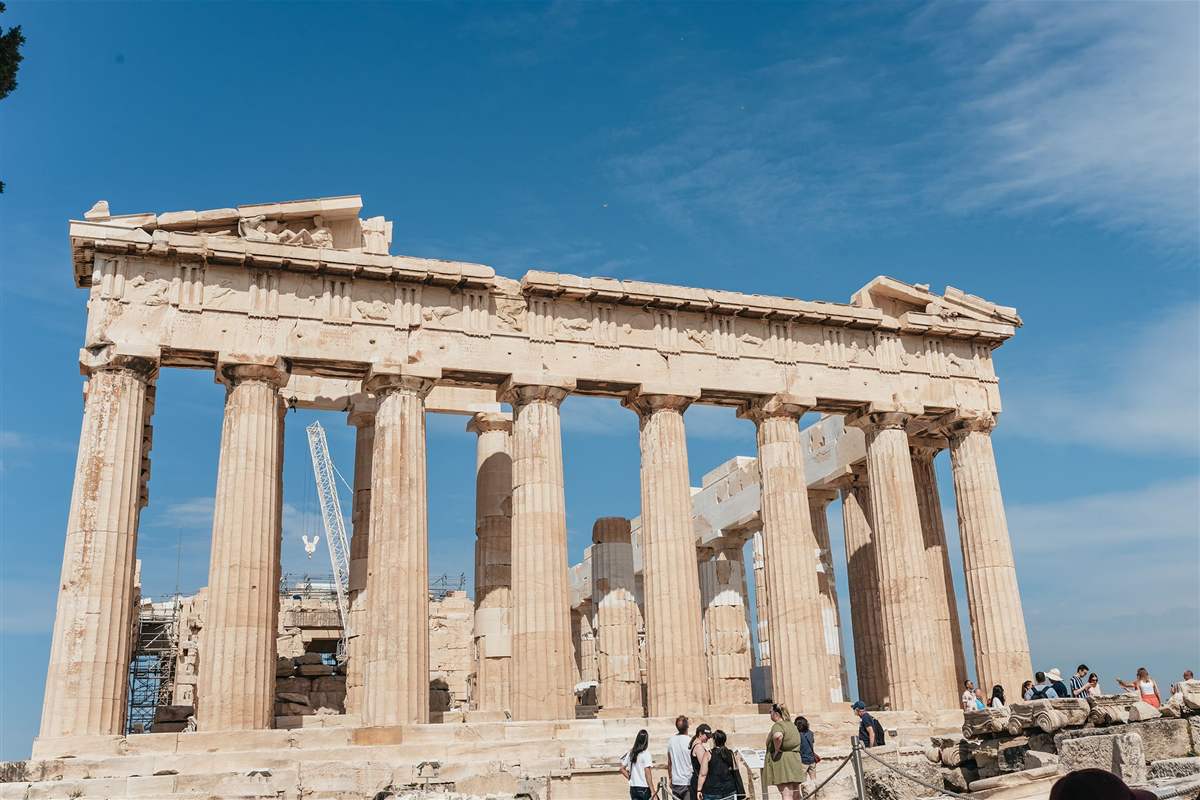
An Acropolis guided tour walks you through the monuments on the hill in order and explains what each one was for, which is the simplest way to read the Parthenon above Athens. Compare the formats first, then browse tours in Greece once you know which format fits your day.
This page covers the formats a visitor can choose, how long the tour lasts and where it starts, the monuments on the route from the gate to the Parthenon, the stories told at the Parthenon and Athena, the Erechtheion and the Temple of Athena Nike, the slopes below the hill, the visit to the Acropolis Museum, and the questions travellers ask.
What is an Acropolis guided tour, and what does it cover?
On an Acropolis guided tour, you walk around the ancient citadel of Athens with a licensed guide. The tour guide explains the temples, myths and history on the spot. The tour covers the buildings on the summit and the theatres on the slope below.
The Acropolis rock stands 150 metres above sea level, right in the city of Athens. UNESCO has placed the hill on its World Heritage list. One operator page says a licensed archaeologist or a local historian leads the walk. That person brings the bare rock to life.
An Acropolis guided tour covers more than architecture. Operator pages say the licensed guide links mythology, history and daily life in ancient Athens. They also name theatre, Athenian democracy and building design as topics. The route is planned in advance, so the group meets the main sights without confusion.
The history the tour tells starts long before the marble temples. A wall 760 metres long guarded the hill, and it stood up to 10 metres high. It served as the main defence from the late Bronze Age until the fifth century BC. The Persians destroyed the buildings on the hill in 480 and 479 BC.
Pericles then led the rebuilding in the fifth century BC. Under him rose the Parthenon and the Propylaea gate, then the Erechtheion and a small temple to Athena Nike. Operator pages place these four buildings at the heart of the walk. On an Acropolis guided tour, each one comes with its own story.
Which kinds of Acropolis guided tour can you choose?
You can choose from four kinds of Acropolis guided tour. They are the hill alone, the hill with the Acropolis Museum, a private tour and a mix with Athens sights. Each kind changes where the time goes.
The first kind stays on the hill. This Acropolis guided tour follows one planned route past the temples and the theatres on the slope. Sellers also list a separate tour of the Acropolis Museum alone, without the hill.
The second kind visits the hill and the Acropolis Museum on one tour. One operator page lists a combined tour of both. It adds that certain tours end with optional museum entry. Read the listing to see which version you are booking. Sellers also list add-ons, such as a full-day extension or an old town walk.
A private Acropolis guided tour gives your party its own dedicated tour guide. You set the pace, and the route can focus on the Parthenon, the Erechtheion or the panoramic viewpoints. You can dig deeper into Athenian democracy, Greek mythology and architectural innovation.
The fourth kind adds more of Athens. Operator pages pair the hill with the Plaka old town or the Agora. One tour of old Athens takes in the Parthenon, Monastiraki and Plaka. Another page joins the hill and the museum with a trip to the Temple of Poseidon.
A city tour spreads the time wider. One listing runs 3.5 hours across the main sights of Athens and the Acropolis, with an expert guide. Another joins a panoramic bus ride with a guided visit of the hill and the museum. If the monuments are your main interest, choose the hill-only Acropolis guided tour.
How long does an Acropolis guided tour last, and where does it start?
An Acropolis guided tour lasts about two hours on the hill. The group meets at a fixed spot near the hill, such as the main entrance or the Akropoli metro station. The tour then leaves on schedule.
Four operator pages describe a standard walk, and they agree closely. Three give about two hours. One gives ninety minutes to two hours, depending on the group’s pace and the weather. One page adds free time on site once the guided part ends. A private Acropolis guided tour runs two to three hours.
The route is not flat. One operator counts about one mile of walking over uneven terrain, uphill and downhill, with around 200 steps. A city tour that adds the Acropolis takes longer. One listing sets the city sights and the hill together at 3.5 hours.
An Acropolis guided tour has no single meeting point. One tour gathers outside the Akropoli metro station, where the tour guide holds a sign with the guests’ names. Another meets just outside the main entrance, on the right as you face it. A third gathers at a tour office near the hill, then walks the short distance to the monuments.
Check the voucher for the exact spot, because each Acropolis guided tour leaves on schedule. The pages ask for five to ten minutes, fifteen minutes, or fifteen to thirty minutes before the start. Tickets are timed, and one operator says you cannot join once the walk begins. One operator lists six summer departures and two in winter.
Which monuments does an Acropolis guided tour visit, from the gate to the Parthenon?
An Acropolis guided tour begins its hilltop route at the Propylaea gate. One plan then moves on to the Erechtheion by way of the small Nike temple, and the Parthenon comes last. Orders differ, but the same four monuments form the core.
The gate comes first on the hilltop because it was the way in. The Propylaea controlled access to the sacred hill, according to one operator. A wall inside its central hall has five doorways, the gates that give the building its name. The building has no sculpture at all, and its upper panels and gables were left bare.
Operators order the stops of an Acropolis guided tour in different ways. One plan runs from the gate to the Parthenon and the Erechtheion, then to the Temple of Athena Nike. Another starts on the south slope with the theatre and climbs to the gate later. Its tour guides can change the order for comfort.
One tour ends at the Parthenon. The group then has free time at the summit for photos and the view over Athens. Another page lets the group explore alone or walk down the south slope. The temple is Doric, built of Pentelic marble, 13.72 metres high, with seventeen columns on each long side.
Ask the operator for the route plan before booking your Acropolis guided tour. The order, the start point and the end point change from tour to tour. One operator says the time does not always allow a deep look at every site.
What stories does an Acropolis guided tour tell about the Parthenon and Athena?
An Acropolis guided tour presents the Parthenon as a thank-you to Athena after the Greeks beat the invading Persians. Inside stood a statue of the goddess about 13 metres high.
On an Acropolis guided tour, the story starts with war and money. Work began when the Delian League was at the peak of its power. The temple was completed in 438 BC, and the carving went on until 432 BC. The Parthenon also served as the city treasury.
The statue was Athena Parthenos, covered in gold and ivory plates. It stood in the main room to the east, shown with a spear and a large round shield. In its right hand it carried a small statue of Nike. The statue is lost, so the tour guide describes it from copies, vase paintings and gems.
Stories also sit in the sculptures. The east pediment held 10 to 12 figures telling the birth of Athena. The ancient geographer Pausanias also recounted her battle with Poseidon for control of Athens. A good Acropolis guided tour adds that one reading takes the frieze as an idealised Panathenaic procession.
The Acropolis guided tour then follows its later life. It became a Christian church, then a mosque once the Ottomans took over in the mid-fifteenth century. In the Morean War, a Venetian bomb hit the powder store inside and severely damaged the temple. Early in the nineteenth century, the seventh Earl of Elgin took sculptures from the temple to England.
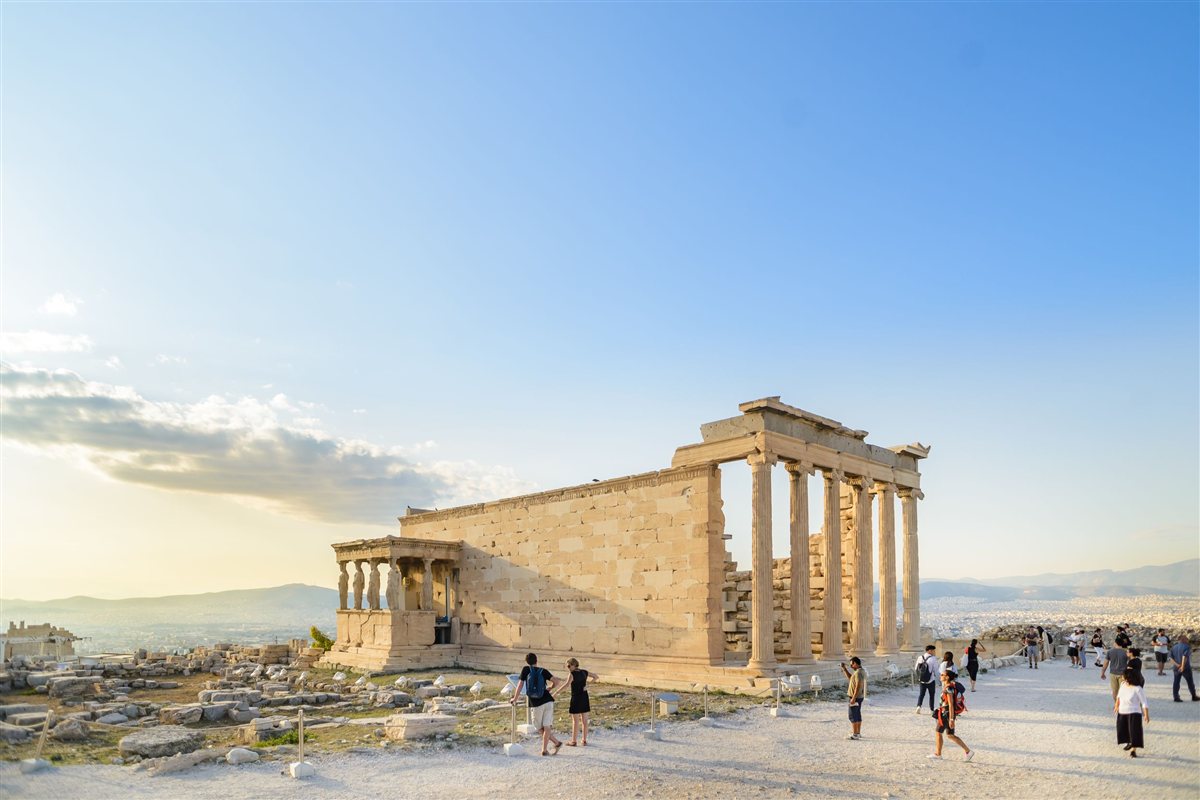
What does an Acropolis guided tour show at the Erechtheion and the Temple of Athena Nike?
An Acropolis guided tour shows the Erechtheion as the temple that held the symbols of Athena’s contest with Poseidon. It shows the Temple of Athena Nike as a shrine to Athena in her role as goddess of victory.
At the Erechtheion, the Acropolis guided tour tells the old myth of two gods who both wanted Athens. Poseidon struck the rock with his trident, and a saltwater spring is said to have erupted. Athena gave the city named after her an olive tree. The temple housed the sacred symbols of that fight, including trident marks in the rock.
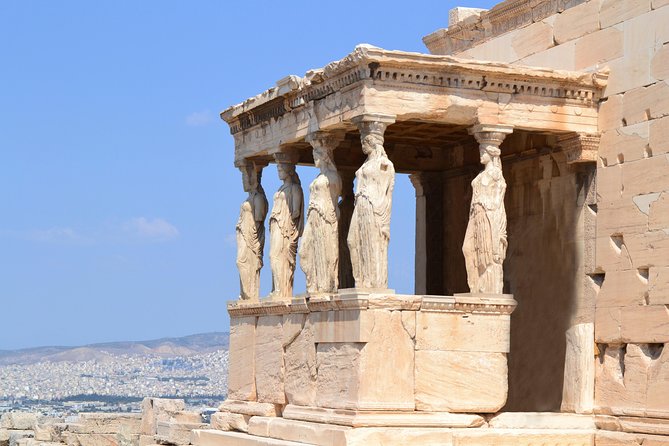
A second story belongs to the caryatids, the female statues that hold up the porch roof. The figures standing there today are reproductions. One original ended up in the British Museum. In later centuries the building also became a church and was last known as the Turkish commander’s harem.
At the Temple of Athena Nike, an Acropolis guided tour tells a story of war and hope. The citizens worshipped Athena and Nike there in hopes of a successful outcome in the long Peloponnesian War. The cult statue had no wings, and legend says the Athenians did not want the goddess to fly away.
A marble parapet around the temple carried reliefs of Nike. The temple’s south frieze showed the battle of Plataea, where the Greeks beat the Persians. The Ottomans pulled it down in the late seventeenth century and used its stones for defences. A German archaeologist rebuilt it in the early nineteenth century.
What do you see on the slopes during an Acropolis guided tour?
An Acropolis guided tour brings the slopes into the story. They hold the Theatre of Dionysus, the Stoa of Eumenes, the Asklepieion, the Odeon and the Areopagus rock. Together these sites cover drama, healing, music, shelter and law.
One kind of tour enters by the south slope, so the Theatre of Dionysus comes before the temples. It hosted the City Dionysia, a festival for the god of wine and theatre. Audiences watched works by Aeschylus, Sophocles, Euripides and Aristophanes on this stage. Lycurgus rebuilt it in stone. The priest of Dionysus sat in the central seat of honour.
On an Acropolis guided tour, the Asklepieion is the stop about healing. The Peloponnesian War was under way when Telemachos founded it in 419 BC. Visitors seeking a cure spent the night in a covered hall. They hoped to see the god Asclepius in a dream. A small cave behind it holds a natural spring.
A long colonnade, the Stoa of Eumenes, links the theatre with the Odeon. Its ground-floor front had 64 Doric columns. The Roman writer Vitruvius says stoas near theatres gave spectators refuge in bad weather. The Odeon of Herodes Atticus had a cedar roof and 33 rows of marble seats. In AD 267 the Heruli destroyed it.
The Areopagus, or Hill of Ares, rises northwest of the Acropolis. Athens tried murder cases there. Myth says the gods tried Ares on this rock. In a play by Aeschylus, Athena presides at the trial of Orestes. The Acts of the Apostles sets the sermon of Paul here, which gives an Acropolis guided tour one more story.


How does an Acropolis guided tour work with a visit to the Acropolis Museum?
Two formats join an Acropolis guided tour to the museum. A combined tour walks the hill first, then enters the galleries with the same expert. A separate museum tour lasts 90 minutes in one format.
Inside, an Acropolis guided tour follows the museum’s own plan. The ground floor, the Gallery of the Acropolis Slopes, holds finds from the homes and sanctuaries on the slopes. The first floor follows the history of the summit on a circular route. The third floor holds the Parthenon sculptures.
The Parthenon Gallery measures 39 by 84 metres. Forty-eight columns trace the outline of the temple. In this hall the pediments, metopes and frieze look outward, as they once did on the building. The frieze of the Panathenaic procession is displayed at eye level. A tour guide can reorder the stops to fit the group and the weather.
A group on an Acropolis guided tour follows the museum rules. Photography without flash is allowed everywhere except the Archaic Acropolis Gallery, where the korai statues stand. Backpacks and bulky items are left in a ground-floor cloakroom, and groups have a separate one. An X-ray check stands at the entrance.
If you skip the Acropolis guided tour, the museum offers a free digital app made with Smartify. A QR code in the galleries opens it. Pick an audio tour of 30 exhibits (one hour) or 60 exhibits (two hours). Audio is in Greek and English. Headphones are not for sale or rent at the museum, so bring your own.
What else do travellers ask about an Acropolis guided tour?
How big is an Acropolis guided tour group, and do you get headsets?
Each Acropolis guided tour sets its own cap on guests. One operator page caps its small group at 24 guests, with an average of 18. A second operator holds its small-group walk to 10 guests and its other tours to 25. That is a big gap, so read the cap on the listing.
Headsets keep a bigger group together. One operator gives each guest a personal earset, so you hear every word, even in busy areas. It says small groups make the tour more personal. Another page lists disposable earphones for groups of over 5 people. A private tour follows your own pace, and its page says you can ask unlimited questions.
Which languages does an Acropolis guided tour run in?
Each operator sets its own language list, so check it before you book. One page offers its tours in five languages: Italian, Spanish, German, French and English. It calls its licensed guides multilingual. A ticket-seller page lists English, German, French, Dutch and Spanish for its tour with the museum. Its tour of the hill alone offers English and French.
Private tours narrow the choice. One page lists an English-speaking tour guide for its private tour. Another operator conducts its group tours in English. Its private tours also run in Spanish and French. If your language is missing from a group tour, ask the operator about a private tour.
Do you tip the tour guide after an Acropolis guided tour?
A tip is not obligatory, but one travel site calls it customary and always appreciated. It lists tours, restaurants and hotel staff among the services where a tip is customary. The site says tipping the tour guide is expected on a pre-booked group tour. That covers tours booked through a company or your hotel.
One operator page for an Acropolis guided tour states that tips for your tour guide are always appreciated. It names no amount. The travel site gives no fixed rule either, because Greece has no set rules for tipping. Decide at the end of the tour, when you know how it went.
Can children join an Acropolis guided tour?
Operator pages welcome families, but the rules differ. One page calls its tour family friendly. Another calls its tour suitable for children and says the stories make ancient ruins easier to follow. It warns that summer heat makes the walk more than a casual stroll. A third page says every child must stay with a responsible adult throughout the tour.
Age limits differ too. One operator does not allow kids under 6 on its tour. Another page says an adult must accompany children. One page calls the walk moderate, with an uphill route, uneven ground and regular stops. With young children, read the listing first, as an Acropolis guided tour differs from one operator to the next.
How are the licensed guides on an Acropolis guided tour qualified?
The Greek state registers tour guides. A government service page names three routes into the profession. You can hold a tour guide diploma of the Ministry of Tourism. You can hold professional rights from another EU country, which a national council must recognise. Or you can graduate from the accelerated training programmes for tour guides.
The Ministry of Tourism issues a Certificate of Fulfilment of Legal Requirements and a tour guide identity card. Its Directorate of Tourism Education and Training is the unit in charge. The page lists the validity as indefinite. This is the state process behind the word licensed on an Acropolis guided tour.