
A Meteora day trip from Athens lets you reach the rock monasteries of Thessaly and be back in the capital the same night. Find more tours in Greece once you have settled on your route.
This page covers the three ways to make the trip, the journey and where it starts, Kalambaka, how the rock pillars formed, the monasteries and their rules, the viewpoints, the other stops, the season and what to pack.
What is a Meteora day trip from Athens, and how does it work?
Coaches leave the capital in the morning, visit the monasteries of Meteora in Thessaly and return at night. The result is your Meteora day trip from Athens, finished in a single day. A guided visit shows all six monasteries and takes you inside two or three.
Meteora sits in Trikala, a regional unit of northwestern Greece. Locals rank its Eastern Orthodox monasteries just behind Mount Athos, and UNESCO lists the site. One long day, out and back, covers the whole Meteora day trip from Athens.
Operators describe the same basic shape for the tour. An air-conditioned coach with Wi-Fi and USB charging leaves the city in the morning. A local tour leader meets the group at Meteora, and a guided tour of four hours or more follows. The coach is back in Athens the same night.
The day’s opening schedule decides which monasteries you enter. One operator page lists three active monasteries inside, while another lists any two, since certain monasteries close on set weekdays. Both promise views of all six monasteries and a stop at a hermit cave.
A Meteora day trip from Athens offers English tour guides, and certain options add Spanish. A free smart audio guide covers eleven or twelve languages, so bring earphones and a charged phone. Operators list guiding inside the monasteries as not included and offer the audio guide there instead.
Your Meteora day trip from Athens starts with a simple booking. Monastery entrance fees are not in the booking, and operators ask for cash. The voucher sits on your phone, so you need no printout. One operator asks only for your name at the coach, and another asks for photo ID. Free cancellation runs until twenty-four hours before the tour.
How do you get from Athens to Meteora: coach, train or private car?
Coach tour, train plus minibus or private car: all three can carry a Meteora day trip from Athens. Pick the coach if you want the day planned for you. A car drive takes about four hours, and the train line needs a check first.
The coach is the simplest choice, because the operator runs the whole Meteora day trip from Athens. A tour operator page says it spares you train timetables, taxis in Kalambaka and mountain driving. Another operator says the coach reaches Meteora in four hours.
By rail, check the line before you plan the Meteora day trip from Athens. Storm damage closed the direct line to Kalambaka. While it stays shut, a travel wiki lists Lamia, Palaiofarsalos and Larissa as the nearest working stops. One traveller’s plan paired a morning train with a minibus tour and a return near ten at night.
Public buses are a third route. They leave Athens from the Liosion KTEL station. A direct bus to Kalambaka runs at times, and other trips change at Trikala. One wiki puts the ride at about five hours, a blog at four and a half. You can hire a taxi at Kalambaka train station to reach all the monasteries.
Driving your own Meteora day trip from Athens takes about four hours on the road. Roads near the monasteries are good and well signposted, with lay-bys and free parking nearby. A car also lets you stop at viewpoints and villages.
Private tours exist too. A private group books its own Meteora day trip from Athens. Operators say it sets the departure time, the lunch stop and the time at each monastery. Private tours suit families with young children. Operators also run a small-group version of the day.
How long is the journey on a Meteora day trip from Athens, and where does it start?
Your Meteora day trip from Athens fills a whole day. Operator pages list a start between seven and nine in the morning and a return before eleven at night. Four and a half hours of coach riding fill each leg, seaside break included.
Two operator pages begin the tour at Larissa Station, the railway station. At the station, the coach for this Meteora day trip from Athens waits across the street, on Deligianni Street. Boarding opens fifteen minutes before departure. The voucher stays on your phone, and the driver takes your name instead of a ticket.
Other tours collect travellers in the city centre. One page lists four pick-up points. Plaka comes first at seven, then the Greek Parliament at five past seven. Omonoia Square follows at quarter past seven, and Karaiskaki Square at twenty-five past seven. None of the pages include a hotel pick-up.
The clock on one operator page shows the day. The coach leaves at eight and stops by the sea at Kamena Vourla at ten. It reaches Meteora near half past twelve. The morning of the Meteora day trip from Athens therefore belongs to the road. Another page leaves at nine and reaches Kalabaka around half past one.
The coach leaves Kalabaka at about six: 18:00 on one page, 18:15 on another. After a second seaside stop, it reaches Athens at half past ten or a quarter to eleven. One operator counts the whole day at about thirteen and a half hours. The Meteora day trip from Athens lasts that long.
What is Kalambaka, and why is it the base for a Meteora day trip from Athens?
Kalambaka is the town below the Meteora rocks and the hub of tourist services for the monasteries. Your Meteora day trip from Athens meets its local tour near Kalambaka, and the coach turns for home there.
Kalambaka is the administrative centre of the municipality of Meteora, part of Thessaly’s Trikala regional unit. Other spellings are Kalabaka and Kalampaka. The census counts 8,573 people in the town itself. Restaurants, bakeries and shops fill its streets, and visitors who stay here find easier access to transport.
The Meteora rocks tower right above the town. They fill the gap between Kalambaka and Kastraki, a village on their western side. This is the north-western edge of the Thessalian plain, near the Pineios river. With that position, the town anchors each Meteora day trip from Athens.
Operator pages show the town at work. On one page, the tour guide welcomes the group in Kalabaka around half past one. On another, the group is back in Kalabaka at half past five, with a short rest before the coach leaves. Both pages send the coach home from there, so the town frames every Meteora day trip from Athens.
The Information Tourist Center of Kalambaka offers free maps, brochures and tour recommendations. A local bus runs from the bus station to Kastraki and each of the six monasteries.
An inscription in one of Kalambaka’s oldest churches shows an ancient Greek settlement named Aiginion. In the tenth century the town was called Stagoi. It held a Byzantine fortress and a bishop’s seat. The Greek Orthodox Church still uses that name. So the starting point of this Meteora day trip from Athens is older than the monasteries above it.


What are the Meteora rock pillars, and how did they form?
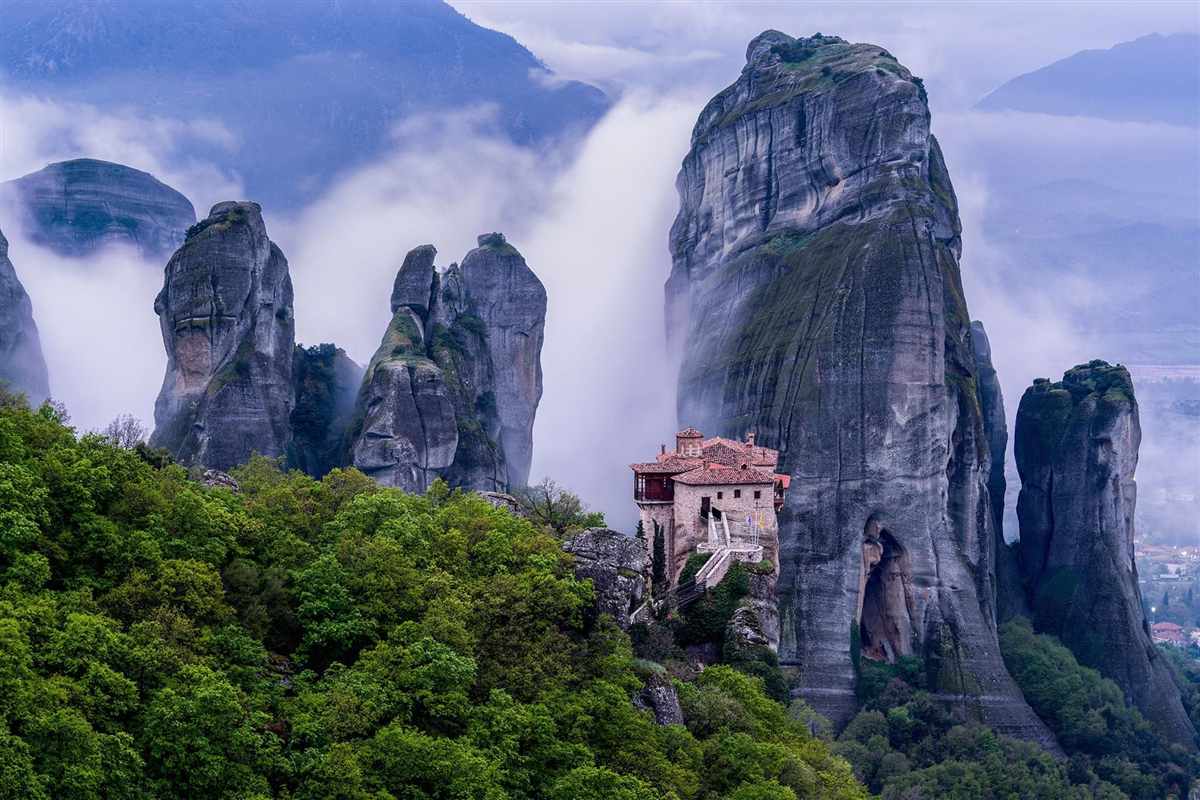
The Meteora rock pillars are columns of sandstone and conglomerate, not volcanic plugs. Earth movements pushed old lake-edge deposits upward, and weather then carved them. Panoramic stops give close views of them during a Meteora day trip from Athens.
Volcanic plugs of igneous rock stand elsewhere, but this rock is different. Streams flowing into a lake delta left stone, sand and mud behind, for millions of years. The deposits hardened into conglomerate. That muddy delta is the rock behind each Meteora day trip from Athens.
Around sixty million years ago, earth movements forced the seabed upward. A plateau rose, and vertical faults ran through the sandstone layer. Water, wind and the extremes of heat and cold widened every fault. Slow weathering shaped the skyline of every Meteora day trip from Athens.
The rock is very even, with little sign of horizontal layering. Weak layers did not erode away underneath. The vertical cracks widened instead, and stable pillars were left. Plants cling to the walls where water collects, a sight for visitors joining a Meteora day trip from Athens.
Tall cliffs frame the stops of every Meteora day trip from Athens. Measured from the Pineios valley floor, the Great Meteoron crowns a precipice higher than 415 metres. The Varlaam cliff measures 373 metres. Rock falls are a constant risk. The rocks shook in a magnitude seven earthquake in the nineteen-fifties, and the thin pillars still stood.
How did the monks come to build monasteries on top of the rocks?
From the eleventh century, hermit monks lived in hollows and cracks of the rock. In the fourteenth century, they began to build on top, to escape Turkish raiders. What they built is the centrepiece of this Meteora day trip from Athens.
UNESCO calls the peaks “columns of the sky”. The hermits lived alone. Prayer was shared just on Sundays and special days, in a chapel below the Dupiani rock. The Hermit Caves of Badovas feature in a Meteora day trip from Athens. Those first monks lived there centuries before any monastery.
Attacks by the Turks grew in the fourteenth century, and the monks looked for somewhere to hide. On the Broad Rock, Athanasios, a monk from Mount Athos, set up the Great Meteoron with his followers. The tour guide tells this story throughout a Meteora day trip from Athens.
Simeon Uroš, the local lord at Trikala, protected and backed the new community. His son John later retired to the Great Meteoron as a monk. UNESCO notes that twenty-four monasteries rose in the fifteenth century, despite incredible difficulties. That was a time of great revival for the hermit ideal.
The Broad Rock kept the monks safe from political trouble. A long ladder was the sole way into the Great Meteoron. The monks pulled it up when they felt a threat. Nets also lifted goods and people. The tale goes that a rope stayed in use until the Lord let it break.
Two monk brothers from Ioannina, Theophanes and Nektarios, hauled materials up to Varlaam for twenty-two years. Yet the building work itself reportedly lasted only about twenty days. Carved steps arrived in the nineteen-twenties and made the climb much simpler. Today stairs lead the way for each Meteora day trip from Athens.
Which monasteries does a Meteora day trip from Athens visit?
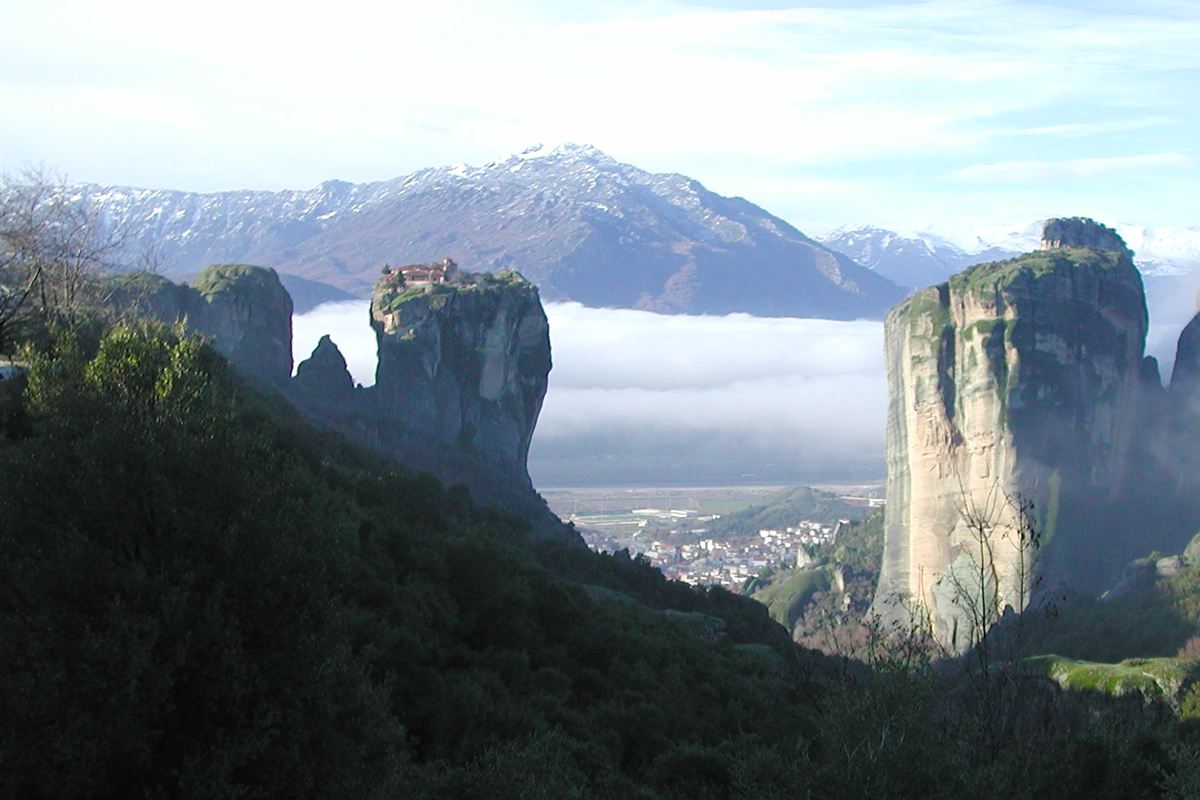
Operator pages show the Meteora day trip from Athens as one look at all six monasteries. You see them from panoramic viewpoints and enter two or three. The six are St. Nicholas Anapausas, Roussanou, Varlaam, Great Meteoron, Holy Trinity and St. Stephen.
Twenty-four monasteries once crowned the rocks, and six are open to visitors today. Two or three of those six get a visit during the Meteora day trip from Athens, depending on the tour. One operator page names entry to two active monasteries, and others name three. You see the rest from the outside.
The day of the week decides which doors are open. Each monastery closes one day a week in the summer season, and the closing days are staggered. Operator pages say the route follows the opening schedule, the traffic and the weather. The schedule sets the monasteries that the Meteora day trip from Athens goes into on your date.
The six sit in small clusters. Great Meteoron, the oldest and largest, and Varlaam, the second largest, are a ten-minute walk apart. Holy Trinity and St. Stephen are a fifteen-minute walk apart. St. Nicholas Anapausas, the smallest, is a ten-minute road walk from Kastraki. Roussanou is named for the hermit who is thought to have settled on its rock first.
One operator page names St. Stephen the easiest monastery to reach during the Meteora day trip from Athens. Its path is flat and paved, with very little climbing. A small bridge leads to the entrance, and nuns live there today. Holy Trinity is the hardest to reach, and its top gives a wide view.
What do you see inside a Meteora monastery?
Inside a monastery, the Meteora day trip from Athens brings you to the main church, called the katholikon. Its walls carry frescoes, and a carved screen holds the icons. Three of the monasteries also keep a museum in the old dining hall.
The katholikon stands in the middle of the monastery, off the main courtyard. At Varlaam it is dedicated to All Saints, and its sixteenth-century wall paintings include the Last Judgment. Art historians rank them among the finest post-Byzantine religious art in Greece. At Great Meteoron the church honours the Transfiguration, and the four evangelists fill the corners under the dome.
Great Meteoron has more rooms to see than any other monastery named for the Meteora day trip from Athens. Illuminated codices, carved wooden crosses and bishops’ vestments fill its museum. The library holds 610 of the codices catalogued at the six monasteries. The ossuary shelves the skulls of former monks, and the old kitchen is black with smoke.
Which museum rooms you see depends on the monasteries chosen for the Meteora day trip from Athens. Great Meteoron, Varlaam and St. Stephen keep museums. Holy Trinity, Roussanou and St. Nicholas Anapausas have no museum exhibits. Varlaam’s old dining hall shows manuscripts, icons and religious objects. Its windlass tower still stands with the crank and rope.
Operator pages list guiding inside the monasteries as not included and offer an audio guide in its place. That audio guide runs on your phone during the Meteora day trip from Athens, covering the rooms inside. The light is dim at the edges of the churches. Each monastery has a gift shop with books, souvenirs and religious items.
Which viewpoints and photo stops belong to a Meteora day trip from Athens?
Lookouts over the rock pillars and the monasteries are part of any Meteora day trip from Athens. Operator pages list multiple photo stops inside the guided tour, with views of the villages Kalambaka and Kastraki.
Each Meteora day trip from Athens is described in similar terms on operator pages. One page lists viewpoints with panoramic views of the villages, the sandstone pillars and the monasteries. Another promises plenty of stops for photos. The lookouts show all six monasteries, but the group enters only two or three of them.
Your Meteora day trip from Athens puts these lookouts inside the main guided tour. Operator pages put that tour at four hours or a little more, with the photo stops included. One page says the group travels through Meteora in a minibus.
One operator describes cliffside lookouts that overlook Kalambaka’s red-tiled roofs and the village of Kastraki. Its stone towers frame 360-degree views of the Thessalian valley. A sunset operator ends its tour at Psaropetra Rock and calls it the top panoramic viewpoint in the area.
Two landmarks stand out. Adrachti is a tall, thin rock pillar like a needle. A travel wiki says it shows from Kastraki and parts of Kalambaka. A trail from Kastraki leads to its base. Holy Trinity is the hardest monastery to reach, yet the same wiki calls its view from the very top captivating.
Free photography outdoors comes with every Meteora day trip from Athens. An operator page says landscape photography has no restriction. It adds that you can take pictures and videos as you wish in monastery courtyards and at viewpoints. Another page says tour guides change the route to suit opening times, road traffic and the weather.
What are the dress code and the visiting rules at the Meteora monasteries?
Every monastery on this Meteora day trip from Athens enforces a modest dress code. Men wear long trousers, women need a skirt reaching below the knee, and all cover their shoulders. Pictures inside the churches are not allowed.
Sleeveless tops are banned for men and women. Men cannot wear shorts above the knee, and women wear a skirt instead of trousers. The entrances lend wrap skirts and scarves to women, but no clothing is lent to men. Check your clothes before you board the coach.
The photo rules are short. You can shoot freely outdoors and in the courtyards on each Meteora day trip from Athens. Inside the inner church sanctuaries, photos and video stay off limits. Taking pictures of monks and nuns is not permitted either.
Drones are strictly forbidden by law anywhere on the site without written permission from the authorities. The monasteries are active, so visitors speak softly during every Meteora day trip from Athens and follow the posted signs.
At prayer times and ceremonies, a travel page asks visitors to stay back and observe quietly. It also calls a scarf over the head a thoughtful gesture.
Every monastery shuts on a different day of the week. Each Meteora day trip from Athens visits only the monasteries that are open that day. Operator pages say the choice follows the daily opening schedule. Entrance fees are paid separately, in cash only.
A travel wiki gives opening from 9:00 and closing times from 15:00 to 17:30, depending on the monastery. St. Stephen also closes for a two-hour break in the early afternoon.
What other stops fill a Meteora day trip from Athens, such as lunch, caves or a sunset?
A Meteora day trip from Athens fills the afternoon with a lunch break near the rocks. It also visits the Hermit Caves of Badovas. Operators list a sunset excursion too, and the coach adds a sea stop on the way home.
During the Meteora day trip from Athens, lunch is a short pause in Kastraki village. One operator page gives about 40 minutes there, under the shade of the rock pillars. Another page includes a traditional Greek lunch, and other pages sell the meal as an add-on. The monasteries have no places to eat, so meals happen in Kastraki or Kalambaka.
Menus list baked chicken with potatoes, pastitsio, stuffed peppers and giant baked beans. One operator page serves bread and water with the meal.
The first monks settled at the Hermit Caves of Badovas, a stop within the Meteora day trip from Athens. They came centuries before the monasteries were built. One travel page says the caves are exclusive to certain guided tours. One tour page includes the cave entry in its inclusions, so read each list of stops before you book.
Check the schedule if a Meteora day trip from Athens promises a sunset. One coach operator lists the departure from Kalabaka at 18:15. One local sunset tour visits a monastery and the Badovas hermitages. It then drives uphill to the cliff edge for the colours of the sky. Another page describes the dark sandstone glowing at golden hour.
On the road home, your Meteora day trip from Athens pauses beside the sea at Kamena Vourla. One operator page lists this break at 20:00. Another says you can choose dinner there. On a clear day, the island of Evia lies just across the water.
When is the right season for a Meteora day trip from Athens?
Operator pages name late spring and October as the comfortable months to plan your Meteora day trip from Athens. Summer brings midday heat and large groups, and winter brings snow, short days and fewer opening days at the monasteries.
Wikivoyage describes baking summer heat, severe winter cold and heavy snowfalls. Another page says July and August push into high heat by midday on exposed paths. A tour page advises water and a light snack from June to August. In the high season, large groups fill the chapels, so an early start helps.
Your Meteora day trip from Athens meets milder air in late spring. One operator page calls the weeks from late spring to early June comfortable for a full day outdoors. It rates September and October as busy. Another page picks October for cooler air and lower humidity than summer.
One operator page calls winter quiet, moody and sometimes snowy, with short days and a higher chance of rain. Holy Week is the opposite. The same page says crowds surge heavily and tells quiet seekers to avoid Easter week.
The calendar also decides which monasteries open to visitors throughout the Meteora day trip from Athens. Summer runs from April to October and winter from November to March. Each monastery closes one day a week in summer, on staggered days. In winter, Great Meteoron closes on Tuesday, Wednesday and Thursday. The monks can change the hours without notice.
Sunset tours move with the seasons, too. One operator lists a start at two in the afternoon from November to February. From June to August it starts at four.
Who suits a Meteora day trip from Athens: families, seniors and walkers?
Families, active seniors and easy walkers fit a Meteora day trip from Athens well. It does not fit anyone who cannot manage stairs or who wants a hiking day. The tour moves by coach, with climbs at the stops.
Families who book a Meteora day trip from Athens need a plan that fits the children’s ages and energy. Young children need close watching on stairs, steep paths and exposed viewpoints. Saint Stephen is the easiest monastery for families. Two or three monasteries, with breaks and viewpoint stops, make a better day than a rush through all six.
Active seniors manage the Meteora day trip from Athens, but the effort differs between monasteries. Great Meteoron and Holy Trinity need long walks and stair climbing. Varlaam, Rousanou and Saint Nicholas Anapausas also have stairs, uneven surfaces or uphill paths. A small bridge leads into Saint Stephen, so it suits travellers with poor fitness or mobility issues.
The coach between stops cuts out extra walking throughout the Meteora day trip from Athens. Heat, crowds and the walk from the parking areas still add to the effort. Anyone with knee, hip, heart or balance problems needs to tell the operator in advance.
Walkers get short climbs, not a hiking day. Reaching the monasteries on foot is a difficult hike, and visiting all six takes a whole day. The trail network totals 40 km, and not every trail is well marked. Parts of it end at a serious drop-off.
Keen walkers do better with a two-day stay than with the Meteora day trip from Athens. A one-day trip is a long day, and a two-day package suits travellers who want no rush. It leaves time for the trails.
What do you need to pack for a Meteora day trip from Athens?
Pack sturdy shoes, modest clothes, water, a snack, cash and a charged phone for the Meteora day trip from Athens. These items cover the climbs, the entry rules and the limited food stops on the road. Add earphones for the audio guide.
Footwear matters first for the Meteora day trip from Athens. Steps at the monasteries are uneven and steep in places, so pick shoes that cover the toes and grip well. Rocky terrain also calls for comfortable walking shoes. Add a light jacket and sunscreen, because the weather is unpredictable. A reusable water bottle belongs in the bag too.
The season sets your layers for the Meteora day trip from Athens. Summer brings limited shade, and walking in the heat calls for litres of water. In October, early mornings and evenings are cool, so a jacket helps, with a hat and gloves if needed. In winter, bring warm, waterproof clothes, because the weather changes quickly.
Pack the monastery clothes even in hot weather, because visitors who break the dress code can be refused entry. Food and drink on the monastery road are limited, so carry water and a snack. Bring cash for small purchases and souvenirs.
Bottled mineral water travels on the coach through the day. Snacks also help on the coach ride, and a water bottle keeps you hydrated. At the stops, your own bottle and a camera are useful extras for the climbs and the viewpoints.
What else do travellers ask about a Meteora day trip from Athens?
Languages and vehicles offered by a Meteora day trip from Athens
Live commentary comes in English or Spanish, depending on the option you pick. Other languages come through a free audio guide on your phone. Operators list eleven or twelve languages, among them German, French, Italian, Japanese and Chinese. Inside the monasteries, the audio guide takes over from the tour guide. Bring earphones and a charged phone.
The vehicles change during the day. A coach with Wi-Fi, USB ports and air conditioning takes you from Athens to Kalambaka. The guided part can run in a smaller minibus. Travellers who want a smaller group can book a semi-private or private Meteora day trip from Athens.
Meteora day trip from Athens: where is the meeting point, and how do you avoid a mix-up?
Two kinds of start exist. One meets on Deligianni Street, opposite Larissa Station, the Athens train station. The other collects travellers at Karaiskaki Square, Omonoia Square, the Greek Parliament and Plaka. Those pick-ups follow each other, from seven o’clock to twenty-five past seven. Your voucher names the right point, so check it at home.
A Meteora day trip from Athens asks for no printed ticket. Open the voucher on your phone, or tell the driver your name. Arrive fifteen minutes before departure, so you have time to find the coach. A pick-up tour from central Athens also asks to see a photo ID with the voucher.
Where are the toilets and rest stops, and do you tip at the monasteries?
The coach has no toilet or food on board. It halts midway so that passengers can visit the toilets and buy snacks. Operators also plan a seaside break at Kamena Vourla, a morning stop and an evening stop. Each break lasts about forty minutes, enough to stretch your legs and have a coffee.
The larger monasteries have toilets: St. Stephen’s, Varlaam and Great Meteoron, and a small tip is expected there. Tips are paid on top of the tour. Monastery entry is cash only, so carry notes and coins for the Meteora day trip from Athens. Cash also pays for small purchases along the way.
Meteora day trip from Athens: how steep is the climb, and how far do you walk?
Expect stairs at every monastery except one. Great Meteoron and Holy Trinity have over 300 steps. Rousanou, Varlaam and St. Nicholas need a climb of around 140 steps. St. Stephen’s is the easiest, joined by a walking bridge with no steps at the entrance. The small cable cars you can see are for hauling supplies, not for visitors.
Each Meteora day trip from Athens goes inside two or three monasteries out of the six. So you climb only a share of these stairs. The paths are uneven, the steps can be steep, and every monastery involves stairs or sloping paths. Operators list severe mobility limits, or a wish to hike, as a poor match for this tour.
Are children welcome, and does rain stop a Meteora day trip from Athens?
Operators design the Meteora day trip from Athens for travellers of all ages. The monasteries still mean climbing stairs and walking on uneven ground, and the day is long. Children up to twelve years old pay no monastery entrance fee. Private versions suit families with young children, because the group sets its own timing.
Rain does not cancel the coach. Operators state that their buses run in every kind of weather. If extreme weather forces an activity to stop, you get a new date, another activity or a refund. Tour guides also adjust the route to monastery hours, traffic and weather.