
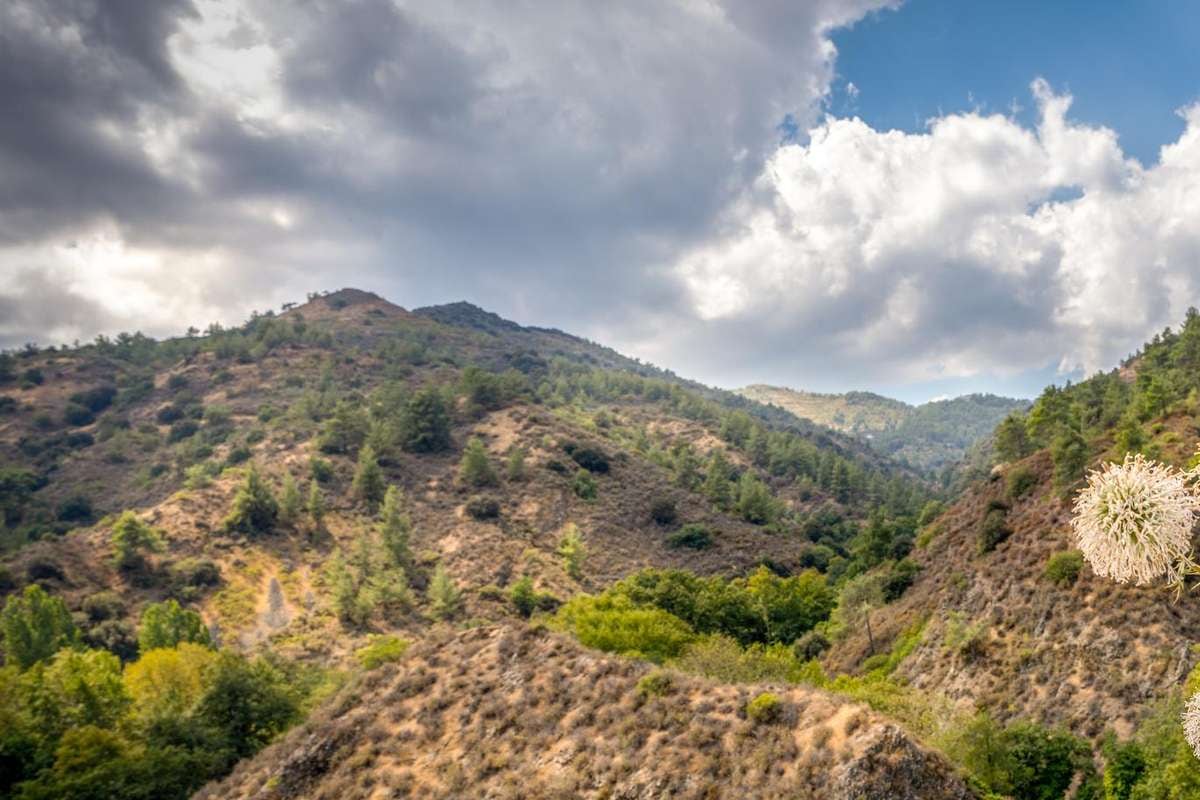
A Troodos Mountains tour starts with a pickup on the south coast or in the east, then climbs into the forested hills of Cyprus, where the air is cooler and the villages sit among the pines, with the monasteries and painted churches of the range within reach in one day. Read on for the stops in order, and see the other tours in Greece if you plan a longer trip.
This page covers what the tour is and how the day runs, its length and pickup towns, the mountains and their geology, the weather through the seasons, the monasteries, the painted churches, the villages and Omodos, the wine and village food, the walks and waterfalls, the wildlife, the kinds of tour, and what to wear and bring, plus a FAQ.
What is a Troodos Mountains tour, and how does it run?
A Troodos Mountains tour takes a full day. A minibus or coach picks you up at the hotel and drives into the pine forest. Cyprus has no bigger mountain range. The vehicle stops at a monastery, a village and a viewpoint, then returns to the coast.
Wikipedia calls Troodos the island’s biggest mountain range and puts it close to the middle of Cyprus. It spreads over a third of the land. Villages lie in its valleys and cling to terraced hillsides. Monasteries and churches from the Byzantine age crown the peaks. One day on a Troodos Mountains tour joins these places together.
Pickup comes first. Three operator pages for Paphos name the hotel or a meeting point close by. One says the tour guide meets guests at the reception desk of its listed hotels. So a Troodos Mountains tour needs no car of your own.
Two pages describe an air-conditioned minibus for a small group. A third says coach or minibus, depending on group size. Once aboard, the Troodos Mountains tour heads inland and uphill into the forest. One page says the scenery changes from sandy beaches to lush peaks in an hour’s drive.
No two pages list the same stops. One Troodos Mountains tour page names Chrysorrogiatissa Monastery, a viewpoint, Kykkos Monastery, lunch at Pedoulas and the village of Omodos. Another names Aphrodite’s Rock, a village, Omodos, Millomeris Waterfall and a winery in the Platres area. A third starts at Omodos and ends with a winery.
Lunch is a set stop on a Troodos Mountains tour. One page makes it a restaurant stop at Pedoulas. Another gives free time for lunch at Troodos Square, near the summit of Mount Olympus. The square has picnic points, shops and a cafe. A third page sets aside an hour and ten minutes for lunch.
At the end, guests are returned to their hotel or to a point nearby. A Troodos Mountains tour ends where it began, in the town where you were collected.
How long is a Troodos Mountains tour, and where does it start?
A Troodos Mountains tour from Paphos lasts about eight hours, as the operator pages state it. Pickups run in the early morning, and the minibus is back on the coast in the late afternoon. Limassol, Larnaca, Ayia Napa and Protaras have their own starts.
- Paphos: on a Troodos Mountains tour, two pages put the forest 60 to 90 minutes from the coast.
- Limassol: one travel page gives 80 kilometres to the plateau, about an hour and a half.
- Larnaca and Ayia Napa: the same page gives 130 to 160 kilometres, 90 to 120 minutes.
- Protaras: another page gives just under two hours to Troodos Square, about 160 kilometres.
Three Paphos pages give the length of the day. They state up to eight hours, seven to eight hours, and about eight hours with travel, photo stops and lunch. A listing page sorts its Troodos trips into four to eight hours and more than eight hours. In short, a Troodos Mountains tour fills a day.
One page splits the hours by stop. It gives forty minutes at Kykkos Monastery, an hour and ten minutes for lunch and thirty minutes at a winery. The rest of that eight-hour day goes on the road and the other stops. Ask any Troodos Mountains tour page for its own split.
The start is early. One page lists pickups from a quarter past seven to a quarter past eight, across Paphos and nearby resorts. Another gives a pickup at about eight and a return between four and five in the afternoon. One sends the exact time by message the day before, and the other by email after the booking.
Days and seasons differ. One page lists a daily departure. Another lists a departure every Monday and Thursday. A third gives a season from March to October. Times and days change, so read the page of the Troodos Mountains tour you pick.
Other towns have their own starts. Travel pages for Larnaca, Ayia Napa and Protaras each list tours to the mountains. One page lists a private tour from Limassol. The Protaras page puts the lower foothill villages a little over an hour away.
The same travel page asks for an early start from the far towns. It gives seven at the latest from Larnaca and Ayia Napa, and half past eight from Limassol. Check that early start when you choose a Troodos Mountains tour from those towns.
What are the Troodos Mountains, and why do they matter for a Troodos Mountains tour?
The Troodos Mountains form a block of old ocean floor that rose into the middle of Cyprus. A Troodos Mountains tour climbs across it. Mount Olympus tops the range at 1,952 metres, and no peak in Cyprus stands higher.
The Geological Society calls this rock an ophiolite, an uplifted fragment of ocean crust. Its page says you can walk from the mantle, deep below our feet, to the modern sea floor. The layers form a dome, and the uplift is still going on. So a Troodos Mountains tour drives over a piece of the sea bed.
Wikipedia names the rocks of that dome: harzburgite, dunite, gabbro, diabase and pillow lava. It calls the ophiolite a Late Cretaceous mid-ocean ridge that has since been lifted up. It dates one lava layer to about 90 million years ago. That makes a Troodos Mountains tour a drive through very old rock.
A Visit Cyprus page gives the same age and adds that the rock formed 8,000 metres below sea level. UNESCO lists the area as the Troodos Global Geopark. The page gives it 1,147 square kilometres, about 15 per cent of Cyprus, rising from 300 metres to the summit.
The geopark holds 110 communities with about 25,000 residents, so rock and villages share one map. One operator page praises the geological park for showing the rock formations and the volcanic origins of the island.
Forest covers the slopes. Wikipedia names the Turkish pine as the commonest tree of the range, with Anatolian black pine at the higher altitudes. A Cyprus newspaper says that as the road climbs, temperatures drop and pine forests replace concrete. On a Troodos Mountains tour, that change comes within the first hours.
The range also feeds the water of the island. A Cyprus travel page says the largest rivers come from the Troodos range. That range is the wettest part of the island. Rivers on the island flow for three to four months a year. Parts of the Kouris and the Diarizos flow all year.
The Kouris dam, the largest of 107 dams in Cyprus, collects the water of the Kouris, Limnatis and Kryos rivers. On a Troodos Mountains tour, the rain falls on the range and the rivers run down from it.
What is the weather like on a Troodos Mountains tour through the seasons?
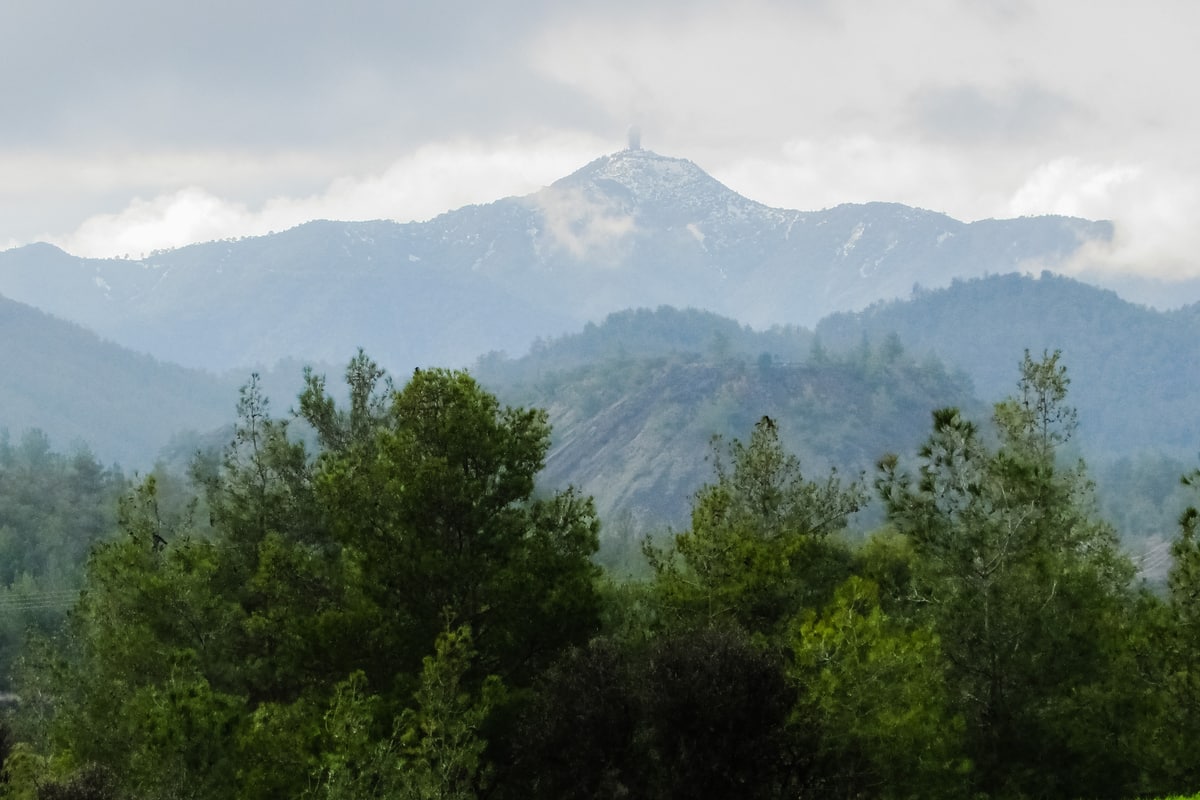
A Troodos Mountains tour meets cooler air than the coast, and each season changes the range. Winter brings snow and skiing, spring brings wildflowers and waterfalls, summer brings cool air and autumn brings golden leaves.
- Winter: snow on the peaks and skiing on Mount Olympus.
- Spring: wildflowers and waterfalls for a Troodos Mountains tour.
- Summer: cool mountain air, away from the coastal heat.
- Autumn: golden foliage on the slopes and in the villages.
Winter is the snow season for a Troodos Mountains tour. A Cyprus newspaper speaks of snow-dusted peaks and says Mount Olympus offers skiing in the colder months. One operator page lists four ski slopes there. One weather page puts the snow above 1,500 metres and calls the ski season small.
The same page lists winter highs from about 4 degrees Celsius in January to 8 in March. Nights fall below freezing. It also lists spring highs from 8 degrees in March to 23 in June.
In spring a Troodos Mountains tour meets wildflowers. Two travel pages say the mountains come alive with them. One weather page says snowmelt in March and April makes Caledonia Falls run at full force. It names the Cyprus orchids as a late spring flower.
Summer is the season of cool air. Three travel pages call the mountains a retreat from the coastal heat. A weather page gives highs near 26 degrees Celsius in July and August. It also names spring and early autumn for pine-shaded walks and cool nights. Those weeks suit a Troodos Mountains tour with walking time.
Autumn is the season of colour. One travel page says autumn brings vibrant foliage, and another speaks of golden tones in the villages and forests. A Cyprus newspaper adds vineyards and chestnut festivals. A Troodos Mountains tour in those weeks is a scenic drive, as the first page puts it.
The road is part of the weather story. When snow falls, the police name the upper roads open only to vehicles with four-wheel drive or snow chains. Two newspaper reports list the Platres to Troodos road and the Karvounas to Troodos road. Read the road report before a winter Troodos Mountains tour.
Which monasteries does a Troodos Mountains tour visit?
Tour titles name Kykkos Monastery as the monastery stop of a Troodos Mountains tour. Its site is high in the range, on the side that faces north-west. Chrysorrogiatissa and Trooditissa stand in the same hills. All three celebrate on the fifteenth of August, in honour of the Virgin.
Tour pages show how a Troodos Mountains tour reaches Kykkos. One listing offers a small-group trip with a Kykkos visit lasting four to eight hours. Another lists a Kykkos visit and lunch on a day of more than eight hours. A Larnaca page lists a Kykkos and Kakopetria tour. A Paphos page joins Kykkos to the villages.
A Troodos Mountains tour to Kykkos reaches the home of an icon of the Virgin. Wikipedia says the icon has served as a template for other Orthodox paintings of the Virgin. A tradition it records tells of a hermit called Esaias, who lived in a cave on this mountain. The monastery has sheltered the icon for over nine hundred years.
The museum is the indoor stop of a Troodos Mountains tour at Kykkos. The Cyprus Tourism Organisation page lists manuscripts and antiquities of Cyprus beside icons and consecrated vessels. The museum opens daily at 10:00. It closes at 16:00 from November to late spring and at 18:00 from June to October. On public holidays it stays shut.
Chrysorrogiatissa stands 1.5 kilometres from the village of Panayia, in the hills north-east of Paphos. A Troodos Mountains tour that adds it meets a single-aisle church with fine frescoes above its three entrances. The Icons and Utensil Treasury opens only on request. The official page gives separate daily hours for summer and winter.
Trooditissa stands at 1,300 metres on the southern slopes, between Platres and Prodromos. The official page calls the monastery a place of prayer, closed to visitors. The church is open daily from 9:00 to 12:00 and from 14:00 to 16:00. Silver leaf covers its icon of the Virgin. On a Troodos Mountains tour, only the church opens.
So the three monasteries give three kinds of visit. Kykkos offers a museum, Chrysorrogiatissa a treasury on request and Trooditissa a church. Each has its own hours, so a Troodos Mountains tour with more than one monastery needs a timed plan.
Which painted churches does a Troodos Mountains tour reach?
At Kakopetria and Kalopanayiotis, a Troodos Mountains tour meets painted churches. Those are the two that tour pages place on a route. The UNESCO listing holds ten buildings in the Troodos region, churches and monasteries alike. They include small chapels as well as grand monasteries.
- Agios Nikolaos tis Stegis, near Kakopetria: walls covered in paintings from the eleventh to the seventeenth century.
- Agios Ioannis Lampadistis, Kalopanayiotis: a thirteenth-century monastery with three churches, monastic cells and an oil press.
- Panagia tou Araka, Lagoudera: the Virgin of the Passion on the south-east wall, with angels who carry a spear and a cross.
- Panagia Phorviotissa, Asinou: a fresco of Christ Pantocrator in the narthex.
A roof tells you which church is which. At Agios Nikolaos tis Stegis the pitched timber roof was built to protect the building from the weather. The Cyprus Tourism Organisation calls it the only surviving monastery church of its kind on the island. A Troodos Mountains tour that stops here sees the roof first, then the paintings inside.
The church is a domed cross-in-square building that once belonged to a monastery. It stands about 5 kilometres from Kakopetria, in the Solea Valley. Wikipedia dates the bulk of its mural decoration to the fourteenth century. A Troodos Mountains tour that stops at Kakopetria reaches this church, and its dome shows Christ Pantocrator.
At Kalopanayiotis, the Lampadistis monastery is the painted stop that two tour pages name. One calls it the highlight of its day and says the murals reach back to the fourteenth century. A Troodos Mountains tour that stops here also takes in the village, which lies in a valley beside a stream.
Panagia tou Araka stands between Lagoudera and Saranti in the Pitsilia hills. It has one aisle and a dome. The Cyprus Tourism Organisation says Theodoros Apsevdis painted its walls in the late twelfth century. Wikipedia adds that the murals were restored around the fourteenth century after water damage.
One tour-planning page names the church at Asinou for its elaborate murals. Wikipedia lists it as a twelfth-century church in Nikitari. Ask which of these churches your Troodos Mountains tour includes, because the hours below cover all ten.
The official pages give the churches two seasons. From 16 April to 15 September, Tuesday to Saturday has two blocks: 10:00 to 13:00, then 14:00 to 17:30. Sunday runs from 11:00 to 16:30. From 16 September to 15 April, Tuesday to Saturday runs from 10:00 to 16:30. Monday is the closed day, so plan the Troodos Mountains tour around it.
Which villages does a Troodos Mountains tour stop at?
A Troodos Mountains tour stops at the mountain villages: Kakopetria, Omodos, Platres, Pedoulas and Kalopanayiotis. Operator pages and the Cyprus Tourism Organisation name them. Each sits at its own height, so one day shows five faces of the range.
On a Troodos Mountains tour, Kakopetria is the village of the old quarter. Wikipedia puts it 55 kilometres south-west of Nicosia, on foothills that face north. Its height is 667 metres, and no village of the Solea Valley stands higher. Two rivers, the Kargotis and the Garillis, join inside the village.
A Troodos Mountains tour finds the old quarter on the western side of the valley, lying between the two rivers. The Cyprus Tourism Organisation says it is restored and declared a protected cultural heritage site. Its alleys are narrow and paved with stone. Roofs are sloped and tiled, and almost every house has a wooden balcony upstairs.
The village also keeps an old watermill. The Cyprus Tourism Organisation says it ground barley and grain from the middle of the eighteenth century. An olive mill museum stands nearby. One operator page lists Kakopetria as a stop on its Troodos Mountains tour for running water and a small waterfall.
Platres is the largest resort of the range. Wikipedia places it on the southern slopes, 5 kilometres from Troodos Square and 25 kilometres north-west of Limassol. It stands at 1,200 metres. A stream runs through it all year, so the trees grow thick.
Wikipedia says Platres is cooler than the big coastal resorts during the summer. On a Troodos Mountains tour, that means fresher air than on the coast. An operator page calls it a good starting point for mountain walks. Wikipedia also counts it among the wine villages.
Pedoulas stands in the Marathasa Valley, 1,100 metres up. The Cyprus Tourism Organisation says it stands among orchards. It is known for its cherries and the products made from the fruit. The community page calls its cool air ideal for summer holidays.
Wikipedia counts 12 churches in Pedoulas. A Troodos Mountains tour with time here finds a Byzantine museum. It holds icons and artefacts from the churches of the region. A folk art museum shows daily village life.
Kalopanayiotis lies in the same valley, 3 kilometres north of Moutoullas. Pedoulas lies 4 kilometres south of it, so the valley has both close by. The Cyprus Tourism Organisation names the sulphur springs of Kalopanayiotis, its traditional architecture and its valley views. A Troodos Mountains tour here sees what Wikipedia lists: cobbled streets, chapels, tiled roofs and shady vine trees.
What is Omodos, and why do tours stop there?
Omodos is a village of the Limassol District, grown up around its Holy Cross monastery. A Troodos Mountains tour stops there for the stone square, the old houses, the medieval wine press and the lace.
- The square: a large cobbled plaza in front of the monastery, where vendors sell their wares.
- The houses: old stone-built homes set among green gardens and vines.
- The monastery: the church of Timios Stavros, with old icons and woodcarvings.
- The wine press: a medieval press a short walk from the monastery.
- The lace: narrow-knit lacing, a craft the village works to preserve.
Omodos sits at about 800 metres, and the Cyprus Tourism Organisation places it among the wine-making villages. Wikipedia puts it 80 kilometres from Nicosia, and a second page puts it 42 kilometres north-west of Limassol. A Troodos Mountains tour stops here because the sights lie close together.
That is why operator pages list Omodos in the names of their trips and in their itineraries. One page calls the village a highlight of its Troodos Mountains tour. Another pairs it with a winery stop on a day out from Limassol.
The monastery is the heart of the village. The Cyprus Tourism Organisation names old icons and impressive woodcarvings inside the church. Dress matters on a Troodos Mountains tour. One operator page says tank tops and shorts are not allowed in the monastery, for men and women.
The wine press stands a short distance from the monastery. Wikipedia carries a photo of the old traditional wine press workplace. Lace is the village craft. The Cyprus Tourism Organisation calls Omodos a centre for narrow-knit lacing, and another page lists embroidery, brocades, tablecloths and quilts.
The village is small, and a Troodos Mountains tour keeps the visit short. One operator page gives the stop free time for the small shops. A news feature on the village describes narrow stone lanes with small galleries and handicraft shops.
What do you taste on a Troodos Mountains tour: wine, Commandaria and zivania?
A Troodos Mountains tour tastes the wine of the slopes, the sweet wine Commandaria and the grape spirit zivania. Commandaria comes from villages on the southern slopes. UNESCO has entered it on its list of living heritage.
Wine is the first taste of a Troodos Mountains tour, because vineyards climb the slopes below the forest. Wikipedia states a rule for wines with a protected designation of origin. Their vineyards must lie higher than 600 or 750 metres. A Cyprus Mail article adds that the altitude and the geology help the quality of the grapes.
The island has seven wine routes, as the Wikipedia list shows, among them Pitsilia and the Diarizos Valley. The Cyprus Mail article says three tasting routes run through the Troodos. It counts 21 local wineries for red, rose and white wines.
The Krasochoria villages are home to the island’s highest concentration of wineries, the article says. It names Omodos among them. A Troodos Mountains tour with a wine stop lands in that wine country.
Commandaria is the wine to know on a Troodos Mountains tour. Wikipedia calls it an amber-coloured sweet dessert wine from the foothills of the Troodos. Sun-dried grapes of Xynisteri and Mavro, two local varieties, go into the bottle. The name itself is a protected designation of origin.
UNESCO describes the work in steps. Growers harvest the grapes late in the season and dry them under the sun. Oak barrels then hold the wine while it ages. Families, cooperatives and wineries of different sizes take part. UNESCO says the wine is served as a dessert wine at special events such as weddings.
Zivania completes a Troodos Mountains tour of tastes as the clear spirit of the mountain villages. Wikipedia describes a colourless drink with a light aroma of raisins. Distillers make it from grape pomace, the leftovers of pressing, and local dry wines. Cinnamon is added in certain villages, which turns the spirit red.
Two operator pages place the wine stop of a Troodos Mountains tour in Omodos. One lists small shops where you taste local wine in your free time. The other names Commandaria as the wine of the village. Two pickup-town pages add that wineries in the lower foothills offer tours and tastings.
What village food comes with a Troodos Mountains tour?
Village food on a Troodos Mountains tour means a meze lunch, trout from mountain streams, cured meats and grape-juice sweets. Operator pages list a meze lunch, a Cypriot lunch and a lunch stop on the day.
- Meze: a spread of small dishes with bread and salad.
- Trout: grown in spring-fed reservoirs, cooked on the grill or in the oven.
- Cured meats: sausage, lountza and hiromeri from the high villages.
- Sweets: grape-juice treats, jams and rose preserve.
Lunch comes in three forms on a Troodos Mountains tour, as operator pages show. One listing offers a 4×4 tour with a meze lunch. Another pairs a hike to the Caledonia falls with a Cypriot lunch. A coach page gives time at Troodos Square for lunch. A Paphos page names the Omodos square for a meze or a coffee.
Wikivoyage calls meze a spread akin to tapas. It says the dishes come as a mixed batch of meat or fish. A meze lunch on a Troodos Mountains tour looks like the table Wikipedia describes. It holds greens with lemon juice and salt, fresh bread and a mixed salad. Hot grilled meat comes toward the end.
A trout lunch fits a Troodos Mountains tour, because the fish grow in the range itself. The Cyprus Food Museum and a Cyprus government publication both say the farms use spring-fed reservoirs. Both name Kakopetria, Platres and Foini as the villages where visitors eat the fish. The museum adds that you can eat it there all year round.
Cured meats belong to the high villages. The Cyprus Tourism Organisation places Agros in the Pitsilia region of the Troodos. Wikipedia gives it an altitude of 1,100 metres. A tourism page and a travel page both name sausages, lountza and hiromeri as its products. Hiromeri is a smoked ham, as the travel page says.
Sweets on a Troodos Mountains tour follow the vine. Wikivoyage lists palouzes, shoushoukos and kiofterka as sweets made from grape juice. It calls palouzes a pudding of grape juice and flour. A travel magazine describes a string of almonds, dipped over and over into thickened grape juice. The Agros pages add rose preserve, jams and homemade sweets.
Where are the waterfalls and walks of a Troodos Mountains tour?
On a Troodos Mountains tour, the waterfalls wait on the forest trails near Platres. The Millomeris Falls drop 15 metres. Operator pages list a hiking tour to the Caledonia falls with a lunch stop. Walking tours sit beside the coach and jeep trips.
On a Troodos Mountains tour with walking time, the Millomeris trail is the short one. Two trail pages list it at 1.2 kilometres and half an hour. It starts between the village church of Pano Platres and the village centre. The first half follows the Kryos River, called the Cold River on those pages.
The second half climbs onto open mountain, and one trail page names a very steep gradient. Two pages give the Millomeris waterfall a drop of 15 metres. One of them calls it the tallest waterfall in Cyprus. Ask any Troodos Mountains tour for waterfall time, because this walk is short.
The Caledonia trail is the longer walk of a Troodos Mountains tour with hiking time. One trail page puts it at three kilometres and about 1.5 hours. The path runs through dense forest beside the Kryos River. That page says the river holds water all year, and the path passes the Caledonia waterfall.
A tour built on the Caledonia trail is a hiking day. One listing for that hiking tour gives a length of more than eight hours. Two other operator pages name the Caledonia trail and waterfall as a forest walking area.
On a Troodos Mountains tour, the Artemis trail is the high walk. It loops around Mount Olympus, which stands higher than any other peak in Cyprus. The Forestry Department lists it at 7 kilometres and difficulty grade 1. Allow 2.5 to 3 hours.
The loop runs through black pine forest inside the Troodos National Forest Park. It gives views over the Limassol, Paphos and Nicosia districts, and the last 200 to 300 metres climb. The trail ends at a point on the Atalanti trail. For the full loop, pick a Troodos Mountains tour that names the Artemis trail.
Cedar Valley is a forest walking area in the west of the range, inside the Paphos Forest. The same two operator pages list it as a forest walk beside the Caledonia trail. The trees of that valley get their own section below.
Which trees and animals does a Troodos Mountains tour show?
A Troodos Mountains tour passes through pine forest, golden oak and Cyprus cedar. It also crosses the home of the Cyprus mouflon, the national animal of Cyprus. Wikipedia calls the mouflon shy and hard to approach, so the trees come first.
- Golden oak: an evergreen shrub or small tree up to 10 metres, dark green above and golden below, found only on the Troodos massif.
- Cyprus cedar: native to these mountains. Wikipedia places it as a variety of the Lebanon cedar. The largest stand, at Tripylos, held 16,000 mature trees in a survey.
- Plane and alder: Platanus orientalis and Oriental alder grow beside rivers and forest streams in the Paphos Forest.
- Greek strawberry tree: an evergreen broadleaf tree of the Paphos Forest, which also holds the golden oak.
A Troodos Mountains tour can show the golden oak at every height from 400 to 1,800 metres. It grows on igneous rock. Wikipedia says its short build earns it the name dwarf oak. The parliament of Cyprus chose it as the national tree, and the forest law protects it.
Wikipedia names an endemic rose of the high ground, Rosa chionistrae. It says the range holds a number of endemic plants and animals. The Cyprus cedar is one of them. It grows in mixed forest with Brutia pine, golden oak and Platanus orientalis.
Wikipedia calls the Cyprus mouflon a wild sheep that lives nowhere but the Paphos District mountains. Males carry horns. Two pages call the animal cautious and hard to approach, and one says it rests in the shade at noon. Count a mouflon sighting on a Troodos Mountains tour as luck.
Herds of about ten to twenty animals stay together through winter. One page says they move all day then and are easier to see. A winter Troodos Mountains tour has the better chance. The Paphos Forest holds them in the west of the range. Wikipedia gives it 10,000 hectares.
Look up on a Troodos Mountains tour, because the sky belongs to the raptors. Wikipedia names four birds of the range: the griffon vulture, Bonelli’s eagle, the raven and the red crossbill. A nature page ranks the Paphos Forest first in Cyprus for nesting raptors.
Which Troodos Mountains tour suits you: a small group, a private tour or a jeep safari?
A small group suits a first visit. A private tour suits a fixed plan. A jeep safari suits an off-road day. Each Troodos Mountains tour of these kinds runs four hours or longer, as operator pages list it.
The group Troodos Mountains tour by coach gives you a driver and a set route. One Paphos page describes about eight hours on a comfortable coach, with pickup at one of ten central points. A listing for a small group version, with a monastery visit, gives four to eight hours.
A private Troodos Mountains tour bends the day to your party. One page says the route is adjustable by starting point, season and interests. It adds hotel pickup and a full day out. Another private day runs 7 hours 30 minutes and visits the artist villages, Lania among them, with tastings.
A jeep safari leaves the paved road, so it is the Troodos Mountains tour for tracks and forest. Pages for a jeep day and a 4×4 day agree on the stops. Both list a forest waterfall, a walk in Mesa Potamos Forest and Omodos. One page sends the jeep up an earthen track to Platres.
The Troodos Mountains tour by jeep keeps its group small. One page sets a limit of ten travellers per group, and another says a jeep takes eight. Car seats, pushchairs and wheelchairs cannot go on board a 4×4, as one page notes.
Two more kinds of Troodos Mountains tour exist. A wine-and-villages day adds a winery stop to Omodos. A hiking day centres on the Caledonia Waterfalls, and one listing pairs a hike there with a Cypriot lunch.
A rental car is one more way. One page says a rental car gives you the flexibility to set your own timing. Another says rural buses in the Troodos Mountains are less frequent and less reliable.
Match the Troodos Mountains tour to your day: driver and fixed route, your own stops, or tracks and forest.
What do you wear and bring on a Troodos Mountains tour?
Wear light layers, comfortable walking shoes and sun protection, and bring water and a camera. A Troodos Mountains tour climbs above the coast, and monasteries ask for proper dress, with shoulders and knees covered.
- Layers: a light jacket on a spring or autumn Troodos Mountains tour, winter clothing in winter.
- Shoes: comfortable shoes for forest paths and village lanes.
- Sun: a hat, sunglasses and sunscreen.
- Monasteries: no shorts or sleeveless tops, shoulders and knees covered.
- Water, a camera and your booking confirmation.
For spring evenings the Cyprus Tourism Organisation lists long-sleeved cotton or a light woollen layer. For October evenings it lists medium-weight clothes. For December and January it lists winter clothing, but not heavy coats. It adds that February evenings can be quite cold. A private tour page asks for a light jacket or coat in spring and autumn.
The same organisation names rain and snow on the Troodos Mountains in winter. A rain layer in the bag is a sensible answer for a winter Troodos Mountains tour.
Shoes matter because the day includes walking. A coach page lists comfortable shoes, water, a camera, sunscreen and a hat as essentials. A private tour page asks for comfortable shoes for the forest paths and village strolls. A 4×4 page asks for suitable footwear and a hat.
Monasteries have their own rules. The Cyprus Tourism Organisation says visitors to any place of worship are expected to show proper dress, not overly casual. A coach page says no sleeveless shirts, shorts or short skirts. It asks you to cover shoulders and knees to go inside.
A page on Kykkos Monastery names a strict dress code: no shorts for men, covered shoulders for women. A page on the Holy Cross Monastery in Omodos asks men and women to skip tank tops and shorts. A light scarf or cardigan is an easy way to cover bare shoulders.
Sun protection stays on the list. One private tour page asks for it, and a gourmet tour page adds sunglasses and a sun hat. Carry water, since a coach page lists it among the essentials. Bring a camera too: a page for a Paphos day trip says to pack walking shoes and bring one.
Papers count on a Troodos Mountains tour as well. A jeep page asks for photo ID and for the booking shown on a phone, both where the day begins.
What else do travellers ask about a Troodos Mountains tour?
Is the road on a Troodos Mountains tour very winding, and is the ride easy for children?
Pages describe the roads in two ways. One travel page says the mountain roads are paved yet winding. Another calls the driving easygoing. Both are travel pages, not road reports. One origin of the name Troodos, Wikipedia says, points to three mountain roads. No page counts the bends, so ask the operator about the route.
The stretches between villages are short. One travel page gives 10 to 30 minutes between villages. Another puts Omodos 15 minutes by car from Platres. A Troodos Mountains tour breaks the day into stops, as the stop lists on operator pages show. If bends upset you, tell the tour guide before the climb.
Seats differ by tour type. A minibus day tour listing says infant seats are available. A jeep listing says infant seats are not available and children under three have no seat of their own. Ask which Troodos Mountains tour suits your child’s age. Read the age rules in the listing before you book.
Can slow walkers and wheelchair users manage a Troodos Mountains tour?
It depends on the tour and the stop. Three churches are listed as wheelchair accessible on Cyprus Tourism Organisation pages. They are Agios Nikolaos tis Stegis, Panagia Asinou and Archangelos Michael at Pedoulas. The first stands in the Solea Valley, 5 kilometres from Kakopetria. The second stands 3 kilometres from Nikitari, on the east bank of a stream.
A Troodos Mountains tour that stops at one of these churches reaches a listed accessible door. Tour listings differ, though. One minibus listing says the tour suits all fitness levels. A jeep listing says the vehicle is not wheelchair accessible. Read the listing of the tour you pick, and ask the operator about each stop.
Village lanes are another matter. A travel handbook says the lanes of Kakopetria, like those of other mountain settlements, twist like a maze. Tell the operator your pace before you book. Ask what the walk from the vehicle to each door looks like on that Troodos Mountains tour.
Are the painted churches and monasteries on a Troodos Mountains tour open every day?
No. The Cyprus Tourism Organisation page for Agios Nikolaos tis Stegis lists Tuesday to Saturday, and Sunday from eleven. The pages for Panagia tou Araka and Asinou also list Monday, so the pages differ. News reports on the timetable list Christmas, 15 August, Easter and Holy Week as closed days.
UNESCO calls all ten painted churches living monuments that still serve as places of worship. A travel handbook says dress codes in churches and monasteries are strictly enforced. It lists long trousers and no bare chests for men, and covered legs and shoulders for women. The tourism pages tell visitors to check before they go.
Photo rules differ from church to church. One page says photography inside Agios Nikolaos tis Stegis is generally not allowed, to protect the paintings. A page on the church at Pedoulas says photos are generally permitted, with no flash. Follow the sign at each door on a Troodos Mountains tour, and keep the flash off.
Is one day enough on a Troodos Mountains tour, or does a night in a village help?
One day gives a first look. The Cyprus Tourism Organisation places one church in the Solea Valley and another in the Pitsilia area. It places Kykkos Monastery in the Marathasa Valley. In winter the churches close at half past four, as the Deputy Ministry of Culture timetable states. A Troodos Mountains tour has to fit all of this into daylight.
A night in a village slows the pace. National Geographic calls Platres an ideal base for the region. Wikipedia calls it the leading hill resort of the island. A travel handbook says Kakopetria has enough hotels, restaurants and services to make a good base. A holiday page lists stays in both villages.
The timetable opens the churches at ten from Tuesday to Saturday and at eleven on Sunday. A morning in the village puts you at the first door when it opens. A Troodos Mountains tour gives a first look, and a night gives a slower visit. Plan the night around the church you want to see first.