
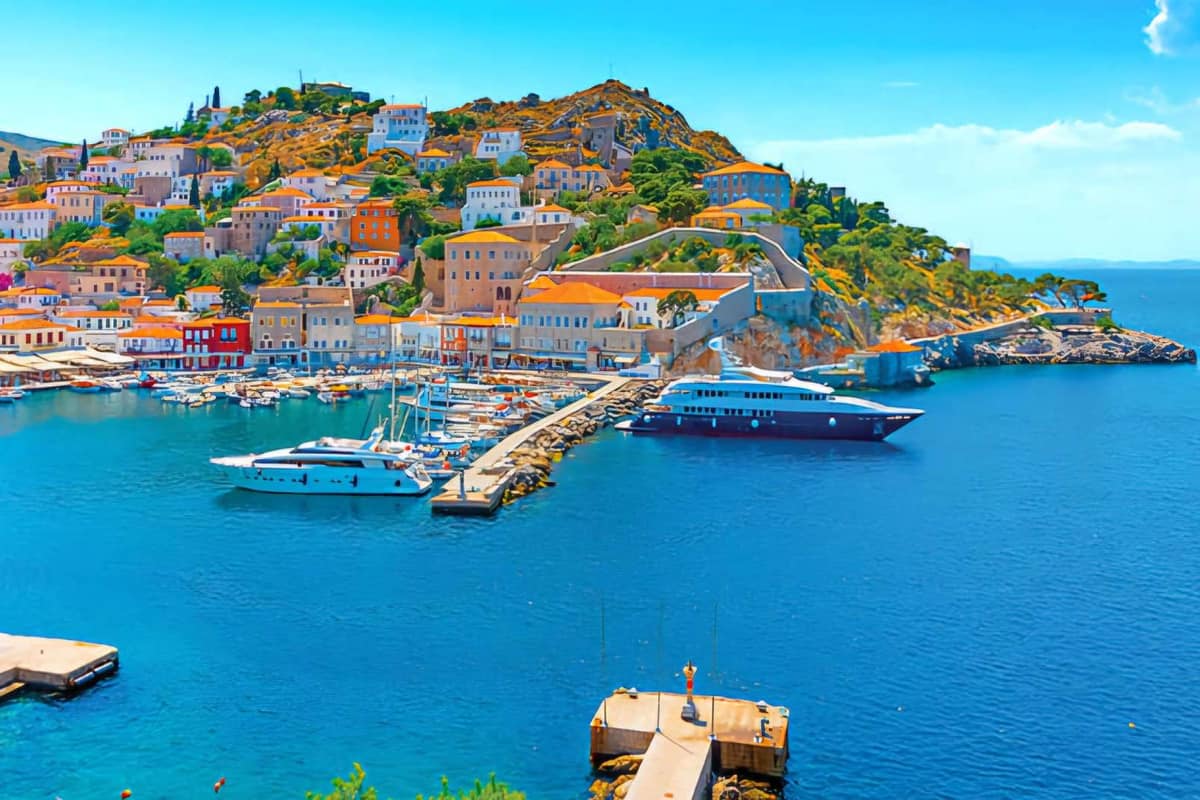
A Hydra day trip starts at the port of Piraeus, with a short crossing across the Saronic Gulf to the island of Hydra. The island has no cars, so the day is spent on foot, by donkey and by water taxi. The timing and the route differ between trips, so check the details before choosing one. Compare the ways to go, then browse tours in Greece for more ideas.
This page follows the order of a day on the island: the length of the day and its timing, the crossing and Hydra Town, the car-free rule and the museums, the beaches and swim stops, the coast walk, the two monasteries, the seafaring story and the food, the kinds of day trip, what to wear and bring, and a FAQ.
What is a Hydra day trip, and how does it work?
In short, a Hydra day trip takes you from Athens to the island of Hydra and back within one day. You sail out of Piraeus in the morning and spend the middle of the day ashore. A boat takes you back in the late afternoon or evening.
Piraeus, the harbour of Athens, is where every Hydra day trip starts. Wikipedia puts Piraeus 37 nautical miles away, which is 69 kilometres. Fast boats cover that distance, and the same boats bring you back to the mainland.
A Hydra day trip lands you on one of the Saronic Islands. It is an Aegean island. Wikipedia names the Argolic Gulf and the Myrtoan Sea as its neighbours. The channel to the Peloponnese is narrow. The island itself covers 49.6 square kilometres. One travel page says it is reachable only by boat.
The island is also written Ydra or Idra. Wikipedia links the name with the old Greek word for water, which points to its natural springs. Wikivoyage adds that the spring ran dry long ago, but the name stays.
The boat on a Hydra day trip docks at the main town. The island has a single main town, which Wikipedia calls Hydra port. The other places are small villages and hamlets, such as Mandraki and Kamini. One travel page says the town can be the only part of the island a day visitor sees.
There are three ways to do a Hydra day trip. The first is a boat you book yourself, by ferry or hydrofoil. The second is a guided day trip. The third is a day cruise. Each one ends with a boat back to the mainland on the same day.
On your own, you book the boat and plan the day yourself. One travel page advises arriving early and leaving late. The idea is to reach more of the island than the town and to avoid a rush.
One operator page sets out a guided Hydra day trip from Piraeus. The boat leaves Piraeus, and a tour guide leads a walk through the town. A short boat ride takes the group to a beach for a swim and lunch. Free time in town is optional. A return boat brings the group back to Hydra port.
A Hydra day trip by cruise gives less time on each island. One travel page says these trips add Poros and Aegina to the same day. The day has the same shape on all three ways. You arrive in the harbour and walk the town. Free time follows for a stroll or a swim, then the boat takes you back.
How long is a Hydra day trip from Athens, and when does it run?
Allow a full day for the Hydra day trip from Athens. One operator page lists 11 hours in all, and a page for a trip with a second island lists 12. Start and return times differ, so read the operator’s own page.
- 8:15: hotel pickup in Athens and the transfer to the port of Piraeus
- 9:00: the boat leaves Piraeus
- 10:30: arrival at Hydra port
- 16:25: the boat leaves Hydra for Piraeus
- 18:00: arrival at Piraeus, then the transfer back to the hotel
These times come from one Hydra day trip page, which calls them approximate. From the 10:30 arrival to the 16:25 departure, the visitor is on the island for almost six hours. The page says the stay has no tour guide, so the island time is yours to use.
A guided Hydra day trip by coach starts earlier. One page describes a 7:45 departure from Athens. The group crosses by boat from Metochi on the Peloponnese coast. It returns by boat in the late afternoon and is back in Athens as evening begins.
Another guided programme from Piraeus ends at sunset. The page says that, as the sun begins to dip, the group boards the return boat. The same programme includes wine and nuts on the return crossing.
A Hydra day trip on your own can run longer. One travel writer crossed from Ermioni and had about seven hours on the island. One travel page counts about seven ferries a day from Piraeus to Hydra, and another counts about five.
Boat times mark the edges of the day. On one timetable page the first boat from Hydra to Piraeus leaves at 7:20 and the last at 21:30. The same page says the ferry runs all year. Another page advises booking ahead, because the boats fill in the busier months.
Days and seasons differ between trips. One page lists its tour for each day, Monday to Sunday. Another lists its trip on Monday, Thursday and Saturday only, and it drops its beach stop in the winter months.
So the length of a Hydra day trip depends on the way you go. Before you book, check the date, the boat times and the programme on the operator’s own page.
How do you reach Hydra on a Hydra day trip: by ferry, by hydrofoil or on a cruise?
A Hydra day trip by sea starts at the port of Piraeus. A fast boat crosses the Saronic Gulf in about 1.5 hours, and the slow car ferry needs about three. A cruise adds stops, and a short hop from the Peloponnese skips the long sail.
A Hydra day trip by boat begins in Piraeus, the chief port of Greece according to Wikipedia. Wikivoyage warns that the port is huge, so find your gate before the day starts. It places the metro station close to gate E6. The Coast Guard Building stands at Karaiskaki Square, and notices of departures and arrivals go up outside it.
Two kinds of boat serve a Hydra day trip on your own. Wikivoyage splits them into a slow car ferry, about three hours, and a fast catamaran, 1.5 hours. One travel writer counts about seven boats a day, each just under two hours. Both pages say seats can sell out in busy months.
On the run that serves a Hydra day trip, Wikipedia names high-speed hydrofoils and catamarans as the boats. It puts Piraeus 37 nautical miles from Hydra. The boats call at Poros first, with Spetses further on. On fast boats, one writer rode 90 minutes out and 75 minutes back.
A guided Hydra day trip uses the same sea route. One programme puts the sea leg at roughly 90 minutes and says Hydra lies less than two hours from Athens. Another programme meets at the Piraeus metro station and reaches the boarding point about five minutes later.
A cruise is the third form of a Hydra day trip. One programme sails from Piraeus to Poros first. It then goes on to Hydra, with a walk and a swim at Vlychos Beach. Another page lists a high-speed vessel from Piraeus and a guided walk in town. It adds a 15-minute boat ride to a sandy beach.
A short hop skips the long sail. Wikipedia says a passenger ferry takes 20 minutes from Metochi, on the mainland, to Hydra. Drivers leave their cars in a secure car park there. A press report on an excursion from Athens counts roughly 25 minutes from Metochi. A sail from Ermioni took one writer just over 30 minutes.
As the boat nears Hydra, one writer says you round a corner of the rocky coast. The town then appears, with buildings stretching up into the hills. On Wikivoyage’s account, the fast boats all tie up midway along the north coast, in Hydra port itself. On a Hydra day trip, that quay is your first step ashore.
What is Hydra Town like on a Hydra day trip?
Hydra Town is the main settlement of the island, and a Hydra day trip lands you in its centre. Wikipedia says the town curls round a crescent-shaped harbour, with stone lanes rising steeply from the water. Wikivoyage places the sights close to the quay.
- The quay: where every Hydra day trip lands, a crescent of water edged with cafes, shops and galleries.
- The clock tower: a landmark in the centre of the harbour town, built in the nineteenth century, as one page states.
- The lanes: narrow, whitewashed and paved with stone, with steps that climb fast from the quay.
- The doors and flowers: painted wooden doors in blue, ochre and sea green, and bougainvillea over the balconies.
On a Hydra day trip, nothing sits far from the quay. Wikivoyage says the sights cluster on the quay and in the lanes behind it. More lie beside the road that runs along the coast. One page names Miaouli Street as the narrow street through the centre of the town.
A Hydra day trip meets two faces of the town. Wikivoyage says the waterfront boulevard is crowded in season, yet calm side lanes begin only minutes from it. One writer found the lanes one street off the main road serene on a weekday. Wikivoyage adds that day trippers go home, which leaves the town peaceful by night.
A Hydra day trip walk up from the quay climbs fast. Within a couple of blocks, one writer says, the cobbles narrow and the steps begin. They are sometimes shallow and sometimes nearly vertical. A second writer calls the higher lanes a maze, and a third says the water stays in sight below.
Wikipedia places the local homes and the guest houses on the steep streets above the harbour. From the water, one writer sees red-tiled roofs and stone houses that seem to grow out of the hillside. Wikivoyage counts no high-rise buildings, and another page says strict building codes keep out modern ones.
A Hydra day trip meets a working harbour. One writer saw large private yachts docked beside small fishing boats with wet nets from the day’s catch. Another says cafes set out tables along the water, right where the ferry drops you.
Why are there no cars on Hydra, and how do you get around on a Hydra day trip?
Hydra bans motorised vehicles, so a Hydra day trip is done on foot, by donkey or by water taxi. Wikivoyage says the only engines on the island belong to the city’s trucks and a fire truck. Everything else moves by hoof, foot or boat.
Wikipedia says the ban is written into law and covers cars and motorcycles. Wikivoyage links it to a policy of careful development, with no high-rise buildings at all. Another page adds that strict building codes allow no modern buildings. That rule sets the pace of a Hydra day trip from the first step off the boat.
Donkeys do the heavy work. One page describes them carrying luggage and deliveries for restaurants. Another says they have the right of way, so walkers step aside when hooves clatter. Wikivoyage places the donkeys and the taxi boats side by side at the port’s centre. A Hydra day trip meets both at once.
The lanes climb fast. One page says two blocks inland are enough for the cobbled lanes to narrow and the steps to begin. The steps are shallow in places and nearly vertical in others. Another writer says the harbour stays in sight below, so the lanes are easy to read. A Hydra day trip rewards slow, steady climbs.
The walks on a Hydra day trip are short. Wikivoyage says Kamini lies a kilometre or so to the west, beyond a small headland. Two pages give the stroll to Kamini as 15 minutes. Wikivoyage says the walk to Vlychos takes 45 minutes. Another page gives 3.5 kilometres, also 45 minutes, for the coast path from the port past Vlychos.
The coast path is wide and well kept, one page says, but it has little shade. Water taxis give another way along the coast. One page lists a short hop to Kamini, and another says the boats zip up and down the shore. On a Hydra day trip, a taxi boat turns a long walk into a short ride.
A guided day trip handles the route for you. One operator page lists a guided walk of the town on arrival, then optional free time. Another describes a walking tour of about 45 minutes. In both, your feet do the work, since no bus or car runs on the island. A guided Hydra day trip is a walking day too.
Which museums and mansions does a Hydra day trip visit?
The museums of Hydra stand around the harbour, where a Hydra day trip lands. The Historical Archives Museum, the Kountouriotis mansion and the cathedral museum all sit at or above the water. The Tombazis mansion stands in the west of the town.
- Historical Archives Museum: ships’ figureheads, paintings and rare documents
- Kountouriotis mansion: a deep yellow house above the harbour
- Tombazis mansion: a branch of an Athens art school
- Cathedral and clock tower: a domed church with an Ecclesiastical Museum
The Historical Archives Museum stands in a stone mansion at the port, says one page. Its rooms hold ships’ figureheads, paintings and carvings, according to another. A third lists ship models, rare books and manuscripts. Rare documents fill its archive. The same port is where a Hydra day trip lands.
The Lazaros Kountouriotis mansion is deep yellow and looks down on the harbour. The house dates from the eighteenth century and belonged to a shipping owner. Wikipedia and the Greek tourism site tie it to the national history museum as a branch. Rooms show furniture, portraits, handicrafts and clothing. A Hydra day trip gets harbour views from its terrace.
The Tombazis mansion stands in the west of the town. Wikipedia notes that the Athens School of Fine Arts holds it today. Greece’s tourism site says it serves as one of the school’s branches. The same site says shipowners built these houses. A Hydra day trip passes the grand fronts of their homes.
Walk through the passage beneath the clock tower, built in the nineteenth century, and you reach the cathedral. Wikipedia calls it the Dormition of the Virgin, and other pages call it the Assumption. It is a domed basilica from the seventeenth century with three aisles and a white marble altarpiece.
Wikivoyage says to look for the bell tower, and that the courtyard is always open. Hours for the interior and the museum are less steady, the same page says. A Hydra day trip with a tight clock can still use the courtyard.
The Ecclesiastical Museum fills the second floor, says Wikivoyage, with textiles and vestments. Another page dates its items to the eighteenth and nineteenth centuries. One operator page describes a walking tour of about 45 minutes that passes this museum. The operator pages list walks and free time, not museum entries. On a Hydra day trip you choose the doors.
Which beaches and swim stops does a Hydra day trip offer?
A Hydra day trip offers rock swim platforms near the harbour and small pebble beaches along the coast. One sandy bay lies at Mandraki. The island has little sand, so swimming means smooth pebbles or a ladder into deep, clear water.
The nearest swim spots are Spilia and Hydronetta, a short walk west of the harbour. They are rock and concrete platforms, not true beaches. Pages describe steps or a metal ladder down into deep water that suits diving. A quick dip here fits into a Hydra day trip without a long walk.
Getting in is the tricky part on a Hydra day trip. Wikivoyage says the ladders set in the sea wall at Spilia are not easy for everyone. Another page says the deep water at Hydronetta suits confident swimmers. Boats also serve both spots, as a local Hydra page states it.
Pebble beaches follow along the coast path, and a Hydra day trip meets Kamini first. Kamini has a small pebble beach beside the little harbour and an old fort. The water is sheltered and shallow, which makes it easy for children. Vlychos comes next, with pebbles, a little sand and a gentle slope into clear water.
Plakes lies just beyond Vlychos. It is a long beach of smooth pebbles with a little sand. It faces Dokos, an island just offshore. The slope into the sea is gentle and the water is shallow. For walkers on a Hydra day trip, Plakes is the last beach on the route.
Mandraki is the island’s only real sandy beach, as two pages state it. It lies along the coast from the harbour. Walk there, or take a short beach boat ride. Visitors on a Hydra day trip who want sand head for Mandraki.
Bisti and Molos lie much further out. Pages describe Bisti as a pebbly cove in a sheltered bay with good snorkelling. You reach it by beach boat or a long hike. Molos is a quiet cove of white pebbles with no beach facilities. One page puts it 70 minutes from the port.
Swim time depends on the kind of trip, as the operator pages state it. One page lists a boat transfer to the sandy beach, a sun bed, lunch and free time in town. Another lists a 30-minute walk to Vlychos with a swim and a meal. It says that stop is not part of its winter Hydra day trip.
Where can you walk on a Hydra day trip: Kamini, Vlychos and the coast path?
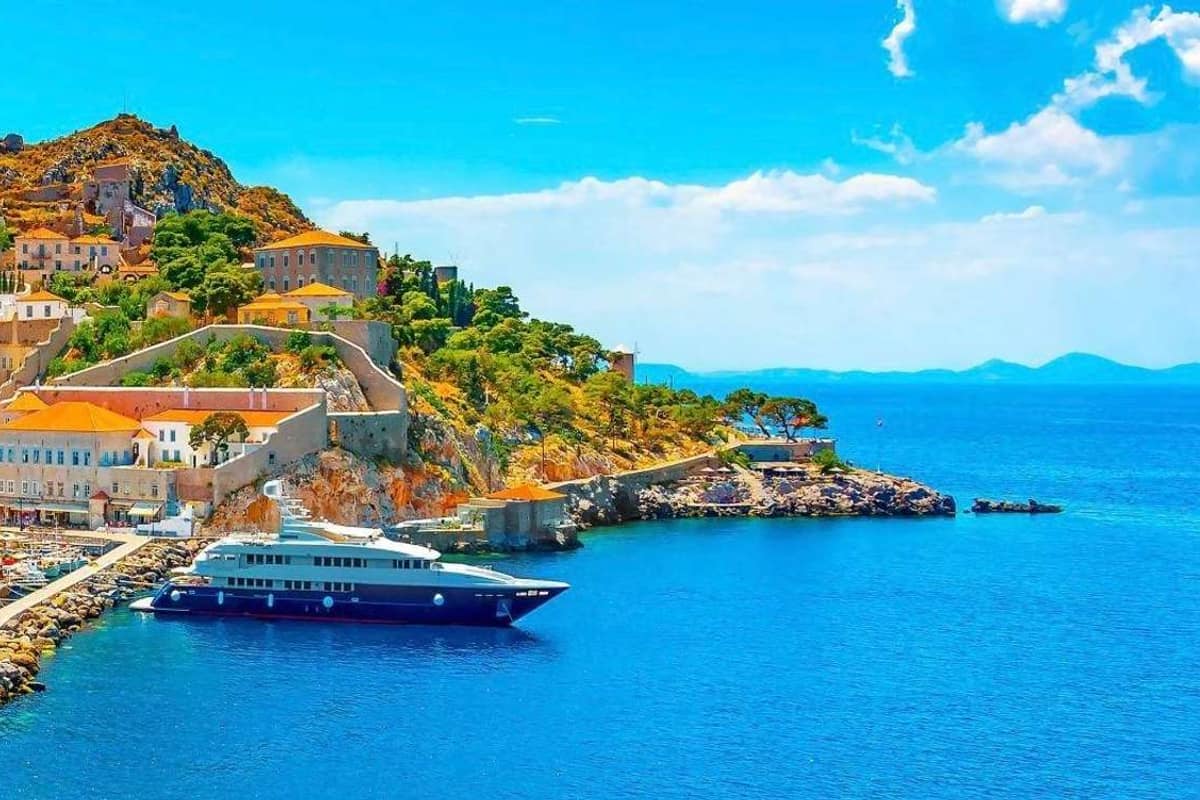
From the harbour, the coast path leads west to Kamini, Vlychos and Plakes. Pages time Kamini at about 15 minutes and Plakes at about 45. A Hydra day trip fits the walk to Kamini easily, and a full day can reach Plakes.
- Kamini: about 15 minutes on foot, beyond a small headland.
- Vlychos: between 30 and 45 minutes, as pages give it.
- Plakes: about 45 minutes, beyond the small port of Vlychos.
- Kamaroti bridge: on the path between Vlychos and Plakes.
Wikivoyage describes Kamini as a neighbouring village with far fewer tourists, one kilometre along the coast to the west. Two other pages time the stroll at 15 minutes. Kamini is the natural first goal for a Hydra day trip. The path there follows the coast road.
Kamini has a small, protected harbour with room for a couple of dozen fishing boats. Pages mention colourful boats, a pebble beach and an old fort beside it. One page points out an old windmill on the way there. Kamini is a short walk out and back on any Hydra day trip with free time.
Past Kamini the path reaches Vlychos and then Plakes. One page measures the whole walk at 3.5 kilometres. The surface is stone and gravel, wide and well kept, and it suits a Hydra day trip in walking shoes. Little of it is shaded, so a sun hat and water matter. Painted arrows mark the route.
Between Vlychos and Plakes the path crosses the Kamaroti bridge, which one page dates to the seventeenth century. Plakes then opens onto its long pebble beach, with Dokos across the water. The coast path is the main walk of a Hydra day trip.
A short, steep climb gives another view. Steps lead uphill from the corner of the harbour to a hill with a Greek flag. One page promises views there over the harbour and down the coast to Kamini. Water taxis at the centre of the port also serve Kamini and Vlychos, as Wikivoyage states.
Time decides how far you walk. One travel site says a three-island cruise leaves time for the town and a little of the coast path. It adds a tip for anyone who books their own crossing: come early and leave late. Plakes needs more of a Hydra day trip than Kamini does.
What is the Monastery of Profitis Ilias, and can a Hydra day trip reach it?
The Monastery of Profitis Ilias is a hill monastery on the slopes of Mount Eros, above Hydra Town. A Hydra day trip on your own can reach it: walking pages put the climb at one to two hours.
The monastery sits at an altitude of about 500 metres. It dates from the early nineteenth century, when Mount Athos monks founded it. It is a monastery for men. One page says it once housed a large number of priests and is now rather quiet. For a Hydra day trip it is a white compound on the hill.
The cobbled path starts at the church of Saint Constantine. It rises through pine trees. Benches along the way give a place to rest, and the views reach back over the harbour and Kamini. Three pages time the climb differently: an hour, an hour and a quarter, and two hours. Allow the longer figure for a Hydra day trip.
Two pages call the way up steep, and one reviewer calls it steep but not insurmountable. One walking page rates the route easy and another rates it moderate. So take the climb at your own pace on a Hydra day trip.
At the top, stone steps lead into the monastery precinct. Pages describe a panoramic view over the island, the Aegean Sea and the coast of the Peloponnese. One page notes whitewashed walls and gilded candelabras and chandeliers in the church. Opening arrangements change, so ask in town on the day of your Hydra day trip.
One walking page says you can explore the monastery and take photos. Another page asks you to make an appointment before you go up. The first page also asks for modest clothing, with legs and shoulders covered. Check both points before a Hydra day trip climbs the hill.
Ayia Efpraxia, a nunnery, stands about 150 metres from Profitis Ilias, among pines and cypresses. A junction on the path leads to either. One page puts the walk from the town to Ayia Efpraxia at 40 minutes. A Hydra day trip on foot can take in both.
Does a Hydra day trip leave the hours for the climb? One page counts about seven hours on the island on a day trip by ferry. A travel writer says a three-island trip covers the town and a little of the coast path. So the climb suits a day on your own better than a fixed timetable.
What is the Zourvas Monastery and the high walk up Mount Eros?
The Zourvas Monastery is a monastery for women at the eastern end of Hydra. Mount Eros, at 588 metres, is the island’s high point. Zourvas is a long outing from the harbour. A Hydra day trip suits the Eros climb better.
- Zourvas: a monastery run by nuns, in the east of Hydra.
- On foot: 2 hours 30 minutes to 2 hours 45 minutes from the town, as two pages time it.
- By boat: a water taxi to Zourva Bay, then 645 steps up to the monastery.
- Mount Eros: 588 metres high, at the heart of Hydra, above Profitis Ilias.
- For a Hydra day trip: the Eros climb starts at the harbour and passes the monastery.
Zourvas is remote, as one page puts it. Nuns live there and look after its gardens and large trees. Two pages say a Virgin icon turned up there in the late eighteenth century. As one writer notes, without cars you can only get so far on a Hydra day trip.
The trek east has little shade and an upward slope, and one page calls it long and rough. A water taxi cuts the walk and drops you at the foot of a cliff. One page says one man built the 645 steps over ten years. A fixed return boat leaves a Hydra day trip little room for either route.
Mount Eros is the highest mountain on Hydra. Two walking pages give its height as 588 metres. One places it at the heart of Hydra. Another says the summit stands about 100 metres above Profitis Ilias. The Eros climb is the high walk that a Hydra day trip on your own can still fit.
The paved track climbs in wide zigzags through the pine forest. The last stretch up Mount Eros is an uneven path, with sections where you use your hands. One reviewer found shade on the first part but none near the top. The walk with the monastery averages four hours and a quarter. That fills much of a Hydra day trip.
From the summit, a 360 degree view takes in the Aegean Sea, the Peloponnese coast and the nearby islands. The landscape on a Hydra day trip changes with the direction you walk. One walking page calls the east mostly stone and the west a pine-covered path. Wikipedia lists cypress and olive trees too, with wild cyclamen and poppies.
How did Hydra grow rich on the sea, and what does the town show today?
Hydra grew rich on shipping. Its captains built a trading fleet and carried cargo to France, Spain and America. A Hydra day trip shows the result today in the tall stone mansions that ring the harbour.
Greeka says the island began to build a powerful merchant fleet in the seventeenth century. Wikipedia adds that a school for mariners opened in that century. Every Hydra day trip lands in a port with deep roots in shipbuilding.
The boats grew with the trade. Wikipedia gives their sizes: 15 to 20 tons in the first half of the eighteenth century. A vessel of 250 tons followed in the middle of it.
The fleet grew, and so did the business. Wikipedia says the shippers began to trade goods for themselves, not just carry cargo. Each vessel became its own small business. A travel magazine says the island’s sea captains ran trade routes across the Mediterranean by the late eighteenth century.
Wikipedia gives two numbers for the nineteenth century: 125 boats and 10,000 sailors, all based here. It ties the mansions that ring the harbour to the wealth that shipping brought. A Hydra day trip meets them as soon as the boat enters the port.
One travel page says rich merchants built grand stone mansions in the late eighteenth and early nineteenth centuries. Greeka says wealthy shipowners built them. It describes three or four storeys, outside staircases to flat roofs and fenced gardens with marble drinking fountains. On a Hydra day trip you see these walls from the quay.
The boom faded when steam took over. Wikipedia says the owners did not adapt to steamships, and rival companies in Piraeus, Patras and Syros gained ground. Residents left, and large mansions fell into ruin. After that, the island lived mainly from sponge fishing, as Greeka and a travel magazine also note.
Today the town shows that past in plain sight. One page calls the whole town a protected national monument. Another says strict building codes allow no modern buildings. Wikivoyage adds that the island has no high-rise houses, so a Hydra day trip meets a low skyline of stone.
Wikivoyage also names a small museum beside the ferry dock. It covers the seafaring ways of the Hydriots, as the people of Hydra are called. You can follow the sea story indoors on a Hydra day trip, as well as along the harbour.
What do you eat on a Hydra day trip?
Eat fish and seafood first on a Hydra day trip. Two food pages name octopus, red mullet and cuttlefish cooked with rice in its own ink. The island adds almond sweets and fried dough with honey, and coffee on the waterfront starts the day.
- Seafood: octopus, red mullet and cuttlefish pilaf
- Pasta: gogles, a short handmade pasta of the Arvanite kitchen
- Pies and stews: a pie with mountain greens, and snail stew
- Meat: lamb kapama, cooked with cinnamon and cloves
Both food pages name every dish in that list except the spices. Look for them on menus during a Hydra day trip. Each one comes from the island’s own kitchen as the pages describe it.
Wikivoyage says seafood tops the menus. It notes that nearly all of it is imported frozen from far away. It adds that only a handful of kitchens serve local fish. On a Hydra day trip, ask where the fish comes from.
A travel writer saw the other side at sunrise. Fishermen came in with the day’s catch and turned their boats into fish stalls. Locals came to buy.
The island grows almost nothing itself. One food page says supplies come from Argolida and Piraeus. A taverna owner on a beach told another writer that all supplies arrive by boat. Even lunch carries a sea story during a Hydra day trip.
The same food page lists the old sailors’ foods: galette, preserved beef, legumes and salted cod. It also lists old imports, such as rice, figs, butter, coffee and sugar. Together they tie the island’s table to its sailing past.
For something sweet, two food pages name almond sweets called amygdalota. One says they are made with flower water, in the shape of a small pear. Lalaggites are fried dough served with honey, or with grape syrup as one page adds. A Hydra day trip leaves room for one sweet stop.
Coffee comes first. A travel writer had Greek coffee at a harbour cafe in the morning. Another page lists it at the port too. Wikivoyage says the harbour cafes serve ouzo and other drinks as well as coffee.
A third writer ordered Greek yogurt with honey and fruit beside the ferry landing. Cafes open at sunrise, a fourth page says, so a Hydra day trip can start slowly.
Which Hydra day trip suits you: a ferry on your own, a guided day trip or a day cruise?
A Hydra day trip comes in three kinds: a ferry on your own, a guided trip and a day cruise. Each mixes freedom and planning in a different way. Choose by the share of the day you want planned for you.
A ferry on your own turns a Hydra day trip into an open day. One travel writer advises you to come early and leave late. The goal is to see beyond the town and feel no rush. You choose every hour yourself.
The hours on the island follow the boats you book. A traveller who crossed alone from Ermioni on the Peloponnese mainland had about seven hours there. That was enough to explore the main village. The first writer calls this way a fit for a confident traveller who is not in a rush.
A set of transfers can frame the same open day. One page for a private Hydra day trip books the boat and the rides to the port. After arrival the day stays open, with no tour guide on the island. It calls its times approximate, as they depend on the boat schedules.
A guided Hydra day trip fills the hours with a plan. One page lists a ten-hour day with six hours on the island. Those hours hold a one-hour guided walk through Hydra Town, past mansions and stone alleys, then free time. The page adds a swim at Spilia, as weather and sea allow.
Another page builds a different day. The group sails from Piraeus and joins a guided tour of the town. A boat then carries everyone to a beach for lunch and a sunbed. Free time in town is optional, and a return boat brings the group back to Hydra port.
Either guided kind of Hydra day trip fits a visitor who wants the town explained and no timetable to watch.
A day cruise puts the Hydra day trip on a ship. Two cruise pages start in the morning. One gives 7:45, and the other has a sailing at 8:30. Both serve lunch on board and give free time on Hydra to stroll, shop or swim. Both return to the marina around seven in the evening.
Neither page states how long the ship stays at Hydra. The same cruise also calls at Poros and Aegina. One travel writer warns that a short stay on each island gives only a taste. His advice for a Hydra day trip is to focus on that island alone.
Whichever Hydra day trip you pick, read the times on the page you book. The pages state them as plans.
What do you wear and bring on a Hydra day trip?
Wear flat walking shoes with a good grip, and carry sun protection, swimwear, a towel and water. A Hydra day trip means steps, cobbles and a coast path with little shade, so pack one small bag.
- Flat walking shoes or sturdy sandals with a good grip
- A hat, sunglasses and sunscreen
- Swimwear, a towel and a water bottle
- A light jacket or cardigan for the cooler hours
- One small backpack or soft bag, plus photo ID
Shoes come first on a Hydra day trip. One packing page calls the cobbled streets challenging and asks for sturdy sandals or comfortable walking shoes. It says to avoid heels and flimsy flip-flops. A second page wants chunky soles for grip, because rain makes the streets slippery.
The lanes climb fast. A visitor describes steps that are sometimes shallow and sometimes nearly vertical. For clothes, one page asks for comfortable, loose-fitting clothes, especially in summer. Another adds a cover-up or sarong for the walk to and from the beach.
The sun needs a plan. A visitor on a Hydra day trip found the coast path wide and well kept but largely unshaded. That visitor calls a hat, water, sunscreen and decent shoes non-negotiable. A packing page adds sunglasses, a reusable water bottle and fresh sunscreen after swimming.
Swim kit for a Hydra day trip is simple. One guided trip page lists swimwear, a towel, sunglasses and water. A cruise page asks for a hat, suntan lotion and a bathing suit. A travel writer notes that the beaches are mostly pebbly. Waterproof beach shoes from the harbour shops make the way into the water easier.
A thin layer is a small extra. One packing page recommends a light jacket or cardigan, because evenings can be cooler, especially in spring and autumn. A day trip runs from the morning into the evening, so the layer is worth its space.
Carry your own kit on a Hydra day trip. A packing page prefers a backpack or soft duffel to wheeled luggage, with a small daypack. A visitor adds that donkeys have the right of way, so step aside when you hear one. One page asks guests to reach the start 15 to 20 minutes ahead, with a photo ID.
What else do travellers ask about a Hydra day trip?
Can children, slow walkers and wheelchair users enjoy a Hydra day trip?
Children who can walk fit a Hydra day trip well. A travel blog answers a parent with a five-year-old that Hydra Town is small and walkable. The reply adds that the donkeys are fun for a child to watch. Water taxis carry visitors from the town to beaches, so the heat needs no worry.
The ground sets the limits. Wikipedia describes the lanes of the town as steep and stone-built, climbing away from the harbour. A travel writer finds cobbled lanes that narrow within a couple of blocks. The steps are sometimes shallow and sometimes nearly vertical. A magazine writer notes stairs and ups and downs, and elderly women carrying three bags of shopping.
Slow walkers and wheelchair users need more care on a Hydra day trip. One travel page calls the ground not wheelchair-friendly. It advises visitors with mobility needs to ask hotels or tour operators first. Wikivoyage places nearly all the sights along the water. Others stand in the streets just behind the harbour or beside the coast road.
How do the weather and the sea change through the seasons on a Hydra day trip?
Wikipedia lists the climate of the island as semi-arid and hot. The yearly mean is near 20 degrees Celsius, with about 390 millimetres of rain a year. A weather page for travellers calls summer quite hot to very hot. July and August bring the hot peak, says the page, while January and February bring the cold one.
The sea follows the seasons on a Hydra day trip. The same page calls the sea cold in April, warmer in June and very warm in July. In September it stays really warm, and in October it is still good for a swim. In November the sea cools again. In the coldest months the page does not recommend swimming.
One blogger on a Hydra day trip came in the first days of late spring. The bougainvillea was in full bloom, and the streets were quiet on a Friday. Weekends can bring visitors from Athens, the blogger adds. The weather page says businesses on the island mainly close near the end of October and reopen in mid-April.
Is a Hydra day trip enough, or does the island need a night?
A Hydra day trip shows the harbour and the main town. One travel writer says the town can be the only part that day visitors see. The writer urges one night at the least, with longer for a hill hike or a beach afternoon. A third writer was still finding new things after three weeks.
On your own ferry, the first writer says to come early and leave late. That way you take in more than the town and keep a calm pace. Another writer spent about seven hours on the island and says staying the night is even better. A fourth says that a little longer lets the island open up further.
According to Wikivoyage, the town is relatively peaceful at night because the day visitors have left. Peaceful back lanes sit minutes away from the busy harbour boulevard. A writer up at sunrise watched merchants unload boats and load donkeys while cafes served coffee. If a Hydra day trip is all you have, one writer advises focusing on Hydra alone.
Is a Hydra day trip like one to Aegina or Poros, and where does the return boat wait?
Aegina covers about 87 square kilometres. Wikipedia lists regular bus services between Aegina town and places throughout the island. Poros covers about 31 square kilometres, has a good road network and draws weekend visitors from Athens. Hydra covers about 50 square kilometres and allows no wheeled vehicles. A Hydra day trip is a day on foot.
Wikivoyage writes that every hydrofoil and every catamaran lands at the port of Hydra, midway along the northern side. A travel writer calls the main town the place where the ferries dock. Another writer found small cafes with tables along the harbour right where the ferry drops you off.
One operator page lists a boat back to Hydra port after the beach stop of a guided trip. Wikivoyage says agencies at the harbour sell seats on all boats. It adds that small boats can sell out in peak periods. Check the time of your boat home before a Hydra day trip takes you up the hill.