
A Cappadocia red tour starts with a morning pickup and spends the day on the north side of Cappadocia in central Turkey, among rock-cut churches, a high rock castle, fairy chimneys and a pottery town on a long river. Follow the day stop by stop below, and open the list of tours in Greece if your holiday carries on across the Aegean.
The sections ahead set out what a Cappadocia red tour is and how long it runs; where the north route lies and what story its rock tells; what the open air museum, Cavusin and Uchisar Castle show; what waits at Pasabag, Devrent and Avanos; which kinds of tour exist and how the roads link the stops; how the visiting rules, the dress and the seasons shape the day; and what else travellers ask.
What is a Cappadocia red tour, and how does it run?
A Cappadocia red tour is a one-day trip around the north of Cappadocia in Turkey. A bus or van collects you at your hotel. A tour guide then leads you through valleys, villages and viewpoints before the drive back.
In plain words, a Cappadocia red tour gathers the main sights near Goreme into one day. A tour article lists viewpoints, fairy chimneys, open air museums and crafts, with light walks and photo stops. Another page says the route keeps the group close to Goreme.
Operator pages describe the Cappadocia red tour as a day that starts and ends at your hotel. One page names Goreme, Urgup and Uchisar as the pickup towns. Another page offers pickup from any hotel in Cappadocia.
Each page sets its own order of stops for a Cappadocia red tour. One operator page says its list shows the general flow of the day. One itinerary opens with Love Valley, then visits Pasabag, the Zelve Open Air Museum and Devrent Valley. A pottery workshop, lunch and Uchisar Castle follow.
Another itinerary opens at the Uchisar viewpoint. Next come the Goreme Open Air Museum and Love Valley. Then come Cavusin, Avanos, lunch, Pasabag and Devrent Valley. The first stop of a Cappadocia red tour is Love Valley on two pages. Uchisar opens the day on three pages, and Devrent Valley on a private tour page.
The number of stops on a Cappadocia red tour differs too. One itinerary lists seven stops with lunch, and an optional workshop stop on request. Another itinerary lists nine stops with lunch. It runs from the Uchisar viewpoint to the Urgup fairy chimneys, then returns to the hotel.
On a Cappadocia red tour, lunch is a set stop in the plan. One page places lunch in Avanos at a local restaurant, and a tour article puts it in or near Avanos. That article names a set menu with soup, a main course, salad and dessert. Another page adds vegetarian options.
One tour article says the name of the Cappadocia red tour comes from the red clay of the Kizilirmak. Wikipedia confirms the parts. Kizilirmak means Red River. Avanos pottery is made with clay taken from red silt along that river.
The tour closes when the vehicle returns you to your hotel. Two pages mention an optional stop at a leather or carpet workshop before the drop-off. One page ends the Cappadocia red tour at Love Valley. Another ends at Uchisar Castle, and a third at Devrent Valley.
How long is a Cappadocia red tour, and when does it start?
A Cappadocia red tour fills a full day of about six to nine hours, going by the operator pages. The hotel pickup falls in the morning, between 9:00 and 10:00, as three pages give it.
The length of a Cappadocia red tour varies by operator. A first page lists 6 hours, a second says around seven hours, and a third says 7 to 9 hours. Two more pages give 6 to 8 hours. A booking page lists 7 hours as well.
The start of the Cappadocia red tour is early. One operator page gives a pickup window of 9:30 to 10:00. A second page says the day starts around half past nine. A tour article names a window from 9:00 to 10:00.
A private tour page says its estimated time of 6 to 8 hours is subject to change. The page links the change to the crowds and to the timing of the departure. It gives an approximate departure of 9:30 to 10:00. So a Cappadocia red tour keeps no fixed clock.
For a Cappadocia red tour, a tour article advises asking for a detailed itinerary before you book. It says group tours add shopping stops. It also advises confirming in advance how much time each of those stops takes.
One sample itinerary of a Cappadocia red tour gives a time for every stop. Pickup runs from 9:30 to 10:00, and Love Valley opens at 10:15. Pasabag follows at 11:00 and the Zelve Open Air Museum at 12:15. Devrent Valley starts at 13:30 and the pottery workshop at 14:15.
The same sample shows how long each stop lasts. Love Valley takes half an hour, Pasabag one hour and the Zelve Open Air Museum one hour. Devrent Valley takes half an hour, the pottery workshop three quarters of an hour and Uchisar Castle half an hour. The page leaves 15 minutes between one stop and the next.
Group size is stated too. A Cappadocia red tour with a group runs on a small bus. One page caps the shared bus at 16 people, another at 15 and a third at 18. A tour article says groups of 15 to 20 people are common.
The return comes in the late afternoon. One page gives a drop-off around 16:30 to 17:00. A tour article gives the return as 16:00 to 17:00. The sample itinerary has the drop-off at 17:00 to 17:15 with the workshop and at about 15:45 without it.
A tour article says the Cappadocia red tour runs all year. An operator page adds that routes can vary slightly by season.
Where does the north route lie on a Cappadocia red tour?
A Cappadocia red tour lies in the north of the touristic Cappadocia region, in Nevsehir Province in central Turkey. Its stops cluster around Goreme, Uchisar and Avanos, a short drive apart, with Urgup to the east.
Wikivoyage says ancient Cappadocia reached from Sivas in the northeast to Aksaray and Nigde in the southwest. Today the name points to a smaller district around Nevsehir. Nevsehir Province covers 5,485 square kilometres. Its neighbours include Kirsehir to the northwest and Yozgat to the northeast. A Cappadocia red tour stays inside this one province.
Wikivoyage lists Goreme, Uchisar, Urgup and Avanos among the towns of the region. It sets Goreme among fairy chimneys and rock churches. Uchisar has carved pinnacles, Urgup has cave dwellings and rock cones, and Avanos makes pottery. A Cappadocia red tour draws its character from this group of towns.
Goreme is not the only base. Wikivoyage calls Avanos an alternative base for exploring the area. Wikipedia calls Urgup a good base, with more amenities than other Cappadocian towns. Both lie within reach of the stops on a Cappadocia red tour.
Main roads shape the map. Wikivoyage places Avanos just off the D300 highway, and Uchisar off the D302 on the way to Goreme. Wikipedia says the newer quarter of Uchisar stands nearer the Nevsehir to Goreme road. It puts Avanos 18 km north of Nevsehir, the provincial capital.
The valleys sit between the towns. Wikipedia sets Zelve on the way to Avanos, 10 km out of Goreme. Cavusin stands between those two towns. Wikivoyage puts Devrent Valley along the road that links Avanos and Urgup. So a Cappadocia red tour moves through a compact cluster of villages and valleys.
The Kizilirmak, the Red River, marks the northern side of the route at Avanos. Wikivoyage says it makes a great loop across Anatolia and reaches the Black Sea near Samsun. Wikipedia adds that the river is a source of hydroelectric power. A Cappadocia red tour meets this river in Avanos.
Two airports serve the area, Nevsehir Kapadokya and Kayseri Erkilet. Wikipedia’s Goreme page names this pair as the nearest to the town. Transfer pages give about 40 km to Goreme from there, with 35 to 45 minutes on the road.
Kayseri is farther away. The transfer pages give roughly 70 to 80 km to Goreme, a drive of an hour or longer. Allow for the longer road before a Cappadocia red tour.
What story of the rock does a Cappadocia red tour tell?
The story of a Cappadocia red tour starts with volcanoes. Ash from old eruptions set into soft tuff. Wind and water carved it into fairy chimneys, and people cut homes, storerooms and churches into the stone.
Wikipedia’s park page says volcanoes spread ash millions of years ago, and it set into soft rock. Lava later covered the tuff and formed a protective cap. Over thousands of years, erosion shaped pillars, tent rocks, rock towers and multicoloured cliffs. A Cappadocia red tour crosses this worn ground.
Wikipedia names wind and water as the carvers. Its page on rock-cut building calls the process a special form of rill erosion, which affects much of Turkey. Solid tuff and ignimbrite let streams cut deep, steep channels. Tower-like shapes form where they meet at right angles, a sight to watch for on a Cappadocia red tour.
A fairy chimney is a thin spire of soft rock under a harder cap. Wikipedia explains that the cap shields the column below, and its weight helps the column resist wear. In time the cap is undercut and falls. The bare cone then wears away fast.
People used this stone early. Wikipedia says cave homes were carved around Goreme from at least the third century. Villagers cut houses, churches and monasteries from the volcanic rock, as Wikipedia states. Around the rock castles, ground-level caves still serve as stables and storerooms. A Cappadocia red tour with stops at Zelve and Uchisar passes carved rooms.
Across the region, churches and monasteries number in the hundreds, as Wikipedia reports. Its page on rock-cut building says Byzantine church design strongly shaped these churches. Builders carved columns although the solid rock needed none for support. On a Cappadocia red tour, look up for domes and barrel vaults, two forms that page names.
These churches span a long period. Around Goreme, Wikipedia dates a group of simpler cave churches to the sixth and seventh centuries. Others come from the tenth and eleventh centuries, the age of much of the painting on the walls. Keep both periods in mind on a Cappadocia red tour.
This rock has World Heritage status. The UNESCO entry pairs Goreme National Park with further rock sites in the region. Wikipedia says streams have sliced the plateaus and high hills of the park into valleys with steep walls. Basalt and thick beds of tuff make up part of this rugged ground.
Uchisar sits on the edge of that park, as Wikipedia states. Inside lies Love Valley, which Wikipedia links with fairy chimneys. Operator pages add this valley to a Cappadocia red tour. The same worn rock fills both the park and the route.
What does the Goreme Open Air Museum show on a Cappadocia red tour?
The museum near Goreme is a rock settlement of monks, with churches, chapels, dining halls and living rooms. On a Cappadocia red tour, this stop brings the painted walls of the rock-cut churches into view.
The museum lies in a valley 1 km east of Goreme, as Wikivoyage states. Another travel page puts the walk from town at about 20 minutes. One trip page lists the museum as a stop on the Cappadocia red tour. Other pages list the Zelve Open Air Museum instead, and one travel writer states that tours stop at either.
The ministry in charge of museums calls the site a rock settlement. Monastic life ran there from the fourth century to the thirteenth century AD. Wikipedia adds that a village named Korama stood here in Byzantine times. A Cappadocia red tour that stops here shows a whole monastic site, not a single room.
The Ministry page names a Girls’ and Boys’ Monastery and nine churches. They include the Dark Church, the Apple Church, the Sandal Church, the Snake Church, Saint Barbara and Saint Basil. It also names the Buckle Church. Wikipedia calls it the largest church in Goreme.
Wikivoyage places the Buckle Church 50 m outside the main compound. Another page puts it outside the main valley enclosure, down the hill toward the town. So the Buckle Church needs a short walk beyond the main loop on a Cappadocia red tour.
A Cappadocia red tour shows two kinds of wall work. The Ministry page states that the first was painted on the rock itself. The later one used the fresco-secco method. The later paintings show scenes from the Bible and the life of Jesus. Wikivoyage adds that the churches became richly painted from the ninth century.
Wikivoyage states that the Dark Church first had no windows, and the darkness kept its frescoes. Another page says the frescoes stand out because the building takes little light. Two pages agree, so the Dark Church is the room to look at closely on a Cappadocia red tour.
Wikivoyage describes a loop trail with the painted cave churches and fairy chimneys along it. Time is the limit on a Cappadocia red tour. A full round takes two to three hours, as Wikivoyage states. One trip lists nine stops in a day, so the museum shares the day with eight others.
Opening hours change. The official Ministry page lists the museum as open every day and gives an opening time of 8:00. Two travel pages say the museum closes earlier in winter. For a Cappadocia red tour, read the official page before the day you go.
What do Cavusin and Uchisar Castle add to a Cappadocia red tour?
Cavusin adds an old cliff village with a rock-cut church. Uchisar Castle adds a 60-metre rock pinnacle with wide views. Together they give a Cappadocia red tour a village stop and a viewpoint stop.
Cavusin is a village in the Avanos District of Nevsehir Province. It lies on the road between Avanos and Goreme, 5 km north of Goreme, as Wikipedia and Wikivoyage state. The Cappadocia red tour routes of two operators pass through the old village.
Wikipedia states that the old part of Cavusin spreads around a big rock ridge, easy to spot from afar. One operator page says the old village was abandoned and carved into the hillside. Another calls it a cliffside settlement with rock-cut churches. This old cliff settlement is the village stop on a Cappadocia red tour.
Wikipedia counts two rock-cut churches in Cavusin, each named for Saint John the Baptist. Wikivoyage places one cave church of that name on the south side of Cavusin. The first church sits by the main road, with its painted walls open to view.
Inside the first church, the walls show familiar Bible scenes such as the Nativity. Wikipedia dates the church to the tenth century through the paintings of a Byzantine emperor and his wife. This church is the main sight of Cavusin on a Cappadocia red tour.
From the ridge above Cavusin, Wikipedia says, you can look down on a group of fairy chimneys. Wikivoyage places a group of fairy chimneys at the north end of the village. Both pages put rock shapes at Cavusin. So the village adds them to a Cappadocia red tour as well as a church.
Wikivoyage states that Uchisar, home of the castle stop on a Cappadocia red tour, lies 4 km from Goreme. Wikipedia places it 7 km east of Nevsehir. Uchisar means outer citadel in Turkish. The name points to the huge rock cone at the centre of the town.
The castle that a Cappadocia red tour points out is a 60-metre pinnacle of tuff. Tunnels and rooms are cut inside it. Wikipedia and Wikivoyage agree that these are largely closed off today. In Byzantine times the rooms were homes, and Wikipedia gives an estimate of around 1,000 residents.
Operator pages call Uchisar Castle the highest point in Cappadocia and a viewpoint over the valleys. Wikivoyage counts 275 steps to the top. One travel writer gives that as the reason the tour only points out the castle, with time at the base.
The order differs by trip. One Cappadocia red tour starts the day at the castle viewpoint. Another stops there late in the afternoon for 30 minutes, as the two operator pages list it.
What do Pasabag and the Devrent Valley show on a Cappadocia red tour?
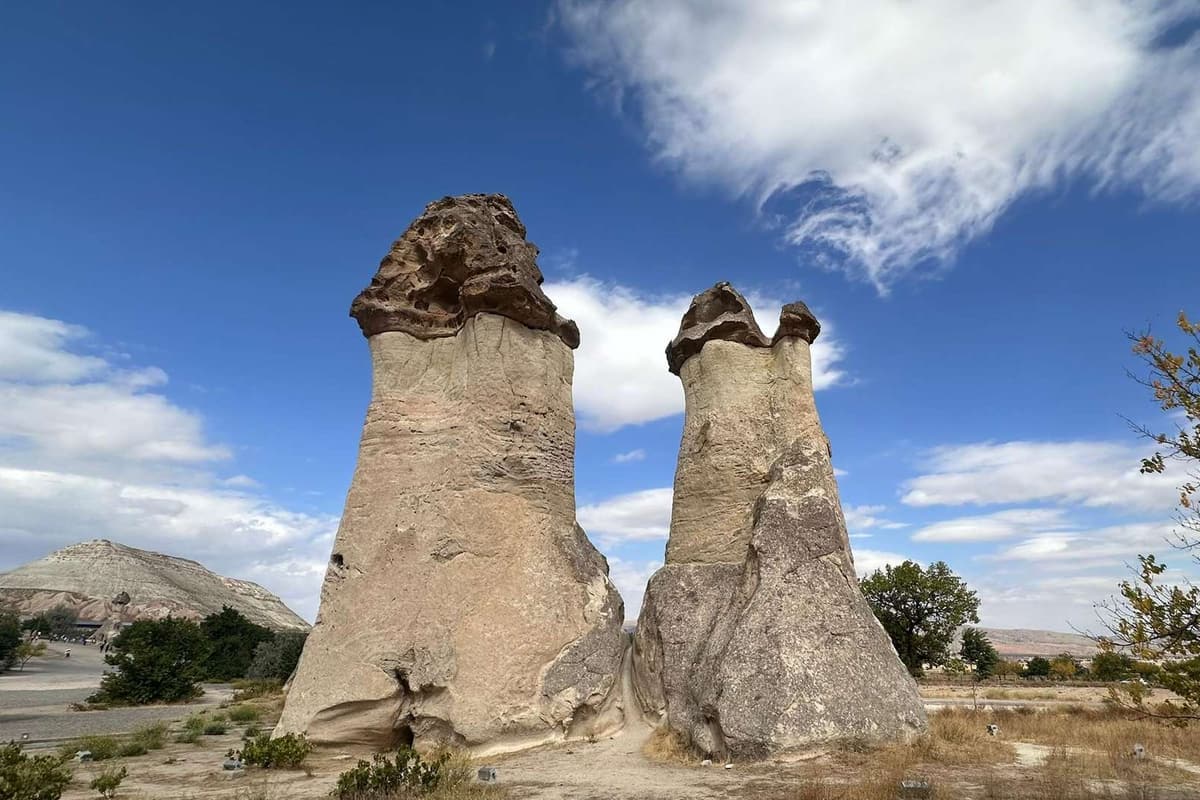
A Cappadocia red tour shows two rock valleys near Avanos. Pasabag, also called Monks Valley, has fairy chimneys with more than one head. The Devrent Valley has rocks that look like animals. Each valley is a short walking stop.
Pasabag lies between Cavusin and Avanos on the main road from Goreme, as one tourism page states. Wikivoyage calls it the closest area of fairy chimneys to Avanos and puts it 5 km south of the town. A Cappadocia red tour stops here for that reason.
Operator pages describe the chimneys as mushroom-shaped. A second page calls them multi-bodied and multi-headed. Paths run through the valley, so a walker sees one chimney from different angles and heights. Photographs of the chimneys are simple to take from these paths on a Cappadocia red tour.
One chimney has three heads. A chapel and a seclusion room lie inside it, both dedicated to Saint Simeon, as two pages state. Crosses decorate the entrance. A tunnel staircase leads up to the cell, and the rooms let the monks cook, eat and pray. A Cappadocia red tour passes this chimney.
The valley took the name Monks Valley because monks once used these formations. One page adds that visitors learn about early Christianity here. The Wikipedia page on Zelve places Zelve 1 km from Pasabag. Zelve and Pasabag are close neighbours on a Cappadocia red tour.
The time at the valley differs. One itinerary sets Pasabag at one hour in the late morning. Another page says visitors have time to explore and to take photographs. Both pages treat Pasabag as a walking stop of the Cappadocia red tour, not a long hike.
Devrent is also called Imagination Valley. Wikivoyage places it east of Avanos along the road to Urgup. A tourism page says it lies just after Zelve. Daily Sabah puts it 10 minutes by car from Goreme. This is a short drive on a Cappadocia red tour.
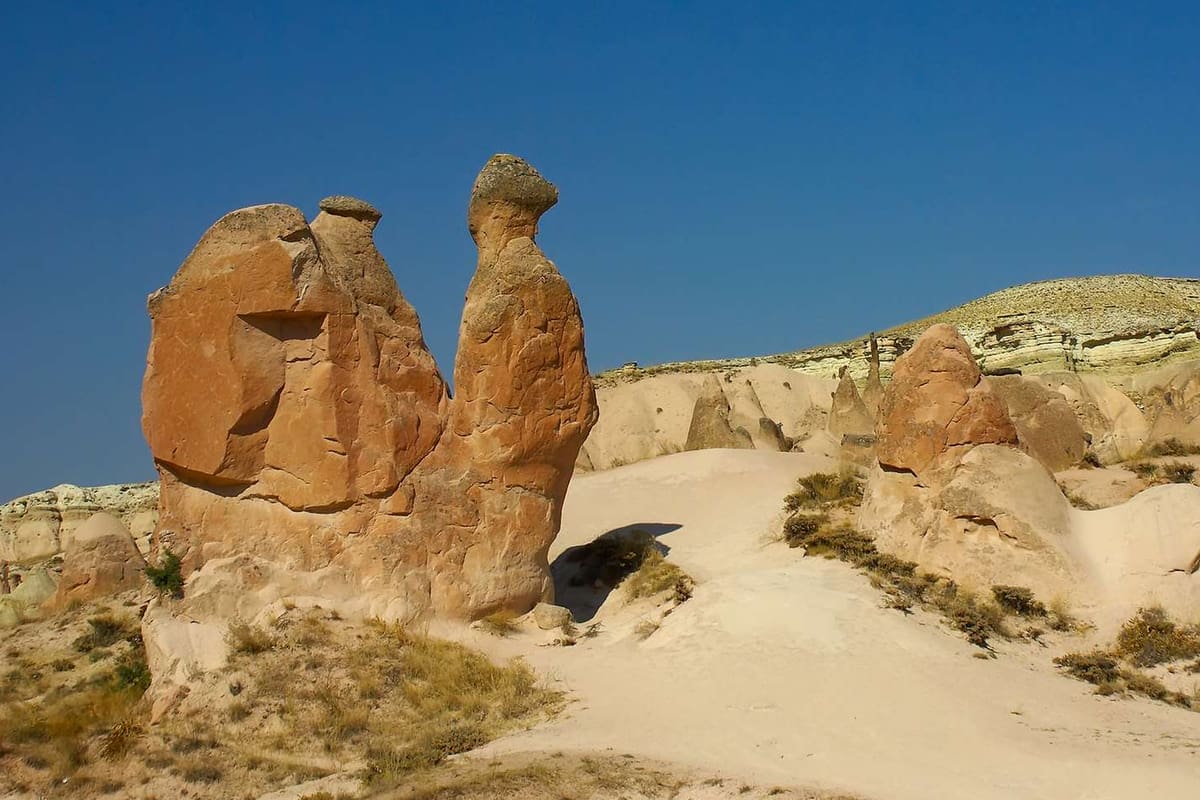
Devrent means “pit and cliff”, as one tourism page explains. Wikipedia says people read a camel into the rock. A traveller page says the rocks all looked like camels. Other pages name a penguin as well. Wind and water cut these shapes, and no sculptor made them. Daily Sabah says the valley has stayed largely untouched by people.
A Cappadocia red tour treats Devrent as a quick stop. One itinerary gives it half an hour. Daily Sabah says parts of the valley are fenced off to protect the rock. An operator page asks visitors not to climb or touch the formations.
Two pages put the Love Valley on the Cappadocia red tour route as well. One itinerary opens the day there. Another page ends the tour there. Wikivoyage describes a dirt road that leads into the valley from the north for cars. Walkers have two shorter routes.
What does Avanos add to a Cappadocia red tour?
Avanos adds the pottery stop to a Cappadocia red tour. The Kizilirmak, called the Red River, runs beside the town. Its potters shape red clay that the river left behind.
Avanos is a town in Nevsehir Province, on the banks of the Kizilirmak. Wikipedia also calls the river the ancient Halys. Wikivoyage says the old town on the north bank is walkable. The modern town lies on the south bank. A Cappadocia red tour reaches the town for its workshop.
Wikipedia gives pottery as the leading industry of the town. It says the craft probably dates to Hittite times. Another page traces its roots to the second millennium BC. A third says clay kitchenware has been made there for thousands of years. Ancient Avanos bore the name Venessa. In the geographer Strabo’s ranking it came third among the kingdom’s towns.
Two pages describe the same steps for a pot. Potters sift clay from old river beds and the hills around the town. They mix it into soft mud and shape it on a foot-powered wheel. The pieces dry in the sun and then in the shade. A kiln fires them at 800 degrees Celsius or more.
On a Cappadocia red tour the workshop is a kind of stop. Tour pages say visitors watch traditional techniques in action. They can try making a pot themselves. One itinerary sets the stop at 45 minutes. A traveller page advises asking before booking how long this stop lasts.
The order of the day differs. One itinerary has the workshop before lunch. Another has lunch first and the workshop afterwards. In both cases the workshop comes after Pasabag and Devrent. The potters close the valley part of a Cappadocia red tour.
Wikivoyage describes a narrow footbridge over the river that sways when it fills with people. A tourism page calls the swinging bridge a symbol of Avanos. It also lists a river walk along the Kizilirmak. Both lie in the town that a Cappadocia red tour visits.
Wikipedia also names the rock-cut Dereyamanli church in Avanos. The Christian population of Roman and Byzantine times carved it. Wikipedia adds that the church is still occasionally in use. The town therefore holds both a craft and a place of worship from the past.
Which kinds of Cappadocia red tour exist?
Four kinds of Cappadocia red tour exist. A group tour shares a minibus, and a private tour has its own vehicle. A third kind speaks another language, and a fourth adds extras such as museum tickets or a pottery stop. All four cover the north of Cappadocia.
The group version is the standard Cappadocia red tour. One page describes it as a set itinerary with shared transport and a small to medium group. A second page puts a limit on the people in one shared bus for a more relaxed day. A third page calls the day a quick introduction to the main sights near Goreme.
The private Cappadocia red tour gives the visitor control. One page says a private tour allows more flexibility in timing, stops and pace. Another page offers a dedicated tour guide and a vehicle for one party only. A third page plans a private day for six to eight hours. It adds that this length is subject to change.
A Cappadocia red tour in another language is the third kind. One page runs a group version with a licensed tour guide who speaks Spanish or Russian. It lists the museum entries and a traditional lunch with it. Another page organises a private tour in the language the visitor chooses.
The fourth kind of Cappadocia red tour adds extras to the day. One small-group trip lists museum tickets, a pottery workshop in Avanos and a local lunch together. Another page describes the lunch as a set menu or a buffet. A third page says the group lunch comes with vegetarian options.
A pottery stop makes a Cappadocia red tour hands-on. One page says visitors are invited to try shaping clay on the wheel. Another page lists a hands-on pottery experience in Avanos. Not every trip offers a class. The private route on one page offers only a visit to a local pottery shop.
A balloon morning sits beside the Cappadocia red tour as a separate trip. One listing pairs sunrise balloon watching with the red tour in a day of eight hours. Another page advises against booking the red tour for the morning after a balloon ride. Both start early, and a rested visitor enjoys the day more.
Length and fit differ by kind. One account of a half-day taxi version covers Pasabag, Zelve and Devrent Valley. The writer visited the Goreme Open Air Museum alone afterwards. The green tour, the southern sister of the Cappadocia red tour, runs about nine hours. The group version is easygoing and suits all ages, as one page states it.
How do the roads and the stops fit a Cappadocia red tour?
A Cappadocia red tour moves between towns on short roads. A minibus or a van collects visitors at the hotel. The order of the stops changes by operator. Every stop lies within a short drive of Goreme.
The vehicle on a Cappadocia red tour is small. One page names an air-conditioned minibus for the group version. Another page names an air-conditioned minivan for the private version, and a third page names a van with a driver. All three pages describe a pickup at the hotel.
The pickup area covers the main tourist towns. One page names hotels in Goreme, Uchisar and Urgup, plus nearby towns. Another page says the tour guide meets visitors in the hotel lobby. The first page adds one point for a hotel further out. Ask about a central meeting point before the Cappadocia red tour starts.
The distances between the stops are short. Wikipedia places Cavusin about five kilometres north of Goreme, and Wikivoyage gives the same figure. Uchisar lies 10 kilometres south of Avanos and 12 kilometres west of Urgup. Zelve lies 5 kilometres from Avanos and 1 kilometre from Pasabag. A Cappadocia red tour strings these places together in a single day.
Public roads in the same area carry shared minibuses called dolmus. Wikivoyage says they link Avanos, Cavusin and Urgup with Goreme, Uchisar, Nevsehir and Ortahisar every 30 to 60 minutes. A single journey takes under 30 minutes. One page calls the distances of a Cappadocia red tour short, because all stops lie close to Goreme.
Operators arrange the stops in a different sequence. One Cappadocia red tour opens at Love Valley and ends at Uchisar Castle. Another page opens at Uchisar Castle and ends at Love Valley. A third page starts with Devrent Valley. A fourth page starts at the Goreme Open Air Museum and moves on to Avanos, Pasabag and Devrent Valley.
Neighbouring stops follow one road. Devrent Valley lies on the road between Avanos and Urgup, right after Zelve, as one page states it. The pottery workshop in Avanos follows Devrent Valley on two pages. At each stop of a Cappadocia red tour the tour guide gives information. Time to explore and take photos follows, as one page states it.
Shopping stops need a word. One page adds an optional leather or carpet workshop on request. The day ends earlier when the visitor skips it. Another page warns that group tours can add shopping stops. It advises asking for a detailed itinerary before booking a Cappadocia red tour.
Visitors reach the pickup area by road from the airports and the cities. Wikivoyage puts the Kayseri bus at one departure each hour, with a ride of 90 minutes through Avanos. Buses from Ankara reach Nevsehir in three hours, where a dolmus carries visitors on to Goreme. Nevsehir Kapadokya Airport has car hire and taxis, as Wikivoyage states it.
What are the visiting rules and the dress for a Cappadocia red tour?
A Cappadocia red tour keeps to the hours posted at every site, and those hours shift with the season. The Culture and Tourism Ministry page on the Goreme Open Air Museum shows daily opening. Two travel pages advise covered shoulders and knees inside the rock churches.
The Ministry page says the Goreme Open Air Museum is open every day. It gives 8:00 as the opening time and 17:00 as the closing time. The box office closes at 16:15. A Cappadocia red tour that visits the museum works inside those hours.
Other pages give different hours. Wikivoyage gives the daily span as 8:00 to 19:00. A travel page says 8:30 to 19:00, with an earlier winter close at 17:00. So the hours move with the season. Read the official page before the day of your Cappadocia red tour.
The Dark Church has its own Ministry page. It shows the same 8:00 opening and 17:00 closing, but its box office closes at 16:45. An operator page adds that tour routes vary slightly by season. The stops of a Cappadocia red tour can shift a little.
The Ministry pages state no rule on photography. One operator page says photos are forbidden in the Dark Church to protect the building. A travel page says a crowd at a church door can cut off the daylight inside. It suggests a torch. Look for the signs at each church on a Cappadocia red tour.
An operator page lists what is not allowed. Visitors keep their hands and feet off the rock shapes, the painted caves and the old buildings. So is leaving litter in valleys and historical areas. The same page says pets are not allowed. Keep to these rules at every stop of a Cappadocia red tour.
Two travel pages advise covered shoulders and knees at the cave churches. One of them names the Goreme Open Air Museum and Zelve. The Ministry pages set no dress rule, so this stays advice. Wikipedia says Zelve spreads over three valleys, and a tunnel links a pair of them.
A trip report says the route crosses uneven ground, so comfortable shoes are necessary. Another page warns against thin-soled sandals and high heels. It also lists a hat, sunglasses and sunscreen. The trip report adds layers, since the weather varies, especially in shaded valleys. Pack both lists for a Cappadocia red tour.
How do the seasons and the time of day change a Cappadocia red tour?
The seasons change the heat, the crowds and the daylight on a Cappadocia red tour. The hour of the day changes the light on the rock. A trip report says the tour runs all year. Wikipedia gives hot, dry weather in summer and cold, snowy weather in winter.
Wikipedia ties the climate to the inland location and the high altitude, and calls the rainfall sparse. It places the land on a high plateau, above 1,000 m in altitude. Wikivoyage adds chilly nights, plus spring thunderstorms with heavy downpours. These facts set the weather for a Cappadocia red tour.
A trip report describes April to June as a warm stretch of bright days and green fields. It calls September and October mild, with fewer crowds. Wikivoyage names September in particular. A travel page lists light jackets and long sleeves for spring, and a medium-weight jacket for autumn. These are the more comfortable months for a Cappadocia red tour.
The trip report calls July and August very hot and dry, and says walking can be tiring. It advises water and sunscreen. A travel page says the Anatolian sun can be intense in every season. It lists light cotton or linen clothes for summer. Pack that kit for a summer Cappadocia red tour.
The first report calls December to February peaceful but cold, with shorter daylight and paths that can turn icy. A travel page lists thermal underwear, heavy coats, scarves, gloves and woolly hats, plus boots with good grip. A winter Cappadocia red tour needs that kit.
Sunrise and sunset, says Wikivoyage, bring slanting light. It tints the rock formations and throws deep shadows. Their shades range across pink, green and yellow. Cloud cover flattens them to grey, the page adds. On a Cappadocia red tour, the sky of the day decides how bright the rock looks.
A travel page says tour groups fill the small churches by mid-morning. It advises visiting early in summer, since the heat is intense at midday. Wikivoyage advises slotting in between the tour groups. A second trip report found Zelve quieter than the Goreme museum. Ask where a Cappadocia red tour puts the museum in the day.
The second report says the sites are crowded in the peak season. It found them calmer in November. Wikivoyage tells hikers near Goreme to start at dawn. That way they miss the afternoon heat and the dust from jeep groups. A walk on a Cappadocia red tour meets the same sun.
Balloons launch at sunrise, says Wikivoyage. The first report advises against a Cappadocia red tour on the morning after a balloon flight, since both start early. A rested group enjoys the stops more.
What else do travellers ask about a Cappadocia red tour?
Who gains from a private or small group, and how long is the museum?
A private day helps visitors who want their own pace. One review says a private Cappadocia red tour let the party stay long or short at chosen spots. A family of three liked the compact day and the number of sights.
A small group suits visitors who want fewer faces around them. One small-group page caps its trip at 12 travellers, another at eight. The first allows about two hours at the Zelve Open Air Museum.
Time at the Goreme museum differs from trip to trip. One article reports that 30 minutes there can feel tight for reviewers. Another trip gives it an entire hour, in a group of up to 15. Ask for the museum minutes on your Cappadocia red tour.
Will a Cappadocia red tour suit children, seniors and slow walkers?
An article for older travellers puts the walking at about 2 to 3 km across the day. It reports minimal stairs and gentle slopes, with 10 to 20 minutes of driving between stops. It also lists restrooms at nearly every stop of the Cappadocia red tour.
The same article describes the main viewing area at Pasabag as a flat gravel loop of 10 to 15 minutes. At Devrent, no walk is required, and the viewing railing stands 20 paces from the vehicle. At the Goreme museum, the Dark Church needs a flight of stairs, and benches offer rest.
A travel journal says children and older travellers can join, and it calls the walking largely short and moderate. It asks visitors to report mobility needs, so the operator can help where possible.
One operator page says its trip does not suit guests with limited mobility. A second page names uneven ground and stairs at certain stops. A third warns of sites with plenty of walking or climbing. Check these points before you book a Cappadocia red tour.
Can you add a balloon morning or the south route to the same trip?
Yes, both are separate outings. One operator page notes that visitors choose to do both routes. The south one is sold as the green tour.
A writer who had time for both preferred the Cappadocia red tour. She thinks the people she met and her tour guide were the reason. A combined one-day version felt a bit rushed to her.
For the balloon, a travel article warns that weather cancels flights, above all in winter. It advises booking early and keeping a spare day. Its author calls two to three nights a good stay, which leaves room beside your Cappadocia red tour.
Which valley shapes are worth your camera?
At Pasabag, aim your camera at the thick trunks and sharp tips of the chimneys. Wikipedia adds that one of them even holds a police station. In Devrent, one travel page spots snails and seals, and another sees figures that look like people.
Zelve adds more subjects to a Cappadocia red tour. Wikipedia says the site spreads over three valleys, with a tunnel linking one pair. It also notes dovecotes, a small mosque and a mill without sails.
Wikivoyage offers a way to read a field of chimneys. Large shapes form at the rim of a plateau, with middle-sized columns below. The oldest pieces at the bottom are the size of statues or garden ornaments. Try to fit all three levels in one picture.
For single chimneys on a Cappadocia red tour, a travel journal suggests a zoom lens of 70 to 200 mm.
What happens in rain, snow or summer heat?
A Cappadocia red tour mixes covered and open stops. One article calls the pottery demonstration a seated indoor activity, and another puts lunch at a local restaurant. At Pasabag, Devrent and the Love Valley viewpoint, you stand in the open air.
A travel journal says spring brings occasional rains, gusts and showers that are hard to predict. For heavy snow, it says to check road conditions. One booking article says that after a poor-weather cancellation, a new date is one of the remedies.
Summer heat reaches inside the vehicle too. The booking article reports reviews that found the van cooling too weak on very hot days. Ask about air conditioning before a summer Cappadocia red tour.