
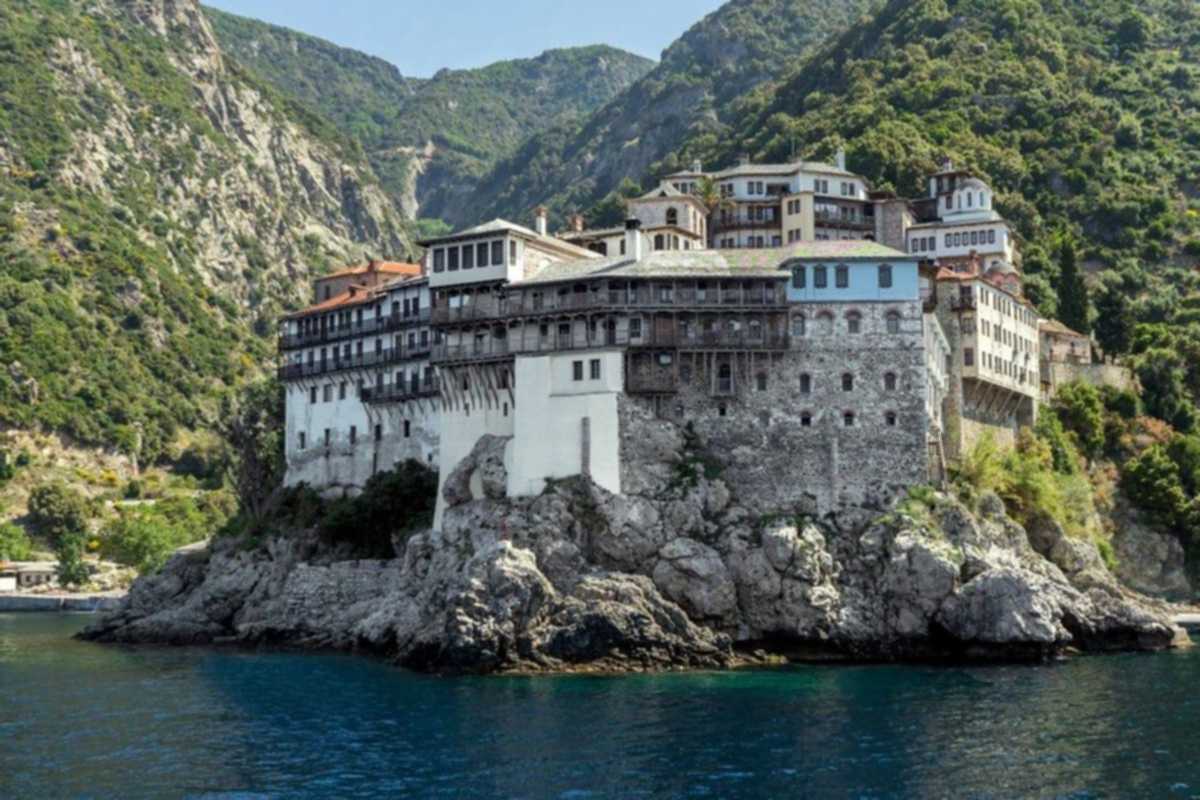
A Mount Athos cruise leaves Ouranoupoli and sails the west coast of the peninsula. Other boat days are listed on our tours in Greece page if you want a different sailing.
This page covers the route, the offshore rule, monastic life and how the cruise compares with a land visit.
What is a Mount Athos cruise, and how does it work?
At its simplest, a Mount Athos cruise is a sightseeing trip along the western shore of the Athos peninsula. Passengers watch the monasteries from the water while a commentary names each one, as operator pages describe it.
The Mount Athos cruise works like a short coastal sail. Passengers board at a port in Halkidiki, and the boat follows the shore of the peninsula without landing. Operator and tourism pages agree on the count: eight monasteries come into view from the water. Wikipedia adds that these tourist cruises run in summer.
Commentary is the heart of a Mount Athos cruise. One operator page offers tour guiding in different languages. Which languages are used depends on the majority of the travellers aboard, and the captain gives the Greek version. The same page adds a tablet with an audio guide for passengers whose language is not spoken on the boat.
The commentary covers the monasteries, the hermitages and the small harbours of the coast. On the longer sailing from Sithonia, one operator page says the tour is heard over the speakers. The schedule is announced the same way.
Language lists differ between operators of a Mount Athos cruise. A tourism page for Halkidiki names seven audio languages: Greek, English, Russian, Serbian, Polish, Bulgarian and German. An operator page names ten for its live tour guide, among them French, Italian and Czech.
Operators sell more than one type of trip. The plain Mount Athos cruise keeps to the monasteries on the coast. A mixed trip adds a swim stop. One operator page puts it at a beach in Sithonia, another at an island. One operator also offers a private charter, with a route chosen by the guests.
Extras sit around the sailing. One page lists a pick-up and drop-off between hotel and boat. Two pages mention dolphins that swim beside the boat.
How long is a Mount Athos cruise, and where does it start?
One operator page puts a Mount Athos cruise from Ouranoupoli at three hours on the water. That page lists departures at 10:30 in the morning and at 14:00 in the afternoon.
Boarding for the morning departure of this Mount Athos cruise opens at 9:30. The page advises passengers to come aboard half an hour before sailing. Its season opens in April and closes in October. The afternoon departure joins the timetable in late spring and runs until the fifteenth of October.
A Mount Athos cruise does not always start at Ouranoupoli. Other trips leave from Ormos Panagias, a port in Sithonia. One operator page lists a 9:30 departure and a duration of seven and a half hours, with boarding from 8:30. It lists online availability from the middle of April to the middle of October.
The sail from Sithonia is longer. The 9:30 operator says the route to the first monastery lasts 2.5 to 3 hours. Both peninsulas stay in view.
Another page for a Mount Athos cruise gives a 9:15 departure and a return at about 16:45 to 17:00. That boat calls at Ouranoupoli at about 13:30, stays about one hour and 45 minutes, then sails again at 15:30.
That is why the length of a Mount Athos cruise depends on where it starts. The operator with the 9:15 departure sails the classic trip on two days of the week, Wednesday and Sunday. A third operator page lists eight hours, with Neos Marmaras or Ormos Panagias as the departure and return ports.
Mixed trips add time on a beach. On one operator page, a mixed Mount Athos cruise leaves Ouranoupoli at 10:30. It adds a swim at the Drenia islets or at Ammouliani island. A tourism page for Halkidiki states that boats leave Ouranoupoli daily, more than once a day.
Days, times and seasons change, so the live timetable of the operator has the last word.
What is Ouranoupoli, and why do Mount Athos cruises leave from there?
Ouranoupoli is the final village before the monastic state, right where the Athos peninsula begins. A Mount Athos cruise sails from its port because the monastic coast begins just beyond the village.
The name means “Sky City” in Greek. It comes from an ancient city, Uranopolis, which Alexarchus, the brother of Cassander, founded in the late fourth century BC. An earthquake later destroyed that city. In the nineteen twenties, families who had fled Asia Minor made their homes here and set up a rug-making trade.
The Byzantine Tower of Prosforion, also called Prosfori, or “The Offering”, is the trademark of the village. Wikipedia dates the tower to the thirteenth century, under Emperor Andronikos II Palaiologos, and ties it to Vatopedi Monastery. Today the tower is a museum. The regional tourism board lists two bronze helmets of the sixth century BC among its finds.
One operator page says the cruise ship leaves from the only port of Ouranoupoli, where the tower stands. So a Mount Athos cruise starts beside a building that once stood under a monastery.
The monastery lost the land in the early twentieth century, when the Greek state needed room for newcomers from Turkey. Later the Lochs, Sydney and Joice, took over the tower. Monks and laymen travelling to or from Mount Athos met there.
In nineteen fifty-six the road to the village was laid on the old pilgrim route. A travel wiki says ferries reach the west coast monasteries from Ouranoupoli and the east coast ones from Ierissos. A Mount Athos cruise along the west coast therefore starts from the village that serves those monasteries.
A nine-kilometre fence marks the line between the monastic state and the municipality of Aristotelis, where Ouranoupoli belongs. The same travel wiki says crossing that border is forbidden. Men who hold a permit board the ferry for Dafni at the port. Every Mount Athos cruise stays at sea and follows the coast.
Why does the boat stay away from the shore on a Mount Athos cruise?
Operator pages put the limit at 500 metres from the shore of the peninsula. They link it to the rule that bars women from Mount Athos. A Mount Athos cruise does not land.
Women are not allowed on Mount Athos for religious reasons, as two operator pages put it. Wikipedia says the monastic community bans women and female animals in what it calls the avaton. It adds that both the law of Greece and religious custom keep women out of the area the monks govern.
The ban dates far back. Wikipedia says emperors, among them Constantine Monomachos, proclaimed it in a chrysobull of the eleventh century. Article 186 of the Mount Athos charter prohibits the entry of women under the ancient customs of the region. So the rule shapes every Mount Athos cruise.
Operators give the limit for a Mount Athos cruise as 500 metres. Two English operator pages say the cruise stays at least that far from the island. A Greek operator page says the ship approaches to 500 metres from the shore, as the port authorities require. Wikipedia gives the same limit for boats along the coastline.
The rule does not keep women off the water. One operator page states that the cruise is open to women. A travel wiki adds that sightseeing boats tour around the peninsula without landing. They need no permit and are the only way for women to glimpse Mount Athos. So a Mount Athos cruise shows the monasteries from the sea.
Landing is a separate matter. The written permit, called the diamonitirion, is delivered by the Pilgrims’ Office branch in Ouranoupoli. Its website says only adult men, plus boys under 18 with their fathers, are permitted to enter Mount Athos. Anyone who wants to step ashore follows that process, not a Mount Athos cruise.
What is Mount Athos, and what is the monastic state?
Mount Athos is a mountain, a peninsula and a monastic state in northeastern Greece. A Mount Athos cruise sails along its west coast, where twenty monasteries rule a self-governed region under Greek sovereignty.
Greeks call it Agio Oros, the Holy Mountain. Of the three legs that Chalkidiki stretches into the Aegean, Athos is the easternmost. Its length is 50 kilometres, and its width varies from 7 to 12 kilometres. Steep, forested slopes lead up to a summit just over two thousand metres high. A Mount Athos cruise shows that shoreline from the water.
An isthmus joins the peninsula to the mainland. Herodotus says a storm wrecked 300 Persian ships off the Athos cliffs in 492 BC. Wikipedia adds that the seas at the end of the peninsula can be dangerous. Today the same sea carries tourist boats on a Mount Athos cruise.
To avoid that sea, Xerxes I had a canal cut across the isthmus in the fifth century BC. The cut ran for 2 kilometres and was 30 metres across and 3 metres deep, enough for a trireme. Digging took three years and finished in 480 BC. Sediment has since buried the canal, but air photos and surveys trace its outline.
A Mount Athos cruise passes a region that the Holy Community governs as an autonomous part of Greece. Byzantine emperors began to grant that autonomy, and it survived Ottoman rule. Under the Greek constitution, the peninsula governs itself while Greek sovereignty over it stays intact. Church matters belong to the Ecumenical Patriarch of Constantinople.
Karyes is the administrative centre and the seat of the synod. Organised monastic communities had grown up on the peninsula by the tenth century. Monastic life there goes back to at least the ninth century. One tourism page calls it the largest monastic state in the Orthodox East. Every Mount Athos cruise sails beside it.
Twenty monasteries form the Holy Community: one Russian, one Serbian, one Bulgarian and the rest Greek. About two thousand monks live on the peninsula. UNESCO listed it in the late twentieth century. The reasons were its long Christian presence, its well-preserved monastery buildings and its protected nature. A Mount Athos cruise passes the west side of that World Heritage Site.
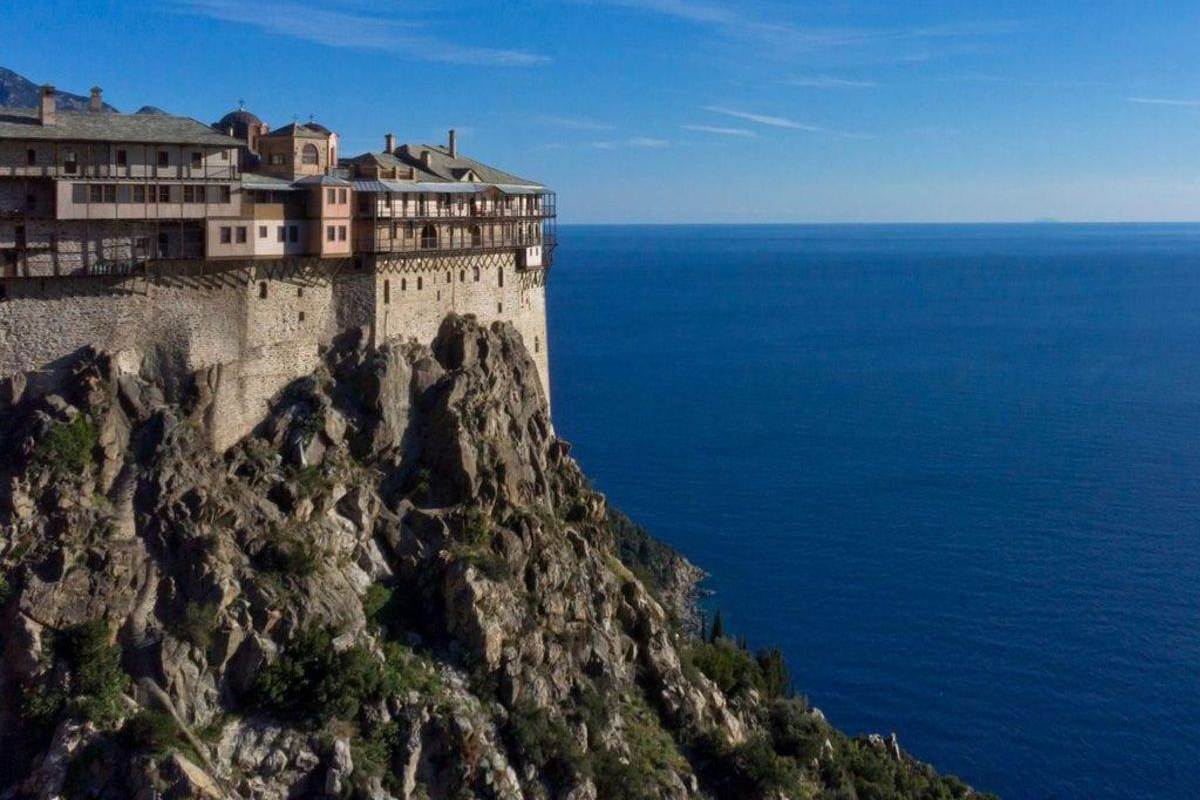
How is the route of a Mount Athos cruise laid out along the west coast?
A Mount Athos cruise leaves Ouranoupoli and sails south along the west coast. As operators describe it, the boat passes eight of the twenty monasteries and reaches the southern end of the peninsula. Then it sails back.
On one tourism page, the boat sets out from the port of Ouranoupoli. It follows the shore towards the southwestern part of the peninsula. Wikivoyage names Ouranoupoli as the ferry port for the west-coast monasteries and Ierissos for the east-coast ones. From Ouranoupoli, every Mount Athos cruise keeps to the western shore.
That page puts a Russian cloister fifteen minutes into the sail. Beaches follow, and then comes Docheiariou, the first monastery, with seven more behind it. Daphni, the main port of the peninsula, also comes into view on this leg of a Mount Athos cruise.
Reading the operator pages together gives a north-to-south order: Docheiariou, Xenophontos, Saint Panteleimon, Xeropotamou, Simonopetra, Grigoriou, Dionysiou, then Saint Paul. Daphni lies between the first four and Simonopetra. The pages agree on this order for a Mount Athos cruise.
The monastery list ends at Saint Paul’s, which one listing places beneath Mount Athos itself. Operator pages then add the New Skete and the Skete of Saint Anna as the last sights. One page has the boat start back to the meeting point as these sketes pass by. So the Mount Athos cruise turns in the south.
One operator that sails from Sithonia runs the same line the other way. Its boat heads first for Saint Paul’s, then works north and ends at Docheiariou. Back at Ouranoupoli, the trip ends in the port where it began. Each Mount Athos cruise from there is a round trip.
Which monasteries near Ouranoupoli come first on a Mount Athos cruise, and what do they show?
Docheiariou is the first monastery a Mount Athos cruise from Ouranoupoli reaches, says a Halkidiki tourism page. Xenophontos, Saint Panteleimon and Xeropotamou follow to the south along the west coast. One operator page lists all four among its eight monasteries.
By the coordinates on Wikipedia, Docheiariou sits farthest north of the eight on a Mount Athos cruise. The municipality of Aristotelis says a defensive tower stands beside its gate. Inside the complex stand the main church of the two archangels, Michael and Gabriel, and the Gorgoepikoos church. The monastery began in the late tenth or early eleventh century.
Two main churches stand at Xenophontos, right by the sea on the western shore. The older church, named for Saint George, lies lower down, close to the water. Its walls go back to the late tenth century. The newer church has eight domes and stands beside the main tower. Both it and the bell tower, which holds workshops, are nineteenth-century.
Saint Panteleimon, also called Rossikon, is the Russian monastery, and operator pages place it on the Mount Athos cruise. Wikipedia calls it the largest on the peninsula. Domes rise over buildings of different heights. Monks from Kievan Rus began it in the eleventh century. The present buildings, closer to the shore, date from the early nineteenth century.
One operator page lists Xeropotamou, midway along the peninsula, among the eight monasteries of its Mount Athos cruise. The name means “of the dry river,” after a seasonal brook nearby. A bridge over it links the monastery with Saint Panteleimon. The monastery goes back to the tenth century, and the Forty Martyrs of Sebaste are the patrons of its church.
These four open the Mount Athos cruise. They offer a gate tower, a pair of churches, a town-sized complex and a monastery midway along the peninsula. Operator pages count eight monasteries in all. The other four lie beyond the port of Dafni.
Which monasteries lie farther south, and what do they show on a Mount Athos cruise?
The southern half of the eight is Simonopetra, Grigoriou, Dionysiou and Agiou Pavlou. One operator page lists all four for its Mount Athos cruise. They stand close to the sea, from a cliff 330 metres up to a point of land at the water.
A single huge rock carries Simonopetra, 330 metres above the sea. The Nativity of Jesus gives its church its title, and a regional tourism page counts seven storeys. The arsanas, the port building, was finished in the sixteenth century. Saint Simon the Athonite started the monastery in the thirteenth century and called it New Bethlehem.
A Mount Athos cruise passes Grigoriou between Simonopetra and Dionysiou. It occupies a jutting corner of land, with the sea around it and steep rocks behind. Wikipedia shows it from sea level. Saint Gregory of Sinai began it in the early fourteenth century, and Saint Nicholas is patron of its main church. Fires burnt it down twice.
Dionysiou stands on a rock that rises straight up from the sea, per a regional tourism page. A defensive tower inside it was built in the sixteenth century. John the Baptist is the patron of its church, and it ranks fifth of the twenty. In the fourteenth century Saint Dionysius of Korisos built it, helped by the ruler of Trebizond.
Farthest south of the eight on a Mount Athos cruise comes Agiou Pavlou. A regional page puts it at the southern end of the western side, near the sea, 140 metres up. Its church carries the title of the Presentation of Jesus at the Temple. It began in the late tenth or early eleventh century under Saint Paul of Xeropotamou.
The southern half of a Mount Athos cruise shows a seven-storey monastery on a rock and another at the water. It also shows a tower on a sea cliff and the last monastery on the west side. Together with the northern four, that makes the eight monasteries that operators count.
What is daily life like for the monks on Mount Athos?
The monks live by a fixed rhythm of prayer, manual work and two shared meals. A Mount Athos cruise passes the walls where that day unfolds. Four hundred other men also work in the monasteries, Wikivoyage says.
From the deck of a Mount Athos cruise you see towers and walls. The day behind them starts in the dark. A Greece travel handbook says the monks wake in the small hours for solitary meditation and study. Around sunrise comes the main liturgy, followed by the morning meal.
A Mount Athos cruise sails at a clock time the operator publishes. Monastic time works differently. Byzantine time counts the day from sunset. The Pantokrator monastery says on its own site that the minute hands show twelve exactly at sunset in every season. Wikivoyage adds that monasteries keeping the Julian calendar run thirteen days behind the Gregorian one.
Church bells and a wooden board, the semantron, keep time. An online exhibit on the Holy Mountain says three knocks on it call everyone to the refectory. Meals there are communal, twice a day. Wikipedia says long vigils are held at religious celebrations and the daily programme changes. The gate closes at sunset and opens at sunrise.
Manual work fills the day until vespers. The handbook says the afternoon meal and a short compline service follow it. Wikivoyage lists bread, olives and vegetables at table, with fish or cheese on occasion. Only water is served to drink on Monday, Wednesday and Friday. A Mount Athos cruise does not reach these tables.
Not every monk lives inside the big walls. Wikipedia describes a skete as a community of hermits with a church and small houses around it. A cell is a house for one to three monks. On the Mount Athos cruise route, one tourism page lists cloister villages with a group of monks in each house.
How does a Mount Athos cruise compare with a permit visit on land and a coach tour from Thessaloniki?
A Mount Athos cruise needs no permit because it stays offshore. A land visit needs a permit from the Pilgrims’ Bureau. A coach tour from Thessaloniki adds a long day on the road.
A land visit starts with the diamonitirion, the permit that the Pilgrims’ Bureau in Thessaloniki handles. Wikivoyage says each pilgrim needs one, alone or in a group. The permit is strictly personal, and a reservation page says pilgrims show it when they board and at each monastery. A Mount Athos cruise has no such step.
The Bureau also limits the daily numbers. Wikipedia and Wikivoyage give the limit as 100 Orthodox and 10 non-Orthodox male pilgrims a day. Wikipedia says the permit covers three nights, or four days with the day of departure. None of that applies to a Mount Athos cruise.
Booking takes planning. A reservation page advises foreign pilgrims to book four to six months ahead in peak periods. Wikivoyage adds that each monastery must agree to the stay, or the pilgrim is turned away. The ferries to the monasteries run early, so pilgrims from Thessaloniki stay overnight in Ouranoupoli or Ierissos.
A coach tour from Thessaloniki packs the Mount Athos cruise into one long day. One operator page lists a start at half past seven in the morning. The road covers 140 kilometres, and the drive takes two and a half hours there and the same back. The whole day lasts 11 hours, a figure two other tour pages also give.
The same operator page has the coach reach Ouranoupoli at about half past ten. It starts back at about five in the afternoon. A land visit differs, because Wikipedia says a pilgrim in a monastery guesthouse can follow the daily schedule. A Mount Athos cruise offers the sea view in one sailing.
What else do travellers ask about a Mount Athos cruise?
What clothing and gear go with a Mount Athos cruise?
The operator pages set no dress rule for the deck. One tour operator tells passengers to bring swimwear, sunscreen, sunglasses and a hat. The swimwear matters only on trips with a swim stop, which the food answer below covers. On a Mount Athos cruise past the monasteries, the sun gear is what counts, and a camera joins it.
The published rules of conduct for Mount Athos name long sleeves, long trousers and closed shoes. They apply to men at church services and are written for visitors who stay on the peninsula. One operator page suggests bread for the seagulls and lists books and maps on board, so the bag stays light.
Is a Mount Athos cruise suitable for children and slow walkers?
Yes, as operator pages describe it. One page calls the three-hour Mount Athos cruise family friendly and marks it wheelchair accessible, with toilets on board. A larger boat has three decks, two bar-canteens, toilets on two decks and both closed and open lounges. A smaller boat spreads its seats over an upper deck, an interior lounge and an outdoor lounge.
Children have their own entertainment. One page lists a documentary about the monks on three TVs in the lounge and video games for the kids. The same page asks passengers to board half an hour before departure. In June, July and August the number of passengers on each cruise is limited.
In which months does a Mount Athos cruise sail, and what happens in bad weather?
One operator runs its three-hour cruise daily from the first of April until the thirty-first of October. Its afternoon sailing runs only from the middle of late spring until the fifteenth of October. Another operator posts a weekly timetable. It places the classic Mount Athos cruise on Sunday and a mix cruise on Tuesday and Friday.
In bad weather, the operator’s terms ask passengers to contact the office before the cruise. The same terms set out what follows when the operator cancels a cruise. A sailing that does not reach the minimum of twenty passengers is cancelled as well. The terms add that a passenger who misses the departure has no claim.
What food and drink does a Mount Athos cruise offer, and is there a swim stop?
The plain three-hour trip has drinks and snacks on board. One operator page lists cold dishes, ouzo, beer and pizza at the restaurant counter. It adds coffee and chocolate at the cafe, and souvenirs such as icons, knit bracelets and incense. On another tour operator’s page, passengers find coffee, sandwiches, beer and refreshments on board, along with an audio guide.
A Mount Athos cruise can also be a mix trip. One mix trip serves soutzoukakia with rice, a cucumber and tomato salad and bread at sea after the last monastery. Operator pages list stops at a beach or at the Drenia islets for swimming. Check the trip name, because a plain sightseeing sailing has no swim stop.
What are the rules for photos and drones on a Mount Athos cruise?
Photos from the deck are part of every Mount Athos cruise. One operator page lists taking photos on board with your own camera or with the crew’s. A zoom lens helps, because the boat sails at a distance from the coast.
The published rules of conduct for Mount Athos ban audio and video recording on the territory of the monasteries. They also ban photos of monks and building interiors without special permission. Those rules say nothing about drones.
Greece requires a Civil Aviation Authority permit for aerial drone filming, says the Greek Ministry of Foreign Affairs. For any flight near the peninsula, ask the Pilgrims’ Bureau in Thessaloniki before you travel.