
An ancient Olympia tour from Katakolo carries cruise passengers from the port to the sanctuary and back again. If a cruise call is not part of your plan, browse more tours in Greece before you choose.
The page covers the drive, the sanctuary, the temples, the stadium, the museum, the season and the questions travellers ask.
What is an ancient Olympia tour from Katakolo, and how does it work?
An ancient Olympia tour from Katakolo is a roundtrip transfer for cruise passengers. A vehicle picks you up at the port and takes you to the archaeological site of Olympia. It returns you there after the visit.
Operators run an ancient Olympia tour from Katakolo in different vehicles. One private page lists four sizes. A bus carries 20 to 50 people, a minibus 10 to 20 and a van 5 to 10. A taxi carries 1 to 4. Another operator offers private cars, minivans, minibuses and a private coach.
Guiding differs. One hop-on hop-off operator lists a port-to-Olympia transfer, a sightseeing route in Olympia and a beach trip. Its audio commentary comes in multiple languages. Another operator pairs a licensed tour guide with the games site and its museum. A third ancient Olympia tour from Katakolo is self-guided, with signs in English and no tour guide inside the site.
Operator pages list the same core stops. Athletes trained in the gymnasium and the palaestra there. The pages name the Temple of Zeus as well, along with the stadium. The Leonidaion, a hotel built in 330 BC for distinguished guests of the games, gets a mention. In the museum, pages name the Nike by Paionios and the Hermes by Praxiteles.
The end of the day differs. One trip gives free time in the modern town of Olympia. A private five-hour page adds a swim stop at Agios Andreas. That village was the harbour of Ancient Olympia in antiquity. This stop shows how one ancient Olympia tour from Katakolo can add a beach.
Comfort and entry also differ. The private page lists air-conditioned cars, wi-fi on board and a bottle of water per person. The entry tickets to the site and the museum sit outside that transfer. A six-hour semiprivate excursion on another page includes skip-the-line tickets. Read what each ancient Olympia tour from Katakolo lists before you choose.
How long is an ancient Olympia tour from Katakolo, and where does it start?
An ancient Olympia tour from Katakolo takes about five hours on the private half-day and group-bus pages. Private trips run from four to seven hours. The day begins where staff or a driver meet you at the Katakolo port.
The five-hour private page splits an ancient Olympia tour from Katakolo into set blocks. The ride out takes 30 minutes. You get 1 hour 15 minutes at the site and 45 minutes in the museum. Then come 1 hour of free time in Olympia and 1 hour at Agios Andreas beach. The ride back takes 30 minutes.
A group-bus ancient Olympia tour from Katakolo lists about an hour out, three hours on site and a 60-minute return. Another operator lists a joined excursion of about 6 hours. It also lists a semiprivate trip of 6 hours with up to 25 people.
The walk itself needs less time than the whole day. One port page says the site takes 90 minutes to 2 hours to walk properly. It asks for 60 to 90 minutes in the museum. A private ancient Olympia tour from Katakolo runs four to seven hours. That operator lists a wine tasting, an olive press and monasteries as add-ons.
Where the day starts depends on the trip. One group page puts the meeting point two minutes from the Katakolo cruise terminal. Multilingual staff wait at an office at the port. A hop-on hop-off operator also lists a bus route between Katakolo port and the site.
On the private five-hour page, the driver waits at the arranged time with a name sign at the pickup spot. Each ancient Olympia tour from Katakolo names its own meeting point, so read it first. One traveller’s private taxi day fitted in over an hour among the ruins, lunch in Olympia and a convent visit.
What is Katakolo, and how does a cruise call fit an ancient Olympia tour from Katakolo?
In western Elis, the seaside village of Katakolo stands on a headland facing the Ionian Sea. Cruise ships tie up beside it, so the port is where an ancient Olympia tour from Katakolo begins and ends.
Katakolo falls under Pyrgos municipality and sits 11 kilometres west of Pyrgos town. A cruise-port page describes a small harbour with two piers right next to the town. A passenger who skips an ancient Olympia tour from Katakolo can browse the market, which has more than sixty shops.
A cruise-port page puts a call in Katakolo at four to seven hours. The ancient Olympia tour from Katakolo has to fit inside that window. That covers the drive in both directions and the time at the site. A second page advises 60 to 90 minutes for the return to the ship.
That page also warns against a bus or train unless the return time fits the all-aboard time. Operator pages describe an ancient Olympia tour from Katakolo with a set pickup. The driver meets passengers at the port at an agreed time, holding a sign with a name. After the visit, the vehicle returns to the port for the ship.
One traveller’s account shows the schedule at work. On a private ancient Olympia tour from Katakolo, the family added a convent about 15 kilometres from Olympia. The driver kept to a definite time schedule. They reached Katakolo with just enough time for a coffee before boarding.
Agios Andreas lies northwest of Katakolo. Wikipedia calls it the natural port that served Ancient Olympia in antiquity. One page adds a swim stop at its beach on the ancient Olympia tour from Katakolo. Another page lets passengers pick the cruise dock or the village as the drop-off.
How far is the drive from Katakolo to Ancient Olympia, and which road does it take?
An ancient Olympia tour from Katakolo covers about 30 kilometres. Port pages put the drive at 30 to 40 minutes. The road runs inland through Pyrgos, then east to Olympia on Greek National Road 74.
Sources measure the run in different ways. Wikipedia places Katakolo 11 kilometres west of Pyrgos and Pyrgos 16 kilometres west of Olympia. A bus-route page lists 13 and 17 kilometres for the same two legs. Other pages give 33 and 34 kilometres for the whole trip.
Whichever figure is right, the time is what counts for an ancient Olympia tour from Katakolo. Private-transfer pages list about 30 minutes in one case and 40 minutes in another.
Pyrgos is the main city of Elis, with the status of regional capital. The town lies at the centre of a plain, and the Ionian coast is 4 kilometres away. Its name means tower. A cruise-port page places it about 20 minutes from Katakolo. Raisins shipped from Katakolo port helped the town grow in the late nineteenth century.
Wikipedia says Greek National Road 74 links Pyrgos with Tripoli by way of Olympia. The drive from Pyrgos to Olympia follows that road. Pyrgos lies 70 kilometres south-west of Patras and 85 kilometres west of Tripoli. A traveller who rented a car for the run called the roads in the area nice and well signed.
Pyrgos sits on a coastal plain, while the site of Olympia sits in the Alfeios valley. No river in Elis is longer than the Alfeios. Seven kilometres south of Pyrgos, it flows out into the sea. A traveller on a private ancient Olympia tour from Katakolo wrote of lush, mountainous countryside full of olive trees.
Wikipedia adds that about a third of Elis is fertile, with the richest farmland on the northern plain. On an ancient Olympia tour from Katakolo, one operator page says the vehicle drops passengers just outside the archaeological site. Wikipedia says visitors then cross a bridge over the Kladeos and arrive at the main gate.
What was Ancient Olympia, and why did the Greeks gather there?
Ancient Olympia was a Greek sanctuary for Zeus, in the west of the Peloponnese. Greeks from all over their world met there for the Olympic Games. An ancient Olympia tour from Katakolo brings visitors off the ship and to these ruins.
The Alpheios River lies to the south of the ruins, and Mount Kronos to the north. The sacred precinct was the Altis. Its name comes from an old word for “the grove”, because olive and plane trees grew there. Visitors on an ancient Olympia tour from Katakolo walk this ground.
The Altis honoured Zeus above all, and other gods had worshippers there too. His games drew visitors from across the Greek world. They helped build a shared Greek identity as a nation. Operator pages describe Olympia as where the Olympic Games were born. An ancient Olympia tour from Katakolo visits the grounds where athletes trained and competed.
Old Greek stories explain how the games began. In one, Pelops beat King Oenomaus in a chariot race for the hand of his daughter Hippodamia. The king died in the race, and Pelops held funeral games for him at Olympia. The Peloponnese, the peninsula where an ancient Olympia tour from Katakolo runs, is named after Pelops.
- Pausanias tells of an early hero named Heracles, not the son of Zeus. With four brothers he raced at Olympia to entertain the newborn Zeus.
- Pindar says Heracles, the son of Zeus, founded the sacred precinct beside the tomb of Pelops. He did it for his father, and then began the games.
Remains of food and burnt offerings from the tenth century BC point to worship long before any building. The earliest building work, around 600 BC, was the Temple of Hera. An ancient Olympia tour from Katakolo reaches a site that once held more than 760 important buildings.
How did the ancient Olympic Games work?
The ancient Olympic Games were contests between Greek city-states. They took place once every four years, to honour Zeus. The first games are traditionally dated to 776 BC, and the last recorded ones to AD 393. An ancient Olympia tour from Katakolo visits the place where they happened.
The games were a religious festival, and 100 oxen were sacrificed to Zeus on the middle day. Three runners called spondophoroi left Elis to announce a truce. Armies were forbidden from entering Olympia. The truce kept pilgrims and athletes safe, but it did not stop every war. An ancient Olympia tour from Katakolo visits the sanctuary they travelled to.
From 348 BC ten judges called Hellanodikai ran the games. They came from Elis, the region where an ancient Olympia tour from Katakolo starts. Each served one Olympiad, after ten months of training in the rules. They rejected athletes who were not well trained. Two days before the games, they led the athletes from Elis to Olympia in a procession.
At first the games had one event, the stadion sprint of just over 192 metres. The word stadium comes from it, and operator pages place the stadium on an ancient Olympia tour from Katakolo. The programme grew to twenty-three contests, with no more than twenty at any one games.
- A two-stade race, the diaulos, was added in 724 BC.
- Wrestling, boxing and the pankration, a fight that mixed both, were in by 648 BC.
- The pentathlon packed five contests into one day, and wrestling came last.
- The hoplite race, run in full armour, was traditionally the last race of the games.
- For a long time only freeborn Greek men took part, but women won chariot races as owners.
The prize was an olive wreath. A boy with both parents still living cut the branches with a pair of golden scissors. The sacred wild olive tree stood near the Temple of Zeus, which an ancient Olympia tour from Katakolo reaches. The judges made the wreaths and crowned one winner for each event.
What does the Temple of Zeus look like today, and what stood inside it?
On an ancient Olympia tour from Katakolo, the Temple of Zeus is a ruin on three uneven steps. Whole, it measured 72 by 30 metres. It held the colossal statue of Zeus, counted as one of seven wonders in the ancient world.
An ancient Olympia tour from Katakolo reaches the very model of a classical Doric temple. Work ran from about 472 until 456 BC. The colonnade had six columns on the short sides and thirteen on the long sides. Inside, a pair of seven-column rows cut the inner room into three aisles. A ramp from the east led up to it.
Visitors see one column of the rear porch set upright again. The German Archaeological Institute raised it, and the work was meant to show the size of the building. Until then, only experts perceived the true scale of the ruin. Fragments of a drum were rejoined with titanium bars, and missing parts were filled with artificial stone.
The main body was local poros, a stone of poor quality. Stucco in a thin layer gave it the look of marble. Roof tiles of Pentelic marble were so thin that light shone through. Lion-head waterspouts, 102 in all, ran along the roof edge, and 39 survive.
Parian marble carries all the carving. In the east pediment, Pelops races Oenomaus by chariot. The west pediment holds a brawl between centaurs and Lapiths, with Theseus and Apollo among the figures. The metopes carried the twelve labours of Heracles. An ancient Olympia tour from Katakolo meets these carvings in the museum.
Mummius, a Roman general, sacked Corinth in 146 BC. He gave the temple twenty-one gilded shields, fixed to the metopes on the east front. Earthquakes in AD 522 and 551 are blamed for the fall of the temple. One study suggests ropes pulled the columns down. So an ancient Olympia tour from Katakolo shows a ruin, not a standing temple.
Placards at each structure name the building, one travel writer reports of an ancient Olympia tour from Katakolo. Researchers pieced the east pediment statues together, and the same writer saw them in the museum.
What is the Temple of Hera, and what does it show on an ancient Olympia tour from Katakolo?
No temple at Olympia is older than the Temple of Hera. Builders raised it between about 600 and 580 BC. Its place is the north side of the sanctuary. Operator pages list it on an ancient Olympia tour from Katakolo beside the Temple of Zeus.
This early Doric temple predates the Temple of Zeus by over a century. The platform measures 19 by 50 metres, so the plan is long and narrow. One operator page for an ancient Olympia tour from Katakolo leaves the time at each area to the guests.
The first columns were wood. Stone replaced them one by one between the mid sixth century BC and the Christian era. By AD 173 one column in the rear room was still oak. Circle the temple and compare the columns yourself on an ancient Olympia tour from Katakolo.
Each replacement was carved in the style of its own age, so the capitals all differ. The shafts differ by nearly 30 centimetres in width. One shaft even has a different number of flutes. Six columns stood across the ends and sixteen along the sides. The walls had a stone base course under mudbrick.
Round discs 2.5 metres wide decorated the gables. One disc is on display in the museum. Inside, Pausanias saw a disc inscribed with the sacred truce and a table for the olive wreaths of the winners. The Hermes of Praxiteles stood here, and the museum that an ancient Olympia tour from Katakolo visits holds it now.
One operator page for an ancient Olympia tour from Katakolo gives the site stop as one hour and fifteen minutes. It names both temples in its highlights. The temple closed when pagans were persecuted late in the Roman Empire. An earthquake felled it in the early fourth century AD. The Olympic flame is still lit in its ruins.
What are the stadium and its stone tunnel entrance, and what can you do there?
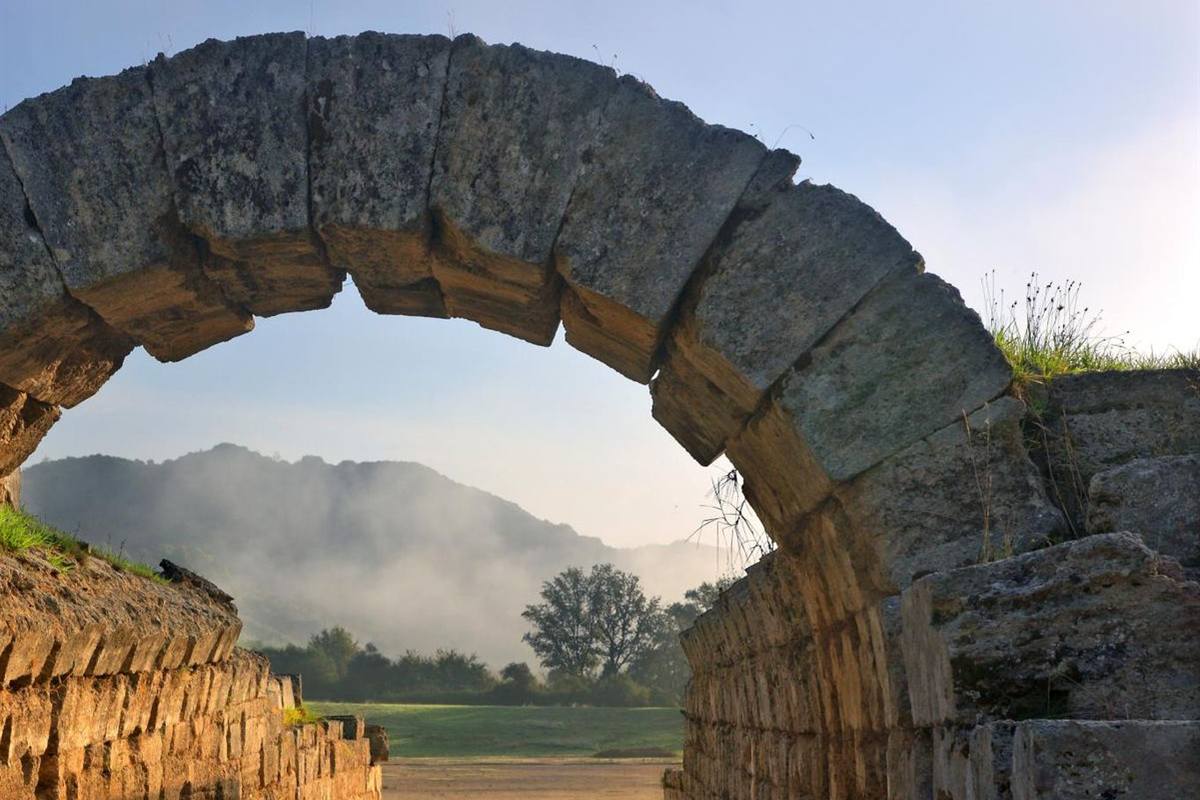
The stadium is the long running track east of the sanctuary of Zeus. Athletes entered it through a vaulted stone tunnel 32 metres long. Its stone starting lines can still be seen. Operator pages place the stadium on an ancient Olympia tour from Katakolo.
The Visit Greece tourism site says the Echo Hall marks the eastern edge of the sanctuary. The hall separates the place of worship from the stadium. The track lies beyond it. Tour listings for an ancient Olympia tour from Katakolo invite visitors to step onto the track.
The whole track is 212.54 metres long, and its surface was hard-packed clay. On an ancient Olympia tour from Katakolo you can stand where the race began. Two marble sills 192.27 metres apart mark the start. Grooves cut in the stone gave runners grip for their toes. A white block lined up every athlete.
The tunnel is called the Krypte. It is a vaulted stone passage 32 metres long, built in the late third century BC. Athletes and judges walked through it from the sanctuary into the stadium. One operator page speaks of entering the ancient stadium on its ancient Olympia tour from Katakolo.
Wikipedia dates the first stadium, a simple track, to around 560 BC. About 500 BC it was rebuilt with sloping sides for spectators. The crowd sat on earth banks on all sides, and Wikipedia gives the capacity as 45,000. A listing for an ancient Olympia tour from Katakolo invites you to test your strength in the original stadium.
Free time decides what you do at the stadium on an ancient Olympia tour from Katakolo. One private page gives free time at the site to explore on your own. A shared minibus page offers a free audio guide that you download. A travel blog says placards at each structure explain what it was.
What were the palaestra, the gymnasium and the Leonidaion?
The palaestra and the gymnasium were the training grounds of the athletes. The Leonidaion was a large guesthouse outside the sacred grove. One operator page lists all three on its ancient Olympia tour from Katakolo.
The palaestra was the wrestling school. Wrestlers, boxers and fighters of the pankration, a no-holds-barred sport, trained there. It dates to the third century BC and measures about 66 by 67 metres. Its sandy court was ringed by 72 Doric columns, and 32 of them have been restored. Port pages name the palaestra on an ancient Olympia tour from Katakolo.
Rooms around the court held changing areas and storage for equipment. In the elaiothesion athletes rubbed their bodies with oil, and in the konisterion they powdered themselves with dust. Stone benches served as lecture rooms. One operator page for an ancient Olympia tour from Katakolo says athletes practised here before the competition.
The gymnasium lay beside the palaestra, west of the sanctuary. Runners and pentathletes trained there. Its open courtyard was about 220 metres long and 120 metres wide. The east porch held the xystos, a roofed track 212.05 metres long, for practising the stadion race whatever the weather. A port listing names the gymnasium on an ancient Olympia tour from Katakolo.
The Leonidaion stood at the southwest corner of the sanctuary, outside the sacred grove. Built around 330 BC, it was bigger than any other building at Olympia. Leonidas of Naxos paid for it, designed it and gave it his name. It had 138 Ionic columns outside and 44 Doric columns around an inner court.
Sources differ on its guests. Wikipedia says athletes lodged there, while the Visit Greece site names dignitaries. The Romans remodelled it as a residence for high officials. An earthquake destroyed it in the late third century AD. Its ruins lie west of the sanctuary. One operator page names them on an ancient Olympia tour from Katakolo.
What do the Philippeion, the Pelopion and the row of treasuries show?
They show how people used Olympia. A Macedonian king built a monument to his family, Greeks honoured a hero’s tomb, and colonies stored gifts for Zeus. All three stand inside the sanctuary that an ancient Olympia tour from Katakolo explores.
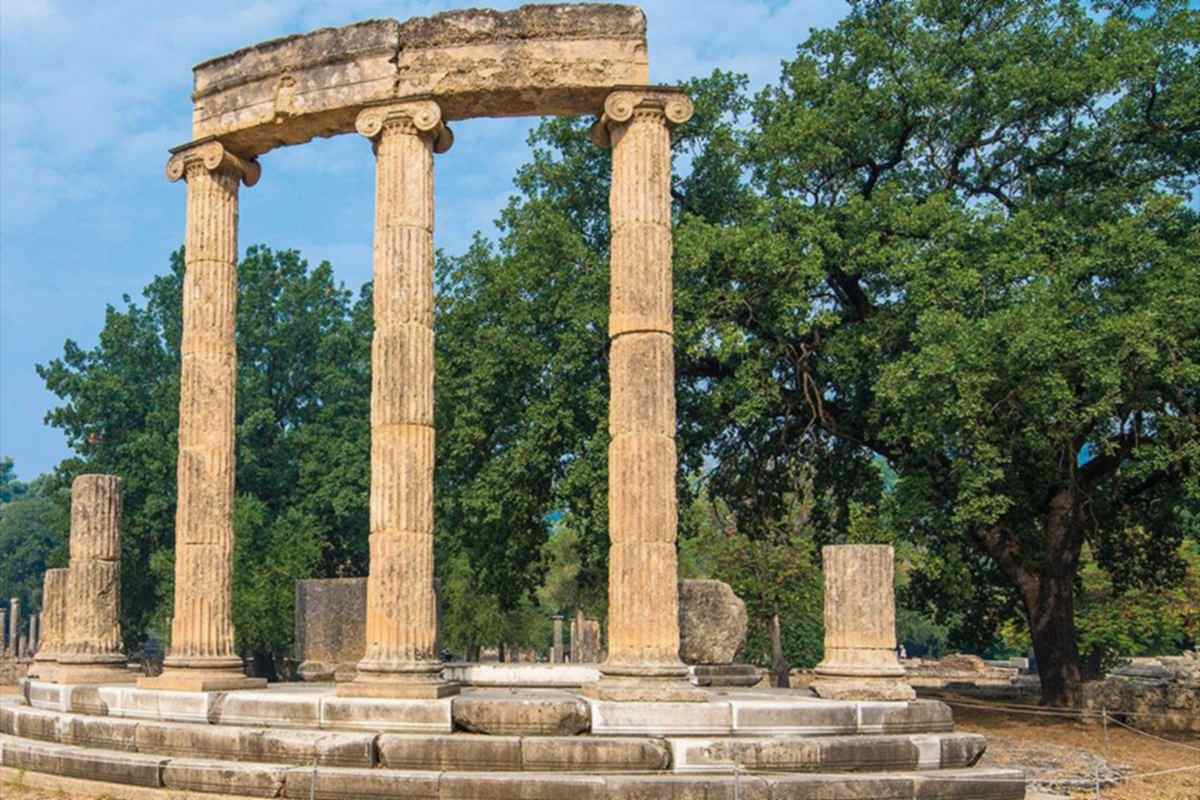
The Philippeion was a circular hall built from limestone and marble. Philip II began it after winning at Chaeronea in 338 BC. His son Alexander the Great finished it. No other building in the Altis was made for people rather than gods. On an ancient Olympia tour from Katakolo, look for its round ruin in the north.
Ivory and gold statues of the royal family stood inside, but none survive. The outer ring had 18 Ionic columns, and nine Corinthian half-columns lined the inner wall. The circle was 15 metres across. Parts from a Berlin museum came back. With them, builders restored part of the ruin that an ancient Olympia tour from Katakolo sees today.
The Pelopion was the alleged tomb of Pelops. The Peloponnese carries the name of this local hero. A five-sided enclosure surrounded a mound of ashes and packed earth. Each year a black ram was sacrificed there in his honour. It served as an altar into Roman times, and an ancient Olympia tour from Katakolo meets its remains.
The treasuries were temple-shaped buildings. They stood on a natural terrace below the Hill of Cronus. Greek colonies built all but two of them to store gifts for Zeus. On an ancient Olympia tour from Katakolo, the row runs from west to east. The cities were Sicyon, Syracuse, Byzantion, Sybaris, Cyrene, Selinus, Metapontium, Megara and Gela.
- Sicyon’s treasury is the earliest of the row and the one in the finest condition.
- Syracuse built its treasury to mark a win against Carthage, in 480 BC.
- The treasuries held bronze and marble statues, armour and weapons taken in war, and vessels of precious metal.
- Foundations and lower courses of multiple buildings still show their original layout.
What was the workshop of Pheidias, and what became of the statue of Zeus?
The workshop was the studio where the sculptor Pheidias made his giant statue of Zeus. It stands directly west of the Temple of Zeus. Both lie close together on an ancient Olympia tour from Katakolo.
The workshop measures about 15 by 32 metres inside, almost exactly the size of the temple’s inner room. A French expedition named it in the early nineteenth century. German excavators confirmed it in the middle of the twentieth. The finds that proved it are worth knowing on an ancient Olympia tour from Katakolo:
- Tools to work gold and ivory, plus ivory chippings.
- Precious stones.
- Clay moulds used to shape the glass plaques of the statue’s robe.
- A cup that reads “I belong to Pheidias”.
Later the workshop became a church. Builders raised a basilica over the foundations between AD 435 and 451. An earthquake destroyed it in AD 551. The Ministry of Culture has restored it for the public. An ancient Olympia tour from Katakolo meets a studio and a church in one place.
Zeus sat about 12.4 metres tall, in ivory plates and gold panels on a wooden frame. The geographer Strabo wrote that he looked ready to lift the roof off the temple. The aisle of the temple was twice as wide as the statue. An ancient Olympia tour from Katakolo visits the home of one of the Seven Wonders.
Nobody knows how the statue ended. The emperor Theodosius I closed the pagan temples in AD 391. One tradition says it burned in Constantinople in AD 475. Another says it perished when fire damaged its temple in AD 425. Only ancient descriptions and coins show its look, so an ancient Olympia tour from Katakolo tells it in words.
What does the Archaeological Museum of Olympia hold, and how are its rooms arranged?
The museum at Olympia keeps the finds of the sanctuary of Zeus in twelve rooms. They run from prehistoric pots to Roman statues. Operator pages list the museum as a stop on an ancient Olympia tour from Katakolo.
The museum site says the exhibits follow time order, in a spacious central hall with eleven more galleries around it. Maps, drawings, photographs, reconstructions and models explain the monuments. One operator page sets aside 45 minutes for the museum stop on an ancient Olympia tour from Katakolo.
Because the rooms run in time order, an ancient Olympia tour from Katakolo meets the oldest finds first.
- Room one: prehistoric pots and stone tools, and a model of the Tumulus of Pelops.
- Room two: Geometric and Archaic bronzes, part of what the museum calls the richest collection of its kind worldwide.
- Room three: the pediment of the Treasury of Megara and a lion-headed spout.
- Room four: terracotta statues, the head of Athena and the helmet of Miltiades.
- Room five: the central hall, with the sculpture of the Temple of Zeus.
- Rooms six to eight: the Nike of Paionios, the tools and clay moulds of the Pheidias workshop, and the Hermes of Praxiteles.
- Room nine: late Classical and Hellenistic finds, such as a small marble head of Aphrodite.
- Rooms ten and eleven: Roman statues, among them the Emperor Hadrian.
- Room twelve: the last centuries of the sanctuary, until the site was abandoned.
On the east pediment, Pelops and Oenomaus line up before their chariot race, and Zeus stands between them. Reclining figures at both ends stand for the rivers Alpheios and Kladeos. The west pediment shows Centaurs fighting Lapiths, with Apollo in the middle. They come from the temple ruins, so an ancient Olympia tour from Katakolo finds them here.
Twelve labours of Heracles fill the metopes. In the Stymphalian birds scene, two heads are plaster copies of the originals in the Louvre. The original museum building from the late nineteenth century now tells the story of the ancient games. One operator page for an ancient Olympia tour from Katakolo names only this museum, though the site has three.
What do the Hermes of Praxiteles and the Nike of Paionios show?
In the Hermes, the god carries the infant Dionysus in his arms. The Nike lands from the sky as the goddess of victory. One operator page names both statues on an ancient Olympia tour from Katakolo.
The Hermes has a hall to itself, room eight. Excavators dug it out of the Temple of Hera, almost intact, in the late nineteenth century. A thick layer of clay protected the marble after an earthquake collapsed the temple roof. One operator page lists that temple among the stops of an ancient Olympia tour from Katakolo.
The face and torso are polished until they glow, but the back still shows rasp and chisel marks. The museum names Praxiteles as the sculptor. Art historians argue over this, because Pausanias gives only a passing remark. Visitors on an ancient Olympia tour from Katakolo see a work that shaped the idea of Praxitelean style.
On an ancient Olympia tour from Katakolo, the Nike of Paionios stands in a small hall, room six. The sculptor came from Mende, and the marble figure is 198 cm tall. She lands with her drapery blown against her body, and an eagle, the bird of Zeus, flies below her feet. Her face, wings and forearms are lost.
The Messenians and the people of Naupaktos gave the statue to Zeus in thanks for a victory over the Spartans. It was set up around 420 BC on a triangular pillar six metres high. The pedestal is still at Olympia, near the Temple of Zeus. One operator page places that temple on an ancient Olympia tour from Katakolo.
What is the modern village of Olympia, and what is there to do besides the site?
The modern village of Olympia is a small town beside the ruins, with market streets, cafes and museums. The stop there fits into an ancient Olympia tour from Katakolo as time for lunch, shopping and extra museums.
Wikivoyage describes the village as tiny, with shops and hotels for visitors. It sits next to the site, and on the west the ruins stop at the Kladeos River. A bridge over the river leads to the main gate. Nobody needs a vehicle in the village, so the ancient Olympia tour from Katakolo stays easy on foot.
Two pages put a village break inside the ancient Olympia tour from Katakolo. A half-day private tour page gives almost an hour in the market streets, called the agora. Souvenir shops sell leather and ceramics, and other shops sell clothes and jewellery. A travel blogger on a private taxi tour ate lunch in the village after the ruins.
The Region of Western Greece lists two neighbouring village museums. The first looks at the history of the ancient games. Its late nineteenth century building was among the first provincial museums in Greece. Its rooms cover early sport and the start of the contests at Olympia. They show Zeus and his worship, women in sport and the winners.
Next door stands the museum of the Olympia excavations. It sits in the Old Ephorate, built in the early twentieth century. Its display follows the digs at Olympia since the late nineteenth century and holds a photograph collection. The tour pages list only the Archaeological Museum, so these two are extras on an ancient Olympia tour from Katakolo.
Beyond the village, two private versions of the ancient Olympia tour from Katakolo add stops after the ruins. A half-day private tour page ends with an hour at a beach. A travel blogger’s taxi tour went on to the Panagia Kremasti convent, about 15 kilometres from Olympia. There the nuns handed out skirts to wear over trousers and shorts.
Which season, heat and light suit an ancient Olympia tour from Katakolo?
The Ministry of Culture lists long opening hours from April to October and short hours from November to March. For an ancient Olympia tour from Katakolo, the summer sun is the main thing to plan for.
Ministry of Culture pages list the Archaeological Museum hours by season. From April to August the museum opens at 8:00 and closes at eight in the evening. From November to March it runs from 8:30 to half past three. The two pages differ on autumn, so check the notice. An ancient Olympia tour from Katakolo works inside those hours.
Katakolo has dry, hot summers and mild, wet winters, say Hellenic National Meteorological Service figures on Wikipedia. August highs average about 29 degrees Celsius and January highs about 14. July brings about 2 millimetres of rain and December about 146. These are coastal figures for the port, not for the valley of Olympia.
Wikivoyage tells visitors to prepare for hot sun and crowds in the summer months. The Ministry of Culture has also changed site hours for a heatwave. In one notice, Ancient Olympia ran from opening to 13:00 and again from 15:00 to 20:00. One private tour page lists air-conditioned vehicles and water for the ancient Olympia tour from Katakolo.
The same figures count about 376 hours of sunshine in July, the highest total of the year. December has about 125. The museum window is twelve hours in summer and seven in winter. So an ancient Olympia tour from Katakolo in July gets the highest sunshine total, and one in December the lowest.
In wet weather, Wikivoyage warns, you cannot shelter from rain and still see the site, so come prepared. December is the wettest month in the Katakolo figures. A winter ancient Olympia tour from Katakolo is a day in the open air.
How does Olympia link to the modern Olympic Games and the flame ceremony?
Every Olympic flame starts at Olympia, kindled by the ruined Temple of Hera. An ancient Olympia tour from Katakolo reaches that ground. The flame is a symbol of continuity between the ancient and the modern games.
Women acting as priestesses stage the lighting beside Hera’s temple. Sunlight hits a curved mirror and kindles a fire, and that fire lights the first torch. If cloud blocks the sun on the day, a flame saved from the dress rehearsal serves instead. The ancient Olympia tour from Katakolo passes the same ruins.
At the ancient games, the altar of Hestia kept a holy fire alight for the whole festival. Every fourth year the temples of Zeus and his wife Hera received extra fires. Carl Diem added the torch relay at the Berlin games; it had no ancient model. An ancient Olympia tour from Katakolo visits the site where the older fires burned.
Pierre de Coubertin turned the old idea into a modern event. His push for more sport in French schools failed, and the plan to revive the games followed. A congress in Paris proposed games every four years and set Athens for the first ones. The ruins inspired the new games, and an ancient Olympia tour from Katakolo shows them.
Coubertin died in Geneva, and, as he wished, his heart was taken to Olympia. A memorial stele, raised by the Greek government, holds it in the Coubertin Grove of the International Olympic Academy. Operator pages name the site and the museum, not the grove, on an ancient Olympia tour from Katakolo.
- After the lighting, the first torchbearer lights a marble altar in the Coubertin Grove.
- The flame goes on to Athens, where a ceremony in the Panathenaic Stadium hands it to the host nation.
- From Athens, the flame travels on to the city that hosts the games.
Who found Ancient Olympia, and how was it dug up?
An English antiquarian, Richard Chandler, re-discovered Olympia’s exact site in the eighteenth century. German archaeologists led the first major dig in the nineteenth. Today the ancient Olympia tour from Katakolo walks the site they opened.
Before the diggers came, the sanctuary lay under up to 8 metres of sediment. People long blamed river floods, although the Kladeos was diverted in ancient times to stop winter flooding. Newer research points to sea water from repeated tsunamis, because shells and tiny sea organisms sit in the layers. An ancient Olympia tour from Katakolo crosses that cleared ground.
Earthquakes began the damage that an ancient Olympia tour from Katakolo shows today. A series of quakes struck the site in the third century. Invaders in 267 AD led to the centre being fortified with stone robbed from the monuments. Around 426 AD the Temple of Zeus seems to have been wrecked after an edict on pagan festivals.
Nobody dug until late spring in the early nineteenth century. Then French scientists of the Morea expedition spent six weeks at the sanctuary. They marked the site in squares, dug trenches in straight lines and found the place of the Temple of Zeus. That first dig covered ground that an ancient Olympia tour from Katakolo walks today.
Ernst Curtius was a German archaeologist. In Athens he signed an agreement that gave Germany the sole right to excavate Olympia. All finds had to stay in Greece. The dig began the next year, paid for by the German government. An ancient Olympia tour from Katakolo crosses the central sanctuary it opened.
- Within six years the team cleared the stadium, with its starting blocks and judges’ seat.
- It also uncovered the temples of Zeus and Hera and recorded 14,000 objects.
- Since the late nineteenth century, the care of the site has been the job of the German Archaeological Institute at Athens.
- A bronze bull figurine, 2,500 years old, turned up by the Temple of Zeus after a downpour, with one horn sticking out of the ground.
- Digs are still in progress at times, so an ancient Olympia tour from Katakolo can pass a working trench.
How does an ancient Olympia tour from Katakolo compare with a taxi, a train or a rental car?
An ancient Olympia tour from Katakolo hands the whole day to one operator. That covers the pick-up at the pier and the ride back. A taxi, a train and a rental car hand pieces of that planning back to you. All four reach the same site.
A taxi turns an ancient Olympia tour from Katakolo into a private run. One travel writer lists two options: the excursion arranged by the cruise company, or a taxi hired on your own. A family booked a private tour through a taxi service. A second blogger saw taxis waiting at the port.
The train is a do-it-yourself ancient Olympia tour from Katakolo. The rail company’s page says the line runs Monday to Saturday and takes 45 minutes. A local site puts the station at the end of the shopping parade, about 200 yards from the port gates. For a ship at the longest pier, it allows five to ten minutes’ walk.
Timing decides an ancient Olympia tour from Katakolo by train. The local site says hours change with the ship schedule. Extra trains for cruise passengers run depending on traffic. Each morning when a cruise is in, a railway employee at the port kiosk tells visitors the day’s routes.
A rental car turns an ancient Olympia tour from Katakolo into a self-drive day. One blogger found the car waiting at the pier, signed the paperwork and checked it for dings. The map app led to the tour bus parking, so the driver asked around for another car park. The car went back to the same spot.
- Missed train: a blogger warns that a missed train back leaves you on your own.
- Rail link: Wikipedia lists the station at Katakolo as a link to Pyrgos and Olympia.
- Same-day rental: the same blogger saw cars and vans on offer at the port for on-the-spot rental.
- Hop-on hop-off coach: its operator page lists the site, the museum and the streets of Katakolo, and riders can step off and back on during the day.
What are the paths, the shade and the walking like at Ancient Olympia?
An ancient Olympia tour from Katakolo means extensive walking on open ground. No personal vehicles are permitted within the site, so everyone walks. A cruise-port page lists gravel, uneven paths and limited shade, and Wikipedia adds that excavations are frequently in progress.
The ruins spread wide, and that scale shapes an ancient Olympia tour from Katakolo. Olympia sprawled beyond its boundary wall, especially in the areas given to the games. Wikipedia says the full site requires extensive walking. Wikivoyage says the walk from the village to the site takes 20 minutes.
The slope is gentle, but the ground is not smooth. A Wikipedia caption says the site is terraced into the gentle north slope of the Alfeios valley. On an ancient Olympia tour from Katakolo, the cruise-port page lists gravel and uneven paths. It also warns that the way to the museum can include a bridge with 25 steps.
A blogger on a self-drive version of an ancient Olympia tour from Katakolo describes a wide paved footpath. White stone lines cross the concrete at regular intervals. The path crosses a small creek on the way to the museum. The blogger left the car in a car park beside it and walked back the same way.
Shade is limited, the cruise-port page says. On an ancient Olympia tour from Katakolo, trees now grow over the site like a grove. Wikipedia names the Judas tree as the main one, a low tree with pink flowers. Olive and plane trees grow in the area too.
- Order of the visit: one blogger walked the ruins first and kept the museum for the end.
- Pace of the visit: that blogger spent a couple of hours among the ruins.
What else do travellers ask about an ancient Olympia tour from Katakolo?
What belongs in your bag for an ancient Olympia tour from Katakolo?
A hat, water and comfortable shoes cover the basics on an ancient Olympia tour from Katakolo. A cruise-port page wants each traveller to carry 1.5 litres of water at the least. It says the ground is uneven and the open site has minimal shade in summer.
A second port page adds lightweight clothing, sunglasses and high-SPF sunscreen to the list. A tour page lists a hat, water and walking shoes that are comfortable, because the site gets hot. A third port page names the sun as a real risk, since shade is almost absent.
The first port page also lists layers, water and comfortable shoes as the packing list for the whole port day.
One private-transfer page for an ancient Olympia tour from Katakolo accepts a mobile or paper ticket. A port page says the site sits in an inland valley with no sea breeze. It calls going early the standard advice.
Does an ancient Olympia tour from Katakolo suit children, wheelchair users and slow walkers?
A private-transfer page for an ancient Olympia tour from Katakolo lists wheelchair-accessible vehicles. Parents can bring a pram or stroller for babies and young children, and seats made for infants are on offer. The page sets a minimum of moderate physical fitness for travellers.
A cruise-port page answers yes for children and calls the site open, with room for energetic children to move around. Accessible excursion pages use step-free routes, shorter distances and no staircase. Their vehicles carry a ramp or a lift where available. Those vehicles are extremely limited, so the pages ask guests to book as early as feasible.
Tour guides are not allowed to push wheelchairs. Guests who need help bring a physically capable companion. One page adds that access can differ from the standards you know at home.
Slow walkers have one more option. On an ancient Olympia tour from Katakolo, one group-tour reviewer liked the view of the ruins from the upper road. She called it a nice alternative to walking all over the site.
Is a tour guide part of an ancient Olympia tour from Katakolo, and what are the photo rules?
It depends on the trip. A joined excursion on an ancient Olympia tour from Katakolo gives guidance on board, then free time in Olympia. A semiprivate trip for up to 25 people adds licensed guidance and guided tours of the site and museum. A private transfer page says a licensed guide can be arranged on request.
A private page offers a choice. A licensed guide can escort you throughout, or give local guidance in Olympia.
One tour page describes guests snapping photos among the ruins. A Greek Foreign Ministry page says archaeological sites and museums need special permits for filming or photography. Drone filming needs a Civil Aviation Authority permit as well. Drone rules sit on the Drone Aware-GR site, the page adds. Check the rule for your own camera at the gate.
The same ministry page adds that filming and photography in open public spaces are generally permitted without prior authorisation. They must not offend public decency or block the flow of traffic.
What happens to an ancient Olympia tour from Katakolo if the ship is late or a strike hits?
Operator and port pages answer this for an ancient Olympia tour from Katakolo. One private-tour page says every excursion is guaranteed to return to the port in time to board. Its team arrives 30 minutes before the ship’s scheduled arrival to welcome guests.
The same page states a guarantee for the case where weather or a Greek workers’ strike keeps the ship away. It also promises to see guests safely to the next port if they miss the ship. A second port page says the ship waits for its own tours.
Closures matter too. A Ministry of Culture schedule closes state sites and museums on December 25 and 26, January 1 and March 25.
One news report describes a work stoppage by archaeological guards. It kept the site and museum of Ancient Olympia closed until noon. The union was protesting the outsourcing of visitor entry control at the Acropolis.
Are there toilets and refreshments on an ancient Olympia tour from Katakolo?
A visitor to the Archaeological Museum of Olympia reports clean modern toilets downstairs. They sit to the left of the main doors as you exit into the courtyard. An accessible excursion page for an ancient Olympia tour from Katakolo lists accessible restrooms with wide doors along its route.
A port page says Ancient Olympia has its own restaurants around the site. One blogger lunched outside under a vine-covered lattice near the car park. A private five-hour page adds an hour at a beach for coffee or lunch before the return.
A private-tour page lists a Greek dining stop as an add-on, with a buffet, coffee and dessert. On an ancient Olympia tour from Katakolo, an olive press add-on serves olives, snacks and oil with baked bread.
How safe is an ancient Olympia tour from Katakolo?
Safety starts at the port. A cruise-port page calls Katakolo an extremely safe, low-crime destination, with violent crime virtually non-existent. The same page asks for standard precautions against petty theft and pickpocketing, especially in crowded places like Ancient Olympia.
One private-tour page for an ancient Olympia tour from Katakolo covers the ride itself. It lists experienced non-smoking drivers, vehicles no older than five years, and liability insurance for all guests. Another page calls the transfer safe and comfortable.
A group-tour page calls its trip a safe, organised day, with staff described as friendly and helpful. A port page names two real risks. One is the sun at the site. The other is losing track of time over a long lunch.