
Greece mainland tours are road trips that stay on the Greek mainland and leave the islands out. They start in Athens and run by coach to Delphi, the monasteries of Meteora and the old sites of the Peloponnese, so they sit beside the island trips among the tours in Greece.
This page names the regions and the roads, then follows the two, three, four and five day plans, the main sights and the seasons. The plans match the trips of this site: the athens kalambaka meteora athens tour, the athens delphi meteora athens tour, the athens nafplio olympia delphi athens tour, the athens nafplio olympia delphi kalambaka athens tour and the 8 day greece tour.
What are greece mainland tours, and where do they run?
Greece mainland tours are road trips that stay on the Greek mainland and leave the islands out. Each plan on this page starts and ends in Athens. The routes run through four regions: Attica, Central Greece, Thessaly and the Peloponnese. Plans last two, three, four or five days.
Wikipedia’s page on the geography of Greece lists the mainland regions from north to south. It puts Attica and the capital Athens in the southern part. Greece mainland tours here start in that part and reach north only as far as Thessaly. Southward, the plans cross into the Peloponnese.
The Pindus runs north-west to south-east across the middle of the country and tops out at 2,637 metres. Extensions of its ranges cross the Peloponnese too. On greece mainland tours the road therefore climbs and drops through mountain country.
The sights suit a land plan. Wikivoyage’s Get around section says almost all archaeological sites in Greece can be reached by bus. A road trip therefore needs no special transport to reach the ruins of the plans.
Wikivoyage’s Peloponnese page offers a different shape: stay in Nafplio and drive out to one ancient site a day. Greece mainland tours here do the opposite. They move on to a new town for each night. The bags travel with you, and the plan covers more ground.
Each of the four plans is a loop that leaves Athens by one road and returns by another. The two and three day plans run north to Kalambaka and Meteora. The four day plan circles the Peloponnese and then turns north to Delphi. The five day plan joins the Peloponnese, Delphi and Meteora in one trip.
A plan of two days holds one night, and a plan of five days holds four. The night stops of greece mainland tours are Kalambaka, Delphi, Nafplio and Olympia, with Arachova as a choice near Delphi. Every plan finishes where it began, in Athens.
Which regions do greece mainland tours cover?
Greece mainland tours cover four regions: Attica, Central Greece, Thessaly and the Peloponnese. Attica holds the start in Athens, Central Greece holds Delphi and Thessaly holds Meteora. The Peloponnese holds Nafplio, Mycenae, Epidaurus and Olympia. Only the four and five day plans reach the Peloponnese.
In ancient times, Attica and the city-state of classical Athens were one and the same, as Wikipedia has it. The Cithaeron and Parnes ranges divide it from Boeotia in the north. The Kifisos, its longest river, crosses the Athenian plain and reaches the sea east of the port of Piraeus. Every plan of greece mainland tours starts in this region.
Central Greece is a traditional region, called Roumeli in daily speech, that covers the southern mainland without the Peloponnese. Its Greek name, Sterea Ellada, means Continental Greece. Wikivoyage describes a very mountainous region with high elevations. Greece mainland tours reach Delphi, Thermopylae and Lamia inside it.
Boeotia and Phocis lie on the road to Delphi. Wikivoyage calls the archaeological museum at Thebes one of the country’s key museums. Mount Parnassus spreads over Boeotia, Phthiotis and Phocis, where its largest part lies, and Delphi stands on its slope. Lamia is the capital of the modern region of Central Greece.
Larissa is the capital of Thessaly. The region meets Macedonia in the north and Epirus in the west. Central Greece lies to its south and the Aegean Sea to its east. The old Thessaly Railways ended at Kalambaka, the base for Meteora. The plans enter Thessaly there.
Wikipedia lists Tripoli and Nafplio as the traditional capitals of the Peloponnese, and both lie on the four day plan. The page counts seven major regions there since antiquity. The four day plan of greece mainland tours touches Argolis at Nafplio and Arcadia at Tripoli. It reaches Elis at Olympia and Achaea at Patras.
Epirus lies west of Thessaly and Macedonia lies north of it. No plan on this page enters either one. The four regions above hold every stop of the plans. They run from the start in Athens to the last night on the road.
How do greece mainland tours travel by road and by ferry crossing?
Greece mainland tours travel by road, on national roads and motorways. The four and five day plans also cross the Gulf of Corinth by car ferry from Rio to Antirrio. A coach seat leaves the driving to someone else, which suits the narrow mountain roads.
Wikivoyage describes the road network as well marked and well kept, with new multi-lane motorways being added. Road signs in Greek repeat in Latin letters. Speed limits reach 120 km/h on the fastest roads, though vehicles on one road travel at very different speeds. Greece mainland tours rely on this network between all stops.
Wikivoyage also warns of narrow mountain roads that twist and turn, in places along a cliff edge. It adds that parking in big cities is very difficult. On greece mainland tours a coach and driver remove both worries. You watch the land from a window seat instead.
Bridges carry the road across the Corinth Canal, which Wikipedia calls mainly a tourist attraction today. Greece mainland tours reach the Peloponnese at this cut. The four day plan makes a short stop there on the way to Nafplio.
The crossing at Rio and Antirrio is the second water crossing of greece mainland tours. On the four day plan it is a car ferry from Rio on the Peloponnese to Antirrio on the mainland. Wikipedia adds that a cable-stayed road bridge also links the two towns and carries four lanes of the A5 motorway.
The bridge opened shortly before the Athens Summer Olympics, as Wikipedia records. Torchbearers carried the Olympic flame across it. Its cable-stayed part has five spans and four pylons.
Wikivoyage’s Meteora page gives the drive from Athens to Kalambaka as about four hours. On the Peloponnese leg, Wikipedia names the A7 motorway as a road that connects Tripoli with Corinth and Kalamata. A plan of greece mainland tours adds stops, so the clock runs longer than any single figure.
Trains play a small part. Wikivoyage reports one or two trains a day on the Lamia to Trikala line, at low speed. It points travellers to the bus there. Every leg of the four plans runs on roads.
What does the two day plan of greece mainland tours cover?
The two day plan of greece mainland tours spends one night in Kalambaka, close to the sandstone pillars of Meteora. It passes Delphi on the way up and returns by Trikala, Lamia, Thermopylae and Kammena Vourla. The shape is two long drives with a night between them.
Day one of the plan opens on Mount Parnassus. Wikipedia gives the mountain a height of 2,457 metres. On this plan of greece mainland tours, Delphi village and the slopes of Parnassus form a short stop. The road then crosses Central Greece toward Kalambaka.
This plan does not enter the archaeological site or the museum of Delphi. A traveller who wants the sanctuary picks a longer plan from the same family. The first drive runs from Athens to Kalambaka, and the second brings the traveller from Meteora back to Athens.
Wikipedia puts Kalambaka below the Meteora massif. An inscription on a church wall shows that an ancient settlement named Aiginion stood here. Kalambaka was the north-western terminal of the old Thessaly railway. Greece mainland tours of two days spend their night in this old town.
Trikala is the first city on the road back from Meteora on these greece mainland tours. After Thessaly joined Greece, the city received a grid plan and Neoclassical buildings in its centre. A seventeenth-century traveller recorded eight mosques there, and only the Osman Shah Mosque, built by Sinan, survives.
One account ties the name of Lamia to a queen of the Trachineans. Another ties it to the Malians, who lived around it. Thermopylae, in the Lamia area, takes its name, hot gates, from hot sulphur springs near the foot of the hill. The Leonidas monument stands east of the A1 motorway, across from the hill with the epitaph.
Kammena Vourla is the last stop on the road back, with the Knimis mountains rising just south of the town. Its name means Burnt Rushes. Cape Knimis, 4 kilometres to the east, divides the Malian Gulf from the North Euboean Gulf. Athens follows, and greece mainland tours of two days end there.
What does the three day plan of greece mainland tours cover?
The three day plan of greece mainland tours adds the Delphi sanctuary, the museum and a night in Delphi. The road runs from Athens by Thebes, Livadeia and Arachova. Day two reaches Kalambaka by Lamia, and day three adds Meteora and the road back.
On the three day plan of greece mainland tours, Thebes is the first of three towns before Delphi. Wikipedia names it the largest city in Boeotia and among the oldest cities with unbroken settlement. Homer’s Iliad calls it Seven-Gated Thebes, to set it apart from Thebes in Egypt.
Livadeia lies 90 kilometres north-west of Athens and is the capital of Boeotia. Its oracle of Trophonius, entered by a descent into an underground chamber, was known beyond Greece. The cathedral of Saint George keeps a relic, the head of the saint, which came back from Venice.
In the centre of Arachova, a steep cliff covered in ivy carries the Bell Tower, topped by a large clock. The town lies 8 kilometres east of Delphi and 26 kilometres west of Livadeia. National Road 48 passes through the town. The three day plan of greece mainland tours follows it on to Delphi.
Day one of these greece mainland tours centres on the sanctuary of Apollo Pythios. Kastri village stood on the ruins until it was moved to free the site for the French School. Legend lists three earlier temples, built of olive branches, of beeswax and wings, and by two deities.
The Treasury of the Athenians, a reconstruction, marks the Athenian victory at Marathon. The museum of Delphi shows golden treasures that archaeologists found beneath the Sacred Way. Day one ends with a night in Delphi.
Day two leaves Delphi for Kalambaka by Lamia. Wikipedia notes that National Road 27 links Itea, 8 kilometres from Delphi, with Amfissa and Lamia. Day three covers Meteora and returns by the road of the two day plan. The first night of these greece mainland tours falls in Delphi and the second in Kalambaka.
What does the four day plan of greece mainland tours cover?
The four day plan of greece mainland tours is a loop through the Peloponnese and Delphi. Day one runs from Athens to Nafplio, and day two ends in Olympia. Day three uses a ferry over the Gulf of Corinth to reach Delphi, and day four returns to Athens.
Day one of greece mainland tours opens with a short stop at the Corinth Canal. The cutting has no locks, because the channel lies at sea level. The first company went bankrupt, and a Greek company completed the cutting. In the seventh century BC the ruler Periander chose a stone trackway, the Diolkos, to tow ships across instead.
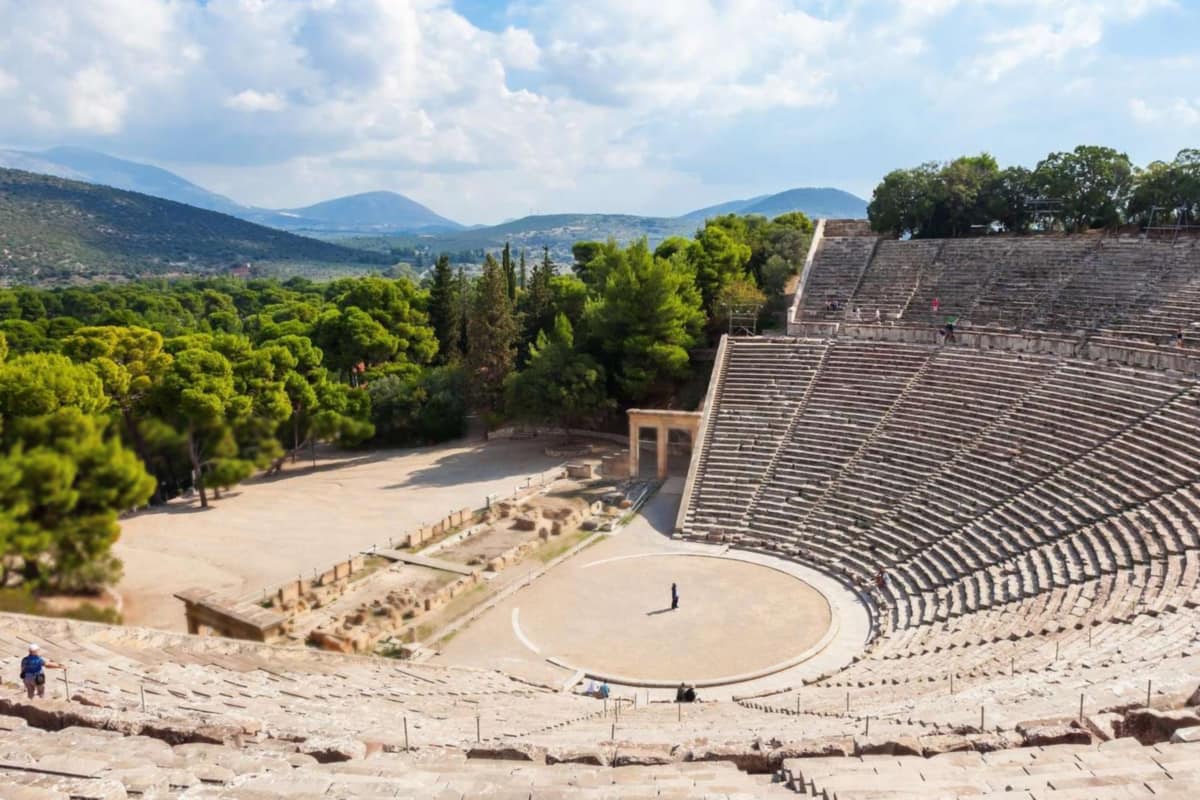
At its height the citadel and its lower town covered 32 hectares. The theatre of Epidaurus follows. The first modern performance there was the tragedy Electra by Sophocles. The circular orchestra measures 20 metres across. A corridor splits the seating into 12 lower sections and 22 upper sections.
The night in Nafplio is the first of three on greece mainland tours of four days. The harbour of Nafplio is too shallow for anything but bulk cargo. Day two crosses Arcadia, a rural, mountainous region with Tripoli as its capital. Mixed farming, olive groves and pasture fill the plains, especially around Megalopoli.
Olympia is the second night stop of the plan. The town of Olympia is small, and the archaeological site lies on its south-east side. Wikipedia notes that visiting the full site takes extensive walking. The plan sets the sanctuary and the museum on day two.
Day three passes through Elis and Achaea to Patras, 215 kilometres west of Athens. In these greece mainland tours, the crossing of the Gulf of Corinth is a car-ferry run from Rio to Antirrio. Wikipedia adds that a cable-stayed bridge also links the two towns, with a longest span of 560 metres.
Nafpaktos stands 9 kilometres north-east of Antirrio, and its name means boatyard. The Venetians knew the town as Lepanto. Galaxidi, the first seaside option, stands on a natural double harbour, 15 kilometres south-west of Delphi. Itea, the second, lies 8 kilometres from Delphi.
The monastery of Prophet Elias is the next stop, and Delphi follows. At the Castalian Spring, the Roman fountain once had seven bronze spouts. The sanctuary of Athena Pronaia includes the Tholos. Day three of greece mainland tours ends with a night in Delphi or Arachova.
Day four holds the Delphi sanctuary and museum, which the three day plan also covers. Arachova comes next, then Livadeia and Thebes, and the road ends in Athens. At Thermopylae, 400 Thebans stood with Leonidas, according to Wikipedia.
What does the five day plan of greece mainland tours cover?
The five day plan of greece mainland tours runs the Peloponnese loop to Delphi in three days. Day four goes to Kalambaka, and day five is spent at Meteora. The road home passes Trikala, Lamia and Thermopylae. The plan has four nights: Nafplio, Olympia, Delphi or Arachova, and Kalambaka.
The first three days follow the four day plan of greece mainland tours. The route goes from Athens to Nafplio, through Arcadia to Olympia, then north to Delphi. A car ferry crosses the Gulf of Corinth on day three. The road bridge between the same two towns bears the name of Charilaos Trikoupis, a prime minister who proposed it.
Day four leaves Delphi after a morning visit to the museum. Greece mainland tours then run north to Kalambaka for the fourth night. Wikivoyage gives the drive from Athens to Kalambaka as about four hours. Arachova, the other night stop on day three, lies 8 kilometres east of Delphi.
Records from the tenth century call the place Stagoi and describe a fort with a bishop’s seat. The wall of the oldest church, to the Virgin Mary, carries remains of an ancient temple, probably of Apollo. Theopetra Cave lies 4 kilometres away. Its chamber records two great changes. Neanderthals gave way to modern humans, and hunter-gatherers turned to farming.
Day five of greece mainland tours on this plan belongs to the Meteora monasteries, described below. The road back to Athens passes Trikala. The national tourism page links Trikala to ancient Trikke, birthplace of the healing god Asclepius. Simeon Uros, who sponsored the monks of Meteora, was based in Trikala.
The return leg of greece mainland tours reaches Lamia, whose castle stands on the ancient acropolis. In the Lamian War the Macedonian regent Antipatros took shelter behind the walls of Lamia. Thermopylae means hot gates, after its hot sulphur springs. Wikivoyage places the pass 80 kilometres north of Delphi.
No other plan joins the Peloponnese, Delphi and Meteora. The two day and three day plans never enter the Peloponnese. The four day plan reaches Delphi but turns back to Athens without Meteora. Only the five day plan of greece mainland tours holds all three areas in one run.
What does Delphi show on greece mainland tours?
On greece mainland tours, Delphi shows the ruined sanctuary of Apollo and a museum for its finds. The Pythia gave her oracles on this ground. The national tourism page says the temple site gives views over the olive grove of Amfissa. UNESCO places Delphi in Phocis, in Central Greece.
The oracle is what draws greece mainland tours to Delphi. Authors including Aeschylus, Herodotus and Xenophon mention it, and people consulted it until the late fourth century AD. Wikivoyage notes that city-states asked about war, while individuals asked about relationships. Priests are said to have turned the priestess’s words into verse.
The walk starts at the Castalian Spring, where visitors washed and drank. Two fountains fed by the spring still survive, and the Roman one stands about 50 metres above the older one. Pilgrims left offerings in niches cut into the rock. The four and five day plans of greece mainland tours reach the spring on day three.
Next, greece mainland tours reach the Athenian Treasury, built of Parian marble. It stands 9.75 metres high and was rebuilt in the early twentieth century. An inscription on its base says the Athenians offered it to Apollo after their victory over the Persians at Marathon. Its metopes are reproductions, and the originals are in the museum.
The Sacred Way leads on to the temple of Apollo. Greek tradition counts five temples on this spot, and the fifth had a Doric colonnade of six columns by fifteen. It was rebuilt after an earthquake in 330 BC. Walls of polygonal stone around the platform carry inscriptions, among them records of slaves freed in the name of Apollo.
The tholos of Athena Pronaia is a round building with an outer diameter of 14.76 metres. Vitruvius names its architect as Theodorus Phoceus. Three Doric columns of the ring stand restored. Pronaia means of forethought, and the spot draws more photographers than any other part of the site.
A later renovation gave the museum a new facade and a hall for the Charioteer. The statues of Kleobis and Biton are among the exhibits. Storage and conservation rooms handle mosaics, ceramics and metals, and a cafeteria and a gift shop serve visitors. The three, four and five day plans of greece mainland tours all include the museum.
What does Meteora show on greece mainland tours?
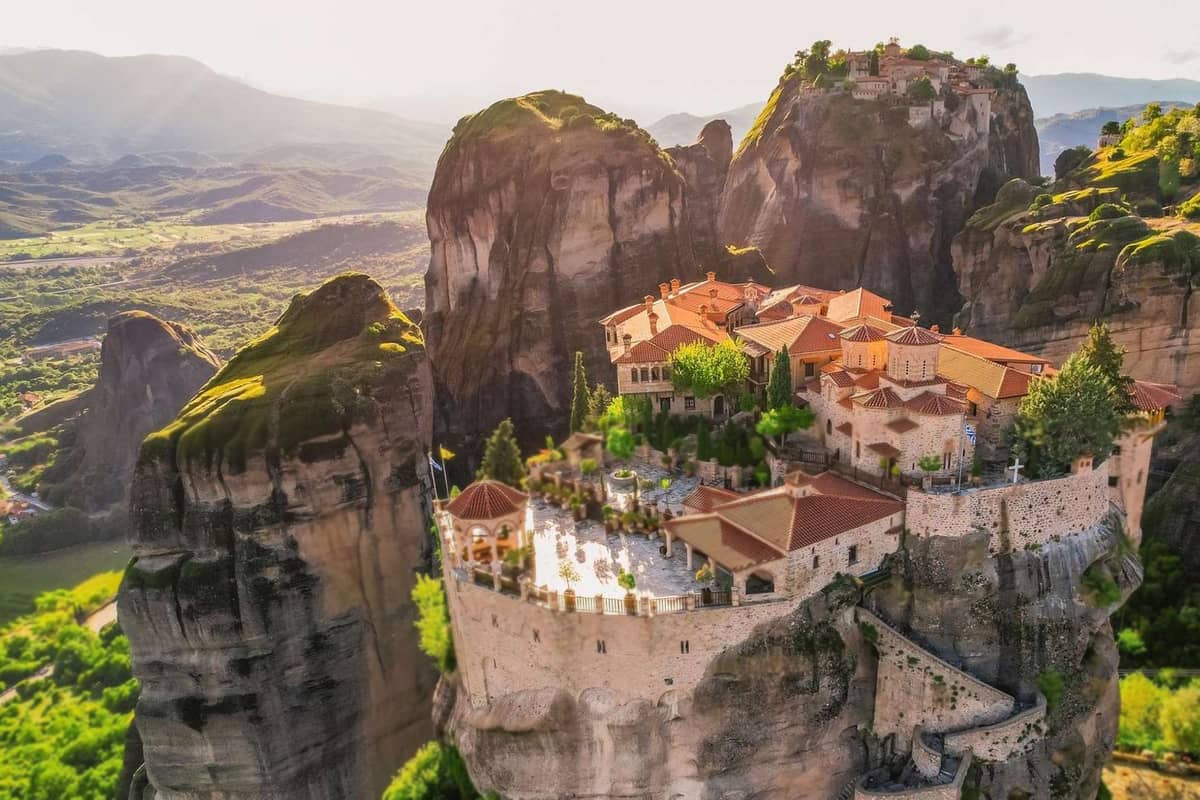
On greece mainland tours, Meteora shows sandstone pillars in Thessaly with monasteries built on their tops. Six monasteries stand there today. UNESCO notes that restoration follows traditional forms and techniques where possible. UNESCO counts about 200,000 visitors a year, and the monasteries limit the visiting hours to control their number.
Greece mainland tours meet rock with an unusual form. Wikivoyage explains that the lack of horizontal layering left stable pillars instead of undercut ones. Wikipedia reports an earthquake of magnitude 7 in the mid twentieth century. The thin pillars still stand. Wikivoyage describes the nearby mountains as baking in summer and snowy in winter.
UNESCO translates the Greek name as suspended in the air. Wikivoyage gives walking times between monasteries. Great Meteoron and Varlaam are about 10 minutes apart, and Holy Trinity and Saint Stephen are 15 minutes apart. The two, three and five day plans of greece mainland tours spend a night in Kalambaka.
Monks settled on the rock columns from the eleventh century onwards, as UNESCO states. Wikivoyage notes that the monastery museums show collections of precious manuscripts and works. It adds that the Greek environment ministry has declared the area a protected zone for rare birds and flowers.
Six monasteries stand today. In the sixteenth century Great Meteoron, the largest, had more than three hundred monks in its cells. Varlaam ranks second in size. Saint Stephen became a nunnery in the twentieth century. Saint Nicholas Anapausas, the smallest, was a resting place for pilgrims, and its name means resting.
Access was hard on purpose, and it is still a climb. Wikivoyage describes a 10 minute climb on a stone path to Saint Nicholas Anapausas. Roussanou has a stairway from a car park. The small cable cars on the rocks carry supplies, not visitors. In the high season the chapels fill up, so Wikivoyage recommends an early start.
UNESCO lists Meteora under five criteria. Painters such as Theophanes the Cretan and Frangos Katelanos worked in the churches. UNESCO says the frescoes that Theophanes painted in the early sixteenth century became a model for the post-Byzantine style. Greece mainland tours reach the site on day two, day three or day five of their plans.
What do Nafplio, Mycenae and Epidaurus show on greece mainland tours?
Day one of the four day plan of greece mainland tours visits three places in Argolis. Nafplio holds the Venetian fortresses of Palamidi and Bourtzi. Mycenae holds the Lion Gate, and Epidaurus holds a theatre that still stages ancient drama.
Marshes once left Nafplio almost cut off from the land. Irrigated farmland around the town grows oranges, lemons, olives and almonds. The bus to Athens runs through Corinth and Argos and takes two to two hours and twenty minutes. Greece mainland tours end day one here.
On greece mainland tours, the Venetian fortress of Palamidi is the climb above Nafplio. It crowns a hill 216 metres high and has eight bastions. Six of them carry the names of ancient leaders and heroes, such as Leonidas and Miltiades. Wikivoyage counts 857 stairsteps up to it, though legend says 999.
On greece mainland tours, walking covers all the major sights of the old town. South of Syntagma Square, the Vouleftikon was once an Ottoman mosque. The Venetian fortress of Bourtzi stands on a rock-island at the port entrance. The archaeological museum shows a bronze armour suit worn by a Mycenaean soldier in the thirteenth century BC.
At its peak, the citadel of Mycenae and its lower town covered 32 hectares and held 30,000 people. The hill beneath rises 274 metres above sea level. Greece mainland tours climb to the Lion Gate. Two lions or lionesses flank a central column there, and its significance is much debated.
Grave Circle A held six shaft graves, and the swords there point to warrior chieftains and their families. Nine tholos tombs belong to Mycenae. Looters emptied the Treasury of Atreus, and its purpose as a tomb was forgotten, so it kept the name Treasury. The ruins had become a tourist attraction by the Roman period.
On greece mainland tours, the theatre of Epidaurus is a fourth century BC work of Polykleitos the Younger. The original 34 rows grew by another 21 in Roman times. Its sound has a long reputation, but measurements on site moderate the claim. The limestone seats do filter out low sounds, such as a crowd’s murmur.
The Corinth Canal is the short stop that opens day one of greece mainland tours. Periander, a tyrant of the seventh century BC, gave up the plan to dig through the isthmus. His Diolkos, a stone carriageway, towed ships across it instead. Remnants of it still exist beside the modern canal.
What does Olympia show on greece mainland tours?
Greek city-states sent athletes to Olympia to compete in honour of Zeus. Four years lay between one festival and the next. Winners received olive wreaths. On day two of the four day plan, greece mainland tours reach this sanctuary from Nafplio.
The modern village serves the adjacent ruins, which lie to its south-east. The land around is fertile and grows citrus, grapes and olives. Judas trees with pink flowers now grow over it, and olive and plane trees grow nearby. Olympus, the mountain of the twelve Olympians, stands in northern Greece, far from this site.
Wikivoyage lists the links to Olympia. Buses and trains from Patras via Pyrgos take around two hours. From Kalamata airport the road trip takes ninety minutes. The four day plan of greece mainland tours drives in through Arcadia, Tripoli and Megalopoli.
Hera shared her temple with Zeus until a separate temple was built for him. The altar of Hera lies apart from the building, on its eastern side. Sunlight in a parabolic mirror kindles the Olympic flame there. Torches carry it to the place where the games are held. That journey begins in the ruins that greece mainland tours visit.
Two neighbours, Pisa and Elis, contended with Olympia for management of the precinct, and Olympia won. The Eleans ran the games, and there was sometimes bias. The games never moved, so greece mainland tours visit their one fixed home. The stadium has been used again for Olympic events, with no intentional change to its ancient layout.
Wikivoyage names the damage: earthquakes broke the buildings, conquerors looted them, and bronze was melted down. Coins found where spectators sat show that they grouped themselves by region, tribe or economic grouping. The coins also point to the city-states that took part, and when. Excavations still continue on the ground that greece mainland tours cross.
The Archaeological Museum of Olympia is overseen by the Ministry of Culture and Sports. An earthquake damaged its first building, which also proved too small for the growing collections. The extent of its bronze collection makes it important worldwide. A separate building houses the museum store.
When do travellers take greece mainland tours, and what do they pack?
Spring and autumn suit greece mainland tours well. For walking and cycling near Delphi, Wikivoyage prefers spring and fall to the very hot summer. Pack shoes for stone steps, sun cover and clothing that meets monastery rules.
Six Meteora monasteries are open to visitors. Wikivoyage marks summer as April to October and winter as November to March, with closing days staggered between the monasteries. One or two are shut on any weekday. Opening starts at 9:00, and every monastery has toilets. Greece mainland tours plan around these times.
Delphi and Olympia are open-air sites. In summer heat, Wikivoyage tells Meteora walkers to bring litres of water. At Delphi, the sanctuaries fill with school classes and tour groups from 10:00. Wikivoyage advises an early arrival or a night nearby, which suits greece mainland tours that sleep in Delphi. At Olympia, there is no shelter from rain.
Arachova, a mountain town 8 kilometres east of Delphi, stands at about 970 metres. Melting snows on Parnassus feed the municipal water of the surrounding communities. Wikivoyage says the mountains east and north of Meteora see severe cold and heavy snowfalls. Greece mainland tours in winter meet snow and cold in the hills.
Shoes with a firm grip suit greece mainland tours, which cover steep steps and stone ruins. Except for St. Stephen, each Meteora monastery can only be reached by ascending hundreds of steep steps. Olympia allows no personal vehicles inside the site, so visitors walk. The full site requires extensive walking, the Wikipedia article adds.
At Meteora, Wikivoyage asks men for pants that cover the knees. Women swap pants for a skirt or sarong and cover the shoulders. The small cable cars seen near the rocks carry food and supplies, not visitors. Photography is allowed outside the inner churches only. Pack for these rules on greece mainland tours that include Meteora.
Wikivoyage reports storms in every season on the heights around Meteora, so a light jacket belongs in the bag. Add a hat or other sun cover for the open sites. Summer visitors can coincide with the Epidaurus Festival, which runs during the summer months.
What else do travellers ask about greece mainland tours?
Five questions follow. They cover the days needed, a first visit, the drive to Delphi, monastery opening days and monastery clothes. Each answer names its source, so you can check every fact before you fix a day of greece mainland tours.
How long do greece mainland tours take to cover Delphi and Meteora?
Greece mainland tours reach Meteora in two days and give Delphi its own day in three. The two day plan makes only a short stop at Delphi village and the slopes of Mount Parnassus. Neither the ruins nor the museum belong to that plan.
Day one of the three day plan ends in Delphi, with a night there. The sanctuary and the museum share that day. Wikipedia describes the museum as fourteen rooms on two levels.
Wikivoyage Delphi places the site and the museum within walking distance of the modern town. It adds that from ten o’clock the site fills with classes and tour groups. The three day plan of greece mainland tours spends its night in Delphi.
Toilets stand in the museum, not on the open-air site, says Wikivoyage Delphi, and the museum also has food. The five day plan adds the Peloponnese before Delphi.
Do greece mainland tours suit a first visit to Greece?
Greece mainland tours suit a first visit when the traveller wants ancient sites and monasteries and leaves the islands out. Every plan starts in Athens and ends there. Wikivoyage Central Greece calls Athens the starting point for exploring Ancient Greek history.
The three day plan passes Thebes on the road to Delphi. Wikipedia calls Thebes the largest city in Boeotia. Wikivoyage Central Greece describes the archaeological museum at Thebes as important in the country.
The plans run two, three, four and five days. A first visit can pick the length that fits the time on hand. The four and five day plans add the Peloponnese.
One town, three spellings: Wikipedia gives Kalabaka, with Kalambaka and Kalampaka as alternative transliterations. The Meteora monasteries stand near it. Wikivoyage also lists a tourist information office in Kalambaka that offers maps, brochures and tour recommendations. Both facts help a first visit to greece mainland tours.
What travel time do greece mainland tours allow from Athens to Delphi?
Wikivoyage Delphi puts the journey from Athens at about three hours, and it states this for the long-distance bus. The pages used here give no single car time for Delphi. For Meteora, Wikivoyage names about four hours by car from Athens.
The three day plan of greece mainland tours drives to Delphi by Thebes, Livadeia and Arachova on its first day. Livadeia rose in importance through its oracle of Trophonius, says Wikipedia. Wikipedia places the Parnassos Ski Centre to the north of Arachova.
Wikivoyage Delphi counts an estimated nine million olive trees on the foothills of Mount Parnassus. Wikivoyage Central Greece places the seaside town of Galaxidi between Patras and Delphi. Wikivoyage Delphi puts it about 40 minutes away by car.
Wikivoyage Delphi also lists Osios Loukas, a monastery on the UNESCO list, about 20 km south-east of Delphi. Treat each figure as a pointer, not a promise.
Is every monastery at Meteora open every day on greece mainland tours?
No monastery at Meteora is open on all seven days, as the VisitGreece route page lists them. The Greek National Tourism Organisation publishes that page. In the summer period, Great Meteoron is closed on Tuesdays, Varlaam on Fridays and Rousanou on Wednesdays.
Holy Trinity is closed on Thursdays. Agios Stefanos is closed on Mondays and Agios Nikolaos Anapafsas on Fridays. Between Monday and Friday, the page shuts at least one monastery each day. In winter, the page lists Great Meteoron as shut for three weekdays, from Tuesday to Thursday. Varlaam is shut for two, Thursday and Friday.
The page names no closing day on Saturdays or Sundays. Wikivoyage Meteora gives nine in the morning as the normal opening time. Closing comes in the afternoon, at a time that differs by monastery. So the weekday decides how the Meteora day of greece mainland tours runs.
What does a traveller wear at a monastery on greece mainland tours?
The VisitGreece route page asks for tops that cover the shoulders, long trousers for men and long skirts for women. It adds one line on manners: respect the quiet in places of worship. Greece mainland tours meet this rule on the Meteora day. Access to the monasteries involves staircases and uphill walking, says the page.
Wikivoyage Meteora lists trousers covering the knees for men. Women choose a sarong or a skirt, never trousers, and keep the shoulders covered. It adds that skirts are lent at the entrance stations but are not washed after every user.
Cameras need care. Wikivoyage Meteora allows photos and video outside the inner church sanctuaries but not inside them. It counts six monasteries in use, one of them a convent for nuns, and adds that every monastery has toilets. Clothes that follow these rules suit the Meteora day of greece mainland tours.