
An 8 day greece tour links Athens, the Saronic islands, the Peloponnese, Delphi and Meteora in one plan. For more trip plans, browse these tours in Greece.
The page covers the eight days in order, the season, Aegina, Hydra, Mycenae, Olympia, Delphi, Meteora, the entry rules and a short FAQ.
What is an 8 day greece tour, and how does the route run?
An 8 day greece tour is a single plan built from three parts. The first three days belong to Athens and the Saronic islands. Four days follow by road through the classical Peloponnese and central Greece. The eighth day is for departure, and the road circuit ends back in the capital.
The opening three days of the 8 day greece tour stay close to Athens. Day one is for arriving. Day two is a morning tour of the Acropolis and its museum. Day three is a cruise to Aegina, Poros and Hydra. Wikivoyage names Athens as the capital of Greece and a major cultural centre of Classical Greece.
Days four to seven make up the road circuit. The route leads from Athens to Olympia, then on to Delphi, then to Kalambaka for Meteora. On day seven it returns to Athens. Day eight is for departure. So the plan splits into the city and islands, the road circuit, and the way home.
The island day sits before the road circuit for a simple reason. Wikivoyage says the streets of Athens melt into Piraeus, the main port of the city. Within an 8 day greece tour, the cruise is easy to place while the traveller is still based in Athens. The four road days then follow in one block.
An 8 day greece tour packs a long list of places into a short time. Wikivoyage says a trip from Athens to Olympia is lengthy but interesting. Here the road reaches Olympia on day four, and the traveller sleeps there. That leaves the ancient site a full morning on day five.
The sections below follow the same order. Next come the season and the day-by-day outline. After that, each stop gets its own section. These run from the Acropolis to the islands, then Epidaurus, Mycenae, Olympia, Delphi, Meteora and Thermopylae. The closing sections turn to entry rules, packing and common questions.
Day four opens at the Corinth Canal. Wikipedia gives it a length of 6.34 kilometres and says it has no locks. Its building ended in the late nineteenth century. The islands of day three also lie in the Saronic Gulf. Every 8 day greece tour of this kind therefore touches the same sea twice.
Which season suits an 8 day greece tour?
Spring and late autumn suit an 8 day greece tour, because Wikivoyage names them as the times to visit Athens. Wikipedia describes a mainly Mediterranean climate for the country, so the season changes how each day of the plan feels.
Wikipedia states that Greece has a mainly Mediterranean climate. It adds that local climates vary widely, because the mainland is very mountainous. That matters here. The route crosses the coast, the central Peloponnese and the hill country near Meteora. The weather of day four is not the weather of day seven.
Wikipedia also says the land west of the Pindus mountains is generally wetter. The east is generally drier and windier in summer. Any summer precipitation falls as showers or thunderstorms, as Wikipedia states for the Mediterranean zone. A summer 8 day greece tour falls in this dry season.
Wikivoyage treats Athens in summer as extremely hot and dry during heatwaves, yet it says this rarely happens. It labels winter the low season. Wikipedia says winters in the Mediterranean zone are wet, and that snow does not stay on the ground for long. Winter dates therefore bring a quieter plan.
The cruise day sails in a drier part of the country. Wikipedia places Piraeus, Aegina and Hydra in a hot semi-arid climate zone. Poros is not named there. An 8 day greece tour therefore finds dry air at the harbours. Wikipedia also notes very windy days in the Cyclades.
Wind is the last point of the season. The meltemi is the name Greeks give to the etesian winds. Wikipedia derives the term etesian from a Greek word meaning annual. The sea day of an 8 day greece tour is the one they touch.
The seaside days, the plains and the hills each feel different. So one line of weather fits only part of an 8 day greece tour. Wikipedia calls the meltemi dry and ties it to the warm season; winter has no twin of it. Check the sea day with the provider. The next section turns to the days themselves.
What happens on each day of an 8 day greece tour?
Each day of an 8 day greece tour has one main task. They are arriving, seeing the Acropolis, sailing to the islands, four days of road travel, and a departure morning. The list below gives the days in order, with one sentence for each.
- Day 1: The traveller lands in Athens, transfers into the city, and has the rest of the day free.
- Day 2: A morning visit climbs the Acropolis and enters its museum, and the afternoon is free.
- Day 3: A cruise from the Athens port spends the whole day among Aegina, Poros and Hydra.
- Day 4: The road passes the canal, Epidaurus, Nafplio and Mycenae, then ends in Olympia.
- Day 5: Olympia comes first, then the road uses the bridge from Rio to Antirrio and reaches Delphi.
- Day 6: Delphi has its site and museum, and the road then goes north to Kalambaka.
- Day 7: The Meteora monasteries come first, then the road returns to Athens by Thermopylae.
- Day 8: A transfer takes the traveller to Athens airport for the flight home.
The pace of an 8 day greece tour starts gently. Three days around Athens leave time to arrive, rest and see the Acropolis before the cruise begins. The cruise fills a whole day on the water. It is the busiest of the three, yet the boat does the moving between the islands.
Then the pace changes. The four road days are the long stretch of the 8 day greece tour. Wikipedia puts Mycenae about 120 kilometres from Athens, and day four runs on far beyond it to Olympia. Each road day holds a morning visit, a stretch of driving and a night in a new town.
The last day is short. After the return to Athens on day seven, day eight is only a transfer. A traveller keeps a spare margin before the flight, since the plan ends on the departure morning. Nothing else is fixed for that day, so the whole 8 day greece tour closes calmly.
Because each day has one main task, this plan is easy to read at a glance. A traveller can ask the provider which stops are full visits and which are short stops. Road days differ in how long each place lasts, and an 8 day greece tour shows that clearly.
How do the arrival and the first Athens days work on an 8 day greece tour?
An 8 day greece tour begins on day one at Athens International Airport, where the flight lands. Wikipedia names the airport after Eleftherios Venizelos and places it at Spata in Attica. Day one holds no visit, so a late landing disturbs nothing else in the route.
The airport opened on 28 March, in time for the Summer Olympics held in Athens. The older Ellinikon airport had reached its capacity, Wikipedia notes, and the new site took over its role. For the traveller, an 8 day greece tour starts in this modern building. The first hours go to bags, the transfer and a quiet evening.
Two parallel runways serve the airport, and they measure four and 3.8 kilometres in length, as Wikipedia states. By road the trip covers thirty kilometres, since hills force a detour, as Wikipedia notes. This is one reason an 8 day greece tour keeps day one free of visits.
Wikivoyage calls Athens the capital city of Greece, where modern life flourishes among ancient monuments. It says the urban area holds 3.15 million people, nearly half of the country. A first-time visitor on an 8 day greece tour meets a busy, lively city before any ruin.
Day two brings a morning sightseeing tour through the old centre, with the Acropolis and its museum as the stops. Wikivoyage says Central Athens is the active heart of the city, with ancient sites and museums close together. The afternoon then belongs to the traveller on this 8 day greece tour.
Wikivoyage counts twelve hills inside Athens, and the Acropolis and Lykavittos stand out among them. Views from the hills reach down to the Saronic Gulf. A free afternoon on an 8 day greece tour can use that view to see the sea of day three.
Syntagma Square is named after the Greek constitution, which was proclaimed from the palace balcony above it, as Wikivoyage explains. Wikivoyage places Plaka south of Syntagma and Kolonaki to its east. It also calls Anafiotika, a part of Plaka, an oasis of calm. Keep the evening of day two quiet, because day three starts early.
What do the Acropolis and its museum add to an 8 day greece tour?
The rock and the museum together form the ancient core of an 8 day greece tour on day two. Wikivoyage says a visit to Athens is not complete without the Acropolis. The museum below the rock keeps the objects that once stood on the hill and around it. The two stops explain each other.
Wikivoyage describes the Acropolis as a plateaued rock perched high above the modern city, with commanding views. The Parthenon stands among its ancient buildings. This view sets the first picture of the 8 day greece tour. Later stops on the road build on it.
An earlier small museum sat on the hilltop, according to Wikipedia. New finds from the digs outgrew its room, and that gap is why the present museum exists. A morning on an 8 day greece tour pairs the old site with the new building built for its finds.
The site was a plot of the unused Camp Makrygianni barracks, opposite the Theatre of Dionysus, as Wikipedia states. Wikipedia gives a walking distance of 400 metres between the Parthenon and the museum. An 8 day greece tour can therefore link both stops on foot in one morning.
Wikipedia says the museum stands on pillars that reach the bedrock. They sit on roller bearings made for a magnitude 10 earthquake. Under the building lie the ruins of Roman and early Byzantine Athens. Diggers found modest private houses and workshops under the site. An 8 day greece tour here also shows daily life.
The first gallery imitates the climb to the rock, since its floor rises gently, Wikipedia explains. A trapezoid hall of archaic finds follows. The same level shows objects from Roman and early Christian Athens, which visitors see on the way down. Visitors then go up to the top level first.
The Parthenon hall has glass walls on all four sides. Daylight falls on the marbles as on the old temple. Sculptures are set low for easy viewing, and the frieze runs as one continuous band inside the columns. This room is the high point of the 8 day greece tour in Athens.
A middle level holds the museum shop, the cafe and the offices. Glass panels in the floor show the digs below. Part of the site is open through the courtyard. Opening days and hours are set by the Ministry of Culture. Read its official page before an 8 day greece tour starts.
How does the Saronic Gulf cruise day fit an 8 day greece tour?
Day three of an 8 day greece tour crosses the Saronic Gulf from Piraeus to Aegina, then Poros, then Hydra. Wikipedia places the gulf between two peninsulas, Attica and Argolis. The day is spent at sea level, with no coach, and it gives the legs a rest after the museum.
Wikipedia gives the gulf a second name, the Gulf of Aegina. Among its islands, Salamis ranks first by size. Wikipedia calls the sea fight fought near it significant. An 8 day greece tour thus starts on a gulf with a long record.
Piraeus has three deep-water harbours from ancient times, named Cantharus, Zea and Munichia, as Wikipedia states. In classical times its naval base had 372 shipsheds for triremes. Wikivoyage adds that the streets of Athens run straight into Piraeus. The transfer for this 8 day greece tour is a city ride.
Wikipedia places Piraeus within Greater Athens, along the eastern shore of the gulf, in the Athens Riviera. It counts Piraeus as the fourth largest municipality in Greece. Its harbour is where an 8 day greece tour turns from city streets to open water.
Boarding at the port asks for identity papers. The passport or national ID card goes in a pocket, not in the large suitcase. A small bag with water and sun cream is enough for the day. Each provider sets its own luggage rules, so read them before an 8 day greece tour starts.
Sailors value this gulf, Wikipedia notes, as land on the Attic side blocks a share of the summer Meltemi. The Argolic Gulf next door gains the same cover. In the Aegean islands farther east, that wind is stronger. Sea conditions change with the wind, so the sailing day of an 8 day greece tour follows the weather.
Wikipedia calls the gulf a busy area for commercial shipping, because of the refineries, Piraeus and the Corinth Canal. The canal’s eastern mouth opens into the gulf. On day four, an 8 day greece tour meets that canal by road, so the same waterway appears twice.
Wikipedia lists the gulf as a meeting area for short-beaked common dolphins. It adds that large whales such as fin whales have been sighted there lately. An 8 day greece tour at sea includes time to watch the water, along with the three island harbours.
What does Aegina add to an 8 day greece tour?
Aegina is the first island stop of an 8 day greece tour. Athens lies only 27 kilometres away across the Saronic Gulf, according to Wikipedia. Wikivoyage adds that the ferry needs barely an hour, so the sailing leg of the day is short and easy.
Seen from the deck, Aegina gives an 8 day greece tour its first island landscape. Wikipedia describes a roughly triangular shape, stretching fifteen kilometres from the eastern edge to the western edge. Two thirds of the land is an extinct volcano. Wikipedia names Mount Oros, at 531 metres, as the highest rise, in the rugged south.
An 8 day greece tour ties up at Aegina town, where the ferries arrive. It sits on the northwest tip, as Wikipedia states. Its houses are Neoclassical with a folk touch, built in the 19th century. Wikivoyage lists a west pier for ferries and an inner harbour for small craft, with cafes close by.
The Temple of Aphaia gives the island its ancient chapter in this 8 day greece tour. It crowns a peak of roughly 160 metres in the east. By road the main port is about thirteen kilometres away, so the temple needs a short drive across the island. Wikipedia gives these figures.
Wikipedia dates the Doric temple that stands today to about 500 BC. An earlier temple on the spot burned down first. Wikivoyage calls the ruin a fine Doric shell standing among pines on a ridge. Turner is named by both sources, so an 8 day greece tour follows an artists’ favourite.
The carved gable figures are not on the island. Wikipedia places them in Munich, in the Glyptothek. Only fragments remain, in the island museums and in the on-site museum. So the 8 day greece tour shows the temple itself and its setting, not the sculptures.
An 8 day greece tour also meets the pistachio, the crop that marks Aegina today. Wikivoyage says the nuts hold protected designation of origin status. The shell is paler and more closed than other kinds, and the kernel is red-green with a sweet taste. Wayside kiosks sell them, and Wikivoyage suggests salt and lemon juice.
What do Poros and Hydra add to an 8 day greece tour?
Poros and Hydra are the middle and last islands of an 8 day greece tour. Poros is a small pair of islands, and a sea channel 200 metres wide lies between it and the Peloponnese. Hydra, further on, bans wheeled vehicles, as Wikipedia states.
The second call, Poros, lies about 58 kilometres south of Piraeus by Wikipedia’s count. Across the strait, on the mainland, stands the town of Galatas. In an 8 day greece tour this means the Peloponnese stays in sight from the deck.
Poros is really two islands. The two parts are linked by a bridge over a thin stretch of water. Sphaeria, the volcanic southern part, carries today’s town. Kalaureia, the northern part, is bigger, and its name means gentle breeze. The shape of the island is one thing an 8 day greece tour shows quickly.
In an 8 day greece tour, Poros town is the main sight. It climbs a hillside in the form of an amphitheatre, with neoclassical buildings. A clock tower is its chief landmark. The Archaeological Museum of Poros, on Korizis Square, houses finds from ancient Troizen and the Sanctuary of Poseidon.
Poros is a green island. Wikipedia mentions rich vegetation and old pine forest across the south and centre. Wikipedia places the sandy beaches on the southern coast. A traveller who prefers trees to ruins finds this stop restful. The 8 day greece tour gives it a place between the other two islands.
Hydra comes last in an 8 day greece tour. High-speed boats from Piraeus, 37 nautical miles away, call at Poros first, as Wikipedia states. A narrow strip of water divides the island from the Peloponnese. Natural springs gave Hydra a name that goes back to the ancient word for water.
One main town exists on Hydra, called Hydra port. Its harbour is shaped like a crescent. Steep stone lanes lead uphill away from the water. By law cars and motorcycles are banned, and the list includes bicycles. Wikipedia names rubbish trucks as the single exception. Public transport means animals and water taxis.
The captains’ mansions add history to this 8 day greece tour. The Tsamados mansion beside the harbour is now a Maritime Academy. The Kountouriotis mansions among others hold furniture of the 18th century, and one belongs to the National Museum of History. The old house of Lazaros now serves that national museum as an extension.
How is the Peloponnese day built on an 8 day greece tour?
Day four of an 8 day greece tour runs from the Corinth Canal to a night in Olympia. The day holds two short stops and two full visits, Epidaurus and Mycenae. Wikivoyage describes the Peloponnese as a peninsula, cut off from the mainland by the narrow canal.
The order of stops in an 8 day greece tour is fixed by the map. First the coach follows the shore to the Corinth Canal. Epidaurus comes next. Nafplio follows as a short stop, then Mycenae. Tripoli and Megalopolis follow, and Olympia is the place for the night.
The coast road of this 8 day greece tour starts with the canal. Wikivoyage says the builders dug it through the Isthmus at sea level, and that it is 6.3 km long. Bridges span the canal and connect the Peloponnese to Attica. The stop is brief, so it works as a window on the landscape, not a full visit.
Epidaurus and Mycenae are the full visits in an 8 day greece tour. Wikivoyage calls the ancient theatre of Epidaurus one of the greatest ancient theatres in the world. It says the view from the palace hill at Mycenae reaches over the Argolid as far as the Saronic Gulf. Wikivoyage lists both sites among the ancient places of the Peloponnese.
Nafplio is a short stop, though Wikivoyage calls it a good base for the area. It names Epidaurus and Mycenae among the places around it. It also says that by car or bus Nafplio is a two-hour ride from Athens. The plan only samples the town, then moves on.
The day is long on an 8 day greece tour because the stops follow one another on a single road. Wikivoyage says that having a car allows stops along the way, and the plan follows that idea. After Mycenae the road crosses central Arcadia. Wikivoyage notes that Arcadia saw a victory in the Greek War of Independence at Tripoli.
The night in Olympia ends the day of the 8 day greece tour on a quiet note. Wikipedia places the site in the Alfeios valley, with the Gulf of Kyparissia about 18 km away. The ruins wait for the next morning. Wikipedia says the full site needs extensive walking. The Kladeos River forms its western border.
What do the Corinth Canal and Epidaurus add to an 8 day greece tour?
An 8 day greece tour gives the Corinth Canal a short stop and Epidaurus a longer visit. Both fall in the first part of day four. The canal is a cut at sea level, and the theatre holds 14,000 spectators. The theatre sits beside an ancient healing sanctuary.
Engineers cut the waterway through the Isthmus of Corinth, a narrow neck of land. The cutting measures 6.4 kilometres from end to end. Because it lies at sea level, it needs no locks. For an 8 day greece tour, a short look from the rim is enough.
Its width of 24.6 metres shuts out the larger modern ships. Builders needed eleven years of work in the nineteenth century to finish it. Wikipedia calls it mainly a tourist attraction today.
Nero began a canal here in AD 67 and broke the soil himself with a pickaxe. Work stopped soon after his death. A carving of Hercules by his labourers survives below an old bridge foundation. An 8 day greece tour passes a site with Roman roots.
Wind rushes along the steep walls of the cutting. Because the tide in each gulf follows its own clock, strong currents run through the channel. Ship operators avoided the route, and traffic stayed far below forecasts. The stop on an 8 day greece tour is for viewing, not sailing.
The town of Epidaurus had its own small theatre, which diggers found well preserved. UNESCO recognised the healing sanctuary and the grand theatre as a World Heritage Site. It is the first large ancient site of the circuit.
The architect was Polykleitos the Younger, working in the fourth century BC. Roman builders later added 21 rows to the first 34. Pausanias praised its symmetry and beauty. Plays are staged there again today.
The lush landscape behind the stage building is part of the design, as is usual for Greek theatres. Its reputation for sound is exceptional. Tales say every word reaches every seat. Measurements on site tone this down, and an 8 day greece tour lets a traveller judge.
The healing sanctuary lies about eight kilometres from the town. Mineral springs flow nearby. A guest house there held 160 guest rooms. In the fifth century it still served as a Christian healing centre. This history adds depth to an 8 day greece tour.
What do Nafplio and Mycenae add to an 8 day greece tour?
On an 8 day greece tour, Nafplio is a short stop and Mycenae is a full visit. Modern Greece first set up its capital in Nafplio. Mycenae was a Bronze Age fortress, and the Lion Gate still marks its entrance. The Treasury of Atreus lies close by.
The port town of Nafplio faces the Argolic Gulf. Its mild climate and short distance from Athens bring visitors all year. Leisure ships fill its port in the tourist season. An 8 day greece tour uses the town as a pause between two ancient sites.
After the Greek War of Independence, strong defences made Nafplio the home of the provisional government. Count Kapodistrias, the leader of the young state, made it the official capital. The town stayed capital through the first years of King Otto’s kingdom.
The Acronauplia is the old citadel of the town, and its walls come from pre-classical times. Under Venetian rule, the city twice held off Ottoman sieges. Above the old town stands a second fortress, Palamidi. On an 8 day greece tour it is a landmark on the skyline.
Palamidi is a baroque fortress built by the Venetians. Its plans came from the officer Antonio Giancix. A French engineer carried out the construction, and it went up quickly. Its eight bastions give the hill a sharp outline.
The bastions changed names three times: first Venetian, then Turkish, then Greek. Six of them honour ancient leaders and heroes, among them Leonidas, Miltiades and Themistocles. Saint Andrew and a French philhellene named Robert give their names to the last two.
The citadel of Mycenae sits on a height of 274 metres. Wikipedia calls its defensive and strategic position ideal for a centre of power. That is why an 8 day greece tour climbs to a hilltop.
Two burial enclosures lie at the site. Grave Circle B is the older one and holds ten cist graves. Heinrich Schliemann dug Circle A, which held nine women, eight men and two juveniles. Finds include the Silver Siege Rhyton and the Cup of Nestor. A traveller on an 8 day greece tour learns the story here.
Two huge upright stones and a lintel 4.5 metres long form the Lion Gate. It was erected in the thirteenth century BC. On the slab above it, two lionesses rest their front feet on a platform shaped like an altar. Their heads are lost. An 8 day greece tour enters the citadel through it.
Wikipedia notes that the relief is the only image of Bronze Age Greece described in the writings of classical antiquity. Beyond the gate stood a granary, identified by jars of carbonised wheat. The gate was never buried, so visitors have always seen it.
The tomb nearby has two names: the Treasury of Atreus and the Tomb of Agamemnon. The second is a traditional name. Pausanias, visiting in the second century, did not link this tomb to either ruler. It closes the Mycenae visit on an 8 day greece tour.
The round chamber is built from 33 courses of cut stone, and a side chamber opens from it. Marble columns from the Mani peninsula once decorated the front. The lintel above the doorway weighs about 120 tons.
What does Ancient Olympia show on an 8 day greece tour?
An 8 day greece tour gives the morning of day five to Ancient Olympia, a sanctuary of Zeus. The Games honoured the god. The site stands beside the Alfeios River in the west of the Peloponnese. A bridge across the Kladeos River takes visitors to the entrance.
The modern town of Olympia lies in Elis and is small. The site itself lies just southeast of the village. Seeing all of it takes extensive walking, so an 8 day greece tour keeps the morning for the site.
Its sacred precinct bore the name Altis. Zeus received the main honours, though other gods were worshipped there as well. Each side ran over 183 metres. Walls closed the area except on the north, where the hill Kronion rises.
Wikipedia counts more than 760 notable structures in the sanctuary, and a large share of them survive as ruins. In the Altis, the great altar of Zeus was the place of the largest sacrifices. The Temple of Zeus stood in the same precinct.
The Pelopion was a separate sanctuary with its own boundary wall. It held the tomb of Pelops, the hero whose name the Peloponnese still carries. A traveller on an 8 day greece tour meets a link between a myth and a map.
The cult image of Zeus, sculpted by Pheidias, was a gigantic statue made of ivory and gold. Antipater of Sidon names this statue as a wonder in his list. Diggers found sculptor’s tools in the workshop of Pheidias, close to the temple. An 8 day greece tour can point this out.
Little more than a field, the stadium has transverse curbing marking its start and end lines. Athletes walked in through an archway at the end of a vaulted corridor. Crowds sat on the sloping sides. A traveller on an 8 day greece tour can stand on the track.
The stadion, a measure of distance in ancient Greece, took its length from this field. The stadium has been prepared again for Olympic use, with no deliberate change to the ancient ground.
The first Games date to the eighth century BC. The festival came round every fourth year until the fourth century AD. The first major contests at the stadium, said to date from the 720s BC, belonged to the festival of Zeus. Learning this adds depth to an 8 day greece tour.
The movable finds are kept in three museums. The Archaeological Museum holds a marble statue of Hermes with the infant Dionysus, a work only attributed to Praxiteles. A jug once owned by Phidias is on view too, together with the Nike of Paionios. Visitors on an 8 day greece tour see them in the morning.
Objects from the Temple of Zeus fill other rooms. A marble Lapith woman struggling with a centaur comes from its west pediment. This sculpture ends the Olympia morning.
How do the Olympia museum and the road to Delphi work on an 8 day greece tour?
An 8 day greece tour reaches Delphi on day five. The route passes the Olympia site, the plains of Elis and Achaea, the Rio-Antirrio bridge, Nafpaktos and Itea. It is a long driving day. The museum visit at Olympia closes the morning before the coach leaves. Plan for a full day.
Wikipedia places Olympia beside the Alfeios River, in the west of the Peloponnese. A bridge over the Kladeos River leads to the main gate, as the same article states. The museum stop ends the stay, and the finds stay fresh in mind during the long drive north. This order suits an 8 day greece tour well.
Wikipedia states that the finds which can be moved are housed mainly in one of three museums at the site. The studio of Pheidias was excavated right beside the Temple of Zeus. Sculptor’s tools found there support its link to the great statue of Zeus. The plan keeps this stop short and focused in the 8 day greece tour.
The plan keeps day five in order. The coach leaves the Olympia valley and crosses the bridge. It then follows the gulf coast and turns toward Parnassus. A route like this one needs steady driving between the short stops. The day feels long but clear, and that is normal for an 8 day greece tour with a circuit.
After Olympia the road crosses the plains of Elis and Achaea toward the Gulf of Corinth. The Rio-Antirrio bridge then joins the Peloponnese to mainland Greece. Wikipedia says the peninsula was once reached only by ferry, or by land through the isthmus in the east. The crossing is the turning point of the 8 day greece tour.
Berdj Mikaelian designed the bridge as a cable-stayed structure, and its longest span is 560 metres. Wikipedia counts five spans and four pylons in the cable-stayed part. The road has two lanes each way, plus a walkway. That deck is the third longest of its kind in the world. It adds interest to the 8 day greece tour.
Nafpaktos is a harbour town beside a bay along the northern shore of that gulf. Wikipedia pictures its old port and the Venetian castle of Lepanto. Itea is a town in Phocis on the same gulf. The ruins of Kirra, the ancient port of Krisa, now form part of its port. The 8 day greece tour passes both.
From Itea the route turns inland to Delphi along Greek National Road 48. Wikipedia sets the two Delphis on that road, east of Amfissa and west of Livadeia. The road runs through a pass, and Mount Parnassus rises along its north side. Wikivoyage mentions hairpin turns for drivers. A coach seat suits an 8 day greece tour here.
What does the Sanctuary of Apollo show on an 8 day greece tour?
Day six of an 8 day greece tour is spent on Mount Parnassus, in the precinct of Apollo. The precinct holds UNESCO World Heritage status. Wikipedia links that status to monuments which the city-states of Greece raised there.
The Pythia, a priestess, gave the oracle that people sought before important decisions in the classical world. Wikivoyage adds that the oracle was always a woman. An 8 day greece tour lets a traveller stand where those consultations took place. The ruins climb the mountain slope.
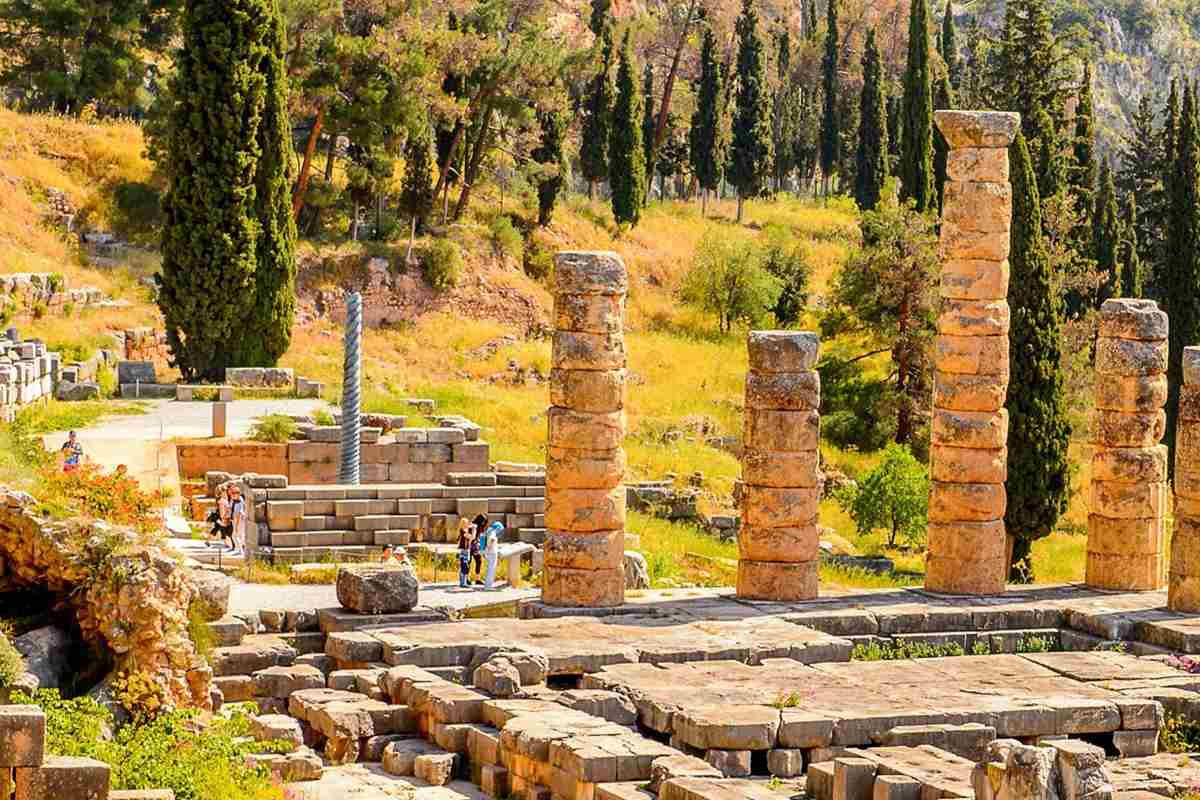
Wikipedia describes the Castalian Spring as the place where visitors purified themselves before going in. From there the Sacred Way ran up to the temple. Treasuries along it held offerings from Athens, Corinth, Boeotia and Thebes. Walking this path is the core of the morning in an 8 day greece tour.
The outer wall of the upper precinct measures 190 by 135 metres, according to Wikipedia, and has nine gates. The rebuilt Treasury of the Athenians stands along the way. It marks the victory of the Athenians at the Battle of Marathon. It is a clear landmark for an 8 day greece tour.
The ruins that stand today belong to a Temple of Apollo from the fourth century BC. Wikipedia describes a peripteral Doric building, erected by Spintharus, Xenodoros and Agathon. Earlier temples stood on the spot before it. Theodosius I ordered its destruction in AD 390, which explains why an 8 day greece tour shows ruins.
Wikipedia notes that the theatre and sanctuaries to Gaia, Dionysus and Neoptolemus surrounded the Temple of Apollo. Wikivoyage lists an ancient theatre, a temple and a stadium among the sights. It also lists the Sanctuary of Athena with the Tholos. One walk can cover all of these in an 8 day greece tour.
Wikivoyage states that the archaeological area is in the open air, with no restrooms. Food and restrooms are found at the nearby museum. Summer brings strong sun and tourist crowds, and Wikivoyage urges preparation. Plan the morning of an 8 day greece tour around these facts.
What does the Delphi museum add to an 8 day greece tour?
The Delphi museum adds the finds that belong to the ruins on an 8 day greece tour. Wikipedia lists the Sphinx of Naxos alongside the Charioteer, and fragments of reliefs from the Siphnian Treasury. Kleobis and Biton stand there too.
Wikivoyage says a short walk from the modern town reaches both the museum and the ruins. Wikipedia adds that Alexandros Tombazis designed the museum building. Wikivoyage says it houses the results of the excavations and restoration. So an 8 day greece tour links each ruin to real finds from the ground.
The museum also holds golden treasures that were discovered beneath the Sacred Way. A small leopard of mother of pearl, found in the Southeastern Mansion, stands in the gallery on the ground floor. Wikipedia describes that building as a private house of the fifth century. Such pieces give an 8 day greece tour a close look at small things.
Wikipedia describes the Sphinx of Naxos as built around 560 BC. It sat on a tall column and guarded the sanctuary. The museum counts the sphinx among its treasures. Seen indoors, it shows the carving at close range. This is one more reason to give the museum a full visit in an 8 day greece tour.
In Greek belief of that age, the world’s centre sat at Delphi. The Omphalos of Delphi, a stone, marked that spot. Wikipedia says the Greek word omphalos meant navel. Another page places the omphalos in the sacred temple of Apollo. An 8 day greece tour links this stone to the ruins outside.
Wikipedia notes that the museum exit stands beside an inscription that mentions Gallio, a Roman proconsul. It also says the site belongs to Parnassos National Park. After the museum the coach heads north for the night in Kalambaka, below the Meteora rocks. That ends the Delphi day of an 8 day greece tour.
What do the Meteora monasteries show on an 8 day greece tour?
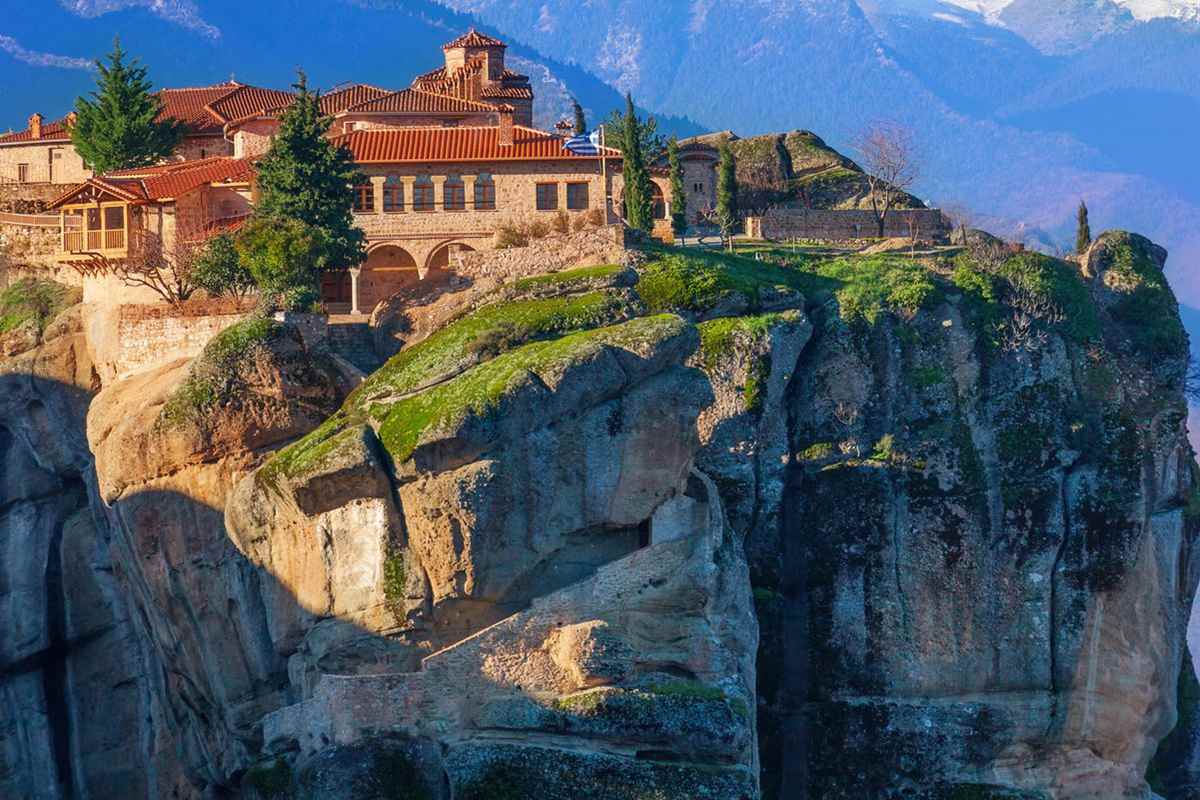
On day seven an 8 day greece tour reaches the Meteora monasteries, which crown tall rock pillars close to Kalambaka. Wikivoyage counts 24 monasteries on these pinnacles in northwestern Thessaly. Six of them are still in use and open to visitors. The rocks are the main sight of the day.
Day six ends in Kalambaka, so the 8 day greece tour starts day seven at the foot of the rocks. According to Wikipedia, Meteora stands near Kastraki village and Kalabaka town, close to the Pineios river. The short start leaves the whole morning for the climb.
Wikipedia notes that the rock columns differ from the volcanic plugs found elsewhere. They rise beside the Pindos Mountains in western Thessaly. Wikipedia names Kalabaka as the seat of the municipality that carries the Meteora name. Wikivoyage describes a muddy lake delta from about 60 million years ago. UNESCO lists the site for its architecture, beauty and religious meaning.
Hermit monks came first and lived in hollows in the rock, as Wikipedia states. Later the Great Meteoron rose on the Broad Rock. Its monks pulled up the ladder when danger came. For an 8 day greece tour this explains the site, because height gave the monks safety.
Wikipedia says visitors once climbed long ladders or rode up in nets. Today steps cut into the rock lead upward. Wikivoyage says every monastery except St. Stephen needs hundreds of steep steps, so an 8 day greece tour includes real climbing. The small cable cars are for hauling food and supplies, as the same page states.
Wikivoyage lists dress rules for the six monasteries. Men cover their knees with long trousers. Women wear skirts or sarongs, with shoulders covered. Cameras are not permitted in the inner church sanctuaries, yet are allowed elsewhere. The page adds that every monastery has toilets. Pack suitable clothes for day seven of the 8 day greece tour.
Wikivoyage states that in summer each monastery shuts one day a week, with the days staggered. Doors open from 9:00, and closing time lands between 15:00 and 17:30. High-season crowds fill the chapels, so early visits suit the plan. The same page notes manuscripts in the museums and relics in the Varlaam museum.
How do Thermopylae, Athens and the last morning work on an 8 day greece tour?
On day seven the 8 day greece tour leaves Kalambaka and runs south past Trikala, Lamia and Thermopylae. It reaches Athens in the early evening. Wikipedia dates the Battle of Thermopylae to 480 BC. Greek city-states under Leonidas I of Sparta faced the Persian Empire there.
Trikala comes first on the road. Wikipedia calls it a city in northwestern Thessaly. The Lithaios river runs through it, and Meteora lies close by. Wikipedia names its Clock Tower, its castle and the Osman Shah Mosque as sights. On an 8 day greece tour it is a passing town, not a planned stop.
Lamia follows. Wikipedia places it in central Greece and names it capital of Phthiotis. Lamia Castle is the fortified acropolis of the city. In antiquity the city held the strip of coast above Thermopylae. That strip joined southern Greece to Thessaly. For the 8 day greece tour it is the last big town before the pass.
The plan then reaches the pass of Thermopylae and the Leonidas monument. Wikipedia says the Greeks held off the Persians for seven days, three of them in direct battle. They blocked the one road through the narrow pass. The 8 day greece tour keeps this look short and plain before the coach drives on to Athens.
Wikipedia reports that a local resident revealed a mountain path to the Persians. Aware of it, Leonidas sent the larger part of the allies away. Wikipedia names 300 Spartans and 700 Thespians among those who remained. Respect suits this visit, as it is a place of memory. The 8 day greece tour keeps it brief and plain.
The evening in Athens is a plain return, with no set plans. Rest, a meal and packing fit well after the hours of driving. A calm evening closes the 8 day greece tour before the last morning.
Day eight brings the airport transfer and your flight home. Allow a spare buffer ahead of check-in, and keep passports and tickets in the day bag. Ask the provider for the pick-up time the evening before. A relaxed last morning ends the 8 day greece tour well.
Which entry rules, heat and packing points matter on an 8 day greece tour?
An 8 day greece tour needs a passport or national ID card, light clothes and water for the heat. The Council of the EU describes the Schengen area as one without internal border controls. Checks at its external borders are harmonised. Carry your documents every day.
Look up the rules that apply to your own nationality before booking. Schengen rules decide whether you face checks on arrival, as the Council of the EU describes. Travel insurance is a sensible single line on the list. Keep copies of your documents apart from the originals during the 8 day greece tour.
An electrical safety charity states that Greece has plug types C and F, with 230 V at 50 Hz. Bring one adapter for phone and camera chargers when you pack for an 8 day greece tour. Carry a bank card and a little cash for small stops. Ask the provider what each day needs.
The sites are open-air, so wear flat shoes with grip. Marble is smooth and the paths are rough. Add a sun hat, water and a small day bag. Wikivoyage says summer at Meteora brings baking heat and advises water. It adds that storms occur all year at higher altitudes. This kit suits every day of an 8 day greece tour.
In a heat wave the Ministry of Culture can change opening hours of archaeological sites. Ask the provider how the 8 day greece tour changes in such weather. Also ask about public-holiday closings and last entry times. Each site sets its own bag checks.
Wikipedia says the meltemi is dry and blows across the Aegean Sea. It adds that these northerly winds temper the summer heat. The wind matters for the island day of the 8 day greece tour. Ask the provider about sea conditions on the morning of the cruise.
Children need breaks on the coach days, so pack snacks and games. Step-free access is not the same at every site. Wikivoyage says only St. Stephen at Meteora spares you the hundreds of steep steps, and visitors with mobility issues can only reach that one. Ask the provider before booking any 8 day greece tour.
What else do travellers ask about an 8 day greece tour?
An 8 day greece tour leaves small gaps that raise small questions. The answers below cover an extra night, free evenings and Greek words. They also cover a quiet island day and walking. A traveller can then plan the details before booking.
Is an extra night in Nafplio or Delphi possible on an 8 day greece tour?
A traveller can ask the provider about a longer version of the plan. The eight days then become nine. Wikivoyage calls Nafplio a romantic town and a great place to stay while travelling around the Peloponnese. The extra night gives time to see the town in daylight and after dark.
Wikivoyage says a visitor reaches the Palamidi fortress by 857 stair steps or simply drives there. It adds that a drive back at night rewards you with a view of Nafplio and the Argolic Gulf.
Delphi gains from a night too. Wikivoyage lists the museum as open from 08:00, with a later closing in summer. It advises arriving early or sleeping nearby, and it names Arachova and Galaxidi as places under thirty minutes away. Any change to an 8 day greece tour needs the provider’s agreement.
How does a free evening work on an 8 day greece tour?
In Athens, Wikivoyage describes Plaka as a historic district at the foot of the Acropolis. It has restored neoclassical homes, pedestrian streets, shops and restaurants. Thissio lies west of the Acropolis and now houses restaurants and cafes.
Syntagma Square is an easy starting point on foot. Wikivoyage says the square is named after the Greek constitution, and a major metro stop lies there. An 8 day greece tour spends its first three days around Athens, so these streets are close to the centre.
In Delphi, Wikivoyage says the modern village has places to eat. Its shops are aimed at the regular tourist. In Nafplio, the night view from Palamidi is the evening sight that Wikivoyage recommends.
Which Greek words help on an 8 day greece tour, and is English understood?
Two travel pages agree on the polite words. Kalimera means good morning, and one page says to use it until noon. Kalispera means good evening. Efharisto is the word for thank you. Parakalo is the word for please.
Both pages add that parakalo also means you are welcome. Nai sounds like the English word no, but it means yes. Oxi means no. Try these words at a cafe or a ticket desk on an 8 day greece tour.
One travel page states that Greeks in tourist areas speak English. A traveller on this route therefore needs only a smile and a handful of words. The bill is asked for with the phrase logariasmo, parakalo.
What do the Saronic islands offer a quiet traveller on an 8 day greece tour?
Wikivoyage places the Saronic Gulf Islands in the Aegean Sea, southwest of Athens. Visitors come for the day, and Hydra also receives cruise ships. The page calls the islands quite touristy, though it is almost all Greek tourism. The island day in an 8 day greece tour is one of these trips.
For calm, Wikivoyage points to Poros, which has two islands linked by a bridge. Well-developed Sfairia island holds the town of Poros, while Kalavria island is quieter. Poros lies within 200 metres of the Peloponnese mainland.
Wikivoyage says the islands are dotted with little churches and museums. A quiet traveller can enjoy these small sights at an easy pace. The only major classical antiquities are on Aegina, as the same page states.
How much of an 8 day greece tour works on foot?
At three stops, the sources agree that walking works. Wikivoyage says all the major sights of Nafplio lie in the old town and are easily covered on foot. For Delphi, it calls the town small enough that walking is all a visitor needs.
Wikivoyage places the Delphi museum and the archaeological site within walking distance of the town. Taxis are also readily available there. The site is in the open air, so a traveller has to deal with the weather.
At Olympia, Wikipedia says the ancient ruins sit south of Mount Kronos. It adds that the site has three museums. A site this size suits comfortable shoes on an 8 day greece tour.