
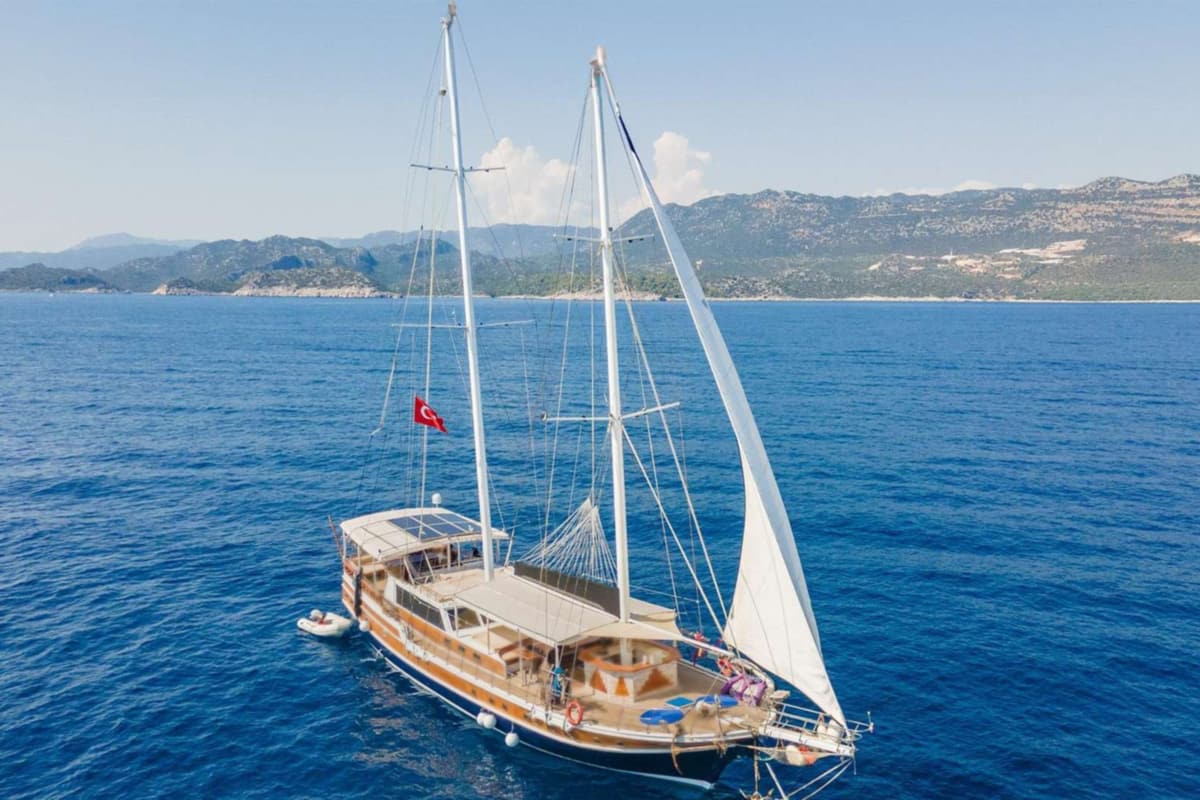
A turkey blue cruise tour spends four days on a wooden gulet between two stretches on land, so the sea sits at the centre of a 14-day plan. Readers who want the Greek side of the Aegean can compare it with the tours in Greece listed on this site.
The page covers the 14-day outline, the season, Istanbul to Marmaris, life on a gulet, Caunos, Tersane Island, Fethiye and Cappadocia, and it points to the 10 day turkey tour and 11 day turkey tour for the land circuits and to the fethiye olympos gulet cruise and antalya kekova gulet cruise for other sails.
What is the turkey blue cruise tour, and how does the 14-day plan run?
The turkey blue cruise tour is a 14-day plan with four days on a gulet in the middle. Five land days lead from Istanbul to Marmaris by way of Ephesus and Pamukkale. Four days sail to Fethiye, and five land days finish in Cappadocia and Istanbul. The trip holds thirteen nights.
The first block builds toward the water. Istanbul fills days one to three, and a night bus then carries the traveller to Kusadasi. Ephesus follows on day four and Pamukkale on day five, with an evening drive to Marmaris. This turkey blue cruise tour reaches the coast only after the big sights.
- Arrival in Istanbul and transfer
- Istanbul city tour with Topkapi Palace
- Free Istanbul day, night bus to Kusadasi
- Kusadasi and the ruins of Ephesus
- Pamukkale terraces, then the drive to Marmaris
- Boarding the gulet at Marmaris
- Ekincik Bay, Caunos and the Dalyan River
- Manastir Bay and Bedri Rahmi Bay
- Tersane Island, then Fethiye
- Free day in Fethiye, night coach inland
- South Cappadocia: Derinkuyu and Ihlara Valley
- North Cappadocia: Goreme, Uchisar, Urgup, Cavusin
- Fly back to Istanbul, day at leisure
- Transfer to the airport
The turkey blue cruise tour puts the sea in the middle for a clear reason. Marmaris and Fethiye are both resort towns on the Mediterranean coast of Turkey, as Wikivoyage describes them. The gulet links the two. Cities come before the water and valleys come after it, so the sea days split the trip in two.
The sea block runs from day six to day nine. The gulet leaves Marmaris, calls at three bays and one island, and ends the sail at Fethiye. A hotel night in Fethiye closes the block. That block is the heart of the turkey blue cruise tour.
The land after the sea is a different world. The Cappadocia article places the region in central Anatolia. It notes that the Taurus Mountains separate it from the Mediterranean Sea. On this turkey blue cruise tour a night coach leaves Fethiye for Cappadocia. Two days in the valleys follow, then a flight to Istanbul.
The numbers are easy to check. Fourteen days hold thirteen nights. Arrival opens the plan and the airport transfer closes it. The twelve days between them carry the sights. Three of them are free: one in Istanbul, one in Fethiye and a last one in Istanbul. This turkey blue cruise tour leaves room to rest.
What is a blue cruise, and where does the name come from?
A blue cruise is a recreational voyage along the south-west coast of Turkey, past ancient cities, tombs and small coves. Turkish calls it Mavi Yolculuk, or Blue Voyage, and Mavi Tur, or Blue Tour. The turkey blue cruise tour builds four days around one.
The name began in books. The Blue Cruise article on Wikipedia traces the term Blue Voyage to Turkish literature. Its source is the title of a book by Azra Erhat. A small group of writers first brought it into print, among them Cevat Sakir Kabaagacli. The turkey blue cruise tour keeps that literary name.
Kabaagacli wrote as The Fisherman of Halicarnassus, the ancient name of Bodrum. He was exiled there in the first half of the twentieth century. He joined companions on the sailing boats that divers used to harvest sponges. Those boats were called gulets, and the outings became known as Blue Voyages. Today a turkey blue cruise tour still runs on gulets.
The first voyages were plain. His Wikipedia biography describes an approach built on simplicity and a break from modern distractions. Cheese, water and rusks were among the essentials, and newspapers and radios stayed ashore. The page sets those trips against the luxurious blue cruises of today.
Other writers joined in. The Blue Cruise article names Sabahattin Eyuboglu and Azra Erhat among the travellers. A literary review called Yeni Ufuklar, or New Horizons, helped to spread the word. The article adds that cruise tourism turned Bodrum from a fishing village into a holiday destination. The turkey blue cruise tour is a late chapter of that story.
The boat has its own history. The Gulet article suggests that the design began in ancient Ionia, with similar vessels around the eastern Mediterranean. It describes the gulet as a traditional wooden vessel with two masts in the common design. Marmaris, where this turkey blue cruise tour boards, is one of the two towns the article names as builders.
The tourist gulet is young. As visitors reached the Aegean coast in numbers, mainly at Bodrum and Marmaris, they needed boats for nearby bays. Working boats for fishing and sponging had no cabin. A cabin and seating were fitted on the rear deck. The gulet of a turkey blue cruise tour grew from that change.
Which season suits the turkey blue cruise tour?
The turkey blue cruise tour suits the dry months of the south-west coast. The Marmaris page on Wikipedia states that showers and rain are very unlikely from late spring to October. Heatwaves hit in July and August, then September brings cooler air.
Summer heat decides how the days feel. Fethiye has hot, long, dry summers with a daytime average of 34 degrees Celsius, says its Wikipedia page. Wikivoyage adds that the hottest days top 40 degrees. In July and August the swim stops do the cooling on a turkey blue cruise tour.
The sea stays warm after the air cools. Wikivoyage puts the water off Fethiye at 24 degrees Celsius in September and October. The Marmaris page calls October warm and bright, with spells of rain. For the four days afloat, the turkey blue cruise tour finds warm water in both months.
The Etesian article gives the Turkish name meltem to the dry northerly wind that crosses the Aegean. Gusts build through the afternoon and fade after dark. Late spring to mid September is when that wind blows. Wikivoyage places the Aegean’s edge at the Datca peninsula, just west of Marmaris. The turkey blue cruise tour starts close to that edge.
Cappadocia is the cold end of the plan. Its Wikipedia page ties the climate to the inland, high position of the region. Summers there are hot and dry, while winters bring cold and snow. Wikivoyage adds hot days and chilly nights. The last days of the turkey blue cruise tour meet that cold in winter.
Spring in Cappadocia brings the Kirkikindi thunderstorms of inland Anatolia, with heavy downpours, says Wikivoyage. Autumn is mild and dry there, and the page singles out September. Marmaris starts to cool in September too. A September turkey blue cruise tour therefore suits the coast and the valleys together.
The season has a clear end. Marmaris hosts a regatta every year in late October, its Wikipedia page notes. Winter is the rainy season there, and the bulk of the rain falls after November. A turkey blue cruise tour belongs to the dry months, not the winter.
What do Istanbul and Ephesus add before the turkey blue cruise tour?
The turkey blue cruise tour spends its first four days on Istanbul and Ephesus. Both are old cities with a long link to the sea and its trade. A night bus joins them, and Ephesus lies near the ruined temple of Artemis, a Wonder of the ancient world.
Istanbul lies along both banks of the Bosphorus, a strait that runs from north to south through the city. The Golden Horn, 7.5 kilometres long, cuts into the European side as a sheltered harbour. Greek settlers founded Byzantium on the Sarayburnu headland in the seventh century BC. The turkey blue cruise tour starts its story beside this water.
The turkey blue cruise tour moves from the free day in Istanbul to the Aegean coast on an overnight bus. Wikivoyage describes the direct coaches from Istanbul to Kusadasi as an hourly service, with night departures among them. Kusadasi sprawls along 25 kilometres of coast. Day four of the plan uses it as a base for Ephesus.
Ephesus began as a Greek colony on the coast of Ionia. Today the coast lies 3 to 4 kilometres away, because sediment filled the plain, Wikipedia explains. Wikivoyage adds that the city moved west from about 290 BC when its estuary turned to swamp. The turkey blue cruise tour reaches a port city that lost its port.
The turkey blue cruise tour stops where the Temple of Artemis rose, one of the Seven Wonders. Around 550 BC the Cretan architect Chersiphron began a larger version, 115 metres long and funded by Croesus of Lydia. Wikipedia calls its marble supposedly a first for a Greek temple. Only foundations and one reconstructed column remain.
Wikipedia gives the Great Theatre an estimated 25,000 seats and believes it the largest in the ancient world. Drama came first, and gladiator combats came later, under the Romans. Harbour Street runs from the theatre to the silted-up harbour. The turkey blue cruise tour gives the theatre its place on day four.
Wikivoyage dates the larger part of what stands today to Roman builders, between 100 BC and AD 260. UNESCO gives the ruins World Heritage status. Wikivoyage places the House of the Virgin Mary among the outlying sites beyond the ticketed area. After this day the turkey blue cruise tour leaves the Aegean coast for Pamukkale.
What does Pamukkale add to the turkey blue cruise tour?
Pamukkale adds the last land sight before the coast: a white hillside in Denizli Province. Travertine terraces climb it, and the ruins of the ancient spa town of Hierapolis crown the slope. The turkey blue cruise tour visits on day five, then drives to Marmaris that evening.
The Turkish name Pamukkale means cotton castle. The white rock shows from Denizli, 20 kilometres away across the valley. The site lies in the Menderes valley, in the Inner Aegean part of the country. The turkey blue cruise tour reaches this valley after the Ephesus day and before the sea.
Wikipedia measures the formation at 2,700 metres in length, 600 in width and 160 in height. Hierapolis sits on top of that formation. These figures describe a whole hillside, not a single pool. Wikipedia adds that visitors have come to its thermal springs since classical antiquity.
Seventeen hot springs feed the terraces, with water between 35 and 100 degrees Celsius. The water is carried 320 metres to the upper edge of the terraces. Wikivoyage explains that the springs carry carbon dioxide through limestone and release it at the surface. Water shapes both halves of the turkey blue cruise tour: rock here, and the sea later.
Wikivoyage reports that hotels once covered the plateau above the terraces. After the UNESCO listing they were removed, and the larger part of the terraces closed to walkers. Wikipedia adds that authorities regulate the water flow and close sections for a time. Visitors on the turkey blue cruise tour walk only where the rules allow.
Hierapolis stands on a terrace about 300 feet above the Lycus river. The city was known for woollen cloth and dyes. Its Roman theatre was built ahead of a visit by Emperor Hadrian, and Wikivoyage counts 12,000 seats. The turkey blue cruise tour walks among those stones.
After Pamukkale the turkey blue cruise tour drives to Marmaris for the evening. Wikivoyage lists a museum of local finds, with ornate sarcophagi, set in the old Roman baths. It also names a lookout, Sunset Spot, with a view over the terraces. Then the interior ends and the coast begins.
Why does the turkey blue cruise tour start at Marmaris?
The turkey blue cruise tour starts at Marmaris because the town has a natural harbour and yacht marinas. An airport at Dalaman lies within reach. The town sits in Mugla Province, on the same coast as Fethiye, where the voyage ends.
Marmaris sits between two sets of mountains by the sea, as Wikipedia describes it. Wikivoyage calls its harbour a good natural one. Pine forests grow around the town, with hiking trails in Marmaris National Park. Mugla Province holds the longest coastline of any Turkish province, 1,100 kilometres. The turkey blue cruise tour starts on this coast.
The name Marmaris comes from the Greek word for marble. Wikipedia ties it to the marble trade of the port. Wikivoyage adds that the hills were quarried for marble, but on a smaller scale than the Marmara Islands near Constantinople. The turkey blue cruise tour boards in a town named for a sea trade.
Marmaris Castle stands close to the yacht harbour. It survived the Fethiye earthquakes of the nineteen-fifties, together with the old buildings around it. Suleiman the Magnificent had it rebuilt during his campaign against Rhodes. It holds 18 former residences, a fountain and a cistern. The Ministry of Culture later turned it into a museum with seven galleries.
Wikivoyage lists Marmaris as a port of entry for boats, with immigration and customs clearance. Wikipedia notes that cruising boats spend the winter there. Yacht marinas also stand in Bodrum, Fethiye and Gulluk, according to its Mugla Province article. A turkey blue cruise tour suits a town built around boats.
Wikivoyage describes boat trips that circle the bay by way of Turunc, Phosphorus Cave and Cennet Island. Phosphorus Cave glows blue inside but is too narrow for boats to enter. Nimara Cave on the same island is a protected area, Wikipedia notes. The turkey blue cruise tour begins in a bay with caves and beaches.
Dalaman Airport lies to the east of Marmaris, an hour’s drive away, according to Wikipedia. Two peninsulas reach out beyond the town, as Wikivoyage shows. Datca is 70 kilometres long and points west, while Bozburun lies to the south. The Greek island of Symi lies between them. From here the turkey blue cruise tour sails towards Fethiye.
How does a gulet work on the turkey blue cruise tour?
In its common design the gulet has two masts and a hull of timber. The turkey blue cruise tour puts you on one for four days. A crew runs the boat while you sleep, eat and swim. That means the cruise needs no sailing skill from you.
On the turkey blue cruise tour the crew does the work of the boat. Two travel pages state that it looks after the boat and the meals. One adds that it manages the anchoring. On day six the skipper welcomes you at Marmaris and explains life on board. After that, the crew runs the days.
Wikipedia says diesel power is now nearly universal on gulets, and a good share are not properly rigged for sailing. A travel page adds that the engine does the moving between stops. Both facts shape how the turkey blue cruise tour travels from bay to bay.
The deck is the shared space of a gulet on the turkey blue cruise tour. The Wikipedia page on the gulet records the first tourist boats, built in the early nineteen-seventies. They gained chambers and seating at the back of the deck. Designs were then refined to give more room for rest and leisure.
On the turkey blue cruise tour a group shares one boat. One travel page states that gulet cabins are narrow and that guests sleep, eat and sunbathe close together. The Blue Cruise article on Wikipedia gives a gulet room for groups of six to twenty-four people.
The day follows the bays. A travel page describes waking at anchor, swimming before breakfast and motoring two or three hours to the next stop. Another page says meals are served while the boat rests in a bay. Days seven and eight of the turkey blue cruise tour follow this pattern.
Two hull shapes carry guests on blue cruises. Charter talk in Turkey nicknames the rounded stern of the Bodrum type the watermelon stern. The aynakic is a cousin of that hull, with a square end. The Bodrum Maritime Museum calls it a version built for more capacity and deck space, as Wikipedia notes.
What do Ekincik Bay, Caunos and the Dalyan River add to the turkey blue cruise tour?
The turkey blue cruise tour leaves the gulet at Ekincik Bay for a river boat into the Dalyan delta. The boat reaches Caunos, an ancient port of Caria. Silt and a sandbar cut it off, and it now stands about 8 km from the sea.
Ekincik Bay is the landing point of day seven. Dalyan lies between Marmaris and Fethiye, so the turkey blue cruise tour meets it between its two harbours. The Wikipedia page on Iztuzu Beach links an article on new laws for turtle nesting areas. Ekincik stands in its title beside Patara and the Goksu Delta.
Caunos was a working sea port. Its history is thought to reach back to the tenth century BC. It had two harbours, and the inner trade harbour had chains to close it. That harbour is now Suluklu Gol, the Lake of the Leeches. The turkey blue cruise tour visits a port that lost its harbour to silt.
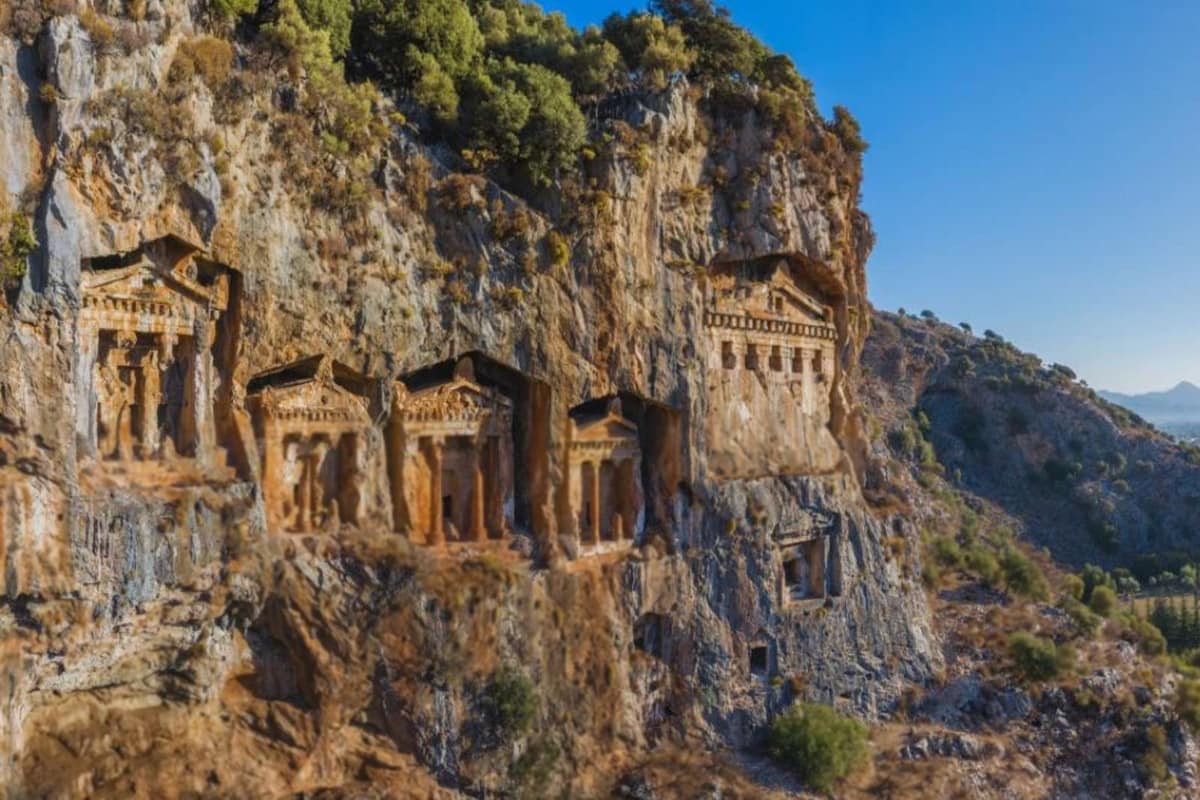
Lycian rock tombs are cut into the cliffs above the river, a short boat trip from Caunos. The Wikipedia article on the city counts six tombs from the fourth to the second century BC. Their fronts copy Hellenistic temples, with two Ionic pillars. The river boat of the turkey blue cruise tour brings both sights into one outing.
The theatre stands on the slope of the acropolis. Wikipedia and Wikivoyage both give it a capacity of 5,000, and Wikipedia adds a diameter of 75 m. The acropolis rock rises 152 m. From its top you see the old city, the river, the estuary and Iztuzu Beach.
The turkey blue cruise tour passes a nesting ground of the loggerhead sea turtle, Caretta caretta, in the Dalyan delta. Iztuzu Beach is a narrow spit between the freshwater delta and the Mediterranean. Wikipedia ranks it among the main breeding grounds of the species in this sea. Wooden stakes mark the nesting zones.
The river trip also reaches the mud baths. The protection area’s page says sulphurous thermal springs lie along a fault south of Koycegiz Lake. Another mud bath sits downriver. Wikivoyage adds that the bath water is piped in and warm rather than hot. The Dalyan outing is an optional extra on the turkey blue cruise tour.
What do Manastir Bay, Bedri Rahmi Bay and Tersane Island add to the turkey blue cruise tour?
On its second sailing day the turkey blue cruise tour moves from Ekincik toward the Gulf of Fethiye. It stops for a lunch swim in Manastir Bay and anchors for the night in Bedri Rahmi Bay. Day nine reaches Tersane Island, in the gulf that Fethiye and Gocek surround.
The plan sails on from Ekincik with the morning wind off Dalaman. The Etesian winds blow over the Aegean in summer and are strongest in the afternoon. They ease at night, and in the southern Aegean they blow from the northwest. Day eight of the turkey blue cruise tour spends the morning under way.
Manastir Bay is the lunch swim of day eight. A boating page places it near Dalaman, about one nautical mile west of Bozburun. Pines run from the water’s edge to the hilltops. The same page rates the shelter as excellent from every direction except the northeast. That suits a swim stop on the turkey blue cruise tour.
The turkey blue cruise tour anchors for the night in a bay named for Bedri Rahmi Eyuboglu. He was a Turkish painter, mosaic-maker, muralist and poet, as Wikipedia describes him. He was born at Gorele on the Black Sea. His work drew on Anatolian village scenes and folk literature. His mosaic panels can be seen in Istanbul.
A fish on a rock gives the bay its story. A Turkish English-language newspaper reports a fish figure that the painter drew on a flat rock. He drew it during a blue cruise in the nineteen-seventies, at a cove then called Tasyaka. The place later took his name and remains a stop for day boats from Gocek.
Tersane Island is the last stop of the turkey blue cruise tour before Fethiye. It lies in the Gulf of Fethiye, across a narrow channel west of Domuz Island. Its name means Shipyard Island. Under Ottoman rule it was probably a place for shipbuilding and repair, according to Wikipedia. The island holds ruins from the Lycian era.
Boats on blue cruises leave from and return to Gocek, a town on the same gulf. Its harbour carries heavy yacht traffic. Its Wikipedia article says artists, poets and Bodrum fishermen made the town known by cruising the Turquoise Coast. That journey was later called the Blue Voyage. The turkey blue cruise tour ends at Fethiye, not at Gocek.
How does the turkey blue cruise tour end at Fethiye?
The turkey blue cruise tour finishes in Fethiye, a port inside the Gulf of Fethiye in Mugla Province. The gulet reaches the harbour on day nine, and the traveller sleeps in a hotel ashore. Day ten stays free before the coach leaves for Cappadocia.
Fethiye carried another name for centuries. Wikipedia lists it as Makri, a Greek word for “long one”, taken from the island at the harbour entrance. Today’s name honours Fethi Bey, a pilot who died while trying to fly from Istanbul to Cairo. A turkey blue cruise tour thus ends in a town named for a pilot.
Modern Fethiye stands on the ancient city of Telmessos. Its Hellenistic theatre had 28 rows of seats for 6,000 spectators, according to the sign at the site. A stage was added around 200 AD. The free day of a turkey blue cruise tour leaves time to walk over and see the ruin.
The Lycians called the place Telebehi, held the heights above the marina and cut tombs into the cliff face. Wikivoyage dates that name from about 500 BC. The Hittites had already recorded the site as Kuwalapassa, in the second millennium BC. A rock tomb in Fethiye is dated to the fourth century BC.
Fethiye Castle spreads along the hillside west of the tombs. The Knights of St John raised it mainly in the fifteenth century, reusing older structures such as rock tombs. Earthquakes have since taken their toll. Offshore, Kizilada island lies 6.4 km from the city, and Wikipedia calls it a popular stopover for boat tours.
The turkey blue cruise tour leaves Fethiye by coach, but the coast has an airport too. Dalaman Airport lies 6 km south of Dalaman town. Wikivoyage says domestic flights from Istanbul and Ankara use its older terminal, and international flights use the newer one. It serves a 200 km stretch of coast that once needed long coach transfers.
Day ten of a turkey blue cruise tour is free for the town. Wikivoyage describes a fish market where you buy fish and carry it to a nearby restaurant to be cooked. A farmers market runs on Tuesday and Friday.
A turkey blue cruise tour traveller can try kar serbeti, a local sorbet that mixes snow with grape molasses. The snow is said to come from the Taurus Mountains. Oludeniz, about 4 km south, is known for its beach spit and Blue Lagoon, as Wikipedia states.
What does Cappadocia add after the turkey blue cruise tour?
Cappadocia adds a high rock plateau after the turkey blue cruise tour, reached by an overnight coach from the coast. Day eleven covers south Cappadocia, with Derinkuyu, the Ihlara Valley and a caravanserai. Day twelve covers the north, with Goreme, Uchisar, Urgup and Cavusin.
The turkey blue cruise tour swaps sea level for highland on one overnight coach. Wikivoyage gives bus times to Nevsehir from two coast cities: eight hours from Antalya, twelve from Izmir, both via Konya. Wikipedia describes Cappadocia as a plateau above 1,000 m, pierced by volcanic peaks.
Day eleven includes Derinkuyu. Of the underground cities excavated in Turkey, it is the largest. It had room for up to 20,000 people together with their livestock and food stores. A turkey blue cruise tour thus moves from open sea to a city dug into volcanic rock.
A room with a barrel-vaulted ceiling on the second floor was reportedly a religious school. A church sits on the lowest, fifth level, reached by staircases that begin between the third and fourth levels. Tandoor ovens stood in the kitchens, and villagers in Cappadocia still use them today. A turkey blue cruise tour walks this layout level by level.
The Ihlara Valley adds painted churches to a turkey blue cruise tour. The Church with Forty Roofs carries an inscription from the late thirteenth century. It names the Seljuk sultan Mesud II and the Byzantine emperor Andronikos II. A painting shows a consul in Seljuk dress beside his wife, a Georgian princess.
A caravanserai joins the south day of the turkey blue cruise tour, a stop on the old trade roads. The word joins Persian karvan, a group of travellers, with sarai, a building round courts. In Turkish the word became han. Wikipedia adds that caravanserais supported the flow of commerce, news and people along the Silk Road.
Day twelve of the turkey blue cruise tour includes Goreme and its open-air museum. Early Christians called the place Korama, and Wikipedia ties that name to a phrase meaning “you cannot see this place”. Both Korama and the village of Matiana sent representatives to the Council of Chalcedon in 451.
Uchisar means “outer citadel” in Turkish, and a chronicle of the fourteenth century gives its first written mention. Old stone houses with carved facades fill the old village. Pigeon Valley runs between Uchisar and Goreme, a walk of around two hours. Pigeon-houses with roosting niches were carved into its sides.
Urgup’s old stone houses cluster round Temenni Hill, a central rock formation. The hexagonal Alti Kapilar, or Six Gates, is the tomb of a military commander and marks the Seljuk presence. On the road towards Goreme, fairy chimneys are sometimes called the Three Beauties.
Cavusin lies 5 km north of Goreme, its old part on a large rock ridge. It has two rock-cut churches, both named for St John the Baptist. The first, dated to between 963 and 969, holds frescoes of the Byzantine emperor Nicephorus Phocas and his wife Theophano. The turkey blue cruise tour closes its Cappadocia days in this village.
How does the turkey blue cruise tour return to Istanbul?
The turkey blue cruise tour returns to Istanbul by air on day thirteen. A domestic flight leaves one of two Cappadocia airports. The rest of that day is at leisure in the city. Day fourteen closes the plan with the road transfer to the airport.
Wikivoyage lists two airports for the region. Nevsehir Kapadokya sits north of Nevsehir town, 30 km away, while Kayseri Erkilet is 70 km east of Goreme. In peak season, Nevsehir has up to six flights a day from Istanbul. The flight of a turkey blue cruise tour leaves from one of the two.
Day thirteen of the turkey blue cruise tour leaves time for the old city. Wikivoyage groups the Roman, Byzantine and Ottoman monuments around Sultanahmet Square and lists the Basilica Cistern, built by the Romans. The Theodosian walls run beside the former Church of the Holy Saviour in Chora. Its whole interior is covered in frescoes and mosaics.
The free day of a turkey blue cruise tour can also take in two quieter sights. Miniaturk, in Sutluce on the Golden Horn, is the city’s first miniature park. Its models come from around the former Ottoman Empire. Wikivoyage adds Ottoman military music concerts, called Mehter, every afternoon at the Military Museum north of Taksim Square.
The turkey blue cruise tour starts and ends in Istanbul, which straddles the Bosphorus. Wikipedia calls the strait one of the world’s busiest waterways. The Sea of Marmara bounds the city on the south, and the Black Sea bounds it on the north.
The airport transfer on day fourteen ends the turkey blue cruise tour. Wikivoyage gives about 50 km and around 50 minutes for a taxi ride between Istanbul Airport and Sultanahmet. It adds that heavy traffic can slow the ride. Official taxi stands wait outside each level of the airport.
What else do travellers ask about the turkey blue cruise tour?
Five answers follow about the turkey blue cruise tour. They cover the swim stops, calm water and seasickness, and the old names and regions of the coast. They also cover the bag for sea and plateau, and the optional Dalyan outing. Each answer rests on one named source and keeps to plain facts.
Is swimming part of every day on the turkey blue cruise tour?
No, the plan keeps its swims for the gulet days. Those run from the boarding at Marmaris on day six to the end at Fethiye on day nine. Days eleven and twelve lie in Cappadocia, an inland region, as Wikipedia describes it. The turkey blue cruise tour offers no sea swim there.
The page names one swim: the lunch swim in Manastir Bay on day eight. The turkey blue cruise tour promises no swim on the other sea days. Swims near turtle nests follow rules. The Wikipedia article on Iztuzu Beach bans parasols, sunbeds and digging in the marked nesting zones.
Day ten is a free day in Fethiye. The Wikipedia article on the town notes that it has no beach of its own. Calis Beach, north of the centre, serves as its beach. A swim that day is the traveller’s choice, not a fixed item.
How calm is the water on the turkey blue cruise tour, and what is seasickness?
Calm water depends on shelter. Wikivoyage’s Fethiye page says Fethiye Island shelters the bay of the town. Calis Beach has no such cover, so the page reports rougher waves there by afternoon. The page ties the rough water to the missing cover.
Seasickness on a turkey blue cruise tour is motion sickness at sea. The Wikipedia article on motion sickness gives mal de mer as another name. Nausea, cold sweat and dizziness are among its signs. The article also lists a loss of appetite and tiredness. It calls the motion of a boat more regular than that of a car.
The same article lists lying on one’s back and not reading while moving among the behavioural measures. It adds that side effects can restrict the use of medicines. A doctor or pharmacist answers medicine questions before the turkey blue cruise tour starts.
Does the turkey blue cruise tour have another name, and which old regions does it cross?
A blue cruise has a second name. The Wikipedia article on it lists Carian Cruise as a lesser-known synonym. That name points to Caria, the ancient name of this corner of south-west Turkey. The turkey blue cruise tour starts in that old land. Rhodes held the part of Caria where ancient Physkos, today’s Marmaris, stood.
The Calbys river, now the Dalyan river, marked the line between Caria and Lycia, says the Wikipedia article on Caunus. Caunos began as a separate state, then joined Caria and later Lycia. On the turkey blue cruise tour, the optional outing of day seven follows that river.
Caunos also holds a clue to the Carian language. Inscriptions in Carian from about 400 BC were found there, among them one in Greek and Carian. The article adds that they helped to decode the Carian alphabets. The old name of the coast leaves a trace in that stone.
What goes in the bag of a turkey blue cruise tour, from sea days to Cappadocia nights?
Two settings share one bag. The sea days run on a gulet, and days eleven and twelve run in Cappadocia. Wikivoyage calls the climate of Cappadocia semi-arid and continental. A turkey blue cruise tour therefore needs clothes for the deck and clothes for the valleys.
Low sun at sunrise and sunset gives the rock formations their colour, Wikivoyage notes, and balloons launch at sunrise too. It adds that overcast skies turn the rocks grey. A warm layer for those hours takes little room in the bag. Swimwear serves the sea days.
Feet need thought too. At Dalyan, a ferry crosses the river to Caunos. Wikivoyage puts the walk to the ruins at about 500 metres. It also lists Cappadocia trails from easy strolls to long canyon treks, and warns against nightfall on rough, unfamiliar ground. Closed, flat shoes suit these walks.
What does the optional Dalyan outing mean for the turkey blue cruise tour?
The plan lists the Dalyan outing on day seven as an optional extra. It adds a river boat to ancient Caunos and a run up the river to the mud baths. The turkey blue cruise tour keeps its shape either way, because the gulet sails on from Ekincik on day eight.
The name Dalyan is the Turkish word for a fishing weir, as the Wikipedia entry for the place explains. Sea bream, mullet and bass travel up the river to Koycegiz Lake. The weirs caught them on the way back. Wikivoyage lists boat trips that run down the delta and up to the same lake.
Wikivoyage describes the estuary south of Dalyan as a wetland that matters to birds. Among the rules that protect nesting turtles, speedboats are banned in the delta and on the river. The river outing of the turkey blue cruise tour therefore runs among rules written for wildlife.