
An asia minor tour links western Turkey’s main sights in one week, from Istanbul to Ephesus. For more trip plans, browse these tours in Greece.
The page covers the season, the seven days, the road legs, Istanbul, Gallipoli, Troy, Pamukkale, Ephesus and a short FAQ.
What is an asia minor tour, and how does the route run?
An asia minor tour crosses the western part of Anatolia, the Asian part of Turkey. This plan runs seven days and six nights in western Turkey. It moves from Istanbul through Gallipoli, Troy and Kusadasi to Pamukkale and Ephesus, then flies back to Istanbul.
Wikipedia calls Anatolia, also known as Asia Minor, a peninsula in West Asia. It makes up the majority of the land area of Turkey and is the westernmost protrusion of Asia. The Mediterranean lies to its south, the Aegean to its west and the Black Sea to its north. A tour of its western side is an asia minor tour.
Seven days and six nights frame the plan. Day one is an arrival day and day seven is a departure day, so five days carry the sights. The six nights make four stays: two in Istanbul, one in Canakkale, two in Kusadasi and one back in Istanbul. This asia minor tour changes base only three times.
The route keeps one order. The Old City of Istanbul opens the plan. The Gallipoli battlefields and Canakkale follow, then Troy. Kusadasi, a beach resort on the Aegean coast, is the base for Pamukkale, Hierapolis, Aphrodisias and Ephesus. Wikipedia places ancient Aphrodisias in western Asia Minor. The flight from Izmir closes the route.
Wikivoyage calls Istanbul the financial and cultural centre of Turkey, and the plan opens there. It also closes there, because the evening flight from Izmir lands in the same city. An asia minor tour built this way arrives and leaves through one city. The last base, Kusadasi, lies 95 kilometres south of Izmir, says Wikivoyage.
Wikipedia describes the Dardanelles as the strait where Asia meets Europe. It places the Gallipoli peninsula on the European bank and Canakkale on the Asian bank. So the road to Canakkale carries the traveller into Asia Minor itself. The sections below cover the season, the days, the links, the sights, the rules and the questions.
Which season suits an asia minor tour?
Spring and autumn suit an asia minor tour: Wikivoyage calls both mild or pleasant in Istanbul, Canakkale and Izmir. July and August bring heat to Ephesus and Pamukkale. Winter brings cold, wet days to Istanbul and Canakkale, and snow settles at Canakkale almost every year.
A winter asia minor tour opens in Istanbul’s weather. Wikivoyage gives December to March a daytime average of about 8 degrees Celsius and a night average of about 2. Humidity and wind chill make the air feel colder. A southwesterly wind called Lodos can bring showery days with highs of 12 to 16 degrees.
On day three an asia minor tour reaches Canakkale and Gallipoli, which Wikivoyage calls windy all year. Canakkale has summer highs around 30 degrees Celsius and winter highs just below 10. Snow is not common, yet it falls and settles almost every year. Spring and autumn are mild. Hot, dry summers and cool winters hold at Gallipoli too.
Ephesus is a year-round site, says Wikivoyage. Summer noon temperatures there push toward 36 or 37 degrees Celsius, with little shade. Winters are mild and wet, and the site is well paved. The same page lists a later closing time from mid-April to September than from October to mid-April. Tour coaches converge on the site.
Pamukkale has its own pattern on an asia minor tour. Wikivoyage says late spring and early summer suit it, since summers are fiercely hot with no shade. The terraces throw back a dazzling white light. The village is crowded in summer, and the pools can be dry in late summer. In winter the climb up the cold cascades is unpleasant.
Kusadasi, the base for two nights, has very hot, dry summers, and its winters are mild and rainy, says Wikipedia. Izmir, where the flight leaves, has hot, humid summers. Spring is the one season that Wikivoyage names as good for Istanbul, Canakkale, Izmir and Pamukkale alike. That gives spring the edge for an asia minor tour, with autumn close behind.
What happens on each day of an asia minor tour?
An asia minor tour of this plan lasts seven days and six nights. It starts and ends in Istanbul. Two nights are in Istanbul, one is in Canakkale, two are in Kusadasi, and the last is in Istanbul again.
- Day 1: Arrive at the Istanbul airport, transfer to the hotel, and join a welcome drink and a briefing.
- Day 2: Take one full day for Old City sights: Hagia Sophia, Blue Mosque, Hippodrome, Grand Bazaar, Topkapi Palace and Suleymaniye Mosque.
- Day 3: Leave Istanbul early for Canakkale, then see the Gallipoli sites before the night in Canakkale.
- Day 4: Visit Troy after breakfast, then drive on to Kusadasi and arrive late in the evening.
- Day 5: Travel from Kusadasi to Pamukkale for Hierapolis, go on to Aphrodisias after lunch, and return to Kusadasi.
- Day 6: Explore Ephesus, the Meryemana shrine and St John’s Basilica, then take the evening flight from Izmir.
- Day 7: Transfer to the airport for your final departure.
An asia minor tour changes pace after Istanbul. Day three is the one early start, because the road to Canakkale comes first and the Gallipoli sites follow it. Day four then carries you from Troy to Kusadasi. The plan stays there for two nights, so you unpack only once on the Aegean coast.
Read an asia minor tour by day type. Days two and six are full sightseeing days, one in the Old City and one at Ephesus. Day four is the long drive day. Day five is a full day out from Kusadasi, so it asks for walking and riding. Days one and seven are for arriving and leaving.
How do the road legs and the flight link the stops on an asia minor tour?
An asia minor tour links its stops by road, with one flight on day six. The legs run from Istanbul to Canakkale, on to Troy and Kusadasi, out to Pamukkale and back, and to Ephesus. The flight takes you from Izmir back to Istanbul.
The first leg of an asia minor tour runs from Istanbul to Canakkale, which sits on the Dardanelles. This narrow strait, 61 km long and 1.2 to 6 km wide, separates European Turkey from Asian Turkey. A travel wiki puts Canakkale 310 km from Istanbul and lists the bus ride on this road at 5 hours.
On an asia minor tour, the road from Istanbul crosses the Dardanelles on a suspension bridge. It is the first fixed crossing of the strait. Ferries still sail from Eceabat to Canakkale in 25 minutes, but strong Lodos winds tend to cancel them. Canakkale is the base for Troy and for the Gallipoli cemeteries, as an encyclopedia states.
The same wiki puts Canakkale 325 km from Izmir, and it lists buses from Izmir to Canakkale at six hours. From Izmir, Kusadasi is 95 km to the south. Add the stop at Troy on day four, and this asia minor tour reaches Kusadasi late in the evening.
Pamukkale is the inland leg of an asia minor tour. Its nearest town is Denizli, 20 km to the south, and a motorway junction lies a 10 minute drive away. Aphrodisias stands near the village of Geyre, 230 km southeast of Izmir. A long road day like this asks for patience and a good night of sleep before it.
Ephesus is the near leg of an asia minor tour. It stands 4 km west of Selcuk, which lies 20 km northeast of Kusadasi. A six-lane highway joins the port of Kusadasi to the Izmir airport. The airport lies south of Izmir, 16 km from the centre. Suburban trains run from Izmir via the airport to Selcuk.
The evening flight of an asia minor tour lands in Istanbul, which has two airports. One lies 30 km northwest of the city. The Asia-side one lies 30 km east of the centre. The wiki lists frequent flights to Izmir from both. It lists the bus from Istanbul to Izmir at 8 hours, so the flight spares you that ride.
What does Istanbul add at the start of an asia minor tour?
An Asia Minor tour starts in Istanbul, a city that straddles Europe and Asia. Day two of the plan covers the Old City in one full day. It runs from the Hippodrome and Hagia Sophia to Topkapi Palace, the Suleymaniye Mosque and the Grand Bazaar.
Wikivoyage says Istanbul straddles the border between Asia and Europe and lies on both banks of the Bosphorus. The Old City stands on the western, European bank. Wikivoyage calls the far bank the Anatolian side of the city. So the Asia Minor tour begins at the edge of its own region.
Day two of an Asia Minor tour opens at Sultanahmet Square, which was once the Hippodrome of Constantinople. Wikipedia says its stands held around 100,000 spectators. Wikivoyage says you can still trace the U-shaped racetrack, now 2 metres below street level. Three monuments from the central barrier of the track still stand on the square.
The Obelisk of Theodosius was first raised at Karnak in Egypt by Thutmose III. It has survived nearly 3,500 years. The Serpent Column was cast to mark a Greek victory over the Persians and brought from Delphi. An Asia Minor tour also sees the Walled Obelisk, built in the tenth century by the emperor Constantine Porphyrogenitus.
Wikipedia says today’s Hagia Sophia is the third church on its site, after the Nika riots destroyed the second. Wikivoyage ranks it among the top ten visited buildings in the world. The Blue Mosque gave its name to the Sultanahmet district. Wikivoyage calls it a working mosque and says to avoid prayer times.
Topkapi Palace has four courts, says Wikivoyage, with the Harem in the second and the Imperial Treasury in the third. On an Asia Minor tour, the Suleymaniye Mosque stands on the Third Hill above the Golden Horn. Mimar Sinan designed it for Suleiman the Magnificent. Wikipedia says the city has no larger mosque from the Ottoman era.
What do the Gallipoli sites show on an asia minor tour?
The Gallipoli sites show where the First World War campaign was fought, on the peninsula across the Dardanelles from Canakkale. Day three of an Asia Minor tour visits Anzac Cove and Lone Pine, then Johnston’s Jolly. Next come the ridges of The Nek and Chunuk Bair. The sites hold trenches, tunnels and memorials.
Wikipedia calls the Dardanelles a narrow strait between the Aegean and the Sea of Marmara. Canakkale stands on the Asian shore and the Gallipoli peninsula on the European shore. Wikivoyage says the Allied landings aimed to silence the shore guns and take control of the straits. The peninsula is now a historical site of over 33,000 hectares, says Wikipedia.
Anzac Cove is a small cove, 600 metres long, between the headlands of Ariburnu and Little Ariburnu, says Wikipedia. Australian and New Zealand troops landed there on 25 April and used the beach as their base for eight months. Wikivoyage says the hills within a kilometre hold memorials and cemeteries. An Asia Minor tour sees this shore first.
Lone Pine adds trenches and tunnels to an Asia Minor tour. Wikipedia says it takes its name from a single Turkish pine that stood on the rise. The Australians dug tunnels towards the Ottoman trenches there. Pine Ridge is the main Australian cemetery and commemoration site, says Wikivoyage. Wikipedia places Johnston’s Jolly on the north-west arm of the same plateau.
The Nek was a narrow ridge, between 30 and 50 metres wide, joining Russell’s Top to Baby 700, says Wikipedia. Its name comes from the Afrikaans word for a mountain pass. Visitors on an Asia Minor tour see the Nek Cemetery, which now covers much of the old battlefield. A white marble sculpture stands where an Ottoman trench ran.
Chunuk Bair is a ridge on the heights north of Anzac Cove. Wikivoyage lists a Commonwealth War Graves cemetery, a memorial to the Anzac dead and a statue of Mustafa Kemal. He later became Ataturk, Turkey’s first President. Monuments and cemeteries can be visited at all hours, says Wikivoyage. Night three of an Asia Minor tour is in Canakkale.
What does Troy add to an asia minor tour?
Troy adds the legend and the layers. On day four, an asia minor tour reaches the ancient city near Canakkale. Wikipedia counts nine settlement layers there, each a city built on the ruins of the last. The ruins also carry a UNESCO listing.
Wikipedia gives the ancient name as Troy or Ilion. Archaeologists number the layers with Roman numerals, from Troy I, the earliest, to Troy IX, the latest. The last two were Greek and Roman cities. They served as tourist attractions and places of worship because of the myth. An asia minor tour joins a very old habit.
An asia minor tour needs only the short version of the legend. Homer’s Iliad is set at Troy but ends before the wooden horse appears. In Virgil’s Aeneid, the Greeks pretend to sail away. The Trojans pull a huge horse, full of hidden warriors, into the city. Wikipedia says the link between myth and reality is unclear.
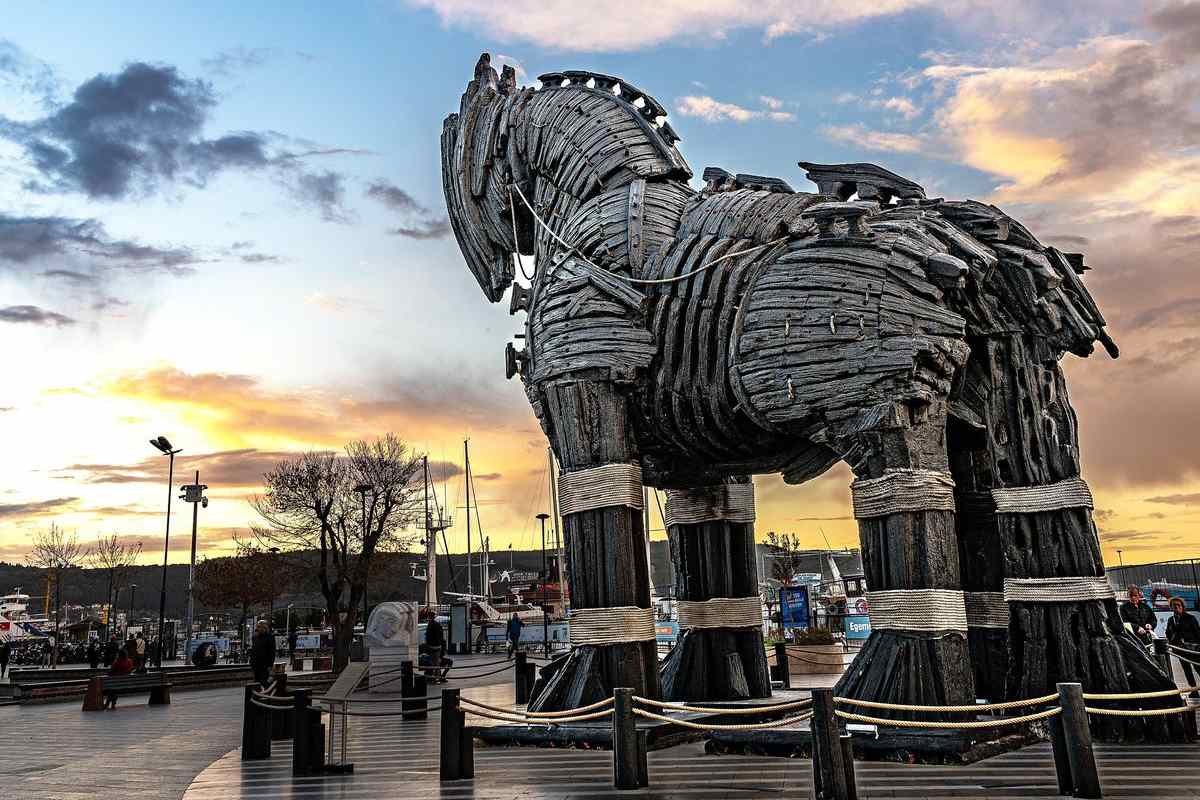
Wikipedia describes the way in. A road leads from the museum area in Tevfikiye to the east side of the mound, called Hisarlik. In the square stands a large wooden horse monument, with a ladder and chambers inside for the public. Past the gate, visitors on an asia minor tour walk dirt roads and railed boardwalks.
Old walls matter here. Wikipedia says the later Greek city reused the Bronze Age citadel wall, and the walls then became tourist attractions. It adds that Alexander the Great visited in 334 BC. He offered sacrifices at tombs tied to Achilles and Patroclus. In the sixteenth and seventeenth centuries, travellers mistook another ruin, Alexandria Troas, for Troy.
Troy Museum stands in Tevfikiye, 800 metres east of the dig. The cube-shaped building houses over 40,000 portable finds. Canakkale, the base for Troy and Gallipoli, shows a horse made for a film on its waterfront. After the ruins, the asia minor tour drives on to Kusadasi and arrives late in the evening.
How do Pamukkale, Hierapolis and Aphrodisias fit an asia minor tour?
Day five of an asia minor tour pairs Pamukkale and Hierapolis with Aphrodisias. Pamukkale is a white travertine hillside. Hierapolis is an ancient spa city on top of it, and Aphrodisias is a marble city of Aphrodite. Wikipedia lists Hierapolis-Pamukkale as one UNESCO site and Aphrodisias as another.
Pamukkale means cotton castle in Turkish. Wikipedia says hot spring water deposits travertine, a sedimentary rock. The formation is about 2,700 metres long and 160 metres high. It has 17 hot springs, from 35 to 100 degrees Celsius. On an asia minor tour, these terraces are the natural sight of the day.
Wikivoyage says the terraces are mostly off-limits to protect them. The one open cascade on an asia minor tour climbs from Town Gate to the museum in about 15 minutes. Visitors walk it barefoot and carry their shoes, since footwear is not permitted on the travertine. The pools are shin deep, so shorts or a swimming costume suit the climb.
Hierapolis means holy city. Wikipedia calls it a Hellenistic Greek city and thermal spa that joined the Roman province of Asia. Two earthquakes struck in Roman times, and it was rebuilt. A cemetery runs over two kilometres along the old road. A tomb relief shows a sawmill. It is the earliest known machine to use a crank and connecting rod.
After lunch, an asia minor tour adds Aphrodisias, a Hellenistic Greek city in Caria named after Aphrodite. Carian marble was cut from the nearby slopes, and its sculptors became well known across the Roman world. Wikipedia estimates that the stadium, about 270 by 60 metres, held around 30,000 spectators. UNESCO lists the site together with the ancient marble quarries.
Wikipedia places Aphrodisias near the village of Geyre. It lies about 100 kilometres inland from the Aegean coast and 230 kilometres southeast of Izmir. Kusadasi sits on that coast, so the tour goes far inland and back in one day. A day like this asks for an early start, water and patience on the road.
What does the Ephesus day cover on an asia minor tour?
Day six of an asia minor tour is the Ephesus day. Rome made this ancient Greek city the capital of proconsular Asia, which covered western Asia Minor. Wikipedia says the ruins stand near Selcuk and carry a UNESCO World Heritage listing.
Wikipedia notes that the Book of Revelation addresses seven churches, and Ephesus is one. Wikivoyage says the walk from the Upper Gate runs north and downhill, which is easier, so tour groups take it. Inside the gate, an asia minor tour meets the Odeon, a small roofed theatre for plays and concerts.
Wikivoyage says the path then passes the Gate of Hercules and joins Curetes Street, the ancient city’s main boulevard. On an asia minor tour, the Temple of Hadrian is a stop along it. Wikipedia says archaeologists re-erected the temple from its fragments. The reliefs in its upper part are casts, and the originals are in the Ephesus Archaeological Museum.
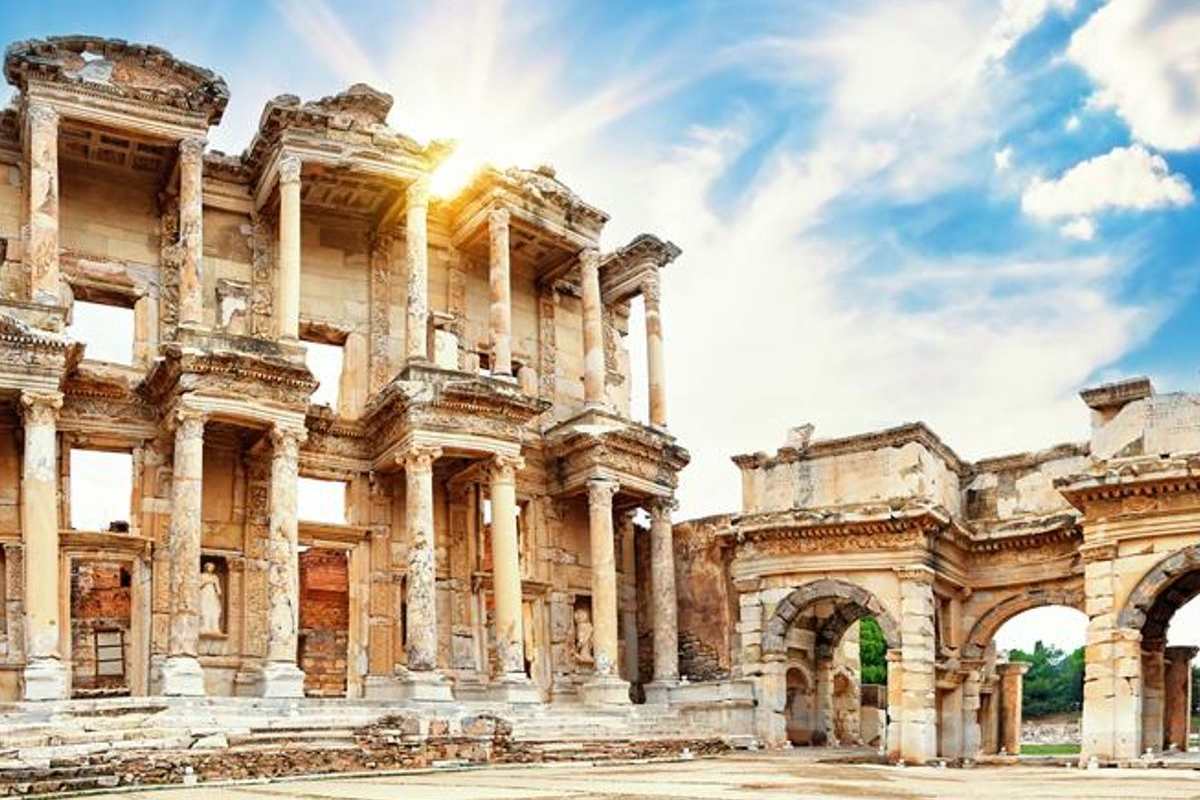
The Library of Celsus began as a funerary monument. Wikipedia says a consul commissioned it for his father, who rests in a marble sarcophagus in a crypt below. It was the third-largest library of the Greco-Roman world and is believed to have held around 12,000 scrolls. Only the facade was rebuilt, and it once appeared on a Turkish lira banknote.
Wikipedia says Ephesus had two agoras, one for commerce and one for state business. It believes the Great Theatre was the largest in the ancient world, with an estimated 25,000 seats. Wikipedia ranks the Temple of Artemis, on the edge of Selcuk, with the ancient world’s seven wonders. One reconstructed column remains.
Meryemana Evi, a Catholic shrine seven kilometres from Selcuk, is also called the House of the Virgin Mary, says Wikipedia. Christians and Muslims both visit it. Ayasuluk Hill holds the ruins of St John’s Basilica, which Justinian built in the sixth century. An asia minor tour drives to the Izmir airport for the evening flight to Istanbul.
Which entry rules, money and packing points matter on an asia minor tour?
Entry rules depend on your passport, so check the Turkish Ministry of Foreign Affairs website before an asia minor tour. Wikivoyage says travellers outside the visa-free list need a visa, and an e-visa can be applied for online. The money is the Turkish lira.
Wikivoyage says the visa-free rule covers tourist and commercial visits only. Wikipedia explains that a passport must stay valid for sixty days beyond the longest allowed stay. A ninety-day allowance therefore needs a passport valid for 150 days after entry. An asia minor tour lasts a week, but the rule counts the allowed stay.
Wikivoyage says a visa on arrival at a Turkish airport is a stamp in the passport, not a printed visa. Wikipedia says an e-visa can allow up to ninety days with multiple entries, unless noted otherwise. Durations differ by country, so read the official page that matches your passport before an asia minor tour.
Wikipedia calls the lira the official currency of Turkey. Wikivoyage says legal exchange offices operate in all cities and almost any town, and calls banks not worth the hassle. It adds that a tip cannot be added to a card bill, so people leave it in cash. Carry cards and a little cash on an asia minor tour.
Mosques and churches ask for respectful clothing. Wikivoyage Turkey defines it as covered shoulders and legs for everyone, plus covered hair for women. It says shoes come off at the door. Churches vary by denomination, but dressing as for a mosque goes a long way. An asia minor tour visits both kinds of site.
Wikivoyage says Ephesus has little shade and urges a big floppy hat and sun protection even on cloudy days. It says the Pamukkale terraces have no shade and a dazzling white light. The grounds are seen entirely on foot, with lumpy bits and potholes near the works. Pack walking shoes for an asia minor tour.
A small day bag suits the long drive days of an asia minor tour. Wikivoyage Turkey says tap water is not pleasant to drink, while bottled water is readily available. Sockets take Schuko and Europlug plugs at 230 volts. Wikipedia notes that luggage cover in travel insurance includes passports and other travel documents.
What else do travellers ask about an asia minor tour?
Can an asia minor tour run in the other direction or start in Izmir?
Yes, the same stops work in reverse order. An asia minor tour can start at Izmir Adnan Menderes Airport. Wikivoyage lists flights there from Athens, Frankfurt and across Europe, as well as from Turkish cities.
As Wikipedia states it, only Istanbul and Ankara have more people than Izmir. Wikivoyage puts the airport 55 km north of Selcuk, the nearest town to Ephesus. An IZBAN suburban train serves both, so a traveller need not enter the city centre.
What changes is the order. Ephesus and Pamukkale come first, then Troy and Gallipoli, and Istanbul closes the trip. An asia minor tour in reverse drops the evening flight from Izmir to Istanbul.
Is seven days enough for six stops, and what goes first when the plan feels full?
Seven days hold every stop, but day five is the tightest. An asia minor tour that feels full loses the second ancient city of that day first. Hierapolis stays and Aphrodisias goes, which gives the day a calmer pace.
The next cut is small. Wikivoyage says the Terrace Houses at Ephesus add 30 minutes to a walk through the site. The houses sit under a protective canopy with raised walkways. The page calls them worth a visit, so drop them only when the day runs short.
Pamukkale gives one easy saving. Wikivoyage says one ticketed area holds both the white terraces and the ruins. It lists three gates and says a visitor can enter or leave by any of them. On an asia minor tour, leaving by the gate where the vehicle waits keeps the walk short.
Does an asia minor tour suit children and older relatives?
Yes, with a plan for the ruins. An asia minor tour has long drive days, so ask each traveller how they feel about hours in a seat. The ruins ask for more walking than the road does, and Wikivoyage names the surfaces plainly.
At Ephesus, Wikivoyage says the pathways are signed clearly and the paving of the main avenue suits wheelchairs and strollers. Both gates have parking and taxis. At Hierapolis the same page calls Frontinus Street uneven going.
For Pamukkale, Wikivoyage points anyone with restricted mobility to the South Gate. The plan spends two nights in Kusadasi. There Wikivoyage describes long sandy beaches with a shallow drop-off, safe for children to bathe.
Which Turkish words help on an asia minor tour, and is English understood?
Six words go a long way. Merhaba means hello, tesekkur ederim means thank you, evet means yes and hayir means no. Lutfen means please and hesap means the check, as Wikivoyage lists them. It adds that lutfen is much less used than please in English.
Wikivoyage calls Turkish the sole official language and its spelling phonetic. The letter C sounds like J. The letter G with a curved mark is nearly silent, so yogurt is said yo-urt.
English is increasingly popular among the younger generation, Wikivoyage says. Tourism training turns out thousands of young people keen to practise on visitors. Ask Ingilizce biliyor musunuz, which means do you speak English, before a long question.
Who helps if something goes wrong on an asia minor tour?
Dial 112. Wikivoyage says this one number reaches all emergency services from any phone, free of charge. That includes the police and the gendarmerie. Its phrasebook agrees and adds the ambulance and the fire service.
Wikivoyage also lists Tourism Police sections in Sultanahmet, Istanbul, and in Izmir. Both places sit on the route of an asia minor tour. A traveller can report a lost passport, a theft or any crime there. The staff speak English, German, French and Arabic.
Every hospital has an emergency ward, called acil servis, open 24 hours. The phrasebook gives Bir doktora ihtiyacim var for I need a doctor and Cantami kaybettim for I lost my bag.