
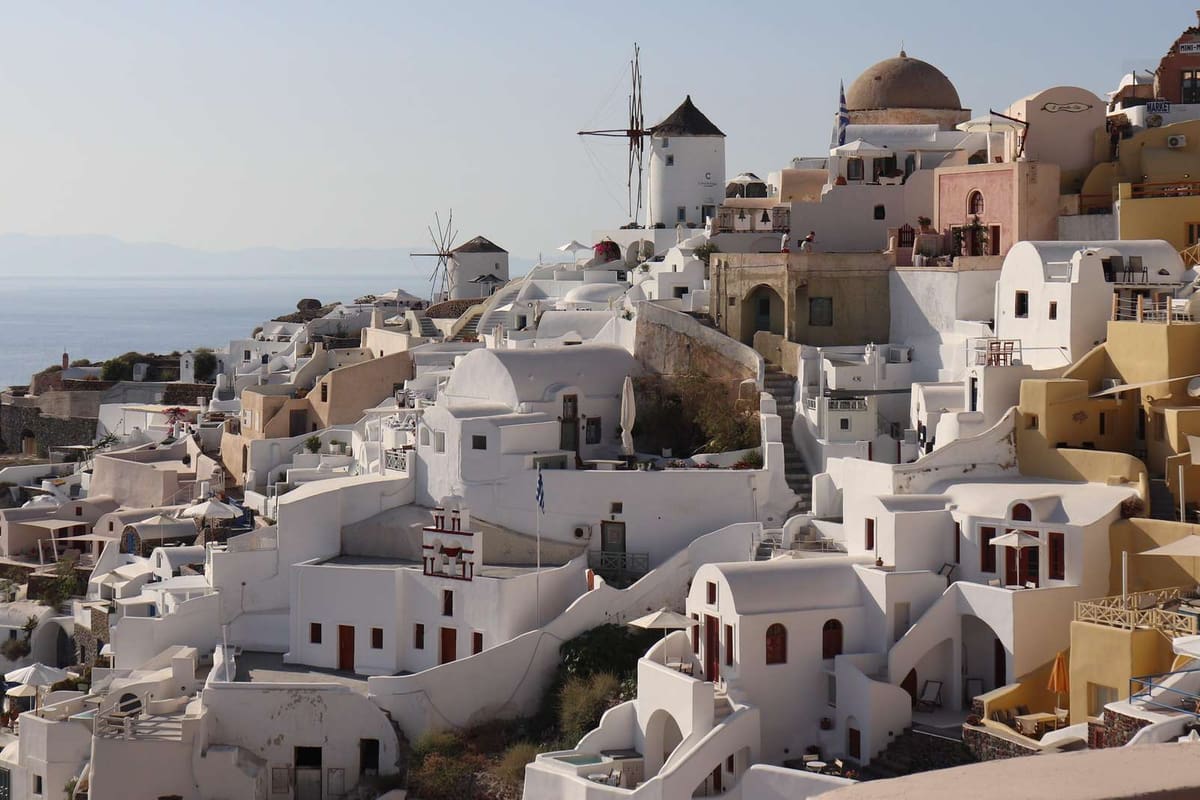
A bed and breakfast in Greece is a small house with a host and a morning table, from a stone mansion on Pelion to a cave room in Oia. The tours in Greece on the home page leave from the same towns.
This page covers the kinds of guesthouse, the Greek breakfast, the mountain villages, the towns and islands and the way to choose a house; the Greece vacation rentals page holds the self-catering houses.
What is a bed and breakfast in Greece?
A bed and breakfast in Greece is a small lodging that offers overnight accommodation and breakfast. The Bed and breakfast article adds that the hosts generally live under the same roof. That host sets the stay apart from a hotel, and the rest of this page builds on that one fact.
The host is the personal side of the stay. Wikivoyage calls the local knowledge of the host family an asset. It says there are just a small number of rooms and much more personal contact than in a hotel. That is the first thing to expect from a bed and breakfast in Greece.
The same words also name a meal plan inside a hotel. The Bed and breakfast article sets that plan beside room-only, half-board and full-board. A hotel room with breakfast is therefore not a bed and breakfast in Greece. That phrase means a house with a host.
Each country has its own word for the idea. The article lists chambre d’hotes for France, minshuku for Japan and zimmer for Israel. Greece has a set of its own: domatia, pension, xenonas and archontiko. A search for bed and breakfast in Greece meets all of them.
Wikivoyage’s page on bed and breakfasts ties the idea to an age-old practice. Travellers have long stayed in a private residence or a boarding house, it says. It adds that almost anyone can set up a spare room and serve breakfast where lodging is not regulated. A bed and breakfast in Greece starts from that simple idea.
Greece sets a procedure for rented rooms. The national public-services registry says the operator sends a notification before the business starts. That procedure replaced the Special Operation Mark, and the check of lawful operation follows afterwards. The registry files rented rooms and apartments under non-primary hotel accommodation, a group beside the hotels.
The Guest house article adds one more mark of the type. It names the lack of full-time staff as a feature that separates a guest house from a hotel. For England it states that a hotel keeps staff on site round the clock. A guest house keeps staff for fewer hours.
These are the five subjects covered for a bed and breakfast in Greece:
- the kinds of guesthouse
- the breakfast on the table
- the mountain villages
- the towns and islands
- the choice and the booking checks
Which kinds of guesthouse count as a bed and breakfast in Greece?
Four kinds of guesthouse count as a bed and breakfast in Greece. They are the room to let (domatia), the small family-run pension, the guest house (xenonas) and the restored mansion (archontiko). The paragraphs below take them in turn and end with the breakfast, which every kind must settle.
Domatia are the basic kind: rooms to let. Wikivoyage glosses the Greek word with one English word, rooms. The registry labels the group FRAR, its abbreviation of Furnished Rooms and Apartments for Rent. A room of this kind can carry a key rating.
The registry page names a classification by key categories for such rooms. It states that the classification is optional. A house that takes it must hold a certificate from the Regional Tourism Service. The page sets fifty days from the notification of its operation. Keys are therefore a choice, not a duty.
The pension is the family-run kind. Among the places to sleep, Wikivoyage Greece lists the small, family-run pension. Wikivoyage’s page on bed and breakfasts adds a note on words. In the Netherlands, it says, the more old-fashioned term pension can stand for a bed and breakfast.
The guest house, in Greek xenonas, is a home turned over to visitors. The Guest house article describes a private home converted for the exclusive use of visitor accommodation. The owner, it says, lives in an entirely separate area of the property in the ordinary case. A bed and breakfast in Greece of this type puts the host close by.
The archontiko is the old mansion that now takes guests. The Pelion article gives the Greek plural, arkhontika, for the larger mansions there. It says a number are now hotels and hostels. Wikivoyage describes a converted stately residence with the owner’s family as staff. A bed and breakfast in Greece can follow that model.
Breakfast is the one point to confirm for every bed and breakfast in Greece. Wikivoyage’s page on bed and breakfasts says that in places breakfast is not always served. It adds that a bare-bones continental breakfast can be little more than coffee and pastries. Wikivoyage Greece states that a studio has no breakfast or other food service.
What does breakfast at a bed and breakfast in Greece include?
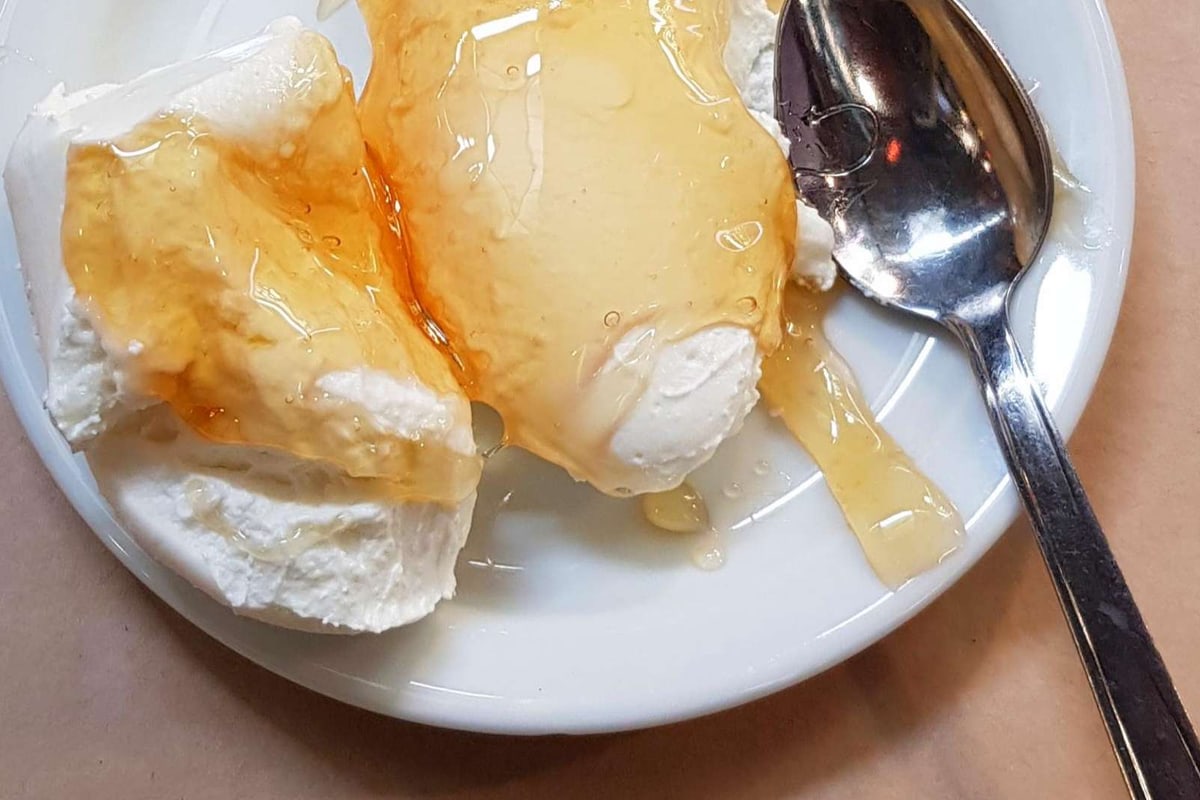
A bed and breakfast in Greece can set out bougatsa, spanakopita or a sesame bread ring called koulouri. Strained yogurt with honey, a spoon sweet and a small cup of Greek coffee can follow. Each food has its own origin and its own regional taste, told below.
In the Bougatsa article, the pastry counts as breakfast food in Greece, either sweet or savoury. The cream version holds semolina custard. Other fillings are feta, mizithra cheese, chocolate cream, spinach with feta, or minced meat. The modern pastry began in Serres and in Thessaloniki, both cities of northern Greece.
The pastry takes its name from pogatsa, a Byzantine Greek word that came from a Roman phrase for hearth bread. In Veria the cream version is very sweet, while in Thessaloniki it is crunchy and less sweet. Ask the host of a bed and breakfast in Greece which town the recipe follows.
Spanakopita is the spinach pie. Spanaki means spinach in Greek, and pita means pie. The filling is chopped spinach, feta, egg and onions, with dill, mint or parsley. At a bed and breakfast in Greece, ask if spanakopita is cut from one pan or rolled in triangles.
Koulouri is a circular bread covered in sesame seeds, and Greeks still eat it regularly, the Simit article states. Its Byzantine ancestor, the kollikion, appears in the ninth century as a small ring of bread sold in Constantinople.
In Greece, strained yogurt is a dessert too. Honey goes on top, as do sour cherry syrup and spoon sweets. Fruit boiled slowly in water and sugar becomes a spoon sweet. Hosts offer it to guests as a sign of hospitality. At a bed and breakfast in Greece, ask which fruit the host preserves.
Greek coffee is a thick, strong black coffee in a small cup, and the grounds stay in, says Wikivoyage Greece. Traditionally the grounds and water boil together on a stove, in a small pot named briki. Name the sugar when you order, because the default is moderately sweet.
Greek Breakfast is a programme of the Hellenic Chamber of Hotels. Its page says it invites hotel visitors in every corner of Greece to taste recipes and products of local producers. A bed and breakfast in Greece can echo that aim of linking local food with the visit.
Which mountain villages hold a bed and breakfast in Greece?
A bed and breakfast in Greece stands in mountain places such as Makrinitsa on Pelion and Arachova on Parnassus. Both sit on slopes, with stone houses and cobbled lanes. Each holds its own facts, from a painted coffee house to a spring festival.
Makrinitsa lies on a slope of the Pelion range, about 500 metres above sea level, says Wikivoyage. Its Ottoman-era mansions and houses have been restored, and guesthouses are among their new uses. The village square, with age-old trees, looks over Volos and the Pagasetic Gulf.
In one traditional coffee house of Makrinitsa stands a big fresco by the twentieth-century folk artist Theofilos. Village streets carry no names. A guest at a bed and breakfast in Greece here finds the way from the pedestrian main street.
Pelion holds twenty-four villages in the traditional style. Wikivoyage names Portaria, Milies, Vizitsa, Tsagarada and Zagora for stone houses with slate roofs and wall decorations. Their history reaches back to the start of the fifteenth century, when villages grew around monasteries.
Local traders built schools in Pelion. Those schools made the villages pivotal in the Greek Enlightenment, Wikivoyage states. The larger stone mansions, the archontika, now take guests as small hotels. A bed and breakfast in Greece on Pelion also sits among orchards of firiki apples and plums.
Arachova is built in an amphitheatre shape on the slopes of Mount Parnassus, says the Greek National Tourism Organisation. Narrow alleys hold cafes with fireplaces and guesthouses. The village Folklore Museum shows the history and customs of its people.
Every spring a three-day festival of Saint George fills Arachova with music, dance and flavours, the same page states. Intercity buses link the town with Athens, and the ride lasts from about two hours thirty minutes to three hours. Ask the host of a bed and breakfast in Greece for the festival dates.
Zagori, in the Pindus mountains of Epirus, adds a second set of stone villages. In any of these villages, a winter stay at a bed and breakfast in Greece is a question of warmth. Ask the host where the fire burns and where breakfast is served.
Which towns and islands suit a bed and breakfast in Greece?
A bed and breakfast in Greece fits the old stone towns of the Peloponnese. Nafplio, Monemvasia and Kardamyli each carry Venetian marks in their old buildings. Nafplio lies on the Argolic Gulf, Monemvasia on a rock off Laconia and Kardamyli on the Messenian Gulf.
In Nafplio, a bed and breakfast in Greece stands inside a small old town. Wikivoyage says you can walk from one end of it to the other in under fifteen minutes. Cars are allowed through only a small part of the streets. No bus runs through the old part.
Syntagma Square, the reference point of the old town, has Venetian-style buildings all around it. The Vouleftikon stands just south of it. It held the first national parliament of Greece and had been an Ottoman mosque before. The Archaeological Museum fills a Venetian building on the same square.
A bed and breakfast in Greece at Monemvasia stands in the lower town, the lived-in part of the rock. The upper town has no residents now, as Wikipedia states. The lower town has walls on its east, south and west sides, and entry is through the west gate.
A house of the lower town is narrow in front and three levels high, as the article describes it. The rock has no natural water source, so a cistern held rainwater on the lowest level. The family lived on the top level. From the nineteen seventies, townspeople sold houses to visitors who restored them.
For a bed and breakfast in Greece on the Mani coast, Kardamyli brings a name from the Iliad. In the Iliad, Agamemnon offers Achilles seven cities, and Homer names Kardamyli among them. It is a trailhead for mountain paths, and the Viros Gorge, 20 kilometres long, lies nearby. The smokestack of an old soap factory still dominates the town skyline.
On a Cycladic island, a village house with a host offers the same idea among whitewashed walls. In Chania on Crete, Wikipedia calls the Kasteli hill of the old town quieter than the district to its west.
How do you choose a bed and breakfast in Greece?
Choose a bed and breakfast in Greece by five plain checks. They are the host, the breakfast hours, the stairs, the parking and the registration number. The photos, the map pin and the reviews then confirm each answer. Each check takes one short message to the host.
Start a search for a bed and breakfast in Greece with the host, not the room. A short message shows how fast the host replies and whether you share a language. Write in simple English and ask one clear question, such as the route from the port or the bus stop.
Ask when breakfast starts and where the table stands: indoors, in a shared room or on a terrace. An early walker and a late sleeper need different hours. Say so in the first message. The answer shows whether the morning meal fits your day.
Old towns hold lanes, and lanes mean steps. Wikivoyage Greece links quiet places to sleep with old town or village parts that you reach only by stairs. Before you book a bed and breakfast in Greece there, count the steps to the door. Pack a bag you can carry.
Old towns keep cars out of their lanes, so the car stays outside. In Nafplio, the central bus station stands where the old town ends in the east, as Wikivoyage describes it. A large car park lies by the harbour, on the north shore.
At Monemvasia, the bus stops in Gefyra, a short walk or taxi ride from the castle entrance.
The Ministry of Tourism page states that rented rooms are notified through the Open Business online system. The system returns a unique number for each notification. When you compare a bed and breakfast in Greece, ask the host for the number of the house.
Study the photos of a bed and breakfast in Greece for the lane, the door and the breakfast table. Put the map pin next to the harbour, the square or the bus stop. Read the reviews for a remark that more than one guest repeats, such as the stairs or the noise. A warm welcome counts too.
Which questions come up about a bed and breakfast in Greece?
Does breakfast at a bed and breakfast in Greece suit special diets?
The Greek kitchen holds a wide range of vegetable dishes, so a diet is easy to name to the host. For a bed and breakfast in Greece, send the diet in writing and ask what each breakfast dish contains.
Wikivoyage Greece says restaurants for strict vegans and vegetarians are practically non-existent outside Athens and Thessaloniki. It adds that Greek cuisine itself holds plenty of vegan and vegetarian dishes. Fava is what a vegan ends up ordering at a taverna, the page says.
The same page explains nistisimo, the word for food suited to people who fast for religious reasons. Such food can still hold honey or seafood, so ask. Guests who eat dairy find a wide selection of mezes, soups and salads.
Wikipedia names lathera, home-cooked dishes of vegetables such as green beans, peas and okra stewed in olive oil and tomato. It also names hortopita, a greens pie in filo.
Does a bed and breakfast in Greece stay open in winter?
Each host decides, and no source lists the houses open in winter. For a bed and breakfast in Greece, a mountain town like Karpenisi in Evrytania draws winter guests.
Wikipedia places Karpenisi in a valley of the southern Pindus Mountains. Mount Tymfristos, 2,315 metres high, lies directly to the north. The article adds that the town has a ski resort and is a popular destination, especially during winter.
The article gives the town a temperate climate, with rain through the year and cooler air because of its height. Its weather station stands at 998 metres. The name comes from an Aromanian word for the hornbeam tree.
Before booking a winter stay at a bed and breakfast in Greece, ask the host three things. Does the house take guests then? Is breakfast served in the cold months? How is the room heated?
What time do check-in and breakfast run at a bed and breakfast in Greece?
The host sets both hours at a bed and breakfast in Greece, so no single hour applies. Ask for the check-in hour, the last hour of arrival and the breakfast hours in writing before the trip.
The Guest house article explains the reason. Hotels keep staff present day and night, the article says. A guest house has less staff time on site, so check-in there is commonly by appointment. It words this for England, so read it as a reason to agree the arrival hour.
Boats and flights shape the hour in Greece. On certain islands, owners of rooms meet arriving ferries to offer them, Wikivoyage Greece states. A van carries guests from the port. Wikipedia notes that quiet hours are set by law in Greece for the whole year. Ask when the house goes quiet at night.
Which regional dishes can you ask for at a bed and breakfast in Greece?
Strapatsada, dakos and trahana show how a region shapes the table. At a bed and breakfast in Greece, ask the host which dish of the area the kitchen offers.
Strapatsada is tomatoes cooked in olive oil with beaten eggs stirred in, and feta goes in at the end. Wikipedia calls it popular in the Ionian Islands, where it also carries the name kagianas. The Cyclades call it koskosela. Its name comes from the Italian strapazzare, glossed as breaking an egg and mixing it while it cooks.
Dakos is a Cretan salad on a slice of paximadi. Crumbled feta or mizithra and chopped tomatoes sit on the rusk, and dried oregano flavours it. Wikipedia gives its other names as koukouvagia and kouloukopsomo, the second said to mean bread for puppies under a table.
Trahana is dried into crumbs. Wikipedia describes the Greek kind as cracked wheat or a couscous-like paste with fermented milk. Cooks turn it into a thick soup with water, stock or milk.