
A Cape Sounion tour from Athens runs south along the Saronic coast. It ends at a marble temple on a headland above the Aegean Sea. Compare the day options in our tours in Greece listings before you choose a departure time.
This page covers how long the trip takes and the drive. It explains the Temple of Poseidon, the sanctuary around it, the coast road and the Laurion silver mines. It also looks at the Athenian fleet and Lord Byron. Last come the timing, the walking, and how a group tour compares with going alone.
What is a Cape Sounion tour from Athens, and how does it work?
A Cape Sounion tour from Athens is a coach excursion of half a day to the southern tip of Attica. The cape lies about 70 km from the city. The coach follows the coast, you visit the Temple of Poseidon, and the coach brings you back.
A Cape Sounion tour from Athens starts in the city centre, though the first step differs from page to page. One operator page offers hotel pick-up from a hotel list. Another asks guests to meet at a fixed point and look for the trip attendant. A third lists three departure points in the centre of Athens.
The ride is by air-conditioned coach with round-trip transfers. Two pages mention Wi-Fi on board, and two mention headsets for the commentary. The winter afternoon version makes no scheduled stops before the cape. You watch the coast from your seat.
The commentary reaches you in two ways on a Cape Sounion tour from Athens. One version gives an audio guide as an app on your phone, so bring your own headphones. Another puts an archaeologist on the coach. One page lists a licensed guide for a guided visit inside the site. Two others leave that guided visit out.
Entry to the archaeological site works in two ways. Two pages list entry as part of the trip. Two others leave it out and tell guests to arrange it at the site. Read the inclusions of the version you book before the day.
At the cape the trip turns into free time. Operator pages list time to walk the rocky headland, take photographs and look over the Aegean Sea. That makes a Cape Sounion tour from Athens a simple day out: ride, visit, walk, ride back. The coach returns to the place where the trip began.
How long is a Cape Sounion tour from Athens, and how far is the drive?
Plan on about four hours for a Cape Sounion tour from Athens by coach. The drive is about 70 km each way. It takes between 60 and 90 minutes along the coast.
Distance comes first. Wikipedia places the cape 69.5 km southeast of Athens, which is 43.1 miles. One operator page says its tours cover about 70 km each way along the coast. The two figures agree, so seventy kilometres is the number to remember for a Cape Sounion tour from Athens.
Drive time varies. One page gives 60 to 90 minutes by road. A second page lists the coach leg at about one and a half hours each way. The first page warns that traffic can stretch the drive. One reviewer there reports a way back that took two and a half hours.
The whole Cape Sounion tour from Athens is longer than the drive. One page says these tours run around four hours, and a winter afternoon version is also four hours. Another page counts a five-hour tour. On the winter version, hotel pick-up begins at half past one in the afternoon. The return is at about half past six.
Time on the headland is shorter than time on the road. One page lists free time of an hour within the site. Another says about one hour at the Temple of Poseidon. A third lists one and a half hours there. That split of road and ruins shapes the half-day trip.
Longer versions exist. A private trip runs about five hours on two pages. One of them says a swimming stop adds about one hour. A ten-hour day joins the cape with the Acropolis and its museum. It leaves at a quarter past eight in the morning. Any Cape Sounion tour from Athens longer than four hours adds stops.
What is the Temple of Poseidon, and why was it built on this cape?
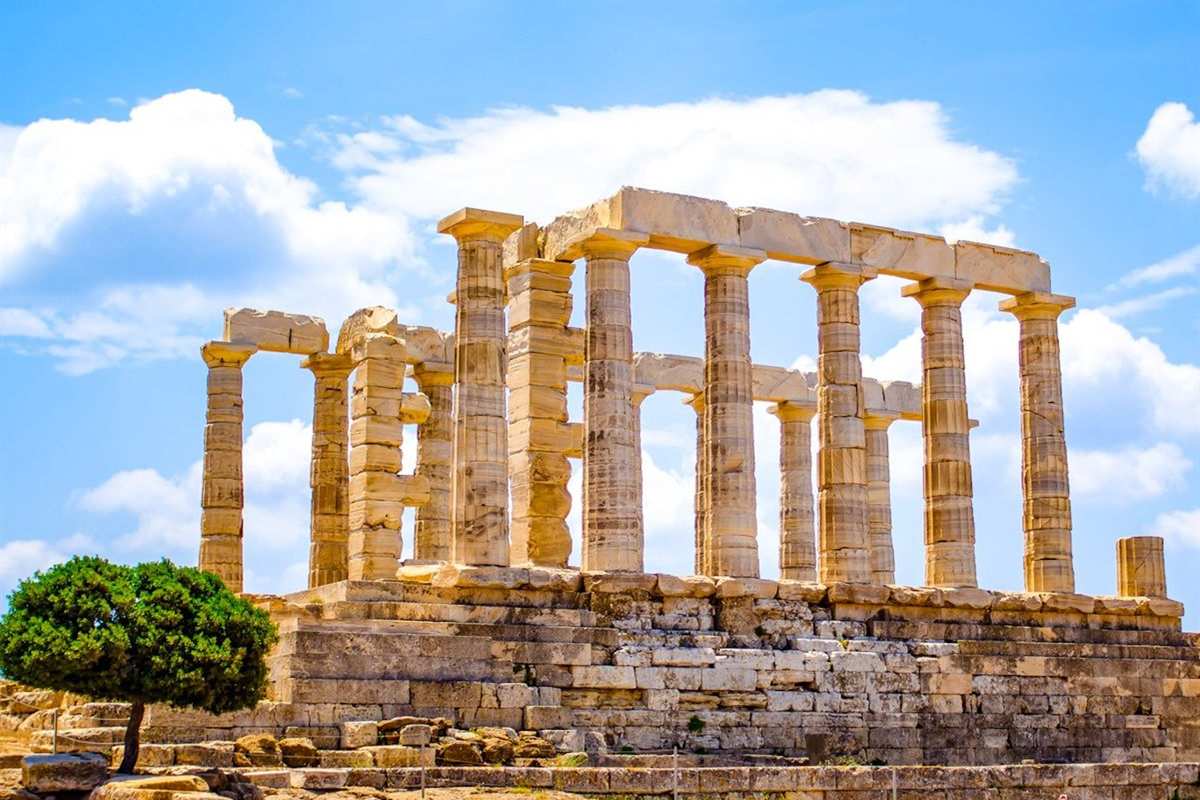
On a Cape Sounion tour from Athens, the Temple of Poseidon is the main monument. The Athenians built this Doric temple of white marble in 444-440 BC for the god of the sea. It overlooks the sea lanes to Piraeus.
The temple stands on the rock almost 60 metres above the sea. It had columns on all four sides, 34 in total, and 15 still stand. They are Doric, cut from local white marble, and each is 6.10 metres high. A Cape Sounion tour from Athens shows you these columns against the sea.
Inside, reconstructions place a windowless hall with a bronze statue of Poseidon, about 6 metres high. A frieze of Parian marble showed a fight with Centaurs, along with the deeds of Theseus. The design is credited to the architect who built the Temple of Hephaistos in the Athenian Agora.
Poseidon presided over the sea, storms and earthquakes, and sailors prayed to him for a safe voyage. The Odyssey calls the cape holy Sounion, the cape of Athens. From here Athens controlled the sea route to Piraeus and the Aegean. A guided Cape Sounion tour from Athens explains how the sanctuary tied Poseidon to the city.
Worship on the cape goes back to at least the eighth century BC. The first temple was built of tufa. Persian troops probably destroyed it in 480 BC. The Athenians beat Xerxes at Salamis and set a captured trireme here as a trophy for Poseidon. The marble building on a Cape Sounion tour from Athens replaced the old one.
Pericles, who also rebuilt the Parthenon, was in power when the marble temple went up. Pausanias took it for a temple of Athena in the second century AD. Inscriptions found in the excavation later proved it was Poseidon’s. Anastasios Orlandos led restoration in the mid-twentieth century and shaped the ruin that a Cape Sounion tour from Athens shows.
What else stands in the sanctuary at Sounion besides the Temple of Poseidon?
Besides the Temple of Poseidon, the sanctuary has a monumental gate, the Temple of Athena Sounias and a smaller temple. It also has a fortress wall and a ship shed. A Cape Sounion tour from Athens leaves free time on the headland.
The ancient entrance to the sacred area of Poseidon was a monumental gate, the propylaea. It was a simple portico of two Doric columns with three entrances, the central one 2.2 metres wide. It was built together with the Doric temple. On a Cape Sounion tour from Athens, this gate marks where the sacred area began.
The Temple of Athena Sounias sat on a low hill roughly 300 metres northeast of Poseidon’s temple. It went up around 470 BC. Its columns stood on the south and east sides only, a quirk the Roman architect Vitruvius noted. Only foundations and bases remain, so the free time on a Cape Sounion tour from Athens suits a look.
Beside it stands a small Doric temple, linked to either the hero Phrontis or Artemis. A burial mound and shrine nearby belongs to Phrontis, helmsman of King Menelaus. In the Odyssey he dies at his post as the ship rounds Sounion. A guided Cape Sounion tour from Athens covers the history of the sanctuary.
The Sounion Kouros, a statue from about 600 BC, stood before the temple as an offering to Poseidon. Excavators found it buried in a pit on the east side, with pieces of other statues. The statue is now in the collection of the National Archaeological Museum. The headland itself is what a Cape Sounion tour from Athens visits.
A wall roughly 400 metres in length separated the cape from the mainland and enclosed about 4 hectares. Square towers guarded it, and the temple stood in its southeastern corner. A ship shed for two warships sat in the northwest corner. On a Cape Sounion tour from Athens you can still trace the wall.
What do you pass on the coast road on a Cape Sounion tour from Athens?
The coach on a Cape Sounion tour from Athens takes the coast road south through Glyfada, Vouliagmeni and Varkiza. It runs beside the Saronic Gulf, through the Athens Riviera, and heads for the southern tip of Attica.
Ten main areas line the coast, says the Greek National Tourism Organisation, from the Bay of Zea to Sounio. Your Cape Sounion tour from Athens reaches the last one. The Riviera itself starts at Piraeus and ends near Sounio and Lavrio. Operators say the coach window shows golden beaches, seaside resorts and dramatic coastal landscapes.
Operator pages put Glyfada first on the route of a Cape Sounion tour from Athens. The town sits on the Saronic Gulf coast and has a modern marina. In ancient times it was a deme, a local district, called Aixone. Vouliagmeni comes next, eighteen kilometres south of central Athens.
The suburb is named after a lake of brackish water. Underground streams from Mount Hymettus feed it, and the warm water makes it a spa all year. Archaeologists found the ruins of Apollo Zoster’s temple on a public beach there. Its beaches have won EU blue flags.
Varkiza follows on a Cape Sounion tour from Athens. Its widely known beach lies twenty-two kilometres from the city centre. The Riviera list names Anavyssos just before Sounio. That town stands thirty-four kilometres southeast of central Athens, at the foot of Olympos hill. Patroklos, a small island of the Saronic Gulf, is visible from the cape.
Operator pages differ on stops. One says no stops are scheduled in Glyfada, Vouliagmeni or Varkiza, so you watch the shore from the seat. A private Cape Sounion tour from Athens adds Lake Vouliagmeni and a walk by the sea.
What is the history of Sounion, from the Laurion silver mines to the Athenian fleet?
A Cape Sounion tour from Athens visits the cape that watched over the Laurion silver mines. Athens spent that silver on 200 triremes. An Athenian-led fleet then beat the Persians at Salamis in 480 BC.
The stop on a Cape Sounion tour from Athens sits on land that once belonged to a silver district. The Laurion mines lie between Thorikos and Cape Sounion, and ancient Sounion held part of them. Mining became more systematic from the late 6th century BC. The silver went mainly into coins and was a chief source of income for Athens.
In 483 BC miners struck a rich new seam of silver. Themistocles proposed to spend it on 200 triremes. Aristides argued for handing the money out to citizens instead. Once Salamis was won, Poseidon received a trophy: a whole captured enemy trireme, placed at Sounio. That trophy stood at the cape that your Cape Sounion tour from Athens now visits.
In 413 BC the Peloponnesian War had reached its nineteenth year, and Athens walled the headland. The aim was to keep ships carrying grain safe on their way to Athens. Sparta held Dekeleia, so the sea route from Euboea was vital. Operator pages list the fort among the sights of a Cape Sounion tour from Athens.
The fort had a small naval base with a shed for two warships. Rebel slaves from the nearby mines later seized the fortress from the Athenians. It stayed in use well into the Hellenistic period. An estimate says almost 20,000 slaves worked the mines. The silver ran dry between 400 and 300 BC.
Companies from France and Greece reopened the workings in the late 19th century, mining lead, manganese and cadmium. The Archaeological Museum of Lavrion covers the story of the mines. Lavrio lies roughly 60 km southeast of Athens; the cape is 8 km south of it. A Cape Sounion tour from Athens ends at the edge of old mining country.
Which time of day suits a Cape Sounion tour from Athens, morning or sunset?
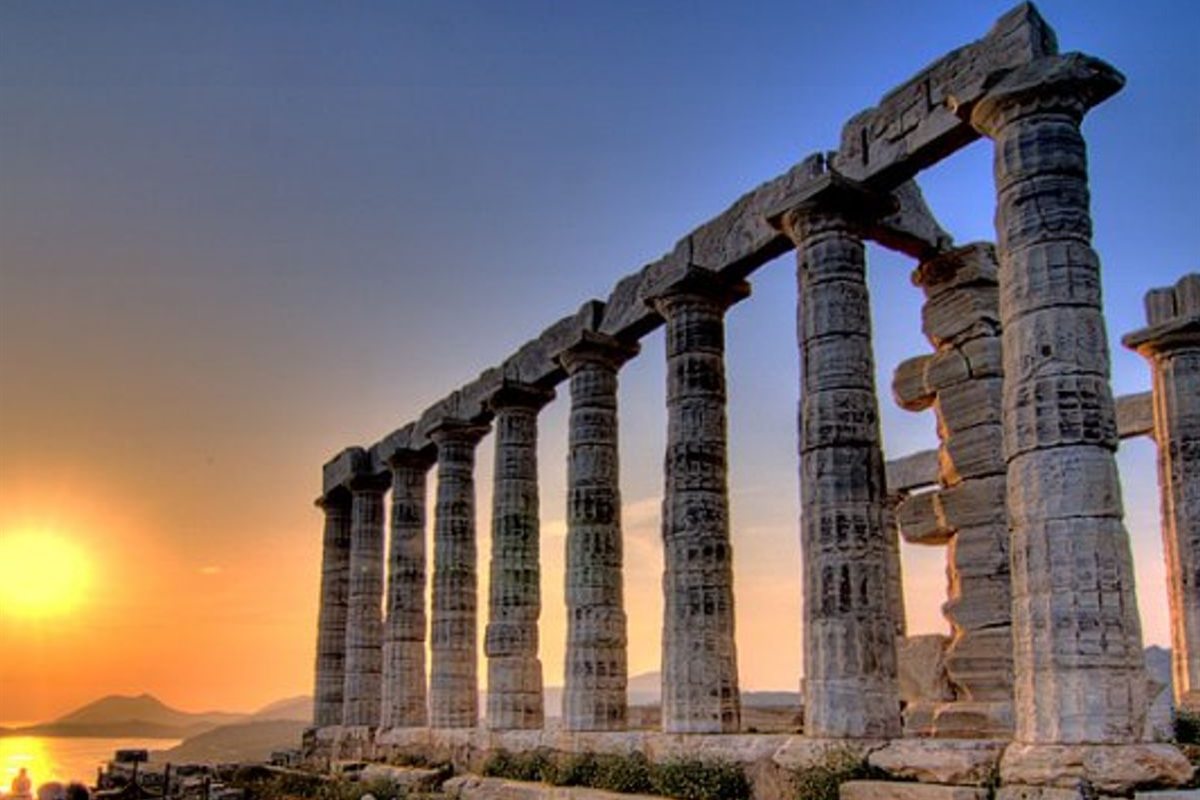
A Cape Sounion tour from Athens suits sunset if you want to see the sun sink into the Aegean. The site opens at half past nine and closes at sunset. A daytime start shows the stone in full light.
Group half-day trips on operator pages leave in the afternoon. One operator moves its sunset departure through the year. It leaves at half past two in early January and at six in June. In between, departures run at three, four or five. The site closes at sunset, so a Cape Sounion tour from Athens is timed around that hour.
Winter has its own afternoon trip. One operator runs a Cape Sounion tour from Athens from November to March, and it lasts four hours. Hotel pick-ups run between half past one and half past two. A guided visit and free time at the cape come first. The drive back ends at about half past six.
A morning start is rarer. One private operator plans its trip for sunset but says it can start in the morning. Another lists private half-day trips in the morning or the afternoon. A ten-hour day tour that adds the Acropolis starts at a quarter past eight. A morning Cape Sounion tour from Athens is a private or day-long choice.
Sunrise is a separate plan from a Cape Sounion tour from Athens. A Greek travel site tells early risers to go before dawn and watch the sun rise over Makronisos island. For sunset, it advises arriving in the early afternoon. Wikipedia says travellers have sought out the sunset over the Aegean since the early nineteenth century.
Sunset is the popular slot. One operator’s booking data for a summer shows that ninety percent of its Cape Sounion bookings were sunset trips. A sunset Cape Sounion tour from Athens carried 46 travellers on a normal June departure and 77 in September. The data counts bookings, not crowds at the site.
What did Lord Byron and the myth of King Aegeus leave at Cape Sounion?
Lord Byron’s name is carved into a column of the Temple of Poseidon. King Aegeus left a myth about the cliff and the sea. A Cape Sounion tour from Athens points to both, and tour pages name the carving and the tale.
On a Cape Sounion tour from Athens, look at the base of one column for the name Byron. The British poet visited in the early nineteenth century. Tour pages say that he, like other travellers of his day, engraved his name on the stone. Wikipedia adds that there is no direct evidence he cut it himself.
Byron also gave the cape a line of verse. Sunium is the Latin spelling of Sounion. In The Isles of Greece, part of Don Juan, he asks to be placed on “Sunium’s marbled steep”. A Cape Sounion tour from Athens lets you stand on that steep and read the line in its own setting.
Byron was not the first writer to reach the cape. Wikipedia lists early travel accounts by Lady Mary Wortley Montagu and Richard Chandler. In the mid eighteenth century the poet William Falconer had his ship wrecked there. In those days it was known as Capo Colonne, Venetian for Cape of Columns, and in Greek as Kavokolones.
Under King Aegeus, Athens paid Crete fourteen young people every nine years, as food for the Minotaur. His son Theseus went to end it. Aegeus asked for white sails on the way home if Theseus lived. Theseus forgot, and the ship came home under black sails. Seeing them, Aegeus believed his son dead and leapt into the sea.
Wikipedia says Aegeus gave his name to the Aegean Sea. The leap is told in more than one place. Other versions put it at the Acropolis or an unnamed rock. The tour pages and a Greek heritage portal tell the Sounion version, from the rocky cliffs. A Cape Sounion tour from Athens at sunset looks out over that same water.
How much walking is there on a Cape Sounion tour from Athens, and who does it suit?
A Cape Sounion tour from Athens asks for a short walk on uneven ground, not a hike. You follow a gently uphill path into the site, then stroll around the rocky headland. It suits visitors who are steady on rough stone.
The Greek national tourism site says you walk a gently uphill path on entering the archaeological area. Low plants and rocky ground line both sides. The Aegean washes the cape on three sides, and the temple rises close to 60 metres up.
Operator pages for a Cape Sounion tour from Athens agree on footwear. One says the trip includes walking inside the site and around the rocky headland, so comfortable walking shoes are recommended. Another says the day involves a fair amount of walking and asks for comfortable shoes.
Time on foot is short. A four-hour trip leaves about an hour for exploring the site on foot. Another page allows ninety minutes at the temple. After the guided visit, one itinerary leaves free time to walk the promontory and take photographs.
Operator pages also set practical limits for a Cape Sounion tour from Athens. One says the experience is stroller accessible but not accessible for wheelchair users. Another asks that every child travels with an adult, and infants travel on an adult’s knee on the coach. The Greek heritage portal lists toilets and a shop at the site.
The tourism site adds a walking tip. Pause a little way back from the columns first, to see the temple against the land. A Cape Sounion tour from Athens therefore suits visitors who manage a gentle slope and rocky ground for an hour.
How does a group Cape Sounion tour from Athens compare with going on your own?
A group Cape Sounion tour from Athens gives you a coach, a set plan and someone to explain the site. Going on your own means choosing the road. The Greek heritage portal gives about two hours by public bus or 65 minutes by car.
On a group trip the coach does the driving. A Cape Sounion tour from Athens leaves from a central point in the city and returns you to it. One page says no stops are scheduled between Athens and the cape. Pages list air conditioning on the coach, and one adds free Wi-Fi.
Going on your own by bus starts in Athens. The Greek heritage portal says the intercity bus leaves from the Pedion tou Areos area. A travel wiki says buses run every hour, and the Sounio bus terminal sits just below the temple. The same wiki lists the last bus back at 21:00.
Skip a Cape Sounion tour from Athens and drive, and you head for the 68th kilometre of the Athens-Sounion highway. The heritage portal gives that address and lists parking there.
Guiding differs too. A group Cape Sounion tour from Athens brings a licensed guide, an archaeologist or an audio guide app. The choice depends on the trip. One itinerary has a guided visit inside the site. Another gives an audio guide app and free time instead.
For visitors on their own, one operator page lists a timed-entry admission. The audio tour plays on your phone in nine languages, so bring your own headphones. The site opens at half past nine and closes at sunset. Entry stops 20 minutes before closing.
Group size is the other difference. One operator’s booking data shows a typical group departure carried 46 travellers in June. In September it carried 77, and the busiest carried 97. The typical booking was for two travellers. So a group Cape Sounion tour from Athens can be a large coach party in September.
What else do travellers ask about a Cape Sounion tour from Athens?
Which months work for a Cape Sounion tour from Athens, and how do wind and heat feel on the headland?
Wikipedia calls the climate at Cape Sounion hot and semi-arid. Dry heat marks the summer, and the winter is mild but wetter. At nearby Lavrio, summer highs run 4 degrees Celsius below those of downtown Athens.
One operator page splits the year in two. A four-hour winter afternoon trip covers November to March, while a separate summer trip covers April to October. So a Cape Sounion tour from Athens has a version for every season.
Sun and wind matter more than rain. The sea lies on three sides of the temple. Wikipedia says the northerly Aegean winds, present between late spring and mid-September, temper the fierce summer heat. A visitor site calls the clifftop extremely hot at midday in July and August, and cold and windy in winter.
What do travellers wear and pack for a Cape Sounion tour from Athens?
Operator pages agree on the basics: a hat, sunglasses, a bottle of water and comfortable shoes. One page adds loose-fitting clothes. Another asks for headphones for the audio guide app. A third says you walk a fair amount on site.
Shoes matter on a Cape Sounion tour from Athens because the headland is rocky. One operator page says the trip includes walking inside the temple site and around the rocky promontory. It recommends comfortable walking shoes.
In winter, add a warm top layer, because the exposed clifftop is cold and windy then. Operator pages describe an air-conditioned coach, and two list Wi-Fi on board. The sun and wind wait for you at the open headland.
Is a Cape Sounion tour from Athens suitable for children, strollers and wheelchairs?
Operator pages set clear rules for the coach. One page says every child needs an adult with them. It adds that an infant rides on the knee of an adult for the whole coach journey.
One booking page for a Cape Sounion tour from Athens calls the trip stroller accessible. The same page says it is not accessible for wheelchair users, and it warns of a fair amount of walking.
Hellenic Heritage is the official platform of the Ministry of Culture. Its Sounion page names accessibility among the amenities but adds no detail. A private trip, which does not run on a shared basis, is described as well suited to couples and families. Ask the operator about steps and slopes before you book.
Where does a Cape Sounion tour from Athens start, and when do I arrive?
Operator pages show three ways to start. One trip collects travellers from hotels in Athens between half past one and half past two in the afternoon. It confirms the exact time after booking. Another has three starting points in central Athens, beside the hop-on hop-off bus stop.
A third kind meets outside the centre to avoid traffic and emails the directions. The meeting point is a city square on one page and a metro station in Chalandri on another. For a Cape Sounion tour from Athens of this kind, arrive at least 10 minutes early.
One page asks for the voucher on your phone, with photo ID. Another says the trip attendant waits at the meeting point with a sign. The winter afternoon coach returns you at about half past six in the evening.
What does the audio guide cover on a Cape Sounion tour from Athens, and what does the sunset closing mean?
On one trip, the audio guide comes in six languages: English, French, Spanish, Italian, German and Russian. It explains the sights you see on the trip. Another trip supplies headsets, and an audio app on a third trip needs your own headphones.
The guiding differs between trips. One puts an expert archaeologist on board as trip attendant but leaves out a guided tour inside the site. Another lists a licensed guide inside the temple.
Hellenic Heritage says the site opens at 9:30 daily and closes at sunset, with last admission 20 minutes before closing. It stays closed on public holidays including Easter Sunday, 25 March, and Christmas Day with the day after it. So a Cape Sounion tour from Athens must reach the gate before last admission.