
A Corfu underwater cruise lets you watch the sea from a cabin below the waterline, after a view of the cliffs from the top deck. Browse more tours in Greece once you have chosen your sailing.
This page covers the length and start of the trip, the view through the windows, the sea life and seabed of the bay, how a glass-bottom boat differs from a cabin, what you see from the deck, who the cruise suits, and the questions travellers ask.
What is a Corfu underwater cruise, and how does it work?
A Corfu underwater cruise is a boat trip from Paleokastritsa with a viewing cabin below the sea surface. You begin on the top deck. Then you go down to the cabin and watch the sea through glass, dry the whole time.
The boat is 15 m long and built for looking, not for swimming. Listing pages set it apart from a plain glass-bottom boat. Its large windows sit in a cabin under the water. One page calls it a semi-submarine. Three pages add that the cabin is air-conditioned.
A Corfu underwater cruise runs in two halves. During the first half, passengers stay on the top deck and look at the cliffs and bays of Paleokastritsa. During the second half, they sit comfortably in the underwater cabin below the surface. The listing pages state this order the same way.
Every seat in the cabin is a window seat, one listing says. Another page promises a view of the underwater world of Paleokastritsa without getting wet. The glass does the work, so the trip is a sightseeing outing and not a swim.
The cruise starts in Paleokastritsa, on the western shore of Corfu. The Ionian Sea laps at that shore. On a Corfu underwater cruise, the cliffs on deck and the water in the cabin belong to the same coast.
How long is a Corfu underwater cruise, and where does it start?
A Corfu underwater cruise lasts 45 to 50 minutes, and the boat leaves every hour. One listing names Alipa port as the start point. You swap your ticket for a boarding pass before you board.
Listing pages disagree slightly on the length. One says 45 to 50 minutes, two say 50 minutes, and another says the cruise lasts an hour. One page even gives 50 minutes in its text and 45 minutes in its list of what is included. So plan for close to an hour, with the boarding included.
Four pages say the boat departs every hour. One of them also lists three set sailings from the first of April, at 11:00, at 13:00 and at 15:00. It adds that the times change in late spring. A Corfu underwater cruise can therefore follow a different timetable later in the season.
The start point is named on one page only. That listing says the sailings leave from Alipa port. The other pages name no dock. One of them says the trip does not include a pick-up or a drop-off. You travel to the start yourself.
Boarding comes before the sailing. At a Corfu underwater cruise you swap your ticket for a boarding pass at the ticket office. One page wants you there a quarter of an hour ahead of the time you chose. Another wants half an hour. A reservation holds only for the slot you picked.
What do you see through the windows on a Corfu underwater cruise?
A Corfu underwater cruise seats you in a cabin with 22 large windows, set 2.2 metres below the surface. The glass lies beneath the sea, and the cabin keeps you dry.
Operator pages for a Corfu underwater cruise agree on the numbers. They give the cabin 22 large windows and a depth of 2.20 metres. One page says each seat has a window beside it, and another calls the view panoramic. You sit and watch, and nobody gets wet.
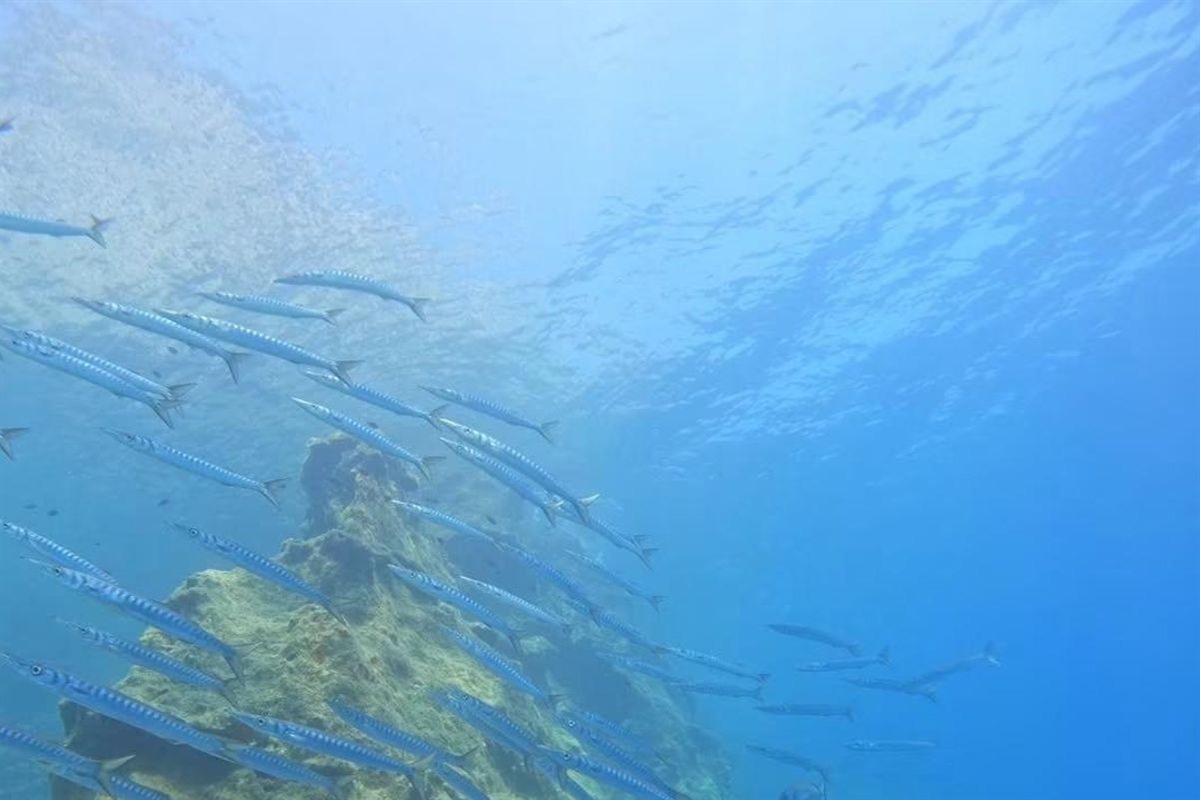
The listings promise sea creatures and fish at the glass, yet none of the four names a species. A Corfu underwater cruise shows whatever swims past on the day. A snorkel-tour page for the same bays lists iridescent fish, starfish and octopuses. That tells you what the bays hold, not what the cabin shows.
Light shapes the view on a Corfu underwater cruise as well. Red, orange and yellow wavelengths fade out in water, and deeper water looks a more intense cyan. Wikipedia adds that very clear water looks more cyan.
A thick layer of water looks a deeper blue than a thin one. Water takes in all light within tens of metres, and the cabin sits only 2.2 metres down. Colours behind the glass lean towards blue for the same reason.
Which sea life lives in the water off Paleokastritsa?
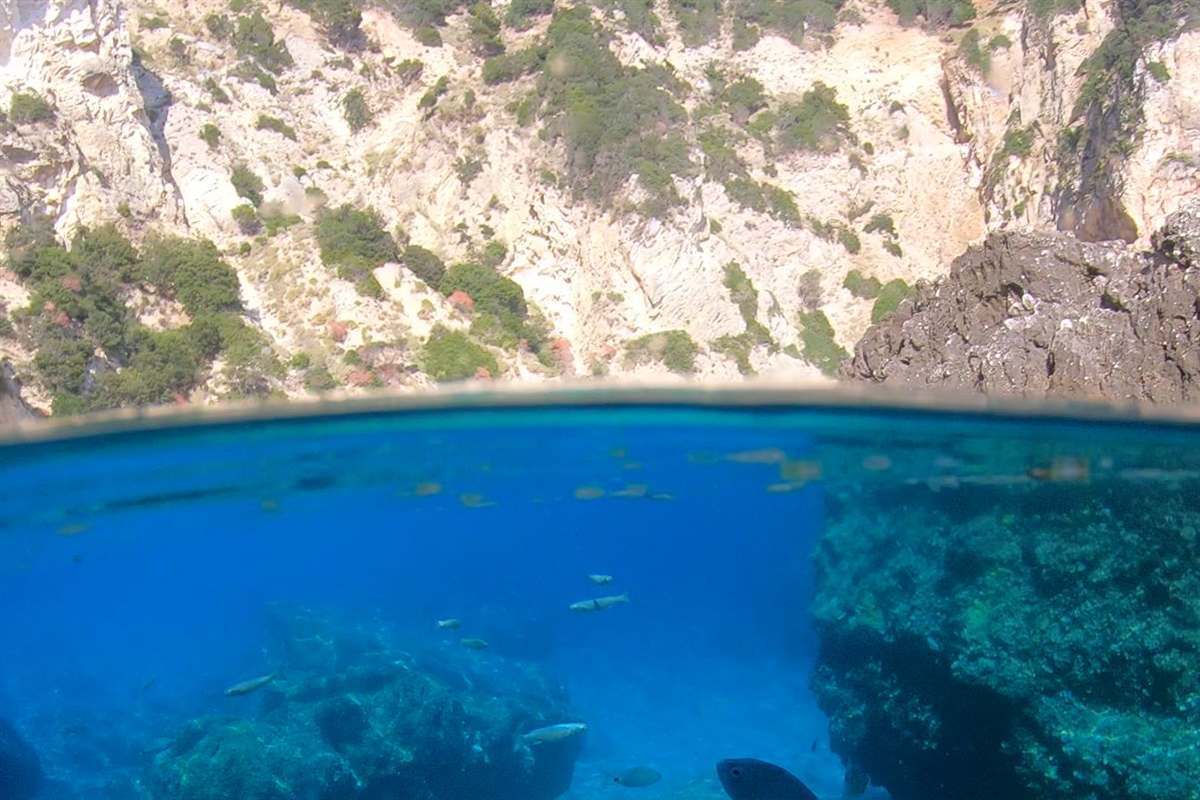
The water off Paleokastritsa holds damselfish, wrasse, bream and octopus, with sea urchins on the rocks. The pages for the Corfu underwater cruise name no species, so this list comes from beach pages and marine sources.
Beach pages name damselfish, wrasse and bream along the rocky shore of the bays. Wikipedia says the Mediterranean damselfish lives in small shoals over rocky ground, 2 to 40 metres down. Young fish are a bright, iridescent blue, and the males turn pale violet. Wrasses clean larger fish, and bream feed largely on seabed animals.
Two pages place octopus at Paleokastritsa, where a Corfu underwater cruise sails. One says octopuses hide in rock crevices, and the other calls them an occasional sight. Wikipedia adds that the common octopus prefers shallow, rocky coastal floors and eats crabs, lobsters and cockles. It changes colour to blend in, so a still octopus is easy to miss.
Sea urchins cling to the same rocks. Wikipedia says the purple sea urchin of the Mediterranean lives on rocks and in seagrass meadows. It grazes on algae and seagrass, and it digs hollows in soft rock, using its mouth and spines. Its long spines are normally purple, and the shell grows up to seven centimetres wide.
Jellyfish drift in too. Wikipedia says the purple jellyfish has a bell 3 to 12 centimetres wide. Greek news reports place it off Corfu and in the northern Ionian Sea, and they call the sting painful. On a Corfu underwater cruise you watch from a dry cabin, so a jellyfish is a sight, not a risk.
What is the difference between a glass-bottom boat and an underwater cabin?
On a glass-bottom boat, panels of glass sit in the hull below the waterline, and you look down through them. An underwater cabin is a room set deeper, with windows around it. The Corfu underwater cruise uses the cabin.
A Corfu underwater cruise belongs to a long line of boats built for looking. Wikipedia places the first glass-bottom boats in Florida, in the late nineteenth century. Visitors floated over the springs of the Silver Springs river to study them from above. Larger boats for paying crowds followed before that century closed.
The glass is the point. Wikipedia explains why: disturbances on the surface spoil a view from above, and glass takes them out of the picture. It likens the effect to a diving mask. A Corfu underwater cruise uses the same trick through the large windows of its cabin.
The cabin kind has a name of its own, the semi-submarine. Wikipedia says this boat cannot dive, so it always floats. Its passenger cabin sits low in the hull. Near the surface the water presses less, which lets the windows be large.
The Corfu underwater cruise fits this second type. Its listing pages describe a cabin with large windows under the sea surface, and a top deck above it. A tour page for a semi-submarine abroad says glass-bottom passengers sit nearer the surface, while cabin passengers sit below it.
What is the sea floor like around Paleokastritsa?
The sea floor around Paleokastritsa is mostly rock. A snorkelling page calls the bay’s bottom rocky. A travel page says the other beaches are mostly pebbles and rocks. A Corfu underwater cruise promises this underwater world, and rock is its floor.
The listing pages for the Corfu underwater cruise do not describe the floor, so travel pages fill the gap. One says small coves are separated by rocky headlands. Another describes a cragged seabed with rock pools. A page on Agia Triada, a cove on the bay’s eastern side, warns of a rocky seabed.
Seagrass is the other part of the floor. Posidonia oceanica is a flowering plant with roots and long green leaves that reach about 1.5 metres. It grows in meadows, and only in the Mediterranean Sea. The Ionian Sea, where Corfu lies, is a long bay of the wider Mediterranean.
Mapping work has found Posidonia meadows at Erimitis, on the north-east coast of Corfu. That is the other side of the island from Paleokastritsa. A meadow under a Corfu underwater cruise is not promised. The European Union lists these meadows as a priority habitat. A Greek travel site says all European countries protect them.
Seagrass also works as a filter. For a Corfu underwater cruise that matters, because the view depends on clear water. A Greek travel site says the meadows act as sediment traps that remove polluting organic substances. Wikipedia says Posidonia does well in clean water, and its leaves and stems cut silt build-up.
Four travel pages call the water at Paleokastritsa clear, and one places it among the clearest on Corfu. Wikipedia says Corfu is made of limestone formations, and limestone is white to gray. Rainwater wears limestone into rough landforms. That fits the cliffs you see from the top deck of a Corfu underwater cruise.
What do you see above the water on a Corfu underwater cruise?
A Corfu underwater cruise starts above the water. From the top deck you see the cliffs and bays of Paleokastritsa and the green and blue sea around them. Then you go down to the cabin.
On a Corfu underwater cruise the first half is on the top deck. The listing pages agree on that. Wikipedia says the village is especially known for its great cliffs. A tourism page adds that small headlands separate the beaches, and a travel article names steep green headlands.
The coast looks broken because of where it sits. Paleokastritsa stands on the side of Corfu that faces the open sea, along the west coast. A travel article calls the shore broken and dramatic, unlike the long sandy beaches of eastern Corfu. Pages on the area add green hills and rugged ground around the bay.
Tourism pages name the small bays of this shore, among them Alipa, Agios Petros and Ampelaki. The cruise pages list no stops and no bay names. They promise cliffs and bays, so a Corfu underwater cruise shows the bays on the course of the boat.
The sea itself changes colour. Wikipedia says the surface reflects the sky. It adds that particles scatter light, so the water looks greener in one spot and bluer in another. Pages on the area call the water turquoise. A Corfu underwater cruise shows that surface colour on deck and the water below it in the cabin.
Who suits a Corfu underwater cruise, and when does it run?
A Corfu underwater cruise suits guests who want a dry look at the sea. Children can join with an adult. The boat leaves every hour, and one listing gives April as the start of the season.
On a Corfu underwater cruise nobody needs to swim. Passengers begin on the top deck, then take seats in the air-conditioned cabin, which three pages mention. Two pages set one rule for families: children aged 12 and under travel with an adult aged 18 or over.
One booking page calls the cruise unsuitable for guests with mobility impairments. The cabin sits below the surface, so ask the operator about the way down before you book. The same page bars pets and smoking on board.
One listing says the cruises start on April first. An article on boat trips from Paleokastritsa puts the main boat season from April into late October. Its busiest weeks run from mid June to early September. A booking page advises early reservations for holidays and weekends. A Corfu underwater cruise holds your place only for the slot you picked.
Wikivoyage calls the summers warm and relatively dry, with about 3,000 hours of sun a year. It puts the rain mainly between November and March. The coast faces the open sea, so wind can change a day on the water. The boat article says captains can change routes in strong wind or heavy swell.
What else do travellers ask about a Corfu underwater cruise?
Will passengers get wet on a Corfu underwater cruise, and is the cabin air-conditioned?
You stay dry. Operator pages say passengers watch the marine life of Paleokastritsa without getting wet. Swimming is not part of the trip. Wikipedia describes glass-bottom boats the same way, with passengers kept dry and away from the water.
Three pages call the cabin air-conditioned, and one booking page lists the air-conditioned vessel under what is included. On a Corfu underwater cruise, the cabin is the dry part of the trip, and it has air-conditioning.
Can you take photos through the glass on a Corfu underwater cruise?
Photography advice for shooting through glass is simple. Turn the flash off, because the light bounces straight back off the glass and leaves a bright glare spot. Keep your lens close to the glass, since moving closer cuts reflections.
The same advice suggests a rubber lens hood as a buffer, so the lens can touch the glass safely. It also says to start with a clean surface and to carry a microfiber cloth for marks. Reflections happen because glass reflects light instead of passing it through. The aim is to keep them off your subject.
How does a Corfu underwater cruise differ from a snorkel trip?
Snorkelling means swimming face-down in the water while you breathe through a tube. The gear is goggles or a diving mask and swim fins. Wikipedia adds that it needs only very basic swimming skills. The head faces downwards in the water.
A Corfu underwater cruise puts no one in the water. You sit in a cabin below the surface and watch through large windows, as the operator pages describe it. The snorkeller meets the sea with a mask; the passenger meets it through glass.
How does a Corfu underwater cruise compare with a caves boat tour or a coach ride?
One operator blog says a blue caves trip from Paleokastritsa depends on the caves visited. It also depends on whether the captain adds swimming stops. Another boat page states that no swimming is included on its trip. Water time differs between boat tours.
A coach excursion crosses the island by road and stays on land. A Corfu underwater cruise takes you out on the sea. You ride on the top deck first, then in the cabin below the surface.
How early do you need to arrive for a Corfu underwater cruise, and what if the weather turns?
One booking page says to be at the start 15 minutes ahead of the chosen departure. Another says to exchange tickets at the ticket office 30 minutes before. You swap the ticket for a boarding pass first, and the reservation holds only for the time slot you picked. Pickup, drop-off, food and drinks are not included.
Pages for other boat trips from Paleokastritsa say a trip is rescheduled in bad weather. One adds that safety worries allow the captain to alter the route. For a Corfu underwater cruise, ask the operator on your booking about sea conditions.