
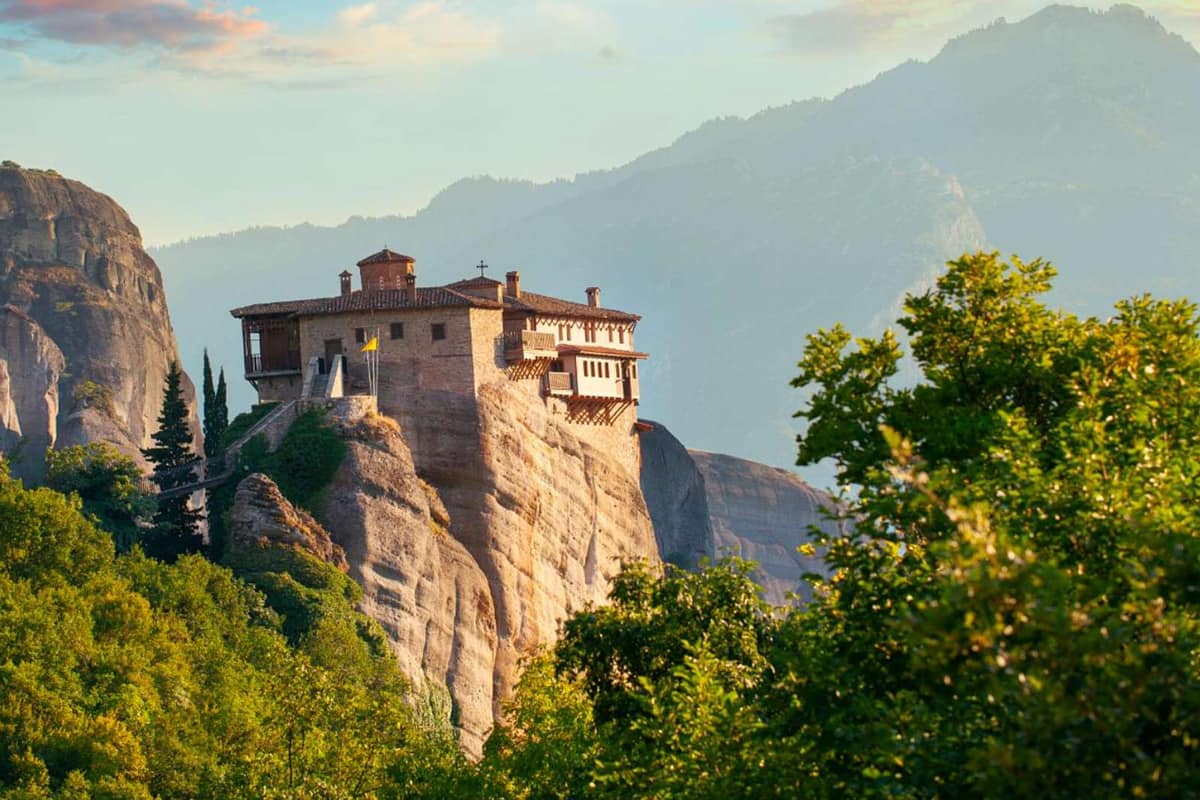
Greece in winter splits in two: snow on the mountains of the mainland and mild, quiet days on the coasts and the large islands. The tours in Greece on the home page run in both halves of the season.
This page covers the weather, the ski centres, Arachova and Delphi, the stone villages, Meteora, Athens and the other cities, the Christmas, New Year and Epiphany customs, carnival, the islands, Crete, the lakes and the winter travel rhythm. The meteora day trip from athens and delphi day trip from athens pages hold the day trips.
What is Greece in winter like?
Greece in winter runs from December to February, with snow on the mountains and mild, wet weather on the coasts. Wikivoyage describes the off season of November to February as mild, but not beach weather. The season brings quiet sites, working cities and a calendar of old customs.
December, January and February make up the core of the season. Late November and early March form its edges, when autumn rain gives way to spring light. Wikivoyage generally starts the cold, rainy season in November and ends it in late March or early April. Greece in winter therefore fits inside that span.
The Greek National Tourism Organisation devotes a page of its own to the season. That page opens by saying that Greece is more than a summer destination. It then invites readers to choose the country for winter holidays. It lists ski resorts, lakes, old towns and village customs as the pleasures of the cold months.
The themes of Greece in winter on this page run in this order:
- Ski centres
- Mountain villages
- Meteora
- The cities in their working season
- Christmas, New Year and Epiphany customs
- Carnival
- The islands
- Crete
- Lakes and birds
Greece in winter is a lived-in country, not a closed one. Athens and Thessaloniki keep their normal working pace, with offices, schools, markets and theatres open. Ancient sites and museums follow a winter timetable, and the summer coaches are gone. Visitors can take their time in the courtyards and galleries.
The country divides into two kinds of winter. In the interior, mountains carry snow, and the villages below them live with it. On the coasts and islands, the days are mild and the rain is regular. A trip to Greece in winter can join a snowy village and a seaside town.
So the first choice on a winter trip is the setting: mountain, city, coast or island. Each setting has its own weather, its own timetable and its own customs. Picking one or two settings keeps a plan for Greece in winter simple, since the differences between them are large.
How does the weather shape Greece in winter?
Height and the coastline decide the weather of Greece in winter. The article places wet winters on the low-lying areas and islands, where fallen snow does not stay long. The alpine mountain zone has harsh winters with abundant snowfall, as the same article states.
Wikipedia’s climate article counts 11 climate types for the country, plus a wide range of local variations. Rain favours the western side of the Pindus mountains, while the eastern side stays drier. On those low coasts the winter rain is persistent, and the western stretches receive more of it.
The same article gives the span of winter averages. Locally, the Dodecanese average passes 15 degrees Celsius. In the mountains they fall below minus 3. For Greece in winter, the table for downtown Athens shows January lows of 7.1 degrees and February highs of 14.2.
Thessaloniki, in the north, reads colder. Its January figures are a daily high of 10.6 degrees Celsius and a low of 3.4. Its February low is 4.4, and December adds a high of 11.8 and a low of 4.9. At night the gap to Athens is nearly four degrees in January, as the two tables show.
Rain shows the west-east split in numbers. The Araxos station near Patras counts 15.9 rainy days in December and 13.7 in January. That means rain on close to half the days of each month. Plans for the west coast need an indoor option for each day.
In the mountains the season turns to snow. The table for Florina counts 7.5 snowy days in January, 6.3 in February and 5.9 in December. At 2,090 metres on Kaimaktsalan, the January daily high is minus 1.8 degrees Celsius. Greece in winter has a true snow season at those heights.
Mid-winter also holds a calm-weather myth. As the article on Alcyone and Ceyx states, the halcyon days are seven winter days without storms. Ovid and Hyginus tie them to Alcyone, who built her kingfisher nest on the shore. Aeolus, her father and the god of the winds, held back the winds for her.
Real weather is less tidy than the tale, since wind and rain still arrive. Short daylight also shapes every plan for Greece in winter. Dawn comes late and dusk arrives early, so sightseeing fits into the middle of the day. Evenings suit museums, long meals and slow walks in town.
Which ski centres open in Greece in winter?
Greece in winter has ski centres on Parnassos, Kalavryta, Vasilitsa, Seli and Kaimaktsalan. Parnassos is the largest, with two areas called Kelaria and Fterolakka on Mount Parnassus. It lies 180 kilometres from Athens. With Kalavryta it is the centre closest to the capital, as Wikipedia states.
Skiing in Greece in winter starts with the numbers of Parnassos. The highest elevation of Parnassos is 2,250 metres, and its base sits lower, at 1,600 metres. The runs add up to 36 kilometres, and the longest run measures 4 kilometres. The centre is 205 kilometres from the airport of Athens.
The centre grew in stages. The first two drag lifts ran at Fterolakka in nineteen seventy-six, as Wikipedia states. The new area at Kelaria was completed in nineteen eighty-one. Today the centre has 16 lifts, and a smaller area called Gerontovrachos lies across a ridge from Kelaria.
The centre has no rooms of its own. Wikipedia names Kalyvia, Arachova, Lilaia, Eptalofos and Amfikleia as the nearest places to stay. From these places, the drive takes 20 to 45 minutes. Equipment hire, restaurants and bars stand at the centre itself. A ski day in Greece in winter therefore begins in a village below the slopes.
Greece in winter reaches the Peloponnese on Mount Chelmos, where Kalavryta has its ski centre east of the town. Only Taygetus and Kyllini rise higher in the Peloponnese than this mountain, which carries the name Aroania as well. Pine forests cover it between 800 and 1,800 metres, and grassland and bare rock lie above.
Vasilitsa puts Greece in winter in the middle of the Pindus, 42 kilometres from Grevena and 417 kilometres from Athens. Wikipedia counts five lifts and 16 trails there. The summit stands at 2,113 metres, and the vertical drop is about 450 metres. Black pine trees surround the trails. Two trails are approved as Olympic trails by the international ski federation.
Kaimaktsalan shows Greece in winter on the northern border, where the summit reaches 2,521 metres. Wikipedia lists it as the third highest peak in Greece. The name borrows kaymak, a Turkish dairy product like clotted cream, to describe the white summit. The article gives it a subarctic climate with long, cold winters. Seli lies in the Vermio Mountains.
How do Arachova and Delphi fit Greece in winter?
Two places share Mount Parnassus in Greece in winter, the town of Arachova and the sanctuary of Delphi. Wikipedia states that snow falls in Arachova, but less than on the north side at similar heights. The Delphi site keeps winter hours of half past eight to half past three.
Western Boeotia holds Arachova, a town set high in the mountains. Wikipedia calls it a day or weekend trip from Attica. In Greece in winter, those trips bring visitors from Athens up to its cobbled streets. The surrounding communities draw municipal water from the snow that melts on Parnassus. Wikipedia gives the mountain very cold winters.
In Greece in winter, the uphill rows of small houses of Arachova sit above the Pleistos valley. The Bell Tower stands against a steep cliff in the town centre, covered with dense ivy. A large clock crowns the tower, and Wikipedia gives it a height of ten metres.
Textiles in bright colours, carpets, rugs, handicrafts and woodcut creations all belong to Arachova, as Wikipedia states. The article also shows a painting of weavers in Arachova, made in eighteen seventy-seven by Theodore Jacques Ralli.
Greece in winter makes this pair easy to combine, since Wikivoyage puts Arachova under 30 minutes from Delphi. Its Delphi page also sends winter visitors to the Arachova villages and to Parnassos Mountain for skiing. The official page puts the site 400 metres from the present-day village, on the road between Arachova and Itea.
The winter timetable set by the culture ministry covers November, December, January, February and March. In that season the archaeological site of Delphi opens from half past eight to half past three. The last admission is at ten past three.
From the first of April the site closes at eight in the evening, which marks the summer season. A visit to Delphi in Greece in winter must fit between the shorter hours. The official site of Delphi shows the same daily hours for the museum.
Free admission days fall on every first and third Sunday from November to March, as the Ministry page states. Wikivoyage describes the site as outdoors and asks visitors to be ready for the weather.
Wikipedia gives 1,250 metres as the height of the Corycian Cave above the sea, on the slopes of Parnassus. No cave in the Delphi region is larger; the first hall spans about 90 metres by 60. Its modern name, Sarantavli, means forty rooms.
Which mountain villages draw visitors to Greece in winter?
Metsovo, high in the Pindus mountains at 1,160 metres, shows why mountain villages draw visitors to Greece in winter. Wikipedia notes that its tourism flourishes in the cold season. Zagori, Pelion and Kastoria add stone bridges, slate roofs and a lake that softens the weather.
Metsovo is a town of Epirus between Ioannina and Meteora. Wikipedia places the largest base of Aromanian life in Greece here. Its winters are snowy, and rain falls all year. The article names the local cheeses Metsovone and Metsovela and a museum for the benefactor Georgios Averoff. Greece in winter finds a ski centre near the town.
Zagori is a region of Epirus with 46 villages over nearly 1,000 square kilometres. About 3,400 people live there. In Greece in winter, Wikivoyage describes snow over the villages and wood smoke in the stone lanes. By the last days of February, the snowpack on the surrounding peaks begins to thaw.
Stone bridges link the Zagori villages. Wikipedia dates the arched bridges to the eighteenth century, when merchants living abroad paid for them to replace wooden ones. Modern roads reached the area only in the nineteen fifties, and mountain roads and these bridges served until then. Wikivoyage counts more than five old bridges around Kipoi, a village at 800 metres.
The Vikos Gorge, about 32 kilometres long, has walls 120 to 1,350 metres deep, Wikipedia states. Measured against its width, it counts as the deepest canyon in one world-records listing, but the claim is disputed. Hikers enter by a path from Monodendri village. In Greece in winter, the stream runs seasonally, and all year only at the lowest end.
Pelion is a hook-shaped peninsula near Volos, with a highest summit of 1,624 metres. Wikipedia says its higher ground gets enough snow for ski facilities from Christmas to Easter. Wikivoyage adds that heavy snow falls in the villages too. In Greece in winter, Pelion’s stone houses use fireplaces with chimneys running through the walls.
Kastoria occupies a headland on the western side of Lake Orestiada. Wikipedia adds that the lake moderates its temperatures. Of its 72 Byzantine and medieval churches, 54 survive.
Fur wealth built the mansions of Doltso and Apozari, two old lakeside quarters. The houses were built across three centuries, the seventeenth, the eighteenth and the nineteenth. The Greek National Tourism Organisation lists Kastoria among four towns for Greece in winter.
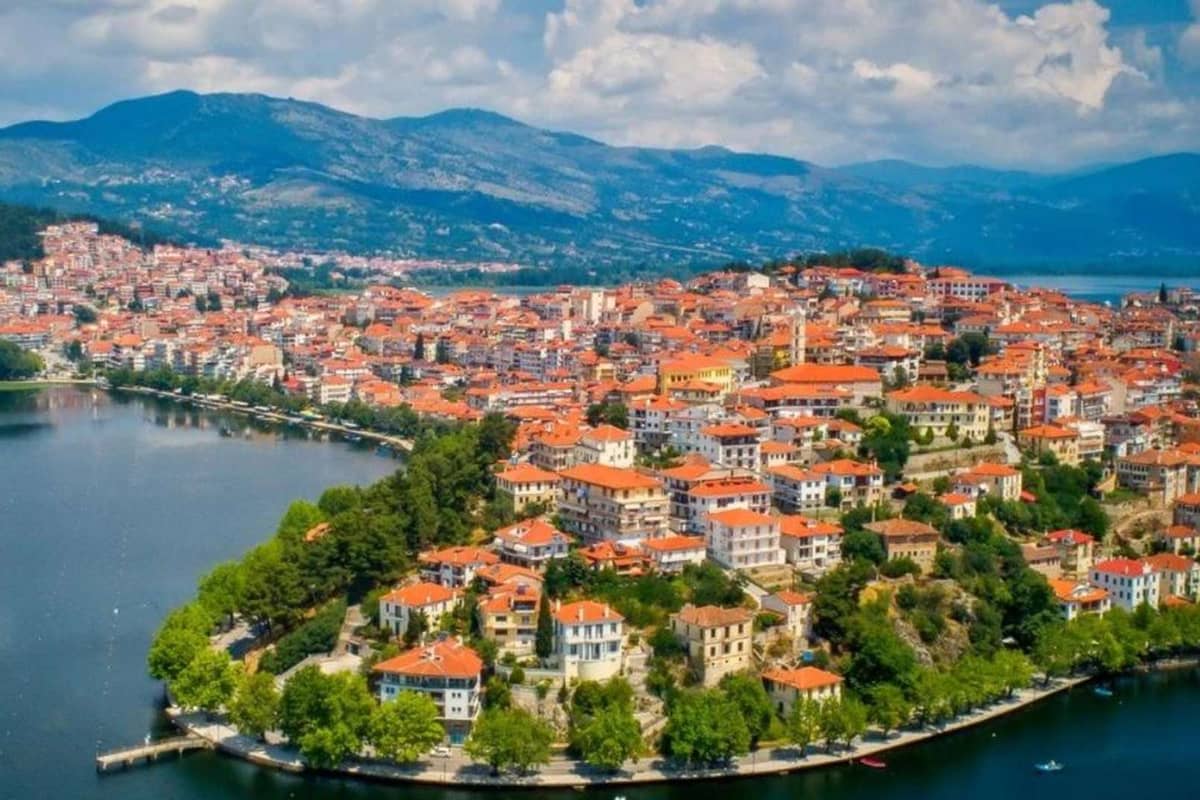
How does Meteora look in Greece in winter?
Meteora in Greece in winter runs on a winter timetable of its own. Wikivoyage lists open days and closing hours for the six monasteries still in use. It adds that each monastery sometimes closes on more days from November to March than in summer.
Meteora’s steep rock pillars stand in Thessaly, within the regional unit of Trikala. Wikivoyage says the mountains to its east and north swing from baking summer heat to severe cold, with heavy snowfall. Low cloud and mist can wrap the pillars and hide the monasteries. That changes the look of Greece in winter here.
Wikipedia counts 24 monasteries on the pillars, begun mainly in the later fourteenth century. Only six still hold monks or nuns: four house men, two house women. Each houses fewer than ten people. Nuns have run Saint Stephen since the nineteen sixties. Wikivoyage lists all six for visitors, which sets the plan for Greece in winter.
Great Meteoron opens Friday to Monday in winter and closes at two in the afternoon. Varlaam opens Saturday to Wednesday and closes at three. Roussanou opens Thursday to Tuesday and closes at two. All three open at nine in the morning. Greece in winter rewards a plan built around the day of the week.
Holy Trinity opens Friday to Wednesday and closes at four in the afternoon. Saint Stephen is open Tuesday to Sunday, from half past nine to one and again from three to five. Saint Nicholas Anapausas, the smallest monastery, has one listed timetable: Saturday to Thursday until four. Check timetables before a trip to Greece in winter.
Wikivoyage asks men for long trousers that cover the knees. A skirt or a sarong, with shoulders covered, is the rule for women. The ticket points lend skirts to visitors without one.
Inside the inner church sanctuaries, no photos or video are allowed, though other areas permit them. Visitors cross a short bridge to enter Saint Stephen. The other five monasteries are reached by hundreds of steep steps.
Kalambaka and Kastraki lie at the foot of the rocks. Wikivoyage ties Kalambaka to amenities and easier transit, and Kastraki to a village feel closer to the pillars. From Kalambaka, a stone-paved trail leads up to Holy Trinity. Between Great Meteoron and Varlaam the walk takes ten minutes. Greece in winter leaves short daylight for these paths.
How does Athens feel in Greece in winter?
Athens stays open in Greece in winter, on winter hours. On its museum pages, the Hellenic Ministry of Culture counts November through March as the winter season. State sites then open from half past eight to half past three, and the major ones from nine to four.
The official tourism page of Greece lists the winter hours of the Acropolis. Gates on the rock open at eight and shut at five in the afternoon. In summer, the same page moves closing time to six in the evening. Greece in winter also brings an early dusk, so the rock suits the first hours of the day.
Those pages also name a free day: one Sunday a month, the first. The rule runs from the first of November until the thirty-first of March. Greece in winter thus has a regular free day at state sites. The Acropolis Museum page carries its own list of free dates, so read that page separately.
Fewer visitors travel in the cold months. Queues at the gates of the big sites are shorter than in summer. Athens in Greece in winter also dresses for Christmas, with decorations and lights in Syntagma Square. An evening walk through the centre takes them in.
A clear day in Greece in winter suits Lycabettus Hill. The Wikipedia panorama shot from the hill labels the Panathenaic Stadium, then the Temple of Olympian Zeus. Its caption goes on to list the Hellenic Parliament and the Acropolis. A large open-air amphitheatre also stands near the top, the same page records.
The National Archaeological Museum is the refuge for a wet day. Its Ministry page lists winter hours from half past eight to half past three. On Tuesday the doors open at one in the afternoon and close at eight at night. The page counts more than 11,000 exhibits and calls them a panorama of ancient Greek civilization.
The Acropolis Museum page lists winter hours from nine to five on Monday to Thursday. On Friday it runs from nine to ten in the evening. Saturday and Sunday run from nine to eight. A Friday evening visit suits Greece in winter, when dusk comes early. The excavation at the base of the museum opens from nine to five.
Which other cities suit Greece in winter?
Thessaloniki fits Greece in winter through its international film festival, held every November in the city. As Wikipedia states, the festival has used four theatres since nineteen ninety-nine. They sit in two newly restored warehouses at the city port, where the festival hub is.
Wikipedia says it started as a national event called Greek Film Week. Its thirty-third edition, in nineteen ninety-two, made it international. It holds three competition sections and focuses on independent cinema and emerging filmmakers. A separate documentary festival follows in March. So Greece in winter gives the city two screen seasons.
The White Tower, a monument on the waterfront, now serves as a museum of the city’s past. The tower article dates it to the fifteenth century, in Ottoman times, and gives its height as 34 metres. The same article records an Ottoman-era name for the tower, the Red Tower.
The city article places Thessaloniki second by size among Greek cities. The name comes from Thessalonike, the wife of Cassander, who founded the city in the late fourth century BC. A World Heritage Site covers the city’s Paleochristian and Byzantine monuments. A winter walk can move from one church to the next.
Ioannina, the largest city of Epirus and its capital, looks onto Lake Pamvotis from the west. The article lists frequent frosts and occasional snowfall for its wet winters, which run colder than on the coast. January daily highs average 9.0 degrees Celsius and lows 0.2. Ioannina shows the colder face of Greece in winter.
The lake is the largest in Epirus, 7.9 kilometres long and 5.4 wide, with an average depth of 4.5 metres. Ioannina Island lies inside it, is inhabited and has a regular boat service. Its monastery of Saint Panteleimon is now a museum of everyday objects and relics from the period of Ali Pasha.
The city holds two indoor stops for a cold day in Greece in winter. The Archaeological Museum documents life in Epirus from prehistoric times to the late Roman period. The Byzantine Museum shows artefacts of the wider region. Across the country, Ioannina has a name for silverwork.
The old town of Nafplio stands mainly on a peninsula that reaches into the Argolic Gulf. Its article says visitors come all year round for the architecture, the nearness to Athens and the mild climate. A ride by regional KTEL bus from the capital lasts up to two hours and twenty minutes.
Patras ranks third in size among Greek cities and lies 215 kilometres west of the capital. Its article calls it the Gate to the West. Trade and contact with Italy pass through its busy port. The city has three public universities and a large student population, so it keeps working through Greece in winter.
How do Christmas and New Year traditions mark Greece in winter?
The twelve days of Christmas, which end on Epiphany, hold the Christmas and New Year traditions of Greece in winter. Children sing carols from house to house and goblins roam the old tales. Honey sweets fill the trays, and a New Year bread hides one lucky coin.
Greece in winter decorates boats as well as trees. The official tourism page says little boats and Christmas trees ornament houses and streets. In Thessaloniki, Wikipedia says, the municipality sets up a Christmas boat as a Greek variant of the tree. Both stand over twenty metres tall.
Greece in winter echoes with children’s voices. The article on Christmas carols states that children walk from door to door with triangles on three eves. The eves are Christmas, New Year and Epiphany. These songs, the kalanta, greet the Nativity, Saint Basil with the New Year, and the baptism of Jesus. Corfu carols use mandolins and guitars.
The kallikantzaroi are underground goblins who saw at the tree that holds up the earth. When Christmas dawns, they climb up for twelve days. Tales from Greece in winter say they come down chimneys, so a night-long fire foils them. On Chios, a sieve left out made the goblin count its holes and never reach three.
The kitchens of Greece in winter smell of honey and almonds. The melomakarono is an egg-shaped sweet of flour, olive oil and honey, dipped in syrup after baking. The kourabies is a light almond shortbread rolled in icing sugar. In certain regions, a single clove sits in each Christmas biscuit.
In Greece in winter, the New Year brings the vasilopita, a bread, cake or pie with a coin baked inside. When the year turns at midnight, a knife marks a cross on it. Slices go to family members and guests, from the eldest to the youngest. The finder of the coin gets good luck for the year.
Saint Basil is the gift-bringer. In Greek tradition he brings presents to children on the first of January. Local custom adds vasilopita slices for Saint Basil, the poor and the household. In Thessaly, a pork pie in phyllo hides the coin.
As the official tourism page states, two door-step luck customs greet the new year in Greece in winter. One is a big onion bulb hung at the front door. The other is a pomegranate broken at the entrance. The same page names the Momogeroi of Macedonia and Thrace and the Ragoutsaria of Kastoria.
How does Epiphany mark Greece in winter?
Epiphany, called Theophany or Phota (the Lights) in Greek, falls on the sixth of January and closes the twelve days. In Greece in winter, it centres on the Great Blessing of the Waters. A priest throws a cross into the sea, a lake or a river, and swimmers dive for it.
The Greek names carry the meaning. Theophany means a divine manifestation, and Greeks also call the day Phota. The article on Epiphany states that the feast recalls how Jesus was baptised in the Jordan. Greece in winter keeps it on the sixth of January, because the Greek church uses the Revised Julian calendar.
The festival starts the evening before. Children sing Epiphany carols on the eve, and the feast of Saint John the Baptist follows on the seventh. In the small sanctification, called Protagiasi, a priest goes from door to door with a cross and a basil branch. He sprinkles each room with holy water.
The Great Blessing happens on the feast day itself. The service begins in the church, with a large vessel of water on a decorated platform. Then the clergy and the people follow the cross in a procession to the closest water. Greece in winter holds this rite at a beach, a harbour, a quay, a river or a lake.
At the water, the priest casts the cross in, and swimmers race to retrieve it. The first to reach it swims back, and the priest blesses the swimmer and the household. The official tourism page adds that men and women both dive in Greece in winter. Winter swimming is one of the customs the article lists.
The day ends the season of goblins. The entry on the kallikantzaros states that the sun starts to move again on Epiphany. The goblins return underground and find the world tree healed. The article on Epiphany adds that it ends the old ban on sailing, as the seas are cleansed of goblins.
A traveller from the US can compare the rite with Tarpon Springs in Florida. The article on Epiphany states that boys between sixteen and eighteen dive into Spring Bayou there for a wooden cross. The town calls itself Epiphany City. At home in Greece in winter, the dive takes place in harbours, rivers and lakes.
What does carnival season add to Greece in winter?
Carnival season, called Apokries, adds three themed weeks of costumes, grilled meat and parades to Greece in winter. Wikipedia names them Preannouncement Week, Meat Week and Cheese Week. Clean Monday closes the season, and Great Lent, a strict fast leading up to Easter, begins on that day.
The highlight of Meat Week is Tsiknopempti, a Thursday that falls eleven days ahead of Clean Monday. Pempti is Thursday, and tsikna is the smell of roasting meat, so the day is named for its smoke. Large outdoor parties grill and roast meat on that day. In the week after, Tirofagos puts cheese, eggs and dairy on the table.
The largest carnival of Greece in winter is the Patras Carnival, first held in eighteen twenty-nine. It joins balls, parades, a hidden treasure hunt and a children’s carnival. A town crier calls the town to George Square on the day of Saint Anthony. The mayor declares the carnival open from the first-floor balcony of the Apollon theatre.
Each carnival group is made of friends, colleagues or neighbours with a name and a costume theme. A group counts between 50 and 300 people. In the treasure hunt, teams answer questions on history, philosophy and mathematics and follow clues hidden around the town. On Saturday evening, the Night Parade on foot is open to every group.
The Grand Parade follows on the Sunday before Clean Monday. It starts around noon with satirical floats. In recent years, between 35 and 40 thousand people have marched in it, so it takes hours to pass. On Sunday night the Carnival King’s float burns at the Saint Nikolaos Street pier. Television carries the ceremony across Greece in winter.
Xanthi holds the second-largest carnival of Greece in winter, after Patras. Its Night Parade on the last Saturday is open to all. The route of the Grand Parade is 3 kilometres long. The festival closes with the burning of the Tzaros at the river Kosynthos. Folk tradition says the fire keeps fleas away in summer.
Clean Monday is a public holiday, and on it the carnival gives way to Lent. The day brings outdoor excursions, shellfish and lagana, a special bread baked only then. Kite flying is the widespread custom, since a kite stands for trying to reach the Divine. Tradition counts it as the start of spring, so Greece in winter ends with kites.
How do the islands change in Greece in winter?
The islands change in Greece in winter as seasonal businesses close and ferry sailings thin out. On Santorini, Wikivoyage sets the off-season between December and March. The capitals Ermoupoli, Rhodes town and Corfu town keep thousands of permanent residents all year, as Wikipedia counts them.
Wikivoyage dates the first closings of seasonal businesses on Santorini to the end of October. The bulk of businesses are shut until spring once December arrives, hotels and guest houses included. Those four months bring cooler temperatures, along with occasional rain and wind. Winter brings Santorini the larger share of its rain across the year.
Over a dozen restaurants in Fira serve all year, and the town stays more or less open. In a small village, only one or two places stay open. Greece in winter on Santorini therefore centres on Fira, where the restaurants keep serving.
Wikivoyage places the beach season of Mykonos from late spring to mid-October, so winter skips the swim. Wikivoyage expects showers on Mykonos from October to April. Ferry links from Piraeus and Rafina to Mykonos largely pause between the end of October and April.
Ermoupoli is the capital of Syros, the Cyclades and the South Aegean. The census gives Syros 21,124 inhabitants. In the nineteenth century, the port of Ermoupoli mattered more than Piraeus. The town stands on a natural amphitheatre, and its city hall stands in Miaoulis Square. An archaeological museum and a municipal library give Greece in winter two indoor stops here.
Cars and motorcycles are banned on Hydra by law; rubbish trucks are its only motor vehicles. Passengers travel by horse, mule or donkey on land and by water taxi along the coast. The municipality counts 2,070 residents, and the island imports its water by boat. Rain in Greece in winter fills cisterns beneath the houses, kept for drinking water later.
Rhodes town has about 56,000 residents. The medieval city, with its citadel built by the Hospitallers, is a UNESCO World Heritage Site. In winter, Corfu town has wet, mild weather that hovers close to 10 degrees Celsius. A museum on the musical heritage of the island gives Corfu town an indoor stop in Greece in winter.
How does Crete fit Greece in winter?
Crete fits Greece in winter as an island with a mild season and snow on its peaks. Winter there is fairly mild by Wikipedia’s account, and the mountain slopes see regular snowfall from November through April. The island is the largest in Greece, so its weather changes from coast to summit.
For sun in Greece in winter, the southern shore of Crete is the place to look. The plain of Mesara and the nearby Asterousia range receive significantly more sunny days, according to Wikipedia. Temperatures are higher there on average, throughout the year. Fruit ripens on the date palms along that shore, and swallows spend the whole year there.
Lefka Ori means White Mountains in Greek, a name drawn from the pale colour of the peaks. Snow covers the peaks until late spring; in summer and autumn the limestone supplies the off-white colour. The range has over 30 summits above 2,000 metres. Wikivoyage gives the walking season of the Samaria Gorge as late spring to mid-October.
Mount Ida, the massif called Psiloritis, stands in the Rethymno regional unit. A natural park that includes it is a member of the UNESCO Global Geoparks Network. On the Nida plateau, shepherds’ huts of local stone serve for shelter and cheesemaking. At 1,750 metres, on the secondary peak of Skinakas, the University of Crete runs an observatory.
For a city stop in Greece in winter, Crete offers Heraklion and Chania. In population Heraklion comes fourth in Greece and first among island towns. Its winters are mild with moderate rain, and warmer than Athens because it lies further south. Chania has mild rainy winters with sunny intervals, and snow is rare near its coast.
The Archaeological Museum of Heraklion suits a wet day in Greece in winter. The winter timetable runs for five months, November through March, according to the official page. On six days of the week the doors open at half past eight and shut at half past three. On Wednesday it opens at ten and closes at five.
A visit to Knossos in Greece in winter follows a winter schedule. The official page states daily hours from eight to five between the first of November and the thirty-first of March. The last entry is twenty minutes before closing. In winter, entry is free on the first Sunday of a month and on the Sunday two weeks later.
Greece in winter includes the olive harvest on Crete, which Wikivoyage places in November and December. Every member of a family helps with the harvest, and olive pressing factories work in the villages. Old presses with huge stone wheels are preserved. Wikivoyage adds that oranges from the area between Rethymnon and Chania are sought after.
Where does nature put on a show in Greece in winter?
Nature puts on its show in Greece in winter at Lake Kerkini, an artificial reservoir in Central Macedonia. Wikipedia states that the lake hosts 227 kinds of birds, 76 of them in the National Red Catalogue. The Strymon River is its main water source. Mountains and hot springs add two more stages.
Lake Kerkini reaches 17 kilometres in length, 5 kilometres in width and 35.5 metres in depth. The surface of the lake is not fixed: it measures from 54 to 72 square kilometres. The Kerkinitis river, which comes down from Krousia, also feeds the lake.
The article adds that at least 31 bird species are protected by a European directive on wild life. Buffalo herds live in the area, and water-lilies grow across a large part of the lake. The mountains Belasica and Krousia offer a panoramic view over the lake.
The Wikipedia article on the Dalmatian pelican carries a photograph of a flock roosting on Lake Kerkini. Adults take on a drabber plumage in winter, which makes them look more like the great white pelican. Anyone planning birdwatching in Greece in winter finds the species described there as a partial migrant.
The same article places the largest known breeding colony at Small Prespa Lake, shared by Greece and Albania. It counts around 1,600 pairs there. The article on the Prespa Lakes lists a national park on the Greek side, one of three in the area.
Above 2,000 metres, snow covers Mount Olympus for close to nine months of each year. Wikipedia states that this snow season runs from September to late spring, so Greece in winter finds the summit white. In places, the winds gather snow 8 to 10 metres thick, called anemosouria in Greek.
The Pozar thermal baths lie 32 kilometres north of Edessa. Wikipedia states that the springs are naturally heated at 37 degrees Celsius. They are a popular attraction in the cooler months, so they belong to Greece in winter. Another article places them in a mountainous area at 360 to 390 metres, on 30 hectares.
The waterfalls of Edessa sit in a city whose name means tower in the water, as Wikipedia states. The abundant waterfalls once powered four large textile factories. Today the article lists the waterfalls and winter sports among its reasons for tourism. That pairing of falling water and snow sports suits Greece in winter.
How do ferries, roads and flights run in Greece in winter?
Ferries, roads and flights in Greece in winter follow the weather, not a fixed plan. Wikivoyage describes the Aegean weather of January, February and March as extremely rough. A boat in harbour can wait there for whole days before it leaves. A traveller therefore leaves room for delay in the plan.
Greece in winter hands the sailing decision to the harbour. Wikivoyage says the port authority makes the call, not the ferry company. The same page calls such a delay extremely unpredictable. It says the hour when a held boat leaves is near impossible to know. Keep a free day behind every crossing that matters.
Wikivoyage Cyclades reports boat lines that pause once October ends and run again by April. Adverse weather brings delays and cancellations to these lines, the page adds. It asks travellers to check with the operator before they fix a departure. Mainland departures for the Cyclades leave from Piraeus, Rafina or Lavrio, in the words of that page.
Wind turns the final boat before a flight into a poor choice, Wikivoyage Cyclades notes. Night crossings meet calmer seas, so the late evening and early morning boats tend to sail. For the flight home, Wikivoyage Greece plans a return to Athens a full day early. A trip to Greece in winter keeps that spare day.
Flights are the second plan when the sea holds the boats. Wikivoyage Greece limits winter air travel to the islands to domestic flights through Athens. Charter flights from European airports reach Santorini and Mykonos between late spring and October, the Cyclades page says. Greece in winter therefore pairs the flight with the ferry.
Roads set their own pace in Greece in winter. Wikipedia’s article on transport states that motorways follow higher construction standards than national roads. A national road can be a fast dual carriageway or a twisting road with two lanes. Wikivoyage Greece says mountain roads take twists and turns, and one driver pulls over when two cars meet.
Before a drive to a snow village, ask the rental desk about chains and read the road report. KTEL is the common name of every intercity and regional bus company, as the same article states. A long-distance bus from Athens needs about three hours for Delphi, Wikivoyage Delphi says. It points winter visitors to Arachova and Parnassos for skiing.
Which clothes and kit suit Greece in winter?
Layers, a waterproof jacket, shoes with grip and a warm hat form the core kit for Greece in winter. Wikipedia’s article on Athens carries a climate table for Elliniko, on the coast. It lists 13.5 rainy days in an average December. So the jacket earns its place.
The same table lists 1.7 rainy days for July, which sets the contrast. A hood on the jacket works better than an umbrella on a windy quay. Greece in winter also asks for an outer layer that blocks the wind. A waterproof shoe or boot keeps the feet dry on wet pavements.
Its sunshine row gives 127.1 hours for December and 362.7 for July. The days are short in December, so a walk or a drive starts in the morning. A thin wool layer rides in the day bag, because the evening air is cooler than the midday air. A day plan for Greece in winter follows the daylight.
Wikivoyage Zagori describes Monodendri as a village of stone houses, stone roofs and stone-paved streets. Rain turns stone and marble slick, so the sole of the shoe matters more than its style. A deep tread and a closed toe suit wet lanes, hill paths and church steps. The Greek National Tourism Organisation names a wide network of signposted trails.
Wikivoyage Zagori calls the rain and low temperatures of the mountains a surprise to visitors who know only sunny beaches. The article on the climate of Greece puts winter averages below minus 3 degrees Celsius locally in the mountains. A warm hat, gloves and a scarf belong in the bag for Greece in winter.
A day on the slopes asks for a waterproof shell, warm base layers, gloves and goggles. The article on the Parnassos Ski Centre states that the centre provides equipment hire facilities. A visitor to a ski centre in Greece in winter hires the equipment on site and packs the clothes. Goggles help when snow blows.
Stone houses keep the chill of a winter night until the heating has run for a while. Wikivoyage Cyclades names rakomelo, a hot drink of raki, honey and hot water. Local people drink it to warm up on a cold day, the page says. A thin wool jumper and warm socks suit Greece in winter indoors and out.
Which other questions do travellers ask about Greece in winter?
Greece in winter brings four common questions. The sea at Heraklion reads 17.1 degrees Celsius in January. State museums close on the first of January and on both days of Christmas. Snow in Athens is relatively uncommon, and a trip’s length follows its settings.
Is the sea too cold for a swim in Greece in winter?
The Wikipedia article on Heraklion carries a table of average sea temperature. It gives 18.4 degrees Celsius for December, 17.1 for January and 16.4 for February. The same table gives 26.1 for August. The sea of Greece in winter therefore sits far below its summer level.
The Wikipedia article on Rhodes carries a second table. Its figures are 18.8 degrees for December and 17.9 for January, against 27.2 for August. Both tables describe southern towns, and they list averages, not daily readings.
The Rhodes Port table in the same article lists a mean daily maximum air temperature of 16.1 degrees for January. The January sea reading of 17.9 is higher than that figure. On that coast the winter sea is warmer than the air by day. Each swimmer in Greece in winter decides what feels warm enough.
Do sites and museums open on holidays in Greece in winter?
The Hellenic Ministry of Culture lists the closed days on its museum page. In Greece in winter that covers New Year’s Day and both days of Christmas. The twenty-fifth of March also falls inside the winter season. The list ends with Labour Day and Easter Sunday of the Greek Orthodox calendar.
The same page lists the holidays when museums stay open. Two of them fall in Greece in winter. Those two days are Epiphany, on the sixth of January, and Clean Monday, when Great Lent begins. A museum visit planned for either date finds the doors open.
Wikivoyage calls Christmas a private, family holiday, with lights and decorations in the city squares. Changes to the days or hours go up on the Ministry website. The page advises a phone call first. The page speaks of museums, so a visit to an open-air site starts with that site’s own page.
Does snow reach Athens in winter?
Snow does fall on Athens. The city article names the snowstorm of the sixteenth of February as a recent example. On that day snow blanketed the entire urban area. The northern districts of the city see blizzards more regularly, the article adds. Wikivoyage lists an occasional snowy day in the Athens low season.
The climate table of the same article lists the lowest readings on record. They are minus 4.0 degrees Celsius for December, minus 6.5 for January and minus 5.7 for February. The record low is below zero in each of the three months of Greece in winter.
Parnitha, a mountain range north of Athens, gets frequent snowfalls in winter, as Wikipedia states. Its summit stands at 1,413 metres. Its distance from the city centre is about 30 kilometres, to the north. For snow within reach of the capital in Greece in winter, a traveller looks to this range.
How long does a trip to Greece in winter need?
The length of a trip to Greece in winter follows the number of settings it joins. A city, a mountain town, a coast and an island each bring their own weather and timetable. One setting fills a short stay, and each added setting adds days.
Daylight sets the pace of each day. The Heraklion article lists mean daily daylight of 9.7 hours in December, 10.0 in January and 10.8 in February. On Crete, sightseeing in Greece in winter therefore fits inside about ten hours. A drive between two settings takes a share of them.
Meteora shows how one setting adds days. Wikivoyage says the closing days of the monasteries are staggered through the week. It advises two days for a visitor who wants to see every monastery. By car from Athens, the same page counts about four hours.
A short trip pairs Athens with one mountain stop. A longer trip adds a second setting and a spare day for the weather. The spare day also absorbs a closed door or a delayed boat.