
An Istanbul Cappadocia Santorini tour carries a traveller from Turkey to Greece in twelve days. Flights, a night bus and two sea crossings link the stops. A reader who wants only the island half can open the tours in Greece first.
Twelve days run from a Bosphorus cruise to a night ferry into Piraeus. Each stop gets its own section below: the season, the old quarter and strait of Istanbul, the flight to Cappadocia, Pamukkale, Ephesus, the Aegean coast road, the Marmaris to Rhodes crossing, Santorini, Athens and a list of reader questions.
What is the istanbul cappadocia santorini tour, and how does the route run?
Istanbul and Athens frame the istanbul cappadocia santorini tour, which fills twelve days. It starts on the Bosphorus and crosses Turkey to the Aegean coast. A ferry leaves Marmaris for Rhodes, a flight links Rhodes with Santorini, and a night ferry reaches Athens. The flight home follows.
- Day 1: Istanbul arrival and Bosphorus cruise
- Day 2: Old Istanbul, evening flight to Cappadocia
- Day 3: North Cappadocia touring day
- Day 4: South Cappadocia, overnight bus to Pamukkale
- Day 5: Pamukkale, then Ephesus road and Kusadasi
- Day 6: Ephesus tour, drive to Marmaris
- Day 7: Marmaris ferry to Rhodes
- Day 8: Rhodes leisure, flight to Santorini
- Day 9: Santorini at leisure
- Day 10: Santorini, then overnight ferry
- Day 11: Athens arrival and free day
- Day 12: Airport transfer, flight home
The istanbul cappadocia santorini tour reads as three chapters. The first two days stay in Istanbul. Days three to six cross inland Turkey and then run down the coast to Marmaris. Days seven to eleven belong to the sea, with Rhodes, Santorini and Athens. Each chapter changes the scenery: city streets, then rock valleys and ruins, then islands.
Marmaris is the hinge of the route. Rhodes has ferry links with Marmaris, Bodrum, Fethiye and Datca on the Turkish side, as Wikivoyage lists them. Symi and Tilos are linked to Rhodes as well. The plan picks the Marmaris link. So the istanbul cappadocia santorini tour leaves Turkey from a harbour town and meets Greece on an island.
Each leg uses the vehicle that suits it. A plane carries the traveller from Istanbul to Cappadocia. A night bus links Cappadocia with Pamukkale, and a ferry crosses to Rhodes. A second plane hops to Santorini. The bus and the last ferry use the dark hours for travel. So the istanbul cappadocia santorini tour fits twelve days.
Wikivoyage lists two main routes to Santorini: ferries out of Piraeus and flights out of Athens. The plan keeps that pairing in view. A flight brings you in from Rhodes, and a ferry takes you out towards Athens. So the istanbul cappadocia santorini tour never repeats a leg or doubles back on its own track.
Which season suits the istanbul cappadocia santorini tour?
Early autumn and late spring fit the istanbul cappadocia santorini tour, as Wikivoyage notes for Istanbul, Pamukkale and Santorini show. Cappadocia adds a mild, dry autumn to that window. The foot-passenger ferry from Marmaris to Rhodes sails from April to October and has no winter service.
Spring is mixed on the istanbul cappadocia santorini tour. Wikivoyage describes Istanbul from April to June as mild, with rain and sun in turns. The Cappadocia page adds heavy downpours from the thunderstorms of inland Anatolia. Santorini is calmer: April and late spring bring rain only rarely. Wildflowers bloom across the otherwise barren island in those weeks.
Summer is hot at the Turkish stops of the istanbul cappadocia santorini tour. The Ephesus page puts noon temperatures near 36 to 37 degrees Celsius, with strong UV and little shade. Pamukkale can be fiercely hot, and Cappadocia has dry days and chilly nights. In Istanbul, summer showers hit the north of the city harder than the south.
Autumn suits the plateau and the coast. On the Cappadocia page, autumn is mild and dry, and September is the pick. Istanbul turns pleasant from late September to early October. Santorini cools from September, and rain grows slowly towards the year’s end. That makes autumn a calm choice for the istanbul cappadocia santorini tour.
Winter slows the Turkish half. Istanbul is chilly and bleak, with rain and the odd snowfall. Cappadocia’s high plateau has cold, snowy winters. Ephesus stays open all year with mild, wet winters, but the cold cascades at Pamukkale are hard on bare feet. A winter istanbul cappadocia santorini tour calls for warm layers and a rain jacket.
On Wikivoyage, Greek Easter marks the start of the Santorini season. The milder windows start in April and end in June, then return in September and October. Seasonal businesses begin to close in late October. By December the page counts hotels among the shuttered ones, closed until spring. The istanbul cappadocia santorini tour fits inside those windows.
What do the old city sights of Istanbul add to the istanbul cappadocia santorini tour?
The old city adds a square, two domed landmarks, a palace and a market to the istanbul cappadocia santorini tour. Within the Historic Areas of Istanbul, UNESCO lists Topkapi Palace, the Blue Mosque and Hagia Sophia. Day 2 of the plan belongs to this old side.
Sultanahmet Square, the Hippodrome track of Constantinople, belongs to the old side of the istanbul cappadocia santorini tour. Paving traces the old track, which lies about two metres below the present surface. The octagonal German Fountain stands at the northern entrance, before the Blue Mosque. The German government built it to mark a visit of Wilhelm II.
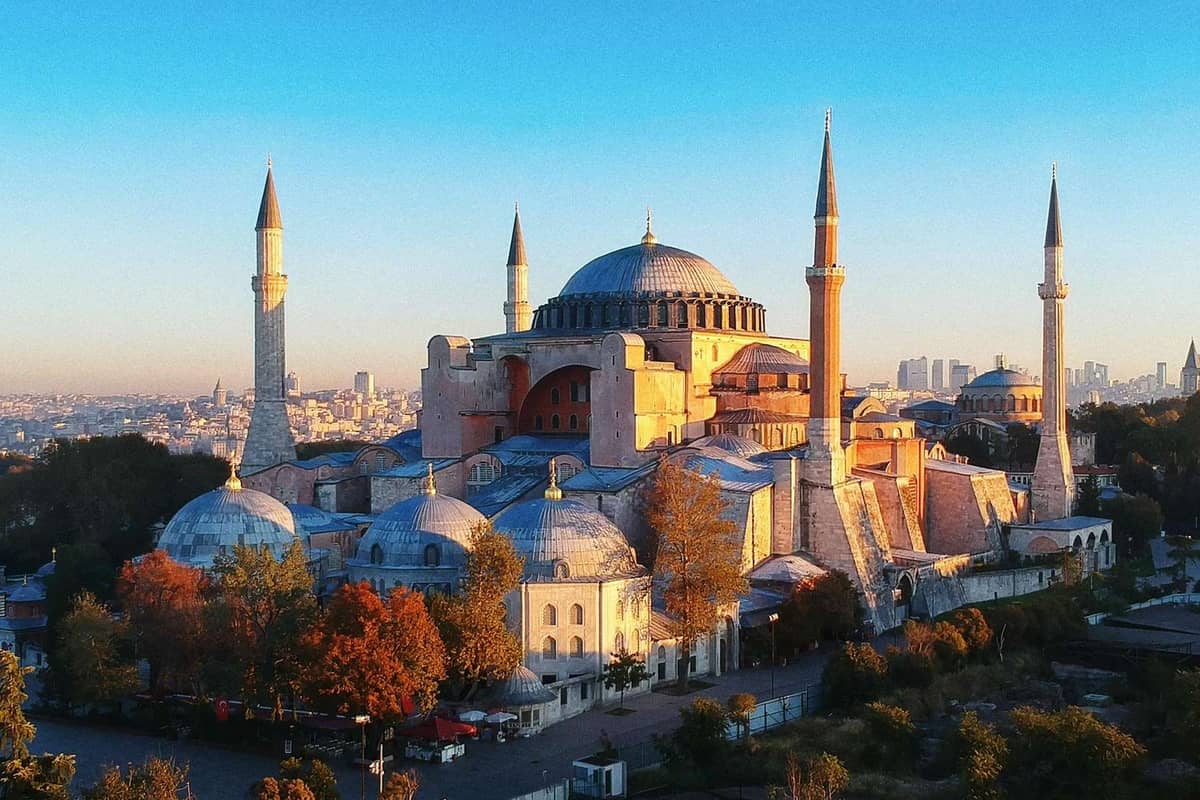
The istanbul cappadocia santorini tour meets Hagia Sophia, which began as the Great Church, so called for its size. That church was consecrated in AD 360. In the eleventh century, a papal envoy delivered an excommunication there. This act is taken as the beginning of the East-West Schism. The Rustem Pasha Mosque later took the building as inspiration.
The Blue Mosque, a landmark of the istanbul cappadocia santorini tour, gives its name to the district of Sultanahmet. It has six minarets, and its prayer hall measures 64 by 72 metres. The father of the traveller Evliya Celebi made the doors of the courtyard entrance. Evliya himself noted a hundred Qur’ans on inlaid lecterns near the mihrab.
Silence ruled the inner courtyards of Topkapi Palace, and Mehmed II wrote seclusion into a code. Low buildings spread around the courtyards, joined by galleries and passages. After a fire at the Old Palace, Hurrem, Suleiman’s wife, moved the harem here. The istanbul cappadocia santorini tour finds a museum, and its collection includes miniatures, religious relics and illuminated manuscripts.
Evliya Celebi described the Grand Bazaar in the seventeenth century, and the istanbul cappadocia santorini tour includes that market. He counted 3,000 shops, plus 300 more in the surrounding hans. A han is a large caravanserai of two or three storeys around a courtyard. Parts of the market were vaulted later, after a law against fires.
What does the Bosphorus add to the istanbul cappadocia santorini tour?
The Bosphorus adds a half-day cruise on Day 1 to the istanbul cappadocia santorini tour. Four lighthouses mark the limits of the strait. Rumeli Feneri and Anadolu Feneri stand at the northern end. Ahirkapi Feneri and Kadikoy Inciburnu Feneri close the southern end. Fener means lighthouse in Turkish.
Between those lighthouses, the strait measures 3,329 metres across at its northern mouth and 2,826 metres at its southern mouth. Its maximum width, 3,420 metres, lies between Umuryeri and Buyukdere Limani. A cruise on the istanbul cappadocia santorini tour follows a channel that tightens and widens between Europe and Asia. Istanbul lies along both banks.
The strait on the istanbul cappadocia santorini tour now has three bridges. Fatih Sultan Mehmet, the middle bridge of the three, carries eight lanes of motorway over 1,510 metres. The Yavuz Sultan Selim Bridge joins Garipce on the European side to Poyrazkoy on the Asian side. The Marmaray rail tunnel runs about 1,400 metres under the strait.
Ottoman palaces stand on or near the shores, among them Yildiz, Ciragan, Ihlamur and the Feriye Palaces. Small fishing villages grew up along the banks from Byzantine times. They came into their own in the nineteenth century. Arnavutkoy was known for strawberries, and Cengelkoy for sweet cucumbers. The istanbul cappadocia santorini tour sees these shores from the water.
Yalis are the waterside mansions that line both shores of the strait. The selamlik was the public area for men, and the haremlik the private part for women and family. Certain yalis had their own hamams, and the early ones had private docks. Foreign powers kept summer embassies at Tarabya and Buyukdere in the nineteenth century.
In Greek myth, floating rocks stood guard on both sides of the strait. These Clashing Rocks, or Symplegades, crushed any ship that tried to pass. The hero Jason slipped between them, and the rocks became fixed. The Golden Horn branches off the strait as an estuary. The istanbul cappadocia santorini tour joins a Greek tale to Turkish water.
How does the flight from Istanbul to Cappadocia fit the istanbul cappadocia santorini tour?
The istanbul cappadocia santorini tour spends the evening of Day 2 in the air. Wikivoyage gives 90 minutes for the flight from Istanbul to Nevsehir Kapadokya Airport and ten hours for the bus. So the old city keeps its whole day, and the valleys get the next one.
Nevsehir Kapadokya Airport stands in the northwest of Nevsehir, and the General Directorate of State Airports Authority runs it. Its yearly capacity is 2,000,000 passengers, as Wikipedia lists. Wikivoyage calls the airport small but adequate. Landing for the istanbul cappadocia santorini tour happens here or at the second airport of the region.
Kayseri Erkilet Airport is the second one, 70 km east of Goreme, as Wikivoyage places it. The city of Kayseri was ancient Caesarea, first called Mazaca. In the time of Strabo it was the capital of the whole country, says Wikipedia. Wikivoyage lists flights from Istanbul there too, so either airport serves the istanbul cappadocia santorini tour.
Nevsehir is the regional hub for buses and minibuses. Wikivoyage says the town made carpets and wine before tourism became its main business. It stands at 1,224 metres. Minibuses leave from one street in town for Avanos, Goreme, Kaymakli, Derinkuyu and Urgup. A full-day tour, as on Day 3, spares you those timetables.
Wikivoyage lists a bus from Istanbul to Nevsehir every second hour or so, day and night, by way of Bolu. The ride takes ten hours. For a traveller who takes it after the old city, that is a night on the road. The istanbul cappadocia santorini tour saves its night bus for Day 4 and flies this leg instead.
Goreme is the region’s main tourist base, set among fairy chimneys and rock churches, says Wikivoyage. The Nevsehir article adds that the majority of arrivals head there. Goreme is small enough to walk, and the open-air museum lies within half an hour on foot. Rose Valley needs wheels, which a day of the istanbul cappadocia santorini tour supplies.
What do the valleys and rock churches of Cappadocia add to the istanbul cappadocia santorini tour?
Here people cut homes and chapels into soft rock, and the valleys show the result. Wikivoyage says tuff made it easy to hollow out dwellings, cellars, stables and ritual spaces. The istanbul cappadocia santorini tour gives one full day to the north and one to the south.
The name is older than the churches. According to Wikipedia, its earliest record is Katpatuka, from the late sixth century BC. The inscriptions are those of Darius the Great and Xerxes I. One proposal reads it as Low Country, yet the plateau stands over 1,000 metres high. The istanbul cappadocia santorini tour reaches it on Days 3 and 4.
North Cappadocia fills Day 3 of the istanbul cappadocia santorini tour. Wikivoyage uses the word castle for large pinnacles carved into extensive homes, such as those at Uchisar. Ortahisar village is dominated by a pinnacle 90 m tall. Avanos makes pottery, and Wikivoyage sends walkers there for trails in Devrent Valley and Pasabag.
Goreme sits in a UNESCO-listed landscape, and its small churches reward a slow look. Wikivoyage names El Nazar Church, the Church of the Evil Eye, set in a fairy chimney. At Aynali Church the custodian lends a flashlight for the dim frescoes. Meskendir Valley has a church with geometric frescoes. The istanbul cappadocia santorini tour adds such quiet corners.
South Cappadocia fills Day 4 of the istanbul cappadocia santorini tour, and underground cities lie that way. Wikivoyage counts 40 sites with such cities, and more keep turning up. Kaymakli, 20 km south of Nevsehir, has four floors open. A church filled the second floor, and the third held the main living space. The fourth held storage and metal-working shops.
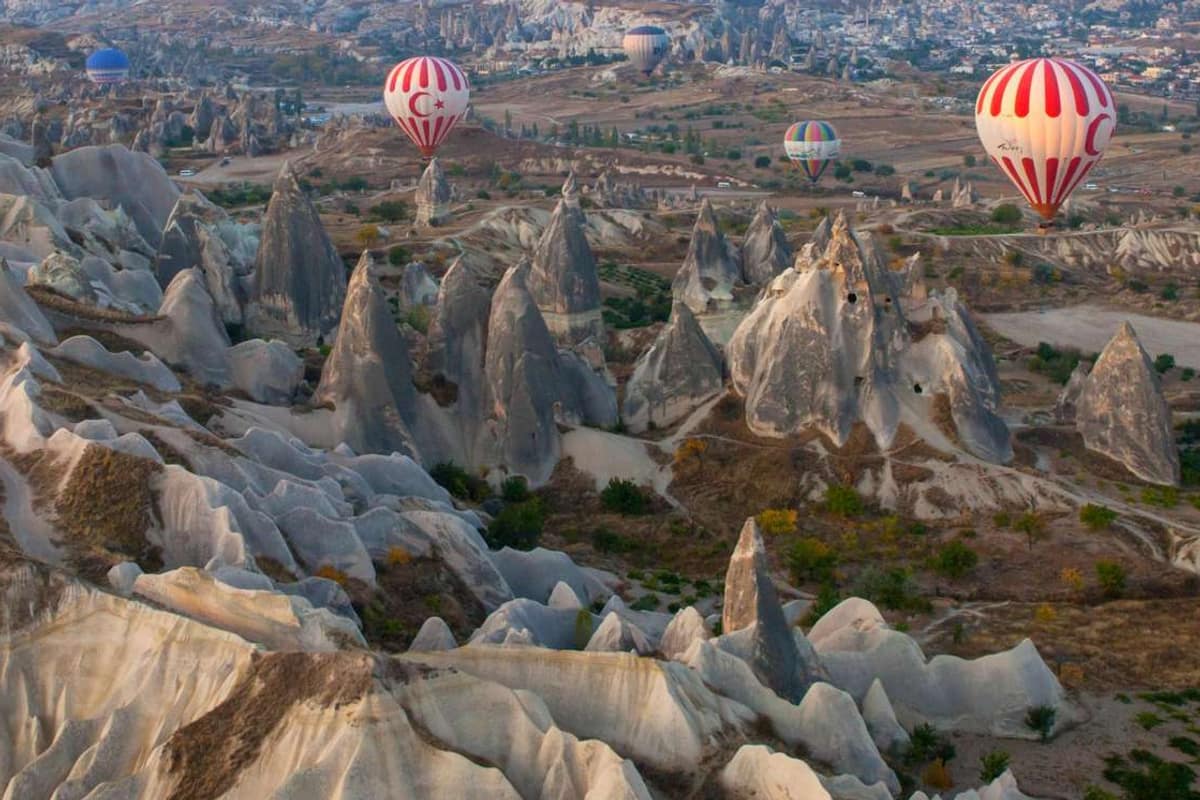
Light shapes the view. Wikivoyage says sunrise and sunset colour the rocks with slanting light, while an overcast sky turns them into grey porridge. Balloons rise at dawn, when the winds are lightest. Rose, Red and Meskendir valleys join into a five-hour hike. A touring day on the istanbul cappadocia santorini tour takes in one slice of it.
What does Pamukkale add to the istanbul cappadocia santorini tour?
Pamukkale brings a white travertine hillside to the istanbul cappadocia santorini tour, crowned by the ruins of Hierapolis. Calcite-rich springs shaped the terraces over thousands of years. UNESCO lists the hillside and the ruins as one site. The night bus from Cappadocia brings the traveller here early on day five.
Hierapolis carries a naming puzzle. The Seleucids founded the city, and its bronze coins read Hieropolis. Wikipedia notes it is unclear whether the name honoured the old temple or Hiera, the wife of Telephus. Later the spelling settled as Hierapolis, which means holy city. The istanbul cappadocia santorini tour spends day five inside that holy city.
Wikivoyage sets out the rules for the terraces. The Town Gate climb is a barefoot wade through shin-deep pools, with no other path. Alani Park, beside that gate, sits outside the ticketed area and offers a picnic spot. For anyone with restricted mobility, the page points to South Gate. The istanbul cappadocia santorini tour follows these rules.
The theatre of Hierapolis changed with each age. Under Septimius Severus the stage front rose in three storeys, carved with reliefs of myths. The stage had five doors and six niches, and marble seats replaced the old limestone ones. A seventh-century earthquake then brought the whole building down. The istanbul cappadocia santorini tour sees what remains.
The Plutonium was a small cave shrine to Pluto, inside the sacred area of the Temple of Apollo. The Hierapolis article describes a fenced entrance, steps going down and suffocating carbon dioxide. Priests sold visitors birds to test the gas. A seventh-century earthquake also shaped the Antique Pool, when a marble portico fell into the spring.
Hierapolis was never made a Roman colony, although Romanization took place. The Nymphaeum, a fountain of the second century, sent water to houses through pipes. Early Christians later walled off the view of the old temple. The istanbul cappadocia santorini tour walks a city last visited by an emperor, Valens, on campaign against Shapur II.
What does Ephesus add to the istanbul cappadocia santorini tour?
A Roman city whose coast moved away joins the istanbul cappadocia santorini tour at Ephesus. UNESCO explains that sediment pushed the shoreline from east to west. The city and its harbours moved with it. The ruins lie 4 km west of Selcuk, and day six gives them the full day.
Celsus, the man the library honours, was a Roman general born in Sardis. Wikivoyage says he rose to be consul, and he was not the Greek scholar Celsus of a century later. The interior was left in ruins, a single chamber modest beside the facade. The istanbul cappadocia santorini tour meets that facade on day six.
The Great Theatre dominates the view down Harbour Street, which leads to the silted-up harbour. Wikipedia blames forest clearing, overgrazing by goat herds, erosion and soil damage for the lost coast. It puts the sea 3 to 4 km from the site today. From the theatre, the istanbul cappadocia santorini tour sees silted ground, not a port.
One column marks the Temple of Artemis in Selcuk. Wikivoyage notes that the Romans knew the goddess as Diana, who watched over hunting, the moon, childbirth, fertility and virginity. UNESCO says her sanctuary at Ephesus existed by the second millennium BC. On the istanbul cappadocia santorini tour, the column is a marker, not a building.
The Terrace Houses were the upmarket homes above Curetes Street, fitted with marble and mosaics. Digging began there in the nineteen-sixties and goes on under a canopy, with raised walkways. The Octagon is a tomb without inscription that held a young woman’s body. The site’s main avenue suits wheelchairs and strollers, with lumpy patches near works, says Wikivoyage.
Selcuk is the town beside the ruins, and the city began on its site. UNESCO traces settlement from the seventh millennium BC at Cukurici Mound to today’s Selcuk. Its museum shows statues, pottery, glass, coins and carved sarcophagi from Ephesus, as Wikivoyage lists. Then the istanbul cappadocia santorini tour turns south on the road to Marmaris.
What do Kusadasi and the coast road to Marmaris add to the istanbul cappadocia santorini tour?
Day five of the istanbul cappadocia santorini tour ends in Kusadasi, a resort town whose name means bird island. Wikivoyage ties that name to Pigeon Island, which a 200 m causeway links to the town. Day six then follows the coast road south to Marmaris, the port for Rhodes.
The istanbul cappadocia santorini tour sleeps in a town 15 km from Ephesus, an easy trip by minibus or taxi. The resort itself is long. Wikivoyage says it sprawls along 25 km of coast, and Wikipedia counts 23 neighbourhoods in the district. Shared minibuses called dolmus run up and down that strip. Taxis also gather by the port.
The castle on Pigeon Island is restored as a museum and open in daylight hours, Wikivoyage lists. Wikipedia dates its rebuilding to the nineteenth century. A second museum, off the Davutlar road, tells how olive oil was made over 2,500 years. One night on the istanbul cappadocia santorini tour leaves little time for either.
From Kusadasi, Wikivoyage points to Selcuk for the nearest railway station, 20 km off. Regional trains run there from Denizli, the rail stop for Pamukkale, through Aydin and Camlik. Suburban trains reach Selcuk from Izmir every hour or two, the same page adds. Day five of the istanbul cappadocia santorini tour joins the same two areas by road instead.
Wikipedia calls Kusadasi a resort on the Aegean coast and Marmaris a resort on the Mediterranean coast. Wikivoyage adds that the Datca peninsula is generally taken as the boundary. Day six of the istanbul cappadocia santorini tour therefore runs from one sea to the other. Wikivoyage names the D400 as the last stretch of the road into Marmaris.
Wikivoyage describes the harbour light south of the Marmaris castle as a small tower that looks like a sentry box. Wikipedia records the westernmost habitat of Tulipa armena on the Marmaris peninsula. It grows elsewhere in eastern Turkey, Iran and Transcaucasia, at much higher altitudes. The istanbul cappadocia santorini tour reaches its last Turkish port here.
How does the ferry from Marmaris to Rhodes work on the istanbul cappadocia santorini tour?
On day seven the istanbul cappadocia santorini tour crosses to Rhodes from Marmaris. Wikivoyage describes the link as foot-passenger boats that sail from April to October. Vehicles do not travel on them, and nothing sails in winter. The sailing joins the Turkish and Greek halves of the plan.
The crossing takes one hour, Wikivoyage states. Each service sails twice a day, so a day return either way leaves six hours ashore. Only the outward leg belongs to the istanbul cappadocia santorini tour. Confirm the date on the official port page, since sailing lists change each year. Check-in in Rhodes and a day at leisure follow the landing.
The Central Port of Rhodes takes the Turkish services, Wikipedia notes, and handles international traffic only. Kolona Port, opposite and north of it, takes the boats that sail between Dodecanese islands. Wikivoyage explains that boat owners from Greek waters complete immigration and customs at Marmaris, a port of entry. The istanbul cappadocia santorini tour crosses a border by sea.
Day seven of the istanbul cappadocia santorini tour changes country, so two details need a look. Your own government’s official travel page lists entry rules and border formalities; read it before leaving home. Wikipedia lists Marmaris in UTC+3 and Rhodes in UTC+2, with UTC+3 for summer time. Check the clock on landing to see which hour the island keeps.
Wikivoyage compares the two peninsulas beyond Marmaris to the claws of a lobster. Datca, narrow and 70 km long, reaches west, while stubby Bozburun points south. In the gap between them lies the Greek island of Symi. Wikipedia calls Symi mountainous and names Datca and Bozburun as its nearest land neighbours.
Wikipedia compares the shape of Rhodes to a spearhead, with limestone as the main bedrock. It counts three national roads and 40 provincial roads on the island. Whitewashed villages such as Faliraki and Kremasti dot the land beyond. Day eight of the istanbul cappadocia santorini tour is a free day here before the flight.
What do Rhodes Old Town and the flight to Santorini add to the istanbul cappadocia santorini tour?
Rhodes Old Town gives the istanbul cappadocia santorini tour a walled medieval city for Day 7 and Day 8. Two bus stations stand just outside its wall, near the waterfront. Wikipedia places the city at the north-east tip of the island, where it forms a triangle.
In the early twentieth century a city plan removed only the Ottoman-era houses built against the walls. Rodini Park holds the Roman water supply of the ancient city along a creek gorge, Wikivoyage says. Wikivoyage describes crossing the outer wall and moat on the way in. Day 7 of the istanbul cappadocia santorini tour is free for that walk.
The Knights repelled the first Ottoman siege, and Wikipedia says that defeat halted a concurrent Ottoman invasion of Italy. Suleiman led the second siege and entered by the gate of St Anastasius. The terms let the Knights leave the city with their wealth. Day 8 leaves time for these walls before the airport transfer and the flight.
UNESCO sets Ottoman mosques and public baths beside Gothic buildings in the lower town. In the year of the last siege its population stood at five thousand. After the Knights left, churches were converted to mosques, including the Mosque of Soliman. The istanbul cappadocia santorini tour meets Ottoman architecture again here, this time inside a Gothic city.
UNESCO says the Great Hospital replaced the order’s first hospice. The order had seven tongues, UNESCO adds, and each held its own inn. The Archaeological Museum runs a wall-top walk from the Palace of the Grand Masters. Wikivoyage adds that it runs on two days a week and is not guided. That walk fits the istanbul cappadocia santorini tour.
Wikipedia gives 24 minutes for the drive from Rhodes airport, the island’s only one, to Rhodes Town. Wikivoyage notes that the walk from the Santorini airport to the centre of Fira is about 5.5 km. Wikivoyage lists both islands among those with international airports. On Day 8 the istanbul cappadocia santorini tour flies between the two.
What do Santorini, the night ferry and Athens add to the istanbul cappadocia santorini tour?
Santorini adds a buried Bronze Age town and a young volcanic island to the istanbul cappadocia santorini tour. The eruption of Thera buried Akrotiri in the sixteenth century BC, and Nea Kameni rose later inside the flooded caldera. Day 9 and Day 10 leave room for both.
Diggers found between 300 and 500 horns in the House of the Benches, almost all altered by fire. Their religious use is not yet known. The first fresco fragments, from Sector Alpha, show the head of a blue monkey and large blue birds. Day 9 of the istanbul cappadocia santorini tour can include the site.
Wikivoyage notes steam and sulphur vents along the way up Nea Kameni. Boats cross the caldera to reach it. Its neighbour Palea Kameni appeared about two thousand years ago, and the Roman writer Cassius Dio recorded the event. Nea Kameni itself kept growing into the twentieth century. That volcano stop suits the istanbul cappadocia santorini tour.
Wikivoyage calls the archipelago young, with no time yet for the sea to wear the rock into fine sand. Beaches there are generally pebbles of varying sizes, in black, white and red. Baxedes, on the north side of Thira, has black sand. Free time on Day 10 of the istanbul cappadocia santorini tour suits a swim.
Wikivoyage gives four to five hours for a fast ferry from Piraeus. A standard ferryboat needs seven to nine hours. It warns that a reservation does not always mean a place to sit. Wikivoyage Greece says boats to popular islands can sell out on holiday weekends. Check them before fixing Day 10 of the istanbul cappadocia santorini tour.
Day 11 starts in Piraeus, which grew again in the nineteenth century once Athens became the capital. The Athens urban area, which also holds Piraeus, has over 3.6 million people. Wikivoyage Greece warns against counting on a same-day ferry before a flight, so Day 11 stays free. Day 12 ends the istanbul cappadocia santorini tour with the flight home.
What else do travellers ask about the istanbul cappadocia santorini tour?
How do prayer times and church visits shape the istanbul cappadocia santorini tour?
Prayer times set the pace of every mosque stop on the istanbul cappadocia santorini tour. Wikivoyage Turkey says worshippers line up in the front rows, so visitors stay behind and keep silent. The Friday noon prayer draws the biggest crowd, so a visitor can be asked to step out. Entry reopens once the worshippers leave.
Wikivoyage Sultanahmet describes a second case, the Kariye Mosque, once the Chora Church. About fifteen minutes before prayer, visitors are sent out. A visitor who kept the ticket can return around half an hour later through the main entrance. The old-city day of the plan therefore needs a spare hour.
The rock churches of Goreme have their own pace on the istanbul cappadocia santorini tour. Wikivoyage calls the open air museum a loop of frescoed cave churches that takes two to three hours. It advises slipping in between tour groups, because the churches are tiny. Tokali Church stands 50 metres outside the compound, so keep the ticket.
The mosques of Goreme town follow the same clock. Wikivoyage says the Halil Aga Mosque, from the thirteenth century, opens only at prayer times. The Central Mosque, built in traditional style, dates from the nineteen sixties.
What does one more night in Cappadocia change on the istanbul cappadocia santorini tour?
One more night on the istanbul cappadocia santorini tour turns the two touring days into a slower stay. It opens the Pigeon Valley walk between Uchisar and Goreme. Wikivoyage describes a one-way hike of 4 km, done downhill from Uchisar. The side canyons join instead of splitting, so the chance of a dead end is lower.
Cavusin sits 5 km north of Goreme and adds rock dwellings of its own. A group of fairy chimneys marks its northern edge. The cave church of St John the Baptist closes the southern edge. The same page lists riding centres, close in number to the balloon operators. Rides for first-timers and young children exist.
Dinner can be a slow local dish. Wikivoyage names testi kebap as the town specialty, served in a clay pot that the guest breaks open. It takes an hour to cook, so restaurants need notice. Ask whether the Day 4 bus of the istanbul cappadocia santorini tour can leave one night later.
What does one more night on Santorini add to the istanbul cappadocia santorini tour?
An extra night on Santorini opens the quiet inland side on the istanbul cappadocia santorini tour. Vothonas tucks into a ravine and serves as the hub of the wine trade, says Wikivoyage. Its buildings were cut out of the ravine walls. The Santorini Wine Museum in the village is the page’s pick for studying the wine region.
Wikivoyage says pumice insulates well, because it is full of small gas bubbles. In the past, houses were built partly into the mountainside or with underground cellars. That design cools the rooms in summer and holds the warmth through winter. The pumice quarries closed in the nineteen eighties, yet the style of square white houses continues.
Panaghia Episcopi is a church for a slow evening. The Byzantine emperor Alexios I Komnenos commissioned it at the end of the eleventh century. It stands not far from the Profeta Elias Monastery. An added night also moves the overnight ferry. Ask the provider of the istanbul cappadocia santorini tour to confirm the new sailing.
How can a traveller read the ferry timetables on the istanbul cappadocia santorini tour?
The istanbul cappadocia santorini tour has two sea legs: Marmaris to Rhodes, and Santorini to Piraeus. Wikivoyage Greece notes that no single complete source for Greek ferry schedules exists, in print or online. Each company publishes its own lists online, and every departure port pins the sailings up at its booking desks.
Wikivoyage Greece says the frequency, reliability and availability of ferries depend largely on the time of year. In the winter off-season, rough seas can keep a boat tied up for days. The decision rests with the port authority. In August, the national holiday fills the boats. Popular sailings at convenient hours sell out on holiday weekends.
The plan leaves a buffer. Wikivoyage Greece advises against counting on an island ferry to reach Athens on the day a plane leaves. Its advice is to be back on the mainland a full day ahead of the flight. On the istanbul cappadocia santorini tour, the night ferry lands on Day 11. The flight home leaves on Day 12.