
A Nisyros day trip from Kos crosses by boat to a volcano island with an active crater, a harbour town and a cliff-top monastery. Browse more day trips in our list of tours in Greece.
This page covers how the day runs, the crossing, the Stefanos crater, the Lakki plain, Mandraki, Nikia, Emporios, the hot springs of Pali, Paleokastro and lunch.
What is a Nisyros day trip from Kos, and how does it work?
Taking a Nisyros day trip from Kos means a boat ride to a small volcanic island south of Kos. A bus then climbs to the crater, and free time follows in the port town of Mandraki.
Nisyros is a Dodecanese island. Its neighbours in the island chain are Kos and Tilos. In summer it gets hundreds of day visitors every day. Boats bring them in the morning. They see the crater, walk around Mandraki, and sail home in the afternoon.
A travel wiki calls Nisyros popular for day trips. A Nisyros day trip from Kos fits the crater and the town into one day.
The day follows a fixed order. Operators list a hotel transfer to Kardamena harbour, the boat in both directions and a bus to the volcano. After the crater, the group goes back to Mandraki. The boat sails back to Kardamena, and the bus drops you at your hotel.
The operator sets the order of stops for your Nisyros day trip from Kos, and it differs. Morning trips see the crater first and Mandraki second. One afternoon listing reverses this. It sails at noon and walks through Mandraki with a tour guide. Then the group rides a bus up to the volcano for 45 minutes at half past three.
The pages describe a guided excursion led by a tour guide or a tour escort. One listing states a maximum group size of 45 travellers, so the day runs as a group outing. Each Nisyros day trip from Kos therefore follows a set plan, and the free time falls in Mandraki.
You can also reach Nisyros alone on a scheduled ferry. Small local ferries link Kos with Mandraki, but sailings are limited and seasonal. You then arrange your own ride to the crater. The organised excursion puts the boat and the bus into one plan.
How long is a Nisyros day trip from Kos, and where does it start?
A Nisyros day trip from Kos lasts between eight and ten hours, which varies by operator. The boat starts from the harbour of Kardamena, a small town in the middle of the south coast of Kos. The crossing takes 45 minutes to an hour.
A Nisyros day trip from Kos has no single length. Two pages say eight hours and two say nine. Another page says more than eight hours, and one tells you to plan for about ten. A travel page counts the whole day at nine to ten hours. Only four to five of them are on Nisyros itself.
A Nisyros day trip from Kos starts early. One operator lists the boat at Kardamena harbour for half past nine, and half past ten on Sundays. A travel page says boarding falls between 8:00 and 9:30. Your voucher gives the exact time and the quay.
The return leaves the port of Mandraki in the afternoon. One operator lists half past three, and half past five on Sundays. Another page gives a return ferry at 16:00. A third page says guests reach their hotel between five and six in the evening. The afternoon listing docks back in Kardamena at half past seven.
Time on the island splits into two parts. Two pages give about 45 minutes at the crater and two hours to wander Mandraki. Then a Nisyros day trip from Kos ends with the boat back to Kardamena.
The day itself starts at your hotel when the trip includes a transfer. One page says pick-up begins at 8 am, with a time slot that depends on where you stay. Another listing makes the transfer optional and meets guests at Kardamena Bridge at half past eleven.
Other trips leave from Kos Town harbour instead of Kardamena. Your voucher names the start of your Nisyros day trip from Kos. Kardamena lies seven kilometres from Kos airport.
How does the boat crossing from Kos to Nisyros work on a Nisyros day trip from Kos?
A bus collects you at your hotel and drives to Kardamena port, in the south of Kos. A fast boat then crosses to Mandraki harbour on Nisyros in 45 minutes to one hour. That sea leg opens this Nisyros day trip from Kos.
Hotel pick-up begins the Nisyros day trip from Kos, and your voucher names the meeting point and the pick-up time. The bus drives to Kardamena, a small town about 7 kilometres from Kos airport, midway along the southern coast. Kardamena is the closest port to Nisyros. One travel site adds that boats leaving Kos Town harbour take noticeably longer.
The boat is a fast ferry. It has two decks with seats on both. Pick the lower or the upper deck and look out over the sea. One operator page puts the crossing at 45 minutes each way. Other pages quote about one hour. Either way, the sea leg of your Nisyros day trip from Kos stays short.
Boat times differ between operators. One page lists a 9:30 sailing from Kardamena, with the return leaving Mandraki at 3:30 in the afternoon. On Sundays that operator shifts both sailings later, to 10:30 in the morning and 5:30 in the afternoon. So your Nisyros day trip from Kos means a morning crossing and an afternoon return.
One travel site says the boats for the Nisyros day trip from Kos sail on fixed days, not daily. One operator lists sailings back from Mandraki on Monday, Tuesday, Thursday, Friday, Saturday and Sunday. Your voucher shows the exact day, time and quay. Wikipedia adds that ships also reach the island from Rhodes and Piraeus.
A Nisyros day trip from Kos lands at the quay in Mandraki. One independent travel site says the buses for the crater wait there. Independent travellers can take a scheduled ferry instead, but sailings are limited and seasonal. One operator page adds that the sea can be choppy at times, depending on the weather.
What is Nisyros island, and why is it called a volcano island?
Nisyros is a Dodecanese island of volcanic origin and almost round shape, set between Kos and Tilos. The volcano counts as active, yet it is not erupting, and fumaroles still sit in the craters. That makes the volcano the heart of this Nisyros day trip from Kos.
The island behind this Nisyros day trip from Kos is small. Its shape is roughly round, about 8 kilometres across, and it covers 41.6 square kilometres. The volcano reaches 698 metres. About a thousand people live there today. One operator page calls Nisyros the island of the black stones.
Wikivoyage describes Nisyros as a volcanic cone with a large collapsed caldera in the centre. Its latest eruptive event, a steam blast, came in the late nineteenth century. Deep below lies an important geothermal field, with fluid hotter than 350 degrees Celsius. Hiking trails cross its geothermal landscapes.
The volcano under any Nisyros day trip from Kos also links the two islands. The wider volcanic complex takes in Gyali, part of Kos and the sea floor that lies between the two islands. Gyali has 22 residents. Much of the island’s wealth comes from the perlite and pumice deposits on Gyali.
Greek myth tells the story with a giant. Poseidon cleaved a rock from Kos and hurled it at the fleeing giant Polybotes. The island’s ancient name was Porphyris, and the Iliad of Homer mentions the island. Visit Greece says people have lived on Nisyros continuously from prehistoric times.
Plan your Nisyros day trip from Kos for a hot, dry climate. The average yearly temperature is about 20 degrees Celsius. The etesian wind of June, July and August bends trees southwards along the east and west flanks of the volcano. Tourism is less developed here than on other Greek islands.
How did the Nisyros volcano form, and what do its craters show?
The Nisyros volcano began to grow about 160,000 years ago. Two huge eruptions later dropped its centre into a caldera. Steam then opened craters in that floor, and your Nisyros day trip from Kos leads you into one.
The oldest rocks on the island formed the peak of the first cone. Over the next 120,000 years, eruptions of lava and ash finished the cone. Geologists count three eruptive stages, each with explosive blasts and flowing lava. The rock they threw out ranged from andesite to dacite and rhyolite.
Then came the great collapse. Two huge eruptions, between 25,000 and 15,000 years ago, threw out magma, pumice and ash. The peak fell in, and the caldera was born. It is three to four kilometres wide. Each Nisyros day trip from Kos puts you on an island with a giant hollow in its middle.
The volcanic complex is larger than the island. It includes the sea floor lying between the two islands, the islet of Gyali and a corner of Kos. The boat of this Nisyros day trip from Kos therefore sails across seabed that belongs to the same volcano.
Steam made the craters. Rain and sea water meet molten magma deep below. At 400 to 500 degrees Celsius the water turns to steam, and the pressure blasts through the rock above. In historical times these hydrothermal eruptions opened about twenty craters across the caldera. A geothermal field under the island holds fluid hotter than 350 degrees Celsius.
The craters show that the volcano is alive. Four eruptions are on record, and nearly all were steam blasts. The final blast, a steam explosion, came in the late nineteenth century. Now the volcano is quiet but still active. Steam vents hiss at the craters, so any Nisyros day trip from Kos brings you close enough to hear them.
What is the Stefanos crater, and how do visitors walk into it on a Nisyros day trip from Kos?
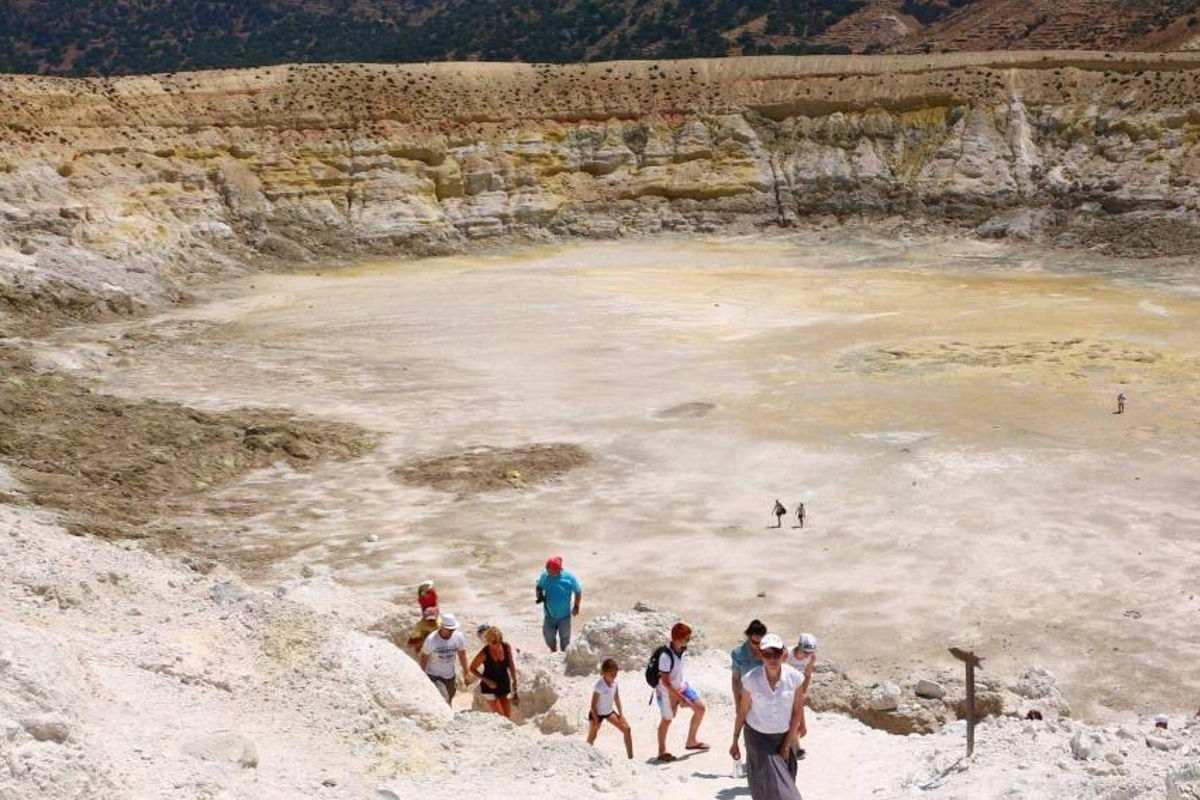
Stefanos is a steam-blasted pit on the caldera floor. It is between 260 and 330 metres across and about 27 metres deep. A coach climbs from Mandraki and a short path leads down into it on the Nisyros day trip from Kos.
Stefanos is one of the largest hydrothermal craters in the world. One page calls the floor a flat grey pan, walled by crumbling cliffs. It also belongs to a very short list of active volcanic craters that visitors can enter. Your Nisyros day trip from Kos heads first for the volcano after landing, and free time in Mandraki follows.
Every Nisyros day trip from Kos lands at Mandraki harbour, where the coaches wait on the quay. One page describes a short ride up into the caldera. A stop at a viewpoint over the crater comes before the walk. One page calls the coach up from the port the hardest part to replace on your own.
Another page says the coach parks at a car park on the rim. A single rough path drops from one corner of it. One operator page lets you choose the bus tour on arrival in Mandraki. Other pages list the bus in the day’s plan.
The path is short, and the last stretch is loose underfoot. Once down, the Nisyros day trip from Kos follows the pale, trodden ground across the floor. One page says the active ground lies on the far side. It is a five-minute flat walk from the foot of the path.
The English-speaking tour escort covers the story of the crater and its geological features. Pages give 45 minutes to an hour at the volcano for the Nisyros day trip from Kos. Walkers have another way in. A travel page rates the half-day hike from Mandraki to Nikia via the crater as a great day out.
What are the steam vents, sulphur crust and hot ground inside the Stefanos crater?
A Nisyros day trip from Kos leads onto a crater floor with hissing vents, yellow sulphur and warm soil. A travel site calls Stefanos the only place in Greece to walk along an active volcano’s crater.
The vents are called fumaroles, holes in the crater floor that give off hot air and gas. Wikipedia calls the volcano active, though it is not erupting now, and lists fumaroles at the craters. Pages for the Nisyros day trip from Kos list hissing vents and warmth under your feet among the sights.
The vents on the Nisyros day trip from Kos come with warnings. One page says the thermal air from the holes feels hot enough to melt your shoe soles. Another says you can hear the fumaroles hiss from the far side of the floor when you stand still.
A path leads down to a yellow, sulphur-stained floor on the Nisyros day trip from Kos. Trip pages describe yellow and white crusted patches around the vents. The crust is thin and hotter than it looks, and one page warns it can give way under a boot. Visitors stay on the pale, well-trodden ground and follow the yellow lines.
The smell comes from hydrogen sulphide, which everyone compares to rotten eggs. A trip page says the nose stops noticing it within ten minutes, and it returns when the wind shifts. A tourism page says the scent covers the whole area up to Nikia. A Nisyros day trip from Kos therefore smells of sulphur beyond the crater floor.
The heat behind the Nisyros day trip from Kos comes from far below the ground. Wikipedia counts Nisyros among the important geothermal fields of Greece, with fluid temperatures over 350 degrees Celsius. A Greek tourism portal says superheated steam under the island causes the explosions that made the craters. The latest steam explosion came in the late nineteenth century.
What are the Lakki plain and the Polyvotis crater, and which other craters lie beside Stefanos?
Lakki is the flat floor of the caldera, and the hydrothermal craters sit on it. One page says everyone on the Nisyros day trip from Kos who visits the crater enters the Lakki plain. Polyvotis is a crater there, with Alexandros, Logothetis and a small Stefanos close by.
The Nisyros day trip from Kos reaches Stefanos, at the far end of a great depression named Rammos and Lakki. The depression lies just east of the centre of the island. Its sides are steep, and its bottom is about 100 metres above sea level.
The plain has a violent past. An eruption in the late nineteenth century covered the floor of Rammos in ash and destroyed the fruit gardens there. A later three-day eruption filled the bottom of Lakki and Rammos with a lake of hot saline water.
Today plants thrive on soil formed from the caldera’s volcanic products. The Nisyros day trip from Kos visits a volcano that one portal calls the Aegean’s only green active one.
The two Polyvotis craters carry the name of the giant Polybotes from Greek myth. Visit Greece gives Polyvotis a diameter of 260 metres. The newest craters and the bulk of them lie in the Lofos area, on a dome of volcanic rock. Tour pages for the Nisyros day trip from Kos name only Stefanos as the crater stop.
- Small Stefanos lies next to the large crater that the Nisyros day trip from Kos visits.
- Alexandros is an explosive vent just beyond Stefanos.
- Megalos Polyvotis and Mikros Polyvotis are the large and small Polyvotis.
- Logothetis lies in the Lofos area, and one page also lists Achilles.
One Greek tourism portal counts twenty craters under 500 metres wide in this part of the caldera floor. Ten are well preserved, and each has its own name. A travel page says Alexandros and Polyvotis lie a short distance from Stefanos. Trails connect them, and anyone who wants to see them all can follow those trails.
What is Mandraki, the main town and port of Nisyros?
Mandraki is the capital, the largest settlement and the main port of Nisyros. Boats from Kos tie up here. Every Nisyros day trip from Kos arrives and leaves here, in this white town of 791 residents.
Mandraki sits in the north-west of Nisyros, on the coast. Its name means harbour. Yet the old town lies in a ravine east of the castle rock, hidden from anyone at sea. Hotels and apartments stand here too, close to the port, and the village is within walking distance of the dock.
Wikipedia says ships reach Mandraki from Piraeus, Rhodes and Kos. Wikivoyage lists a car and motorcycle rental at the port, an occasional bus and about two taxis. One page says the coaches for the crater wait on the quay. The bus ride starts here, so the quay is the first stop of your Nisyros day trip from Kos.
Wikivoyage says the island returns to a calm atmosphere once the day boats leave. Each Nisyros day trip from Kos therefore meets the town in its busy hours. The municipality counts 1,048 residents, and 791 of them live in Mandraki. The town stands by the site of the Greek and medieval capitals.
The streets show white or coloured houses of two floors with wooden balconies. According to the national tourism organisation, builders used volcanic rock for the houses and pumice stone as insulation. The squares have pebbled floors, and the Square of the Dolphins is named as the typical one.
Plateia tis Ilikiomenis, the old lady’s square, is where visitors and residents meet. A tour page suggests coffee in the shade of the big ficus tree. Operators list free time to walk these lanes during your Nisyros day trip from Kos. The village honours Agios Nikitas, the protector saint of the island, on 21 June.
What are the Knights’ castle and the old streets above Mandraki?
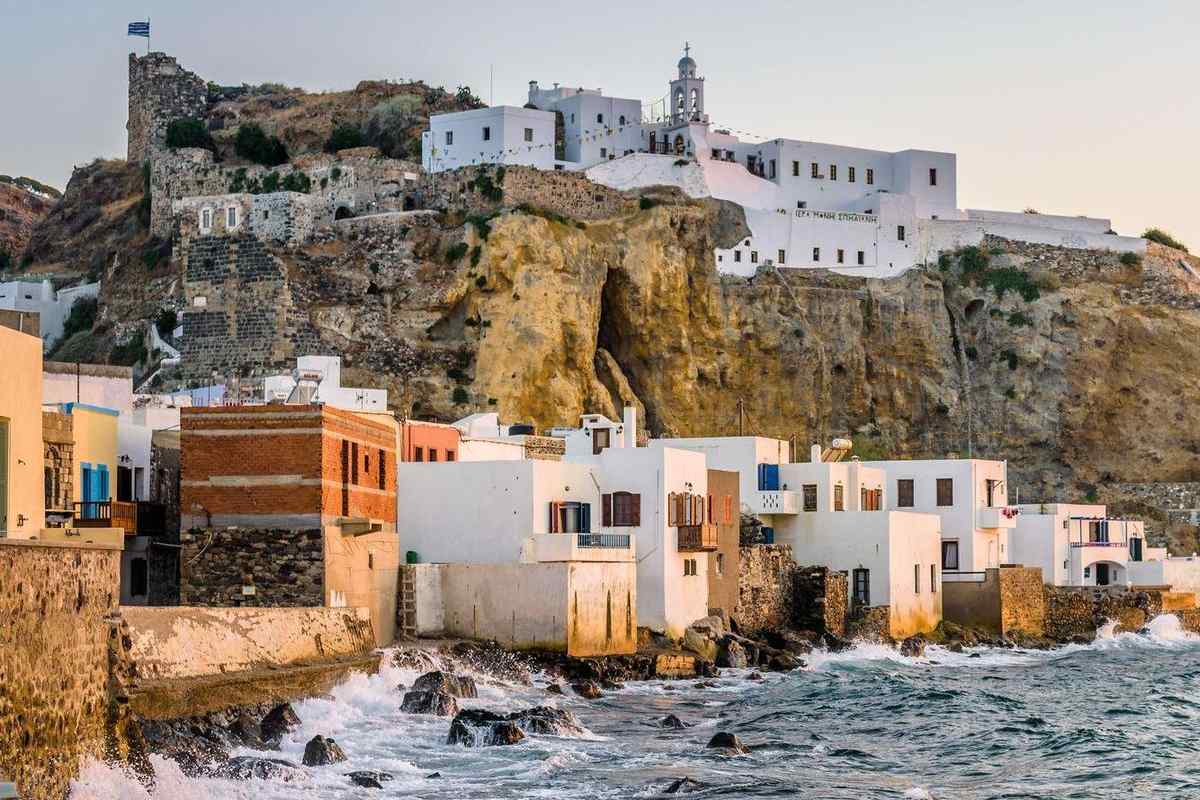
A castle of the Knights Hospitaller crowns a rock 150 metres above sea level in Mandraki. Sources date it to the early fourteenth century, and its walls still carry coats of arms. A short climb through the old lanes fits inside the Nisyros day trip from Kos.
The Knights of St John took Rhodes early in the fourteenth century, and Nisyros became their possession soon after. The island was small, so the order gave it to one knight to rule on its behalf. Wikipedia says the Genoese lords of the island allowed the Knights Hospitaller to settle, and they built the crusader castle.
The walls use square stones and hard plaster, and long, narrow battlements still stand. Visit Greece says the Grand Masters’ coats of arms are visible on the walls. A history page names Milly, Orsini and d’Aubusson, who led the order in the fifteenth century.
Towers and walls guard only the eastern, land side. The sea cliffs were high enough to stop an attack. That history page says the rock was fortified mainly in the second half of the fifteenth century. Sources therefore differ on the first building date. On Kos, the same order left the castle of Neratzia, which dominates the port.
A stepped alley climbs the rock from the main lane of the town. One page says the climb takes five to ten minutes and is mostly shaded. Reach the top terrace for a wide view over the harbour. With two or three hours of free time, your Nisyros day trip from Kos leaves room for it.
Operator pages on the Nisyros day trip from Kos name narrow streets, white houses, coloured doors and little chapels. Another page names the old mill, the dome of Panagia Potamitissa and Kazarma, the former Italian Residency. A third says the lanes photograph well late in the day, on the walk back to the boat.
What is the Panagia Spiliani monastery, and why does a Nisyros day trip from Kos stop there?
Panagia Spiliani is the cave monastery of the Virgin Mary, set on a steep volcanic rock above Mandraki. A Nisyros day trip from Kos stops there because it is the chief place of pilgrimage on the island. It also gives a wide view over the town.
Operators describing a Nisyros day trip from Kos call this stop Panagia Spiliani, the Virgin Mary of the Cave. The church stands in a natural cavity on top of a hill northwest of Mandraki. The cave is divided into two churches.
The icon is what pilgrims climb for. It is double-faced, with the Virgin Mary and the Infant on one side and Saint Nicholas on the back. A scholarly page dates it to the last quarter of the fourteenth century.
Tradition says a local farmer found the icon in a cave near the hot springs of Mandraki. The next day it was missing. Locals later found it in a cave on a rock 30 m high, and the monastery stands above that cave. A second legend says regretful pirates founded the place and became its first monks.
The monastery sits inside the free time in town. One Nisyros day trip from Kos gives about two hours in Mandraki for walking, the monastery and lunch. Another gives about three hours. One tour page calls the visit optional, so plan the hours on the quay.
The monastery stands 130 steps up from town. One page puts the climb at five to ten minutes, with shade on much of the way. That climb fits inside a Nisyros day trip from Kos. From the terrace at the top, the harbour spreads below. Dress for a working monastery, with shoulders and knees covered.
The Dormition of the Virgin Mary is the main day of the monastery. The festival lasts nine days, from 6 to 15 August. On 15 August a procession carries the icon through the island. August falls inside the season of a Nisyros day trip from Kos, April to October on one tour page.
What do the museums of Nisyros show, from the Archaeological Museum to the Volcanological Museum?
The museums of Nisyros stand in two villages. Mandraki holds the Archaeological, Folklore and Ecclesiastical museums, and Nikia holds the Volcanological Museum. Visitors taking a Nisyros day trip from Kos can walk to the Mandraki museums, because the village is small.
Mandraki, where the free hours of a Nisyros day trip from Kos pass, holds the Archaeological Museum beside Heroes Square. A building donated by the Giannidis brothers houses it. The collection holds vases, tombstones, sculptures and architectural parts, chiefly from the Hellenistic and Roman periods. Behind the Town Hall, an outdoor collection of ancient objects adds more.
Another account lists finds from a prehistoric settlement and a cemetery on Gyali, dating to the final Neolithic period. It adds Archaic, Classical and Hellenistic finds, and objects of late ancient Christianity and the Byzantine and post-Byzantine eras.
The Folklore Museum lies on the road that leads up to the monastery. It shows traditional costumes, large wooden vessels, farm and fishing tools, old typewriters, kitchen utensils and photographs. The Ecclesiastical Museum sits in the monastery itself, with chalices, incense items and old gospels from the nineteenth century.
The Volcanological Museum in Nikia explains the volcano that a Nisyros day trip from Kos walks into. Nikia is the village nearest the crater. The museum sits in an old school with a view over the caldera. It opened in June of the first decade of this century.
Six sections run from how volcanoes form to the volcano of Nisyros and the volcanoes of Greece. Inside, you find rock samples, maps, charts, volcano models, photographs and three-dimensional animated images, plus experimental devices for young visitors. Sources disagree on the opening days, so confirm them when you plan your Nisyros day trip from Kos.
What is the village of Nikia, and what do its views add to a Nisyros day trip from Kos?
Nikia is a small village on the caldera rim, roughly 400 metres up. Its panoramic crater view adds a high, wide look at the volcano to your Nisyros day trip from Kos.
Nikia lies roughly thirteen kilometres from Mandraki, the port where every Nisyros day trip from Kos lands. English Wikipedia lists 61 residents, so the village is small.
One side of the village faces the Aegean, and the other side faces the craters of the volcano. Wikivoyage names a viewpoint in Nikia that looks down into the crater valley. It counts one square and two restaurants in the village.
All the lanes of Nikia end at the central square, called Porta. A local craftsman, Paschalis Paschalakis, made the pebble mosaic on its floor. The church, the old town hall and a neoclassical café stand around the square. Its far side looks out to the sea.
The houses are painted white and have single-pitched tile roofs, coloured doors and pebbled courtyards. The white walls look very different from the yellow crater floor. Here the Nisyros day trip from Kos gains a second picture.
The remains of a knights’ castle crown the top of the village. From there you can see the nearby islands and the volcano. That makes Nikia a high stop for any Nisyros day trip from Kos with the village on its list.
Operators run two kinds of Nisyros day trip from Kos. One lists the crater by bus, then free time in Mandraki. The other lists lunch in Mandraki, then a bus transfer to Nikia with a forty-five-minute volcano visit.
Wikivoyage calls the walk from Mandraki to Nikia through the crater a half day’s hike. It lists the boat back to Kos at 3:30 pm. It also says a night on the island is worth it. That suits walkers who want a longer stay than the Nisyros day trip from Kos allows.
What is Emporios, and why does the village sit on the rim of the caldera?
Emporios is a small village, 8 kilometres from Mandraki, on the caldera rim. It stays out of sight from the sea, which helped it flourish in the age of piracy. It lies off the route taken by the Nisyros day trip from Kos.
Greek Wikipedia explains the choice of site. Being unseen from the sea, the village flourished in the age of piracy. The builders made it look like a castle, with houses close together, narrow streets and arches.
The houses are small, smaller than those of Mandraki, and their flat roofs gather rainwater for cisterns. The slope is steep, so the streets climb in steps and the houses stand in tiers.
The ruins of a knights’ castle stand on the hill above the village. The Knights of Saint John ruled the island from the fourteenth century. They built it later, where an older Byzantine fortress had stood.
Inside the castle stands the Byzantine church of Taxiarch Michael. One source dates it to the thirteenth century and notes its carved wooden icon screen and wall paintings. A tourism site calls the view from the castle hill spectacular.
A cave near the village is warmer than the air outside because of the island’s hydrothermal activity. Operator pages use the same word for the Stefanos crater, which the Nisyros day trip from Kos walks into.
In the early twentieth century Emporios was a thriving village with shops. After an earthquake in the nineteen-thirties, its people started to leave. Greek Wikipedia lists 27 residents in the last census it names, mainly farmers and herders.
Operator pages for the Nisyros day trip from Kos list the crater, Mandraki and, on one tour, Nikia. None of them lists Emporios. One travel site points to the scheduled ferry for the caldera rim villages. It suits a slow day or a night on the island.
Wikivoyage says Nikia and Emporios have one or two restaurants each. It adds that the tavern in Emporios has a great view of the crater valley. Lunch on the Nisyros day trip from Kos happens in Mandraki, so that tavern belongs to a longer stay.
Which beaches and swim stops lie around Nisyros?
A Nisyros day trip from Kos lands you in Mandraki. The closest beach to the port is Hochlaki, a shore of round black pebbles. Sandy shores lie farther along the northeastern coast, at Pali, Katsouni and Lies.
Hochlaki is the shore beside the town where every Nisyros day trip from Kos lands. The name comes from the pebbles that mark both the shore and the sea bed. The beach stands close to the Panagia Spiliani monastery. One travel page warns that the huge dark stones make walking difficult.
Gialiskari lies two kilometres north of Mandraki, on the road to Pali. That puts it close to the port of a Nisyros day trip from Kos. Its sand is coarse and dark, although pumice mining once turned the coast white. Katsouni, the largest beach on the island, lies between Pali and Lies.
Operator pages list the crater, Mandraki and the monastery. None names a beach stop within the Nisyros day trip from Kos. Two to three hours of free time in town are the window for a swim. The nearest shore is Hochlaki. Take water and snacks, because beaches here are mostly not organised.
Pali has the long family beach. It lies four kilometres east of Mandraki, a long stretch of sand sprinkled with dark pebbles. Tamarisk trees give natural shade, and tavernas stand on the sand. Pali lies beyond the town stop of a Nisyros day trip from Kos.
Katsouni has sand, small pebbles and trees that shade it for free. Lies stretches for over a mile, with small coves along its shore. Pachia Ammos means thick sand, and a steep path over the hills leads down to it. The islet of Gyali, north of Mandraki, is called the island of pumice stone. A boat from Nisyros reaches it.
What are the hot springs of Pali, and are they part of a Nisyros day trip from Kos?
Hot springs lie near the fishing village of Pali on the northeastern coast. No operator itinerary lists them as a stop on the Nisyros day trip from Kos. Pali’s springs are not part of the standard day, which runs between the crater, Mandraki and the monastery.
Pali is a small fishing village. It lies four kilometres east of Mandraki, the quay at which the Nisyros day trip from Kos lands. The Thermiani spring lies 800 metres east of the village, next to the chapel of Panagia Thermiani. Roman baths worked there, and the water is a mild 33 degrees Celsius.
A local tourism page says an inscription found at the spot ties the spring to Hippocrates, the father of medicine. Outside Pali, at a place called Limni, the ruins of Roman baths sit inside a rock. An infirmary and an Asclepion stood there.
Opposite the spring, beside the sea, stand the Pantelidis baths. The doctor Hippocrates Pantelidis built them in three phases, finishing in the early twentieth century. At their peak they had up to 300 beds. Three ships moored in the port of Pali every week to bring guests.
After the death of the founder, the baths emptied. The imposing listed buildings fell into disrepair, and a later restoration by his grandson was never finished. A Nisyros day trip from Kos has no stop at these ruins. The boats from Kos tie up in Mandraki.
Hot water gushes from the ground at places across Nisyros, at 30 to 60 degrees Celsius. Loutra, about a kilometre from Mandraki, holds the municipal thermal baths, built in three phases. Guests came from the Dodecanese, Asia Minor and Egypt. Of all the springs, Loutra lies nearest to the harbour of a Nisyros day trip from Kos.
Avlaki, in Nikia, has water that reaches 60 degrees. A trip to Pali needs its own transport. Wikivoyage says the island has one road, an occasional bus and about two taxis. It also suggests staying a night, because the island turns calm again after the afternoon boats leave. A Nisyros day trip from Kos cannot offer that.
What are the ancient walls of Paleokastro, and what do they tell about Nisyros in antiquity?
Paleokastro is the ancient acropolis on the hill above Mandraki, ringed by walls of black volcanic stone. The walls show Nisyros as a defended city. Your Nisyros day trip from Kos lands in the town below this hill.
The date depends on the source. Wikipedia gives the fifth century BC. An Aegean islands portal dates the acropolis to the sixth to fourth centuries BC. An inscription on the north gate belongs to the fourth century BC. Either way, ancient walls rise above the town that every Nisyros day trip from Kos reaches by boat.
Large blocks of black volcanic stone make up the wall. One source gives the average width as 3.50 to 3.80 metres, and stones reach 3.5 tons. Six rectangular towers still stand along the southern stretch, and two along the eastern one. It was built for war, above the harbour used by any Nisyros day trip from Kos.
The only surviving gate faces southeast. It is 2.10 metres wide and still stands intact, covered by stone plinths three metres long. An inscription on the north gate records how wide the open ground outside the walls had to stay. That ground had to stay free for defence.
The wall was one part of a wider plan. The portal says towers and lookout posts on Nisyros and its islets warned of danger with smoke or fire. A steep rocky shore on the west and north of the hill gave natural protection. Your Nisyros day trip from Kos meets a town that planned its defence.
Writers add a little more. Wikipedia says the Iliad mentions the island, and that its ancient name was Porphyris. So Nisyros has a long written past, well before any tour boat arrived.
An early Christian basilica was built inside the wall. The hill looks over the islet of Gyali. Visit Greece lists the climb to Paleokastro on its Mandraki walk. The tour pages list the crater, Mandraki and the monastery, and none names the hill. Any visit falls in the free time of a Nisyros day trip from Kos.
Where is lunch on a Nisyros day trip from Kos, and what food does Nisyros offer?
The boat docks in Mandraki, the lunch stop for your Nisyros day trip from Kos. Free time follows the crater visit. Tour pages name tavernas and local restaurants. Nisyros adds chickpea fritters, goat with rice, almond soumada and island cheeses.
Operators build lunch time into the Nisyros day trip from Kos itself. One tour page gives two hours in Mandraki for the streets, the monastery and a meal at local eateries. Another operator gives three hours in the town.
One operator names the square Plateia tis Ilikiomenis, under a big ficus tree, for coffee. A traveller review says a sit-down lunch eats into the town time, so the writer packed snacks. Wikivoyage says Mandraki has plenty of restaurants, so the Nisyros day trip from Kos leaves both choices open.
Start with the drinks. Soumada is the traditional refreshment of the island, a non-alcoholic drink with almond flavour. A Greek farms portal says it is made from bitter almond. Visit Greece says you can taste soumada or kanelada, a cinnamon drink, on that square. Koukouzina is a spirit distilled from figs and grapes.
Mandraki menus carry dishes from goat, lamb, pork and chickpeas. Kapamas is goat stuffed with rice. Bogana is lamb slow-cooked with potatoes and plenty of garlic. Boukounies is pork cooked in its own fat. Capers go into the salads, a taste to remember from your Nisyros day trip from Kos.
Chickpea fritters go by pithia in one source and revithokeftedes in another. Kopanisti and sakouliasti, a spread, are island cheeses, and trygias is goat cheese dipped in red wine. For sweets, try halva with almonds and pastelaries, which are figs stuffed with almond slivers and sesame.
Watch the clock. One operator timetable lists the return boat from Mandraki at 15:30. On Sundays it leaves at 17:30. Plan lunch to end before that boat leaves, whichever Nisyros day trip from Kos you pick.
What else do travellers ask about a Nisyros day trip from Kos?
Which months suit the Nisyros day trip from Kos, and how hot is the crater?
One travel page rates the months. Late spring to mid-June gives a bearable crater, a calmer sea and boats that are not full. September to early October brings cooler ground, a warm sea and thinner crowds. Sailings reduce through October.
The same page gives the excursion season as late spring to October. It lists no excursion boats in winter, only scheduled ferries. So the Nisyros day trip from Kos pauses between November and April.
July and August are harder. The page calls the midday crater floor punishing: an unshaded bowl with reflective walls, hotter than the coast. It advises reaching the rim before midday and doing the crater first. Visitors are told to bring more water than they expect to need.
Which shoes, clothes and bag suit the crater path on the Nisyros day trip from Kos?
Closed shoes come first. One listing asks for sturdy footwear, such as trainers, and calls sandals and flip-flops unsuitable on the uneven ground. A travel page describes loose grey grit over warm ground, with sharp crusted edges. It says sandals send you back at the bottom of the path.
Two listings name sun protection: a hat, sunglasses, sunscreen and a bottle of water. One adds a small backpack and a light jacket, since the weather can shift during the day.
One boat listing does not let you carry food or drinks aboard and sells drinks at its bar. Comfortable clothing suits the Nisyros day trip from Kos, which fills the whole day.
How strong is the sulphur smell on the Nisyros day trip from Kos, and who suits the walk down?
One listing says the sulphur smell can be unpleasant near the crater. Another page has visitors leaving the volcano with the smell of hydrogen sulphide still on their skin. A third calls it a really bad smell. It asks pregnant guests and guests with heart problems to avoid the tour.
The pages differ on who suits the walk down. One calls the Nisyros day trip from Kos an educational outing for children. Another does not advise young children to go to the bottom.
A third asks for moderate fitness, and a fourth does not recommend the tour for walking difficulties. A fifth sends guests with a respiratory condition to the rim.
Which languages and hotel pick-ups come with the Nisyros day trip from Kos, and how crowded is it?
Listings name English for the tour. One lists a tour assistant who speaks English. Another lists a bilingual tour guide in English and German, with no German-speaking tour guide on Fridays. Two pages leave out the Kefalos area for hotel pick-up. Another tells guests whose hotel is not listed to go to the nearest listed hotel.
The exact pick-up place and time arrive from the operator the day before. If you make your own way, arrive 15 minutes early. The crater fills and empties in waves, a travel page says, because the boats arrive together. A travel page rates Tuesday and Wednesday sailings of this Nisyros day trip from Kos as quieter than weekend ones.
What does a windy day mean for the boat on the Nisyros day trip from Kos?
The crossing on the Nisyros day trip from Kos runs south into open water. So the meltemi, the summer north wind, matters. It builds through the afternoon and peaks in July and August. One travel page calls it the usual reason a volcano trip is cancelled. It says operators decide the evening before or at dawn.
Two listings tie the length and route of the day to the weather. One offers a new date when bad weather cancels it. Another can move the trip to the next day. A third says stops and times can differ slightly. Book early in your holiday, because a cancelled trip on your last full day cannot be moved.