
A Pamukkale from Antalya trip starts on the Mediterranean coast in the morning and runs north across the Taurus Mountains to the white terraces and the ruined spa city of Hierapolis in the province of Denizli. The day is long and ends back in Antalya. Read the plan below, then step outside it to the tours in Greece for the Greek side of a wider journey.
This page covers how a Pamukkale from Antalya trip runs, how long it lasts and when it leaves, what the road across the mountains shows, what the white terraces show, what the ancient city of Hierapolis adds, the kinds of trip that exist, and the questions travellers ask about the kit, the season, the pools and slow walkers.
What is a Pamukkale from Antalya trip, and how does it run?
A Pamukkale from Antalya trip is a full-day excursion. It leaves Antalya in the early morning and drives north to Denizli Province. It visits the white travertine terraces and explores the ruins of ancient Hierapolis. It returns to Antalya the same evening.
A Pamukkale from Antalya trip is a day trip. The whole journey fits into one day, and you return to Antalya for the night. Wikipedia places Pamukkale in southwestern Turkey, in Denizli Province. The ruins of the Greek city of Hierapolis crown the travertine formation.
Operator pages for a Pamukkale from Antalya trip start with a pickup in Antalya. Five pages name a hotel pickup. One page adds the airport and the cruise ship as other meeting places. Another names the Kundu and Lara hotel area. Two pages describe an air-conditioned vehicle for the road.
The drive north on a Pamukkale from Antalya trip takes about three hours on one page and four on another. One page lists a comfort break and a stop at a shop for local products. Another lists a breakfast stop early on the road, then a lunch break in Denizli.
The order of stops differs from page to page. A Pamukkale from Antalya trip does not run one fixed way. One page lists the terraces, then the pool, then Hierapolis, with lunch during the Hierapolis visit. Another lists lunch on arrival, then the terraces, then Hierapolis. A third puts Hierapolis before the terraces.
A tour enters the site at its upper end. Wikivoyage says tour buses go to the South Gate, which leads straight into Hierapolis. A travel blog says you walk through Hierapolis to reach the travertines. An operator page has the group descend the ridge afterwards.
A Pamukkale from Antalya trip has three parts: the road north, the time on the site and the road back. Wikivoyage says the travertines and Hierapolis share one area with three gates. A travel blog adds a museum that explains the excavation, and one operator page names it among its stops.
A tour guide leads the group on a Pamukkale from Antalya trip. Two pages say the tour guide speaks English. One page has the group meet the tour guide again at the pool complex. The vehicle then takes the road back to Antalya.
How long is a Pamukkale from Antalya trip, and when does it leave?
A Pamukkale from Antalya trip lasts about 11 to 12 hours on four operator pages. Pickup in Antalya runs from 6:15 to 7:30 in the morning. The drive north takes about three to four hours each way.
The departure hour differs by page. One page sets the pickup at 6:15, another at 6:30, a third at 7:00 and a fourth at 7:30. The 6:15 page adds that pickup times vary by hotel area. A Pamukkale from Antalya trip does not leave everyone at the same minute.
A transport page puts Pamukkale about 240 kilometres from Antalya, almost three hours by car. A booking page gives about 300 kilometres. A travel blog puts the drive between 3 and 3.5 hours. Wikipedia and Wikivoyage both place Denizli, the nearest town, 20 kilometres from Pamukkale.
The page with the 11-hour day lists three hours each way. Six hours of that day are on the road. The 6:15 page runs to a drop-off at 8:00 in the evening. That is longer than the 12-hour pages, so read the length as a range.
Time at the site is shorter than the road. A booking page gives the group three hours for Hierapolis and the thermal water on a Pamukkale from Antalya trip. Another page lists three hours at Pamukkale and one hour at Hierapolis. One page adds an optional workshop stop of 30 minutes, and another mentions local workshops.
The return of a Pamukkale from Antalya trip starts at different hours on different pages. One page starts the drive back at 4:00 in the afternoon. It lists the hotel drop-off at 8:00 in the evening. Another starts the return at 6:30 in the evening. The first page notes that traffic and season change the arrival time.
One page says the tour runs all year round, and another says it runs daily. Wikivoyage gives the daily hours of the site as 8:00 until half past eight in the evening. It opens the South Gate at 6:30 in summer.
A travel blog gives other opening hours for the site. The operator’s own timetable therefore sets the real day of a Pamukkale from Antalya trip.
What does the road show on a Pamukkale from Antalya trip?
The road on a Pamukkale from Antalya trip leaves the coast and climbs through the Taurus Mountains. It crosses high country and falls to the valley of Denizli. Wikipedia says Antalya has high mountains in all directions inland.
The Taurus Mountains flank Antalya, which stands on the southwest coast of Anatolia, as Wikipedia states it. Wikivoyage calls the city hemmed in by mountains, with difficult routes inland. Wikipedia adds that 77.8 percent of the province is mountainous and 10.2 percent is plain. A Pamukkale from Antalya trip has to cross that high ground.
A Pamukkale from Antalya trip passes through the Bey Mountains. Korkuteli lies there. Wikipedia places it 56 kilometres north-west of the city of Antalya. The tourism ministry’s page on these mountains calls them the western part of the Taurus. A travel blog names Korkuteli, Acipayam and Denizli as the towns on the main road north.
Next on a Pamukkale from Antalya trip comes Acipayam. Wikipedia places it in high country between the Aegean and Mediterranean regions. It describes a plain watered by two reservoirs and noted for melons and watermelons. Wikipedia gives Antalya an elevation of 30 metres. The Denizli tourism directorate puts Acipayam at 950 metres.
Denizli lies lower. The same directorate gives the city 428 metres. Wikipedia places Pamukkale in the River Menderes valley. So the last stretch of a Pamukkale from Antalya trip runs down into that valley.
The province around it is a mix of ground. Wikipedia counts 47 percent of Denizli Province as mountains and 25 percent as high plateau and tableland. The directorate lists low and high meadows, plateaus and mountains.
Wikipedia names limestone as the rock beneath the Taurus Mountains. On the drive back, an operator page says, a Pamukkale from Antalya trip passes forest views from the bus. A travel blog calls the road scenic all the time, with ample stops for fuel, food, picnics and rest. Operator pages place rest stops and meal breaks inside the day.
One page adds a photo stop at Lake Salda, a crater lake in Burdur Province. Wikipedia counts it among the deepest lakes in Turkey and gives its surface as 1,316 metres above sea level.
What do the white terraces show on a Pamukkale from Antalya trip?
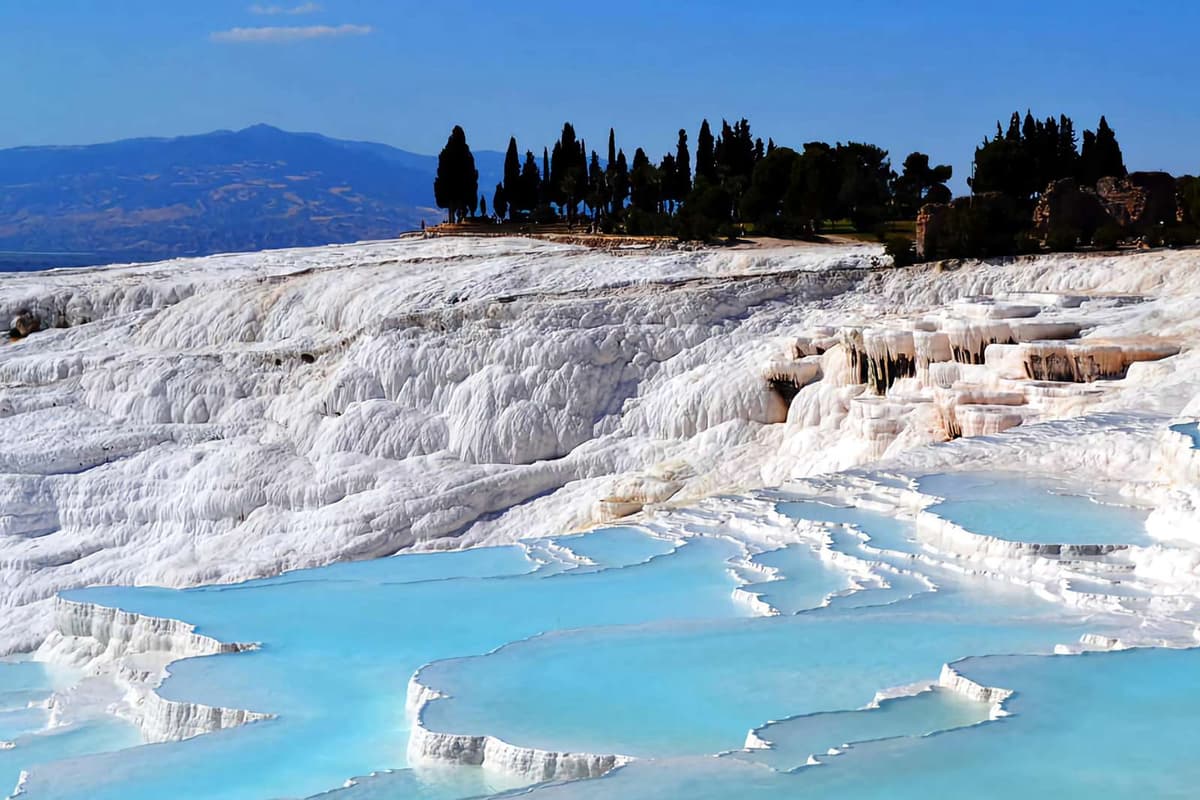
The white terraces show a hillside of travertine, a rock built by hot spring water. Each step holds a pool. A Pamukkale from Antalya trip reaches them in Denizli Province. Their Turkish name means “cotton castle”, as Wikipedia states it.
NASA describes white calcite terraces and rimstone pools. It traces the name to the bright white rocks. Wikipedia agrees: the name refers to the white limestone that calcite-rich springs shaped over the ages. One operator page says the whiteness on a Pamukkale from Antalya trip can first look like snow. Up close it proves to be rock.
Wikipedia gives the travertine formation about 2,700 metres in length, 600 metres in width and 160 metres in height. UNESCO says the springs rise from a cliff close to 200 metres high over the plain. It speaks of mineral forests, petrified waterfalls and terraced basins. A Pamukkale from Antalya trip meets a hillside of that scale.
Hot water first leaches calcium and other minerals from the limestone bedrock, says NASA. Wikipedia lists 17 springs in the area, and their water runs at 35 to 100 degrees Celsius. Carbon dioxide leaves the water once it reaches the surface, and calcium carbonate stays behind. That is how a Pamukkale from Antalya trip ends up on white rock.
Wikipedia’s page on travertine says volcanic activity supplies the carbon dioxide at hot springs. It names Pamukkale as one of the spectacular deposits. It names white, tan, cream and rusty kinds, and says pure, fine travertine is white.
Wikipedia says the water drips slowly down the mountainside, collects in the terraces and cascades into the pools below. Wikivoyage describes terraces glistening white, each lip keeping a shallow pool. One travel blog sets the white formations against the green fields below them. That is the view on a Pamukkale from Antalya trip.
Hierapolis-Pamukkale is one UNESCO site, and Wikipedia marks it as both cultural and natural. Wikipedia says Pamukkale draws over two million visitors every year.
The rule on the terraces is plain: no shoes on the travertine, as Wikivoyage and an operator page state it. A Pamukkale from Antalya trip that steps onto the terraces does so barefoot.
What does Hierapolis add to a Pamukkale from Antalya trip?
Hierapolis adds the stone half of a Pamukkale from Antalya trip. It is a spa city from the second century BC. UNESCO lists it together with the white terraces, and its ruins stand on top of them.
A Pamukkale from Antalya trip enters one ticketed area, as Wikivoyage states it. That area holds the terraces and the ruins together. An operator page says the ancient city waits at the top of the travertines. Its main street ran north to south, about 1,500 metres long, with an arcade on both sides.
Wikipedia counts 50 rows of seats in the theatre that a Pamukkale from Antalya trip visits. Eight stairways split them into seven sections. UNESCO adds that the theatre dates from the time of Severus. Its frieze shows a ritual procession and a sacrifice to the Ephesian Artemis.
One operator page lists the theatre, the necropolis, the temples and the Roman baths. These are the ruins a Pamukkale from Antalya trip sees. In the necropolis, local families and visitors who came for the waters used different tomb types, as Wikipedia states it. UNESCO says the burial ground shows the funeral customs of the Greek and Roman age.
A temple to Apollo rose on a seismic fault. Wikipedia says the place was revered as a gateway to Hades. UNESCO also says gas escaped from the fault. Only the foundations of the temple remain. Beside it, the Ploutonion is a small cave shrine to Pluto, with stairs that lead down.
The antique thermal pool lies among fallen columns. Wikipedia explains that an earthquake in the seventh century AD brought the marble portico down into the spring. It puts the water between 36 and 57 degrees Celsius. An operator page names the same pool Cleopatra’s Pool.
Two more buildings finish a Pamukkale from Antalya trip at Hierapolis. The archaeological museum fills the old Roman bath, with a gallery of reliefs from the theatre, as Wikipedia states it. The Martyrium of Saint Philip sits on a hilltop beyond the northeastern walls. Its central octagon is 20 metres wide.

Which kinds of Pamukkale from Antalya trip exist?
Five kinds of Pamukkale from Antalya trip exist. These are a small-group trip, a coach group trip and a private trip. The others are a trip with a second stop and a day by public bus.
A small-group Pamukkale from Antalya trip rides an air-conditioned bus with hotel transfers. An English-speaking tour guide goes along, as one operator page states it. The same page gives three hours at the site. Another page describes a small-group tour with lunch in a unique setting and a stop at Cleopatra’s Pool.
A coach group Pamukkale from Antalya trip is the seat-in-coach kind. You share an air-conditioned coach or van with other travellers. One English-speaking tour guide leads the day, as an operator page words it. Another page describes a full-day guided tour with transport and a buffet lunch.
A private Pamukkale from Antalya trip belongs to your own party alone, with one tour guide and one driver. One page says the private van leaves time to explore at your own pace. Pickup is at a hotel or the cruise port. The page names families, couples and small parties that wish to avoid a large group.
Another private page gives the whole day as 10 hours 30 minutes. Each leg of the drive lasts between 3 and 3.5 hours, and rest stops are part of it.
A lunch stop belongs to the group and the private Pamukkale from Antalya trip alike. One page lists a buffet lunch. Another names a local restaurant in Denizli, after a breakfast stop in Korkuteli. A third names a Turkish lunch with vegetarian dishes.
A Pamukkale from Antalya trip with a second stop adds Aphrodisias. One page puts this ancient city about 100 kilometres from Pamukkale. A private page that adds it gives about two hours at each site. The whole day runs 11 hours 30 minutes. Another page names Karahayit, a village with red thermal springs, as a stop nearby.
By public bus, one page puts the ride from Antalya to Denizli at about 4 to 5 hours. A minibus then leaves for Pamukkale every 20 minutes. Wikivoyage says that ride takes 20 minutes. The first page calls a two-day Pamukkale from Antalya trip the relaxed choice.
What else do travellers ask about Pamukkale from Antalya?
Which clothes and kit does a Pamukkale from Antalya trip need?
Pages advise good walking shoes, a swimsuit, a towel, sunglasses, a sun hat and water. Shoes come off on the terraces, and flip-flops count as shoes there, so pack a small bag to carry them. A Pamukkale from Antalya trip meets bright white rock with no shade, as two pages state.
Wear the swimsuit under your clothes, so a dip needs no changing time. One page adds a wrap to pull over wet swimwear. Temperatures climb in summer, so add sunscreen.
Another page says food, snacks and coloured drinks stay off the white terraces, so finish them before the climb. One page says the lower gate has no lockers, so pack light and bring a camera for the white rock.
Which time of year and day suits a Pamukkale from Antalya trip?
A Pamukkale from Antalya trip meets the weather of the Denizli area. Wikipedia describes hot summers and cold winters, when the surrounding mountains carry snow. Springs and autumns are mild and rainy.
The terraces follow the weather. Wikivoyage reports empty pools through the winter and during dry weather. Another page says the water rotates between sections so the rock can recover. A pool can stand empty on the day.
Two pages name early morning and late afternoon as the quieter hours. One page calls sunset the reason to stay overnight. The rock turns golden and pink then, after the day-trip groups leave. Wikivoyage calls the view from the Sunset Spot impressive at any hour when the sun shines.
Is a Pamukkale from Antalya trip suitable for a child, an older traveller or a slow walker?
One operator page calls the full day tiring for younger children. It adds that the stops along the way break up the ride. A Pamukkale from Antalya trip is a long day on a coach. Older travellers and slow walkers do well to plan a rest at each stop. One page notes that the coach has air conditioning.
On site, three pages call the terrace rock wet, bumpy and slippery in places, so a slow pace helps. One page also calls the barefoot section hilly. The ruins of Hierapolis have uneven ground.
Wikivoyage points walkers with limited mobility to the South Gate, the gate motorists use. From there the path leads straight into the ancient city.
Can travellers swim on a Pamukkale from Antalya trip?
Not in the terrace pools. Two pages call these pools shallow and say wading is the limit. Wikivoyage says they are shin deep and advises swimwear or shorts. The Antique Pool, also called Cleopatra’s Pool, is the swimming place, with warm mineral water among fallen columns. A Pamukkale from Antalya trip finds this pool inside the Hierapolis site.
Wikipedia names designated thermal pools for bathing, this one among them. It adds that the water flow is regulated and certain sections are closed from time to time. One page adds that only one section of the terrace pools is open at a time.
The pool complex has changing rooms, lockers and a shop for swimwear and towels, as two pages describe it.