The seven churches tour follows the seven cities that the book of Revelation names, and this plan needs eight days and seven nights to reach six of them. It runs from Istanbul and Troy down the Aegean coast to Pamukkale and then out to the Mediterranean at Antalya. Readers who plan a Greek stay around the trip can look through the tours in Greece on this site.
The page sets out the day plan and the seasons, then Istanbul, Canakkale and Troy, Pergamon and Smyrna, Ephesus, Sardis and Philadelphia, Laodicea and Hierapolis, and the Antalya coast with Side, Aspendos and Perge, before it answers the questions travellers ask about the seven letters, opening days and what a faith-based trip holds besides ruins. Readers who prefer a route built around the people of the New Testament can open the biblical turkey tour, and readers who want to add Ankara and Cappadocia can compare the 10 day turkey tour.
What is the seven churches tour, and how does the route run?
The seven churches tour is an eight-day plan with seven nights, built on the cities that Revelation addresses. Ephesus and Smyrna open the list, Pergamon and Thyatira follow, and Sardis, Philadelphia and Laodicea close it. Today all seven cities lie in western Anatolia, which is part of Turkey.
According to Revelation 1:11, John of Patmos was told to send his visions to the seven churches. At that moment he was on Patmos, an island at the eastern end of the Aegean Sea. Chapters two and three give each church its own message. The seven churches tour turns that list of seven names into a road across western Turkey.
The plan starts in Istanbul and ends at Antalya on the Mediterranean coast. Wikivoyage traces the name of Antalya to Attalos II, a king of Pergamon. The cities of the book lie between, with Troy near the start and the coast at the end. The seven churches tour takes its eight days in this order:
- Istanbul arrival and short briefing
- Istanbul sights, road to Canakkale
- Troy, Pergamon, night in Izmir
- Smyrna, Ephesus, second night in Izmir
- Sardis, Philadelphia, then Pamukkale
- Hierapolis, Laodicea, then Antalya
- Side, Aspendos and Perge
- Transfer to Antalya airport
On the seven churches tour, six of the seven cities are stops. Pergamon comes first, then Smyrna and Ephesus, then Sardis, Philadelphia and Laodicea. Laodicea ends the list in the book and on the road. In the order of the book, Thyatira sits between Pergamon and Sardis. The plan does not stop there, and this page says so plainly.
A book from the nineteenth century already recorded a journey to these sites. Alexander Svoboda published The Seven Churches of Asia with twenty full-page photographs and an itinerary. The Wikipedia article calls them the first photographs of the seven churches produced and published. Today the seven churches tour follows the same list of sites.
The New Testament closes with Revelation, a book written in Greek. Its seven letters introduce the rest of it, and the whole book is addressed to all seven churches. In that age the cities lay in Greek-speaking Anatolia. The seven churches tour visits their ruins and their modern towns today.
Which season suits the seven churches tour?
Spring and autumn suit the seven churches tour. Wikivoyage calls both seasons warm and pleasant in Izmir, where the plan sleeps for two nights. It names spring and autumn months for sightseeing in Antalya, the last city of the plan. Summer brings heat on the stone, and winter brings rain.
A spring seven churches tour meets warm, pleasant days in Izmir. At Pamukkale, the Wikivoyage advice is to arrive in late spring or early summer. Its Turkey page adds that spring is thunderstorm season in inland places. Days five and six head inland, so pack a coat that sheds rain.
Summer is hard on open ruins. Wikivoyage reports noon temperatures of 36 to 37 degrees Celsius at Ephesus. At Pamukkale it describes fierce summer heat and a dazzling white light, with no shade. Antalya summer days average 30 to 35 degrees and are humid yet rainless. The seven churches tour then needs water, a hat and early starts.
Autumn eases the heat. Wikivoyage says the sea off Izmir lags a month or so behind the land. It is about 20 degrees in September and October. The same site lists October and November among the sightseeing months of Antalya. The seven churches tour ends on that coast, so autumn gives it a gentle finish.
Winter is the weak season. Wikivoyage gives the Marmara coast, Istanbul included, almost twenty rainy days a month, and Antalya storms, downpours and strong winds. Ephesus has mild, wet winters. Climbing the cold cascades of Pamukkale barefoot is miserable then. A winter seven churches tour needs a rain layer and warm clothes.
One route crosses three climates in eight days. The Turkey page of Wikivoyage gives the Marmara coast a dry-summer oceanic climate. The Aegean and Mediterranean coasts get a typical Mediterranean one, with hot, dry summers. Pamukkale, inland, has a subcontinental Mediterranean climate. The seven churches tour packs for all three.
What do Istanbul, Canakkale and Troy add to the seven churches tour?
Istanbul, Canakkale and Troy add the opening road of the seven churches tour. They are three stops ahead of the first Revelation city on the route. Day two runs from Istanbul to a night in Canakkale. Day three starts at Troy and then turns south to Pergamon.
Day two of the seven churches tour gathers three Istanbul sights around the old Hippodrome. Wikipedia says the Sultan Ahmed Mosque rises on its southeast side. The site once held the bleachers and the imperial box. Digs at the start of the twentieth century uncovered ancient seats in its courtyard. Hagia Sophia stands across from the mosque.
Canakkale is the night stop of day two on the seven churches tour. It is a seaport on the south bank of the Dardanelles, at the strait’s narrowest point. Mehmed II built a fortress here in the fifteenth century. With the fort of Kilitbahir opposite, it controlled traffic through the strait. People soon called the pair The Castles.
Minibuses make Troy easy to reach from the town. The Gallipoli battlefields are harder to see without a private car. Intercity buses link the town with Istanbul, Bursa and Izmir, and the airport lies 3 kilometres from the centre. In Roman times Alexandria Troas, in the Troy region, was a free port. These links suit the seven churches tour.
Day three of the seven churches tour opens at Troy. In the Iliad, the Achaeans pull their ships ashore by the Scamander river and make camp at its mouth. The city stands on a hill across the plain, and much of the fighting takes place on that plain. Greeks and Romans took the war as fact.
Archaeology adds a second map. The mound of Hisarlik holds nine layers, rebuilt again and again over 4,000 years. Layers of the mound resemble the Troy of the poems. Wikipedia notes that no definitive evidence shows a Greek attack. UNESCO lists the site, so the seven churches tour starts its ruin days at a World Heritage place.
What do Pergamon and Smyrna add to the seven churches tour?
Pergamon and Smyrna are the third and second cities of Revelation. The seven churches tour stops at them on days three and four. Wikipedia calls Pergamon, in north-west Turkey, the farthest north of the seven churches of Asia. Smyrna lies beneath today’s Izmir, on the Aegean coast.
The seven churches tour meets the message to Pergamon at the altar of Zeus. Revelation praises the believers there for holding their faith in the place it calls the seat of Satan. A reading noted by Wikipedia links the phrase to the Pergamon Altar, which resembles a gigantic throne. Its reliefs went to Berlin late in the nineteenth century.
Pergamon sits on a mesa that falls away sharply on three sides. On the south side, three terraces form the approach. The theatre is one of the steepest in the world. Two walkways divide its seating across, and stairways split it into seven sections low down and six higher up. The seven churches tour climbs this hill.
Pergamon was a centre of parchment making, and the word comes from pergamenos, meaning from Pergamon. Wikipedia calls the tale that the city invented parchment untrue, since Anatolia used it earlier. In the second century about 200,000 people lived there. Galen, the physician, was born in Pergamon and began his training at the Asclepieion.
Smyrna, the second city of Revelation, is praised in the book for its hardship and poverty. The same letter warns of suffering to come. A church and a bishopric stood there from the earliest times. Old Smyrna, founded about the eleventh century BC, lies at Bayrakli, around 700 metres inland today. The plan visits it on day four.
Alexander the Great inspired the newer city, which drew residents from the fourth century BC. It grew on the slopes of Mount Pagos, where Kadifekale stands today. Smyrna broke with King Eumenes of Pergamon in 197 BC and turned to Rome. The two had no earlier bond, so the city founded a cult of Rome.
What does Ephesus add to the seven churches tour?
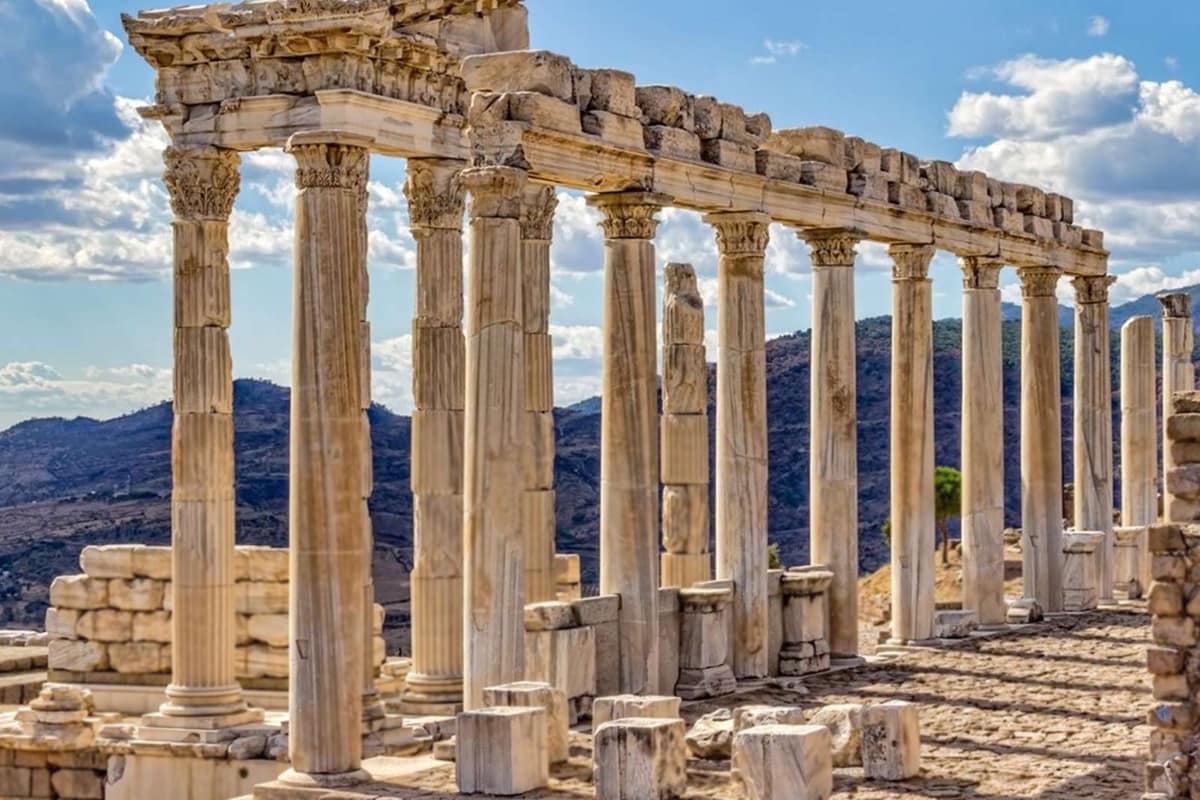
Ephesus opens the list of seven cities in the book of Revelation. The seven churches tour reaches it on day four. The letter to Ephesus praises a church that laboured hard and did not faint. It also warns that the church had forsaken its first love, as Wikipedia summarises the text.
The church at Ephesus stayed important for centuries after the letter. Bishop Ignatius of Antioch wrote to its Christians in the early second century. Later in that century, Bishop Polycrates of Ephesus wrote to Pope Victor I about the keeping of Easter. The seven churches tour meets that long record in a single city.
The Library of Celsus honours Tiberius Julius Celsus Polemaeanus, a governor of Roman Asia. His son Gaius Julius Aquila built the greater part of it, around the year 125. Damage in 262 left it out of use by the year 400. On the seven churches tour, you see a facade rebuilt from original pieces in the twentieth century.
The Great Theatre first served drama, and gladiator fights joined the programme in later Roman times. Archaeologists found the first evidence of a gladiator graveyard at Ephesus. Around 150, Publius Vedius Antoninus and his wife put up the small roofed Odeon for about 1,500 people. On the seven churches tour, the theatre frames the long view down Harbour Street.
Justinian rebuilt the Basilica of Saint John in the sixth century. Procopius reports that the older church was small and ruined, so the emperor tore it down. Work began by 548 and ended by 565. The imperial capital supplied its model, the Holy Apostles church there. The seven churches tour walks among its ruins on Ayasuluk Hill.
A museum in Selcuk displays about 64 thousand finds from Ephesus, from Hellenistic to Early Christian times. Items from Cukurici Hoyuk, Saint John’s basilica and the Temple of Artemis are held there too. It also holds an ancient statue of Artemis. The seven churches tour also visits a carpet-weaving school, a calm break between ruins.
What do Sardis and Philadelphia add to the seven churches tour?
Sardis, once the capital of the Lydian Empire, is the fifth city of Revelation. Philadelphia, now Alasehir, is the sixth. Both sit in the valley of the Gediz River, called the Hermus in antiquity. The seven churches tour visits them on day five, before the drive to Pamukkale.
Sardis became the capital of Lydia in the seventh century BC. From there, kings such as Croesus ruled an empire. The Pactolus stream, which runs through the ruins, once held electrum, a natural alloy of gold and silver. Under Alyattes, Lydia minted the first coins from it. The seven churches tour stands on that ground.
The Sardis Synagogue is the largest Jewish site known from antiquity. Its assembly hall held nearly one thousand people. A fountain in its forecourt let worshippers wash their hands. Excavators also restored the Roman bath-gymnasium complex. The Temple of Artemis was a massive building in Greek style. The seven churches tour passes all three ruins.
Cyrus the Great conquered Sardis around 547 BC, after he defeated Croesus in battle. The letter to Sardis urges a church that was spiritually alive in part to strengthen itself. It points to the faithful in the city, who walk in white. The seven churches tour holds both stories in one valley.
A king of Pergamon founded Philadelphia in 189 BC, and the Turkish name Alasehir means multicoloured town. Coins show that Roman emperors renamed it for a time, first Neocaesarea and later Flavia. An earthquake struck in AD 17, and Tiberius relieved the town of taxes. A small theatre on Toptepe Hill is all that remains of Roman Philadelphia.
In the sixth century, Philadelphia was called little Athens for its festivals and temples. The letter in Revelation praises a church of little power for keeping the word, with no rebuke. The ancient road from Sardis to Laodicea ran through the town. The seven churches tour drives that stretch toward Pamukkale.
What do Laodicea and Hierapolis add to the seven churches tour?
The book of Revelation names Laodicea seventh and last, so the city closes the seven churches tour. The plan visits Hierapolis first, then drives about ten kilometres south to Laodicea. Revelation addresses this trade city in its third chapter. The ruins lie at Eskihisar, near Denizli.
The letter to Laodicea ends the list of seven. Wikipedia sums it up in one line. The church is called lukewarm and insipid, wealthy in money but poor in spirit. A traveller on the seven churches tour can set that verdict beside the ruins.
King Antiochus II of the Seleucid Empire founded Laodicea and named it after his wife, Laodice. The city sat on a major trade road and soon grew wealthy. It handled large money deals and a wide trade in black wool. The seven churches tour reaches a trade city.
Two theatres, a stadium, baths, a gymnasium and a council hall stand among the ruins. Near the south end of town lies the stadium. Its seats run along two sides of a narrow valley, closed at both ends. The west theatre held 8,000 people.
Water reached the city through an inverted siphon. This double pipeline dropped into the valley and climbed back to a tank at the city edge. A thick crust of lime coats its low arches at the old leaks. The seven churches tour shows how far builders went to move water.
Hierapolis, the spa city beside the white terraces of Pamukkale, faces Laodicea across the valley. The letter to the Colossians sends greetings from Epaphras, who worked hard for the Christians of all three cities. Day six of the seven churches tour joins the first two in one drive.
The theatre of Hierapolis dates from the reign of Hadrian. The martyrium of Saint Philip lies in the necropolis, which runs two kilometres towards the north gate. A bath house of the third century outside the city gates became a church in the fifth.
What do Side, Aspendos and Perge add to the seven churches tour?
Side, Aspendos and Perge are three ancient cities of the Pamphylian coast near Antalya. They carry the seven churches tour from the Revelation cities to a day of coastal ruins. Day seven visits all three, and day eight ends with the transfer to Antalya airport.
Side stands on a small peninsula about one kilometre long and four hundred metres across. Athena was its patron deity. At the tip of the peninsula you find the Temple of Apollo. The ruined Temple of Athena lies beside it.
The theatre of Side seats 15,000 to 20,000 people and dates from the second century. The Byzantines turned it into an open-air sanctuary with two chapels. That adds a Christian layer to the seven churches tour.
Aspendos lies forty kilometres east of Antalya, on the Eurymedon River. The Roman theatre measures 96 metres in diameter, with seats for 7,000 people. Zenon, a local architect, built it. Post holes for 58 masts held an awning over the audience. On the seven churches tour, this is the theatre of antiquity that survives in the finest state.
The Seljuks used the theatre as a caravanserai. A recent film festival showed that it can hold over 20,000 people. The Roman aqueduct runs 19 kilometres. Its last two kilometres form an inverted siphon with towers 30 metres high.
Under Rome, Pamphylia Secunda had its capital at Perge, 15 kilometres east of Antalya. A long channel with cascading pools ran along the centre of the main street. The source calls this a unique feature for a Roman city. Day seven of the seven churches tour reaches it.
The theatre of Perge lies outside the walls near the stadium. It is larger than the theatres of Myra and Patara. The south baths are noted for their size and their sculpture. Plancia Magna, a priestess of Artemis, turned the Hellenistic gates into a monumental complex.
Antalya takes its name from Attalos II, a king of Pergamon, who based his fleet there. Antalya Airport has two terminals 1.6 kilometres apart, T1 for domestic flights and T2 for international ones. So the seven churches tour ends in a city tied to Pergamon, the third city of Revelation.
What else do travellers ask about the seven churches tour?
Five questions follow about the seven churches tour. The first three cover the reason for the letters, the lampstands and stars, and the meaning of the word church. The last two cover opening days and the time between ruins.
Why did the seven cities receive letters, and how does the seven churches tour follow them?
No single reason for the choice of these seven appears in the articles behind this page. They give the setting instead. The book blends three kinds of writing: letter, apocalypse and prophecy. Its author names himself only as John and sees himself as a Christian prophet.
Scholars read the setting in two ways. One view says the book comforted Christians who faced persecution from a Roman emperor. Another view says the strain lay inside the Christian communities of Asia Minor. They debated whether to engage with the wider world or withdraw from it. The seven churches tour crosses the land of those communities.
Prophet is a key word of the book. It appears 21 times in its different forms, more than in any other New Testament book. The Greek title is singular, so the form Revelations with an s is considered an error.
What do the seven lampstands and seven stars mean for the seven churches tour?
In John’s vision, the Son of Man walks among seven lampstands and holds seven stars in his right hand. Revelation 1:20 explains both signs. The seven stars are the angels of the seven churches, and the seven lampstands are the seven churches.
Who are the angels? The Greek word means messenger. The New Testament uses it for human and divine messengers alike, such as John the Baptist. Origen took them as guardian angels of the churches. Epiphanius of Salamis rejected that view and read them as the bishops.
Augustine of Hippo also read them as church leaders. He noted that the letters speak of a fall from first charity, which cannot be said of angels. A traveller on the seven churches tour finds all three views side by side in the same article.
What did the word church mean in the first century, and what does that change for the seven churches tour?
The Greek word ekklesia, behind the English church, means called out or called forth. In a Greek city it named the assembly of the citizens. The New Testament uses it for a distinct congregation in a given city.
So the seven churches of Revelation were groups of people, not seven buildings. The article on the congregation says the term is distinct from a church building. The seven churches tour therefore visits cities, where those groups once met.
The same word worked on two scales. It can mean one local congregation or the whole body of the faithful. The article on the Book of Revelation adds that its author was accepted by the congregations to whom he wrote.
Are the sites of the seven churches tour open on Sundays and holidays?
Hours change with the site and the season, and only the official page holds the answer. Wikivoyage lists Ephesus and Laodicea as open daily. It lists Kadifekale in Izmir as open at all hours.
Daily means Sunday is not a closing day on those pages. The Terrace Houses open half an hour later and close half an hour earlier. For the other sites on the route, no hours turned up in the articles consulted. Check each official page before the seven churches tour.
Holidays need a second check. The Wikivoyage page on Turkey says banks, offices and businesses close on official holidays. For 29 October, it adds that a Thursday date brings the Friday and the weekend into the travel plans. Religious holidays follow the Muslim lunar calendar, so their dates move every year.
What does a faith-based group trip hold besides ruins on the seven churches tour?
On a faith-based seven churches tour, reading, talk and prayer join the walking. Travel pages for church groups describe Bible reading, short talks on the history and time for prayer at the stops. This page covers the places, and the group brings the rest.
The book itself gives a group plenty to read. It rarely quotes the Old Testament directly, yet it echoes older scriptures. The article on the Book of Revelation names five sources for over half of those echoes. They are Daniel, Ezekiel, Psalms, Isaiah and Zechariah.
The meaning of the letters also draws debate. One reading takes the seven churches as seven periods of church history. The Eastern Orthodox priest Dimitri Cozby calls that view a greatly oversimplified take on history. A traveller on the seven churches tour can hold both readings in mind at the ruins.