
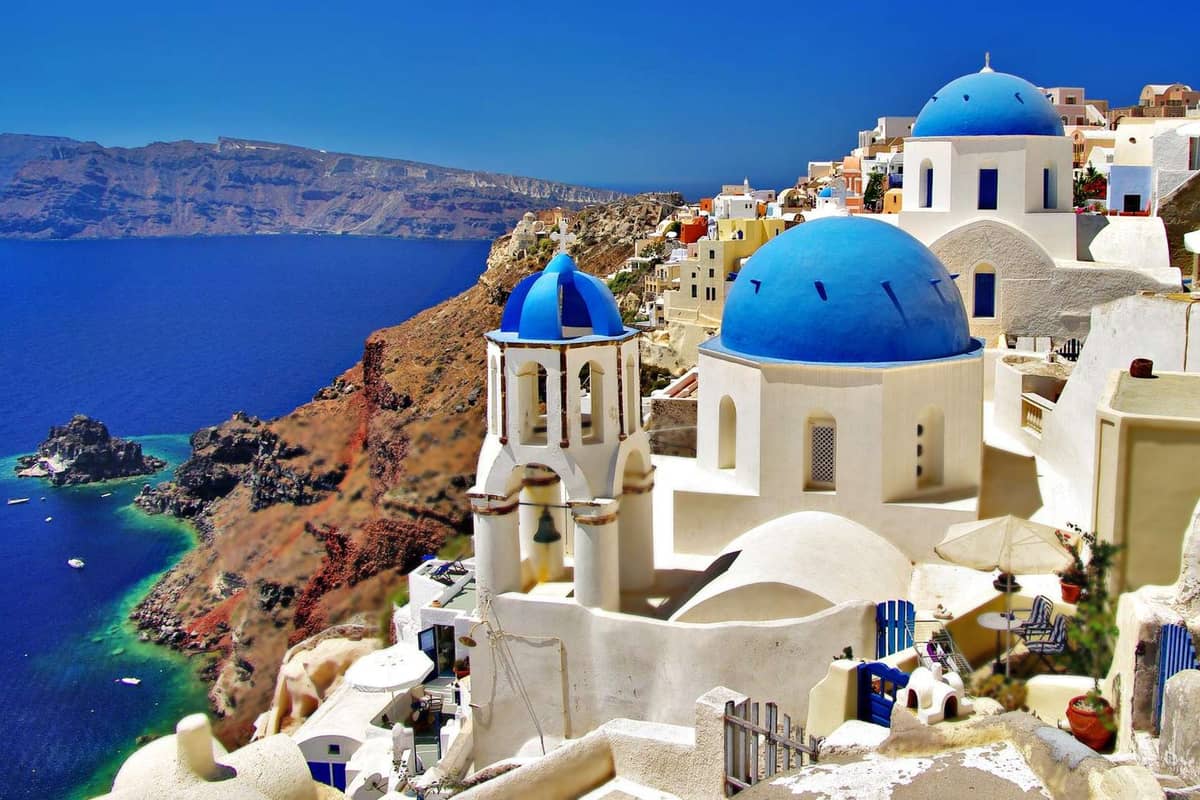
Travel to Greece from Australia means a long flight with one stop, the entry rules of the Schengen Area and a summer that falls in the Australian winter. The tours in Greece on the home page begin in Athens and on the islands.
This page covers the distance and the flight routes, the arrival airports, the entry rules, the seasons and the time gap, the length of a first trip, the Greek Australian links, money, plugs, driving, health papers, ferries, customs and the World Heritage sites; the travel to Greece from USA page covers the American trip.
What does travel to Greece from Australia involve?
Travel to Greece from Australia is a long-haul trip with a change of plane on the way. It crosses Asia or the Middle East and meets the border rules of the Schengen Area. It ends in a country where the seasons run the other way round.
The trip follows one pattern. A first flight leaves Australia for a hub city on the way. A second flight reaches Athens or another Greek airport. The change between them can be brief, or it can fill a whole night. Each part of travel to Greece from Australia gets its own section below.
These are the subjects of this page:
- Flights and airports
- Entry rules
- Seasons and time
- The Greek Australian link
- Money
- Phones and driving
- Getting around Greece
- Language, sites and other countries
Wikivoyage places Greece among the countries bound by the Schengen treaty. The area takes its name from an agreement signed in Schengen, Luxembourg, in nineteen eighty-five. Its article adds that, for travel, the members mostly act as one jurisdiction with a shared visa policy. For travel to Greece from Australia, the entry rules are therefore those of the area.
The seasons run in the opposite order in the two countries. When Australia has summer, Greece has winter, and the other way round. The calendar is therefore the first choice, before any flight is booked. A later section sets out the months and the climate by season.
Visitors from other European countries form the larger group, Wikivoyage notes. The count from other world regions is rising, it adds. Greece welcomed 33 million visitors in the year twenty eighteen, more than three for every resident. Travel to Greece from Australia belongs to the smaller group of trips from outside Europe.
The country that waits at the end is both mountainous and coastal. The Aegean and the Ionian seas hold its islands. Its four land neighbours are Turkey, Bulgaria, North Macedonia and Albania. The flight ends at one airport, but travel to Greece from Australia then spreads across the whole map.
One more thread ties the two countries together. The article on their relations calls them close and says the two capitals host each other’s embassies. It dates the large Greek community in Australia to the nineteen-fifties and nineteen-sixties. That community makes travel to Greece from Australia a family journey for people with roots in Greece.
How far is travel to Greece from Australia?
Athens was a stop when the Kangaroo Route opened to passengers between Australia and Britain in nineteen thirty-five. That first service ran from London to Brisbane for 20,526 kilometres. Travel to Greece from Australia covers a stretch of that long way, so the old route sets the scale.
Passenger flights from Australia to Britain across the Eastern Hemisphere go by the name Kangaroo Route. An Australian airline coined it. The name dates from nineteen forty-four and plays on the word hop, a leg of a route. It also echoes the hop of a kangaroo.
The first service left London for Brisbane on the thirteenth of April, nineteen thirty-five. The flights from Brisbane to London opened to passengers on the seventeenth of April. Flights were weekly, and one journey took twelve and a half days. Compared with those days, travel to Greece from Australia is far quicker.
The article lists the stops of the eastbound trip. Passengers flew from Croydon to Paris and took an overnight train to Brindisi. The plane then called at Athens and stopped overnight at Alexandria. The path ran on through Baghdad, Karachi, Delhi, Calcutta, Bangkok and Singapore to Darwin.
The route kept getting quicker. In nineteen forty-five the scheduled time for the whole route was seventy hours. In nineteen forty-six two airlines together set a record of sixty-three hours from Sydney to London. Later Kangaroo Routes of the nineteen-fifties and nineteen-sixties added other stops, among them Frankfurt, Zurich, Rome, Athens and Beirut.
The war years brought longer legs. In nineteen forty-three, flying boats crossed the Indian Ocean from Western Australia to Ceylon without a stop. The crossing covered over 6,500 kilometres and took between 27 and 33 hours. At that time no commercial route covered more distance without landing. Travel to Greece from Australia now breaks the way into separate flights.
In nineteen nineteen, the first flight from England to Australia covered 14,350 kilometres. A modified bomber flew the route between London and Adelaide. Non-stop flights between Australia and Europe began only in two thousand and eighteen, on the twenty-fifth day of March. The first one linked Perth and London.
The word Antipodes names points on opposite sides of the Earth, as its article defines it. As a British term, it also names Australia and New Zealand, which lie roughly opposite Britain. The word suits travel to Greece from Australia, which this page plans as two flights and a stop.
Which flight routes serve travel to Greece from Australia?
Travel to Greece from Australia runs through a hub city. The list of destinations for Athens International Airport, as Wikipedia gives it, names Singapore, Doha, Dubai and Abu Dhabi. The list for Sydney Airport names the same four cities. Melbourne, Perth, Brisbane and Adelaide are the other main departure airports.
The Mascot site of Sydney Airport lies 9 kilometres south of the central business district. Its article names it the busiest airport in Australia. Melbourne Airport lies at Tullamarine, 22 kilometres north-west of the city. It opened in nineteen seventy and replaced Essendon Airport for all international flights. Each is a starting point for travel to Greece from Australia.
Perth Airport is the only airport in Western Australia with regular international flights, its article states. Brisbane Airport serves 29 international destinations, by the count of its own article. Adelaide Airport lies about 6 kilometres west of the city centre. Each of the five airports carries a table of its international routes.
The tables of Sydney, Melbourne and Perth name three Asian links: Singapore, Hong Kong and Bangkok. Singapore appears in the table of all five airports. Its airport is called Changi Airport, and the Bangkok airport is called Suvarnabhumi Airport. For travel to Greece from Australia, only Singapore of the three also appears in the Athens list.
Doha, Dubai and Abu Dhabi are the links in the Middle East. The airport of Doha is called Hamad International Airport. A table in the Athens article lists the busiest intercontinental destinations from Athens. All three cities appear in it, and all three appear in the Sydney list too.
The Athens list names no Australian city, so travel to Greece from Australia becomes a connection through a hub. The map in the same article marks Hong Kong as a cargo-only link. The Adelaide table marks one Hong Kong route as seasonal. A link can therefore run for part of the year only.
A long layover on travel to Greece from Australia gives the traveller a choice. The traveller can rest at the hub airport or leave it for a short city break. The entry rules of the stopover country decide whether leaving the airport is possible. A city break turns the wait into the first stop of the holiday.
Which Greek airports suit travel to Greece from Australia?
By size, Athens International Airport stands first among the Greek international airports. It is the main gate for travel to Greece from Australia. About 20 kilometres separate central Athens from the airport, which stands to the east, as Wikipedia states. Thessaloniki, Heraklion, Rhodes and Corfu hold international airports too.
The airport company was set up in nineteen ninety-six as a public-private partnership with a 30-year concession. Its start of operation fell on the twenty-eighth, in March of two thousand and one. It is named after Eleftherios Venizelos. The four hub links of the Athens list land here, at the Greek end of travel to Greece from Australia.
The article describes the airport as modular, with six planned phases. The first phase allowed 26 million passengers a year. At the opening that phase called for only 16 million, but advanced IT logistics lifted its capacity. The final phase allows 50 million passengers a year, and the layout leaves room for five more terminals.
The suburban railway and the third line of the Athens Metro stop at the airport station. Opening day was the thirtieth of July, two thousand and four, two weeks before the Olympic Games. Between Doukissis Plakentias station and the airport, both train types share tracks. Travel to Greece from Australia ends on a platform for a rail traveller.
Buses of Transport for Athens link the airport directly with the wider Athens area, as the airport article states. Wikivoyage Athens adds that buses, unlike the metro, run through the night. A late landing on travel to Greece from Australia therefore still meets a public link. Domestic flights to the islands leave from the same airport.
Thessaloniki Airport serves northern Greece as its main airport. Its runway was extended by 1,000 metres into the sea, to a total of 3,440 metres. The airport took the name Makedonia in nineteen ninety-three. Heraklion International Airport opened in March, nineteen thirty-nine, on flat farmland. It is a shared civil and military airport.
Rhodes International Airport opened a new terminal in two thousand and five for rising charter traffic. Corfu International Airport was founded in nineteen thirty-seven and became international in April, nineteen sixty-five. Its air traffic reaches a peak from April to October, its article states. These island airports suit the later stages of travel to Greece from Australia.
Which entry rules cover travel to Greece from Australia?
Australia is on the visa-free list of the Schengen Area. Travel to Greece from Australia needs no visa for a short visit. The limit in the visa policy article is 90 days, counted inside any 180-day window. That limit counts across the whole Schengen Area, not Greece alone.
Wikivoyage names Greece as a party to the Schengen Agreement. Normally no immigration controls stand between the countries that signed it. For travel to Greece from Australia, that makes one entry check serve the whole group. Rules also ask each airline on a flight into the Schengen Area to check entry papers before boarding.
The visa policy article names an older benefit for Australians. Bilateral agreements from before the Schengen rules give Australian citizens a separate 90 days in each of twelve countries. The twelve are Austria, Belgium, Denmark, Finland, France, Germany, Iceland, Italy, Luxembourg, the Netherlands, Norway and Sweden. Greece does not appear on that list.
So days in Greece share one count with every other Schengen country on the trip. Plan travel to Greece from Australia with the whole itinerary in view. The Schengen Area article also sets two passport dates. Validity must run at least three months past the planned departure. The issue date must fall within the previous ten years.
A visa exemption lets a traveller seek entry at the border. It does not entitle anyone to enter. The same article lists what the border officer checks. A traveller explains what the stay is for. Enough funds must cover the stay and the return home, or onward travel to a country that admits the traveller.
A stay beyond 90 days is a different matter. Travel to Greece from Australia that runs longer needs a long-stay visa or a residence permit, as the article states. Long-stay visas cover less than a year, and residence permits cover longer periods. Procedures differ from country to country.
Travel to Greece from Australia for work is a separate visa matter. The working holiday table lists Greece with Australia: up to 12 months, for applicants aged 18 to 30. Greece keeps an embassy in Canberra, as the relations article states. Consulates general stand in Sydney, Melbourne and Adelaide, with a consulate in Perth.
How do ETIAS and the Entry/Exit System change travel to Greece from Australia?
Two EU systems reshape travel to Greece from Australia. The Entry/Exit System already records the border crossings of travellers who are not EU or EFTA citizens. Passport stamps stopped once it ran at every checkpoint. ETIAS, an electronic authorisation for visa-exempt visitors, is scheduled for twenty twenty-seven and is not running yet.
The Entry/Exit System, or EES, logs each crossing by third-country nationals at the border of the Schengen Area. For travel to Greece from Australia, each entry and each exit becomes a record. Greece lies inside the area, so a flight arriving from outside it ends with that check.
The database holds your name, your birth date, your fingerprints and facial recognition data. It also stores the place and time of each crossing. Use began on the twelfth of October twenty twenty-five. On the tenth of April of the following year, the system covered every checkpoint, and passport stamps ended.
On the first entry of travel to Greece from Australia, an officer photographs your face and/or scans your fingerprints. In certain cases, the details can be registered in advance, as the article notes. It names self-service points at specific border posts, and an official mobile application where the country of arrival offers it.
Later entries are quicker, because an agent only verifies identity, the article explains. At certain crossing points, self-service kiosks serve travellers with biometric passports. These are travellers who passed through the system within the past three years.
The article also records waits as long as five hours at certain border points after the system began. For travel to Greece from Australia, leave a wide gap before any onward flight on the day of arrival.
ETIAS is planned as an electronic permit for visitors who need no visa, covering the Schengen Area and Cyprus. Once it runs, travel to Greece from Australia will need that authorisation before entering the Schengen Area. The ETIAS article gives the start as twenty twenty-seven, one year behind the Entry/Exit System. Its first target was January of twenty twenty-one.
ETIAS is not a visa and needs no visit to an embassy. An approval is no promise of entry, since the border officer makes the final call. An authorisation holds for three years, or ends sooner when the passport expires. Check the official EU travel pages for the current start date before booking.
Australia itself uses a step of this kind. The ETIAS article names Australia’s Electronic Travel Authority among the systems that gave the EU technical inspiration. The visa policy article lists Australia among the countries that ask visitors from Schengen states for an electronic authorisation. It compares those systems to the planned ETIAS.
How do the seasons change travel to Greece from Australia?
The seasons run in reverse, so travel to Greece from Australia swaps an Australian winter for a Greek summer. The Season article states it plainly: when the north has summer, the south has winter. A flight in June leaves one season behind and lands in the other.
The same article lists meteorological dates for each half of the world, and it notes that Australia prefers that reckoning. Set the northern dates beside the southern ones, and the pairs for travel to Greece from Australia read as follows:
- Greek spring, from the first of March, matches the Australian autumn.
- Greek summer, from the first of June, matches the Australian winter.
- Greek autumn, from the first of September, matches the Australian spring.
- Greek winter, from the first of December, matches the Australian summer.
For travel to Greece from Australia, warmth lags behind the sun in both halves. The article puts the warm months of the north in June, July and August. The warm months of the south are December, January and February. The two sets never overlap.
A traveller from the tropical north knows a different pattern. The article notes wet and dry seasons in the northern parts of Queensland, Western Australia and the Northern Territory. They run beside the temperate names or in their place. In those terms, travel to Greece from Australia meets dry weather in summer and wet weather in winter.
Place changes the Greek season. The Climate of Greece article puts a hot semi-arid type in Piraeus and along much of the Athens coast. It reaches across the greater part of the Cyclades too. The same article adds a warm-summer Mediterranean type for ground above 1,000 metres, such as Mount Parnitha in Attica.
For travel to Greece from Australia, the school year sets the dates for families. The School term article lists four terms, from late January or early February to early or mid-December. Term two ends in late June or early July, and term three starts in mid-to-late July. The break between them sits inside the Greek summer.
The article ends term four in mid-to-late December and lists a summer break of one to two months after it. For travel to Greece from Australia, that long break sits inside the Greek winter. The Greek shoulder months, between the hot season and the wet one, fall in term time apart from the breaks.
How does the time difference affect travel to Greece from Australia?
Greek clocks run seven to nine hours behind Sydney and Melbourne, as the two offsets give it. So travel to Greece from Australia crosses a wide time difference. Greece keeps UTC+2 in winter, while New South Wales and Victoria keep UTC+10, with one more hour in summer time.
Athens clocks sit two hours ahead of UTC for the colder months, on Eastern European Time. Daylight saving lifts them to three hours ahead. The clocks go forward on the Sunday that ends March and back on the Sunday that ends October.
Australia has three main time zones in standard time, as the Time in Australia article lists them. Western Australia sits at UTC+8, South Australia and the Northern Territory at UTC+9:30, and the eastern states at UTC+10. For travel to Greece from Australia, the city of departure sets the size of the gap.
Each state and territory decides on daylight saving for itself. New South Wales, Victoria, Tasmania and the Australian Capital Territory move to UTC+11. That lasts from the first Sunday in October to the first Sunday in April. South Australia moves to UTC+10:30. Western Australia, the Northern Territory and Queensland do not use it.
Take Sydney or Melbourne for travel to Greece from Australia. From the first Sunday in April to the first Sunday in October, UTC+10 against UTC+3 gives seven hours. In the Greek winter, UTC+11 against UTC+2 gives nine hours. In a short spell in October, and again around the turn of March into April, the gap reads eight hours.
Because Western Australia and Queensland skip daylight saving, only Greece moves their gap. Athens runs five hours behind Western Australia in Greek summer time and six hours behind in winter time. Against Queensland, the gap reads seven hours in Greek summer time and eight in winter time.
The Jet lag article ties jet lag to the time zones crossed, not the hours spent in the air. Greek clocks sit behind Australian ones, so the outbound flight counts as a trip west. For travel to Greece from Australia, the article lists early waking among the signs of a westward flight.
The article lists poor sleep, dizziness, nausea, headaches, irritability and trouble concentrating as signs. It gives an average of one day per hour of time zone change. By that average, a gap of seven to nine hours points to seven to nine days. The article adds that adjusting is harder when travelling east, so the flight home asks more.
For travel to Greece from Australia, the article calls light a powerful outside cue for the body clock. Meal times and set activities act as cues too. Evening light delays the clock, which suits a westward flight, since time is lost at the destination. Morning light does the reverse and suits the flight home.
Which trip length suits travel to Greece from Australia?
Two to four weeks on the ground suit travel to Greece from Australia. A change of plane and a wide time gap eat the first days, so rest comes first. Two weeks hold Athens and one island group at an easy pace. A month adds a stretch of the mainland.
The long flight itself drains the first day. The Jet lag article describes travel fatigue as tiredness, headache and disorientation. A cramped space, dry air and little to eat or drink cause it. It can pass after one day and a night of good sleep. For travel to Greece from Australia, leave the first day free of bookings.
Two weeks is the short plan. The Wikivoyage page on Crete says vacationers from Europe seldom stay beyond two weeks. A number of them see only the major highlights and the area around their lodging. A traveller who has crossed the world wants at least as long, at an easy pace. Fourteen days is a floor, not a target.
Split the days between three kinds of place. Wikivoyage Greece lists eight island groups and gives Crete a region of its own. Four more of its regions lie on the mainland. They are the Peloponnese, Thessaly, Central Greece and Northern Greece. For travel to Greece from Australia, Athens, one island group and one mainland stretch make a balanced month.
The look of the land changes with each region. Wikivoyage Greece names Neoclassical buildings in Ermoupolis and Nafplion. It names Ottoman-influenced ones in Grevena and Kozani. Whitewashed Cycladic houses stand on Paros, and pastel baroque homes stand on Corfu. A split across regions shows more than one Greece in a single trip.
Island hopping asks for time. Wikivoyage Cyclades calls hopping very popular there. It adds that excellent ferry schedules make hopping an option for a trip longer than one week. A fortnight with Athens at each end fits one island group at an easy pace. Travel to Greece from Australia rewards that slower plan.
Plan the first and last nights near the airport or in the city that holds it. After landing, a bed and a short ride are all the first night needs. Before the flight home, the last night needs the same, with bags packed early. For travel to Greece from Australia, these two nights use no sightseeing time.
Which first routes suit travel to Greece from Australia?
Four first routes suit travel to Greece from Australia. They are Athens with the Cyclades, Crete alone, the Ionian islands and the classical mainland. Each route stays in one region, so the days go to places and not to transport. A visit to a family village can end any of them.
The first route for travel to Greece from Australia joins Athens to the Cyclades. Wikivoyage Cyclades names Santorini, Mykonos and Paros for a first visit to the group. On Naxos, the village of Apeiranthos first appears in writing in fourteen twenty. The Italian traveller Cristoforo Buondelmonti named it in his Book of the Islands of the Archipelago.
The second route stays on Crete. Wikivoyage says Crete needs time to explore fully. Gortyn, 45 kilometres from Heraklion, stands in the valley of Messara. The Romans governed Crete and Cyrenaica together as one province, with Gortyn as its capital. Discovered in eighteen eighty-four, the Gortyn Code is the oldest known ancient Greek law code, and the fullest.
The third route follows the Ionian islands. Wikivoyage describes them as green, unlike the Cyclades. It adds that air routes there are seasonal, so the low season needs a connection through Athens. Plan the dates of travel to Greece from Australia around that. Ancient Athens dredged tar from Lake Keri on Zakynthos with myrtle branches tied to poles.
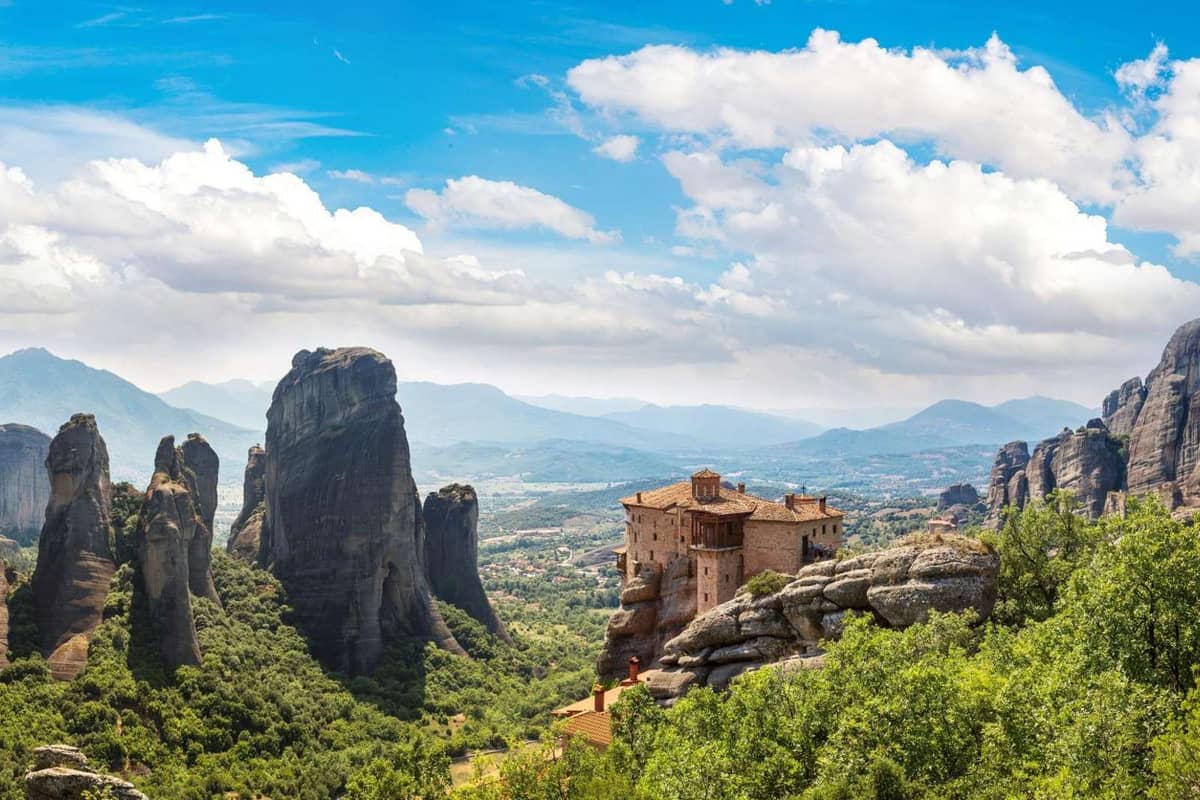
The fourth route covers the classical mainland: Delphi, Olympia, Nafplio and Meteora. The Corycian Cave sits in Parnassus National Park, north of Delphi. The excavation of nineteen sixty-nine by the French School of Athens found 22,000 astragals, mostly sheep and goat ankle bones. The article adds that they were believed to serve in games of chance.
A fifth plan belongs to families with roots in Greece. Either end of a route can hold a visit to a home village. For travel to Greece from Australia, the days then divide between family and the sights of one route. The sections on Greek Australians name the home islands.
Choose one route for a first trip and keep the others for a return visit. A route that stays in one region needs fewer transfers between places. That leaves more of the two to four weeks for the places themselves. For travel to Greece from Australia, one region per trip is a sound plan.
How do Greek Australians shape travel to Greece from Australia?
Greek Australians add a family side to travel to Greece from Australia. At the census of twenty twenty-one, 424,750 people in Australia stated Greek ancestry, alone or with another ancestry. A second figure counts 92,314 residents who were born in Greece. For these families, the flight is a visit home.
Greek migration to Australia grew especially in the years after the Greek Civil War and the Second World War. That flow shaped the community that stands behind travel to Greece from Australia. Wikipedia calls Greek Australians one of the largest groups of the Greek diaspora. Arrivals peaked at 160,200 in nineteen seventy-one and have slowed since then.
The first known free Greek migrant to Australia was Katerina Georgia Plessos. She reached Sydney in eighteen thirty-five with her husband, a major. They had married in eighteen twenty-seven on the island of Kalamos, where he was commandant. Her story shows how old the ties behind travel to Greece from Australia are.
In Melbourne, travel to Greece from Australia starts in a city with the largest Greek-speaking population outside Greece and Cyprus. The census of twenty sixteen counted 173,598 people there with Greek ancestry. Lonsdale Street holds the Greek Precinct, and Melbourne is a sister city of Thessaloniki.
Greek schools anchor community life in Melbourne. The article counts three Greek Australian day schools and dozens of after-hours Greek schools. Societies for aged care and welfare, youth groups and sporting clubs form a wider network. Hellenic student groups work at all seven universities of the city.
Language carries the link too. In twenty sixteen, 237,588 residents spoke Greek at home, and Greek ranked seventh among the languages of Australia. The Greco-Australian dialect, an Australian-based form of Greek, is spoken by immigrants and by Australians of Greek descent.
The first Greek weekly newspaper appeared in Melbourne in nineteen thirteen. A multicultural broadcaster now airs a Greek-language radio programme every afternoon. The Melbourne article describes Hellenic identity and values as handed down through the generations. For these families, travel to Greece from Australia ends at one village. The next section names three home islands.
Which home islands draw travel to Greece from Australia?
Three home islands link travel to Greece from Australia to old family places: Kythira, Kastellorizo and Ithaca. Kythira’s population peaked at about 14,500 in eighteen sixty-four and stood near 3,650 at the census of twenty twenty-one. The Kythira article traces the fall mainly to emigration, including emigration to Australia.
In August, visitors and natives returning for the holidays can triple the population of Kythira, the article adds. The festival of the Panagia takes place at Potamos on the fifteenth of August. A wine festival runs at Mitata on the first Friday and Saturday of August. Dates for travel to Greece from Australia can follow either feast.
The article lists the sea routes. For travel to Greece from Australia, the port of Diakofti serves Gythion, Kalamata, Antikythera, Piraeus, Crete and Neapolis. The airport lies between Friligiannika and Diakofti, about 20 kilometres from the capital. Private funds from the local population largely paid for its extension when the twenty-first century began.
Five Australians appear among the notable people listed for Kythira, from a lawyer to a surgeon and a racing administrator. An Australian children’s television programme is set on the island. Chora, the chief town, houses the Historical Archives of Kythira, the second largest in the Ionian islands.
Kastellorizo shows the same pattern on a smaller scale. Early in the twentieth century the island reached its peak, an estimated 9,000 inhabitants. By the late nineteen twenties it held 3,000. About 8,000 islanders lived away, predominantly in Australia, Egypt, Greece and the United States.
The count fell to a low of 222 in nineteen eighty-one. It reached 594 at the census of twenty twenty-one, all in the one town. Emigrants in Australia, especially in Perth and Sydney, are known as Kazzies. Kastellorizo is twinned with Perth, so travel to Greece from Australia can end in a twin town.
On the nineteenth of July, before the feast of Agios Elias, children and then men jump into the sea. In the Horafia quarter stands the cathedral named for Saints Constantine and Helena. Its granite columns came from a temple of Apollo at Patara.
Ithaca reaches Australia through a Brisbane name. A former suburb of Brisbane, now a neighbourhood of Red Hill, is called Ithaca. The article on it believes a governor of Queensland chose the name after the Ionian island. Ithaca Creek and Ithaca Hall carry it on.
On the island, travel to Greece from Australia reaches the Polis cave, which lies in the north close to Stavros. Worship went on there from the early Bronze Age into Roman times, the article says. Votive offerings point to rites for the nymphs. Heinrich Schliemann linked it to Odysseus, yet no clear link exists.
Which shared history marks travel to Greece from Australia?
Travel to Greece from Australia follows a shared history that starts on Lemnos. During the First World War, the harbour at Moudros served the Allies as a base for the Dardanelles campaign. In nineteen forty-one, Australian forces took part in the Battle of Greece and then in the Battle of Crete.
Moudros lies along the eastern edge of the bay at the centre of Lemnos. In early nineteen fifteen, the Allies made Lemnos their base in the bid for the Dardanelles Straits. For travel to Greece from Australia, the island has a namesake in Victoria. The town of Lemnos was founded in nineteen twenty-seven for returning First World War soldiers.
A trained nurse of the Australian Army Nursing Service worked on Lemnos. She served in the laboratories of No. 3 Australian General Hospital from nineteen fifteen. The Commonwealth War Graves Commission keeps East Mudros Military Cemetery. It holds 885 burials from the Gallipoli campaign, including 148 Australians and 76 New Zealanders.
Travel to Greece from Australia also touches the Battle of Greece in April of nineteen forty-one. The 6th Australian Division stood across the Haliacmon valley, reaching the Vermion range. The evacuation of about 10,200 Australian troops from Nafplio and Megara fell on the twenty-fifth, Anzac Day. German forces reached Athens on the twenty-seventh.
The Battle of Crete began with German airborne landings on the morning of the twentieth, in late spring. Three days before, the garrison on Crete held about 6,500 Australians, 15,000 Britons, 7,750 New Zealanders and 10,200 Greeks. The 2/4th Australian Infantry Battalion stood in the Rethymno and Heraklion sector, beside a British brigade and Greek battalions.
Two cemeteries give travel to Greece from Australia a place for quiet respect. The Commonwealth War Graves Commission keeps Souda Bay War Cemetery on Crete. It holds 19 First World War burials, 731 identified Second World War burials and 776 unidentified ones. The Commission also keeps Phaleron War Cemetery at Palaio Faliro, southeast of Athens, with the Athens Memorial.
For travel to Greece from Australia, Anzac Day on the twenty-fifth of April ties these places together. The day was devised to honour the soldiers of Australia and New Zealand who fought at Gallipoli. Dawn services keep the hour of the first landing, traditionally twenty-eight minutes past four in the morning.
Which festivals link travel to Greece from Australia?
Travel to Greece from Australia meets festivals in both countries. In Melbourne, the Antipodes Festival fills the Greek Precinct on Lonsdale Street every year. In Greece, Ohi Day falls on the twenty-eighth of October. It recalls the Greek no to the ultimatum that Italy sent in nineteen forty. Parades and church services follow.
Travel to Greece from Australia can start at the Greek Precinct on Lonsdale Street in Melbourne. The Greek community holds the Antipodes Festival there every year. It has more than 90 stalls for food, retail and community groups, with free live entertainment and rides for children. In twenty twenty, more than 100,000 visitors came.
For travel to Greece from Australia in spring, check the date of Pascha. Wikivoyage describes midnight fireworks that close the Holy Friday and Saturday evening processions. The Greek Orthodox Church counts the date of Easter differently from Catholic and Protestant churches. Pascha can follow theirs by one or two weeks, and sometimes the dates coincide.
The Italian ambassador delivered the ultimatum at Kifissia shortly after three in the morning. Italian troops crossed from Albania into Epirus at half past five, thirty minutes before the ultimatum ended. By the middle of November, the Greek army had stopped the invasion. The holiday takes its name from ochi, the Greek word for no.
People first marked the day in nineteen forty-one, while Athens was under occupation. It became a national holiday in October of nineteen forty-four. In Thessaloniki, a sister city of Melbourne, the feast of Saint Demetrius opens the celebrations on the twenty-sixth. The student parade follows on the twenty-seventh, and the military parade on the twenty-eighth.
Travel to Greece from Australia in late March meets Greek Independence Day on the twenty-fifth. The date coincides with the Feast of the Annunciation. Greek communities abroad also mark it. A projection of the Greek flag appeared on the Sydney Opera House in March of twenty twenty-one. The National Museum of Australia in Canberra also showed it.
Church life is part of the Greek Australian story behind travel to Greece from Australia. The Greek Orthodox Archdiocese of Australia answers to the Ecumenical Patriarchate of Constantinople. Its seat is the Cathedral of the Annunciation of Our Lady in Redfern, Sydney. It counts more than 130 parishes, eight monasteries and six dioceses.
How do money and cards work for travel to Greece from Australia?
Travel to Greece from Australia means paying in euros instead of Australian dollars. Greece uses the euro, and Wikivoyage notes that one euro divides into one hundred cents. The Australian dollar divides the same way, so the system feels familiar. The notes in your hand are where the two currencies differ.
On travel to Greece from Australia, the first euro note feels new to the touch. Australia was the first country to make polymer banknotes, from polypropylene, as the Australian dollar article states. The Euro banknotes article says euro notes are pure cotton fibre, which improves durability and gives a distinctive feel.
Every coin in your change during travel to Greece from Australia carries a Greek design on its national side. One artist, Georgios Stamatopoulos, designed all eight, as the Greek euro coins article states. The small coins show ships, from an Athenian trireme of the fifth century BC to a modern tanker.
The three middle coins show Greeks of history. The one-euro coin shows an Athenian tetradrachm, a coin within a coin. The two-euro coin shows the abduction of Europa, with Zeus taking the shape of a bull. The denomination appears in the Greek alphabet on the national side.
In Greek, the euro cent is the lepto, with the plural lepta. The same article says this name served the hundredth part of the phoenix and the drachma. Both were earlier currencies of the Greek state. Wikivoyage states that the euro replaced the drachma in January two thousand and two.
Cash machines stand almost everywhere in Greece, as Wikivoyage states. It warns that a machine can refuse a five-digit PIN and advises changing it to four digits before leaving home. Check the PIN of your card before travel to Greece from Australia.
Cards are widely accepted during travel to Greece from Australia, as Wikivoyage states. The places include shops, hotels and the offices for ferries, flights and rental cars. Paying by card directly can give a better exchange rate than changing cash. Small notes and coins suit a periptero, the street kiosk that sells newspapers and chilled drinks.
Tipping in a Greek restaurant was traditionally not customary, as Wikivoyage states. A tip was once taken as an insult, and the way to show thanks was to come back. In tourist areas that custom has almost vanished, but off the beaten track it is still alive. No set rate exists, and tipping a taxi driver is uncommon.
A visitor on travel to Greece from Australia comes from outside the European Union. Wikivoyage states that a shop can offer tax-free shopping to non-EU residents. They can ask for a VAT refund at the port of exit from the EU. Ask for the voucher before leaving the shop, and show it with the items to the customs officer.
Which plugs and phone plans suit travel to Greece from Australia?
Travel to Greece from Australia needs a plug adapter, because the sockets differ. The mains electricity table lists Type I for Australia and Types C and F for Greece. It gives both countries the same supply, 230 volts at 50 hertz. For the phone, a virtual SIM or a Greek SIM card keeps data simple.
The plug you pack for travel to Greece from Australia changes its letter. The Australian plug is Type I. Greece lists Type C and Type F. Type C is the Europlug. Type F is the Schuko, with a CEE 7/4 plug and a CEE 7/3 socket rated for 16 amps.
The table lists Greece at 230/400 volts and 50 hertz. It lists Australia at the same pair. A note beside Australia says that Western Australia uses 240/415 volts. The article calls all such voltages nominal, with a degree of permitted variation.
The article explains that an amendment in nineteen ninety-seven replaced two old standards. Their numbers were 220/380 and 240/415 volts. The new harmonised standard is 230/400 volts. The article adds that the old numbers can still be found in places.
Wikivoyage says an EU citizen can use a home SIM card in Greece as normal. A visitor on travel to Greece from Australia has two other routes. One is a Greek SIM card, and the law asks for identification to start a prepaid plan. Wikivoyage counts at least three mobile carriers in Greece.
The other route is a virtual SIM, with data bought as credit at home. Wikivoyage calls it easier than buying a Greek SIM card. Ask your own Australian provider about roaming before you fly.
Calling home is a separate task during travel to Greece from Australia. Wikivoyage describes a prepaid calling card as a phone number and a PIN code, dialled before the usual number. Shops and kiosks sell these cards, and public phone boxes accept them. Ask for an international calling card to ring abroad.
Save one more number before travel to Greece from Australia: 112, the emergency number Wikivoyage lists for Greece. According to the 112 article, the GSM standard includes this number. It adds that in Australia, 112 on a mobile phone redirects to 000.
How does driving work on travel to Greece from Australia?
Driving on travel to Greece from Australia means changing sides: Australia keeps left, and Greece keeps right. Wikivoyage’s page on driving in Europe says traffic circulates on the right, except in seven places, all islands. The International Driving Permit translates the home licence and works only beside it.
A sign on the Great Ocean Road reminds visitors to keep left in Australia. The traffic article says Australia has always kept left. For travel to Greece from Australia, the first drive therefore starts on the opposite side. A side trip to Cyprus meets left-hand traffic again, as the article names it among four island nations.
The permit article names three treaties. Vienna dates from nineteen sixty-eight, Geneva from nineteen forty-nine and Paris from nineteen twenty-six. The article on the Geneva treaty lists both Australia and Greece as parties. The Geneva text lets a country require the permit, especially when the home licence does not follow the treaty model.
Validity on travel to Greece from Australia depends on the treaty. The Geneva treaty gives a permit one year from issue, with a grace period of six months. The Vienna treaty allows up to three years, or until the home licence expires, if that is sooner. A Vienna permit is valid for one year after arrival, the article adds.
Wikivoyage Greece says where the permit matters on travel to Greece from Australia. A rental desk need not ask for it, but the permit is needed after a police stop or an accident. A non-EU driver without the permit can find an insurance policy void. The Europe page adds that a local minimum driving age can override a foreign licence.
The highways article names motorways with the letter A and national roads with the letters EO. Green signs mark motorways, and blue signs mark national roads as a rule. Highest limits run from 130 kilometres per hour on motorways down to 90 on national roads. Toll roads are limited to motorways, and the Aktio-Preveza undersea tunnel is the single exception.
Village roads on travel to Greece from Australia can be narrow. When two cars meet, Wikivoyage Greece says, one driver pulls over to let the other pass. Road signs in Greek are repeated in Latin letters. Manual cars make up the bulk of rentals, so reserve an automatic ahead. Rental terms can bar ferries, and only larger ferries carry cars.
Which health papers matter for travel to Greece from Australia?
Health papers for travel to Greece from Australia start with insurance cover. Wikivoyage Greece says non-EU nationals receive only emergency care free in the public system. EU nationals show a European Health Insurance Card, which the EU describes as evidence of cover in an EU country.
The EU page says a card holder gets the same care rights as people insured in that country. It covers treatment that cannot wait until the holder is home. On travel to Greece from Australia, a passport holder falls in the non-EU group that Wikivoyage Greece describes.
The EU page lists what the card leaves out. It does not cover rescue and repatriation, which need separate insurance cover. It does not cover private health care and works only in the public system. It does not cover planned treatment. Read a travel insurance policy for those same three items.
On travel to Greece from Australia, the number for emergency medical services is 166, as Wikivoyage Greece lists it. The healthcare article names the National Center for First Aid, or EKAB, for emergency and ambulance services. Helicopter ambulances serve the islands, Wikivoyage adds, taking urgent patients to the nearest island or city with a major hospital.
Wikivoyage Greece calls pharmacists highly trained. For a simple, common illness, it says, a visit to the pharmacist supplies the medicine. The pharmacy article says the green pharmacy cross is widely used on signs in Europe. A pharmacy that is shut on a Sunday posts a sign naming the nearest open ones.
Medicines need a plan on travel to Greece from Australia. The Hellenic contact point for cross-border healthcare says a pharmacist applies national rules when dispensing a medicine. A medicine can be unauthorised for sale, or unavailable, in another country, even inside the EU.
Wikivoyage Greece advises knowing the generic name of a medicine, because brand names can differ. It adds that a number of UK and US prescription medicines can be bought without one in Greece.
Final checks for travel to Greece from Australia are short. Wikivoyage Greece states that no inoculations are required for Greece. A hotel can advise where to go for care, the page adds. Sunscreen is sold in supermarkets, grocery stores, pharmacies and shops selling beach gear.
How do ferries and domestic flights continue travel to Greece from Australia?
After the long flight, travel to Greece from Australia continues from Athens by plane, boat or bus. Wikivoyage notes that Greece has limited train routes, and that trips by bus or ferry are lengthy. Flying to the islands from the mainland is therefore worth considering.
Athens has three ports, which Wikivoyage names as Piraeus, Rafina and Lavrio. Their distances from the city centre differ. Rafina is twenty-five kilometres to the east, and Lavrio about sixty kilometres to the south-east. Piraeus, eight kilometres to the south-west, is the closest on the boat leg of travel to Greece from Australia.
Three natural harbours make up Piraeus. Its central harbour, Kantharos in antiquity, handles passenger and commercial shipping. Ferries from there reach the Cyclades, the Dodecanese, Crete and parts of the Aegean to the north and east. Zea and Mikrolimano, to the east, serve recreational and fishing craft.
Wikipedia names Rafina, in eastern Attica, as the second harbour serving Athens, after Piraeus. Its ferries serve southern Euboea and a wide share of the Cyclades. Lavrio was known in antiquity for the silver mines of Laurium, and its archaeological museum tells their story.
On travel to Greece from Australia, Kastellorizo shows the onward trip on a small scale. Ferries link it with Rhodes, Piraeus and the Turkish town of Kas, as the Kastellorizo article states. It lies about two kilometres from Kas, roughly halfway between Rhodes and Antalya. The airport links it by air, and one small bus collects visitors there.
For travel to Greece from Australia, Wikipedia counts sixteen civil international airports in Greece. The two biggest by passenger numbers stand in Athens and Thessaloniki. Wikivoyage lists Corfu, Thessaloniki, Kalamata and Kavala among the far-reaching places where a flight is worth considering.
For travel to Greece from Australia, the KTEL buses cover almost the entire country, as Wikivoyage describes. The name KTEL covers every regional and intercity bus company. The majority of the regional units run their own networks and label the vehicles with their region. Thessaloniki holds the biggest of the four major bus terminals, as Wikipedia lists them.
Wikivoyage calls the railway underdeveloped next to other European countries. Its traffic is concentrated on the Athens to Thessaloniki corridor and on suburban lines around both cities. On the other three lines, one or two trains a day is the norm, and Wikivoyage prefers the bus there.
Which language and customs help travel to Greece from Australia?
Language is a light task for travel to Greece from Australia. Wikivoyage says an English speaker meets no significant language problem. Basic English is expected of almost everyone working in tourism and public transport. Even a Greek hello and a Greek thank you win a warm reception.
The Wikivoyage phrasebook states that Greek uses a twenty-four letter alphabet, the same one as in Classical Greek. Wikivoyage Greece adds that the Latin and Cyrillic alphabets descend from the Greek alphabet. About half the letters resemble Latin ones. With a little study, it says, written place names are not hard to decipher.
On travel to Greece from Australia, the same town can be spelled in different ways on maps and signs. Wikivoyage names three causes. Greek letters are rendered in Roman ones. Greek grammar changes a word by its role in the sentence. A language reform in nineteen seventy-six also played a part.
The phrasebook marks the stressed syllable in capitals. Good evening is kalispera, said kah-lee-SPEH-rah. Good morning is kalimera, said kah-lee-MEH-rah. Thank you is efharisto, said ef-hah-rees-TOH. Wikivoyage Greece adds that Greeks judge politeness by behaviour rather than by words.
Yes is ne, said neh, and no is ochi, said OH-hee. The Wikipedia article on the nod states that in Greece a single downward nod means yes. A single upward nod means no, and it comes with raised eyebrows. On travel to Greece from Australia, listen for the word as well as the nod.
On travel to Greece from Australia, a visit to a church or monastery can bring a dress code. Where one applies, women cover their shoulders and everyone covers the knees, Wikivoyage says. In high summer the code is enforced lightly, since the crowds are large. Suitable clothing is available to borrow at the entrance of the busier sites.
Customs on travel to Greece from Australia start with informality, as Wikivoyage describes it. People gesture freely with their hands and take leisure seriously. Over-stressed politeness, it adds, can make a person seem pretentious. A raised palm with spread fingers is rude, and Wikivoyage names that sign mountza.
As Wikivoyage notes, lunch is a mid-afternoon meal, and dinner starts late in the evening. If a Greek host offers food, the same page advises tasting everything on the plate. It also calls respect for elders very important in Greece.
Which World Heritage sites reward travel to Greece from Australia?
The Wikipedia list states that Greece holds twenty-one properties inscribed on the World Heritage List. Cultural sites make up eighteen of them, and three are mixed. For travel to Greece from Australia, eight of them fit a first trip. They begin at the Acropolis in Athens and end at the Old Town of Corfu.
The same list names the mixed group: Mount Olympus, Mount Athos and Meteora. Each counts for nature and for culture alike. The list opened with Bassae and its Temple of Apollo Epicurius. In nineteen eighty-one Greece ratified the convention behind the list, so its natural and cultural sites became eligible.
Eight sites suit the routes of travel to Greece from Australia. Each line below gives the site and its region, as the list states them.
- Acropolis, Athens: Attica
- Archaeological site of Delphi: Central Greece
- Archaeological site of Olympia: West Greece
- Meteora: Thessaly
- Archaeological site of Mystras: Peloponnese
- Medieval City of Rhodes: South Aegean
- Delos: South Aegean
- Old Town of Corfu: Ionian Islands
One early temple on the Acropolis carries the nickname Bluebeard temple. Its pediment showed a three-bodied man-serpent with dark blue beards, the article states. Delphi has a tale of its own. One tale of the sanctuary’s discovery has a goatherd watching his goats play with great agility near a chasm.
The article on Olympia states that earth deposits up to eight metres deep once buried the site. At Meteora, people and goods once rose to the monasteries by net or by ladders latched together. Steps carved into the rock in the nineteen-twenties now carry visitors up.
The archaeological site of Mystras climbs the Taygetos slopes above the modern village and the city of Sparta. The nuns of the Pantanassa Monastery are the sole inhabitants of the site, the article states. For travel to Greece from Australia, Mystras adds a Byzantine town to the Peloponnese.
Nineteen sixty brought protected-monument status to the whole medieval town of Rhodes, granted by the Ministry of Culture. Delos lies not far from Mykonos, as Wikivoyage states. Pilgrims came to its sanctuary of Apollo from all over Greece, and the island grew into a trading port.
Each site sells its own entry ticket, and Wikivoyage states that no combined ticket remains. Ticket rules change. Before any site day on travel to Greece from Australia, the Ministry of Culture pages give the current terms.
How does travel to Greece from Australia combine with other countries?
The Schengen Area article counts 29 countries that have lifted the border controls between them. Greece is one of them. Three links suit travel to Greece from Australia: Italy by sea, Turkey across the Aegean and Cyprus by air. The visa-free 90 days count across the whole area.
Wikivoyage links Patras and Igoumenitsa in mainland Greece with four Italian ports: Venice, Ancona, Bari and Brindisi. Ferries also link Italy with the Ionian Islands, mainly in summer. For travel to Greece from Australia, a sea crossing adds one more leg.
Patras is dubbed Greece’s Gate to the West. Its busy port ties the city to Italy in trade and communication. The Egnatia Odos, the A2 motorway of northern Greece, is 670 kilometres long and ends at Igoumenitsa. Its name comes from igoumeni, a word meaning commander or abbot.
The list article places the Old Town of Corfu at the Adriatic Sea’s entrance. Wikivoyage calls the main routes from Italy sea routes of the Adriatic. For travel to Greece from Australia, Corfu suits a stop on the way in or out.
Turkey stands outside the Schengen Area, and the article lists it with four other countries along the eastern land border. The Turkish government sets its own visa policy, as the article on that policy states. For travel to Greece from Australia, a side trip across the Aegean means checking the Turkish rules before booking.
Wikivoyage pairs Marmaris with Rhodes, Cesme with Chios, Bodrum with Kos and Kusadasi with Samos as sea links. It also places the beach towns of Samos a stone’s throw from the Turkish mainland.
Cyprus is a different case. The Schengen visa policy applies to Cyprus as well as to the Schengen Area, the article states. ETIAS, the planned authorisation for visa-exempt visitors, covers the same two. For travel to Greece from Australia, one more flight adds Cyprus. Wikivoyage also lists sea links from Piraeus and Rhodes to Larnaca and Limassol.
The flight home need not leave from the city where the flight out landed. Fly into Athens, cross to Italy by sea from Patras and fly home from an Italian city. Ask the airline about open-jaw tickets when booking the long-haul legs of travel to Greece from Australia.
Which other questions come up about travel to Greece from Australia?
Which passport does a Greek Australian use for travel to Greece from Australia?
A Greek Australian with Greek citizenship holds two passports. The Entry/Exit System article states that EU dual citizens need a valid passport or national identity card. It advises them to travel with the European one. For travel to Greece from Australia, that means carrying both documents.
The Greek Australians article mentions the formal inclusion of Greece into the European Union. A Greek citizen is therefore an EU citizen. The Entry/Exit System article leaves out holders of EU passports and of EU national identity cards.
The same article names the gain. On travel to Greece from Australia, entry on a European passport means no processing as a foreign tourist. No short-stay limit applies, and no biometric data is taken at the border. The visa policy article adds that EU nationals enter visa-free on a valid passport, passport card or identity card.
Wikivoyage adds a point on work. Citizens of EU and EFTA countries work in Greece without restrictions, while citizens of other countries need a work permit. Before booking travel to Greece from Australia, ask the Greek embassy in Canberra about the papers of the whole family.
Which personal factors change jet lag on the flight to Greece?
The Jet lag article lists factors beyond the clock. They are arrival time, age, stress levels, sleep before travel, and caffeine or alcohol. Two of them, sleep and stress, belong to the days before departure. For travel to Greece from Australia, the week before the flight is part of the plan.
The article states that insufficient sleep before a flight can worsen the symptoms. A well-rested state before travel helps the body adapt more efficiently to new time zones. High stress also disrupts the natural rhythms of the body, it adds, and makes adjusting harder.
Chronotype is another factor, meaning a lean towards mornings or evenings. The article says people who stay up late by nature can find westward travel easier. Travel to Greece from Australia runs west on the clock, so that line fits. It also states that people over sixty are more sensitive to rhythm changes.
The article clears up one point about the route. Crossing the International Date Line does not itself add to jet lag. The count of time zones crossed decides, with a largest possible gap of twelve hours.
Which everyday habits does a first-time visitor notice in Greece?
Three habits meet a visitor in the first afternoon. They are a glass of water with each drink, a long shop lunch break and a weekly farmers market. Wikivoyage describes all three. Travel to Greece from Australia brings them into the first day.
Wikivoyage says a glass of water traditionally comes with any drink, one glass per drink, especially with coffee. Sometimes a glass arrives before the order. In tourist areas, the page notes, a visitor can need to ask for it.
Tap water is drinkable in places that tourists visit, the page states. It advises asking at the hotel in case of doubt. The taste suffers on the small islands that import their water, where it is heavily chlorinated.
Wikivoyage describes a long midday lunch pause that runs from about two until five in the afternoon. It applies away from tourist resorts and large supermarkets. Shops then reopen until eight in the evening, sometimes later. On travel to Greece from Australia, the first shopping stop fits before two or after five.
Every town holds a farmers market, called Laiki Agora, once a week or more. They sell regional produce and daily goods. Stalls offer pickled olives and nuts, and the page says tasting before buying is allowed.
Can a visitor learn Greek during travel to Greece from Australia?
Yes, Wikivoyage lists Modern Greek courses for foreigners in Greece. For travel to Greece from Australia, they suit anyone who wants the language. Schools stand in Athens and Thessaloniki. Island centres offer residential programmes that join language study to a holiday.
The page says the courses are designed for English speakers. Other schools run courses for speakers of other first languages. One school of Modern Greek language belongs to Aristotle University of Thessaloniki. A school can add individual tutoring to its classes.
Wikivoyage adds that Greeks study and understand English above any other foreign language; French, Italian and German follow.
The Australian side has an older story. The Greek Australians article says Anna Perivolaris was a leading organiser of Greek culture in Sydney in the nineteen-twenties. She then organised a Greek after-school club in Perth.
In Melbourne, the Hellenic Museum tells the ongoing story of the Greeks in the city. The Greek community article says it houses the centre of the Hellenic Foundation for Culture. Travel to Greece from Australia can begin there.