
A 10 day turkey tour runs as one loop from Istanbul across Anatolia and back along the Aegean coast, so a single trip reaches the capital, the rock valleys of Cappadocia and the ancient cities. The day outings along the route sit beside the other tours in Greece on this site.
The page covers the ten days in order, the seasons and the road and air legs, then Istanbul, Ankara, Cappadocia, Pamukkale, Ephesus, Pergamon, Troy and Gallipoli, and it sits next to the turkey blue cruise tour, the 11 day turkey tour, the asia minor tour and the athens istanbul cappadocia tour pages.
What is the 10 day turkey tour, and how does the route run?
The 10 day turkey tour is a circuit of ten days and nine nights. Istanbul is both the first and the last stop. The route crosses the plateau of Central Anatolia and returns along the Aegean coast. One flight, from Istanbul to Ankara, joins the road legs and a single night coach.
Here is the 10 day turkey tour, one day at a time.
- Day one: Istanbul arrival
- Day two: Istanbul old city
- Day three: Ankara, then Cappadocia by road
- Day four: Cappadocia valleys
- Day five: Cappadocia, then the night coach
- Day six: Pamukkale, then Kusadasi
- Day seven: Ephesus and Saint John’s Basilica
- Day eight: Pergamon, then Canakkale
- Day nine: Troy, Gallipoli, Istanbul
- Day ten: airport transfer
The night count follows the day count. Ten days leave nine nights, because day one begins with an arrival and day ten ends at the airport. One of the nine nights passes on a coach, and the rest pass in towns and cities.
The area of Turkey is 783,562 square kilometres, according to Wikipedia. Wikivoyage adds that this is more than double the area of Germany. No 10 day turkey tour covers a country of that size. This plan takes one loop through three of its seven regions.
Each region has its own job on the 10 day turkey tour. Wikivoyage calls Marmara the cradle of the Byzantine and Ottoman empires. It describes Central Anatolia as steppe with the capital, Hittite and Phrygian ruins, and Cappadocia. The Aegean holds Greek and Roman ruins between the sea and olive groves.
The days form four blocks. Days one and two belong to Istanbul. Days three to five cross the plateau, from Ankara to Cappadocia. Days six to eight follow the Aegean coast. Day nine visits Troy and Gallipoli and returns to Istanbul that evening. Day ten is the airport transfer, so the 10 day turkey tour ends where it began.
Wikivoyage says the variety of its terrain gives Turkey the character of a small continent. One loop therefore shows steppe, coast and strait. A 10 day turkey tour works as a first visit to the west and the centre of the country.
Which season suits the 10 day turkey tour?
The 10 day turkey tour suits spring and autumn, because the trip joins a hot coast to a cold plateau. Summer is hot on the Aegean and dry on the plateau. Winter is cold and snowy in Central Anatolia, and wet, cool to mild on the coast.
The split comes from the land itself. Wikipedia describes hot, rainless summers and cool to mild, wet winters on the western coasts. Inland areas have harsher winters, sharper swings in temperature and little rain. The 10 day turkey tour crosses both zones in ten days.
Summer asks for sun care on the coast. Wikivoyage says Ephesus has hot, dry, sunny summers and little shade. It calls Pamukkale fiercely hot, with strong glare off the white terraces. Kusadasi has very hot, dry summers, as its Wikipedia page notes. Plan the 10 day turkey tour with a hat and water.
The terraces of Pamukkale change with the season. Summer brings crowds to the village, as Wikivoyage describes it. Winter makes the cold cascades unpleasant to climb barefoot. The same page adds that late spring and early summer suit a visit, which fits the plan for day six.
Winter belongs to the plateau. In Cappadocia the climate is markedly continental, with cold, snowy winters and sparse rain, as Wikipedia states. Wikivoyage says Ankara is cold and snowy in winter, though heavy snow is rare. The Aegean coast has wet winters, cool to mild. A winter 10 day turkey tour needs warm layers for days three to five.
Spring brings changing weather. Wikivoyage names late spring as a pleasant time for Istanbul and for Pamukkale. Ankara gets its rain mainly in spring, as that page states. Cappadocia sees thunderstorms with heavy downpours. A spring 10 day turkey tour therefore carries a rain jacket.
Autumn is the calm season. Wikivoyage calls the fall in Cappadocia mild and dry, with September as the pick of the months. Early autumn also gives Ankara its kindest weather, with cold nights and mild, dry days. Late September to early October is pleasant in Istanbul. This is the quiet window of the 10 day turkey tour.
How do the road and air legs work on the 10 day turkey tour?
The 10 day turkey tour flies once, from Istanbul to Ankara, and travels by road for the rest. Wikivoyage gives that flight as an hour, against six hours by intercity bus. The hours saved go to the sights further west.
Wikivoyage says Istanbul has hourly flights to Ankara. It places the capital’s airport, Esenboga, 30 kilometres north of the city centre. So the flight day of the 10 day turkey tour also holds a transfer into town. Intercity buses leave Istanbul for Ankara every quarter of an hour, day and night.
From Ankara the 10 day turkey tour continues by road. Wikivoyage says buses run to Nevsehir every hour, and the fastest take three hours non-stop. Nevsehir is the transport hub of Cappadocia. The plan adds stops on the way, so the day runs longer than that bare time.
Night five is the one night leg of the 10 day turkey tour. A coach carries the travellers from Cappadocia towards Pamukkale through the dark hours. This swaps a hotel night for road time and frees day six for Hierapolis. Wikivoyage names Denizli, 20 kilometres from Pamukkale, as the gateway town for intercity buses.
Along the coast the 10 day turkey tour keeps to the road. Wikivoyage places Kusadasi 95 kilometres south of Izmir and Bergama 120 kilometres north of it. Buses from Canakkale to Bergama take four hours, says that page. Day eight covers that ground, with Pergamon on the way.
The Aegean sights lie far from the start. Wikivoyage gives direct buses from Istanbul to Kusadasi as nine to ten hours, and to Bergama as eight to nine. The route reaches them after the plateau, not in one straight run.
One flight and long road days balance each other here. Wikivoyage gives a bus from Istanbul to Nevsehir as ten hours. The 10 day turkey tour splits that stretch into a flight and a road leg, with the capital between them. Each leg then ends at a sight, not only at a hotel.
What does Istanbul add to the 10 day turkey tour?
Istanbul gives the 10 day turkey tour its first two nights and one full day. Day two moves from a Roman racecourse to a Byzantine church and the great mosques of the Ottoman sultans. The route starts with the layers of one city before it crosses Anatolia.
The Hippodrome on day two of the 10 day turkey tour began as a Roman racetrack. Septimius Severus gave the town of Byzantium a hippodrome in the third century AD. Constantine the Great renovated it when he refounded the town as Constantinople. The Ottomans took no interest in chariot racing, and builders used its stone.
The 10 day turkey tour meets Egypt on this square before it reaches Anatolia. The pink granite shaft began at the Temple of Karnak under Thutmose III. Theodosius later had it cut in three and moved here. The top section survives on a marble pedestal, and carvings on the base show how the obelisk was raised.
The Serpent Column is the Greek monument here. In the fifth century BC, Greeks cast a bronze tripod at Delphi to celebrate victory over the Persians. Only the base remains, and parts of the serpent heads are in the Istanbul Archaeology Museum. The Walled Obelisk, raised by Constantine Porphyrogenitus in the tenth century, was once clad in gilded bronze.
The Sultan Ahmed Mosque rose in the early seventeenth century beside the old Hippodrome, facing Hagia Sophia. Its complex also holds the tomb of Ahmed I and a madrasa. Justinian built the present Hagia Sophia after the Nika riots destroyed the church before it. The day-two list of the 10 day turkey tour starts with these two.
After the Sehzade Mosque impressed him, Suleiman asked Mimar Sinan for a mosque of his own. The Suleymaniye stands on the Third Hill, and its layout echoes Hagia Sophia. Behind the prayer wall, an enclosed cemetery holds two octagonal tombs, one for Suleiman and one for Hurrem. A restoration in the early twenty-first century preserved the original plaster.
What does Ankara add to the 10 day turkey tour?
Ankara adds the capital of Turkey and the deep past of Anatolia to the 10 day turkey tour. A flight from Istanbul on day three lands there, and the road to Cappadocia follows it. The stops are a museum of ancient Anatolia and the mausoleum of Ataturk, founder of the republic.
Until the republic began, Ankara was a provincial town of fewer than 30,000 people. Then Ataturk made it the capital. Wikivoyage notes that travellers who only pass through miss an important chapter of Turkey’s story. Wikivoyage counts almost 5.2 million residents, second only to Istanbul. The 10 day turkey tour stops here for that reason.
The city is far older than the republic. Greeks called it Ankyra, meaning the anchor. Wikipedia lists ten peoples with archaeological sites there, from the Hattians to the Ottomans. The ruins of Ankara Castle crown the old hill. The old name Angora lives on in a cat, a goat and a rabbit.
The Museum of Anatolian Civilizations on the 10 day turkey tour fills a vaulted Ottoman bazaar of the fifteenth century. Ten domes cover its hall, and the walls between the old shops were removed to make galleries. Ataturk wanted a Hittite museum, so the Hittite finds of the region went to Ankara.
The Neolithic hall rebuilds a Catalhoyuk room with bull heads on its walls. A wall painting there shows Mount Hasan erupting. The 10 day turkey tour meets that volcano’s work again in Cappadocia. A Phrygian hall copies the tomb of King Midas. Another hall tells of Assyrian donkey caravans, which traded tin and textiles for silver and gold.
Anitkabir means grave monument in Turkish. Emin Onat and Orhan Arda won an international competition with its design, which drew 49 entries. Ataturk’s symbolic sarcophagus lies in the Hall of Honour, and his remains rest in the chamber below. The 10 day turkey tour pairs it with the museum on day three.
How does the 10 day turkey tour reach Cappadocia?
The 10 day turkey tour reaches Cappadocia by road from Ankara on day three. Aksaray lies 240 kilometres south-east of Ankara and about 50 kilometres west of Cappadocia. A Seljuk caravanserai near it breaks the drive. The rock castle of Uchisar is then the first sight of Cappadocia.
Wikivoyage describes the highways of the region as straight and fast. Its Cappadocia page gives three hours as the quickest non-stop bus run from Ankara to Nevsehir. The D300 highway links Konya, Aksaray, Cappadocia and Kayseri. The 10 day turkey tour adds a museum, a mausoleum and a caravanserai, so stops set the day’s length.
Aksaray sat on the Silk Road, the old trade route to Konya from the east. The Seljuks ruled it from the eleventh century and raised strong caravanserais there, so merchants travelled under protection. Its name means white palace, though no trace of that palace remains. The 10 day turkey tour passes through what Wikivoyage calls an industrial town.
A caravanserai was a roadside inn for travellers, merchants and their caravans. The 10 day turkey tour stops at one near Aksaray. In the countryside, one stood about a day’s journey from the next. The common form was a rectangle with one protected entrance, rooms around a courtyard and space for pack animals.
Agzikara Han stands 17 kilometres east of Aksaray, and Wikivoyage calls it richly decorated. It dates from the thirteenth century. Tepesi Delik Han lies 5 kilometres further on and is now a cafe, a souvenir shop and a filling station. Wikivoyage notes that access to Agzikara Han was closed at its last update, so check the current status.
Uchisar is the first sight of Cappadocia on the 10 day turkey tour. It lies 7 kilometres east of Nevsehir and 12 kilometres west of Urgup, beside Goreme National Park. The old village sits at the foot of a giant rock cone. The castle is really that rock itself, open to the public with views from its summit.
What does Cappadocia add to the 10 day turkey tour?
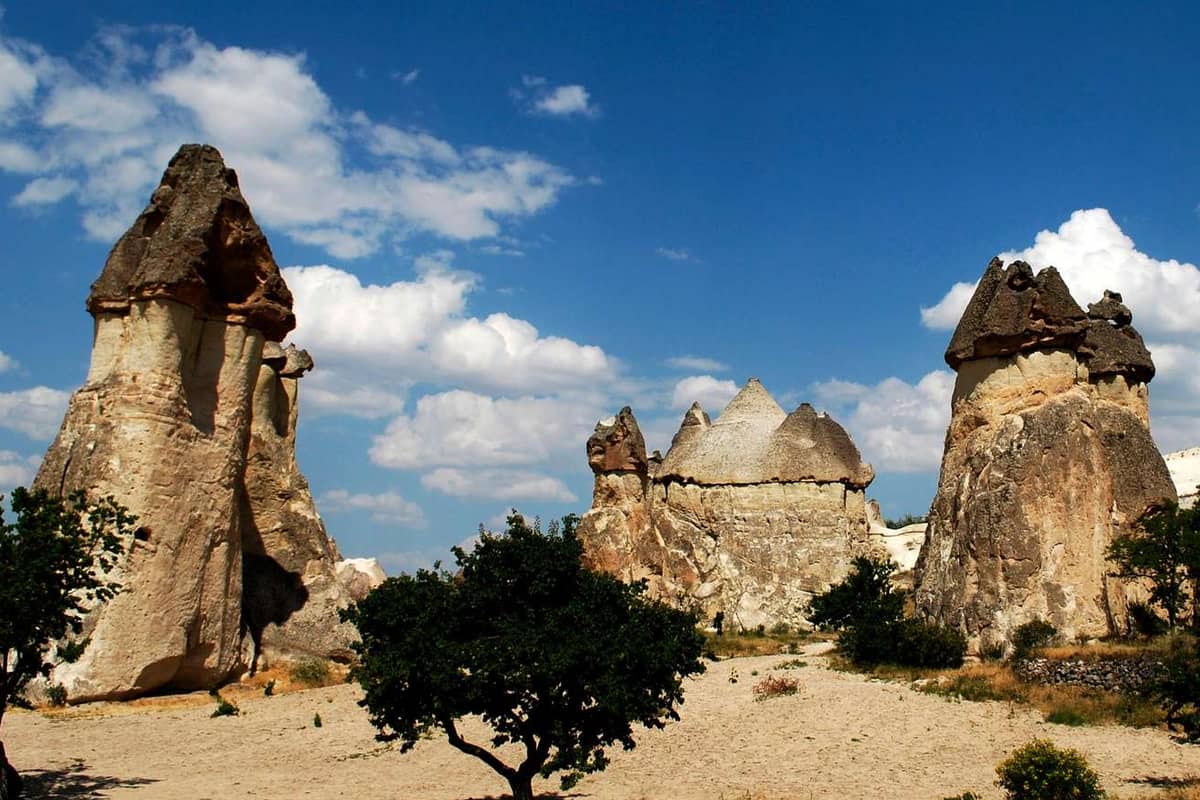
Cappadocia gives the 10 day turkey tour two days in a land of soft volcanic rock. Churches and whole villages are cut into it. Day four visits Devrent Valley, Zelve, Pasabag, Avanos and the Goreme Open-Air Museum. The Esentepe viewpoint ends the day. Day five is a second Cappadocia day.
UNESCO describes the Goreme park and its rock sites as a landscape sculpted by erosion. Ridges, valleys and pinnacles fill the area between Nevsehir, Urgup and Avanos. Two extinct volcanoes bound it: Erciyes at 3,916 metres and Hasan at 3,253 metres. The 10 day turkey tour crosses this ground on days four and five.
Devrent Valley opens day four of the 10 day turkey tour. Wikipedia’s article on Avanos notes that people see a camel in one of its rock shapes. Wikivoyage explains how such shapes form. A hard cap on a soft column twists the stone into a fairy chimney. Pink, green and yellow tints show in the stone.
Zelve is the next stop on the 10 day turkey tour. It began as a Byzantine monastery carved into the rock, as Wikipedia’s Zelve article states. Villagers have long since moved out, and the valley now serves as an open-air museum. Pasabag, the Monk’s Valley, lies 1 km away, with chimneys that end in sharp points.
Avanos lies beside the Kizilirmak, known as the Red River, and its main industry is pottery. Wikivoyage puts the Goreme Open-Air Museum one kilometre east of the town and calls its church collection fine. Church paintings in the region turn rich from the ninth century. The 10 day turkey tour reaches the museum on day four.
UNESCO lists the park under four criteria, three cultural and one natural. The listing counts more than 200 registered rock-hewn churches. The global union of geologists, the IUGS, put the region’s ignimbrite rocks among 100 geological heritage sites. The overnight coach of the 10 day turkey tour then leaves Cappadocia for Pamukkale.
What do Pamukkale and Hierapolis add to the 10 day turkey tour?
Day six of the 10 day turkey tour brings a snow-white hillside and an ancient spa city, Pamukkale and Hierapolis. Hot springs built the terraces, and a Greek town grew beside them. UNESCO lists the two together as one site. The drive to Kusadasi follows.
The overnight coach from Cappadocia ends in the valley of the Menderes river. Wikipedia places Pamukkale there, in Denizli Province, and Wikivoyage names Denizli as the nearest town, 20 km south. Coaches also run to Pamukkale from every coast resort within 100 km. On the 10 day turkey tour, a night of travel replaces a hotel stay.
Carbon dioxide makes water slightly acid, so the water dissolves limestone, Wikivoyage explains. When hot springs rich in the gas reach the surface, it escapes and the stone settles as travertine. UNESCO measures the steps from under one metre to six metres high. On the 10 day turkey tour, this white hillside is the landscape stop on day six.
UNESCO says the kings of Pergamon founded the spa town of Hierapolis late in the second century BC. Its hot springs also served to scour and dry wool. According to Wikipedia, the full length of the theatre facade still stands, at 91 metres. The 10 day turkey tour meets Pergamon itself on day eight.
Hierapolis gives the 10 day turkey tour a city of tombs as well as a spa. Wikipedia’s article ranks the necropolis among the finest preserved in Turkey, with about 1,200 tombs. They fall into four types: simple graves, stone coffins, round mounds and larger family tombs. A main street 1,500 metres long ran north to south beside the cliff.
UNESCO lists Hierapolis-Pamukkale as one site under both cultural and natural criteria. Wikivoyage says the terraces were largely placed off-limits after the listing, and the plateau hotels came down. Wikipedia adds that officials control how the water flows and shut certain sections for a time. The springs feed a canal system that reaches 70 km north-west, UNESCO adds.
What do Ephesus and Kusadasi add to the 10 day turkey tour?
Kusadasi is the Aegean coast base of the 10 day turkey tour, and Ephesus is the ancient city inland. Day seven opens up Roman Ephesus, with the Library of Celsus, a large theatre and the Temple of Hadrian. The Temple of Artemis and two Christian sites near Ephesus complete the story.
Wikipedia notes that ancient Ephesus outshone the small port of Kusadasi until silt filled the harbour of Ephesus. Today it is the Aegean coast base of the 10 day turkey tour. Wikivoyage describes a 200 metre causeway to Pigeon Island and its castle museum. Cruise ships that call at its harbour send passengers on to Ephesus, Wikivoyage adds.
Nine steps lead up to the three doors of the Library of Celsus on the 10 day turkey tour. Four pairs of columns flank them. Behind them, one hall measured 17 by 11 metres and ended in an apse. Wikipedia adds that the rebuilt library performed well when an Aegean Sea earthquake tested it.
Wikipedia credits the theatre of Ephesus with room for 24,000 spectators. The Temple of Hadrian is a compact building from the second century, according to Wikivoyage. A carving of Medusa decorates its portico. Its frieze shows Androklos, the legendary founder, with his dog. Day seven of the 10 day turkey tour walks past both.
The Temple of Artemis was counted among the Seven Wonders and has left little behind. UNESCO says the sanctuary of Artemis was founded by the second millennium BC. Pilgrims came from around the Mediterranean until Christian pilgrimage took over. Wikipedia adds that Croesus of Lydia is said to have been the main contributor to its rebuilding.
The House of the Virgin Mary, a domed chapel, stands seven kilometres from the ruins. Christian pilgrims have visited it since the fifth century. The UNESCO text also mentions the remains of Saint John’s basilica on Ayasuluk Hill. UNESCO lists Ephesus for its Hellenistic, Roman and early Christian traditions. Day seven of the 10 day turkey tour includes both sites.
What does Pergamon add to the 10 day turkey tour?
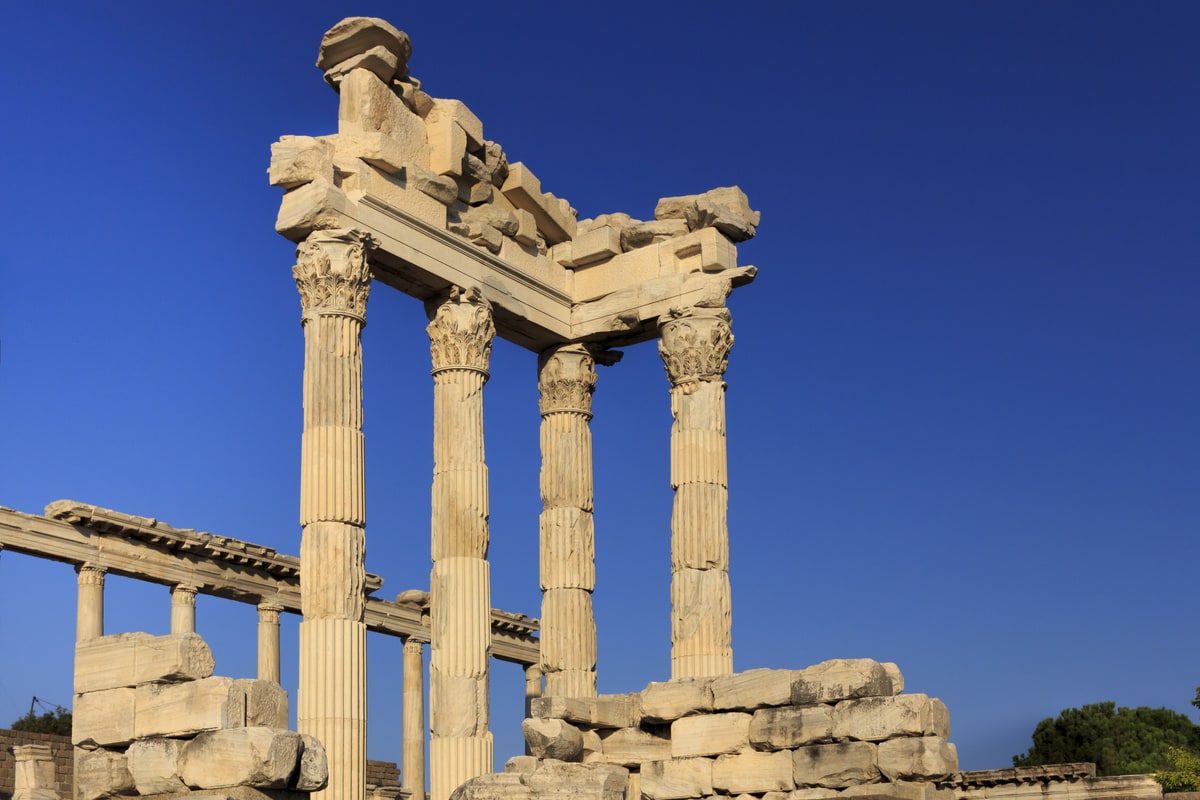
Pergamon adds a royal hill city to the 10 day turkey tour. On day eight the route climbs the acropolis above Bergama, then visits the healing temple in the valley. UNESCO lists the site as a multi-layered cultural landscape. The Attalid kings ruled from this hill from 281 to 133 BC.
The acropolis sits on a mesa made of andesite, a volcanic rock. The mesa has steep drops to the north, west and east. Three natural terraces on its south side give the way up. The old streets climbed in hairpin bends. On the south slope, the Sanctuary of Demeter had seats for roughly 800 initiates.
The Great Altar, thought to honour Zeus and Athena, stood on a shelf made by terracing. Its place was planned in relation to the neighbouring Temple of Athena. The foundations remain on the hill, while the frieze is on show in Berlin. On the 10 day turkey tour, the hill keeps the place and Berlin keeps the carvings.
Only the library of Alexandria outranked the library of Pergamon in the ancient Greek world. Pergamon held at least 200,000 scrolls. The exact building is not certain. In 133 BC the last Attalid king, Attalus III, died without an heir and left Pergamon to Rome. So the 10 day turkey tour stands where a kingdom ended.
Galen, a physician of the Roman world, was born at Pergamon. His father was an architect. At sixteen, Galen began four years of study at the local healing temple, as an attendant. His Greek name comes from a word for calm. The 10 day turkey tour therefore visits the town where he began.
The healing temple worked as a spa for the sick. Patients bathed in a sacred spring and believed the god Asclepius showed them the cure in a vision. Archaeologists found the gifts left afterwards, among them small terracotta body parts. On the 10 day turkey tour, each gift shows what its giver believed was healed.
What do Troy and Canakkale add to the 10 day turkey tour?
Troy and Canakkale add a legend and a night stop to the 10 day turkey tour. Troy holds nine cities built one on the ruins of another, and UNESCO lists the site. Canakkale is the port town where the Dardanelles are narrowest. The route rests there on the night of day eight.
After a visit to Frank Calvert, Heinrich Schliemann won permission to dig. The mound was then about 200 metres long and rose 31.2 metres above the plain. Part of the Priam’s Treasure he found now sits in the Istanbul Archaeology Museum. On the 10 day turkey tour, a ladder leads into the wooden horse monument before the gate.
The Karasids held the Asian side of the strait in the early fourteenth century. The Ottomans first took control of Gallipoli later in the same century. Mehmed II then had a fortress built at the narrowest point, and a town grew north-east of it. So the 10 day turkey tour rests in a town born as a stronghold.
From the late fifteenth century, Jewish refugees from Spain settled in Canakkale. Their community supplied ships with provisions and acted as consular agents for European nations. Spanish stayed their mother tongue into the late nineteenth century. The 10 day turkey tour rests in a port that long served ships from other lands.
In the early twentieth century Canakkale was a busy port and a stopping point for vessels on the strait. Its exports were grain, hides, wine, pottery and ceramic tiles. The city was then estimated at about 22,000 people. Today it has about 144,000, so the 10 day turkey tour rests in a much larger town.
Wikivoyage says the city has served travellers in war and peace since antiquity. Today it has an airport with flights from Ankara, and buses leave for Bursa, Istanbul and Izmir. So the 10 day turkey tour rests where roads, sea lanes and air links meet. Ankara, the capital of day three, is one of those links.
What does Gallipoli add to the 10 day turkey tour?
Gallipoli adds a quiet, respectful stop on day nine of the 10 day turkey tour. The peninsula lies in the European part of Turkey, between the Aegean Sea and the Dardanelles. Its historical national park keeps the cemeteries, memorials and battlefields of the First World War campaign.
The peninsula sits in southern East Thrace, on the European side of Turkey. In antiquity it was renowned for its wheat. A Long Wall guarded its narrowest part, an isthmus about 6.5 km wide. So the 10 day turkey tour steps onto ground that has seen farming and defence for centuries.
The park holds more than battlefields. Its heritage list counts 36 wrecks under the sea, 32 archaeological sites, 14 bastions and six fortresses. The memorials remember soldiers of five nations: Turkey, France, England, Australia and New Zealand. The Turkish government set up the park in the nineteen-seventies, so the area has been protected for decades.
Wikivoyage says the monuments and cemeteries stay open at all hours. A body of the national ministry for tourism and culture oversees the park. The battlefield sites on the west coast lie away from the main highway. A car or an organised tour reaches them. The 10 day turkey tour plans that part of the day in advance.
A poem is carved into the hillside above Kilitbahir, on the peninsula. Its opening lines ask the traveller to stop, because the soil underfoot saw the end of an era. The words set a calm tone. At Gallipoli, the 10 day turkey tour is a day for reading memorials, not for hurry.
The evening drive to Istanbul ends day nine of the 10 day turkey tour. Wikivoyage describes the same road from the other end. Gelibolu lies off the O-6 from Istanbul, and buses take four hours to reach it. Gelibolu also holds a museum for the mapmaker Piri Reis, born there. Day ten then holds only the airport transfer.
What else do travellers ask about the 10 day turkey tour?
What does a traveller wear in mosques and monasteries on the 10 day turkey tour?
A traveller covers shoulders and legs and carries a scarf for the hair on the 10 day turkey tour. Wikivoyage Turkey states the mosque rule for everyone and adds covered hair for women. Shoes come off before entering any mosque.
Mosques in tourist areas host sightseers and worshippers side by side, so Wikivoyage Turkey calls them more relaxed. Even so, the page asks for the traditional steps at mosques and tombs. At prayer, visitors stay behind the worshippers and keep silent. Friday at noon draws the largest congregation, and limited space can send visitors outside until the hall empties.
Wikipedia counts hundreds of churches and monasteries in Cappadocia, among them those of Goreme and Ihlara. Wikivoyage Turkey says church rules differ by denomination, yet mosque-style dress takes a visitor a long way. One scarf and long trousers therefore cover both kinds of door on the 10 day turkey tour.
Which airports serve Istanbul, and how do they link to the city?
Istanbul has two international airports, and the 10 day turkey tour starts at one of them. The bigger one is Istanbul Airport. Wikipedia sets it in Arnavutkoy, in the European half of the city. Sabiha Gokcen, in Pendik, is the secondary airport.
Wikivoyage puts Istanbul Airport 30 km north-west, on the Black Sea coast. Sabiha Gokcen serves the Asian side and has one terminal. The big airport is not convenient for that side. Metro line M11 serves the first airport and line M4 the second. A ferry or a rail change continues from M4 to the European side.
Wikipedia counts five concourses at Istanbul Airport, named A, B, D, F and G. It reserves Concourse G for domestic flights. Wikivoyage warns that Ataturk Airport has closed and that old signs and maps are out of date. Ask which airport the flight uses before the first transfer of the 10 day turkey tour.
How much walking does a full site day hold on the 10 day turkey tour?
A big site takes about two hours on foot, and the 10 day turkey tour strings them together. Wikivoyage times the Ephesus grounds at 90 minutes to 2.5 hours. It gives the Goreme Open Air Museum 2-3 hours along its loop trail.
At Pergamon, Wikivoyage says the acropolis takes a couple of hours. The lane up is a 3 km hike. A cable car from near the exit gate reaches the main entrance. At Pamukkale, the Town Gate route is a 15-minute climb up the terraces, barefoot, with shoes in hand.
Istanbul adds hills. Wikivoyage describes the old city as a ridge, said to carry the seven hills of Constantinople. It calls the trek modest by Balkan and Mediterranean city standards. Flat shoes with grip and a water bottle keep a site day on the 10 day turkey tour comfortable.
Is ten days enough for a first visit to Turkey?
Ten days give nine nights and eight touring days. Day one is an arrival and day ten is a transfer. The 10 day turkey tour spends them on a circuit across three regions, not on one coast.
Wikivoyage splits Turkey into seven regions. It files Istanbul and Canakkale under Marmara. Ankara and Cappadocia sit in Central Anatolia, and Pamukkale, Ephesus and Bergama in Aegean Turkey. Those three regions are the whole story of the 10 day turkey tour.
Four regions wait for a second trip. Wikivoyage describes the east as high and mountainous, with harsh winters. It lists Mount Nemrut, a UNESCO site whose summit carries ancient statues.
It also lists Ani, the ruins of a medieval Armenian capital, and Sumela, a monastery on cliffs. Oludeniz, with its Blue Lagoon, is another name on the page. The 10 day turkey tour leaves all of them for later.
What changes in a month with snow or heat on the 10 day turkey tour?
Heat and snow change the clothes and the pace of the 10 day turkey tour, not the route. Ephesus is open all year, and Wikivoyage reports summer noon heat of 36 to 37 degrees Celsius.
Ephesus hours follow the season. Wikivoyage lists a close at five in the evening from October to mid-April. From mid-April to September the close is at eight in the evening. Winter brings mild, wet days, yet the well-paved paths let a visitor step round the puddles. Check the official page for current times.
Cold months bring their own limits. Wikivoyage says Ankara winters bring snow, but the falls are seldom heavy. Istanbul in winter averages about 8 degrees by day, with wind chill. Pamukkale pools can run dry in winter, and the cold barefoot climb is miserable. Pack layers for the 10 day turkey tour in either season.