
The 7 day turkey tour fits six nights into one loop: it starts in Istanbul, drops south-west to Canakkale and Troy, follows the Aegean coast to Kusadasi, Pamukkale and Ephesus, and flies back to the Bosphorus from Izmir. Travellers who add a Greek holiday to the trip can browse the tours in Greece on this site.
The page covers the route, the seasons and what a week leaves out, then Istanbul, Hagia Sophia, the Blue Mosque, Topkapi Palace, the Grand Bazaar, the Dardanelles, Canakkale, the Gallipoli peninsula and its memorial sites, Troy, Kusadasi, Pamukkale, Hierapolis, Ephesus, the House of the Virgin Mary and Izmir, and it points to the 10 day turkey tour for readers who want Ankara, Cappadocia and Pergamon, the 11 day turkey tour that adds Cappadocia and a Bosphorus day and the 13 day turkey tour that reaches Marmaris and Fethiye on the south-west coast.
What is the 7 day turkey tour, and how does the route run?
The 7 day turkey tour is a plan of seven days and six nights. It runs south down the Aegean side of Turkey and opens and closes in Istanbul. Canakkale, Troy, Kusadasi, Pamukkale, Ephesus and Izmir lie in between. One evening flight closes the loop.
Count the days and the shape shows. Arrival fills day one and the airport fills day seven, which leaves five full days for sights. Nights break down as three in Istanbul, two in Kusadasi and one in Canakkale. Only the flight on day six leaves the road, so the 7 day turkey tour is mostly a drive.
The list below counts the days of the 7 day turkey tour.
- Day one: land in Istanbul
- Day two: Istanbul mosques, bazaar, palace
- Day three: early road to Canakkale, Gallipoli
- Day four: Troy, then Kusadasi
- Day five: Pamukkale and Hierapolis
- Day six: Ephesus, then Izmir to Istanbul
- Day seven: airport transfer
Wikivoyage files Istanbul and Canakkale under the Marmara region. It files Kusadasi, Ephesus and Izmir under the Central Aegean, and Pamukkale under the Southern Aegean. Every stop of the 7 day turkey tour therefore falls inside two regions, so the map stays small. Marmara supplies the city and the strait, and the Aegean supplies the ruins.
Water sets the order. The Dardanelles, as Wikipedia describes it, connects the Sea of Marmara with the Aegean Sea. Istanbul lies on the Marmara side. The road from the city meets the strait first and the open Aegean after it. That order gives the 7 day turkey tour its southward line.
Wikipedia’s tourism page says the focus is on historical sites and on seaside resorts along the Aegean and Mediterranean coasts. It names Kusadasi among the major resort towns. It also lists Ephesus, Troy, the House of the Virgin Mary, Pamukkale and Hierapolis as attractions. The 7 day turkey tour holds all five.
The week has three moods. The city opens it, the strait and Troy carry the middle, and the Aegean ruins close it. Istanbul fills the first two days. Canakkale and Troy fill days three and four. Pamukkale and Ephesus fill days five and six, and day seven is the transfer to the airport.
Which season suits the 7 day turkey tour?
The 7 day turkey tour suits mild air, which means late spring and early autumn. Wikivoyage lists Istanbul as pleasant in both windows, and Canakkale as mild in both seasons. Summer is hot and humid on the Aegean coast. Winter is chilly and wet in the north and milder in the south.
Wikivoyage calls the Mediterranean label simplistic for the whole country. It says the southern and western coasts fit that label quite well. The 7 day turkey tour stays on those coasts, apart from Istanbul. The Istanbul page of the same wiki puts the city in the oceanic group, with a Mediterranean touch. So the week meets two kinds of weather.
Spring is mild on this route. In Istanbul, rain and sun trade places from April to June, as Wikivoyage describes it. It calls Canakkale mild in spring, with showers that pass quickly. It also names spring as thunderstorm season for inland locations. Day five takes the 7 day turkey tour away from the coast to Pamukkale.
Summer is the hot season. Wikivoyage says the Aegean coast has hot, dry summers. In the valleys behind that coast, daytime averages sit around 35 degrees Celsius or higher. Izmir adds humidity, so July and August highs of 30 to 35 degrees feel closer to 40. Pack a hat for the 7 day turkey tour.
Autumn eases the heat. Wikivoyage lists September to November as mild in Istanbul. It calls late September to early October pleasant, with less rain than winter. Canakkale’s fall is mild too. The Ephesus page gives a closing time of five in the afternoon from October to mid-April. Site days on the 7 day turkey tour grow shorter.
Winter splits the week in two. Wikivoyage gives Istanbul winter days an average near 8 degrees Celsius, with damp air that sharpens the wind chill. It puts Izmir winter days at 12 to 16 degrees, with occasional downpours. A winter 7 day turkey tour needs a warm coat for the city days and an umbrella for the coast.
What does a week leave out of the 7 day turkey tour?
A week leaves out Cappadocia, Ankara, the south coast and the east. The 7 day turkey tour uses two of the seven major regions of Turkey. The other five hold other landscapes, so seven days work as a first look and not as a full survey.
Seven major regions share the 783,562 square kilometres of Turkey, according to Wikipedia. Central Anatolia, the Black Sea, Eastern Anatolia, Southeastern Anatolia and the Mediterranean are the five that the plan skips. No 7 day turkey tour covers that much ground, so it picks one corner.
Central Anatolia is the first gap. Wikipedia describes the relief of Cappadocia as a plateau higher than 1,000 metres, with volcanic peaks rising through it. Ankara, the capital, belongs to the same region. Wikipedia’s tourism page names its Anitkabir mausoleum as the top landmark. A week on the Aegean side cannot add a plateau as well.
The Mediterranean south is the second gap. Wikipedia places Antalya on the southwest coast of Anatolia, flanked by the Taurus Mountains. It lists Perga, Aspendos and Side in Pamphylia, and Patara, Xanthos and Myra in Lycia, as nearby ancient cities. The 7 day turkey tour reaches none of them.
The east is the widest gap. Wikipedia notes that the Anatolian plateau grows more rugged as it runs eastward. Eastern Anatolia holds Mount Ararat, the highest point of the country, and Lake Van, its largest lake. Wikivoyage adds Gobeklitepe, with the oldest known megaliths in the world. A 7 day turkey tour there is all travel time.
A first look still has value. Seven days show the pattern of the Aegean side: a city, a strait, a legend, ruins and a port. They do not show the whole country. A second visit can take one gap at a time, the plateau, the south coast or the east. The 7 day turkey tour is the first step.
How did Istanbul grow into the start of the 7 day turkey tour?
Istanbul grew from a Greek colony called Byzantium into Constantinople and then Istanbul. That long story is why the 7 day turkey tour begins here. The city lies on two continents, so day one lands a traveller where Europe meets Asia. A free evening follows.
Greek colonists from Megara founded Byzantion in the seventh century BC. Legend names a king called Byzas as their leader. Pliny the Elder gives Lygos as an earlier name. Nobody knows where Lygos came from or what it meant. So the 7 day turkey tour begins in a city with a puzzle in its name.
In the third century AD the city briefly carried the name Augusta Antonina. Septimius Severus chose it in honour of his son. Constantine the Great later rebuilt the city on a monumental scale and called it New Rome. It became his eastern capital in AD 330. The 7 day turkey tour spends its first night there.
Constantinople stayed the main official name through the Byzantine age. The West used it until the early twentieth century. The Ottomans used an Arabic form of it, Kostantiniyye, for the whole urban area. Only the walled core was always called Istanbul. That core is where day two of the 7 day turkey tour spends its hours.
The name Istanbul appears in Armenian and Arabic texts from the tenth century. One reading takes it from a Greek phrase meaning to the city. A later review prefers the Greek phrase for in Constantinople. Everyday Greek still calls the city simply the City. So the city where the 7 day turkey tour begins carries a Greek-born name.
The Bosphorus cuts through Istanbul in northwestern Turkey. Roughly two-thirds of the residents are on the European shore, the rest on the Asian shore. The Archbishop of Constantinople, known as the Ecumenical Patriarch, still has his seat in Istanbul. So a traveller on day one lands in a city that keeps its old names alive.
What do Hagia Sophia and the Blue Mosque add to the 7 day turkey tour?
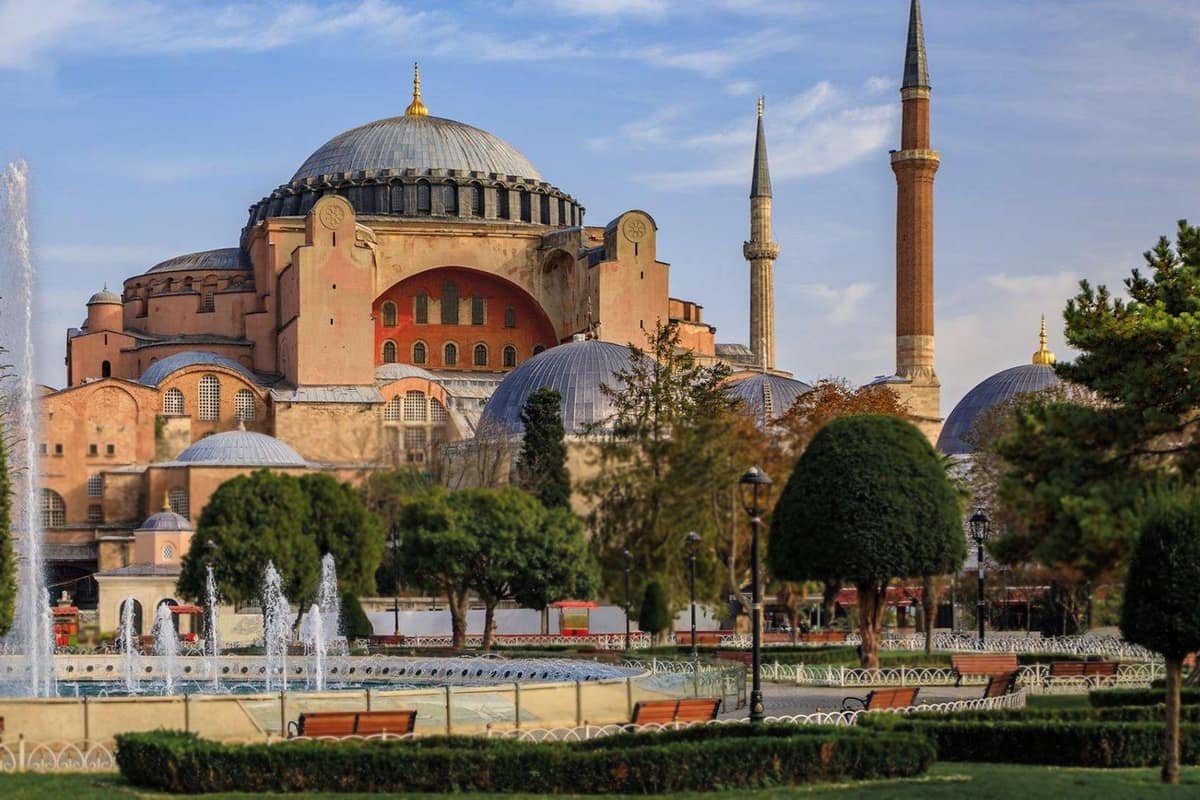
Two great domed buildings join the 7 day turkey tour on day two. One is the church of Justinian called Hagia Sophia, and the other is the mosque of Ahmed I. They stand across from each other, and the older one inspired the architects of the younger.
Emperor Justinian ordered Hagia Sophia. He chose Anthemius, a mathematician from Tralles, and Isidore, a geometer from Miletus. Builders imported columns and marble from across the Mediterranean. The walls use mortar joints one and a half times as thick as the bricks. The 7 day turkey tour reaches this church, finished in AD 537, on day two.
The dome rests on four curved triangular supports called pendentives. Forty windows around its base make the dome seem to hover. An earthquake brought the first dome down. Isidore the Younger built a new one with forty ribs, about six metres higher. The 7 day turkey tour stands under that dome.
Hagia Sophia began as a church. In the thirteenth century it served for a time as a Latin Catholic cathedral, then returned to Orthodox use. After the Ottoman conquest Mehmed II made it the first imperial mosque of Istanbul. It was a museum in the twentieth century, and the 7 day turkey tour meets it today as a mosque.
Sultan Ahmed I ordered the Blue Mosque, and Sedefkar Mehmed Agha designed it. It is one of five mosques in Turkey with six minarets. A popular tale says an architect misheard gold minarets as six minarets. Wikipedia calls the story apocryphal. The 7 day turkey tour passes all six towers.
Iznik tiles cover the lower walls, and the 7 day turkey tour meets them inside the prayer hall. Ahmed I banned tile production and sale for other uses, so his order finished on time. The finest panels sit high on the north gallery wall and show cypress trees, flowers and fruit.
What do Topkapi Palace and the Grand Bazaar add to the 7 day turkey tour?
Topkapi Palace adds the home of the Ottoman sultans to the 7 day turkey tour. The Grand Bazaar brings a covered market begun in the fifteenth century. Both stand in the Fatih district of the old city, so day two stays in one area.
Topkapi Palace is a row of courtyards that grow more private. The First Courtyard is the largest, and the church of Hagia Irene inside it served the Ottomans as an armoury. In the Second Courtyard the sultan sat on a gold-plated throne to hold audiences. The 7 day turkey tour walks through them in that order.
The Gate of Felicity opens onto the private Third Courtyard. Nobody passed it without the sultan’s authority, and even the Grand Vizier entered only on set days. The Harem wing, added late in the sixteenth century, housed the sultan’s mother, wives and children. Day two of the 7 day turkey tour covers the main rooms among hundreds of chambers.
The Imperial Treasury is housed in the Conqueror’s Pavilion, one of the oldest buildings of the palace. Its porch has views of the Bosphorus and the Sea of Marmara. The throne of Ahmed I, made of walnut and inlaid with mother-of-pearl, also stands inside. The 7 day turkey tour links this throne to the Blue Mosque, which Ahmed I ordered.
The Grand Bazaar grew around the Old Bedesten, endowed to the foundation of the Hagia Sophia Mosque. A Byzantine eagle relief still crowns its eastern gate. Fires and repairs without one plan gave the western part a maze of lanes. The 7 day turkey tour also crosses the old Hippodrome, where emperors and citizens met for chariot races.
Merchants once sat on wooden divans facing their shelves. A customer sat down with the dealer for tea or Turkish coffee. The market had no advertising and no artificial light, to prevent fires. Gates closed every night, and guards paid by the guilds patrolled it. Day two walks the same lanes today.
What do the Hippodrome and the Suleymaniye Mosque add to the 7 day turkey tour?
The Hippodrome and the Suleymaniye Mosque add a race track and a mosque complex to the 7 day turkey tour. The first is a Roman and Byzantine circus, now Sultanahmet Square. The second is a sixteenth-century mosque on a hill. The plan visits both on day two.
The word hippodrome joins two Greek words, hippos for horse and dromos for path. Turkish also calls it Atmeydani, Horse Square. Four teams raced here: the Blues, Greens, Reds and Whites. Each chariot had four horses, and up to eight ran at once. Paving in Sultanahmet Square marks the old course, which the 7 day turkey tour can follow.
The 7 day turkey tour meets red granite from Aswan in the Obelisk of Theodosius, cut for Thutmose III. Constantius II shipped it to Alexandria, and Theodosius I raised it in the Hippodrome in AD 390. Damage in antiquity left it 18.54 metres tall. Reliefs on its base show a chariot race and the raising of the shaft.
The Serpent Column first stood at Delphi, a bronze of three intertwined snakes. It honours the thirty-one Greek city-states that fought at Plataea. Constantine’s Column once held a bronze statue of the emperor that resembled the sun god. A gale felled the statue in the twelfth century, and a cross took its place.
Suleiman the Magnificent commissioned the Suleymaniye Mosque, and the architect Mimar Sinan designed it. The 7 day turkey tour finds it on the Third Hill, which looks down on the Golden Horn. It is the largest Ottoman-era mosque in the city. Sinan tucked buttresses into the outer walls, so the outline climbs in steps to the central dome.
A courtyard with marble, granite and porphyry columns leads to the prayer hall. Suleiman’s tomb, in the garden behind, was built after his death on his son’s order. The complex once held four madrasas, a medical school, a hospital and a public kitchen. The old-city walk of the 7 day turkey tour closes on this hill, with an extensive view.
How does the 7 day turkey tour reach Canakkale?
The 7 day turkey tour reaches Canakkale by road on day three, after an early start from Istanbul. Wikivoyage puts the town 310 kilometres from Istanbul. Its drive runs west, then south on the O-6 down the Gallipoli peninsula. The plan arrives around midday and visits the Gallipoli sites before the night stop.
This road day also crosses between continents. The Gallipoli peninsula lies on the European side, between the Aegean and the Dardanelles. Canakkale stands across the Dardanelles on the Asian shore, and Wikipedia notes that the strait separates the two halves. So day three of the 7 day turkey tour runs from the European side to the Asian side.
A suspension bridge now spans the strait. Wikivoyage measures it at 3.563 kilometres and says it sweeps across the Dardanelles high above Gelibolu. Nothing fixed linked the two shores before this span, and ferries still run beside it. So a road day on the 7 day turkey tour does not depend on a ferry timetable.
Wind shapes this road. Wikivoyage lists two wind limits for the bridge. Tall vehicles stop when the wind exceeds 50 kilometres an hour, and all traffic stops above 125. The same wiki also calls Canakkale windy all year. An early start gives the 7 day turkey tour room for a slow hour on the way.
On the Asian side, the highway splits near Lapseki. One branch runs east along the Marmara coast towards Bursa. The Canakkale road stays on the main route and rejoins the older highway at Kemiklialan, as Wikivoyage describes it. So the plan skips the Bursa branch, since it needs the strait town and not the Marmara shore.
A week must spend its road hours with care. The 7 day turkey tour has its first long drive on day three. Day four adds a second, from Troy to Kusadasi, which ends in the evening. After that the plan stays at Kusadasi for two nights. No hotel change comes before the flight from Izmir on day six.
What does the Dardanelles add to the 7 day turkey tour?
The Dardanelles adds a narrow strait with a long record to the 7 day turkey tour. Marmara lies at its north-eastern end and the Aegean at its south-western end. Canakkale sits on its shore, so the strait is the view from the night stop of day three.
The English name probably comes from Dardanus, an ancient city on the Asian shore. In legend, the city took its name from a son of Zeus and Electra. Helle, a king’s daughter, fell from a flying golden ram into these waters. The strait’s old Greek name honours her. The 7 day turkey tour crosses a strait of old stories.
The strait twists like a river. Its average depth is 55 metres. Two currents run through it: a surface flow towards the Aegean and a saltier undercurrent in the other direction. Sailing ships must wait at anchor for good conditions before they enter, the encyclopedia notes. The 7 day turkey tour views that water from the Canakkale shore.
Herodotus describes two bridges of boats at Abydos that carried the Persian army of Xerxes towards Greece. Harpalus the engineer is said to have lashed the ships together, bows to the current, with two anchors each. A storm destroyed both, Herodotus writes. Alexander the Great crossed here in 334 BC. The 7 day turkey tour stands beside that water.
The myth of Hero and Leander also belongs to this strait. Hero, a priestess of Aphrodite, lived in a tower at Sestos on the European side. Leander of Abydos, opposite, swam across each night, guided by her lamp. One stormy winter night the wind blew it out, and he drowned. The 7 day turkey tour reaches that shore.
Nara Castle stands north of Canakkale on the site of ancient Abydos. Wikivoyage says Abydos was a fishing port from 670 BC and the main ferry port for crossing the strait. The crossing route later shifted north, and the town was abandoned by the fourteenth century. The 7 day turkey tour meets the same water at Canakkale.
What does Canakkale add to the 7 day turkey tour?
Canakkale gives the 7 day turkey tour a night on the Asian shore, at the narrowest point of the Dardanelles. About 144,000 people live there, as Wikivoyage counts, and a university gives the town a student buzz. The plan arrives around midday on day three and leaves for Troy on day four.
The Ottomans built a fortress here called Kale-i Sultaniye, meaning fortress of the sultan. From the late seventeenth century the town was known for glazed ceramics, which the traveller Richard Pococke compared to Delftware. The place later became Canak Kalesi, the pottery castle. The 7 day turkey tour sleeps in a town named for its pots.
The old fortress is now Cimenlik Castle, open as a military museum and an art gallery. Wikivoyage calls it the Naval Museum, with boats, artefacts and exhibits on local battles. The castle was built in the fifteenth century to command the straits. The 7 day turkey tour finds a museum inside a fortress made to guard the water.
A clock tower built late in the nineteenth century signposts the old quarter. Narrow streets of cafes fill it. Wikivoyage puts the nightlife west of the harbour, near the tower. The wide waterfront promenade is the evening spot, and a horse made for a film about Troy stands there. The 7 day turkey tour ends day three beside that water.
Wikivoyage describes the City Museum as small, with signs only in Turkish. The contents of the old archaeology museum have moved to the Troy Museum, Wikipedia adds. Ferries link the town with Kilitbahir, where the second castle stands. A summer water-bus runs to the island of Gokceada, and the plan keeps to the mainland.
Wikipedia notes heavy visiting around 18 March and 25 April, when the First World War is remembered. The town’s kilns appear to have grown as rival potters at Iznik and Kutahya declined. The clumpy animal-shaped pots were once looked down on, and collectors now seek them out. So the 7 day turkey tour meets a town of craft and remembrance.
What does the Gallipoli peninsula add to the 7 day turkey tour?
The Gallipoli peninsula adds a long headland of camps, crossings and memorials to the 7 day turkey tour. Wikivoyage says the area is dotted with war memorials and cemeteries of both sides. The plan visits them on day three and returns to Canakkale for the night.
Around 560 BC the Athenian statesman Miltiades the Elder founded a major colony on the peninsula, Wikipedia records. Lysimachus, a successor of Alexander the Great, later made Lysimachia his capital there. The 7 day turkey tour visits ground that Greek settlers and rulers shaped long before the First World War.
The town of Gallipoli was the first Ottoman stronghold in Europe, Wikipedia states. It fell within a month of an earthquake that broke its walls. It then became the launch point for Ottoman expansion into the Balkans. In the Crimean War, British and French forces camped there. The 7 day turkey tour passes an old staging post.
Wikipedia’s article on the park counts 14 bastions, six fortresses and 36 underwater wrecks among its heritage. Its memorials remember soldiers from Turkey, England, France, Australia and New Zealand. A commission named for the war graves of the Commonwealth tends those plots, the same article states. The 7 day turkey tour crosses a protected heritage landscape.
Wikivoyage names CATAB, an arm of the Ministry of Tourism and Culture, as the body that oversees the park. The park article quotes its aim: to develop the area as an open-air museum. Wikivoyage adds that it is a coordinating agency, with no rangers or visitor centres. So the 7 day turkey tour visits an open-air museum.
Wikivoyage notes that the battlefields on the west coast need a car or an organised tour. Kabatepe, on that coast, holds the Epic Promotion Centre, a war museum with a film show. Gelibolu, the town in the middle of the peninsula, is not the place of the landings. So the 7 day turkey tour travels by road.
What do the memorial sites add to the 7 day turkey tour?
The memorial sites add five named places to the 7 day turkey tour. Anzac Cove lies on the shore. Lone Pine and Johnston’s Jolly share a plateau, and the Nek and Chunuk Bair sit on the ridges. All five stand close together along the Aegean coast.
Anzac Cove is called Anzak Koyu in Turkish. Wikivoyage adds that the landings are known in Turkish as the Ariburnu Battle. Plugge’s Plateau rises above the northern headland. A rock called the Sphinx overlooks the shore, as Wikipedia’s captions note. The 7 day turkey tour reaches a cove whose landing date, 25 April, is known as Anzac Day.
Lone Pine stands on a rise with a view south as far as Gaba Tepe, Wikipedia notes. Its cemetery and memorial form the main Australian place of remembrance on the peninsula. Memorial pines grown from Gallipoli seed have been planted in Australia, New Zealand and at Gallipoli. The 7 day turkey tour visits the Australian memorial.
Johnston’s Jolly is the north end of Plateau 400. Anzac troops named it after the artillery of Colonel George Johnston, used to jolly up the Turkish defenders. The cemetery was made after the Armistice, from remains found on the surrounding ground. The 7 day turkey tour pairs this ridge with the trenches and tunnels of both sides.
On Russell’s Top, the plateau beside the Nek, erosion has hidden much of the old trench system. A survey found barbed wire, ceramic pieces and food containers sticking out of the ground. The park article records one problem here: self-made footpaths across the trenches harm the historical value of the land. The 7 day turkey tour includes the Nek.
Wikipedia gives Canak Bayir, meaning basin slope, as an older Turkish name of Chunuk Bair. A memorial to the New Zealand dead was unveiled on the ridge in the nineteen-twenties. In Stratford, New Zealand, the Malone Memorial Gate honours Lieutenant-Colonel Malone, a commander there. The 7 day turkey tour ends its memorial stops on this ridge.
What does Troy add to the 7 day turkey tour?
Troy adds the walls of a Bronze Age city to the 7 day turkey tour, with an old story. Wikipedia calls the city known above all for the tale of the Trojan War in Greek mythology. The ruins welcome visitors as a tourist destination, and UNESCO lists the hill. The plan gives Troy day four, before the road to Kusadasi.
Stone walls climb a steep hill, with square towers along them: this is the Troy of the Iliad. On top stood the Temple of Athena and King Priam’s palace. Wikipedia adds that Dares Phrygius named six gates: the Antenorean, Dardanian, Ilian, Scaean, Thymbraean and Trojan. So the 7 day turkey tour sets that poem beside the stones.
The wall of Troy VI still shows its limestone base to visitors, Wikipedia notes. Its segments were seven to ten metres long and met at shallow angles, a sawtooth pattern. The blocks fit closely, with no rubble core behind them. The 7 day turkey tour therefore meets Bronze Age stonework at the hill itself.
Julius Caesar’s family claimed descent from Venus through the Trojan prince Aeneas, Wikipedia records. In 48 BC Caesar gave the city gifts. In 20 BC Augustus funded the rebuilding of the sanctuary of Athena Ilias, the council house and the theatre. The 7 day turkey tour reaches a hill that Rome cared for.
In the phase called Troy VIIb3, people reused older ruins for worship. Wikipedia names two reused places, the Troy VI walls and the ruined Terrace House. Animal bones, pottery and burned incense show worship and shared feasts. The 7 day turkey tour therefore sees walls that people revisited in ancient times.
The last city, Ilium, flourished until the founding of Constantinople, which is now Istanbul. A series of earthquakes then devastated the city around 500 AD, and only a small settlement remained. The wooden horse in the entrance square is a modern monument, not a find from the dig. The 7 day turkey tour then drives on to Kusadasi.
What does Kusadasi add to the 7 day turkey tour?
Kusadasi gives the 7 day turkey tour an Aegean base for two nights. It sits between the long road from Troy and the long trip to Pamukkale. Wikipedia lists a district of 265 square kilometres with 130,835 residents at its latest count. It calls the town a large resort on the Aegean coast.
Day four of the 7 day turkey tour ends here, after the long drive from Troy. The same hotel holds the traveller on day five, so the bags stay put during the Pamukkale trip. Kusadasi and Istanbul are the only stops where the plan sleeps in one place two nights running.
Wikipedia describes Kusadasi in antiquity as a minor port where trading vessels called. In the nineteenth century its trade declined, because the Izmir to Selcuk to Aydin railway bypassed the town. The resort of today is a recent layer on that quiet past. So the 7 day turkey tour uses a modern resort as its base.
Residents trim the name to Ada, which is the Turkish word for island, says Wikipedia. The island behind the name has a name of its own, Guvercinada, meaning Pigeon Island. A statue called Pigeons in Hand stands on the shoreline. Two nights of the 7 day turkey tour pass beside an island whose outline named the whole town.
Wikivoyage lists Zeus Cave at Guzelcamli, just outside the entrance of the Dilek national park. It is a cavern with a brackish pool 10 m deep, where a spring channel mixes with sea water. Minerals stain the pool deep blue. A legend says Zeus hid there from Poseidon. The plan leaves it aside.
Wikivoyage names the harbour as a cruise port that sends passengers on to Ephesus. Taxi drivers wait by the port for the same trip. The ride goes to the south gate of the ruins. Drivers then pick the passenger up at the north gate. So day six of the 7 day turkey tour begins close to its first sight.
What do Pamukkale and Hierapolis add to the 7 day turkey tour?
Pamukkale and Hierapolis add one UNESCO site with two sides to the 7 day turkey tour. One half is a white travertine slope. The other is an ancient spa town, Greek in origin and Roman in its rebuilding. The listed area covers 1,077 hectares, as Wikipedia gives it. The day trip on day five reaches both parts.
The white is a fresh coat, says UNESCO. New deposits of calcium carbonate give the stone a dazzling white coating. The water builds petrified waterfalls, stalactites and pools alike. UNESCO ties the colour to the water flow, so the springs matter as much as the rock. The 7 day turkey tour sees the slope in that living state.
UNESCO’s page lists the care behind the site. A protected area of about 66 square kilometres surrounds it, larger than the listed property. Visitor centres stand at the north and south entrances. Italian teams have dug there since the nineteen fifties, and the work goes on. So the 7 day turkey tour visits a site still being studied.
According to Wikipedia, Hierapolis was built on a grid, with side streets about 3 metres wide. The Frontinus Gate has three openings of squared travertine and two round towers. A later north gate, from the late fourth century, reused stone from the demolished Agora. Brackets with the heads of lions, a panther and a Gorgon lay fallen before it.
Septimius Severus built new works at Hierapolis to thank his secretary Antipater. Antipater was a native of the city and taught the emperor’s two sons. On a visit, Caracalla gave the city the title neocoros, with privileges and the right of sanctuary. UNESCO adds that the theatre hosts performances again, so the 7 day turkey tour reaches a working ruin.
Wikipedia dates the Martyrium of Saint Philip to the fifth century. It stands on the hill outside the north-east wall. The plan is an octagon 20 metres across, with eight rooms around it. Four rooms were entrances and four were chapels. Hierapolis gives the 7 day turkey tour an early Christian building beside the Greek and Roman ones.
How does the Pamukkale day trip fit the 7 day turkey tour?
The Pamukkale day trip fits the 7 day turkey tour as one long shuttle day from Kusadasi. It ends at the same Kusadasi hotel that night. Wikivoyage puts the coast about four hours by road from Denizli. Pamukkale lies 20 km north of that city, as the same page states.
Day five is the one day of the 7 day turkey tour that turns inland. Pamukkale belongs to Denizli Province and to the Inner Aegean region, within the Menderes river valley. The Kusadasi hotel keeps the bags. The traveller leaves with a day bag and returns to the same bed that evening.
The same Wikivoyage page names Kusadasi among the closest big resorts to Denizli. Its Selcuk page lists a regional train that takes three hours from Selcuk to Denizli. Selcuk is 20 km from Kusadasi. So the two road legs fill a large share of day five.
The site holds two sights in one ticketed area. Tour buses go straight to the South Gate, and a path from there leads into Hierapolis. The North Gate is the other bus and car park, with a 2 km trail down through the necropolis. Wikivoyage says each of the three gates works as an entrance or an exit.
A shuttle day leaves out the neighbours. Wikivoyage lists Laodicea, a ruined Roman city 10 km south of Pamukkale. It also lists Kaklik Cave, 30 km east, where travertine pools make a miniature Pamukkale. The 7 day turkey tour keeps to the white slope and Hierapolis. The plan has six nights and much road to cover.
The rhythm of a shuttle day is simple: the road out, the site, the road back. Wikivoyage notes one rule for the terraces: no footwear on the stone. Sandals that slip off easily suit the day. The 7 day turkey tour then returns to the same Kusadasi hotel, and day six begins close by at Ephesus.
What do Ephesus and the House of the Virgin Mary add to the 7 day turkey tour?
In the 7 day turkey tour, Ephesus on day six is a city that a king moved. Lysimachus relocated its people about two kilometres from the old settlement around the Temple of Artemis. He named the new site Arsinoea, after his second wife, and the old name returned after his death.
Inside the upper gate, the Odeon is a small roofed theatre with 22 stairs. Entrances stand at both sides of the stage. Wikivoyage’s route passes a statue of Nike and a monument to Memmius. Memmius was a grandson of the dictator Sulla. The Gate of Hercules opens onto Curetes Street. The 7 day turkey tour follows this line downhill.
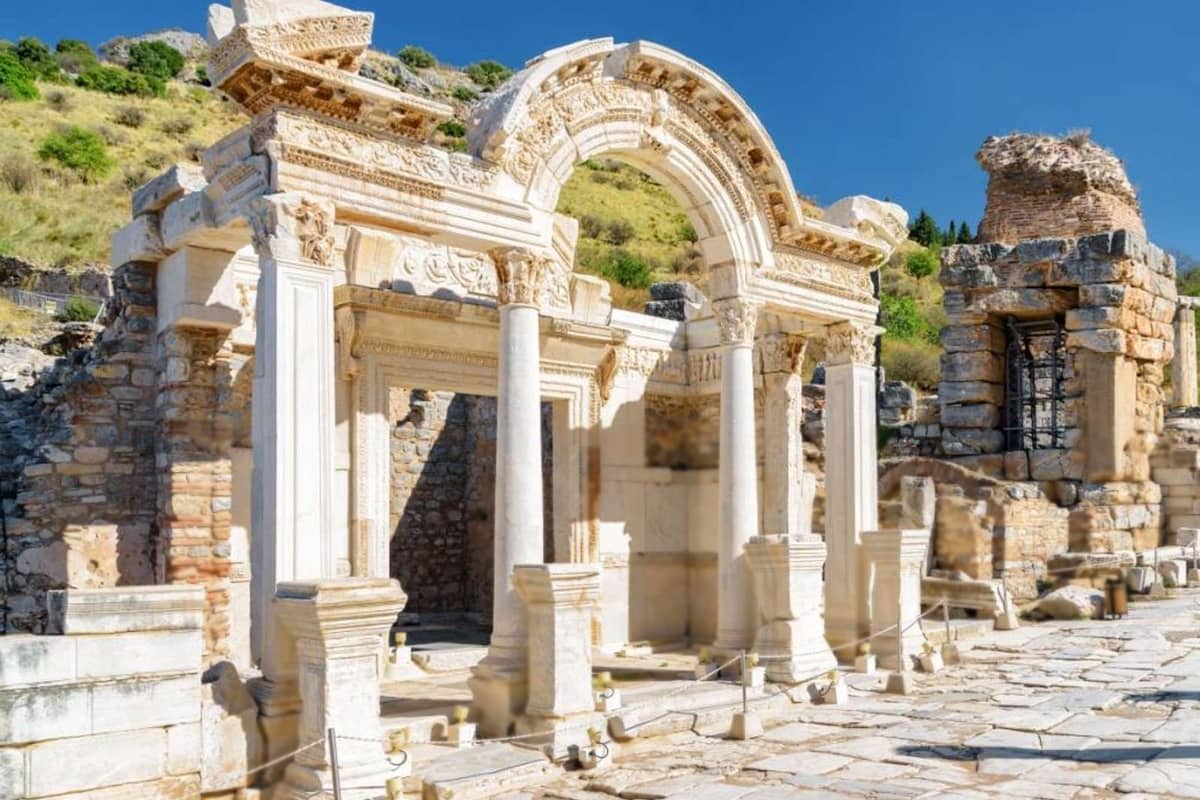
The 7 day turkey tour reaches the Temple of Hadrian, a second-century building repaired in the fourth. Its reliefs include the emperor Theodosius I, shown with his wife and their eldest son. Further on, the Library of Celsus honours a Roman consul. A marble statue of Celsus, once in its upper storey, is now in the Istanbul Archaeological Museum.
The Commercial Market, or Tetragonos Agora, lies past the library. Wikivoyage doubts that its Temple of Serapis, begun in the second century, was ever finished. The 7 day turkey tour ends the walk at the Great Theatre, which no roof ever covered. It has hosted major rock concerts, but Wikivoyage calls it too frail for loud shows now.
On day six the 7 day turkey tour reaches Mary’s House, a chapel near Selcuk on Mount Koressos. The Catholic Church has never ruled on whether it was Mary’s home. Pope Pius XII later gave the site the rank of a Holy Place, and Pope John XXIII made it permanent. Supporters cite the fifth-century Church of Mary in Ephesus.
On Ayasuluk Hill in Selcuk, the 7 day turkey tour reaches the ruins of the Basilica of Saint John. Procopius wrote that Justinian’s new church there matched the Apostles’ shrine in the capital. Its nave columns came from Constantinople or the Proconnesus quarries.
Wikivoyage adds that Byzantine aqueduct ruins, 15 metres tall, run west from Selcuk towards the hill. Storks nest on top of them, and floodlights light them at night. They stand beside the road to the basilica, so the walk to the hill passes them.
What does Izmir add to the 7 day turkey tour?
Izmir adds ancient Smyrna, a port on a broad gulf, to the 7 day turkey tour. As Wikivoyage states, the inlet was sheltered from winter storms and never silted up. Large ships found room there, and the port outgrew its rivals. It also had fertile land behind it and good trade routes inland.
Day six ends at Izmir, the exit of the 7 day turkey tour. Wikipedia counts up to 8,500 years of settlement and over 3,000 of recorded city life. The first Smyrna stood five kilometres north of today’s centre, in the suburb of Bayrakli. Folklore names it as the birthplace of Homer, though nobody knows where he lived.
Kadifekale, the velvet castle, overlooks the Gulf of Izmir from Mount Pagos. Pausanias tells how two goddesses ordered Alexander, in his sleep, to found a city here. Strabo wrote that the mound held a small share of Smyrna, and the harbour flats held the rest. The stadium and the theatre sat on the slopes below the summit.
The Agora of Smyrna lies in downtown Izmir, where Wikipedia says remains of the old water network survive. Greeks built the agora in the fourth century BC. An earthquake in 178 AD ruined it, and Marcus Aurelius ordered its reconstruction. Its parts include the Faustina Gate, the North Stoa and a Corinthian colonnade.
Konak Square names the central district, since Konak means mansion and the governor’s mansion stood there. An octagonal mosque with Kutahya tiles stands in the square. Kemeralti, the main bazaar, fills the streets east of it, and Wikivoyage calls it atmospheric. Day six leaves little time, so the 7 day turkey tour only points the way to the bazaar.
The exit airport carries the name of Adnan Menderes, a former prime minister of Turkey. It sits in the Gaziemir district, 14 km from the centre of Izmir. It replaced Cigli Air Base, which now serves only as a military base.
At peak hours an IZBAN commuter train calls at the airport station roughly every ten minutes. The D550 road, signed E87, leads south from there towards Selcuk. The 7 day turkey tour leaves the Aegean coast from this airport.
How does the 7 day turkey tour end in Istanbul?
The 7 day turkey tour ends with an evening flight from Izmir to Istanbul. A hotel night follows, then an airport transfer on day seven. Wikivoyage gives the road between the cities as 480 km, about five and a half hours with traffic. The plan flies that leg instead of driving it.
Istanbul has two airports, one on each shore of the city. Istanbul Airport serves the European side, in Arnavutkoy, near the Black Sea coast. Sabiha Gokcen Airport serves the Asian side. Wikivoyage’s Istanbul to Izmir page says the flight takes one hour and leaves hourly from each. The 7 day turkey tour lands at one of the two.
Wikivoyage adds that Istanbul Airport offers a domestic flight at least every day to each major Turkish city. Wikipedia counts five concourses there and says concourse G serves domestic flights only. International flights use concourses A, B, D and F. The 7 day turkey tour flies a domestic leg on the evening of day six.
Metro line M11 links Istanbul Airport with the city, with its station outside exit 11. Line M4 runs from Sabiha Gokcen to Kadikoy, a ride Wikivoyage puts at about an hour. The same page notes that two hours before departure is cutting it very close there. So the day-seven transfer of the 7 day turkey tour needs time.
The week follows the water from the Bosphorus at Istanbul to the Dardanelles at Canakkale. It then runs down the Aegean coast through Kusadasi to Izmir. The 7 day turkey tour gathers a city of two shores and a battlefield peninsula. It adds a legendary hill, white terraces and a Roman port city.
Day seven is only the transfer, with no sightseeing in it. Rules for entry differ by passport, so read the travel page of the government that issued yours. Timetables differ, so confirm the departure time with the operator of your plan. The 7 day turkey tour ends at an airport, as it began.
What else do travellers ask about the 7 day turkey tour?
Which drinks besides tea and coffee does the 7 day turkey tour meet?
Ayran, salep and lemonade add three more drinks to the 7 day turkey tour. Ayran blends yogurt with water and is drunk cold. Salep, a hot winter drink with cinnamon, comes from the roots of wild orchids. Lemonade traditionally comes with baklava.
Wikipedia ranks ayran first among cold drinks and says it goes with nearly every dish except fish and seafood. It comes with salt, according to taste. Wikivoyage adds that ayran is never served with sugar. Homemade ayran comes in a copper cup, by tradition. A thicker strained yogurt, suzme, is made by straining the curds from the whey.
Menus on the 7 day turkey tour hold one trap: in Turkish, soda means mineral water. Wikivoyage says what English calls soda is gazoz. Salgam is a fermented juice, mild or spicy, that is combined with kebabs. Boza is a sour-sweet drink fermented from wheat or millet and served cold.
How does a kebab meal run from soup to main dish?
A kebab meal on the 7 day turkey tour starts with soup and meze. Wikivoyage names lentil soup, mercimek corbasi, as a starter. Meze are small dishes of olives, cheese, pickles and more. The grilled main dish follows, and bread is on the table throughout.
Kebab covers more than skewers, says Wikipedia, because stews and casseroles count too. Doner is meat cut in thin slices from a large turning spit, and sis is skewered meat. Iskender kebap serves doner with yogurt, tomato sauce and butter, and it began in Bursa. Adana kebap is hand-minced meat with chili on a wide skewer.
On the 7 day turkey tour, Ephesus fills day six. Wikipedia names cop sis as a speciality of Selcuk and Germencik, near Ephesus. The dish is boneless meat, pounded, with tomatoes and garlic. Black pepper, thyme and oil marinate it on wooden skewers. Yogurt can sit beside almost any meat dish.
Which sweets and ice cream wait on the 7 day turkey tour?
Baklava, Turkish delight and dondurma are the sweets to know on the 7 day turkey tour. Wikivoyage describes baklava as layers of phyllo and ground nuts, soaked in honey and spices. Turkish delight, called lokum, helped digestion after meals in Ottoman times and carried the name rahat hulkum.
Milk puddings form a second family. Wikipedia names muhallebi, sutlac (rice pudding), keskul, kazandibi and tavuk gogsu. Kazandibi means the bottom of the kazan, after its burnt surface. Kunefe holds shredded dough around melted cheese and arrives hot, topped with pistachios or walnuts. Kaymak, a clotted cream, is served beside sweets to cut through their sweetness.
Two sweets link to places on the route. Dondurma, called gum ice cream, is one kind of ice cream made with salep powder or corn starch. Mesir macunu, a jelly-like sweet tied to Manisa or Izmir, holds 41 spices. The 7 day turkey tour passes the Izmir area on day six, on the way to its airport.
Which small manners help a visitor in Turkey?
Three small habits smooth the 7 day turkey tour. They are a slight bend for elders, a soft handshake and shoes off at a home door. Wikivoyage lists them under respect. It adds that Turkish people understand visitors do not know every custom, and they tolerate blunders.
Handshakes come with greetings and goodbyes, and Wikivoyage says a Turkish handshake is softer than a Western one. A grip that is too firm is rude. A man greeting a woman waits to see whether she offers her hand. Greeting without a handshake is acceptable, especially when the setting is informal.
If a host invites you home during the 7 day turkey tour, bring a gift. Wikivoyage says flowers or chocolate both work. Shoes come off just outside or inside the door. Do not put your feet up or show the soles of your feet to someone. Do not point a finger at a person.
Where is smoking banned on the 7 day turkey tour?
Smoking is banned in airports, metro stations, ferries, buses, taxis, restaurants, bars and cafes. That covers the 7 day turkey tour from its first airport to its last. Wikivoyage calls a breach a finable offence. Rules change, so check a government travel page before the trip.
The ban reaches public places such as schools, theatres, cinemas and government buildings. Wikivoyage lists public transport as well: planes, ferries, trains, trams, buses, minibuses and taxis. Sports stadiums are the only outdoor spaces it names. The evening flight of day six on the 7 day turkey tour falls under the same rule.
In restaurants, bars, cafes and traditional tea houses, the ban has no exceptions, Wikivoyage says. Owners who fail to enforce it face a heavy fine, so venues apply it strictly. A smoker on the 7 day turkey tour asks a nearby non-smoker for permission first. If that person objects, a stop and an apology follow, as locals do.