
The 13 day turkey tour has three parts: three days in Istanbul, a road run down the Aegean coast past Troy, Pergamon and Ephesus, and a gulet cruise along the Turquoise Coast that closes with a flight from Dalaman. For the Greek side of the Aegean, read the tours in Greece next to it.
Below come the route and the season, then the three Istanbul days, the Dardanelles crossing to Troy, Pergamon, Izmir, Ephesus, Kusadasi, Priene, Miletus, Didyma, Marmaris, Ekincik, Dalyan, Iztuzu, the bays of Kurdoglu, Manastir and Bedri Rahmi, the Gocek bays, the Yassica Islands and the exit through Fethiye and Dalaman. It leans on three sibling pages: the turkey blue cruise tour that gives the gulet a page of its own, the 11 day turkey tour that adds Cappadocia and the 7 day turkey tour that fits the Aegean sights into one week.
What is the 13 day turkey tour, and how does the route run?
This 13 day turkey tour is a thirteen-day plan in three parts. Days one to three stay in Istanbul. Days four to eight drive from the Dardanelles down the Aegean coast to its ruins. Days nine to thirteen reach the sea: a gulet cruise, then a flight from Dalaman to Istanbul.
The 13 day turkey tour has three parts because the route crosses three kinds of day. City days are spent on foot between big buildings. Ruin days are long drives with ancient sites along the way. Sea days are slow and happen on the water. The list below shows where each day falls.
- Arrival in Istanbul, welcome evening
- Old City: Hippodrome, mosques, Topkapi Palace
- Spice Bazaar, ferry, Suleymaniye, Grand Bazaar
- Gallipoli, Dardanelles ferry, night in Canakkale
- Troy, then on to Kusadasi
- Pergamon and the road south
- Kadifekale, then Ephesus
- Priene, Miletus and Didyma
- Drive to Marmaris, board the gulets
- Ekincik, Dalyan, Caunos, Iztuzu Lagoon
- Kurdoglu, Manastir Bay, Bedri Rahmi Bay
- Gocek bays and the Yassica Islands
- Fethiye, Dalaman, flight to Istanbul
On a map, the 13 day turkey tour draws a line down the west of the country. Wikipedia places Istanbul in north-western Turkey and the Blue Cruise coast in the south-west. Gallipoli, Troy and the Aegean ruins sit between those two ends. A flight from Dalaman then closes the loop at the start.
The sea part of the 13 day turkey tour is a short Blue Cruise. Bodrum, Marmaris, Fethiye and Antalya all serve as starting ports for such a voyage. This plan boards at Marmaris and lands at Fethiye. Wikipedia’s Blue Cruise page leaves the length open, from a couple of days to weeks. The gulet part here runs for three days.
The 13 day turkey tour visits four world heritage entries. Wikipedia’s tourism article lists Historic Areas of Istanbul, Archaeological Site of Troy and Pergamon. The Ephesus article records the same status for its ruins. City days and ruin days therefore both carry that status.
Which season suits the 13 day turkey tour?
Two windows fit the 13 day turkey tour: late spring and early autumn. Istanbul, where the plan opens, is quite pleasant in both, as Wikivoyage describes it. Neither window falls in the July and August heatwaves that Wikipedia notes for Marmaris.
The 13 day turkey tour crosses from one climate zone into another. Wikipedia gives the Marmara coast, with Istanbul, summer averages of 20 to 25 degrees Celsius. It gives the Mediterranean belt, which reaches Mugla and north to Manisa, summer averages of 26 to 29. The sea days therefore sit in the warmer zone.
Spring is gentle in the city. Wikivoyage calls Istanbul mild from April to June, with rain and sun taking turns. Late spring is the pleasant end of that run. A late-spring 13 day turkey tour spends its first three days there. Wikivoyage adds that size and sea give Istanbul distinct microclimates, so districts can differ in weather.
Summer is the hot season for the ruin days of the 13 day turkey tour. Wikipedia says summers on the Mediterranean belt get almost no rain. Its Fethiye page adds that the summers there are growing hotter and drier. Istanbul averages 26 degrees by day in July and August, though humid Black Sea air makes it muggy.
Autumn is the second pleasant window. Wikivoyage calls late September to early October quite pleasant in Istanbul, and less rainy than winter. It also notes that rain falls on about 150 days of the year. Rain comes down harder in summer and fall, so the 13 day turkey tour calls for a light waterproof.
Winter suits the 13 day turkey tour least. Wikipedia puts winter means on the Marmara coast between 2 and 6 degrees Celsius, with occasional snow. Fethiye is milder, at a daytime winter average of 16 degrees. Wikivoyage adds that Fethiye winters bring heavy rain and strong winds, with closures among the tourist facilities.
The coast also fills up. Wikivoyage notes that Marmaris, home to 95,851 people, more than doubles in tourist season. That count covers the extended township, which runs south into Icmeler. A 13 day turkey tour in either window stays clear of the July and August heat peak.
What do the three Istanbul days add to the 13 day turkey tour?
The three Istanbul days add the imperial heart of the 13 day turkey tour. On Wikivoyage’s account, one kilometre of Sultanahmet holds the palace, two great mosques and a cluster of museums. Day one is for arrival, so two days carry the sights.
Day two of the 13 day turkey tour opens on Sultanahmet Square, once the Hippodrome of Constantinople. Chariots raced there, and the emperor met ordinary citizens at the races, on occasions Wikipedia calls rare. Seven statues honoured the charioteer Porphyrius there. Two of the bases survive and are displayed in the Istanbul Archaeological Museum.
Next comes the Turkish and Islamic Arts Museum, on the square’s west side. Its home is the palace of Ibrahim Pasha, the second grand vizier of Suleiman the Magnificent. The building has also been barracks, a register office and a prison. Carpets, calligraphy and Qur’ans fill its rooms, and the 13 day turkey tour visits before the mosques.
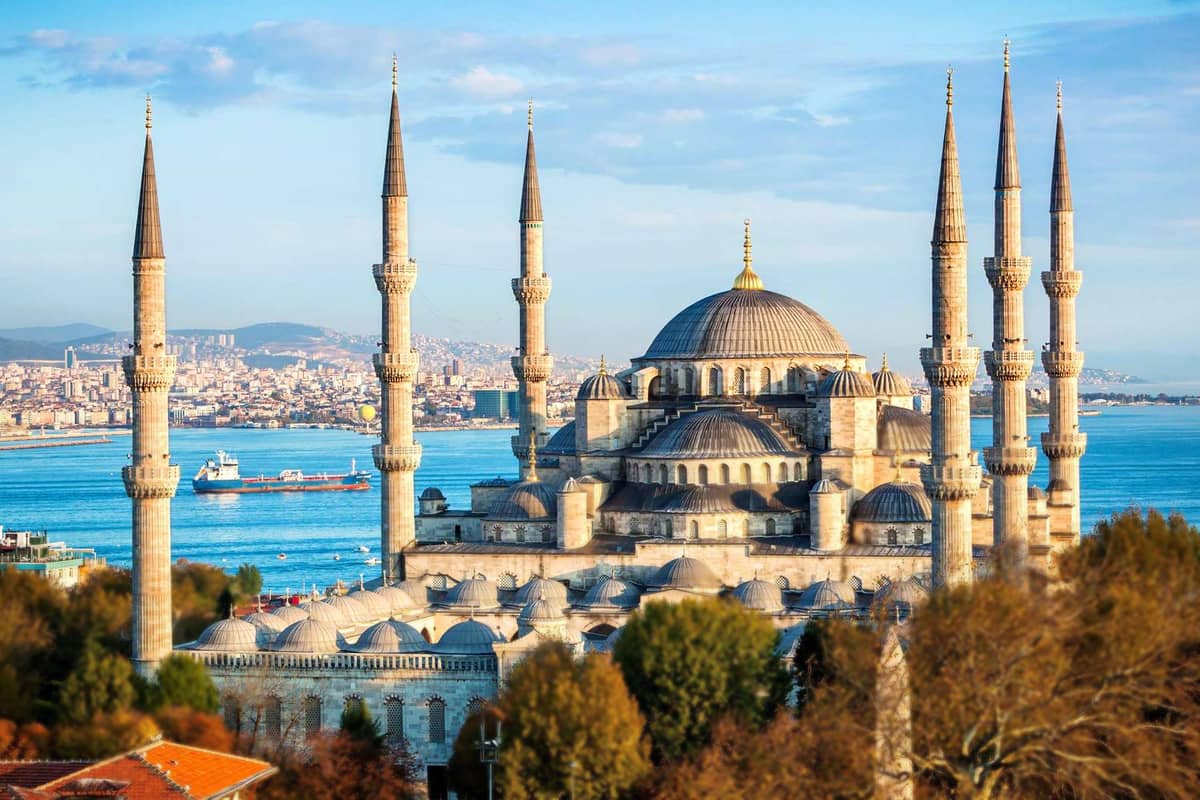
The two great buildings face each other. Hagia Sophia has been a cathedral, a mosque and a museum. Today it is a mosque again. The Blue Mosque has a central dome 23.5 metres wide. The area around it is now called Sultanahmet, after the mosque. Both fall on the Old City day of the 13 day turkey tour.
Topkapi Palace ends the Old City day of the 13 day turkey tour. Mehmed the Conqueror put his own quarters on the summit of the headland. The palace stands on Seraglio Point, above the Golden Horn, and has wide views. Pavilions wound down towards the Bosphorus shore. The museum holds Ottoman clothing, weapons, miniatures and manuscripts.
Day three turns from the hill to the water, starting at the Spice Bazaar. It holds 85 shops, and their stock runs from spices and Turkish delight to jewellery, souvenirs and dried fruit. Eminonu is a low-lying quarter by the water, north of Sultanahmet. The Bosphorus ferry follows in the plan of the 13 day turkey tour.
From the ferry deck, the 13 day turkey tour sees Europe on one bank and Asia on the other. Wikipedia calls the western banks the starting point of the European continent. It gives the strait a maximum length of 30 kilometres and a maximum width of 3.7 kilometres. Depth in midstream varies from 13 to 110 metres.
On day three, Suleymaniye Mosque echoes Hagia Sophia in its design and layout, as Wikipedia notes. Tradition has Justinian boasting that he had surpassed Solomon when Hagia Sophia opened. The Grand Bazaar then adds 61 covered streets, as Wikipedia counts them. Day two is the formal mood of the 13 day turkey tour, and day three the busy one.
What do Hagia Sophia and the Blue Mosque add to the 13 day turkey tour?
The 13 day turkey tour meets two domed halls built more than a thousand years apart. Justinian had Hagia Sophia built in the sixth century as a church. Ahmed I ordered the Blue Mosque in the seventeenth century as an imperial mosque.
Justinian began the third church on 23 February, weeks after its predecessor was destroyed. The dome spans 32.6 metres yet is only 0.61 metres thick. Wet mortar let its weight push the walls outward. After the earthquake of 558, Isidore the Younger made the walls upright and raised the dome. The 13 day turkey tour enters that rebuilt hall.
The floor is mainly marble from Marmara Island, crossed by green Thessalian bands that writers likened to rivers. Basket capitals carry the monograms of Justinian and Theodora. After the Ottoman conquest the church became the first imperial mosque of Istanbul. Sinan designed two of its four minarets, each 60 metres tall.
Opposite Hagia Sophia, Sedefkar Mehmed Agha built the Blue Mosque on the ideas of his master Sinan. Tile orders kept the whole Iznik industry busy, and the sultan banned tile sales to other buyers. The walls show cypress trees, flowers and fruit. The 13 day turkey tour reaches this mosque on the Old City day.
The four minarets at the corners of the prayer hall have three balconies each. The two at the courtyard corners have two. The courtyard holds 26 columns and 30 domes. Ahmed I’s tomb stands by the Hippodrome square. A hospital and a soup kitchen were built over the curved southwest end of the old race track.
What does Topkapi Palace add to the 13 day turkey tour?
For the 13 day turkey tour, Topkapi Palace is both the sultans’ home and the seat of their government. It is a spread of low buildings around courtyards, not one tall block. Each of the four main courts sits behind a gate, and the First Courtyard is the largest.
Gilded calligraphy with Qur’an verses crowns the arch of the Imperial Gate. In the First Courtyard, the church of Hagia Irene served the Ottomans as an armoury. The Gate of Salutation leads on to the Second Courtyard, and only the sultan rode through it. The 13 day turkey tour passes these gates during the Old City visit.
The Imperial Council of the Grand Vizier and the ministers met in a domed chamber called Kubbealti, “under the dome”. A window with a golden grille let the sultan listen unseen. The Tower of Justice, the palace’s tallest structure, is a landmark visible from the Bosphorus. The day-three ferry of the 13 day turkey tour follows that strait.
The 13 day turkey tour visits a palace whose private courts lie beyond the Gate of Felicity. The Harem housed the sultan’s mother, wives, children and servants, each group around its own courtyard. In the Treasury, the Topkapi Dagger was made for Nader Shah of Persia. He was assassinated before the gift left the empire.
The Fourth Courtyard holds pavilions that look out over the water. The gilded Iftar Pavilion looks over the Golden Horn. The Grand Kiosk looks over the Sea of Marmara and the Bosphorus. Sinan rebuilt the kitchens after a fire, with two rows of 20 chimneys. Topkapi closes the Old City visit of the 13 day turkey tour.
How do the Bosphorus and the Dardanelles shape the 13 day turkey tour?
The Bosphorus and the Dardanelles are the two straits at either end of the Sea of Marmara. The 13 day turkey tour uses both. A ferry follows the Bosphorus through Istanbul on day three. A car ferry crosses the Dardanelles to Canakkale on day four.
Ancient Greeks explained the name Bosporos as “cattle passage”. It links to the myth of Io, a woman turned into a cow. Everyday Turkish shortens the name to Bogaz, “the strait”. At its narrowest, between Kandilli Point and Asiyan, it is about 700 metres wide. On day three, the 13 day turkey tour sails along this water.
The Golden Horn is an estuary that branches off the strait. It once worked as a moat for Constantinople and as a sheltered anchorage for imperial navies. The strait itself helped Constantine choose the site for his new capital. The 13 day turkey tour looks down on the junction from Topkapi.
Between the straits lies the Sea of Marmara, which links the Black Sea to the Aegean. Its surface water is low in salt, close to the Black Sea’s. Its deep water is as salty as the Mediterranean’s. Four gulfs cut into its southern coast: Izmit, Gemlik, Bandirma and Erdek.
The Dardanelles, also called the Strait of Gallipoli, winds from northeast to southwest like a river. The Gallipoli peninsula forms its European bank, and the Troad forms its Asian bank. Its ancient name, Hellespont, means “Sea of Helle”. The Bosphorus frames the city stay of the 13 day turkey tour, and the Dardanelles opens the Aegean coast.
How does the 13 day turkey tour cross the Dardanelles to Troy?
The 13 day turkey tour crosses the Dardanelles by car ferry on day four, after an early drive south. The ferry lands at Canakkale on the Asian shore, where the plan stops for the night. Troy follows on day five, before the long road on to Kusadasi.
Two ferry lines serve Canakkale. Wikivoyage times the Eceabat ferry at 25 minutes and the Kilitbahir ferry at 15. So the 13 day turkey tour spends less than half an hour on the water. Eceabat, a small modern town, is also where the yearly swim across the Hellespont starts. Bad weather can stop sailings.
Kilitbahir, the village that gives the shorter ferry its name, means ‘the key of the sea’ in Turkish. Mehmed II built its castle with a clover-shaped plan and three courtyards. The inner castle has seven floors, and a small military museum sits inside. The Sari Kule, a tower of big cut stones, came later, under Suleyman the Magnificent.
Canakkale stands at a pinch point only 1.5 km across, Wikivoyage notes. It served as a crossing place and a post controlling shipping. Northeast of the town the strait widens into the Sea of Marmara, then narrows again as the Bosphorus. So the 13 day turkey tour crosses the twin of the strait it sailed on day three.
Troy stands on the mound of Hisarlik. Nine cities rose there, each on the ruins of the one before. In the late eighteenth century a French scholar named a mound near Pinarbasi, 5 km south, as Troy. That view held for almost a century. Day five of the 13 day turkey tour visits the accepted site.
Dares Phrygius lists six gates for the city of legend, from the Antenorean to the Trojan. Homer’s poem sets King Priam’s palace on the hilltop, beside a shrine to Athena. The upper layers, VIII and IX, already drew visitors thanks to that myth. So the 13 day turkey tour follows an old habit.
The Troy Museum on the 13 day turkey tour stands 800 metres east of the mound. The four-floor cube wears rust-coloured weathering steel, which gives the look of an object dug from the site. Its collection counts over 40,000 artefacts. UNESCO calls Troy a cultural bridge linking the Troad with the Balkans, Anatolia and the Aegean.
What do Pergamon and Izmir add to the 13 day turkey tour?
Pergamon brings a royal hill city and a healing sanctuary to the 13 day turkey tour on day six. Day seven opens in Izmir, at the hill fort of Kadifekale. Wikivoyage places Bergama, the town below Pergamon, 120 km north of Izmir. It lists the ruins among Turkey’s top sights.
Wikivoyage links the name Pergamon to a word meaning hill. The acropolis rises 335 metres above sea level. The massif is 5.5 km long and one kilometre wide. Its small peak carries the upper city. In Hellenistic times Elaia, at the river mouth, served as the port. On day six the 13 day turkey tour climbs that hill.
The 13 day turkey tour reaches the foundations of the Great Altar. Its inner frieze, 1.60 metres high, told the life of Telephus, a son of Heracles and the city’s mythical founder. The Attalids traced their line to Heracles, and the Seleucids claimed Apollo. Citizens called themselves Telephidai. The reliefs now stand in Berlin.
The Heroon was a shrine to the dynasty’s kings, among them Attalus I and Eumenes II. The temple of Dionysus on the 13 day turkey tour has an Ionic porch, four columns wide. One kilometre south, the forecourt of the Red Basilica rests on the Pergamon Bridge. It is 193 metres wide, the largest bridge substructure of antiquity.
The library, second only to Alexandria’s, fell out of use after the Roman takeover in 133 BC, Wikivoyage says. The sanctuary of Athena had a two-storey stoa added under Eumenes II. Weapon reliefs on its balustrade marked his military victory. On day six the 13 day turkey tour climbs through that sanctuary.
The 13 day turkey tour then drops to the Asclepieion, in the valley 3 km south of the acropolis. What stands today dates from Hadrian’s restoration in the second century AD. Over 300 such healing temples are known in the Roman world, says Wikivoyage. A theatre of 3,500 seats and a circular treatment centre belong to the site.
Strabo wrote that Smyrna’s hill held a minor share of the city. The larger share lay by the harbour, while a stadium and a theatre filled the slopes under the top. In the fourteenth century the Aydinids captured the hill castle, while the Genoese held the port. Day seven of the 13 day turkey tour starts at the hilltop.
What do Ephesus and Kusadasi add to the 13 day turkey tour?
Kusadasi adds a resort base to the 13 day turkey tour on day five. Ephesus, on day seven, adds one of the largest Roman sites in the eastern Mediterranean. Ephesus overshadowed the small port of Kusadasi, and the shadow lifted only when silt blocked the old harbour.
The 13 day turkey tour rests at Kusadasi, on the coast of the old Ionian League. Ephesus was one of its twelve cities, and Panionium, 25 km south of the town, was the central meeting place. The ruins are poorly preserved, and their authenticity is debated. Ionians settled the Kusadasi area in the ninth century BC.
Pliny says the Temple of Artemis took 120 years to build. It ranks among the Seven Wonders, yet one column is all that stands. A British Museum dig in the nineteenth century revealed it. Fragments of its frieze went to London and to Istanbul. So the 13 day turkey tour meets this Wonder through its traces.
On the 13 day turkey tour, the Library of Celsus is a rebuilt facade. Austrian archaeologists dug up its fragments in the early twentieth century. The German archaeologist Volker Michael Strocka led the rebuilding in the nineteen-seventies. Copies fill the gaps where originals went to museums in Vienna and Istanbul. The interior stays in ruins.
Ephesus also holds the Fountain of Pollio, raised in AD 97 for the builder of the Marnas aqueduct. Its front is concave. The Temple of the Sebastoi, also called the Temple of Domitian, was among the largest temples in the city. Its plan had 8 by 13 columns.
The 13 day turkey tour also climbs Ayasuluk Hill in Selcuk. In the sixth century Justinian tore down a small ruined church there and built a far larger one. Next door stands the Isa Bey Mosque, finished in the fourteenth century. Its Syrian architect took the Great Mosque of Damascus as his model.
In Selcuk, the Ephesus Archaeological Museum shows about 64,000 pieces from Hellenistic, Roman and Early Christian times. Its star exhibit is the ancient statue of Artemis from her temple. Mary’s last home, in Roman Catholic tradition, stands 7 km from Selcuk. The 13 day turkey tour adds it to day seven. Three recent popes have visited this place of pilgrimage.
How do the Ionian cities link on the 13 day turkey tour?
Four stops of the 13 day turkey tour belonged to the Ionian League. They were Ephesus, Priene, Miletus and, later, Izmir, then called Smyrna. Herodotus named twelve founding cities, as Wikipedia records. Didyma was never a city, only a sanctuary on the land of Miletus.
Kinship and worship bound the cities, not a state. Wikipedia calls the league religious and cultural, not political or military. Delegates met on Mount Mycale for the Panionia, a festival of Poseidon. A new temple went up there around 540 BC. The 13 day turkey tour visits neighbours who shared a festival, yet never formed one state.
Geography put them side by side. Ionia proper was a narrow strip between sea and mountains. Wikipedia gives it no more than 150 kilometres from north to south. A voyage along its indented coast was reckoned at nearly four times the straight distance. Three river valleys fed the strip: the Hermus, the Cayster beside Ephesus and the Maeander.
Herodotus sorted the twelve by speech. Miletus, Myus and Priene shared one Ionic subdialect, and Ephesus shared another with five other cities. Chios with Erythrae made a third group, and Samos had a dialect of its own. Smyrna, an Aeolic city beside the Ionians, joined later. The 13 day turkey tour opens its seventh day in Izmir, its modern successor.
Wikipedia calls the Didyma sanctuary the largest on the territory of Miletus. The Didymeia festival, first recorded at the start of the third century BC, ran under that city’s care. Strabo set the border of Ionia and Caria at an altar of Poseidon six kilometres away. The Ionian day of the 13 day turkey tour closes near a frontier.
What does the Aegean Region add to the 13 day turkey tour?
The Aegean Region gives the 13 day turkey tour its western coast. Wikipedia counts it as one of seven geographical regions of Turkey, with Izmir as its largest city. It holds the longest coastline of the four coastal regions. Days six to eight of the plan run through it.
Wikipedia bounds the region by the Aegean Sea to the west and the Marmara Region to the north. Central Anatolia lies to the east, the Mediterranean Region to the south. It lists eight provinces, among them Izmir, Aydin and Mugla. On day nine the 13 day turkey tour moves from Aydin Province into Mugla Province, both on that list.
One listed area is named for the Buyuk Menderes, the Great Meander. The river is 548 kilometres long, rises near Dinar and reaches the Aegean close to Miletus. In Wikipedia’s account, its winding course gave the English word meander. The 13 day turkey tour meets the old delta of that river at Priene and Miletus on day eight.
The river built new land. Ancient writers, as Wikipedia reports, said its mud pushed the coast four to six kilometres seaward. Small islands joined the mainland. Wikivoyage adds that Lake Bafa was an inlet of the sea until the Maeander closed its outflow. Mount Mycale, behind Priene, runs out into the Aegean as a peninsula pointing at Samos.
Wikipedia describes a Mediterranean climate on the shore. Summers are hot and dry, and winters are mild to cool and wet. The semi-arid interior has cold, snowy winters. Wikivoyage says Aegean olive oil was exported across the Mediterranean. The grapes are mainly the sultana kind, dried into raisins. The 13 day turkey tour keeps to the coastal side.
What do Priene, Miletus and Didyma add to the 13 day turkey tour?
Priene, Miletus and Didyma add three Ionian sites south of Ephesus to the 13 day turkey tour. Day eight visits all three. Priene is a planned town. Miletus is a city of thinkers and harbours. Didyma holds the temple of a great oracle, so the day moves from streets to ideas to prophecy.
Priene was laid out on a plan in the fourth century BC, on the slopes of Mount Mycale. Its article counts six main streets about six metres wide, crossed at right angles by fifteen narrower ones. That makes about eighty blocks, with eight houses to a block. The 13 day turkey tour climbs a town set out like a chessboard.
Alexander the Great offered to fund the Temple of Athena Polias, and it was dedicated in 323 BC. Pytheos, the architect of the Mausoleum at Halikarnassos, designed it. Five columns stand again, raised from rubble and three metres shorter than the calculated original. The town council met in a hall like a little theatre under a wooden roof.
Miletus was home to the Milesian school: Thales, Anaximander and Anaximenes. The Ministry of Culture and Tourism page for the site treats Thales as the father of philosophy. It credits Hecataeus of Miletus with the first world map. On day eight the 13 day turkey tour stands in a city that shaped early Greek science.
The Delphinion was the sanctuary of Apollo Delphinios, beside the Lions’ Harbour. Its courtyard measured about 60 by 50 metres and held altars and statue bases. Its inscriptions record treaties and lists of officials. Silt from the Maeander later left the ruins about 10 kilometres from the sea. The 13 day turkey tour sees an inland port.
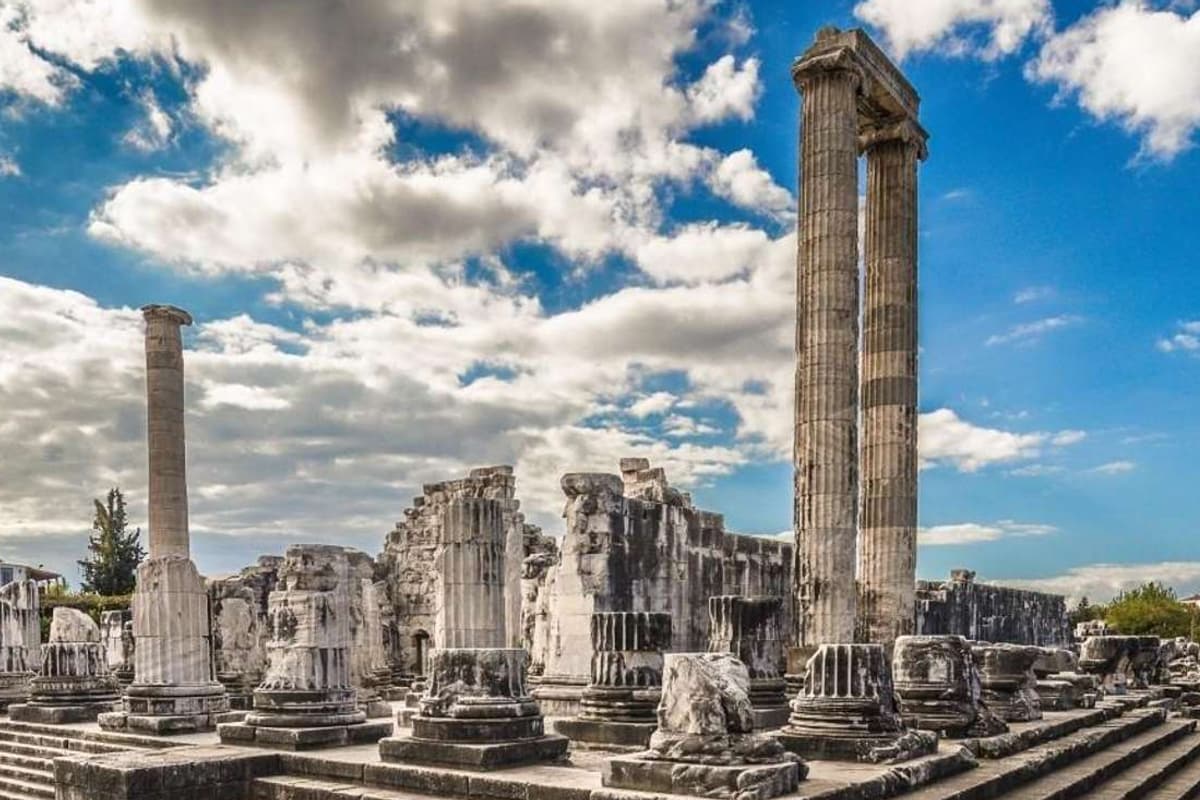
Didyma lay at the end of a Sacred Way about 20 kilometres long, built for festival processions from Miletus. Its temple had a double ring of Ionic columns, each 19.70 metres high. Work ran on for over 600 years, and the temple was never finished. The 13 day turkey tour closes the day at one of the great unfinished temples.
Inside, two sloping tunnels led to an open courtyard with walls 25 metres high. Above the oracle spring sat the priestess, and her answers came in verse. At Didyma, unlike Delphi, questions and answers were written down. In the stadium beside the temple, spectators cut their names into the steps to mark their seats.
How does the 13 day turkey tour reach Marmaris and the gulets?
The 13 day turkey tour reaches Marmaris on day nine, after the three Ionian sites. The drive ends in Mugla Province, where the plan boards its gulets for the Turquoise Coast. Marmaris has a natural harbour and is one of two towns where gulets are built.
The sites of day eight lie in Aydin Province, while Marmaris belongs to Mugla Province. Wikivoyage names the E87, also numbered D550, as the road through both. It calls Marmaris a port and beach resort on the Mediterranean coast. So the 13 day turkey tour turns from Aegean ruins to the southern shore.
In the sixth century BC the place was called Physkos. Wikipedia describes a fine harbour there and a grove sacred to Leto. Wikivoyage adds that mountains hem the harbour in and leave no hinterland, so Marmaris never grew into a major port. The 13 day turkey tour arrives at a small harbour with a long past.
Marmaris was a place where fleets met before they sailed on. Suleiman the Magnificent gathered ships here before his attack on Rhodes, as Wikivoyage tells it. In the late eighteenth century Nelson mustered his fleet here before sailing for Egypt. A British force of 120 ships then spent eight weeks at anchor in the bay.
The resort is young. Wikivoyage describes a small, sleepy fishing and trading port until tourism spread along the coast from the nineteen-eighties. Dalaman airport was upgraded in the last year of that decade. That put the town within a 90 minute coach transfer. The 13 day turkey tour reaches the result of that boom.
On day nine the 13 day turkey tour boards a gulet. The Turkish word was borrowed from Venetian and French terms for a schooner. Marmaris is one of two towns that the gulet article names as builders. Bodrum yards kept building boats for fishing, sponging and trade with the islands into the nineteen-thirties.
A rounded stern and a clipper stem mark the Bodrum type. The tirhandil is an older, double-ended Aegean boat. A handful of them are left among today’s blue cruise boats. The nineteen-seventies brought a rapid rise in shipyards and workshops. Day nine ends aboard, and the sailing starts the next morning.
What do Ekincik, Dalyan and Iztuzu add to the 13 day turkey tour?
Ekincik, Dalyan and Iztuzu add a river, an ancient port and a turtle beach to the 13 day turkey tour. Day ten leaves the gulet at Ekincik, then goes by boat to Dalyan village, Caunos and the mud baths. The plan reaches Iztuzu, where Caretta caretta turtles nest.
Day ten follows the river that flows from Koycegiz Lake to the sea. The lake is one of Turkey’s largest coastal lakes, and the dunes of Iztuzu Beach created it in antiquity. Boats are the preferred transport in Dalyan, which sits on this river. The 13 day turkey tour travels through a maze of reeds.
Caunos shipped salt, salted fish, pine resin and dried figs, as its article lists. Its ruler Mausolos built walls too big for the town, the article suggests, expecting a busy port. Silt closed its harbours, and a malaria epidemic in the fifteenth century left the city abandoned. The 13 day turkey tour visits ruins that lay forgotten.
The palaestra at Caunos was a wrestling school with Roman baths. In the Byzantine era the cold room of the baths became a church. A wind-measuring platform from about 150 BC was used in city planning. A temple of the third century BC faces a circle of columns, one of six temples dug up so far.
Mud baths sit on the same river. At Sultaniye a thermal spring has a water temperature of 40 degrees Celsius, says the article on the protected area. Another mud bath lies downriver, where the Nile turtle can be spotted. That turtle has a soft shell and grows to about one metre. The 13 day turkey tour includes the mud baths.
The Iztuzu sandbar closed the old estuary and ended Caunos as a port, as Wikivoyage explains. The beach is about 4.5 kilometres long and has had protected status since the nineteen-eighties. It sits in a reserve that was the first of its type in Turkey. The 13 day turkey tour reaches a beach that reshaped the coast.
The loggerhead turtle, Caretta caretta, is endangered and dates back about 45 million years. Adults mate in a bay warmed by thermal springs in late April. Eggs are laid at Iztuzu in late spring and early summer. Vehicles and pets are banned, and the beach shuts at night. The 13 day turkey tour visits under these rules.
What do the Lycian rock tombs add to the 13 day turkey tour?
The Lycian rock tombs add an ancient people to the 13 day turkey tour. Lycia was a region of the south-west coast, with its own language and its own league of cities. Its cliff tombs look down on the Dalyan river on day ten and on Fethiye on day thirteen.
The Teke Peninsula sits at the heart of Lycia, between the Gulf of Fethiye and the Gulf of Antalya. The gorges of the Dalaman River were the traditional border with Caria. That river reaches the sea west of Dalaman, where day thirteen of the 13 day turkey tour ends.
The Lycian League held a general assembly for its twenty-three cities, as Strabo is quoted. The largest cities held three votes, the middle ones two and the small ones one. Classical writers listed Telmessos, today’s Fethiye, as Carian at times and Lycian at others. That town is where the gulets of the 13 day turkey tour land.
Lycians cut their tombs to set types. The Tlos article separates house-type rock tombs from temple-type rock tombs. The Tomb of Bellerophon there is temple-type, with four columns on an unfinished front. The Lycia article pictures the Dalyan tombs as rock-cut and temple-like. Day ten of the 13 day turkey tour brings that kind into view.
The tombs along the route date to about 400 BC. The Dalyan article gives that date for the tomb fronts above the river. A sign at Telmessos gives it for Fethiye. Lycian is attested only from about 500 to 300 BC, in a script adapted from the Greek alphabet of Rhodes. Both dates fall inside that span.
What does Turkish food add to the 13 day turkey tour?
Turkish food adds a map you can taste to the 13 day turkey tour. Wikipedia ties Istanbul and Izmir to Ottoman court cooking: moderate spice, rice over bulgur, vegetable stews, stuffed dolmas. The plan opens in Istanbul and reaches Izmir with the Kadifekale visit on day seven.
Dishes take the names of places. Urfa kebab is less spicy and thicker than Adana kebab. Kebabs are common abroad, yet meals in Turkey centre on rice, vegetables and bread. A home meal starts with soup, then a vegetable dish, pilav and a salad. That pattern shapes the meals of the 13 day turkey tour.
Meze open the meal, with or without drinks, and a plate can stand as a main dish. Cacik is cucumber with yogurt, dried mint and olive oil, and the English word yogurt is Turkish. Artichoke dolma is an Aegean speciality, and days five to eight of the 13 day turkey tour follow that coast.
The cuisine article lists fish as grilled, fried or poached. Bugulama steams fish under a lid with lemon and parsley. Pazida levrek wraps sea bass in chard leaves. In Eminonu, grilled fish in bread with tomato and onion is a fast food. The Spice Bazaar stands in that quarter on day three of the 13 day turkey tour.
Dough and honey close the table. Gozleme is folded flatbread or phyllo with spinach or cheese, cooked on a griddle. Pide is a broad, flat wheat bread, and yufka is a thinner one. Wikivoyage calls the pine honey of Marmaris darker and thicker than flower honey. The 13 day turkey tour boards its gulets there on day nine.
What do Kurdoglu, Manastir Bay and Bedri Rahmi Bay add to the 13 day turkey tour?
Day eleven of the 13 day turkey tour sails past Cape Kurdoglu and then splits its hours between two bays. Manastir Bay holds the lunch swim, and Bedri Rahmi Bay holds the night at anchor. Wikipedia names Cape Kurdoglu as the western edge of the Gulf of Fethiye, where Fethiye and Gocek sit.
The cape has a partner on the far side. Wikipedia puts Cape Iblis, also called Cape Angistro, at the eastern edge of the same gulf. The same page adds that yachting and tourism draw people to this water. The 13 day turkey tour therefore sails into a gulf with two clear gateposts, one at each end.
A sailing-coast page describes the shore before the cape. The Dalaman plain runs for 6.5 miles, and planes using the airport pass overhead. Two small islands near Gocek give poor shelter but good diving in fair weather, the page says. It also asks skippers to watch for rocks under the water off Kurdoglu.
Manastir is the Turkish word for monastery, and a travel page glosses the bay as Monastery Bay. The page says ruins of a monastery lie under its water. The lunch swim of the 13 day turkey tour takes place in that bay. A map page adds a huge stone seagull on the north side of one cove.
A second ruin lies in the same bay. The travel page names a sunken bath, also called Cleopatra’s Bath. It adds a belief that the queen bathed there herself. A map page lists Ruin Bay and Cleopatra’s Bay as neighbouring spots. The bay gets one lunch swim.
Bedri Rahmi Bay carries the name of a painter with two notable siblings. Wikipedia calls his elder brother Sabahattin a well-known writer. His younger sister Mualla was one of the first restoration architects. She is known for her work on the Harem section of Topkapi Palace. The 13 day turkey tour sees that palace on day two.
After a Paris exhibition of African art, the painter took up woodblock printing, to let more people see his work. He also made mosaics, and Wikipedia lists a 250-square-metre panel for the Brussels Fair. Istanbul Modern shows his art today. The 13 day turkey tour spends its last night in that city.
What do the Gocek bays and the Yassica Islands add to the 13 day turkey tour?
Day twelve of the 13 day turkey tour cruises between the Gocek bays. It spends the night at the Yassica Islands. Wikivoyage says the Twelve Islands, or Oniki Adalar, dot the Gulf of Gocek and are visited by boat trips.
Gocek has an older name. Wikipedia says the town was Callimache in ancient times and lies between Telmessos and Caunos. A local legend adds that Icarus landed in the sea near Gocek after his flight. The 13 day turkey tour has seen Caunos already and ends at Telmessos, so day twelve links the two.
The harbour did not begin with yachts. Wikivoyage says it was built to ship out logs. Chromium ore was mined nearby from the nineteenth century. The town grew into a resort in the nineteen-eighties. Wikipedia adds that special protection bans multi-storey buildings, and hotels have two floors. The 13 day turkey tour cruises past that old cargo coast.
A tunnel changed the way in. Wikivoyage says a tunnel replaced the old hairpin road over the mountains. Wikipedia gives the toll tunnel a length of 980 metres. Gocek lies 19 kilometres east of Dalaman Airport, a coach ride of about 30 minutes, as Wikivoyage states. The 13 day turkey tour flies out from that same airport.
Gocek Island is the large island that shelters the village, and Wikivoyage lists good beaches there. Wikipedia adds that a water taxi runs from the harbour to the main island beach. The town has no beach, because boat wharfs line the shore. Boats are the way to the sand.
The Yassica Islands are a cluster of tiny islets in the Gulf of Gocek. One travel page counts five, and another says they carry no names of their own. Two pages describe the largest island. One gives it a sandy beach, and the other a small natural pool at its tip.
A charter page says the islands have no road and no settlement, so visitors arrive by sea. The same page says the channels between the islets are shallow enough to show the seabed. A day cruise from Fethiye gives four islets one hour each, as Wikivoyage says. The 13 day turkey tour gives the Yassica Islands a whole night.
How does the 13 day turkey tour end at Fethiye and Dalaman?
The 13 day turkey tour ends on day thirteen. The gulet reaches Fethiye in the early afternoon. A road leads to Dalaman, and a flight returns to Istanbul. Wikipedia names Dalaman Airport as one of three airports serving south-west Turkey, with Milas-Bodrum and Antalya.
Fethiye sits on a gulf with ancient names. Wikipedia lists the names Gulf of Telmessos and Glaucus Sinus for it. The ancient cities of Lydae and Telmessos lay on its shore. The 13 day turkey tour ends its sea days on the shore of that old Lycian gulf.
Telmessos was known for a school of diviners. Wikipedia records that Croesus consulted them before declaring war on Cyrus. Alexander the Great reached it in 334 BC, after the siege of Halicarnassus. It later carried the name Anastasiopolis for a time, apparently in honour of an emperor. The 13 day turkey tour ends in that old town.
The Tomb of Amyntas is cut into the mountainside on the south side of Fethiye. Wikipedia traces its name to a Greek inscription that reads Amyntou tou Ermagiou, meaning Amyntas, son of Hermagios. The page calls its interior spacious beside other tombs cut into mountainsides. The 13 day turkey tour ends in a town beneath a cliff of tombs.
Fethiye is also where a long trail starts. Wikivoyage describes the Lycian Way as 540 kilometres of marked path for hikers, and Fethiye is its western end. The first section runs nine kilometres to the abandoned village of Kayakoy. The 13 day turkey tour trades that walk for a boat and a flight.
Dalaman is a river town. Wikivoyage says the small Dalaman river carved a fertile plain, so the land around the town is farmland. The flat plain was an obvious site for an airport. A local myth says a late Ottoman mansion there is a railway station built by mistake. The plan crosses this plain.
Istanbul has two international airports, as Wikipedia states, and Wikivoyage says Dalaman Airport has daily flights from both. A bus from Istanbul to Fethiye takes 14 hours, so the flight replaces a long road day. A hotel night in Istanbul follows. A transfer on the last morning closes the 13 day turkey tour.
What else do travellers ask about the 13 day turkey tour?
What is a hamam, and which rooms does a bath visit pass through?
A hamam is a public steam bath, and the 13 day turkey tour lists no bath stop. In Istanbul, the Bayezid II Hamam now houses a museum about hammams. A traveller who wants a bath adds it as a private choice.
An Ottoman bath starts with the changing hall, the camekan. The article says it can be the largest domed chamber, with a central fountain and wooden galleries. The hall doubles as a lounge, where bathers chat over sherbet, tea or coffee on either side of the wash. The warm room, the iliklik, links the hall to the hot room.
The hot room, the hararet or sicaklik, drew the richest decoration. A large heated marble table, the gobektasi or navel stone, took its centre for bathers to lie on. Wikivoyage says baths offer a scrub, a massage or both. It warns that cleanliness varies, so a traveller on the 13 day turkey tour chooses with care.
How is Turkish tea made and served on the 13 day turkey tour?
Turkish tea arrives hot in a small tulip-shaped glass called an ince belli. Wikipedia names Rize tea from the Black Sea coast as the main Turkish tea. The 13 day turkey tour meets a glass at breakfast, in shops and in tea gardens.
A pair of stacked teapots, the caydanlik, does the work. The lower one boils the water. The small one on top brews the leaves into a strong liquor. The host thins each glass from the lower pot. A guest asks for koyu, dark, or acik, light. Beet sugar cubes come with it, and milk or lemon almost never join.
Tea gardens draw tourists too, the page notes, in Sultan Ahmet and Taksim in Istanbul. Wikivoyage adds that a round of tea follows a meal or a long shop visit. Hold the glass by the rim on the 13 day turkey tour, since the tea is served boiling hot.
What is Turkish coffee, and why does UNESCO list its culture?
Turkish coffee is brewed from very fine grounds in a pot called a cezve and served unfiltered. The grounds stay in the cup. UNESCO has put the drink and its customs on a worldwide list of living heritage. A cup on the 13 day turkey tour joins that tradition.
Sugar is named at the order, so a traveller on the 13 day turkey tour needs a short word list. Sade is plain, az sekerli adds a little, orta a moderate amount, and cok sekerli is sweet. Wikipedia adds that Turkish delight comes alongside and that a glass of water is sipped first.
The habit is old in Istanbul. The article dates the first coffeehouse there to the sixteenth century, opened by two Arab merchants. Suleiman the Magnificent kept a chief coffee-cook, the kahvecibasi, and it became a custom for sultans. Wikivoyage warns against drinking the sludgy grounds left in the cup.
What does a Turkish table offer along the Aegean coast?
The Aegean table of the 13 day turkey tour rests on olive oil, vegetables, herbs and fish. Wikipedia names olive oil as the main cooking oil in the west, where olive trees grow thickly. The same article calls Aegean cooking rich in vegetables, herbs and fish.
Breakfast shows the style on the 13 day turkey tour. A Turkish breakfast spreads cheese, olives, tomatoes, cucumbers, jam and honey, as Wikipedia lists it. Cilbir pairs poached eggs with yogurt. Wikivoyage adds that bread arrives in a large basket at any meal. The thin sesame ring called simit goes by the name gevrek in Izmir.
The sea supplies the main course. Wikivoyage names levrek, the sea bass, and cipura, the gilthead sea bream. Both are cooked whole on the grill with herbs and olive oil. It calls the Aegean easy for vegetarian travel. Wild herbs, eaten cooked or raw with an olive oil dressing, serve as main meals there.
How do travel, sight and sea days divide the 13 day turkey tour?
Thirteen days hold twelve nights, and the 13 day turkey tour spends them in three blocks: city, ruins and sea. Days one to three belong to Istanbul. Days four to eight hold the road and the Aegean sites. Days nine to thirteen turn to the gulets.
Four days on the 13 day turkey tour carry a long move. Day one is the arrival at Istanbul airport. Day four is the drive to Gallipoli and the car ferry to Canakkale. Day nine is the drive to Marmaris and the boarding. Day thirteen ends with the road to Dalaman and a flight to Istanbul.
The 13 day turkey tour lists no free day, so the slow hours sit at sea. Days five to eight are four site days in a row, from Troy to Didyma. Days eleven and twelve hold sailing, a lunch stop and nights at anchor, with no ruin. Treat them as the rest.