
An Aegina day trip starts at the port of Piraeus, a short ferry or hydrofoil ride from central Athens, and ends with the crossing back on the same day. Compare the ways to make the trip, then browse tours in Greece for more ideas on the islands of the Saronic Gulf.
This page explains how the day runs and how long it lasts, then follows the island in the order a visitor meets it: the crossing, Aegina Town, the Temple of Aphaia, Kolona, Paleochora, the monastery of Saint Nectarios, the pistachio, Perdika, the beaches and the inland island. The history of the island and a comparison of the kinds of day trip come next, and a FAQ closes the page.
What is an Aegina day trip, and how does it work?
An Aegina day trip is a return journey from Athens to the Saronic island of Aegina within one day. You sail from the harbour of Piraeus. You spend the hours ashore on the sights and the sea, then head home in the evening.
Wikipedia counts Aegina among the Saronic Islands, with a distance of 27 km to Athens. From west to east the island spans about 15 km. It spans about 10 km between its northern and southern tips. Its surface area is 87.41 square kilometres, which suits an Aegina day trip well.
Your Aegina day trip by public boat or on a guided tour begins in Piraeus harbour. Wikipedia puts Piraeus 8 km southwest of central Athens. Wikivoyage tells travellers to follow the signs for Aegina to Gate E8. It adds that the gate can shift, so check the electronic screens.
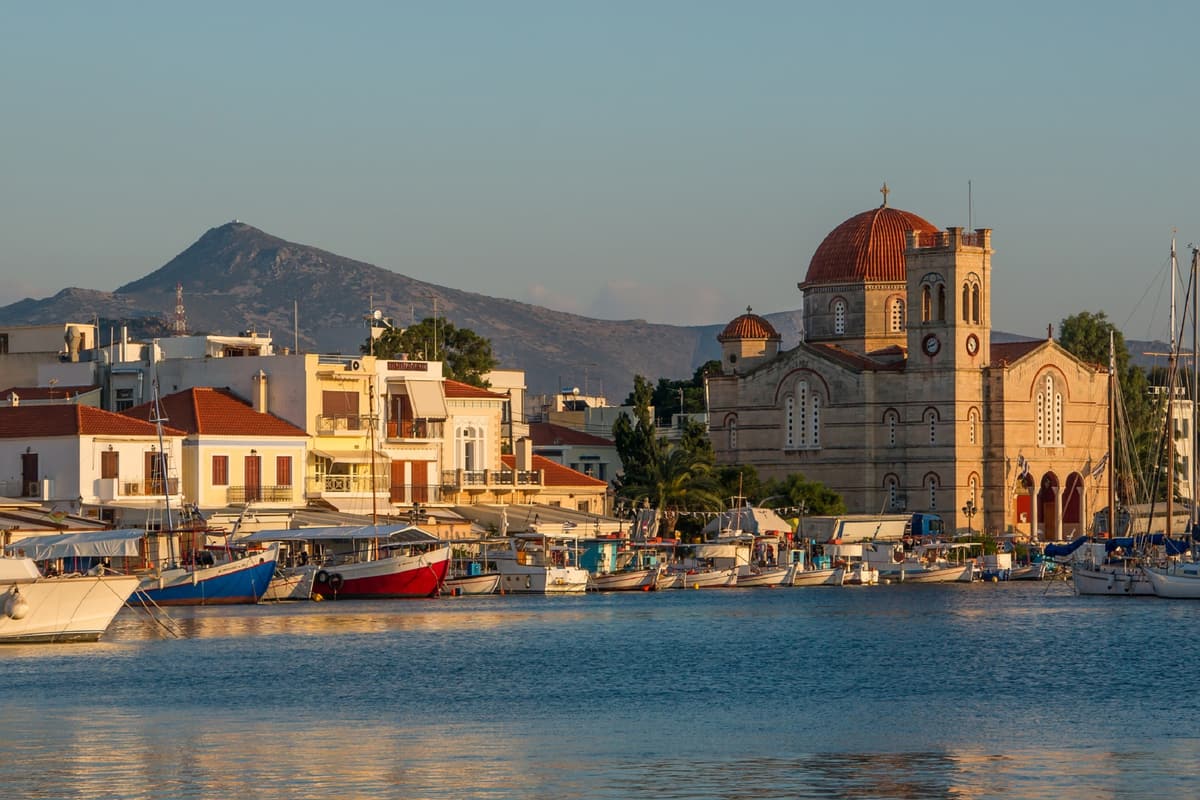
The boat docks at Aegina Town. Wikipedia names it the regional capital and places it in the northwest of the island. Wikivoyage says the town is mainly geared to day-trippers. From the quay, a guided group boards a coach. A traveller on their own walks the town or takes the island bus.
Wikipedia lists three draws today: pistachios, the pilgrim site of Saint Nectarios and the Temple of Aphaia. Those three give the day its shape. Wikivoyage names two reasons to visit: an old port that offers a break from the city heat, and the temple. A beach swim and a seafood lunch fill the gaps between the sights.
Two operator pages list the same stops for a guided Aegina day trip. The medieval town of Paleochora, the monastery of Saint Nectarios and the Temple of Aphaia come first. A beach swim, a pistachio tasting and free time in Aegina Town follow. One page adds a trip attendant on the ferry and a coach.
An Aegina day trip comes in three forms. You can go on your own by ferry or hydrofoil, join a guided day trip, or board a day cruise. One page says a one-day Saronic cruise visits Aegina, Poros and Hydra. It gives only one to two hours at each island. Each form ends with the crossing home.
How long is an Aegina day trip from Athens, and when does it run?
A guided Aegina day trip from Athens lasts 11 hours on two operator pages. One of them counts 4.5 hours on the island itself. On your own, the first and last boats of the day set the length.
Both operator pages give the guided Aegina day trip as 11 hours. The count runs from the meeting at the port of Piraeus to the return there. One page lists 4.5 hours on the island and two hours on the beach. The other page also lists two hours of free time for the beach and seafood.
Both pages end the island part in Aegina Town. One lists a walk toward the port past neoclassical mansions, then a pistachio tasting. The other lists free time in the town, with the same tasting. That is how a guided Aegina day trip closes.
The crossing takes a share of that time. One operator page gives the ferry crossing as 75 minutes. The other page says Aegina is only 70 minutes from Athens. Both crossings together add up to more than two hours at sea on a guided Aegina day trip.
On your own, the boat timetable sets the day. Wikivoyage lists hydrofoils every hour between 7:00 and 17:00 in normal times. Another page lists the first fast boat at 7:30 and the last one at 7:30 in the evening, in summer.
A third page lists ferries between 7:20 and 20:30. The times differ, so look up the current schedule before you book an Aegina day trip. The guided trips meet at the Piraeus port. One page says the meeting point can vary, so read the booking details.
An Aegina day trip runs in every season, as one page states, with 15 daily connections throughout the year. Another page lists 4 to 6 ferries a day in winter, against one every one to two hours in summer. One blog lists late spring to early autumn as the time to visit.
One independent plan sets the first boat at 7:30 and the arrival at 8:30. The temple takes 90 minutes from 9:00. The beach follows at 10:45, lunch is at 1:00, and the boat home leaves at 6:00 in the evening. Another page recommends at least seven to nine hours ashore, which fits a full Aegina day trip.
How do you reach Aegina on an Aegina day trip: by ferry, by hydrofoil or on a cruise?
An Aegina day trip starts at Piraeus, the port that lies eight kilometres south-west of central Athens. A hydrofoil reaches the island in about 40 minutes, and a regular ferry in about an hour. A day cruise adds a swim stop on the way.
Wikipedia puts the largest harbour in Greece at Piraeus, the chief port of the country. For an Aegina day trip, Wikivoyage tells travellers to look for signs reading Aegina and Gate E8 inside the port. The electronic screens show the true gate, which can move to E7. Another page lists Gates E8 and E9.
Getting to the port is simple. One page says Line 1, the green metro line, runs from Monastiraki to Piraeus in 25 minutes. From the station, the gate is a short walk: one page counts two blocks, another counts 10 to 15 minutes. The X80 bus also runs from Syntagma to Piraeus, about 30 minutes by one page.
The crossing comes at two speeds. Wikivoyage says hydrofoils carry foot passengers only and take 40 minutes. Conventional vessels need 70 minutes, and they take cars and motorbikes. Wikipedia gives forty minutes and about an hour for the same two boats. An Aegina day trip on your own works with either one.
The route runs across the Saronic Gulf. As Wikipedia states, the Attica and Argolis peninsulas form the gulf, and Aegina is one of its islands. The same page says commercial shipping keeps the gulf busy.
On an Aegina day trip, one travel writer left the lounge for the top deck. It was sunny and warm in early April. From a chair there, the writer watched the ferry pass cruise ships in the harbour. Tankers and freighters lay at anchor outside it. Houses on Aegina came into view as the island drew near.
A day cruise reshapes the Aegina day trip. Two operator pages describe a boat from Marina Zeas in Piraeus. It calls at Agistri, then at Moni or Metopi, where guests swim, and ends at Aegina. Both pages give a day of about ten hours, with lunch on board.
At the swim stop, both pages invite guests to jump in from the boat, and one adds snorkelling. That page says the choice between the two islands depends on the weather. It also says the plan can change for weather or safety reasons.
One page says the boat leaves at nine in the morning. It reaches Aegina at around three in the afternoon and starts back at about half past four. Check the times on the operator page, as they can change.
What do you see in Aegina Town on an Aegina day trip?
Aegina Town is both the capital of the island and its main port, so an Aegina day trip begins here. Tiny coloured fishing boats moor in its long harbour. Cafes, fish taverns and little shops line the waterfront.
Wikipedia says the island’s buildings are neoclassical, blended with a strong folk element, and date from the nineteenth century. Another page adds bright colours and narrow streets. The backstreets reward an Aegina day trip on foot. One travel writer finds colourful doors, vintage signs and bakeries there.
One page says a fresh food market in town sells the catch of the day each morning. A second page puts the fish market on a road parallel to the waterfront.
A travel writer notes small grills with octopus on them. They mark the ouzeries that serve fish mezedes along the quay and in the streets behind it. Athenians come here to drink ouzo and eat seafood, and an Aegina day trip can share that habit.
A short carriage ride is one way to begin an Aegina day trip. One page says horse-drawn carriages gather on the waterfront of Aegina Town and run from spring to autumn. The drivers take visitors around the town and its suburbs. One travel writer’s driver pointed out the churches and the pistachio farms.
The Archaeological Museum of Aegina holds ancient vessels, pottery, ceramics and statuettes, as Wikipedia lists them. Another page says it shows finds from the temples of Apollo and Aphaia. A visit adds a short lesson in the past to an Aegina day trip.
The small chapel of Agios Nikolaos sits right at the harbour, and Wikivoyage places it on the west pier. A pedestrian market street holds shops with postcards and T-shirts. Boats along the dock sell vegetables, as one travel writer tells it.
Wikivoyage describes the town as geared mainly for day-trippers, and an Aegina day trip is exactly that.
Why is the Temple of Aphaia the highlight of an Aegina day trip?
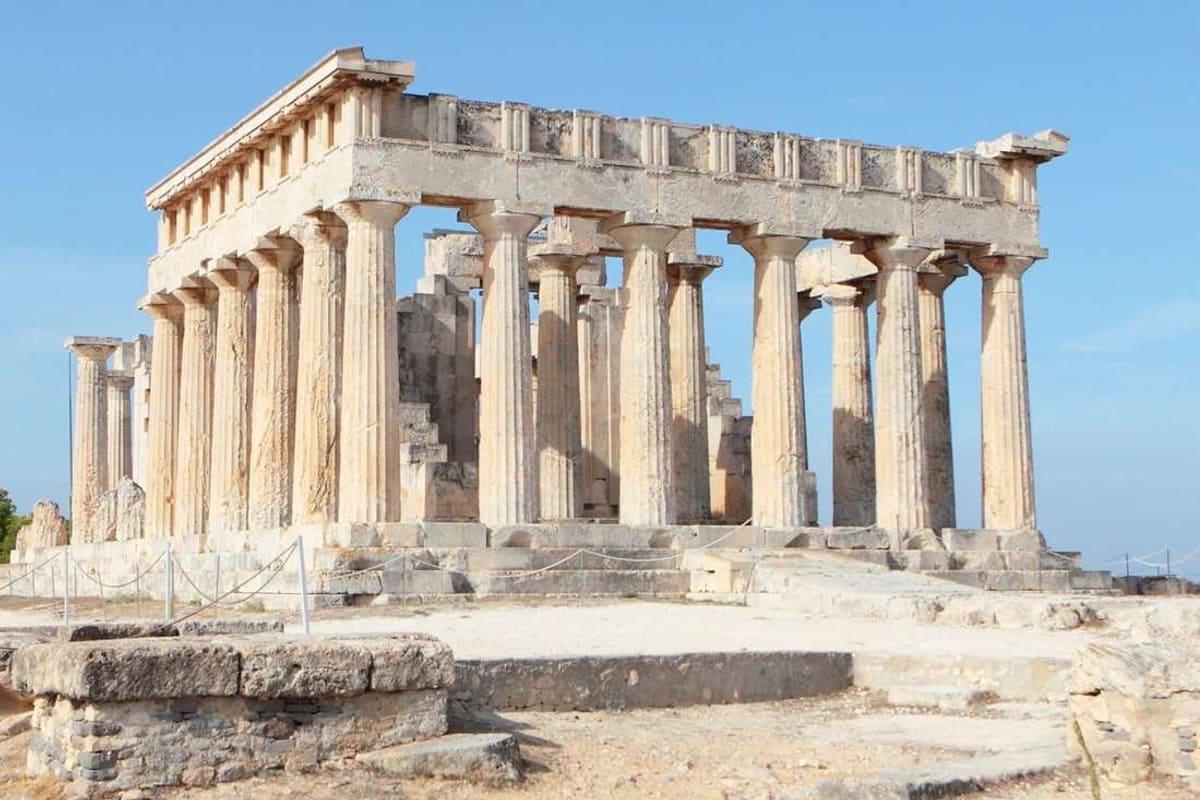
Of all the ancient sites on an Aegina day trip, the Doric Temple of Aphaia ranks first. It crowns a pine-covered hill in the east of the island, thirteen kilometres east of Aegina Town by road.
The temple standing today goes back to about 500 BC, Wikipedia says. An older temple, from about 570 BC, once stood on the same spot and burned around 510 BC. The plan has six columns across the ends and twelve along the sides. About two dozen of the thirty-two columns still stand.
Wikipedia says people honoured Aphaia, a local goddess, at this one sanctuary only. Late Bronze Age figurines were found here in large numbers. So an Aegina day trip reaches a cult older than the stone temple. Her worship blended with that of Athena and Artemis by the second century BC, Wikivoyage says.
The pediments carried painted marble figures. The east pediment shows Heracles and Telamon at Troy, with Athena at the centre. The west pediment shows the war that Homer tells, with Ajax prominent. Wikipedia reads their style as the change from Archaic to early Classical art. An Aegina day trip meets a turning point.
In the early nineteenth century the fallen figures were removed from the site. Wikipedia places the marbles in the Glyptothek in Munich today. The site museum shows a restored section of the older temple’s upper wall and pediment. An Aegina day trip shows where the marbles stood, though the main groups are in Munich.
The hill rises about 160 metres. On a clear day, Wikipedia says, the Acropolis of Athens shows across the gulf. Another page names Cape Sounion as well. J. M. W. Turner painted the temple. From the hill, an Aegina day trip looks back toward Athens.
Getting there is simple. Wikivoyage lists a blue bus route from the harbour bus stand past the temple to Agia Marina. On weekdays, three buses a day pass the temple. Taxis and hired cars also work; a heritage page gives about seventeen minutes by car. An Aegina day trip on your own can use any of these.
Day cruises treat the temple as an extra. Two operator pages call a coach excursion to it optional. One page gives the temple and the monastery together as a tour of about fifty minutes. Another page describes a drive across the island that skips the site. So the line-up differs from one Aegina day trip to the next.
What is Kolona, and what does it say about ancient Aegina on an Aegina day trip?
A hill beside the harbour, Kolona keeps the last standing column from the Temple of Apollo. On an Aegina day trip, it shows the island’s long past, from the Neolithic age to the first Christian centuries.
Kolona means column. A single column of the Doric temple survives, and pages date the temple to the sixth century BC. Two pages say Venetian sailors named the hill after the temple columns, which they saw from the sea.
The hill held a village long before the temple. Pages place the first houses in the Late Neolithic period. Wikipedia names Kolonna as the key site of Aegina in the Early Bronze Age, a fortified place built of stone. A museum page says the settlement flourished in the third millennium BC.
The settlement had wide contacts. Wikipedia names the Greek mainland as the chief partner. Finds also show touches of the Cyclades and of Crete. The island’s place between Attica and the Peloponnese made it a site of trade. An Aegina day trip therefore starts at a hill that looked outward over the sea.
A museum page says the settlement was destroyed and rebuilt about ten times. Two pages say the hill was a place of worship and the acropolis of Aegina from the seventh century BC. People left the hill by the end of the first millennium AD. Each layer adds to what an Aegina day trip can show.
The museum stands beside the site. It opened in the early nineteenth century as the first museum of the free Greek state, a museum page says. Three rooms run from the first villages to Roman times. A short stop here fits an Aegina day trip well.
One room shows a copper foundry inside a house of two floors, dated to the Early Helladic period. Other cases hold inscriptions and local sculpture of the seventh to fifth century BC. Pediment fragments from the Archaic temples of Apollo and Aphaia are also on show. Wikivoyage calls the museum small.
From the harbour, Wikivoyage places the hill half a kilometre north. A heritage page puts the main port about fifteen minutes away on foot. The hill overlooks the port, so the walk shows the ferries coming and going. A visitor needs no bus for this part of an Aegina day trip.
What is Paleochora, and is it part of an Aegina day trip?
Paleochora is the abandoned medieval capital of Aegina, a hill settlement of small Byzantine churches. One kind of trip stops there, another skips it, so the route decides if an Aegina day trip includes it.
Paleochora stands on a hill inland, facing the monastery of Saint Nectarios. Wikipedia calls it the main settlement of the island, from the Middle Byzantine period to the early nineteenth century. On an Aegina day trip, you meet it as a ruined town, not as a living village.
People moved up the hill in the ninth century to stay safe from raids from the sea. Two pages agree on this. The hill was a strong point inland. When the raids faded in the early nineteenth century, families moved down to the town of Aegina. Your ferry lands in that town on an Aegina day trip.
The religious-sites page counts 38 churches that still stand on the hill. They are small single-aisle churches, with cross-in-square and twin churches among them. Wikipedia adds that the houses left almost no trace, not even foundations. A castle once crowned the summit, and its ruins remain. Ruins and churches make up this stop on an Aegina day trip.
Wikipedia states that a number of the churches keep their wall paintings inside. Two pages single out the church of Agios Nikolaos Mavrikas, with paintings from the fourteenth century. Paintings like these are the sight on the hill for an Aegina day trip. The Archaeological Service of western Attica, Piraeus and the Islands oversees the site.
The monastery lies about six kilometres from the port, as two pages state, and Paleochora faces it. Wikivoyage says a footpath climbs from the monastery church. The road to the temple passes by, says Wikipedia. One page names a taxi or a rental scooter as ways to reach the site. That suits an Aegina day trip on your own.
One trip page lists Paleochora first, then the monastery and the temple, on a day of about eleven hours. Another page, for a trip of about ten hours, names the monastery, the temple, a beach and the town. It does not name Paleochora. Read the stop list before you choose an Aegina day trip.
Who was Saint Nectarios, and why does a day trip visit his monastery?
Saint Nectarios was an Orthodox bishop who spent his last years in the Holy Trinity monastery on Aegina. An Aegina day trip visits it because the monastery is a pilgrimage site on the road to the temple.
Nectarios was born in the nineteenth century and moved to Constantinople at fourteen. He taught on Chios, became a monk and studied in Athens. He served as a priest in Egypt and became Metropolitan of Pentapolis, as Wikipedia states. He was bishop in Cairo for one year. That life led him to Aegina.
He later directed a church school in Athens for fifteen years. At the request of nuns, he set up the Holy Trinity monastery on Aegina in the early twentieth century. He withdrew to it, wrote, preached and lived out his life there as a monk. That monastery is the reason for this stop on an Aegina day trip.
The National Tourism Organisation page says the building went up where a small Byzantine monastery had been. The relics of the saint are kept there, and they draw pilgrims through the year. Another page says two chapels inside hold his tomb and the relics. An Aegina day trip shares the site with those pilgrims.
The church is large, says Wikivoyage, and a second page calls it imposing. It is a modern building, not a medieval one. A flight of steps climbs to the Holy Trinity church. The ninth of November is the day of his feast, as Wikipedia states. A visitor on an Aegina day trip meets a place of worship.
One trip page states that shoulders and knees must be covered to enter the monastery. The same page calls its trip moderately active, with stairs and walking on uneven ground. Comfortable walking shoes suit the stop. Plan the clothes for any Aegina day trip that includes the monastery.
The monastery lies on the road to Agia Marina and the temple, as Wikivoyage places it. The port is about a quarter of an hour away by road, says the National Tourism Organisation page. Two trip pages put the monastery before the temple. An Aegina day trip by coach stops here on the way.
What is the Aegina pistachio, and how does it fit an Aegina day trip?
The Aegina pistachio is a protected product of the island, grown on its plains and sold in the harbour town. An Aegina day trip meets it in the harbour shops, in local sweets and at the festival in September.
Wikipedia calls the pistachio the characteristic crop here now. It links Aegina with its pistachio production, the Temple of Aphaia and the pilgrimage site of Saint Nektarios. That makes the nut one of three reasons to take an Aegina day trip.
The nut also carries a European protection label, the Protected Designation of Origin. Travel pages say the label shields it from pistachios of other regions. A Greek news report says only part of the island’s harvest is certified under it. The crop therefore has a legal name, not only a local one.
The groves grow on the stony but fertile plains of the north and west. The trees blossom in April, and the nuts grow from there. They lose their leaves in November and stand bare until late March, as one travel page states. A winter visit sees bare branches.
The harvest runs from August to the end of September. An Aegina day trip in those weeks meets the picking. The nuts are picked with a long pole and go quickly to hulling machines. The shells turn black if they wait, and black shells cannot be sold, as the same page states.
The pistachio festival falls in September, along the seafront of Aegina Town, as event pages state. Visitors taste and buy the nuts and the sweet or salty treats made from them. One event page gives the dates of a single year. Check the official programme before you plan an Aegina day trip around the festival.
On an Aegina day trip the nut comes in these forms:
- raw, roasted and salted nuts
- candied nuts
- pistachio butter
- pistachio ice cream and bakery sweets
- a pistachio cream paste and a liqueur
The shops line the waterfront promenade of Aegina Town. One day plan puts the pistachio shopping at the harbour in the afternoon. It comes after the temple and the beach and before the evening sailing. The shopping then sits close to the return boat, which suits an Aegina day trip with a fixed departure.
What is Perdika, and how do you reach it on an Aegina day trip?
Perdika is a fishing village on the south-western corner of Aegina, about ten kilometres from Aegina Town. On an Aegina day trip you reach it by island bus in about twenty minutes, or by taxi.
Two travel pages place Perdika in the island’s south-western corner. One adds that the village was built high on a hill, so the sea is always in sight. Another page says it borders the area of Aeginitissa, with a transport link to Aegina Town.
On an Aegina day trip the island bus is one way there. It starts at the harbour bus stand and follows the south coast. A travel page gives twenty minutes for the ride. Wikivoyage says no route takes over half an hour. The bus lists its destinations in Greek only. If in doubt, ask the driver.
A taxi is the other way. Wikivoyage says local drivers know the roads and the parking spots. The driver also plans the time for the run back to the ferry pier. Another page says you can ask a driver to take you around for the day. That makes an Aegina day trip by taxi easy to plan.
The options for the ride from the harbour:
- the island bus, about twenty minutes
- a taxi hired for the trip or the day
- a rental car, motorbike or scooter from the agencies near the harbour
The small harbour holds moored boats and yachts, as one page states. Wikivoyage describes a pleasant cafe strip beside the water. Another page names traditional fish tavernas and ouzo bars. Fresh fish is the draw across Aegina, as the island is surrounded by sea. An Aegina day trip that ends here at midday fits a long lunch.
Boats to the wooded islet of Moni leave from the harbour. The crossing takes about ten minutes, as two pages state. Wikivoyage also notes a scenic path that rounds the headland and faces Epidaurus.
One page says the village has no sandy beach of its own, but Sarpa beach lies about two kilometres away. Another page describes Sarpa as clear water and soft sand, near Perdika. A swim there fits an Aegina day trip with time to spare.
Not every plan includes the village. One suggested day lists Perdika among its top places. Another plan, built around the temple, the town and the beach at Agia Marina, leaves it out. Ask the operator whether an Aegina day trip calls at Perdika before you book.
Which beaches and swim stops does an Aegina day trip reach?
Swim stops on an Aegina day trip lie along three coasts. Wikivoyage names four beaches. Souvala lies north, Agia Marina east, Marathonas south of town and Perdika near the south-western tip. A guided trip adds one beach stop to the day.
On an Aegina day trip, Agia Marina is the beach that one guided page names. It describes golden sand, calm water and a clear view of the Athens coast. Another page calls the beach built-up, with beach bars, sun beds and umbrellas. In the guided order, the swim follows the temple.
A guided Aegina day trip fixes the swim time. One page runs eleven hours, with four and a half of them spent ashore. It lists two hours on a sandy shore with a seafood lunch. A second page runs nine to ten hours and leaves time to swim or rest.
The south coast holds more beaches. The southern bus route stops at Faros, Marathonas, Aeginitissa and Perdika in turn, as Wikivoyage lists it. It puts Marathonas about five kilometres south of the town. Another page names Aeginitissa as a swimming beach south of town. A third page calls the water at Marathonas shallow and calm.
At the south-west tip, Perdika is a fishing village with a cafe strip by the harbour, says Wikivoyage. One page plans an Aegina day trip with lunch at Perdika and a swim afterwards. A water taxi of about ten minutes also runs from the harbour to the small island of Moni.
The north coast is a strip of beaches and resorts, says Wikivoyage, with Souvala as its main village. The north bus route runs to Vagia. One page says a bus, taxi or rental vehicle is needed for the beaches on an Aegina day trip. Another page calls Agia Marina and Souvala well organised, with watersports.
A day cruise swims from the boat instead. Passengers jump off the boat to swim. One cruise page lists a swim off a small uninhabited island. It adds a second swim off Aegina before the boat heads back to Athens. The page gives about ten hours for the whole day. That kind of Aegina day trip puts the sea first.
What can you see inland on Aegina, beyond the sights of an Aegina day trip?
Inland Aegina is a volcano with farm plains in the north and west and rugged hills in the south. A guided Aegina day trip rides a coach across the island, while hills and olive groves wait for walkers.
Two thirds of the island, Wikipedia says, is an extinct volcano. It calls the plains of the north and west stony but fertile. Pistachio is now the island’s characteristic crop. One page says the drive to the temple winds through olive groves and quiet inland villages. The coach on a guided Aegina day trip visits the temple.
Wikipedia calls the southern part rugged, mountainous and volcanic. Mount Oros is the high point of the island, a cone of about 530 metres. Wikivoyage explains that Oros is Greek for mountain. The guided pages list the temple, the monastery and a beach, so the summit stays outside an Aegina day trip.
Walkers can climb it. Wikivoyage lists a well-marked path from the Anitseo road. It takes 45 minutes and passes ruins of a temple to Zeus. The summit view sweeps across the Saronic Gulf. A hiking page lists a six-hour circuit from Anitseo village. It adds that a small chapel stands on the ruins.
One page places the ancient olive grove in the valley of Elaionas, at the foot of Mount Oros. Two hiking pages call the trees centuries old. The path from the village of Sfentouri takes about one hour. It passes souvales, old stone water tanks. The guided pages for an Aegina day trip list no olive grove walk.
One page calls the island quite green, with forests in places. A hiking page names the pine forest of Mesagros, where clay workshops have worked since ancient times. It lists nine signposted trails called Paths of Culture, set up by the municipality with environmental groups. One trail climbs from Mesagros to the Temple of Aphaea in fifty minutes.
A convent stands on a hill in the middle of the island. According to Wikivoyage, a lane climbs southwards to it from Agios Nektarios. Two pages date the Chrysoleontissa monastery to the seventeenth century. One page says the remote site guarded it against raids. A guided Aegina day trip lists the monastery of Saint Nectarios, but not this convent.
What did Aegina give to the world, from its first coins to its time as a capital?
An Aegina day trip shows what the island gave the world. Its silver coins carried a sea turtle. Its fleet rivalled Athens. In the early nineteenth century it hosted the first government of newly independent Greece.
Wikipedia ties the start of coinage to the island you reach on an Aegina day trip. It says the ancient writer Ephorus named Aegina as the first European city-state to strike coins. The dates differ. One page puts the start in the sixth century BC, while another describes a turtle coin from about 700 BC.
A traveller on an Aegina day trip can picture the design easily. The front of an early silver stater shows a sea turtle. The back holds a square punch mark with eight sections. Wikipedia dates one such stater to between 550 and 530 BC. Later coins show a land tortoise and a dolphin.
The coins also set a standard, so an Aegina day trip touches the wider Greek world. Wikipedia says the Aeginetic weight standard spread across that world in the seventh century BC. A stater weighed about 12.2 grams and was divided into two drachmae of 6.1 grams of silver.
Sea power came with the coins. Wikivoyage calls Aegina a maritime trading state from the seventh to the fifth century BC. Wikipedia adds that it was one of three main states trading at Naucratis in Egypt. The harbour on an Aegina day trip is the place to picture those ships.
Athens was the rival, and that rivalry runs through any Aegina day trip. Greektravel.com calls Aegina a major power in classical Greek times and, for a period, the main competitor of Athens. Wikivoyage says the trade rivalry escalated to war, after which the island lost its importance. Roman, Byzantine, Venetian and Ottoman rulers followed.
The temple on the eastern hill belongs to the strong years. Wikipedia dates the standing Temple of Aphaia to about 500 BC. Its pediment sculptures are thought to show the change from Archaic to Early Classical technique. Guided trips on an Aegina day trip stop there, as two operator pages show.
The island’s second moment, in the early nineteenth century, also belongs to an Aegina day trip. Wikipedia says the island was an administrative base for the revolutionary side during the Greek War of Independence. Ioannis Kapodistrias took office as leader of the new Greek state. He reached Nafplion on 7 January and arrived in Aegina the next day.
Three town sights recall that time, and a walk through town on an Aegina day trip passes them. A statue in the main square honours Kapodistrias. He founded the island’s archaeological museum in October of his first year as governor. His orphanage, built for children orphaned in the war, later became a prison that locals call The Prison.
Which Aegina day trip suits you: a ferry on your own, a guided day trip or a day cruise?
Choose an Aegina day trip by the time you want on land. A ferry on your own gives full freedom. A guided day trip gives a fixed set of stops. A day cruise gives swim stops and lunch afloat.
On your own, you set the clock and the route. One travel writer suggests at least seven to nine hours on the island. That makes a ferry on your own the open version of an Aegina day trip. You plan each transfer yourself, by bus, taxi or scooter, and you choose which sights to skip.
A guided day trip follows a set plan. The two operator pages share one outline. The group takes the ferry from Piraeus. A coach or minibus serves the island, and an English-speaking tour guide comes along. Both pages list the monastery of Saint Nectarios and the Temple of Aphaia.
The two pages differ on the rest of the Aegina day trip. One includes the ferry tickets and adds a swim at Agia Marina beach, then time in Aegina Town. The other opens with a walk through Paleochora. It adds two hours of free time for the beach and seafood, and it ends with a pistachio tasting.
Both pages count the ferry crossings inside the Aegina day trip. One gives ten hours and the other eleven. That long, planned day suits a traveller who wants the monastery and the temple explained and no bus timetable.
A day cruise makes the Aegina day trip one stop among others. Two cruise pages list lunch on board and a swim stop at a small island. Neither page states how long the boat stays at Aegina. Another page offers an optional guided visit to the Temple of Aphaia, so a cruise can still reach the temple.
Match the Aegina day trip to your wish. A ferry on your own suits a traveller who wants to linger in the harbour town and walk to Kolona. A guided day trip suits a traveller who wants a plan. A day cruise suits a traveller who puts the sea before the island.
What else do travellers ask about an Aegina day trip?
How do you move around the island on an Aegina day trip?
On an Aegina day trip on your own, you get around by island bus, taxi, scooter or bicycle. Wikivoyage calls the bus a limited service built for villagers, and another page counts only around five buses a day. Read the times before you set out.
A taxi suits an Aegina day trip with a fixed boat home. A sign at the taxi rank by the port lists routes. One page says you can ask a driver to take you around for a day. Wikivoyage adds that a driver knows where to park.
Wikivoyage says five rental agencies near the harbour also hire out motorbikes and scooters. Another page says bicycles are for hire on the island. Wikipedia says farmed plains lie in the north and west, while the volcanic south climbs into mountains. Check the slopes first.
What do you pack and put on for an Aegina day trip?
Wear comfortable walking shoes and carry a hat, sunscreen, swimwear and a towel. A tour operator page lists these items. The Athens tourism page says the paths around the Temple of Aphaia are rough.
Wikivoyage warns that the sea breeze cools you, so you miss how much sun you take. It asks you to keep drinking water. Another page says the temple has little shade, so it advises a morning visit on an Aegina day trip.
At the monastery of Saint Nectarios, one operator page says everyone must cover their shoulders and their knees. A cruise page for the Saronic Gulf says evenings can bring breezes. It lists a sweater or jacket for then.
What are the weather and the sea like through the seasons on an Aegina day trip?
Wikipedia classes the climate of Aegina as hot and semi-arid. Its mean temperature across the year is near 20 degrees Celsius, and annual rain stays under 340 millimetres.
One travel page puts the highs of the high season, July to September, at 34 degrees. The Athens tourism page says July and August are hot, with Athenian weekenders filling the island. From December to February, the first page gives highs near 15 degrees and lows near 9.
That page also names the Halcyon Days: clear, pleasant winter days in the Saronic Islands. An Aegina day trip in winter meets cool but bright weather. A travel writer who swam in early April stayed in the sea for about a minute and a half.
Which food do you try on an Aegina day trip beyond the pistachio?
Try fish and seafood first on an Aegina day trip. One travel page says food on the island is characterised by fish and names sardines as a specialty. The Athens tourism page lists fresh octopus and grilled sea bream, with salad vegetables grown on the island.
A travel writer on an Aegina day trip found small ouzeries serving fish mezedes, with octopus cooking on small grills. His table held grilled octopus, fried squid, a Greek salad and marides, the small fried fish.
The first page also lists padaika, lamb chops with potatoes, and moussaka with minced meat, aubergines and potatoes. Vegetarians find casseroles and stuffed vegetables there. For a sweet end to the day, the Athens page adds thyme honey and almond sweets from the morning market.
Does an Aegina day trip work for children, slow walkers and wheelchair users?
An Aegina day trip suits children and slow walkers in the harbour town. It is harder at the Temple of Aphaia. The Athens tourism family page calls Aegina the day trip with the highest success rate for families with young children. It describes the harbour as small and walkable.
That page says strollers handle the harbour and Kolona but not the approach to the Temple of Aphaia. Children can climb among the ruins at Kolona. An operator page for a guided trip notes uneven ground at the ancient sites and stairs.
One operator page says its guided trip is not wheelchair accessible. A news report says the Culture Ministry’s works at the temple added a lift for visitors with disabilities. The site page lists accessibility without details. Ask the Piraeus and Islands Ephorate of Antiquities before an Aegina day trip.