
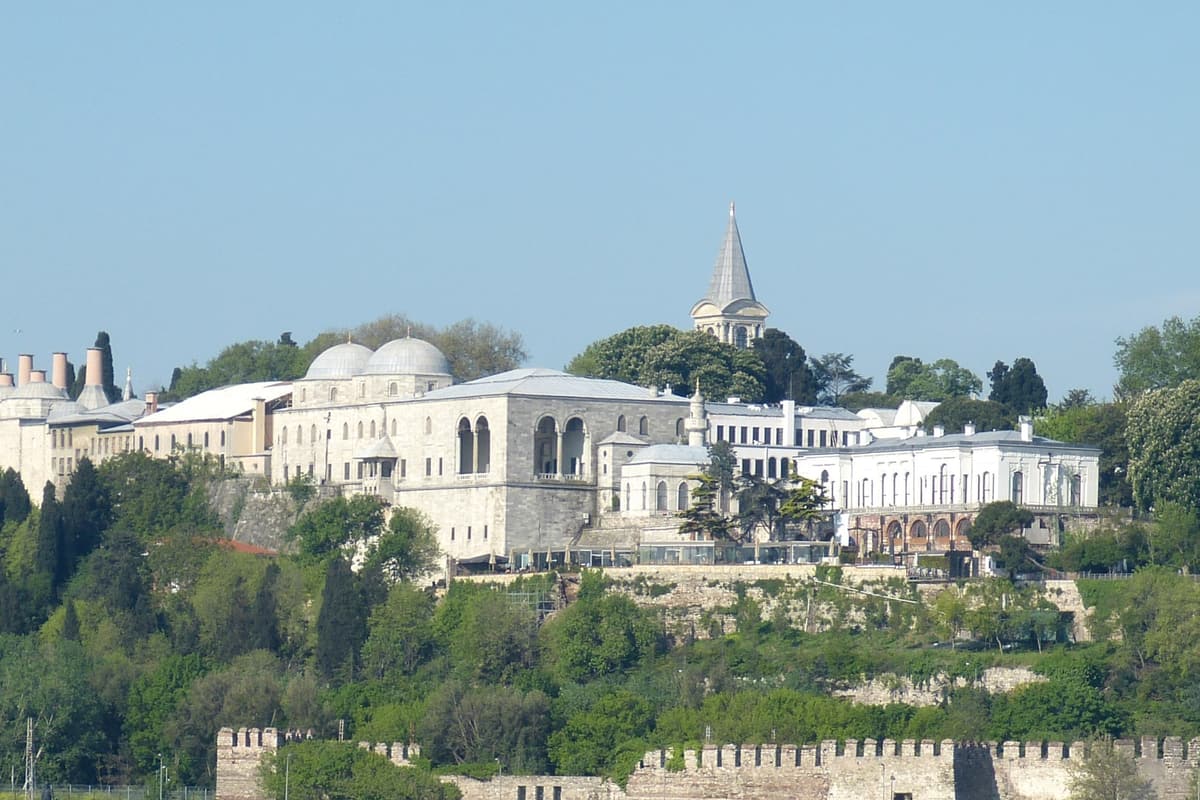
A Topkapi Palace tour starts at the palace of the Ottoman sultans on Seraglio Point in Istanbul. The walk moves through the gates and courtyards in order, with the Harem and the Imperial Treasury as separate parts of the visit. The palace sits above the Bosphorus and the Golden Horn. Compare the options before you book, and see tours in Greece for trips in the Aegean.
This page covers how the tour runs, its length and start, the courtyards in order, the Imperial Council hall and the kitchens, the Harem, the treasury and the Spoonmaker’s Diamond, the sacred relics and the kiosks, how to reach the palace and what to wear, and the questions travellers ask. The page keeps to facts that hold for the palace and its museum rooms.
What is a Topkapi Palace tour, and how does it run?
A topkapi palace tour is a guided walk across the former home of the Ottoman sultans in Istanbul. Operator pages place the start outside the Imperial Gate. They then list the courtyards, the Harem, the treasury and the views over the water.
Topkapi was the main residence of the sultans and the administrative centre of the empire. Building began in the fifteenth century on the orders of Sultan Mehmed II. The court stayed for nearly four centuries, then left for Dolmabahce Palace during the nineteenth century. Today the site is a museum, administered by Turkey’s ministry for culture and tourism.
Each topkapi palace tour works inside a layout of courtyards. The palace sits on Seraglio Point, a headland that overlooks the Golden Horn. It has four main courtyards, with halls, kitchens and pavilions around them. High walls close off the whole site. The Ottomans called it the Palace of Felicity.
Three operator pages agree on the meeting point. The group meets beside the Fountain of Sultan Ahmed III, in the cobbled square just outside the Imperial Gate. The official museum page calls the fountain a rococo-style work of the eighteenth century. The gate is the palace’s main entrance, known in Turkish as Bab-i Humayun.
The entry arrangement of a topkapi palace tour differs by page. One page gives the group skip-the-line access for the palace and again for the Harem. Another says its tour guide handles the queue on site and leads the group through fast-track entry. Both pages promise entry without a wait in the regular queue.
The order of a topkapi palace tour differs between pages. One itinerary lists two courtyards, the Harem, the Sacred Relics and the Treasury, then ends in the Fourth Courtyard. Another starts with a short walk through Sultanahmet and keeps the Harem for last. A private tour page says the order can change with your interests.
A topkapi palace tour treats the Harem as a stop of its own on all three tour pages. The official museum page adds that the visitor route through the Harem changes when rooms close for restoration. It describes the Harem as the quarters of the imperial family.
Wikipedia counts hundreds of rooms and chambers inside the palace, and visitors see only the key ones. A topkapi palace tour therefore follows a chosen route. One itinerary page ends that route in the Fourth Courtyard, with views over the Golden Horn and the Bosphorus.
How long is a Topkapi Palace tour, and when does it start?
A topkapi palace tour lasts from 90 minutes to about three hours, as operator pages state it. A morning start at nine o’clock matches the opening hour on the official museum page. The palace is closed on Tuesdays.
- 90 minutes: a short walk through the highlights, as one operator page words it.
- From 60 to 150 minutes: a private visit, with up to four hours arranged in advance.
- About two and a half hours: an itinerary that begins at nine in the morning.
- Three hours: a small-group tour that begins with a walk through Sultanahmet.
The length of a topkapi palace tour follows the stops on the route. The 90-minute page promises a lively walk. The three-hour page adds a district walk before the gates. The two-and-a-half-hour itinerary lists five stops, from the courtyards to the Fourth Courtyard.
A topkapi palace tour starts at the time its operator sets. One itinerary page names nine in the morning as its start. The private tour page names no time. It says the tour guide contacts you before the day to confirm the plan. The official page places the main box office in the First Court.
The official museum page lists the opening hour as nine in the morning. Closing is at six in the evening. The page gives the same hours for both seasons, so any topkapi palace tour has to fit inside that window. Summer begins on the first of April and ends on the first of October.
The same page lists the box office as closing at half past five in summer. In winter it closes at five. Tuesday is the closed day, and a private tour page agrees, so plan a topkapi palace tour for another day. A visitor page notes that opening times can change on public holidays. Check before you go.
Weather also shapes the date of a topkapi palace tour. Wikivoyage calls spring and autumn mild. Its spring is April to June. Its autumn is September to November. The pleasant windows fall in late spring and early autumn. Two visitor pages suggest weekday mornings, with arrival between nine and half past ten.
Visitor pages plan two to four hours for a solo visit. A guided topkapi palace tour of 90 minutes to three hours sits inside or below that range. One page says about two hours is enough for the Treasury, the Harem and the Sacred Relics. A fuller visit with the kitchens and viewpoints takes three to four hours.
What do you see in the courtyards on a Topkapi Palace tour?
A Topkapi Palace tour crosses four main courtyards, and a gate controls each step inward. Wikipedia describes the First Courtyard as the easiest to enter and the Fourth as the hardest. Each gate leads from public ceremony toward private life.
The Imperial Gate is the main entrance, on the south side of the palace. A Topkapi Palace tour passes under it first. Its central arch opens into a passage with a high dome. The monograms of Mehmed II and of Abdulaziz, who renovated the gate, have been identified on it.
Inside lies the First Courtyard, which is bigger than the other three. It is also known as the Parade Court and as the Court of the Janissaries. Court officials lined the path here in full court dress. A Topkapi Palace tour crosses this wide park, whose slopes toward the sea were terraced in Byzantine times.
On a Topkapi Palace tour, Hagia Irene is the first building on the left after the Imperial Gate. It is the oldest known church building in Istanbul. It is one of only two Byzantine churches in the city that never became mosques. Today it works as a museum and concert hall.
The Gate of Salutation, called the Middle Gate, leads on to the Second Courtyard. Its top is crenellated, and a pair of pointed octagonal towers flank it. In Ottoman times everyone, even the grand vizier, got off the horse here. Visitors on a Topkapi Palace tour pass through on foot.
The Second Courtyard, called Divan Square, was the working heart of the palace. Courtiers gathered here, and the sultan held audiences seated on a gold-plated throne. A cistern from Byzantine times lies below, and old sarcophagi stand in front of the kitchens. The council hall and the kitchens open off this square on a Topkapi Palace tour.
At the far end, the Gate of Felicity leads into the Third Courtyard, called the Inner Court. A dome on slim marble pillars covers it. The gate symbolised the sultan’s presence in the palace, and even the grand vizier needed permission to pass. Behind it, a Topkapi Palace tour finds the Audience Chamber, a square kiosk with 22 columns.
The Fourth Courtyard, called the Imperial Sofa, was the innermost sanctuary, with pavilions, gardens and terraces. Its oldest building is the Tower of the Head Tutor, a square watch tower where the chief physician prepared medicines. One page places the end of a short Topkapi Palace tour on a terrace of this courtyard.
What was the Imperial Council hall, and what are the palace kitchens on a Topkapi Palace tour?
The Imperial Council hall was the room where the grand vizier and the ministers ran the state. The palace kitchens cooked the meals of the court. Both open off the Second Courtyard on a Topkapi Palace tour.
- The grand vizier chaired the council.
- The other viziers handled military and political affairs.
- Two military judges, the kadi’askers, sat on it too.
- The finance officers, called defterdars, looked after the finances.
The council acted as the cabinet of the Ottoman state. It handled governing, received foreign ambassadors and also served as a court of law. By the sixteenth century the full council met on Saturdays, Sundays, Mondays and Tuesdays. A Topkapi Palace tour shows the hall where that work took place.
Sessions began at dawn and ran for seven to eight hours. They ended at midday in summer and by mid-afternoon in winter. The members ate three times: after they arrived, after the main talks and after the petitions. One page plans about 15 minutes for the hall in a two-hour Topkapi Palace tour.
The hall stands in the Second Courtyard, beside the Tower of Justice. Inside are three domed rooms in a row. The first, called Kubbealti, which means under the dome, was the meeting room. The second held the secretaries. The third, the Defterhane, was where the head clerks kept the council records.
Marble and porphyry pillars hold up the porch, which has a green and white wooden ceiling decorated with gold. Kutahya tiles cover the main room. Its rococo style dates from repairs ordered by Sultan Selim III and Sultan Mahmud II. On a Topkapi Palace tour, the room next door shows clocks from the palace collection.
A window with a gold grille opens high in the wall of the hall. Through it the sultan or the valide sultan followed the talks unseen. The window opened from rooms in the Tower of Justice next door, which has tall windows in a Palladian style. No other building in the palace stands as high.
Built in the fifteenth century, the palace kitchens copy the plan of the kitchens at the old palace in Edirne. After a fire in the sixteenth century, the court architect Mimar Sinan rebuilt them and added the tall chimneys. A Topkapi Palace tour enters by three doors in the portico: the lower, imperial and sweets kitchens.
The ovens are cold now, but the rooms still show the life of the court. They hold cooking tools, a collection of silver gifts and a large porcelain collection. The palace owns 10,700 pieces of Chinese porcelain, and the kitchen rooms display part of it. The wider collection adds Japanese Imari ware and about 5,000 European pieces.
What is the Harem, and is it part of a Topkapi Palace tour?
The Harem is the private quarters of the sultan’s family inside the palace, and it has its own entry arrangement. Whether a Topkapi Palace tour includes it depends on the product, so read the tour description before booking.
On a Topkapi Palace tour, the Harem route starts in the Second Courtyard. A museum page puts the Harem door under the Tower of Justice, in the west part of that courtyard. Visitors pass the Carriage Gate first. Just inside is the Domed Cupboard Room, where the Harem kept its records.
The pages give different room counts. A museum page speaks of 300-odd rooms, while Wikipedia says the Harem held more than 400. Both agree that only a small part is open. The museum page adds that the complex has six floors and visitors see one. So a Topkapi Palace tour shows the Harem in part.
A Topkapi Palace tour that enters the Harem reaches the courtyard of the Valide Sultan, the sultan’s mother. Wikipedia calls her apartments, with the sultan’s own rooms, the main section of the Harem. Blue Iznik tiles cover the courtyard walls, and murals of the nineteenth century in her salon show views of Istanbul.
The Imperial Hall dates from the late sixteenth century, under Murat III. Osman III had it redecorated in the eighteenth century. Wikipedia adds that its tile belt carries calligraphy and blue-and-white Delft tiles, with mirrors of Venetian glass. If time is short, one page points to this hall and the Valide Sultan courtyard, the heart of the Harem.
The Privy Chamber of Murat III is the oldest and finest surviving room of the Harem. A Topkapi Palace tour that reaches it sees an original interior. Blue-and-white and coral-red Iznik tiles line the walls. The room has a fountain, and the sound of its water made quiet talk hard to overhear.
Beyond that room, a Topkapi Palace tour can reach the Twin Kiosk, two rooms of the seventeenth century. One has a painted dome, and the other has a fireplace with a tall gilded hood. Stained glass windows look out over the terrace. The Courtyard of the Favourites is the last section, and it overlooks a large pool.
The entry rule differs from page to page. A museum page and another visitor page both say the Harem has a separate ticket. A ticket page says it can be separate or included, depending on the product. The route also shifts when rooms close for restoration. So check that your Topkapi Palace tour names the Harem.
One page gives about 2 to 3 hours for the main palace without the Harem. With the Harem added, it says at least 3 to 4 hours.
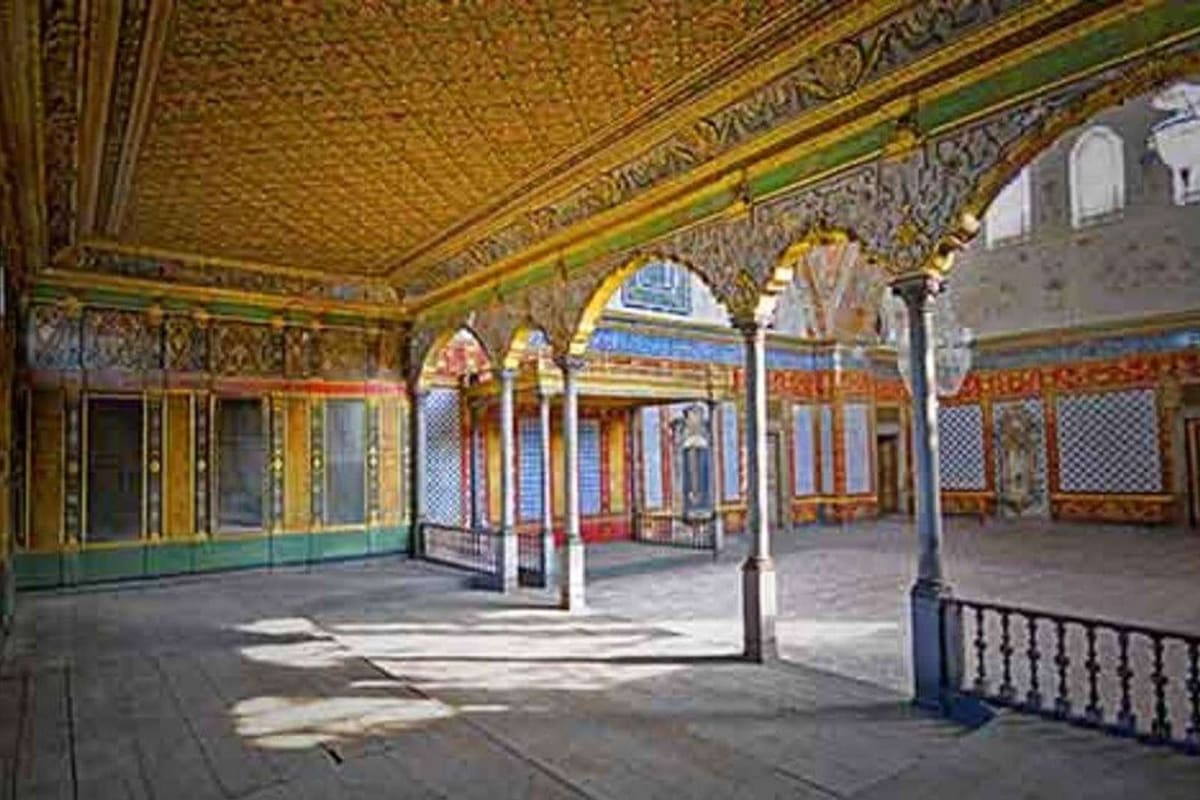
What treasures does a Topkapi Palace tour show: the Imperial Treasury and the Spoonmaker’s Diamond?
A Topkapi Palace tour shows the Imperial Treasury, which fills the Conqueror’s Pavilion in the Third Courtyard. Its rooms hold thrones, jewelled objects, armour, the Topkapi Dagger and the 86 carat Spoonmaker’s Diamond.
- First room: an iron coat of mail set with jewels, and an ebony throne inlaid with nacre and ivory.
- Second room: the Topkapi Dagger, and jewelled plumes made for sultans and their horses.
- Third room: the Spoonmaker’s Diamond, in a glass case on the wall.
- Fourth room: a gold-plated throne in the Indian style, set with pearls and emeralds.
The Treasury is a collection of artworks, jewellery and heirlooms of the Ottoman dynasty, as Wikipedia describes it. The pavilion has two floors on a terrace above the garden. Its rooms open to the courtyard through an arcade. A Topkapi Palace tour that enters it walks through four rooms.
The Spoonmaker’s Diamond is an 86 carat, pear-shaped stone set in silver. A double row of 49 cut diamonds surrounds it, and it weighs about 17 grams. Wikipedia calls it the eye-catching jewel of the third room. Anyone on a Topkapi Palace tour that enters the Treasury can stop at its case.
How the stone reached the palace is not known for certain. The museum records list a smaller ring stone with the same name. The tales about the larger diamond disagree, and Wikipedia calls their details doubtful and disputed.
The Topkapi Dagger was made in the eighteenth century as a gift for the ruler of Persia. Three large emeralds from Colombia sit on its gold hilt, and a watch under another emerald lid tops the handle. Rose-cut diamonds and enamel baskets of fruit decorate the scabbard. On a Topkapi Palace tour, the dagger is one room before the diamond.
The Imperial Treasury holds more than jewels. It has a gold ceremonial throne with tourmalines, made in the late sixteenth century. Two gold candleholders weigh 48 kilograms each. A museum page and Wikipedia place arms and armour in the Outer Treasury, a separate hall in the Second Courtyard. That hall lies on the route of a Topkapi Palace tour.
What are the sacred relics, and which kiosks and views does a Topkapi Palace tour offer?
A Topkapi Palace tour enters the Sacred Relics rooms in the Third Courtyard. It then climbs to the Fourth Courtyard. Kiosks and a marble terrace there look out over the Golden Horn and the Bosphorus.
The Sacred Relics rooms form part of the Privy Chamber in the Third Courtyard. Wikipedia says the architect Sinan built the chamber under Sultan Murad III. The museum page calls the rooms the Sacred Safekeeping Rooms and says Iznik tiles decorate them. Visitor pages list the relics among the key sections of a Topkapi Palace tour.
Objects linked to the Prophet Muhammad are kept inside. Wikipedia names a cloak, two swords, a bow and a letter. Together they are known as the Sacred Trusts. On a Topkapi Palace tour, visitors see them in very dim light, which protects the objects. One page puts this stop at about twenty minutes of the route.
When the court lived here, the rooms opened only once a year. The imperial family came on the fifteenth day of Ramadan to honour the memory of the Prophet. Today any visitor can enter, and a Topkapi Palace tour can pass through the rooms. Muslim pilgrims also come to see the relics, as Wikipedia states it.
A Topkapi Palace tour reaches the garden kiosks in the Fourth Courtyard. Sultan Murad IV had the Revan Kiosk and the Baghdad Kiosk built in the seventeenth century. The royal architect was Hasan Aga, as Wikipedia states it. Both have a central dome and sofas in the side bays.
The Revan Kiosk is the smaller of the two. Blue-and-white Iznik tiles line its walls. Wikipedia says the pavilion was used for a forty-day religious retreat. The wall that faces the colonnade is set with marble.
The Baghdad Kiosk has a marble front with strips of porphyry. Inside, a Topkapi Palace tour finds green, yellow and blue tiles on the recessed shelves. The cupboards and window panels carry mother-of-pearl and tortoiseshell. Wikipedia and the museum page both call it one of the last examples of classical palace architecture.
A Topkapi Palace tour that crosses the terrace passes the Circumcision Room, across from the Baghdad Kiosk. Sultan Ibrahim added this small summer kiosk for a religious ritual of the young princes. Blue-and-white tile panels cover its front. They are older than the room and once decorated halls of Sultan Suleiman I.
The marble terrace lies up the steps beyond the Tulip Garden. It holds a pool, three pavilions and the gilded Iftar bower. Sultan Ibrahim commissioned the bower as a place to break the fast of Ramadan. One visitor page calls the terrace a place to rest at the end of a Topkapi Palace tour.
How do you reach the palace for a Topkapi Palace tour, and what do you wear?
Ride tram line T1 to the Sultanahmet or Gulhane stop, then walk to the Imperial Gate. The gate lies a short walk from either stop. A Topkapi Palace tour asks for covered shoulders and knees in the relic rooms, so dress for respect.
- Shoes: flat and comfortable, for cobbles, slopes and steps.
- Clothes: shoulders and knees covered, as visitor pages ask for the relic rooms.
- Bag: a small one, because the palace has no cloakroom or luggage storage.
- Water: a bottle for the sunny courtyards in summer.
Tram line T1 serves the palace. The museum page gives 700 metres from the Sultanahmet stop and 600 metres from the Gulhane stop. A tour page gives nine and eleven minutes on foot. Allow ten minutes to reach the meeting point of a Topkapi Palace tour. The tram stop named Topkapi lies elsewhere in the city.
From Sultanahmet, the Imperial Gate lies about three minutes to the north, as one page states it. Hagia Sophia stands across the square, so the walk from it is short. The museum page calls the Imperial Gate the first outer gate. It holds the security scanners and a military guard post, and it opens into the First Courtyard.
The Gulhane side offers a second way in. The park lies beside the palace, and Wikipedia places one of the larger palace gates at its southern entrance. The museum page adds a steep path through the park, from the Archaeology Museum access to the First Courtyard. Your Topkapi Palace tour sets the entrance, so follow its meeting point.
Security queues at the Imperial Gate can be long, as the museum page notes. Another page says the Archaeology Museum access sometimes has a shorter queue. Visitor pages advise an early weekday start. One tour page asks the group to arrive fifteen minutes before the meeting time. Keep a margin before a Topkapi Palace tour begins.
Dress follows the relic rooms. Visitor pages want shoulders and knees covered, as in the mosques of Istanbul. One page adds that shorts and sleeveless or strapless tops are not allowed in the relic rooms. A Topkapi Palace tour in summer therefore needs a light top with sleeves and trousers or a long skirt.
Pack light. One page says the palace has no cloakroom or luggage storage, so large bags stay at the hotel. The security check at the gate applies to every bag, as another page states. The museum page bans smoking across the grounds and lists no parking. A Topkapi Palace tour moves on foot, so a small bag is easiest.
What else do travellers ask about a Topkapi Palace tour?
Which kind of Topkapi Palace tour suits you: a group, a private tour or a combined day?
A group topkapi palace tour suits visitors who want a ready plan. Two operator pages state that skip-the-line access covers the ticket queue only, and every visitor still passes the security check. One page says groups reach 40 people in high season, and headsets go to the larger groups.
A small-group day keeps the numbers low, and one seven-hour page caps its group at 15 people. A private topkapi palace tour needs at least two people on one operator page. That page words it for couples, families and small groups. It says the route can change with your interests, your time and the museum rules.
A combined day wraps the old city around a topkapi palace tour. One six-hour page starts at the palace and the Harem. It breaks for lunch, visits the Blue Mosque and ends at Hagia Sophia. The seven-hour page starts at the Hippodrome and ends at the palace. A shorter combo sends you into Hagia Sophia with an audio guide.
Can children and slow walkers manage a Topkapi Palace tour?
The ground sets the pace on a topkapi palace tour. A visitor page says the main entrance has ramp access and parts of the courtyards are accessible. It adds that heavy cobblestone paving covers the grounds and that certain areas have steps with no ramp.
The official museum page calls access possible and names the cobblestone-covered hills as a hurdle for limited mobility. An access page lists small ramps between the Harem rooms, with one room entered by a step. It names a restroom without steps beside the ticket booth and another in the Third Courtyard. Pages differ on wheelchairs, so ask at the entrance.
For children, a visitor page says very young ones can find the walking distances and the history less engaging. It points older children and teenagers to the Treasury and the Harem. A small-group page calls its route a walking tour with uneven surfaces. A private topkapi palace tour page asks groups with mobility needs to say so in advance.
Are photos allowed inside the rooms of a Topkapi Palace tour?
Pages differ on the rooms, so the notices at each door settle it during a topkapi palace tour. The official museum page rules out photography in the halls of the museum. A visitor page permits photos in the outdoor areas and in a range of indoor exhibition spaces, within limits.
Three visitor pages agree that flash stays off. One bans flash and tripods inside the galleries. Another says photos need natural light and tripods need a special permit. A third allows non-flash phone photos in open interiors if you do not block other visitors. It restricts interior filming.
The Sacred Relics rooms and the Treasury hold the strictest limits on a topkapi palace tour. One page says parts of the Sacred Relics room allow no photos. Another says the Treasury restricts photography completely. For the Harem, one page answers yes and asks you to watch the posted limits. None of the pages sets a separate Harem rule.
Can an audio guide replace a Topkapi Palace tour, and which days are closed?
An audio guide works as an alternative to a topkapi palace tour for independent visitors. The official museum page recommends audio guides or tour guides to bring out the details of the palace. A visitor page says the app suits visitors who want flexibility. A tour guide suits those who want the history in depth.
The audio guide is a smartphone app. A visitor page says the palace has no Wi-Fi, so the app needs a download before arrival. Thick walls weaken mobile reception in certain rooms. Another page says hosted entry only helps you arrive and is not a guided topkapi palace tour.
Tuesday is the closed day on the official page. Two visitor pages add the first day of the Ramazan holiday. One page calls weekdays quieter than weekends. Another names June to August as the months with the highest visitor numbers. One combined page lists seven hosted entry slots, the first at nine and the last at three.