
The 12 day greek islands tour on this page runs for eleven nights. It starts and ends in Athens and spends the days between on Mykonos, Paros and Santorini. Readers who want to compare trips first will find the whole list under tours in Greece.
The page sets out the twelve days and the seasons, then Athens with its arrival day, the Acropolis and the Parthenon, the Acropolis Museum, Plaka, the hills and the flight home, then Mykonos beyond its town, the Mykonos beaches, Parian marble, the Paros beaches, the villages and beaches of Santorini and the volcano, and closes with five answers to what readers raise. For a shorter route through the same islands, see the 7 day greek islands tour; for a longer plan with a cruise to Patmos, Rhodes and Crete, see the 14 day greek islands tour.
What is the 12 day greek islands tour, and how does the route run?
The 12 day greek islands tour has twelve days and eleven nights, and it starts and ends in Athens. Three islands of the Cyclades sit between the two Athens stays: Mykonos, Paros and Santorini. Ferries carry the traveller from island to island, and one flight brings the traveller back to the capital.
Read the 12 day greek islands tour as a plan with a firm shape, not a loose list. It holds two Athens stays, three island stays and two kinds of travel, the ferry and the flight. The numbered list below gives the twelve days in order, using names only, so the whole shape is clear.
- Day 1: Athens arrival, then free time
- Day 2: Acropolis tour, museum, free afternoon
- Day 3: ferry to Mykonos, hotel transfer
- Day 4: free day on Mykonos
- Day 5: free day on Mykonos
- Day 6: ferry from Mykonos to Paros
- Day 7: free day on Paros
- Day 8: ferry from Paros to Santorini
- Day 9: free day on Santorini
- Day 10: free day on Santorini
- Day 11: flight to Athens, night in Athens
- Day 12: airport transfer, departure flight
Athens opens and closes the plan. Wikipedia calls it the capital of Greece. Wikivoyage names Piraeus as the main port of the Athens area. It gives Santorini two main routes, a sea route from Piraeus and an air route from Athens. So the 12 day greek islands tour begins and ends in the capital.
The three islands share one line in the Cyclades. Tinos lies north of Mykonos, with Paros and Naxos to its south, says Wikivoyage. It puts Paros in the middle of the group. It places Santorini between Ios and Anafi, in the south. Each island lies further south than the last, so the 12 day greek islands tour keeps one direction.
The coordinates on Wikipedia agree. Mykonos lies near 37.5 degrees north, Paros near 37.1 and Santorini near 36.4. Wikivoyage lists boats to Mykonos from Paros more than once a day, and from Santorini daily. The group counts about 220 islands, yet the 12 day greek islands tour uses only three of them.
Each island change follows one pattern. Day 3 starts with a transfer to the pier. The ferry crosses to Mykonos. A second transfer ends the day at the hotel. Day 6 and Day 8 repeat both steps for Paros and Santorini. The other days of the 12 day greek islands tour carry no change of base.
Which season suits the 12 day greek islands tour?
Spring and early autumn suit the 12 day greek islands tour. Wikivoyage names two milder windows for Santorini, one starting in April and one starting in September. It recommends spring and late autumn for Athens. Spring sits on both lists. The next paragraphs take each season in turn, sea and city together.
Spring is gentle on the 12 day greek islands tour. Wikipedia’s table for Mykonos gives an average high of about 19 degrees Celsius in April. The last spring month brings about 23. Wikivoyage finds pleasant temperatures and little rain on Santorini in both. It adds that dining and shopping choices on Mykonos stay thin before late spring.
Summer is the hot side of the 12 day greek islands tour. The Mykonos table lists an average high of about 28 degrees Celsius in July and August. Nights stay near 24. Wikivoyage says Santorini turns extremely hot after spring, with an extreme UV index and hardly any trees for shade. It calls the island crowded in summer.
Early autumn suits the 12 day greek islands tour: it keeps the warmth and drops the heat. The Mykonos table gives an average high of about 26 degrees Celsius in September. October brings about 22 degrees. Wikivoyage says Santorini cools again from September, and the chance of rain gradually rises as the year closes.
A winter 12 day greek islands tour loses its swim days. Wikipedia dates the rainy season on Mykonos from October to March. Wikivoyage says the off-season on Santorini runs from December through March, with cooler air, rain and wind. By December, a large share of businesses, hotels among them, close until spring on that island.
The two Athens stays face the city’s own weather. Wikipedia says the areas south of the centre see less extreme swings in temperature, as the Saronic Gulf moderates them. It adds that Kifissia, in the north, is moderately cooler because it stands higher. The 12 day greek islands tour meets this weather on Days 1, 2 and 11.
Swimming draws the outer limits. For beach days on Mykonos, Wikivoyage points to late spring through mid-October. The table gives night lows of about 18 degrees Celsius at its start and 19 at its end. A 12 day greek islands tour with five free days stays inside it for the sea.
How are the twelve days shared out on the 12 day greek islands tour?
The 12 day greek islands tour shares eleven nights across four places. The count runs Athens two, Mykonos three, Paros two, Santorini three, and a last night in Athens. Three days move by ferry, two days hold a flight, and five days stay free. The other two days hold arrival and sightseeing in the capital.
The first two nights belong to Athens. Day 1 is for arrival and rest. Day 2 brings a morning sightseeing round of the Acropolis and its museum, then a free afternoon. Wikivoyage’s district list puts the ancient sites and the museums in central Athens. One morning of the 12 day greek islands tour can therefore reach both places.
Mykonos and Paros follow one pattern: a ferry day, then free days. Mykonos takes Days 3, 4 and 5. Paros takes Days 6 and 7. Wikivoyage says the larger share of the ferries to Santorini stop at Paros first. So the middle stop of the 12 day greek islands tour sits on the sea road.
Santorini takes Days 8, 9 and 10, a ferry day and then two free days. On the archipelago, almost all accommodation and tourist services sit on Thira, says Wikivoyage. That island covers 73 square kilometres and holds about 15,500 people, as the page states. The three nights of the 12 day greek islands tour need no further move.
Day 11 is the one flight. Wikivoyage calls the air route between Athens and Santorini faster than the sea route. It adds that flying avoids possible sea sickness. The page gives 30 to 45 minutes for the flight. So the 12 day greek islands tour keeps the ferries for island changes and ends by air.
The final night is in Athens, and Day 12 brings the airport transfer and the departure flight. The night in the capital puts the traveller on the mainland before the journey home. This closing part of the 12 day greek islands tour is short and simple. It leaves no island change on the final day.
Five free days are the heart of the plan. A free day has no fixed visit. The traveller sets the pace: a beach, a village walk, a museum or plain rest. Later parts of this page describe each island in turn. Read together, they make the 12 day greek islands tour one story.
What does arrival in Athens add to the 12 day greek islands tour?
Arrival in Athens opens the 12 day greek islands tour with a flight, a hotel ride and free time. The airport carries the name Eleftherios Venizelos, and its code is ATH. It handles the capital’s passengers and those of the wider Attica region. Day one ends at the hotel with nothing booked.
The airport itself stood ready in October of the year before it opened. Its opening was still delayed by one month, because surface connections to the Attiki Odos highway were unfinished. A traveller on the 12 day greek islands tour meets only the finished result. Day one needs only the ride to the hotel and a rest.
The main terminal splits its work in two. All 153 check-in desks are here. Hall A looks after non-Schengen and non-European routes. Hall B looks after Schengen routes and domestic services. The airport planned a first physical expansion for the main terminal’s south wings. The 12 day greek islands tour begins in one of these halls.
Metro line 3 runs from Dimotiko Theatro to the airport. It joins Piraeus, the western suburbs and the east. Wikivoyage says trains with an airplane logo on the front are the airport trains. Other metro trains turn back at Doukissis Plakentias. The 12 day greek islands tour keeps day one free, so a train ride fits.
Regional buses also reach Rafina and Lavrio from the airport. The ride by express bus lasts between 45 minutes and ninety, Wikivoyage says, depending on the traffic. Buses keep running through the night, unlike the metro trains. The plan’s transfer carries your bags to the hotel, so the 12 day greek islands tour needs no bus.
Athens lies on a plain that Wikipedia calls the Attica Basin. Four mountains bound it. Parnitha, one of the four, stands 1,413 metres high and is a national park. The Cephissus, the Ilisos and the Eridanos are the historical rivers of the city. The 12 day greek islands tour therefore starts in a wide basin.
Athens has two old nicknames: the glorious city and the violet-crowned city. According to myth, the city was named for the goddess Athena. Modern scholars generally agree that the goddess in fact took her name from the city. Day one of the 12 day greek islands tour is free for a walk and an early night.
What do the Acropolis and the Parthenon add to the 12 day greek islands tour?
On day two, the Acropolis and the Parthenon give the 12 day greek islands tour its ancient heart. Pericles led the programme that raised the main temples of the rock, in the fifth century BC. Day two is a morning sightseeing tour of Athens with the Acropolis.
The word acropolis joins two Greek words, one for the highest point and one for the city. Other acropoleis stand elsewhere in Greece. In ancient times the rock of Athens was also called Cecropia. The name comes from Cecrops, the legendary serpent-man and supposed first Athenian king. The 12 day greek islands tour visits the Athenian one.
The Acropolis is a UNESCO World Heritage Site, inscribed on five cultural criteria. Long before Pericles, a Mycenaean wall 760 metres long ringed the hill as its main defence. Four buildings of his programme still carry the story, and the next paragraphs take them in turn. The 12 day greek islands tour visits all four on day two.
Stone workers built the Parthenon. Quarrymen cut each marble block to exact sizes and worked around the faults in the Pentelic marble. The architects rejected substandard blocks. Temple building was a specialised craft, so skilled men moved to where the work was. On the 12 day greek islands tour, day two shows what that labour built.
The Greeks had beaten the invading Persians, and the Parthenon was built in thanks. It was dedicated to Athena. Phidias led the sculpture, while Ictinos and Callicrates designed the building. At each end a regular Doric temple has six columns, but the Parthenon has eight. The 12 day greek islands tour meets this plan on day two.
In the late fifth century BC, Mnesicles began work on the Propylaea. Paintings by Polygnotus decorated its northern wing. South of the gate, a small Ionic temple for Athena Nike was finished before that century ended. Both buildings use Pentelic marble from Mount Pentelicus. These stones belong to day two of the 12 day greek islands tour.
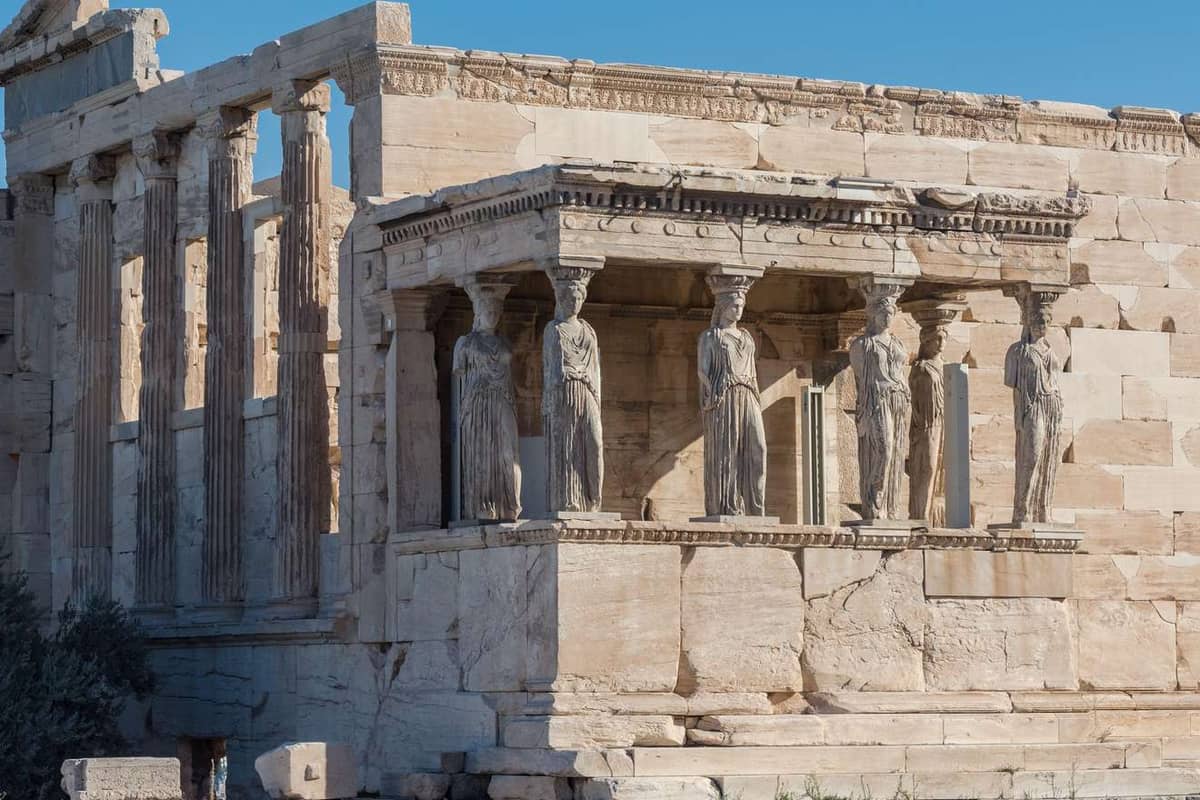
The Erechtheion has two porches. Ionic columns carry one, and huge female figures, the caryatids, carry the other. Athena Polias held the eastern half, and the cult of Poseidon and Erechtheus held the western half. Fire destroyed the inside in the first century BC. The 12 day greek islands tour fits all of this into one morning.
What does the Acropolis Museum add to the 12 day greek islands tour?
The Acropolis Museum gathers what the digs on the rock and its slopes have found. Its objects cover Bronze Age, Roman and Byzantine Greece. The museum welcomed its first visitors in two thousand and nine. The 12 day greek islands tour includes it on day two, alongside the rock itself.
Wikipedia calls the Acropolis Museum an archaeological museum. The aim was to keep every object from the rock and its slopes under one roof. The founding came in two thousand and three, and the organisation of the museum followed in two thousand and eight. The 12 day greek islands tour spends part of day two among these finds.
In classical times a road climbed from this spot to the sacred rock, and the museum stands along it. Gendarmerie barracks once filled the lot, across from the Theatre of Dionysus. The land was public, so a limited number of nearby private houses had to be expropriated. The 12 day greek islands tour visits it beside its rock.
Glass sections of the floor reveal an excavation underneath the building. Private homes and workshops from the classical and the early Byzantine eras lie there. In June, two thousand and nineteen, visitors walked through the site for the first time. The dig below goes on. The 12 day greek islands tour meets an old Athenian neighbourhood under its feet.
The Parthenon hall crowns the building and sits askew on the levels below. That tilt gives the hall the same cardinal orientation as the temple. Its columns are spaced like the temple’s own. From the hall’s northern side, a visitor sees the ancient temple above. That view links the two stops of the 12 day greek islands tour.
Inside the columns, the frieze forms a continuous band around the walls of a rectangular space. The museum also keeps pieces of the pediments of an older temple of Athena. The Pisistratids built that temple in the sixth century BC. The 12 day greek islands tour thus meets the building that came before the Parthenon.
The building was one of six finalists for the European Union Prize for Contemporary Architecture. The Akropoli metro station sits next to the entrance on Dionysiou Areopagitou Street. Opening days and entry rules are on the official museum page, because this page gives none. The afternoon of day two stays free on the 12 day greek islands tour.
What does Plaka add to the 12 day greek islands tour?
Plaka adds an old quarter on foot to the 12 day greek islands tour. Wikipedia calls it the historical old quarter of Athens. Labyrinthine streets and neoclassical buildings fill its slopes under the Acropolis. The free afternoon of Day 2 leaves time for a slow walk through them.
Wikivoyage states that the edges of Plaka are not precisely defined, yet it names clear borders. The Ancient Agora and Monastiraki Square close the west side. The Acropolis and Dionysiou Areopagitou Street close the south. The Temple of Olympian Zeus marks the south-east. These lines give the 12 day greek islands tour a simple map.
Two readings of the name Plaka exist. One links it to the Arvanitika words Pliak Athena, meaning Old Athens. The other links it to a plaque that marked the central crossing. A linguist backs the plaque, because plaka is a common Greek place name from the eleventh century. Both readings suit the 12 day greek islands tour walk.
Plaka rests on the homes of the ancient town of Athens, as Wikipedia states. Homes have stood here without a break since Neolithic times, so monuments of every period line its streets. An Albanian community also lived here until the late nineteenth century and kept its own courts. The 12 day greek islands tour crosses these layers.
Anafiotika is the corner of Plaka that looks like an island village. Settlers from Anafi, an Aegean island, raised it under King Otto, and Wikipedia calls its style traditional Cycladic. Wikivoyage places Santorini between Ios and Anafi. So the 12 day greek islands tour meets an island style in Athens before the ferry to Mykonos.
The quarter has seen hard and easy decades. Wikipedia reports a decline from the nineteen-fifties to the nineteen-seventies, caused by the building boom, car traffic and tourism. A preservation plan followed in the nineteen-eighties. Wikivoyage adds that Plaka was gentrified in the nineteen-nineties and now has pedestrianised streets. That suits the 12 day greek islands tour on foot.
Wikivoyage places the Roman Agora at the western end of Plaka. Its Tower of the Winds shows a different wind deity on each of its eight sides. At Monastiraki, a sign on Ifaistou Street announces the Flea Market of Athens. Second-hand and surplus shops fill that street. Both stops fit the 12 day greek islands tour.
What do the hills and viewpoints of Athens add to the 12 day greek islands tour?
Four hills near the Acropolis add height to the 12 day greek islands tour. Twelve hills stand inside Athens, Wikivoyage notes, and these four are among them. Lycabettus borders Kolonaki. The Areopagus lies north-west of the rock, the Pnyx west, and Philopappos Hill south-west. Day 1 and the afternoon of Day 2 stay free for a climb.
A Cretaceous limestone hill, Lycabettus stands 277 metres high, as Wikipedia states. Central Athens has no higher point. Pines grow around its base. On the Kolonaki side, the funicular begins its climb from Aristippou Street. That climb gives the 12 day greek islands tour a wide city view.
Two stories explain the name Lycabettus. Popular tales say wolves sheltered there, and the Greek word lycos means wolf. The other source is an old Pelasgian word, Lucabetu, meaning mastoid hill. A myth adds that Athena dropped a limestone mountain there while carrying it to the Acropolis. Wikipedia records all three stories.
The Chapel of St George stands on one of its two peaks, dated by Wikipedia to the nineteenth century. A panorama there shows the Acropolis, the Panathenaic Stadium and the Olympian Zeus temple. An amphitheatre under the open sky near the summit reopened after fifteen years closed. The 12 day greek islands tour can use it for an evening.
Philopappos was a prince of Commagene, and his Roman tomb stands on Mouseion Hill. Wikipedia places the hill south-west of the Acropolis. After his death, his sister Julia Balbilla joined the citizens of Athens in erecting it. White Pentelic marble forms the monument, and two-thirds of its facade remain for the 12 day greek islands tour.
The Pnyx lies west of the rock, less than a kilometre away. It had three building phases. In the first, the crowd faced a platform on the north. In the second, the seating turned to face one on the south. One historian suggests a crowd of about 6,000 citizens. The 12 day greek islands tour passes where Athens once assembled.
The Areopagus is a rocky outcrop north-west of the Acropolis. Its name comes from Areios Pagos, the Hill of Ares. Myth says the gods tried Ares there for the killing of Poseidon’s son Halirrhothius. Wikipedia adds that Solon reshaped its council and that Acts sets a sermon of Paul there. The 12 day greek islands tour passes both tales.
What do the flight from Santorini and the last Athens night add to the 12 day greek islands tour?
The flight from Santorini closes the island part of the 12 day greek islands tour on Day 11. Wikivoyage gives the Athens flight a time of 30 to 45 minutes. The airport sits about 6 kilometres south-east of the centre of Thira, just north of Kamari, as Wikipedia states.
Wikipedia gives Santorini airport a height of 39 metres above sea level. Flights began there in nineteen seventy-two, and the field serves both military and civil traffic. The article notes that major airports are rare among the Cyclades, and Santorini has one. The 12 day greek islands tour leaves the island from this airport on Day 11.
Wikipedia gives the length of the main asphalt runway as 2,197 metres. Beside it lies a parallel taxiway, which was built to the same specification as a runway. As Wikipedia adds, the airfield takes medium-sized jets and smaller aircraft. Since the apron was redesigned, up to nine civilian airliners can stand there at once.
Wikipedia lists four ways to reach the terminal: buses, taxis, pick-ups arranged by hotels and hired cars. Wikivoyage adds that charter flights come from European airports from late spring to October. Wikivoyage lists the Piraeus ferries and the Athens flights as the main ways to Santorini. The 12 day greek islands tour leaves by air.
After landing, the plan moves to a hotel in Athens. At the airport, Wikivoyage says, one platform serves the metro and the suburban railway. An airport train comes every 36 minutes with an airplane logo at its front. The metro does not send every train to the airport. The logo helps a traveller on the 12 day greek islands tour.
The last evening in Athens suits a walk on Dionysiou Areopagitou Street. Wikivoyage describes the street as pedestrianised, and it begins beside the Temple of Olympian Zeus. Walkers pass Plaka below the Acropolis and reach Thiseio, just past the Temple of Hephaestus. The Parthenon and the Agora stay in sight, and the busy city centre stays behind.
Day 12 ends the 12 day greek islands tour with a transfer to the airport. Wikivoyage notes that the express buses never stop, unlike the metro. Traffic sets the length of the bus ride, which Wikivoyage puts at 45 to 90 minutes. Wikivoyage advises a visit to the metro station on the eve of departure.
What does the island of Mykonos add beyond its town to the 12 day greek islands tour?
Beyond its town, the island of Mykonos adds a small, dry, windy land to the 12 day greek islands tour. Wikipedia gives 85.5 square kilometres, a summit of 341 metres and a place 150 kilometres east of Athens. Days four and five of the plan leave room to see all of it.
Wikivoyage measures Mykonos at 12 to 15 kilometres from end to end and 10 across, small for the Cyclades. The same page lists six ways around the island: bus, taxi, car, scooter, quad bike and boat. For the remote north beaches, the page adds, a hired car or motorbike suits the 12 day greek islands tour.
Digs on Delos by the French School of Archaeology, Wikipedia notes, helped tourism take over the island’s economy. Jet-set visitors from abroad began arriving in the nineteen-sixties. By one estimate, yearly visitors reach at least 1.5 million, and it has room for roughly 50,000 visitors each night. The 12 day greek islands tour joins that flow of people.
The original inhabitants were Carians, according to Herodotus, with Ionians from Athens apparently next. Delos, only 2 kilometres away, made the island a place for supplies and transit. Rome, then the Byzantine Empire, held it until the twelfth century. Venice ruled it directly from the fourteenth century. That record sits behind the 12 day greek islands tour.
After the attack by Hayreddin Barbarossa in the sixteenth century, the Ottomans held Mykonos for close to three centuries. Pirates raided regularly while trade made the island prosper. British and French ships clashed in the harbour in June, late in the eighteenth century: the Battle of Mykonos. A governor and a council of syndics ran local affairs.
Ano Mera sits inland, about 7 kilometres east of the town, while every other settlement hugs the coast. Tavernas stand on three edges of its large square. Wikivoyage dates the monastery of Panagia Tourliani to the sixteenth century. On the 12 day greek islands tour, the village is a gateway: Kalo Livadi lies 2 kilometres away.
Delos, an uninhabited UNESCO island, lies close to Mykonos. Ancient Delos imported all its food, fibre and timber. Cisterns, wells and drains handled its limited water. Wikivoyage lists boats from the town on every day but Monday, when the ruins are shut. Days four and five of the 12 day greek islands tour can hold that trip.
What do the beaches of Mykonos add to the 12 day greek islands tour?
Wikivoyage’s list of Mykonos beaches covers four shores: south, east, north, west. The south beaches sit sheltered from the prevailing northern wind and have bus links from town. That gives the 12 day greek islands tour a clear choice of sand and sea for Days four and five.
Psarou lies 5 kilometres from the town and has a bus stop. Platys Gialos, at 6 kilometres, has a long sandy beach, about a quarter of an hour by bus. Paranga, also 6 kilometres out, is sandy, with rocks in the water but sandy places to enter. The 12 day greek islands tour finds three south-coast choices here.
Fishing boats converted for visitors leave Platys Gialos every hour or less for the beaches along the south shore. Strong wind can cancel them, Wikivoyage warns, so the bus is a sound backup. From June to September, boats leave the town harbour for Agrari and Elia, but rarely. Check every sailing on the 12 day greek islands tour.
Eight kilometres from the town, Elia is one of the larger beaches of the island. Wikivoyage lists water sports and three restaurants there. Agrari sits next door, calmer and less popular, a 5-minute walk over the rocks. After the last boat back, two later buses still run. Elia suits a free day of the 12 day greek islands tour.
On the east coast, Kalo Livadi lies 10 kilometres out and offers a long, quiet sweep of sand. Kalafati, at 12 kilometres, is large and less developed, and windsurfers favour it for the offshore breeze. Draoumia and Tafarnis lie beside it. Lia, at 14 kilometres, is uncrowded. A bus reaches Kalafati only a handful of times a day.
The north coast faces the wind. Ftelia looks north, so summer gusts suit windsurfers but not swimmers. Panormos is a long beach facing east onto Panormos Bay. Agios Sostis, on the same bay, has no rental loungers or umbrellas. Fokos has coarse sand and one tavern. Each needs your own transport on the 12 day greek islands tour.
On the west coast, the beaches lie nearest the town. Megali Ammos, 1 kilometre south, is a ten-minute walk, though a big slab makes swimming harder. Ornos, 3 kilometres south, has sand that slopes gently into the water. Agios Ioannis offers snorkelling and a view of Delos. Day five of the 12 day greek islands tour can pick one.
What does Parian marble add to the 12 day greek islands tour?
A white, semi-translucent stone, Parian marble was quarried on Paros during the classical era, Wikipedia records. Among the statues cut from it is the Venus de Milo. That links the island to ancient sculpture on the 12 day greek islands tour. Day six brings the ferry from Mykonos to Paros.
Marble forms the body of Paros, though gneiss and mica-schist appear here and there. One mountain of 724 metres gives Paros the outline of a plump pear. The island’s name lives on in the term Parian, used for marble and porcelain with matching qualities. On Paros, the 12 day greek islands tour meets the origin of that word.
As the Paros article puts it, marble was the chief source of wealth on the island. Exports ran from the sixth century BC onwards. Greek sculptors, Praxiteles among them, used it for their work. The stone is white and translucent. The 12 day greek islands tour thus visits an island that a stone once made rich.
Marathi was the ancient name of the mountain whose north flank holds the old quarries, below a former convent. Workers cut tunnels into the rock by lamplight, so the stone is called Lychnites, from the Greek for lamp. Such tunnels can still be seen today, which gives the 12 day greek islands tour a story below ground.
Fieldwork found open-pit workings at Chorodaki, Marathi and Agios Minas. In the valley of Agios Minas, one shaft is the Grotto of the Nymphs and another the Grotto of Pan. Reliefs by their entrances gave them those names. Their size once misled scholars into thinking the stone came only in blocks of about one cubic metre.
The Winged Victory of Samothrace, made about 220 to 190 BC, is carved from Parian marble. So is the Venus de Milo, along with the Medici Venus. The stone of the Venus de Milo is thought to come from a 100-metre-long quarry on Paros. Travellers on the 12 day greek islands tour stand near that source.
Paros has working quarries and abandoned ones. Modern attempts brought no large exports. The state owns the larger part of the remaining white marble, for archaeological restorations only. An ancient temple of Apollo, in ruins, gave its marble to the medieval castle above the Parikia seafront. Day six lands the 12 day greek islands tour here.
What do the beaches of Paros add to the 12 day greek islands tour?
The free day on Paros is day seven of the 12 day greek islands tour, and the beaches fill it. Wikipedia puts Golden Beach on the island’s eastern shore, close to the village of Drios. Logaras, Pounda and Agia Irini join the list, as do Naousa Bay, Piso Livadi and Parikia. So every side of the island has a shore.
Wikivoyage gives Paros a coastline of 120 kilometres around an island of 196 square kilometres. With that much shore, the choice of bay matters more than the distance on the 12 day greek islands tour. The same page marks the island out by two features, its beaches and its villages. Day seven can hold one long swim.
A steady wind shapes the east coast on the 12 day greek islands tour. Wikipedia ties the windsurfing of Paros to a strong, constant wind across the water between Paros and Naxos. Wikivoyage lists the Dryos shore among the popular places for surfing. Dryos has neighbouring beaches called Chryssi Akti, meaning golden beach, and Tserdakia, the new golden beach.
Quiet shores need effort on the 12 day greek islands tour. Wikivoyage sends peace seekers to Laggeri, with its sand dunes. Tsoukalia, Glyfa and Glyfades are reached on foot along a narrow path, or from the sea. Kalogeros needs the dirt road from Molos and shows interesting rock formations. Pick one bay and keep the day loose.
Other bays suit an easy day on the 12 day greek islands tour. Pounta and Farangas are popular and well equipped, as Wikivoyage describes them. Lolantonis is just as busy but smaller, with natural shade. Logaras gets the family tip. Kolymbithres adds huge rocks around sandy coves, and Monastiri and Santa Maria complete the list of standout beaches.
The sea floor is a draw too on the 12 day greek islands tour. Divers at Aliki find the ruins of an ancient town lying under the water, according to Wikivoyage. Wikipedia counts a dozen smaller islets around Paros and places Antiparos to the south-west. Wikivoyage adds boat trips to nearby islands such as Despotiko and the Panteronisia.
Day seven needs a loose plan on the 12 day greek islands tour. Wikivoyage urges travellers not to stay on one beach daily, as each has its own mood. It suggests Agia Irini, Krios, Kato yalos, Parasporos and Farangas. Marpissa, with well-preserved old houses, makes an easy pause between swims. Buses link the towns, so the day stays simple.
What do the villages and beaches of Santorini add to the 12 day greek islands tour?
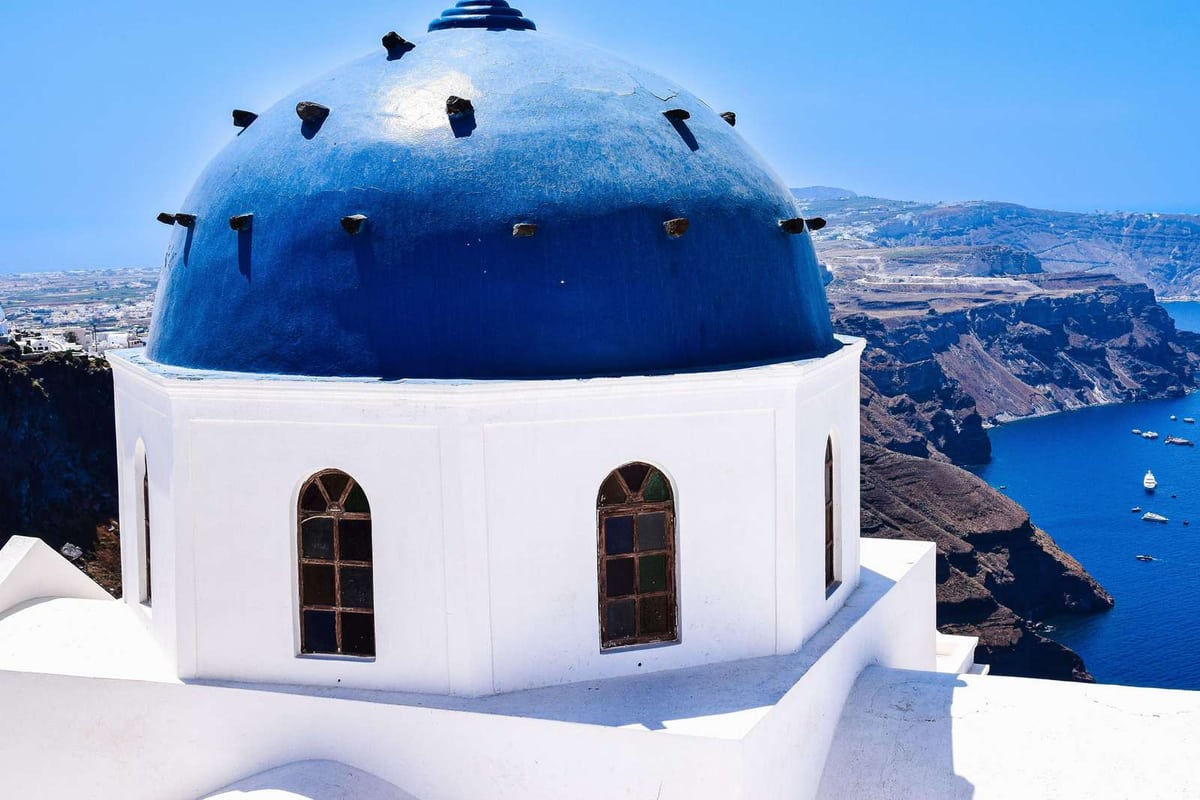
Days nine and ten of the 12 day greek islands tour are free days on Santorini. Day eight brings the ferry. Wikivoyage divides the island into an inner caldera side and an outer side. Pyrgos, Imerovigli, Megalochori and Emporio are villages on its list. The black, white and red beaches lie on the outer coast.
Wikivoyage places Pyrgos on the island’s highest point and lists a Venetian castle, narrow lanes and a monastery there. Pyrgos was one of the five castle settlements the islanders built against pirates. The Profeta Elias monastery crowns the hill nearby, and the view repays the climb. Both fit a slow free day on the 12 day greek islands tour.
Emporio keeps a Venetian castle on a hilltop, and the 12 day greek islands tour passes narrow streets. Wikivoyage dates the castle to the fifteenth century, and it still forms the village centre. Nearby stands the marble temple of Agios Nikolaos Marmaritis, a square of 4 metres each way. Dating to the third century, it still serves for worship.
Imerovigli sits just above Fira on the highest stretch of the caldera cliffs. The island article shows it as an example of Cycladic architecture. Megalochori keeps old white Cycladic churches and a name for its wineries. Vourvoulos, inland, is known for its vineyards. Each village gives the 12 day greek islands tour a different lane to walk.
On the 12 day greek islands tour, vines stand far apart in volcanic soil, with dew as their main moisture. Growers coil the vines into low baskets, and the grapes hang inside, out of the wind. The lighthouse at Cape Akrotiri is still run by the Greek Navy. Fira sits on the rim and Oia at the north end.
The caldera cliffs leave no room for beaches at the water’s edge. Wikivoyage places the beaches on the outer side of the ring. It explains the pebbles: the archipelago is young, and the sea has had no time to make fine sand. Wikivoyage asks for proper footwear, so pack shoes for the 12 day greek islands tour.
Each beach takes its colour from the rock behind it. Kamari is a black sand beach that runs on into Perissa. Shades shift along the 3 kilometres from Perissa through Perivolos to Agios Georgios. Red Beach, south of Akrotiri, owes its name to iron-rich rock above the water. Baxedes in the north is a stretch of black sand.
What does the volcano add to the 12 day greek islands tour?
The volcano gives the 12 day greek islands tour its ring of islands. The caldera spans about 12 kilometres by 7, and its walls climb to 300 metres on three sides. Thera, Therasia and Aspronisi make up the ring. The Kameni islands rise in the middle, and days nine and ten leave time to see them.
The present caldera dates to the Minoan eruption, 3,600 years back. The island article says the blast lasted for weeks. Massive waves followed, and ash lay hundreds of metres deep around the island. Because of that blast, the 12 day greek islands tour meets a flooded crescent instead of a typical mountain island. It also destroyed the earliest settlements.
Researchers also dated a far older blast to roughly 520,000 years back, with deposits up to 150 metres thick. Their volume of 90 cubic kilometres is more than six times that of the Minoan deposits. The blast reached above the waves and blanketed three neighbouring islands. The 12 day greek islands tour therefore visits a volcano with a long record.
Nea Kameni has an almost round outline about 2 kilometres wide, and its area is 3.4 square kilometres. Palea Kameni, the smaller one, covers just 0.5 square kilometres. Repeated small eruptions, first under the sea, built both from lava. Boat days on the 12 day greek islands tour land on these dark shields in the middle of the caldera.
Wikivoyage puts the ferry trip from Thira to Nea Kameni at 20 minutes. A climb leads to the crater, and steam and sulphur vents appear on the way. The same page lists a church and a hot spring on Palea Kameni. Together they turn the 12 day greek islands tour into a short trip on the water.
From the water, the cliffs read like a stack of layers. The island article describes solidified lava piled up, with the main towns standing along the top edge. Wikivoyage points to a ship inside the caldera as the way to enjoy the steep cliffs. A boat gives the 12 day greek islands tour that angle, which the rim cannot.
Santorini shares a volcanic line across the southern Aegean with Methana, Milos and Nisyros. The oldest of at least four overlapping calderas lies in the south. The geologists’ union IUGS counts the Quaternary Santorini Caldera among its 100 sites of geological heritage. Days nine and ten of the 12 day greek islands tour sit inside that setting.
What else do travellers ask about the 12 day greek islands tour?
What makes a free island day differ from an Athens day on the 12 day greek islands tour?
An Athens day on the 12 day greek islands tour runs on a booked slot. A free island day runs on walking and buses. Wikivoyage names the Acropolis as the one attraction that needs advance planning. Nearly every other ancient site lies within two kilometres of it.
Day 2 is the busy Athens day, with its morning tour and a free afternoon. Wikivoyage names the National Garden as a place to rest from the heat and noise of town. It also credits the Metro with sparing a walker much of the traffic. Day 1 stays open for a slow first walk.
The island days carry no ticket slot at all, and the 12 day greek islands tour keeps them loose. On Paros, Wikivoyage names walking as the way to move inside the resorts, with buses between the towns. On Santorini the buses meet at Fira, and a driver or the ticket office names the route.
Which shoes and clothes suit the Acropolis and the island stones on the 12 day greek islands tour?
Comfortable shoes with good traction suit the 12 day greek islands tour. Wikivoyage asks readers to leave high heels at home. Pointed heels harm marble that is soft and slick, so certain sensitive sites have banned them.
Santorini asks the same of your feet on the 12 day greek islands tour. Wikivoyage describes cobblestone paths and cliffside steps there. It names sneakers or comfy walking shoes as the ideal pair. Wikivoyage also calls the Acropolis shadeless at peak heat, so the rock offers no shade then. Heels suit neither the steps nor the marble.
Churches have a rule of their own. Wikivoyage finds the small Orthodox churches of Athens tucked in among the concrete. Its rule of thumb for them is long sleeves and covered legs, as a mark of respect. Day 7 on Paros mentions white churches, so the rule is worth carrying along.
How do the Acropolis opening times work on the 12 day greek islands tour?
The Acropolis keeps seasonal hours, so the 12 day greek islands tour checks the official page before Day 2. For April to August, Wikivoyage lists an opening at eight o’clock and a closing at eight o’clock at night. The last entry falls thirty minutes before closing.
Winter hours shrink with the daylight, and by December the gate closes at five in the evening. Timed-entry tickets are mandatory, Wikivoyage states. Staff admit nobody to the gate line until within fifteen minutes of the booked time. The official page lists opening days and any change of hours.
The Acropolis Museum sits outside the security perimeter of the rock, so it needs its own timed ticket. Wikivoyage advises planning the time for both places. It sets one hour as the floor for the rock and two hours for a lover of history. Day 2 of the 12 day greek islands tour joins both in one morning.
How does the 12 day greek islands tour handle luggage on the ferry days?
On the 12 day greek islands tour, Day 3, Day 6 and Day 8 are ferry days. Each ends with a transfer to the hotel. Wikivoyage calls the ferry the one thing in Greece that leaves on time. A traveller needs to be prompt at the pier.
Day 6 brings a busy landing on Paros. Wikivoyage says a windy or night arrival can feel overwhelming, so know where you are going before the boat docks. Santorini coaches carry large bags in holds, Wikivoyage notes. In peak season a bus filled at its first stop skips the stops after it.
Day 11 is the flight, and the 12 day greek islands tour meets a small airport. Wikivoyage calls the Santorini airport very small. It says the airport takes bags for drop-off only in the last two hours before a flight. Seating in the gate areas is limited, while a cafeteria and a large number of seats wait outside the terminal.
What does a swim stop at the sea add to the 12 day greek islands tour?
A swim stop on the 12 day greek islands tour can mean a beach with no facilities at all. Wikivoyage says White Beach on Santorini has no pier. Boat guests wade ashore through waist-deep water to a very small beach.
The beach has only a small number of chairs and umbrellas, as the page notes. For snorkelling, Wikivoyage praises Red Beach and Perissa for their sea life. It praises the visibility around Santorini but notes fewer fish than at more popular dive spots. Days 9 and 10 are free on Santorini, so a snorkel stop has room there.
Paros adds two sea stops to the 12 day greek islands tour. Wikivoyage says Kalogeros beach, with its rock formations, needs the dirt road from Molos. Tsoukalia, Glyfa and Glyfades need a narrow path or a boat. Day 7 is the free day on Paros, so a swim stop fits there.