
The 7 day greek islands tour joins Mykonos, Paros and Santorini on one ferry route that starts and ends at the port of Piraeus, and seven of its nine days are island days. For other routes across the country, the list of tours in Greece is one click away.
This page sets out the day plan, the ferry season and the sea legs, then Mykonos Town, Little Venice and the windmills, the churches and museums of Mykonos, Parikia and the Church of 100 Doors, Naoussa, Lefkes and the Byzantine Road, Fira, Oia, the Akrotiri dig, the Cyclades as a group, the white houses and domes, and the night ferry with the last day in Athens, before the FAQ closes the page. Two longer plans sit beside it: the 12 day greek islands tour adds Athens sightseeing and a flight home, while the 10 day greek islands tour reaches Patmos, Rhodes and Crete.
What is the 7 day greek islands tour, and how does the route run?
The 7 day greek islands tour is a ferry route through three islands of the Cyclades. It visits Mykonos, Paros and Santorini in that order, with a night and a free day on each. Seven of the nine program days are island days. The last of them ends on the night ferry to Piraeus.
A 7 day greek islands tour moves in one direction through the Cyclades. The route enters the group at Mykonos and crosses to Paros. It ends on Santorini, which Wikipedia calls the southernmost member of the group. So each outbound ferry leg takes the traveller further south. Only the night ferry home runs north.
The nine days of the program run in this order.
- Ferry from Piraeus to Mykonos
- Free day on Mykonos
- Ferry from Mykonos to Paros
- Free day on Paros
- Ferry from Paros to Santorini
- Free day on Santorini
- Free morning, then the night ferry
- Piraeus arrival, free day in Athens
- Check-out and end of the program
Island hopping means moving between islands by boat, with a night or more on each. Wikivoyage Greek islands says ferries reach every island, so the sea works as the road. Wikivoyage Cyclades suggests island hopping to travellers with more than one week. The program counts nine days, so the 7 day greek islands tour fits that note.
Wikivoyage Cyclades calls Paros a ferry hub. Wikivoyage Paros adds that the bulk of the boats heading for Naxos and Santorini call there first. Wikipedia lists Mykonos, Paros and Thira, the other name of Santorini, among the major islands of the group. That makes the 7 day greek islands tour a trip inside one group.
The rhythm repeats three times: a ferry day, then a free day. Days 1, 3 and 5 are ferry days that end with a transfer and a night on the new island. Days 2, 4 and 6 are free days with nothing fixed. That rhythm gives the 7 day greek islands tour one slow day after every crossing.
The name counts island days only. Days 1 to 7 are island days: two on Mykonos, two on Paros and three on Santorini. Day 7 ends on the night ferry. Day 8 is a free day in Athens, and Day 9 is check-out. So the 7 day greek islands tour counts every day up to the night ferry.
The program lists three ways to bend the route. A hotel in Athens can come before the start. A day ferry can replace the night boat on the way back. The days can also move to fit a traveller’s own dates. In each case the 7 day greek islands tour keeps the same order of islands.
Which season suits the 7 day greek islands tour?
The 7 day greek islands tour suits the shoulder months at sea. Wikivoyage Mykonos names early season, from the middle of late spring through June, and post-season, from September into mid-October. July and August bring crowds and a steady wind. The bulk of the Piraeus ferries to Mykonos stop by the end of October.
The sea sets the season of this route more than the sights do. Wikivoyage Cyclades says the ferry timetable shrinks out of season. It tells readers to check with the operator before fixing a departure, since bad weather brings delays and cancellations. So the dates of a 7 day greek islands tour start with the sailing list.
Spring opens slowly on the islands. Wikivoyage Mykonos says March and April bring limited choice of restaurants, shops and sea routes. Businesses shut for renovation return in late spring. The same page names the middle of late spring the early season. That early season is the first window for a 7 day greek islands tour.
High summer crowds the 7 day greek islands tour. Wikivoyage Mykonos reports heavy crowds on the island through July and August. It says booking ahead matters only between mid-July and late August, or near a Greek holiday. On the fifteenth of August, the bulk of the boats to Mykonos call at Tinos, so buy tickets early.
The summer wind belongs to the same picture. In July and August, says Wikivoyage Cyclades, the constant meltemi blows and eases the heat a little. Wikivoyage Mykonos warns seasickness sufferers that these waters turn notoriously choppy at times. So the wind is worth reading before the dates of the 7 day greek islands tour are fixed.
Autumn is the second shoulder window. From September, Wikivoyage Santorini notes, cooler air returns. Wikivoyage Cyclades says the weather changes in October and rain starts to fall. Seasonal businesses on Santorini begin to close late in October, Wikivoyage reports. A September date for the 7 day greek islands tour comes well before that point.
Winter is the quiet season. Wikivoyage Santorini puts the off-season from December to March, with occasional rain and winds. Fira remains largely open, with over a dozen restaurants that run all year. Smaller villages can keep only one or two places open. The 7 day greek islands tour is a plan for the other months.
How do the ferries link the stops of the 7 day greek islands tour?
The ferries of the 7 day greek islands tour start at Piraeus and hop south through Mykonos, Paros and Santorini. Wikivoyage Piraeus calls the port the chief exit point from Athens by sea for the Aegean islands. Three sea legs lead out, and one night leg brings the traveller home.
Piraeus is a large port, and Day 1 of the 7 day greek islands tour begins there. Wikivoyage Piraeus groups the departures by gate. One gate serves the Saronic Gulf islands and four serve the Aegean islands. Three more gates are for Crete, the Dodecanese and the East Aegean islands. The Cyclades boats sit in the Aegean group.
The first leg runs from Piraeus to Mykonos. Wikivoyage Mykonos says ferries and catamarans serve the island daily from the mainland. It puts the crossing between three hours thirty minutes and five hours fifteen minutes, depending on the type of boat. So Day 1 of the 7 day greek islands tour is built around one crossing.
The second leg is short. Wikivoyage Paros mentions a boat ride of one hour from Mykonos to Paros. Wikivoyage Mykonos lists Paros with Syros, Andros and Tinos, islands with more than one boat a day. So Day 3 of the 7 day greek islands tour is one short crossing and a transfer.
The third leg crosses to Santorini. Wikivoyage Santorini says the ferry from Piraeus passes Paros and Naxos on its way to the island. This page found no sailing time for the Paros to Santorini leg alone, so the timetable decides. The way home on the 7 day greek islands tour is the night boat from Santorini back to Piraeus.
On Day 3, the plan names Naxos or Syros as swaps for Paros. Wikivoyage Naxos describes the island as a hub of sea transport, with connections in all directions. Wikivoyage Syros calls Ermoupoli the capital of the Cyclades, well connected with Athens. A swap keeps the 7 day greek islands tour on one sea route.
Read a timetable one leg at a time. Wikivoyage Greek islands says routes and the number of sailings change with the season. Wikivoyage Cyclades says tickets are on sale at travel agencies around the local port. So check each leg on the official page for the date of the 7 day greek islands tour.
What does Mykonos Town add to the 7 day greek islands tour?
Mykonos Town, also called Chora, adds tiny whitewashed lanes, houses and churches to the 7 day greek islands tour. This harbour town stands on the west coast of Mykonos. Day 1 of the plan ends here, after the ferry from Piraeus and the transfer to the hotel.
Wikivoyage lists two ports for Mykonos, so check where the boat will dock. The bulk of the ferries go to Tourlos, the new port, which lies roughly 2 km north of town. The fast catamarans serve the old port, in the town itself. Day 1 of the 7 day greek islands tour starts at one of them.
A shuttle bus leaves Tourlos for town every half hour, Wikivoyage reports, and the ride lasts about 12 minutes. A walk from Tourlos needs roughly 45 minutes. From the old port, a brief stroll beside the coast reaches the centre. Any of these ways suits the arrival day of the 7 day greek islands tour.
Mykonos Town keeps cars out, Wikivoyage says, so parking sits on the outskirts and beside the old port. There are two bus stations, one on each side of town. No bus runs between the two, and the stroll through the lanes lasts about 20 minutes. So the 7 day greek islands tour moves through this town on foot.
Along the streets run small shops, boutiques, galleries, cafes, bars and restaurants, as Wikivoyage lists them. Rapid growth on the island has left the Cycladic building style of the town intact, it adds. Mykonos also holds a large artists’ colony, and its galleries show original works. A free hour on the 7 day greek islands tour fits a gallery.
Manto Mavrogenous Square lies on the harbour front of Mykonos Town. In its middle sits a statue of the woman who led the island in the Greek Revolution. Wikivoyage names it Taxi Square, the main taxi point on an island with only about 30 taxis. The square is an easy meeting point for the 7 day greek islands tour.
Ayia Kyriaki Square holds the Municipal Library, which fills an eighteenth-century mansion in the main town, Wikipedia notes. Its shelves hold over 8,000 volumes, along with old photographs, documents, Cycladic coins and seals. The collection also includes sketches and books from an American artist’s own library. A short indoor stop like this suits the 7 day greek islands tour.
What do Little Venice and the windmills add to the 7 day greek islands tour?
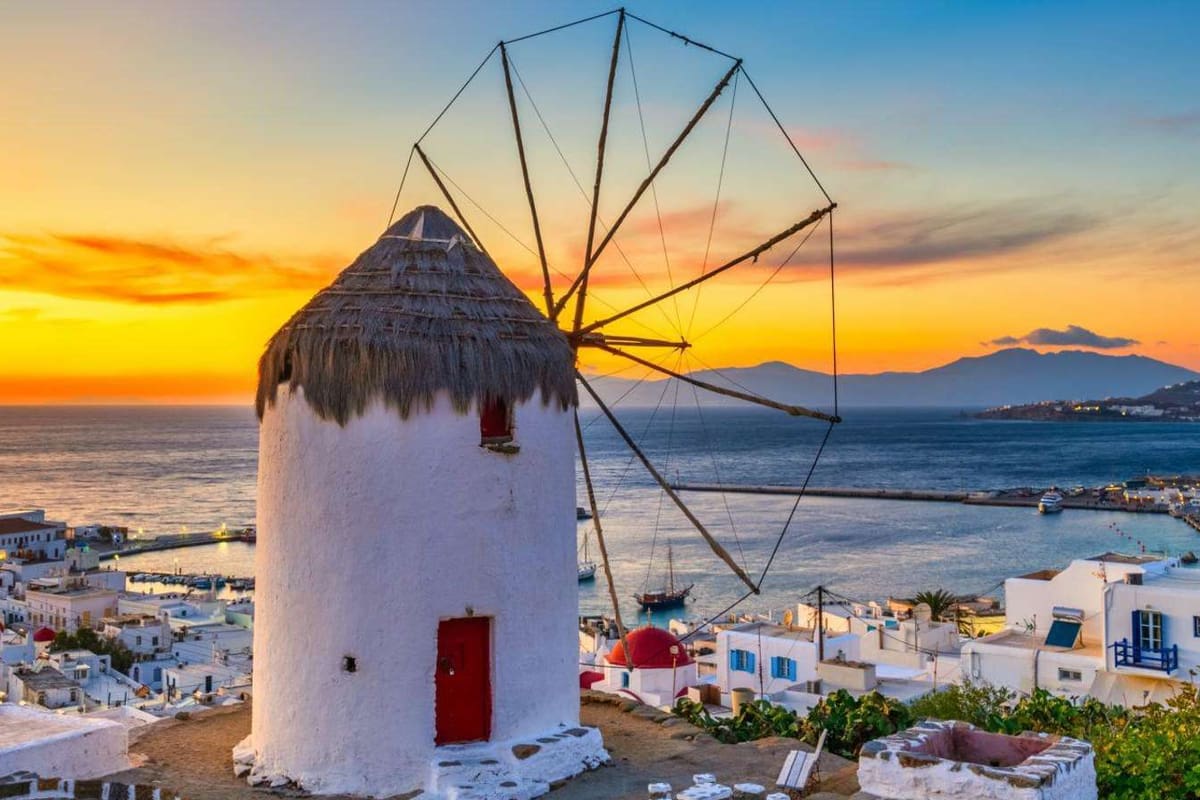
Little Venice and the windmills add the west edge of Mykonos Town to the 7 day greek islands tour. Little Venice is a row of old sea-front houses with wooden balconies. The windmills are round white towers on the hill above, linked to it by a flight of steps.
Wikivoyage places Little Venice, also named Alefkandra, on the western edge of town. Its medieval houses climb two and three floors from the water, and colourful wooden balconies hang from them. Steps lead down from the windmills, so the 7 day greek islands tour links the two on foot.
The first of these fishing houses went up around the middle of the eighteenth century. Rich merchants or captains owned them at first. Little basement doors opened onto the water and onto storerooms below. Seeing them, people guessed the owners were secret pirates. Day 2 of the 7 day greek islands tour leaves room to look at them.
Cafes, bars, galleries and little shops now fill a number of the old houses. The coast draws artists, who come to paint it. People gather there at sunset, which gives the 7 day greek islands tour an evening plan. Wikivoyage puts it five minutes on foot from the southern bus station, with a sign across the square.
The island has 16 windmills, and seven of them sit on the hill above Chora. The Venetians began them in the sixteenth century, and work ran on into the early twentieth century. The mills share one look: round white walls, tiny windows and a pointed roof. The 7 day greek islands tour sees them from every point of town.
Kato Mili means lower mills. Its row crowns a hill over the water, where the strong north winds blow. Wikivoyage names the meltemi, a wind that blows steadily through July and August. The island’s other name, Island of the Winds, comes from very strong winds. The windmill hill explains that name on the 7 day greek islands tour.
Wheat grinding at the mills ended around the mid-twentieth century. The mills were an important source of income, since the island once produced a great deal of wheat and bread. One mill is now a museum. From there the 7 day greek islands tour looks over all of Chora and a stretch of the harbour.
What do the churches and museums of Mykonos add to the 7 day greek islands tour?
The churches and museums of Mykonos fill Day 2 of the 7 day greek islands tour with quiet choices. Panagia Paraportiani, five joined whitewashed churches in the Kastro quarter, is the main church stop. The Archaeological, Aegean Maritime and Folklore museums are the museum stops. Wikivoyage lists all four in the town.
The island holds about 400 churches, Wikivoyage reports. Wikipedia gives the reason: for years, a rule made islanders raise a church on their plot before any house. The sole Catholic church on Mykonos, Our Lady of the Holy Rosary, dates from the seventeenth century. Its icon of the Virgin Mary and the Child came from Venice.
The church stood by a side gate of Kastro. Its name, Paraportiani, means standing beside the door and comes from that gate. In the early thirteenth century the Ghisi family built a castle there. The castle was destroyed in the sixteenth century, and later houses covered its remains. The 7 day greek islands tour walks this oldest quarter.
Two centuries passed between the first stones, laid in the fifteenth century, and the last, in the seventeenth. It is five churches in one. The four lower churches are dedicated to Saint Sozon, Saint Anastasia, Saint Eustathios and the Saints Anargyroi. A fifth church sits above that base. Wikivoyage adds that only one lower chapel is open to visitors.
The old port has the Archaeological Museum close by. Alexandros Lykakis designed its neoclassical building, and the municipality gave the land. The vases, stelae and urns come from the islet of Rheneia. Little on show was found on Mykonos itself. It stays open all year, which suits the 7 day greek islands tour in any month.
George Drakopoulos, a Mykonian, set up the Aegean Maritime Museum, which opened in nineteen eighty-five. The museum occupies a nineteenth-century house at Tria Pigadia, near the middle of town. The garden shows the Armenistis Lighthouse, a restored exhibit, and ancient gravestones of sailors from Mykonos and Delos. A visit suits Day 2 of the 7 day greek islands tour.
Tria Pigadia, in the middle of town, has three wells of the same design in a row. Dug into sand, each is only 5 to 6 metres deep. The Folklore Museum occupies a captain’s house from the eighteenth century. Day 2 of the 7 day greek islands tour makes space for both.
What do Parikia and the Church of 100 Doors add to the 7 day greek islands tour?
Parikia adds a working port town and the Church of 100 Doors to the 7 day greek islands tour. Day 3 is the ferry day to Paros. The official Paros page names Parikia as the island’s harbour for goods and for passengers alike. The church stands close to the quay.
On the 7 day greek islands tour, Day 3 ends with a night on Paros. The island has its capital at Parikia, built over the ground of ancient Paros. Its bay lies on the north-west flank of Paros. The official page suggests the name comes from the parikous, the crofters of the great church.
Kastro hill rises above the port. A Venetian castle once crowned it, and its ruins remain. The official page says the builders took columns and other pieces from ancient temples, still clearly visible. The Paros article names a temple of Apollo as the main source of its marble. The 7 day greek islands tour reads history in a wall.
Cycladic houses, neoclassical mansions, fountains and small churches line the old town around the castle. The official page counts about 40 churches worth a visit nearby. Wikivoyage adds the Valley of the Butterflies, a green oasis near Parikia and a biotope of the tiger moth. The 7 day greek islands tour keeps a free day for each.
Finds from the Neolithic, Early Cycladic, Mycenaean and Roman periods fill the Archaeological Museum of Paros. Roman mosaic floors are on show too. A fragment of the Parian Chronicle is inside as well. Its marble entries run from the fifteenth century BC down to 264 BC. The 7 day greek islands tour meets antiquity here.
The Church of 100 Doors is a group of buildings. The official page counts a cruciform church, six chapels, a narthex and a baptistery of the fourth century. In the reign of Justinian, arches replaced the first wooden roofs, and a dome crowned the skylight. This stop of the 7 day greek islands tour spans centuries.
Builders reused ancient stone on a large scale here. The official page estimates over 2,500 ancient pieces went into the church, its baptistery and one chapel. Two pilasters at the entrance carry the words Zeus Eleftherios. Day 4 of the 7 day greek islands tour is free, so the church and castle fit it on foot.
What does Naoussa add to the 7 day greek islands tour?
Naoussa brings a working fishing port to the 7 day greek islands tour. It lies along the northern shore of Paros. The official Paros page says the village was built around its port. A wall once led from the village to a Venetian bastion. Fishing boats fill the sheltered port today.
Naoussa occupies the north-eastern corner of Paros. The encyclopedia article calls it a fishing village and a community. The Paros article lists three older forms of the name: Naussa, Agoussa and Ausa. In Russian it was known as Auza. A 7 day greek islands tour that stops on Paros meets a place with a long list of names.
Boats find shelter in the wide natural bay of Naoussa. In the ancient world, the Paros article says, a chain or boom barred its entrance. In the late eighteenth century, the Russian squadron of Count Alexey Orlov made it a home base. So the 7 day greek islands tour passes a bay that has sheltered fleets for centuries.
At the northern side of the harbour lies the Venetian castle, a sight for the 7 day greek islands tour. Wikivoyage says it is half sunk beneath the sea. Travel pages give different centuries for it, so the safe word is Venetian. The official page adds that parts of this bastion still stand.
The official page describes a network of narrow whitewashed streets in the Cycladic style. Old fishermen’s warehouses are now taverns, cafes and ouzo restaurants that serve fresh seafood. Wikivoyage points to octopus in vinegar and gouna fish at the ouzeri. Evenings draw people from all over the island, and the 7 day greek islands tour can join them.
The Folklore Museum of Naoussa shows the collection of Doctor Othon Kaparis, with a library and a photo archive. Finds from the dig at Koukounaries, a Mycenaean acropolis, sit in the Archaeological Museum. An Early Cycladic cemetery also lies at Plastira, says the page. The 7 day greek islands tour can add a museum hour on a slow day.
Day 4 of the 7 day greek islands tour is free, so Naoussa works as a day out. Wikivoyage notes bus services between the towns of Paros. It also lists boat trips and private cruises around Paros that reach Antiparos, Despotiko and the Panteronisia. The Naousa article names Kolympithres as a nearby beach, with a view back towards the village.
What do Lefkes and the Byzantine Road add to the 7 day greek islands tour?
Lefkes adds an inland mountain village and the start of the Byzantine Road to the 7 day greek islands tour. The official Paros page calls the road a marble-paved path over 1,000 years old. It leads from Lefkes down to Prodromos, a village on the open plain in the east.
Day 3 brings the ferry to Paros, and Lefkes waits inland, 10 kilometres from Parikia, as the Paros article states. The official page says the village is built under a pine-covered hill. Its houses are arranged like an amphitheatre on the slope. The 7 day greek islands tour leaves the sea behind for a morning.
Narrow streets in Lefkes are closed to cars, so the village is walked. Ramnos Street is the main street, with a view of the east coast, says the official page. It holds neoclassical buildings, a museum of Cycladic folklore and the House of Literature. The 7 day greek islands tour gains a slow village hour here.
At the end of Ramnos Street stands Agia Triada, a church built of Parian marble in the nineteenth century. It is a three-aisle basilica with a raised middle aisle and two bell towers. The official page calls it a listed historical monument. Locals meet on the main square nearby. The 7 day greek islands tour can pause there.
In the late nineteenth century, Lefkes was the capital of Iria, a municipality named for an ancient name of Paros. Residents moved to Athens in the nineteen seventies. Tourism later led to rebuilt homes and landscaping. The latest census it quotes counts 545 inhabitants. The 7 day greek islands tour visits a village that rebuilt itself.
The official page calls the Byzantine Road the island’s oldest trail. It runs 3.5 kilometres from Lefkes to Prodromos, beside the car road. Except for 150 to 200 metres, the path goes downhill. The walk takes about 45 minutes, the page adds. Wikivoyage praises its old stones. The 7 day greek islands tour can walk it downhill.
The page says the sea, the west coast of Naxos and the mountains of Ikaria show in the distance. The path ends in Prodromos, once called Dragoulas. Prodromos, Marmara and Marpissa form the villages of Kephalos, named for a hill. Day 4 of the 7 day greek islands tour is free, and this walk fills it.
What does Fira add to the 7 day greek islands tour?
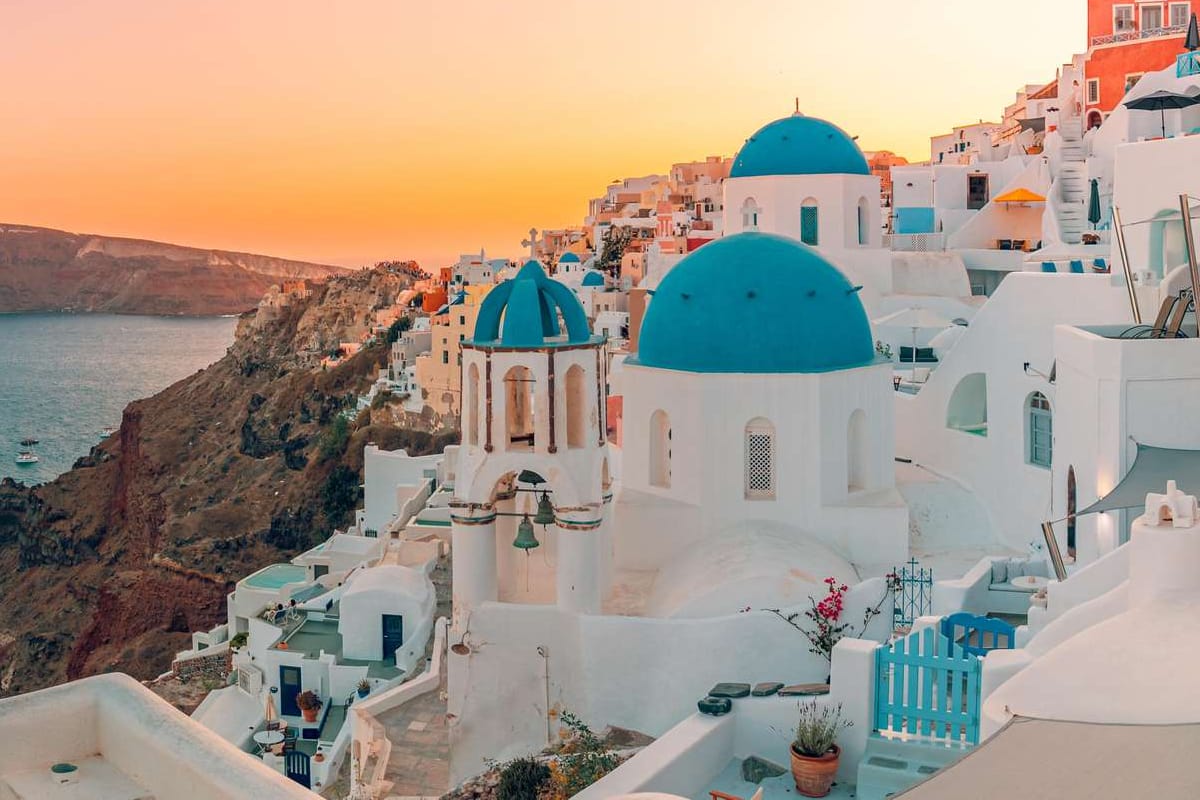
Fira, the capital of Santorini, is where the 7 day greek islands tour spends Day 5 and Day 6. Whitewashed houses line the caldera rim, and the town sits well above its port. It holds two main museums, two cathedrals and the bus hub that links the whole island.
Fira takes its name from another pronunciation of Thira, the old island name, Wikipedia explains. Wikivoyage describes a marriage of Venetian and Cycladic building styles along its white cobblestone streets. The 7 day greek islands tour reaches that island on Day 5, after the ferry. Wikivoyage puts the town 275 metres over its port, on the caldera rim.
Ferries on the 7 day greek islands tour dock at Athinios, the new port on Thira, as Wikivoyage describes it. A bus meets each arrival and takes about 15 minutes to reach Fira. The road from the port climbs steeply, with seven turns of 180 degrees. Day 5 therefore holds one short and winding transfer by road.
The old port below Fira has no road. Two ways lead up: a cable car, or 588 zigzag steps that donkeys also climb. Erosion shaped Skaros Rock from the cliffs at Fira, and it holds the ruins of a fort. Fira’s Karavolades Stairs lead down into the caldera, Wikivoyage notes. The cliff face is a sight in itself.
Fira’s two main museums suit the free Day 6 of the 7 day greek islands tour. Wikivoyage says the Museum of Prehistoric Thera covers the Bronze Age town at Akrotiri. Pottery and figures from the third millennium BC onward fill the Archaeological Museum of Thera. Wikivoyage adds that Fira also has museums on naval history, tomatoes, wine and ethnography.
Fira is home to two cathedrals of different Christian traditions, Wikivoyage points out. The Catholic one dates from the thirteenth century, and its bell tower is a landmark. Island churches hang bells in odd-numbered groups on a stepped wall, as at the Three Bells of Fira. Each fills a free hour on the 7 day greek islands tour.
From the rim, Wikipedia describes an 18 kilometre sweep of caldera. Imerovigli, just above Fira, stands on the highest part of the caldera cliffs. A rim trail links Fira to Oia, so the 7 day greek islands tour has a walk close by. A dozen or more places to eat in Fira stay open through the quiet winter.
What does Oia add to the 7 day greek islands tour?
Oia is a village at the northern end of Santorini, strung along the caldera edge for almost two kilometres. The 7 day greek islands tour adds cave houses, blue-roofed churches, a castle ruin and a nightly sunset crowd. Wikivoyage calls it a restored traditional settlement perched on the cliffs.
Wikipedia puts Oia 11 kilometres from Fira. Its hilltop setting, about 150 metres up, earns it the name Eagle’s Nest. A public bus line links Fira and Oia via Firostefani and Imerovigli. The rim walk from Fira can take under three hours. Day 6 is free, so the 7 day greek islands tour fits a trip north.
Homes in Oia are built into niches carved from the caldera slope, as Wikipedia describes. The cave houses were used by ships’ crews, on the lip of the crater. Pumice filled with tiny bubbles insulates the rock houses, Wikivoyage explains. A cave house on the 7 day greek islands tour shows how islanders built with the rock.
Wikivoyage says square white houses stand beside blue-roofed churches in Oia. Only a handful of churches have blue roofs, it adds. Postcards show those same buildings from different angles. The same source counts two windmills in the village. Look for them on the 7 day greek islands tour, and walk slowly, as Wikipedia calls the paths narrow.
A castle ruin crowns Oia. Wikipedia ties it to Pyrgos as part of one Venetian defensive network. Maps long named the village Apanomeria, meaning upper side, until the name Oia took over. Wealthy captains built neoclassical mansions here in the late nineteenth century. The 7 day greek islands tour also crosses the sea, as Oia’s captains once did.
An earthquake on 9 July in nineteen fifty-six, magnitude 7.8, damaged Oia, as Wikipedia records. By nineteen seventy-seven, only 306 people lived there. In the nineteen-seventies, a national tourism programme began to restore old houses. The work won a European prize, Wikipedia adds. That rebuilding is why the 7 day greek islands tour finds a living village here.
Crowds gather in the town at dusk, Wikivoyage says, all there to see the sunset. For a short moment, the walls and the caldera take on the setting sun’s colours. Nea Kameni is in view, and Ammoudi harbour lies 300 steps below. Day 6 of the 7 day greek islands tour can end with this view.
What does Akrotiri add to the 7 day greek islands tour?
Akrotiri, in the south of Santorini, is a Bronze Age town that ash sealed and diggers have partly reopened. The 7 day greek islands tour gains paved streets, drains, wall paintings and houses of three storeys from one site. Wikipedia and Wikivoyage both compare the buried town to Pompeii.
A nearby village gave Akrotiri its name, and the ancient name is not known. The first digs on the island, in eighteen sixty-seven, followed a quarry find of old artifacts. For the 7 day greek islands tour, the dig explains the island’s past. Wikipedia links it to the Minoans through Linear A writing and similar art.
The earliest life dates to the fifth millennium BC, when fishers and farmers had a small village. Fragments of foreign pottery point to trade links across the Aegean. By the close of the third millennium BC, it had grown a great deal. The 7 day greek islands tour meets a town that grew over thousands of years.
Wikipedia notes paved streets, a drainage system and fine pottery, all signs of a skilled community. Then the eruption buried the town in ash, which kept it remarkably well preserved. Walls rise as high as eight metres, and houses reach three storeys. A visit on the 7 day greek islands tour shows streets, not just stones.
Inside the houses, diggers found huge storage jars called pithoi, mills, pottery and stone staircases that still stand. A loom workshop hints at cloth woven for export. The dig has opened only the south end of the town so far, and the rest lies underground. Wikipedia notes that Akrotiri was a town, unlike the palace centres of Crete.
The wall paintings kept their colour well under thick layers of volcanic ash. One house held frescoes of two antelopes, a man holding strings of fish and boats with leaping dolphins. Another scene shows women seated in the shade under light canopies. The 7 day greek islands tour reads the island’s story in these scenes of daily life.
Spyridon Marinatos led the modern dig, which started in nineteen sixty-seven. After his death, Christos Doumas took over as head of the excavations. Wikivoyage adds that a giant canopy covers the town, so summer visits stay comfortable. Day 5 brings the ferry, and Day 6 is free for the south on the 7 day greek islands tour.
What does the Cyclades group add to the 7 day greek islands tour?
The Cyclades group gives the 7 day greek islands tour its setting. According to the article on the group, this archipelago lies in the Aegean Sea, southeast of the mainland. Islands circle Delos, which the old Greeks held sacred, and that circle gave the group its name. The route visits three of them.
The article on the group names twenty major islands. Milos, Ios, Tinos and Syros stand beside the three of this route. Smaller islands such as Donousa and Irakleia form the Lesser Cyclades. The Sea of Crete lies along the southern edge. On this map, the 7 day greek islands tour covers only three islands of the group.
The group has a dry, mild climate, and its soil is poor except on Naxos. Farms yield olive oil, wine, wheat, fruit and tobacco. Wikipedia names three strains that tourism has put on the group: erosion, pollution and water shortages. Wikivoyage calls the islands bare and rocky, so the 7 day greek islands tour crosses dry slopes.
In the Bronze Age the islands had a culture of their own. The article on Cycladic culture says its early phases ran from the late fourth into the third millennium BC. Its main objects are simple flat figures carved in white marble from the islands. A 7 day greek islands tour crosses the home of those figures.
In the last years before the twentieth century, Christos Tsountas studied graves on different islands. He coined the term Cycladic civilization. Collectors later paid for the figures, and graves were looted. The setting of the finds was largely lost, so their meaning stays uncertain. One idol of Parian marble stands one and a half metres high.
Boat models point to crews of oarsmen drawn from scattered communities. A frying-pan vessel from Syros has a ship cut into it. Wikipedia calls the culture seafaring, and a 7 day greek islands tour is a sea route too. When Crete’s palace culture rose, the islands grew less important. Delos kept its role as a sanctuary into the Classical age.
Wikivoyage tells first-time visitors to the Cyclades to choose Santorini, Mykonos and Paros. It calls island hopping popular and says ferry timetables are excellent. The route follows that advice: two nights on Mykonos, two on Paros and two on Santorini. Day seven is the night boat. So three islands fill a 7 day greek islands tour.
What do the white houses and domes of the Cyclades add to the 7 day greek islands tour?
The white houses and domes of the Cyclades give the 7 day greek islands tour its look. Wikivoyage says the villages of Santorini are packed with cubic stone buildings, whitewashed and set in dense clusters. The article on the island describes traditional houses built low, from stone found on the island.
Wikivoyage opens its Cyclades page with a picture in words. It speaks of bare rocky islands and brilliantly white villages built of cubes. They sit on hills above what the page calls the wine-dark sea. The same page warns of crowds in high summer. That is the picture a 7 day greek islands tour follows from island to island.
On Santorini, builders whitewashed or limewashed the houses. Volcanic ashes gave other colours, and these now tend to replace white on house fronts. The article says this traditional style developed up to the great earthquake of nineteen fifty-six. The island shares its building style with the other Cyclades. A 7 day greek islands tour meets both looks.
Whitewash is a simple paint. The page on whitewash says it is made from slaked lime or chalk. It hardens in the air as it reacts with carbon dioxide and turns into calcite. Lime wash gives walls a glow, because calcite crystals bend light twice. That material gives a 7 day greek islands tour its white walls.
Not every island follows the white cube. Wikivoyage calls Syros an island of Italianate architecture, and the plan lists it as a swap for Paros. Wikipedia describes the site of Ermoupoli as a natural amphitheatre filled with neo-classical buildings and old mansions. A 7 day greek islands tour that keeps Paros keeps the white cube.
Domes belong to the churches. The cross-in-square plan, prominent in the ninth century, became the main Byzantine church form. It has a square middle block, four arms of equal length and a domed roof. Wikivoyage names a blue-domed church of Saint Spirou in Firostefani. A neo-Byzantine church on Syros shows its dome from much of Ermoupoli.
Windmills belong to the skyline too. The Paros article shows a windmill in Marmara and labels it a traditional Cyclades design. The page on whitewash says a blue laundry dye was a common addition of the nineteenth century. That is a fact about paint, not a rule for the domes of a 7 day greek islands tour.
What do the night ferry and the last Athens day add to the 7 day greek islands tour?
The night ferry and the last Athens day close the 7 day greek islands tour. Wikivoyage says standard ferries need about seven to nine hours from Piraeus to Santorini. The return sailing runs overnight, and the boat reaches Piraeus on the morning of day eight.
Day seven ends at sea. The route uses a night boat, and the crossing runs into day eight. Wikivoyage adds that fast ferries and catamarans make the trip to Santorini in about four to five hours. The official timetable tells you which kind sails on your night. That choice shapes the end of a 7 day greek islands tour.
Breakfast, free time and a port transfer fill the morning of day seven on a 7 day greek islands tour. Wikivoyage notes that ferry departure times change from day to day. Bus times to the port are handwritten and pinned up the day before, at the Fira bus stop. Public buses also wait at the port when each ferry arrives.
Settle two things before the crossing: the booking and the class. Wikivoyage Greece notes that boats to popular islands do sell out on holiday weekends and in high season. Wikivoyage lists ordinary ferries and faster boats, and it names deck class, where you can sleep outside. Both choices shape the night sailing of a 7 day greek islands tour.
The 7 day greek islands tour returns to Piraeus, where the boat docks on the morning of day eight. Wikipedia states that nearly every island of eastern Greece has a ferry route from the central port. Wikivoyage places the posted arrival and departure times at the Coast Guard building, by Karaiskaki Square, the main bus terminal.
From the quay, Athens is close. Wikipedia names buses, trolleybuses, the Suburban Railway, Metro Lines one and three and the Athens Tram at Piraeus. Two stations, for the Metro and the Suburban Railway, stand next to the seaport. Wikivoyage says the central Cyclades ferries sail from a spot just across from the Metro station.
Day eight is a free day in Athens. Wikivoyage says the areas that interest visitors lie mainly in the central Athens municipality. Day nine is check-out, and the 7 day greek islands tour ends there. Wikivoyage Greece says to plan on reaching Athens at least a day before a flight home. Ferries can still run late.
What else do travellers ask about the 7 day greek islands tour?
What does a free island day hold on the 7 day greek islands tour when nothing is booked?
Days two, four and six of the 7 day greek islands tour carry no ticket to catch. They are the free days, one on each island. Nothing fixes a start time, so the traveller sets the pace and the day follows.
In summer, says Wikivoyage, public life slows on Santorini. Restaurants and other services shut for the midday heat, between twelve and three o’clock. A swim or a rest fits that gap, and a walk fits the morning. The lanes and one long meal fill the rest.
Paros gives the 7 day greek islands tour a sea option for its free day. Wikivoyage lists boat trips to Antiparos, Despotiko and the Panteronisia. It adds that a car does not reach every one of them. Inside the resorts, the same page points to walking, with buses linking the towns.
How do Paros, Naxos and Syros compare when the plan allows a swap?
A swap changes the middle stop of the 7 day greek islands tour, not its shape. Mykonos and Santorini stay in place around it. Each island below gets one fact from the sources, so the choice stays simple and the days stay the same.
Paros is the stop the plan names, and Wikivoyage gives it a coastline one hundred and twenty kilometres long. Wikivoyage ties much of the economy of Naxos to agriculture, and its mountainous interior holds green valleys and villages. The same page puts it about two hours from Santorini by regular ferry.
Wikivoyage places Syros off the normal tourist track, and Ermoupoli is known for its neoclassical buildings. From Syros the page puts Mykonos ninety minutes away by normal ferry, and Paros the same. Santorini is seven hours away by the same type of ferry. Pick the swap that suits your own days on the 7 day greek islands tour.
What does packing for the ferries of the 7 day greek islands tour mean?
Packing for the ferries of the 7 day greek islands tour means two bags. A small day bag rides with you on deck, and the large case goes below. The day bag holds the ticket, an identity card or passport, water and one warm layer. Keep what you need on the day within reach.
Read the ticket before the day of sailing. Wikivoyage warns that a ferry reservation on Santorini does not always give a seat. Its Paros page tells arrivals to know where they are going. The ferry landing there is busy with people offering rooms. Keep the hotel name and address with the ticket.
Shoes matter as much as bags. On Santorini, Wikivoyage finds cobblestones and cliffside steps, so heels and uncomfortable shoes do not suit the paths. Pick one pair that is easy on the feet. Wear it on every island day of the 7 day greek islands tour.
How does luggage move from a hotel to the port on the 7 day greek islands tour?
Three mornings end at a port on the 7 day greek islands tour. These are day three on Mykonos, day five on Paros and day seven on Santorini. The plan lists a transfer for each, so the bags ride in a vehicle, not in your hands. Ask the hotel the evening before.
Santorini needs a little planning. Hotels there advise booking a taxi ahead, says Wikivoyage. It adds that rides are shared among passengers, so a cab can stop for others on the way. Port buses run to a handwritten timetable that goes up in Fira one day ahead, because ferry times change daily.
The new port of Mykonos is Tourlos, as Wikivoyage names it, around two kilometres out of town to the north. Walking from it takes around forty-five minutes along a busy main road with no sidewalk. The page recommends a taxi, which suits the 7 day greek islands tour with bags.
How can the sea change a sailing day on the 7 day greek islands tour?
Three sailings of the 7 day greek islands tour depend on the sea. These are Mykonos to Paros, Paros to Santorini and the night boat to Piraeus. Wikivoyage says sea transport on Santorini always depends on the weather. Ferries can delay or cancel departures, especially in winter or rain.
Wikivoyage says winter sailings to Mykonos are irregular, and a boat can be cancelled when wind and sea turn rough. It also notes that a flight from Athens to Santorini is faster and avoids possible seasickness. Air tickets sell out earlier than the ferries in season.
Keep the plan loose around each sailing. Read the official timetable page the evening before and keep the ticket at hand. Leave a spare hour at the port. Carry a snack for the deck in case a delay comes. A calm hour in hand makes the 7 day greek islands tour feel the same on a windy day.