
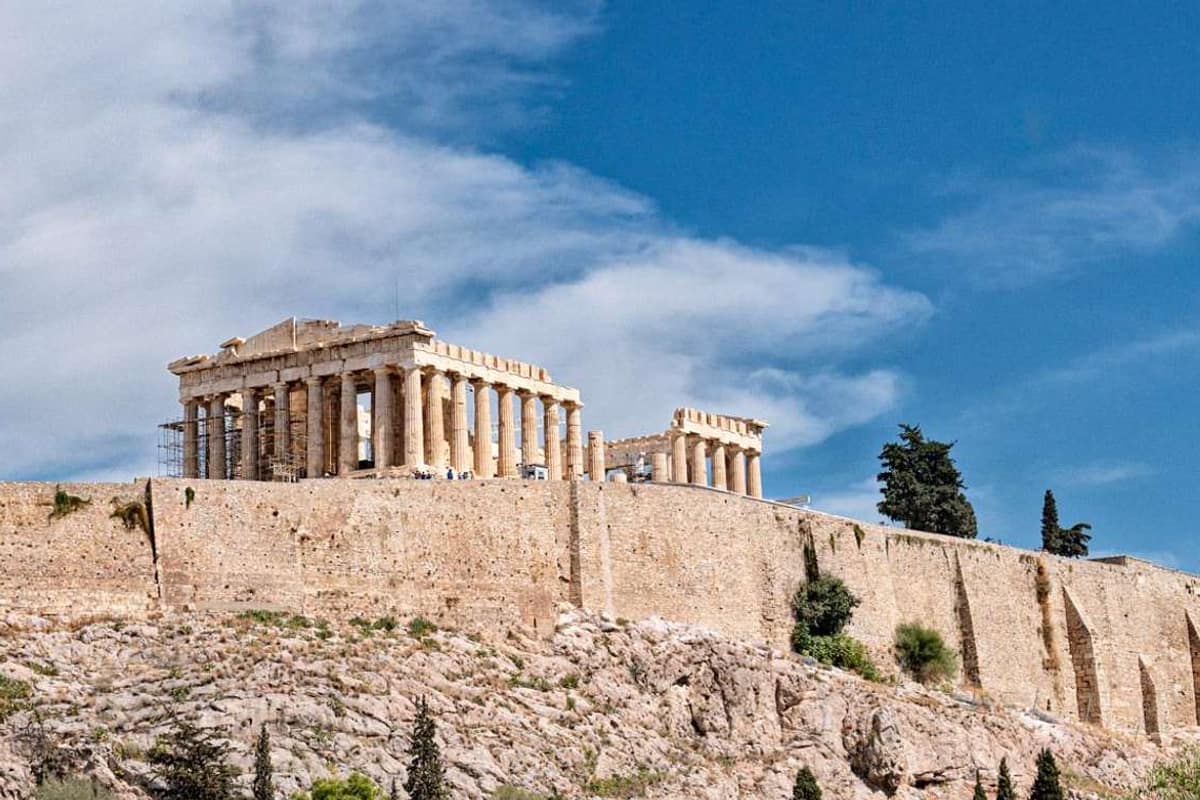
An Athens mythology tour starts near the rock of the Acropolis and walks through the stories of the gods and heroes at the places where the Athenians placed them. The walk climbs the slopes, passes the temples, then drops to the Ancient Agora and the old quarter of Plaka. Compare the kinds of tour before you book, and browse tours in Greece for trips across the country.
This page follows the order of a walk: the outline and the length, the gods and heroes it tells about, the contest for the city, the Parthenon, the Erechtheion and the Temple of Athena Nike, the Theatre of Dionysus and the Areopagus, the Agora and the Temple of Hephaestus, the Minotaur story and Plaka, the kinds of tour, and the questions travellers ask.
What is an Athens mythology tour, and how does it run?
An Athens mythology tour is a walk with a tour guide who tells tales of Greek gods and heroes. Each tale is told where it belongs. The route climbs the Acropolis, crosses the Ancient Agora and ends in the old streets.
Wikipedia defines Greek mythology as myths that the ancient Greeks told about the world, its gods and its heroes. An Athens mythology tour fixes those stories to real stone. A hill becomes a stage, and a temple becomes a home.
One operator page says the ancient Greeks used myths to explain natural and social events. So an Athens mythology tour tells each tale at its own place. The tour guide adds one plain clause of history. A second page calls its evening trip a storytelling walk, not a theatrical performance.
One four-hour Athens mythology tour starts with the Temple of Olympian Zeus, seen from outside. It climbs past the Theatre of Dionysus, named for the god of wine, to the Acropolis. There the tour guide tells of Zeus, Athena and Poseidon. The Temple of Athena Nike, the Propylaia, the Erechtheion and the Parthenon are the stops.
The same Athens mythology tour then walks down to the Ancient Agora, where the Temple of Hephaestus stands. The page lists the story of Theseus among the tales told there. It closes the walk with the story of how Athens began and rose to greatness.
A shorter evening Athens mythology tour circles the rock through Plaka. Its stops are Plaka, the pedestrian street around the Acropolis and the Pnyx. At each stop storytellers speak in person, so the tales of Dionysus and Athena come at the right spot.
Other trips end indoors. Two pages send the group from the Acropolis down to the Acropolis Museum. One of them names the Caryatids and the metopes, each metope showing a different mythological scene. That kind of Athens mythology tour lasts four hours. A family trip walks on from the Acropolis to the Pnyx instead.
How long is an Athens mythology tour, and where does it start?
An Athens mythology tour lasts from two to four hours, as operator pages state it. Two hours covers the Acropolis alone or an evening storytelling walk. Three hours suits a private city walk or a family trip. Four hours adds the Agora or the Acropolis Museum.
The meeting point differs from page to page. One names the fountain in Syntagma Square. Another names the street-level exit of the Acropolis metro station. A third names Hadrian’s Arch. One private four-hour trip collects guests at a hotel when the hotel stands near the Acropolis.
Start times of an Athens mythology tour follow the heat. One page lists departures at 8:00, 2:45 and 4:45 for a two-hour Acropolis walk. It says the slots avoid the peak heat. A second page names early morning or late afternoon departures. The four-hour walk starts at half past eight.
One evening storytelling walk starts at 5:30, Monday to Saturday, and its page says it does not run in August. That page and the four-hour walk page both list days without a tour, among them Easter Sunday and Christmas Day. Read the page of your trip first.
The ground covered stays small on an Athens mythology tour. One page puts the walking at about one hour of a four-hour tour, on uneven, uphill paths at the Acropolis. Wikipedia puts the rock at 150 metres above sea level. The evening walk keeps distances short, with pauses for the tales.
Wikivoyage recommends the seasons of spring and late autumn. It calls the humidity of summer exhausting. It also says the Acropolis has no shade at the peak of a sunny summer day. A summer Athens mythology tour therefore starts early. One page adds two shaded stops to its two-hour Acropolis walk.
A self-guided Athens mythology tour on a phone covers 5.2 kilometres. Its page puts the time at a little over three hours. It has no tour guide and no fixed start time, so the walker sets the pace. The route runs from the Discus Thrower statue to the Academy of Athens.
Group size is part of the answer. Up to 15 guests join the four-hour walk, the two-hour Acropolis walk and the family trip. One small-group Acropolis trip stops at 12, and the evening walk takes up to 20. The family trip runs at nine in the morning from the middle of June through August.
Which gods and heroes does an Athens mythology tour tell about?
An Athens mythology tour tells about the twelve Olympians, led by Athena, Zeus, Apollo, Dionysus and Hephaestus. It also tells about heroes such as Theseus. Each god and hero is tied to a hill, a temple or a lane of the old city.
Wikipedia names the twelve Olympians as Zeus, Hera, Demeter, Poseidon, Athena and Aphrodite. Then come Artemis, Apollo, Ares, Hephaestus and Hermes, plus either Hestia or Dionysus. It adds that no single list is fixed. Tradition placed them on Mount Olympus, which is why they are called Olympians. This is the cast an Athens mythology tour draws on.
One tour page names Athena and Zeus first among the figures of its stories. Zeus is the king of the gods, as Wikipedia states it. He is a sky and thunder god who rules from Mount Olympus. Athena is the goddess of wisdom and handicraft and the patron of Athens. Her symbols include the owl and the olive tree.
On an Athens mythology tour, Poseidon stands for the sea, storms, earthquakes and horses. Wikipedia calls him the protector of seafarers. Apollo stands for healing, prophecy, music and poetry. Dionysus is the god of wine, the grapevine and festivity.
Hephaestus is the blacksmith of the gods, and Wikipedia says he was worshipped in Athens. Two tour pages also name the healer Asclepius, a son of Apollo, among their stops. Wikipedia says healing was linked to Apollo, either through the god himself or through his son.
The heroes follow the gods. Wikipedia calls Theseus a divine hero of Greek mythology. It says he is described as a son of Aegeus, king of Athens, and also as a son of Poseidon. Four operator pages for an Athens mythology tour promise stories of gods and heroes.
An Athens mythology tour also shows where the Athenians placed their gods. Olympus was the home of the Olympians, and Poseidon’s home is given as Olympus or the sea. Athena’s home was the Acropolis. Wikipedia says her temples stood on the fortified acropolis and that the Parthenon is dedicated to her.
How did Athena win Athens from Poseidon, and where does an Athens mythology tour tell it?
Athena won Athens in a contest of gifts. She gave the first olive tree, and Poseidon gave a spring of salt water. An Athens mythology tour tells the story at the Erechtheion, a temple along the northern side of the Acropolis.
An Athens mythology tour tells the story in order. It is the founding myth of Athens, as Wikipedia calls it. The gods wanted cities with a place of worship of their own, as Wikipedia states it. Athena and Poseidon both wanted Athens. Cecrops, the first king, was to judge between them. The rock itself was once called Cecropia, after him.
The story that an Athens mythology tour tells has a simple rule. Each god gave the Athenians one gift, and Cecrops chose the better one. His trident hit the earth, and a spring of salt water rose. Wikipedia notes that the water was salty and undrinkable.
Athena then gave the first domesticated olive tree. Wikivoyage notes that olive trees provide food. Cecrops accepted the gift and declared Athena the divine patron of the city. In the retelling on Wikipedia, Athena called the city Athens after herself.
Tellings differ on the judges. In one, Wikipedia says, Zeus appointed the twelve gods as judges. Wikivoyage says the people voted and Athena won by a single vote. Both versions end with the city bearing her name, so an Athens mythology tour can use either one.
The story belongs to the Erechtheion. Wikipedia says this temple stands along the northern side of the rock. One tour page calls it the place of the contest between Athena and Poseidon. The page says this is what the ancient Athenians held.
Three signs keep the story alive on an Athens mythology tour. Wikipedia says the marks below the north porch were thought to be left by the trident. It names a saltwater well in the western room. It places the sacred olive tree of Athena in the Sanctuary of Pandrosos beside the temple.
The building honours both rivals, so an Athens mythology tour can name them side by side. Wikipedia says the eastern part was dedicated to Athena Polias and the western part served the cult of Poseidon-Erechtheus. Wikipedia adds that Poseidon stayed on the rock in the form of Erechtheus. One family tour page lists a visit to Athena’s olive tree.
What does the Parthenon show on an Athens mythology tour?
The Parthenon is the temple of Athena on the top of the rock. An Athens mythology tour reads it as a story in marble. Its pediments, its frieze and its statue all tell of her.
Wikipedia says the Parthenon is a temple of Athena, patron of the city. The word parthenos is Greek for maiden, and the temple takes its name from it. A second source gives her the title Athena Parthenos. On an Athens mythology tour, that title marks Athena as the maiden goddess.
The columns follow the Doric order. The front and back show eight columns each, and the long sides show seventeen, as two sources state. The marble is Pentelic. A Greek temple was the house of its god, as one source puts it. So a statue of Athena stood inside.
The sculptor Phidias made that statue of gold and ivory. An Athens mythology tour tells of it in words, because two sources call it lost. It is known from copies, vase paintings, gems and coins. A shallow pool of water lay in front of it, as two sources state.
The pediments hold the birth of Athena in the east and her contest with Poseidon in the west. A Greek geographer of the second century named both scenes, as Wikipedia states. On an Athens mythology tour, both scenes are found above the two porches, one at each end.
In the corners of the east pediment, the hours of one day pass. The horses of Helios, the sun, rise full of energy. The horses of Selene, the moon, look tired at the end of the night. Two sources describe the pair this way.
A long frieze ran round the outer wall of the inner room. Wikipedia reads the frieze as a Panathenaic procession, and a second source agrees. On an Athens mythology tour, that procession is the festival of Athena in stone. The line of people grows crowded as it nears the seated gods at the east end.
At the east end, a scene shows a cloth being folded. Wikipedia says it is read as the gift of Athena’s new robe, the peplos. The Athenians held the great festival every four years to honour her. Wikipedia says the surviving sculptures now stand mainly in museums. So an Athens mythology tour tells these scenes in words.
What are the Erechtheion and the Temple of Athena Nike on an Athens mythology tour?
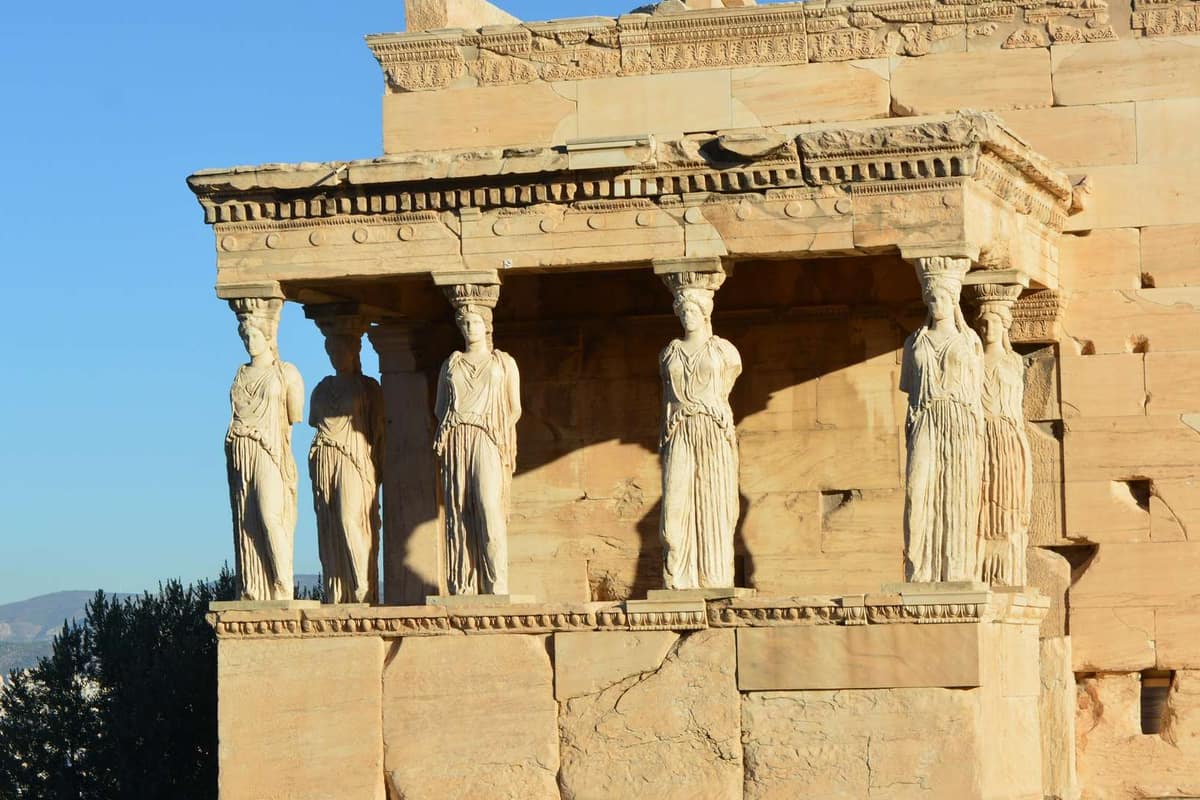
On an Athens mythology tour, the Erechtheion is the temple of old shrines and the Porch of the Maidens. Beside the gate stands the shrine of victory, the Temple of Athena Nike. The gate itself is the Propylaia.
The Erechtheion stands on the Acropolis, on its north side, as Wikipedia states. It is an Ionic temple, dedicated mainly to Athena. The ground there is uneven. A second source says builders planned around old shrines, among them the altars of Poseidon and Hephaestus. On an Athens mythology tour, that makes it a house of old cults.
The Porch of the Maidens, or Caryatid Porch, is the signature feature of the temple. Six female figures stand in place of columns, all facing south, and carry the roof on their heads. The figures on the porch today are replicas. An Athens mythology tour that ends in the Acropolis Museum meets the originals kept in Athens.
The Erechtheion also kept the old wooden image of Athena. Wikipedia says it was carved of olive wood. A second page says the Athenians gave it a new robe every four years at the Panathenaia.
Next to the temple lay a walled precinct, the Sanctuary of Pandrosos. Wikipedia places the sacred olive tree of Athena there, and a second source lists the tree among the old shrines. One family trip lists a visit to that tree. On an Athens mythology tour, the tree is the sign of her gift to the city.
Wikipedia says the Nike temple is smaller than every other temple on the Acropolis. It stands on a bastion to the right of the Propylaia. A second source says it is the first building a visitor meets. Builders finished it around 420 BC with four Ionic columns at each end.
The statue of Athena Nike had no wings, so the Athenians later called the goddess Wingless Victory. Two sources say a story arose that the wings were left off to keep Victory in the city for ever. On an Athens mythology tour, this is a small myth of its own.
The Propylaia is the gateway, so an Athens mythology tour on the Acropolis passes through it. The Propylaia dates from 437 BC to 432 BC, as Wikipedia states. A second source counts six Doric columns at its front. Operator pages order the stops differently. One private four-hour trip takes the gate and the Nike temple first, then the Parthenon.
Which myths belong to the Theatre of Dionysus and the Areopagus on an Athens mythology tour?
At the theatre on the south slope, an Athens mythology tour tells of Dionysus, the god of wine and theatre. At the Areopagus, a rock north-west of the Acropolis, it tells of Ares and Orestes. Both stories belong to places a visitor can see.
The Theatre of Dionysus grew out of the sanctuary of Dionysus Eleuthereus, which means Dionysus the Liberator. The sanctuary lay below the southern face of the rock. Wikipedia dates the first orchestra terrace to the sixth century BC. On walks of three to four hours, an Athens mythology tour stops here before the climb.
Dionysus was the god of wine, orchards and festivity. Wikipedia says the festivals held for him gave rise to Western theatre. At the City Dionysia, Athenians carried a wooden statue of the god to the theatre. They watched tragedies and, from 487 BC, comedies. An Athens mythology tour tells this story on the slope.
Wikivoyage calls it the main theatre of Classical Athens, where great Greek plays were first shown. Two tour pages add the sanctuary of Asclepius on the same slope, with its healing stories.
The Areopagus is a bare rocky outcrop just north-west of the Acropolis. Its Greek name, Areios Pagos, means Hill of Ares. Myth says the other gods held a trial for Ares here, so the story explains the name. Two operator pages list this rock on an Athens mythology tour of two hours.
In history the rock gave its name to the council of elders of Athens, which later sat as a court. In the myth of Orestes, the goddess Athena sets up a court of twelve judges and takes part herself. The votes tie, and by her rule the tie sets Orestes free.
From the top, two travel pages describe a close view of the Acropolis, and one adds the Agora below. The view helps an Athens mythology tour join the myths to the city. A tour guide can point out the Acropolis, where Athena won her city, and the Agora, where the Athenians met.
What do the Ancient Agora and the Temple of Hephaestus add to an Athens mythology tour?
The Ancient Agora shows the everyday city where the Athenians honoured their gods. The Temple of Hephaestus shows the god of craft in a Doric temple that still stands. An Athens mythology tour uses both to link the myths to daily life.
The Ancient Agora lay north-west of the Acropolis and served as a market and a meeting place. Wikipedia lists a monument there to the heroes of the ten Athenian tribes. It doubled as a board for posting new laws. The monument gives an Athens mythology tour a place to speak of heroes as well as gods.
The Agora also held places for the gods. Wikipedia says an altar of the twelve gods was set up there around 522 BC. It became the point for measuring distance from the city, and it was a place of refuge. On an Athens mythology tour, this altar is where the whole family of Olympians meets in one story.
Hephaestus was the god of craft, fire and metalworking. Athena was the patron of craft and weaving, so the two shared temples and festivals in Athens. At their joint feast, the Chalkeia, craftsmen closed their workshops and joined a procession. An Athens mythology tour can tell of this feast beside the temple.
The Temple of Hephaestus stands on a hill that overlooks the Agora from the north-west. Wikipedia says this Doric temple still stands almost whole. Its eastern pediment showed Athena’s birth, and the western one showed Hephaestus returning to Olympos. Ten metopes on the east front show the Labours of Heracles.
Four metopes on the long sides show the Labours of Theseus, so the building was long called the Theseion. Inscriptions inside showed that it belongs to Hephaestus. An Athens mythology tour of two hours or four lists this temple as a stop, as four operator pages show.
In the third century BC, the temple gained a small garden with pomegranate, myrtle and laurel plants. The Panathenaic Way, 1.5 kilometres long, linked the Dipylon Gate in the north-west with the Acropolis and crossed the Agora. The reconstructed Stoa of Attalos on its east side is now the Museum of the Ancient Agora.
Wikivoyage describes the Agora today as a green space that faces the Acropolis. On walks of four hours, an Athens mythology tour reaches it after the rock, as two operator pages show.
How does the Minotaur story fit an Athens mythology tour, and what does Plaka add?
The Minotaur story fits an Athens mythology tour because its hero, Theseus, is a young Athenian who sails to Crete. Plaka, the old quarter below the rock, then gives the walk a place to slow down and listen.
Wikipedia calls Theseus a divine hero of Greek mythology, known for defeating the Minotaur. Wikivoyage adds that, by legend, he united the ten tribes of early Athens. Two operator pages put a statue of Theseus where the walk begins or finishes. An Athens mythology tour can therefore meet the hero before it tells his tale.
The Minotaur tale on an Athens mythology tour is short. King Minos of Crete required Athens to send fourteen young citizens to his island, seven men and seven women. The Minotaur lived there, at the centre of the Labyrinth, a maze that the architect Daedalus designed. Wikipedia describes the creature as a man with a bull’s head and tail.
Theseus volunteered. Minos had a daughter, Ariadne, and she helped him with a thread that led him back out of the maze. One app-guided walk builds its plot on the fourteen young Athenians. It sets its puzzles at the Pnyx, the Areopagus and the Tower of the Winds. An Athens mythology tour can use the same tale as its thread.
The story ends at sea. Aegeus, king of Athens, asked his son to swap the black sail for a white one on the voyage home. The change was forgotten, and Aegeus took the black sail as a sign of loss. Wikipedia states that the Aegean Sea carries his name.
Wikipedia places Plaka in the old heart of Athens, below the rock, on its north side and its east side. It names labyrinthine streets, neoclassical architecture and the nickname “Neighborhood of the Gods”. One page of an Athens mythology tour pauses there for a Greek coffee between two stories. Another page strolls through Plaka while it tells the city’s legends.
A longer Athens mythology tour moves on to the Acropolis Museum. Wikipedia says the museum is built around the finds of the Acropolis site. Its first level holds sculptures from the Erechtheion, from the Propylaia and from the small Temple of Athena Nike. Two operator pages place the museum after the rock on four-hour trips.
Which Athens mythology tour suits you: a small-group walk, a private tour or a day trip to Delphi?
Pick an Athens mythology tour by company and by time. A small-group walk suits travellers who like a set start and shared stories. A private tour suits a tailored pace. A day trip to Delphi takes about ten hours, as operator pages state.
A small-group Athens mythology tour keeps one expert storyteller and one group together. One page sets the minimum age at seven and lists a stroll through Plaka with tales of gods and people. Another two-hour walk runs from Syntagma Square through Plaka to the Ancient Agora and ends near the statue of Theseus.
A private Athens mythology tour belongs to your own party. One page states that the host tailors the route and the pace to solo travellers, friends or families. It names the Academy of Athens and Monastiraki Square as places where stories come alive. A second private walk ends at the Academy of Athens.
An Athens mythology tour with museum time lasts four hours on the pages that list it. The group climbs the rock and then walks down to the Acropolis Museum. There the stories carry on among statues and everyday objects. Two pages offer this as a private trip, and one is made for families with children.
A day trip that adds Delphi takes ten hours, as pages state it. About three hours are on the road to the site. In antiquity Delphi counted as the navel of the world. Its Temple of Apollo is where the priestess Pythia spoke for the god. One page spends two and a half hours at the site.
Time decides the choice. A walk of two or three hours fits a short stay in Athens. A day trip to Delphi fills a whole day and leaves the city behind. Choose the Athens mythology tour whose length fits your day. Read its page for the departure time and the place to meet.
What else do travellers ask about an Athens mythology tour?
Which clothes, shoes and extras suit an Athens mythology tour?
Wear comfortable clothes and flat shoes with a good grip. One operator page recommends comfortable clothes and shoes for all guests on its Athens mythology tour. Another page adds a hat and sunscreen for hot sunny days.
The official Athens visitor site asks for caution on the slippery marble ground of the Acropolis. It also calls the cobbled streets of the city tricky, even in the flattest shoes. For winter rain, it suggests shoes that can stand a little water.
For the evening, the same site suggests a sweater or jacket in spring and autumn, because the nights turn cool. Carry a bottle of water too. On an Athens mythology tour, a hat and sun protection suit the open rock in summer.
Does an Athens mythology tour work for children, older teens and slow walkers?
Operators build family versions of the Athens mythology tour. One family page describes a four-hour private tour with a professional storyteller. It is offered as an alternative to standard tours that can bore small children. Another list names a family mythology tour among its mythology walks.
The family page says children enjoy stories about mythology and the Greek gods. A third operator page tailors its private tour to the group, with friends or with curious kids. One walking-tour page states that its tour suits people with reduced mobility.
Slow walkers ask about the ground. The official Athens visitor site calls the Acropolis partially accessible. The lift on the Peripatos path climbs roughly 25 metres to the plateau. It stops in strong wind or extreme weather.
The lift entrance is about 350 metres from the main entrance. The climb to the Areopagus is not particularly steep. The same site says its steps are worn smooth and suggests sneakers. Keep that in mind on an Athens mythology tour.
Does an Athens mythology tour go inside the archaeological sites?
That depends on the kind of tour. Acropolis versions of the Athens mythology tour walk through the gateway and past the temples. Street versions tell the myths in the squares and lanes of the old centre and from viewpoints.
Entry to the sites is not always part of the trip. One operator page marks the entrance to attractions as excluded, and another says entrance tickets are not included. A third offers entry as an add-on during booking. A fourth includes the tickets in only two of its options.
At the foot of the ascent, the official Athens visitor site places the ticket office on the left. The main entrance lies just beyond it. One operator page asks every guest to carry a passport in case the ticket gate checks it. Ticket rules change, so the operator page for your Athens mythology tour has the current rule.
How does an Athens mythology tour tell myth from history?
A tour guide on an Athens mythology tour tells the stories as stories and the buildings as history. One operator page calls the tour guide both a historian and a storyteller, who weaves tales into historical context. Another says the tour shows how mythology and history intertwine across the city.
A third page says the tour shows how the ancient Greeks explained natural and social events through myths. Wikipedia describes Greek mythology as the body of myths originally told by the ancient Greeks. It says scholars study the myths to learn about the religion and politics of ancient Greece.
Written and archaeological sources agree in places and differ in others. Wikipedia adds that ancient vase paintings show gods, heroes and scenes from the stories. It says the Acropolis hill had settlers in the fourth millennium BC. On an Athens mythology tour, the myth shows what the Athenians believed, and the stones show what they built.