
The best beaches in Greece range from white pebble coves under Ionian cliffs to pink sand lagoons on Crete and volcanic rock shores in the Cyclades. The tours in Greece on the home page reach a number of them by boat.
This page covers the kinds of beach, Crete, the Ionian islands, the Cyclades, the mainland and the Sporades, the beaches for shallow water, snorkelling and quiet days, and the way in by road, path or boat; the when to visit Greece page covers the sea by month.
Which are the best beaches in Greece?
The best beaches in Greece spread along a coast of 13,676 kilometres. This page sorts them by region and by place traits: sand, pebbles, rock, water and the way in. Crete, the Ionian islands, the Cyclades, the mainland and the Sporades each hold a distinct group.
Counts of the islands differ by source. In the Geography of Greece article, estimates begin at 1,200 and top out at 6,000. The figure of 6,000 comes from the Greek Tourism Organization, which counts 227 inhabited islands. A list of the best beaches in Greece therefore starts from a choice of places, not from a full count.
The Foundation for Environmental Education certifies Blue Flag beaches against its own standards. Thirty criteria in four categories are the minimum a beach has to meet. The criteria cover water quality, environmental management, services and information for visitors. In the Blue Flag article, the table for Greece shows 583 beaches.
France launched the scheme in nineteen eighty-five, and eleven coastal municipalities received the first awards. Greece is one of the countries in the programme today. The article says the awards are issued every year.
These are the best beaches in Greece that the next sections describe, grouped by region.
- Crete: Balos, Elafonisi, Falasarna, Vai, Preveli
- The Ionian islands: Navagio, Myrtos, Porto Katsiki, Egremni
- The Cyclades: Sarakiniko, Kleftiko, Red Beach, Kolymbithres, Agios Prokopios
- The mainland and the Sporades: Voidokilia, Simos, Lalaria, Koukounaries
Sand is the first trait that sets one of the best beaches in Greece apart from another. The grain can be fine or coarse. The colour can be white, pink or dark, and stones can lie among it. The next section sorts the shores by this trait.
Water is the second trait. It can be shallow or deep, sheltered or open to the wind, clear or tinted. A lagoon, a small cove and a wide bay each swim differently. That is why the best beaches in Greece look so unlike each other.
The way in is the third trait. A beach can lie beside a road, below steps or a path, or be open only to boats. Each region below states the way in as a source gives it. That lets you compare the best beaches in Greece on this point.
How do sand, pebbles and rock shape the best beaches in Greece?
Sand, pebbles and rock give each of the best beaches in Greece its own colour and feel. Myrtos on Kefalonia is a shore of round white cobblestones. Elafonisi on Crete has pink sand. Sarakiniko on Milos is greyish-white volcanic rock carved by waves.
Pebbles come first on the Ionian side. The Myrtos article says the stones grow smaller towards the water, so cobbles give way to pebbles along the beach. It links that sorting to very high wave energy. Wikivoyage describes Porto Katsiki on Lefkada as a relatively large sandy beach surrounded by white cliffs. One coast can hold both kinds.
Among the best beaches in Greece, Elafonisi shows that sand can carry living colour. Tides and waves leave deposits of pigmented micro-organisms there, which live beside native seaweed, as Wikipedia states. The pink therefore comes from living things, not from crushed rock. It is a different cause from the red of Santorini.
Sarakiniko has more rock than sand. The site sits on the northern coast of Milos. Waves pushed by north winds shape its greyish-white volcanic rock. The sand itself occupies a small corner of the whole area, tucked among the rock formations. Its sand is thin and white, and a couple of trees give small patches of shade.
Red Beach on Santorini is a volcanic sand beach. Its red-hued sand takes its colour from oxidised iron. The nearby caldera supplies the grains: black and red volcanic rock, ground to a powder. Akrotiri is the village from which you reach it. Volcanoes shape the best beaches in Greece on Milos and Santorini alike.
On Paros, Wikivoyage lists Kolymbithres among the standout beaches and describes huge rocks and sandy coves. Rock does not cover the shore here, as it does at Sarakiniko. Sand and rock share the beach, so the view changes from one cove to the next.
Dunes add one more material to the best beaches in Greece. Wikivoyage describes Elafonisos in the Peloponnese as a flat, mainly sandy landscape with extensive dunes.
Trees add the last material. Chrysi sits in the Libyan Sea, close to Ierapetra, and nobody lives there. The article puts it about 15 kilometres south of Crete. Its juniper woodland, Juniperus macrocarpa, grows naturally, and Europe holds no larger forest of that species. The island also carries a protection label: area of intense natural beauty.
Which of the best beaches in Greece lie on Crete?
Five beaches show the range of Crete. Balos lies in the north-west, Falasarna at the west end and Elafonisi at the south-western corner. Preveli sits on the south coast and Vai in the east. These best beaches in Greece stand beside a lagoon, an islet, an old harbour, a river and a palm forest.
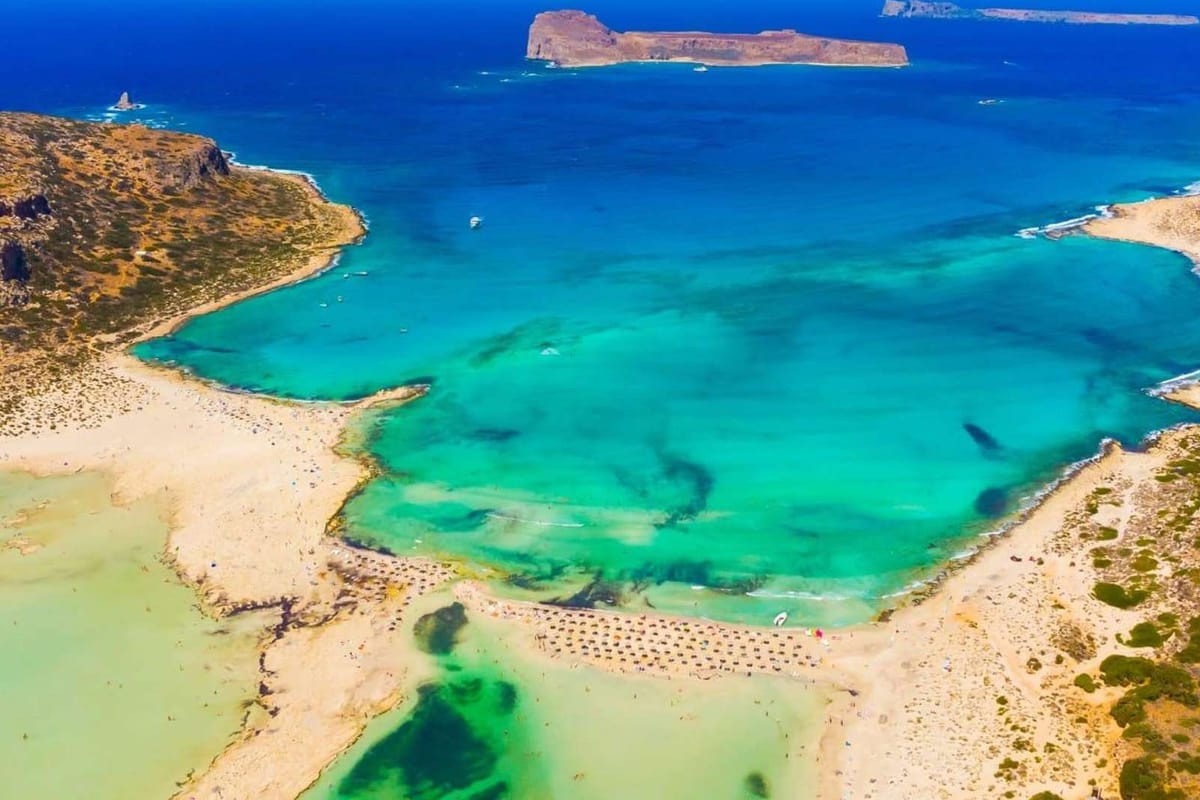
In north-western Crete, Balos belongs among the best beaches in Greece. Its lagoon fills the water between the shore and Imeri Gramvousa, an uninhabited island whose name means Tame Gramvousa. The article credits a pirate chief’s wife, Vousa, with the island’s name. Gramvousa and Rodopos are peninsulas of this corner, and Gramvousa lies further west.
By Crete’s south-western corner lies Elafonisi, a small islet. Shallow water joins it to the shore, and visitors wade across in fine weather. One large wooden cross commemorates a passenger steamer that sank there early in the twentieth century. A lighthouse was built on the hilltop because of that wreck, which still lies below the cliffs.
Falasarna lies at the west end of Crete, and olive groves and tomato greenhouses fill its valley. Behind this beach, one of the best beaches in Greece, lies a walled ancient harbour. City walls protect it on all sides, and two artificial channels join it to the sea. Six bollards on the quays still show rope marks from mooring ships.
In eighteen fifty-nine a British naval officer noted that the sea stood 100 yards from the old harbour. He concluded that the ancient shoreline had risen by twenty-four feet or more. The article dates the change to over sixteen centuries ago. A cape rises 90 metres above the harbour, and its acropolis holds a temple to the goddess Dictynna.
Vai lies in east Crete, between Cape Sidero and Cape Plaka, and its name is Greek for palm. Thousands of palms fill a valley that runs down to a beach 256 metres long. These palms set Vai apart among the best beaches in Greece. European Natura areas cover the cape, and overnight stays on the beach are not allowed.
Preveli, a place with a monastery above the shore, lies in the Rethymno region of southern Crete. A lagoon and a beach lie below it, at the seaward end of the Kourtaliotiko gorge. Cretan date palms form a glade behind the sand. The article names a feudal lord, Prevelis, as the monastery’s probable founder in the Middle Ages.
Which of the best beaches in Greece lie in the Ionian islands?
Four beaches show the Ionian coast: Navagio on Zakynthos, Myrtos on Kefalonia, and Porto Katsiki and Egremni on Lefkada. All four of these best beaches in Greece lie on the western coasts of their islands. The Ionian Sea washes each one.
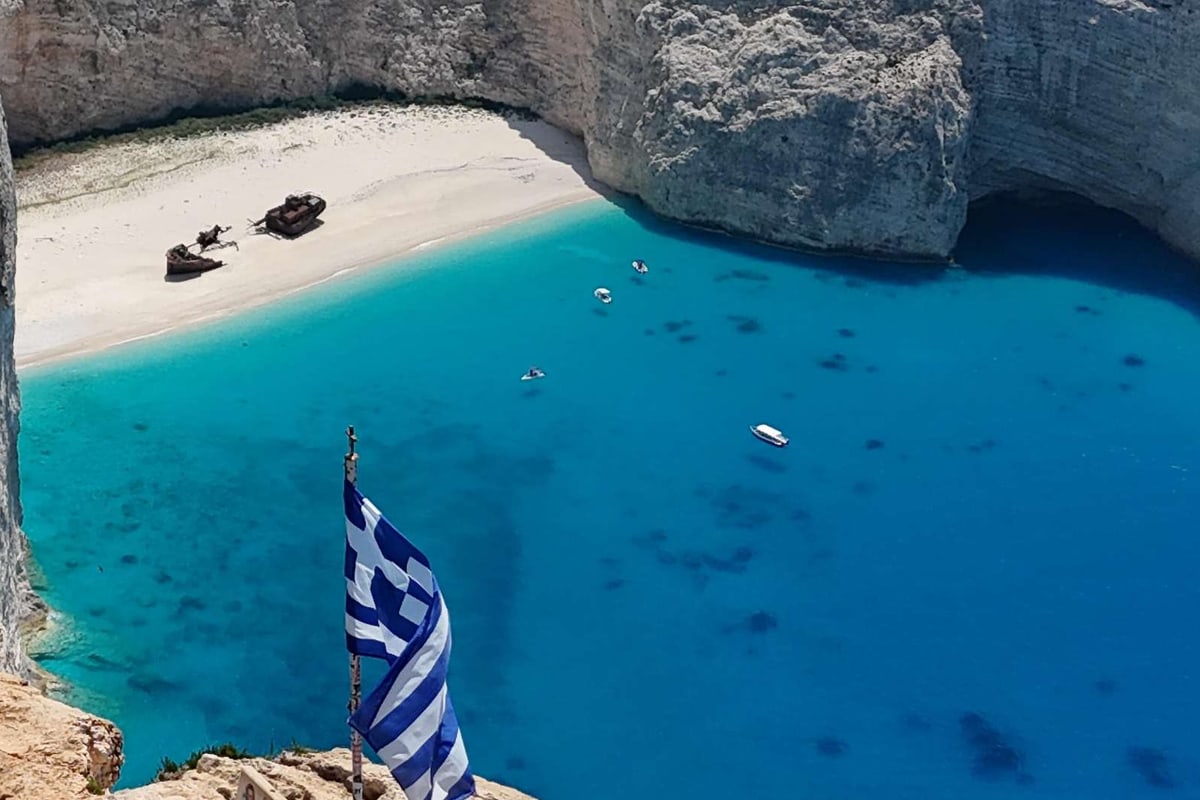
Navagio, one of the best beaches in Greece, is a cove under the cliffs of north-western Zakynthos. Only boats reach it, because high cliffs cut it off. The outline of Zakynthos is an arrowhead, and Cape Skinari is its tip. A mountainous plateau fills the western half of the island.
The wreck gave the cove its nickname, Shipwreck Beach. On the fifth of October, nineteen eighty, a coaster ran aground there in a storm and poor visibility. The hull still lies under the limestone gravel of the shore. Between Keri and Skinari, the western shore of the island also holds arches and other rock formations.
Among the best beaches in Greece, Myrtos on Kefalonia shows how a sea builds a shore. Its cobbles shrink in size toward the water. Wikipedia links this to strong waves and an abrupt drop of the slope near the edge of the sea. Longshore drift has helped to shape the curve of the beach.
Porto Katsiki means goat port. Tradition ties the name to an earlier period in which goats alone reached the area. A concave pale cliff rises behind the beach, on the west coast of Lefkada. Wikivoyage calls the cliffs white. Car parks and canteens serve it, and Lefkada itself sits off the west coast of Greece.
Egremni, a remote beach with clear water, lies in the south-west of Lefkada. Among the best beaches in Greece, Egremni became a major destination of the island. The rise began once a sealed road was built, in the mid nineteen-nineties. Wikivoyage lists Egremni among the longest beaches of the island and describes its water as crystal blue.
The four coasts look west, so the evening sun goes down into open sea at these best beaches in Greece. Zakynthos, Kefalonia and Lefkada all belong to the Ionian Sea. Late afternoon light falls on the cliffs and the pale stone behind the sand. Evening suits a stop at any of the four.
Which of the best beaches in Greece lie in the Cyclades?
Five of the best beaches in Greece lie in the Cyclades, which sit in the central Aegean Sea. Milos holds Sarakiniko and Kleftiko, Santorini holds Red Beach, Paros holds Kolymbithres and Naxos holds Agios Prokopios. Volcanic rock, granite and sand give each one its look.
Of all the Cyclades, Milos sits furthest to the south-west. The Laconian coast lies 120 kilometres to its west. The rock of the island is volcanic, and that activity started two to three million years back. Local people call the landscape of Sarakiniko Lunar.
Sarakiniko, among the best beaches in Greece, has two sides. The west side holds the lunar white rock. The east side turns into a desert, with dry plants and stony ground. A ship crashed on Sarakiniko in two thousand and three. Its wreck shows when the waves draw back.
Wikivoyage lists Kleftiko beside Sarakiniko. Its sea caves and tall rock arches served pirates as a hideout, as the page states. The page names boats as the main way in. The same page adds that places in the west of Milos lie out of reach of normal vehicles.
Red Beach, one of the best beaches in Greece on Santorini, shows how rock gives colour. Wikivoyage places it south of Akrotiri. The page ties the name to the red sand and to the iron-rich cliff face above the water. Akrotiri is known for a Bronze Age Minoan settlement, a lighthouse and a Venetian castle.
On Paros, the best beaches in Greece include Kolymbithres, in the west of Naoussa bay, four kilometres from Naoussa. The Paros tourism page describes granite rocks, worn by salt, water and air, that run down to the sea. Greek Wikipedia says weathered rock forms hollows that fill with sea water, which gave the place its name.
The meltemi blows from the north over the Aegean, and the Etesian article calls it dry and strong. According to the article, the wind blows from the end of spring through to mid-September. Paros has the bay of Naoussa on its northern side. Between Paros and Naxos, the Paros article reports a wind that is strong and constant.
Agios Prokopios is a seaside village on Naxos. The best beaches in Greece on that island include the long sandy stretches facing the Aegean. Herons rest at the Red Lake, close to the village, before their migration flight to Africa. A feast for Agios Prokopios falls on the eighth of July.
Which of the best beaches in Greece lie on the mainland and the Sporades?
Four of the best beaches in Greece lie on the mainland coast and in the Sporades. Voidokilia is in Messinia, Simos lies off the Peloponnese, and Lalaria and Koukounaries lie on Skiathos. Each has its own setting: a lagoon, dunes, white cobbles or a pine forest.
Voidokilia is one of the best beaches in Greece on the Ionian Sea. It lies in Messinia, in southern Greece. The bay is shaped like the Greek letter omega. A semicircular strip of dunes forms from its sand. It belongs to a protected zone in the Natura network.
Behind the dunes lies Gialova Lagoon, a brackish water about eight kilometres north of Pylos. Migratory birds stop there first on their way from Africa to Northern Europe. The lagoon is also known as Divari, from a Latin word for a fishery.
A hiking route to Nestor’s Cave begins where the beach ends in the south-west. Above the cave stand the ruins of a Frankish castle of the thirteenth century. Homer is presumed to mean this beach by sandy Pylos. In myth, Hermes hid stolen cattle in the cave.
Between the Peloponnese and Kythira lies Elafonisos, a small island off the coast of Cape Malea. Simos, also called Fragos, is one of the best beaches in Greece on the island. Wikivoyage describes fine light sand, largely shallow turquoise water and extensive dunes. It names two parts: Megalos Simos and Mikros Simos.
The sunken city of Pavlopetri lies just off the Elafonisos coast. It dates back to the early third millennium before Christ. On land, the main church, Agios Spyridon, stands on a tiny separate piece of ground. A bridge over shallow water links it to the main part of the island.
The best beaches in Greece on Skiathos include Lalaria. The Greek National Tourism Organisation describes white pebbles and sheer cliffs. Wikivoyage adds crystal clear water and large stones on the shore. It states that only daily boats serve the beach. Skiathos counts over 60 beaches around its coastline of 44 kilometres.
In the south-west, Koukounaries is another of the best beaches in Greece on Skiathos, 16 kilometres from the main town. A stone pine forest on a wooded peninsula separates its lagoon from the sea. The beach on the sea side is also called Chrysi Ammos, which means golden sand.
Skiathos Town was the island’s only settlement until nineteen sixty-four. Then the Greek National Tourism Organisation zoned the island for tourism. A paved road along the coast soon joined the town to Koukounaries.
Halkidiki, in northern Greece, adds a mainland group of beaches. Wikipedia lists summer resorts on all three of its peninsulas: Kassandra, Sithonia and Athos.
Which of the best beaches in Greece suit shallow water, snorkelling or quiet days?
Elafonisi suits shallow water, rarely more than half a metre deep, as the Greek National Tourism Organisation states. Among the best beaches in Greece, Xehoriati on Zakynthos suits snorkelling, and Kedrodasos beyond Elafonisi suits a quiet day. Laganas bay on Zakynthos adds turtle beaches with rules of their own.
The tourism page describes Elafonisi as a peninsula that gives the feeling of a separate island. Another page of the same body says a narrow strip of sand joins the islet to the mainland. The eastern side has services and activity. For a family that wants a wading shore among the best beaches in Greece, this lagoon fits.
Zakynthos holds two more shallow shores among the best beaches in Greece. Wikivoyage lists Limni Keri as a pebble beach in a sheltered bay with clear, shallow water. It lists Porto Zorro as a beach with sand, shallow water and rock formations at one end. Balos is a lagoon of white, powder-like sand and emerald water.
Tsambika on Rhodes has golden, fine sand at the foot of a historic monastery. The tourism page pairs a swim there with a visit to the eighteenth-century monuments. Among the best beaches in Greece, Tsambika suits a day that mixes the sea with a little sightseeing.
Clear water beside rock is what a snorkeller seeks at the best beaches in Greece. Wikivoyage lists crystal-clear water at Sarakiniko on Milos and vivid blue water at Kleftiko. On Zakynthos, it calls Makris Gialos good for swimming and snorkelling. Xehoriati has rocky reefs, and Porto Limnionas is a lagoon with steep limestone walls and very clear water.
Laganas bay has been a marine park since nineteen ninety-nine. According to the park article, it was the first Mediterranean national park made for sea turtle protection. It spans 135 square kilometres, forms part of the EU Natura network, and forbids fishing in its marine zones. A boating ban applies off the nesting beaches.
The Laganas article puts the egg-laying of the turtles in June, July and August. Ecologists watch the protected beach at all times. Wikivoyage adds that Gerakas keeps parts of the beach off limits during nesting and closes at dusk. Signs and volunteers remind beachgoers to keep away from the turtles.
Quiet days at the best beaches in Greece come from a walk or a boundary. At Elafonisi, the dunes lead to Kedrodasos, a protected cedar forest of 11 hectares whose trees reach the shore. The tourism page names it for anyone who wants isolation. Xehoriati lies a walk of about one kilometre through the old village of Alykanas.
How do you reach the best beaches in Greece and when?
Each of the best beaches in Greece has its own way in. The tourism organisation puts Elafonisi 76 kilometres from Chania by road. It puts Balos 17 kilometres from Kissamos, with part of the route on a dirt road. Late spring through October is the swimming window.
A road leads to Elafonisi, one of the best beaches in Greece with a bus link. A single morning bus from Chania is listed on Wikivoyage. The tourism page adds that the beach receives a very large number of visitors in the summer months.
That page asks visitors to respect the delicate ecosystem by avoiding sand movement and shell collection. Elafonisi lies in the European Natura network. It names sea lilies, other rare plants, seabirds and the Mediterranean monk seal among the life that shelters there.
Among the best beaches in Greece, Balos asks for a little effort. Part of the road is dirt, followed by a short hike, as the tourism page states. The other way is a boat from Kissamos port, which also calls at Gramvousa. The page adds that Balos has no services, so sun protection comes with you.
Simos lies on Elafonisos, an island off the far south-east of the Peloponnese. The tourism page says buses link Sparta or Neapoli with Pounta, where a ferry crosses to the island. It gives about four hours from Athens to Pounta, and about two and a half from Kalamata.
Where the road stops, tracks, steps and boats finish the way to the best beaches in Greece. Wikipedia says the parking for Voidokilia is reached by sand tracks, from the Gialova Lagoon parking area or from Petrochori. Wikivoyage lists a steep hill or steps down to Gerakas. Preveli has boats from Plakias.
The months decide how busy the best beaches in Greece feel. Wikivoyage puts the pleasant weather in late spring and early summer, then again in September and October. From mid-July until mid-August comes the height of summer, when the bulk of tourists arrive. The same page advises an early start, with the afternoon kept for the beach.
What do readers still ask about the best beaches in Greece?
Four questions come up beside the best beaches in Greece. Which island holds the sand? Who can use the shore? Where is nudism accepted? Which beach suits a half day from Athens? Each answer below adds facts that appear nowhere else on this page.
Which island is the one to pick for sandy beaches?
No page read for the best beaches in Greece ranks the islands by sand. No island can be named the leader. Skiathos does give a hard number. Wikipedia states that its 44 kilometres of coast carry more than 60 beaches, the larger share of them sandy.
The island itself is small. Wikipedia gives its length as about 12 kilometres and its width as 6 kilometres on average. The main town stands in the east. The south-east and south-west have gentler slopes, and the greater part of the settlements lie there. The main road follows the eastern and southern coast.
The article names Achladies, Troulos, Vromolimnos, Asselinos, Megali Ammos and Mandraki among them. The bus line from the main town has 26 stops, and stop 26 is Banana Beach. For the best beaches in Greece, such a count shows how much sand one small island holds. It does not rank Skiathos above the others.
Are the best beaches in Greece open to the public?
Greek law backs open access to the shore. A BlueCoast information page states that Greek law guarantees free and unobstructed access to the seashore and beach. That holds for the best beaches in Greece as for any other stretch of coast.
Wikipedia’s article on the Greek coastal development law lists stricter rules for beach management and free access for citizens. It also lists protected and remote beaches, those in the Natura network, that cannot be developed. The BlueCoast page adds that leasing cannot block public movement or cover the whole coastline with sunbeds.
On the best beaches in Greece, open access still comes with rules for the stay. The Blue Flag article states that a flagged beach cannot allow camping or dumping, and that pets stay off it.
The article adds that each municipality has to make at least one Blue Flag beach accessible to the physically disabled. Wikivoyage Greece notes that on a free beach the umbrella and other facilities are optional.
Are there nudist beaches in Greece?
Yes, nudist beaches exist, and Wikivoyage Greece states that nudism is tolerated on them. They stand on all shores of the mainland and on the greater part of the islands. Nudism on the best beaches in Greece is therefore a question of the place.
Wikivoyage names the islands where nudist beaches are popular: Crete, Zakynthos, Rhodes, Gavdos and Antiparos. It adds that nudity is not so common in the Greek public. It also states that topless sunbathing is not accepted outside the tourist areas. The rule follows the place, so watch what the others on the beach do.
Wikipedia adds two notes. The Vai article states that Itanos beach and Psili Ammos beach in eastern Crete have been clothing optional. The Voidokilia article calls its beach in Messinia friendly for naturists. Vai and Voidokilia both appear among the best beaches in Greece on this page.
Which beach near Athens works for a half day?
Lagonisi on the Athens Riviera is one place to check. Wikipedia places it roughly 30 kilometres from Athens, towards the south-east, on a peninsula that the Saronic Gulf washes. Reaching it needs no ferry, which sets it apart from the island coves among the best beaches in Greece.
Three sandy beaches carry names in the article: Pefko, Galazia Akti and Agios Nikolas. A rabbit gives the place its name. The peninsula is shaped like one, and Lagonisi translates as island of the rabbit.
Greek National Road 91 links the place with Athens and with Sounio. Kalyvion Avenue runs close by and links it with Kalyvia Thorikou. Cape Sounio lies 35 kilometres south-east of Lagonisi.
Water sports are what Anavyssos is known for, a coastal resort of Attica 34 kilometres south-east of Athens centre. The Lagonisi article calls the two places together the driest part of mainland Greece. The Athens Riviera article lists bus route 122 to Saronida and route 123 on to Anavyssos.