
A Corfu Paleokastritsa tour is a bus shore excursion that links the Paleokastritsa coast on the west of Corfu with the island’s Old Town. For other Greek day outings, see the listing of our tours in Greece.
This page covers the length and start of the trip, the drive, the bays of Paleokastritsa, the monastery above the sea, the beach, the Old Town, how the trip compares with a taxi or a rental car, and the questions travellers ask.
What is a Corfu Paleokastritsa tour, and how does it work?
A Corfu Paleokastritsa tour is a half-day road trip from the cruise port or a hotel. It crosses the island to Paleokastritsa on the north-west coast and adds time in the Old Town of Corfu.
Paleokastritsa stands in the north-west of Corfu, among steep cliffs and a string of bays. The Corfu Paleokastritsa tour pairs it with Corfu Town, which is the island’s capital. Vehicles differ: one page lists cars, minivans and minibuses, and another an eight-seat minivan. The version in this post runs by bus as a shore excursion for cruise passengers.
A Corfu Paleokastritsa tour has three parts: the ride, the stops, and free time. One operator page lists the monastery, the resort of Paleokastritsa, the Bella Vista viewpoint and Corfu Town. Another adds a swim, a lunch or a trip by boat to the sea caves in the free time.
The order changes from trip to trip. One itinerary heads straight to the Old Town and reaches the monastery later. Another drives out to Paleokastritsa first and returns to the Old Town to finish the day. A private half-day shore excursion on a third page pairs a scenic drive to Paleokastritsa with time in Corfu Town.
You can pick a driver or a licensed tour guide. On one page the route and the stops stay the same either way. The tour guide adds commentary at each stop. A Corfu Paleokastritsa tour with commentary suits visitors who want the history of the monastery and the town.
How long is a Corfu Paleokastritsa tour, and where does it start?
A Corfu Paleokastritsa tour lasts about four hours. It starts with a pickup at the cruise terminal or at your hotel. Longer versions of the route add stops and run for up to eight hours.
Lengths differ by trip. One operator page sets the day at four hours. A tour listing shows a shore excursion to Paleokastritsa and Glyfada that lasts up to four and a half hours. It also carries a trip with Achillion Palace added, from four to eight hours.
Start times differ too. One operator page lists a morning start at 9:00 and an afternoon start at 2:00, with pickup included. A Corfu Paleokastritsa tour for cruise passengers meets them at the cruise terminal. Hotel guests are collected at their accommodation.
Cruise ships berth at the New Port of Corfu, which also serves ferries. One operator page includes port pickup and drop-off, and its booking form asks for the name of your ship. Another page adds bottled water. Meeting instructions arrive after booking, together with the voucher.
The return of a Corfu Paleokastritsa tour is timed to the ship. One page promises a return to Corfu port ahead of the ship’s departure. Its four-hour length is built around port call windows. Another operator sells half-day shore excursions and a full-day island tour from the same port.
How far is the drive on a Corfu Paleokastritsa tour, and which road does it take?
The drive on a Corfu Paleokastritsa tour covers about 24 kilometres, from Corfu Town to the northwest coast. Travel pages give a driving time of about 40 minutes by car, so the road leg stays short.
The pages differ a little on the distance for a Corfu Paleokastritsa tour. The island’s tourism site says 23 kilometres westbound from Corfu Town. Two travel pages say 24 kilometres, and a third says 25. For scale, Wikipedia says the island runs approximately 64 kilometres long.
One travel page says road 24 joins Corfu Town to Paleokastritsa. Another lists the main route as Kontokali, Agios Vasileios and Gardelades. A third page adds that the scenic road through Makrades and Lakones takes slightly longer than the main road.
One operator page describes the route of a Corfu Paleokastritsa tour as coastal roads through orange, lemon and olive groves. Near the bays the roads grow narrow, a travel blog reports. A travel wiki also notes poor surfacing on a number of roads across the island.
Operator pages differ on the order of the day. One four-hour trip heads to the Old Town first, then drives to the monastery and the bays. Another leaves Paleokastritsa for the Bella Vista look-out and then returns to Corfu Town.
What is Paleokastritsa, and what do you see there on a Corfu Paleokastritsa tour?
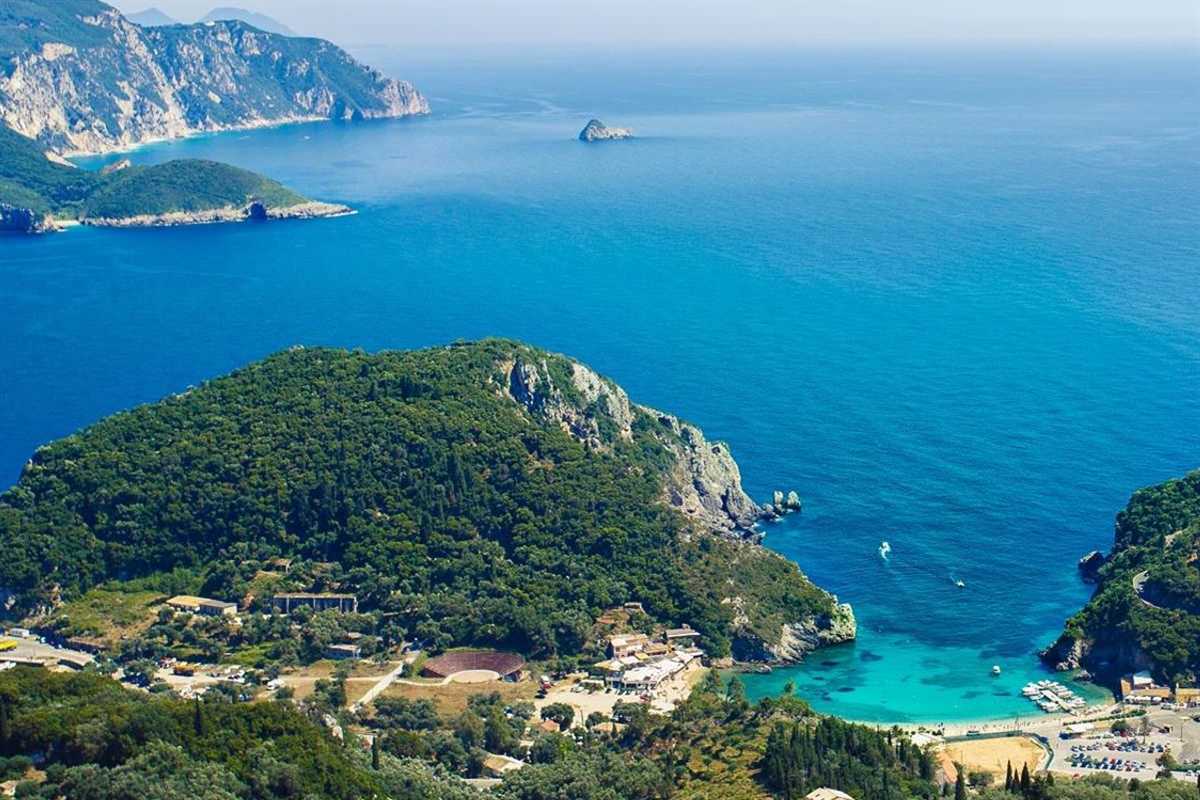
Paleokastritsa sits along the northwest shore of Corfu, around two peninsulas and six small coves. A Corfu Paleokastritsa tour reaches this coast and shows cliffs, clear water and hills of cypress, olive and citrus trees.
Wikipedia explains the Greek name, “Old Little Castle”, through the nearby fortress of Angelokastro. Angelokastro crowns the top of the shoreline’s highest peak, on a steep cliff 305 metres above the sea. Two operator pages list the monastery and the bays for a Corfu Paleokastritsa tour, not the castle.
The Corfu tourism site describes six coves and beaches with deep, cold, crystal-clear water. Rock formations drop into the sea there and open into domed grottoes. Another page says the sea currents keep the water cold, even in summer.
Caves that only boats reach line this shore. Small boats leave from the harbour area and from Agios Spyridon beach. One page puts a boat trip between half an hour and two hours. On a Corfu Paleokastritsa tour the cave boat is an option, as two operator pages show, not a fixed stop.
Legend adds to the view. Myth links this bay to Odysseus, and Wikipedia reports a suggestion that he landed here and first met Nausicaa. Locals consider a rock near the horizon his petrified ship.
Lakones, a traditional village, lies 6 kilometres from the bays by road. One operator page lists its Bella Vista viewpoint, with a panorama of Paleokastritsa and the rugged coastline. A Corfu Paleokastritsa tour that adds this stop gains a view reaching Corfu, the mainland and Albania, another page says.
What does the monastery above the bay add to a Corfu Paleokastritsa tour?
The monastery adds history and a quiet pause to a Corfu Paleokastritsa tour. It dates from the thirteenth century, stands on a hill above the bay, and holds a small museum of icons.
The monastery belongs to the Virgin Mary and is still a working house of monks. One trip page says eight monks live there. It is built on the west side of the central bay and faces the sea. A courtyard with a well and a garden of bougainvillea wait outside.
Inside, the church has a flat painted ceiling, a gilded iconostasis and hanging oil lamps. Venetian influence shows in the style, as in the other churches of Corfu. The museum sits in a modern building. It shows Byzantine and post-Byzantine icons, old church books and church vestments. One notable icon shows the Dormition of the Virgin Mary.
Visitors on a Corfu Paleokastritsa tour need modest clothes, so cover your knees and your shoulders. Skirts or shawls are provided at the entrance to anyone who needs them. Flash photography is forbidden inside the church. A code of silence applies, and the living quarters of the monks are closed to visitors.
In July and August the monastery fills up, and sometimes more than one ship docks at the same time. The visit is a stop, not a long stay, so the Corfu Paleokastritsa tour keeps time for the bay below.
What can you do on the beach during a Corfu Paleokastritsa tour?
You can swim, rest and take a boat to the sea caves during a Corfu Paleokastritsa tour. Trips of this kind leave free time at the bay to eat, swim or go out by boat.
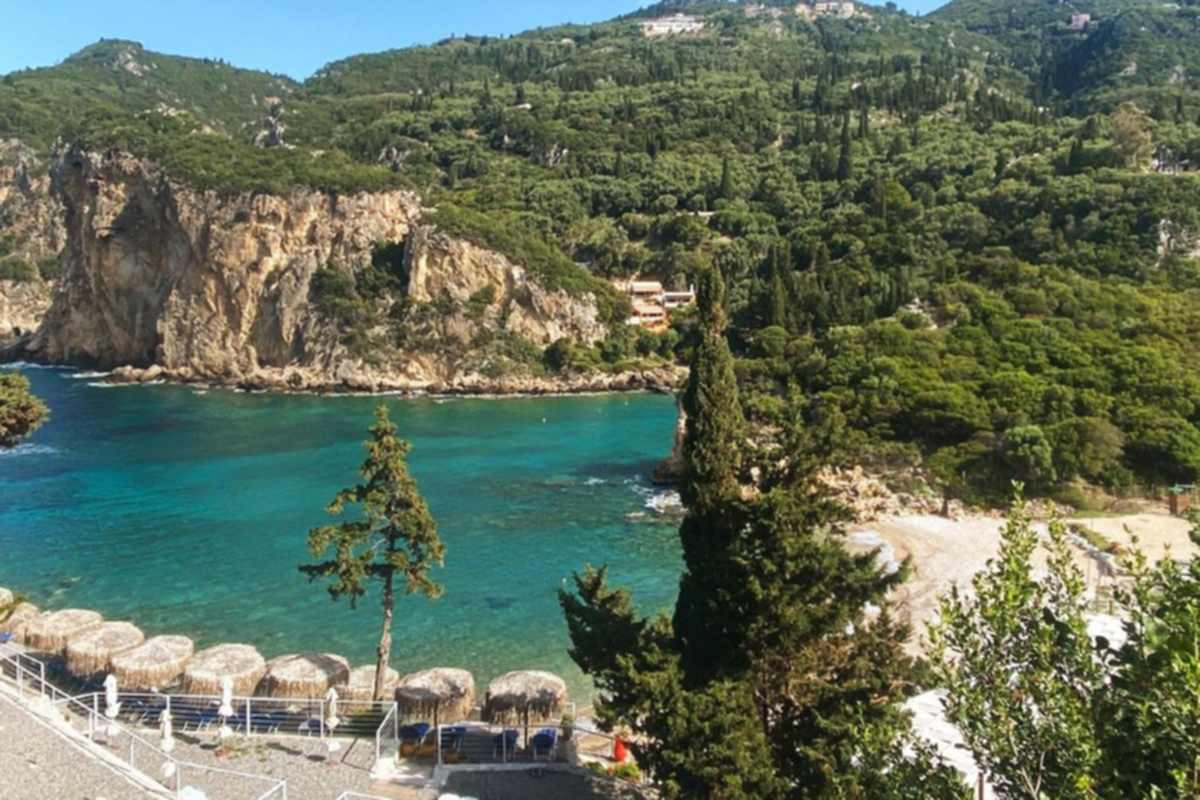
On a Corfu Paleokastritsa tour the main beach is Agios Spiridon, a short walk from the monastery. A small church of Saint Spyridon stands near it. The beach is a small mix of sand and small pebbles in a cove ringed by cliffs. The water is calm and clear enough to show the rocky bottom.
Bring a swimsuit and a towel, or rent them locally. The sea feels cold, even in August. Sunbed and umbrella rentals line the beach, along with kayaks, paddleboards and pedal boats. Snorkellers find marine life close to shore on the rocky left-hand side. Waterfront tavernas serve traditional dishes and locally caught seafood.
Small boats leave through the day from the harbour area and from Agios Spiridon for the sea caves. Inside, the light plays on the rock. The cave ride is optional and comes on top of the swim. A Corfu Paleokastritsa tour lets you pick between sand and sea.
The beach fills fast in peak summer, mainly from late morning until the afternoon. Both July and August are very crowded. A short swim and a taverna lunch suit the stop better than a long beach day.
What does the Old Town of Corfu offer on a Corfu Paleokastritsa tour?
The Old Town of Corfu gives a Corfu Paleokastritsa tour its walking half. The UNESCO World Heritage List includes it, and it was built between the Old and New Fortress. Two operator pages place it on the route.
On foot, a Corfu Paleokastritsa tour meets a dense network of narrow lanes called kantounia. The old centre is free from cars. Washing lines stretch between the buildings, and one operator page calls the streets narrow and cobbled. Visit Greece says you feel as though you are in an open-air museum.
Facing the Old Fortress, the Spianada is a big open square. The name is borrowed from Venetian and describes flat, open ground. Venetian troops once used the ground as a firing range. On the western side stands the Liston, a row of arcades. Its French builders drew their idea from the Rue de Rivoli, a street in Paris.
One operator page lists the cricket ground, a British legacy, and free time along the Liston arcades. It also names the old Church of Saint Spyridon and the palace named for Saint Michael and Saint George. The palace is built of white Maltese stone. Saint Spyridon, patron saint of Corfu, has his relic in that church.
The order changes with the operator. On one page the Old Town comes first on the Corfu Paleokastritsa tour, before the monastery. On another page it closes the day, with free time for shopping.
How does a Corfu Paleokastritsa tour compare with a taxi, a rental car or the public bus?
A Corfu Paleokastritsa tour fixes the stops and the return. A taxi, a rental car or the public bus leaves the planning to you. The village is about 24 kilometres from Corfu Town, towards the north-west.
A taxi starts at the main rank on Spianada Square. Unlike a Corfu Paleokastritsa tour, it has no set stops. The ride lasts 30 to 40 minutes, and the length shifts with the season and the time of day. In high season a taxi can be hard to find, so booking ahead is the advice.
The green intercity bus takes more steps than a Corfu Paleokastritsa tour. From Corfu Town you ride a blue city bus to the intercity station and change there. Sources give the ride as 45 minutes to just under an hour. The last stop is next to the main beach, and timetables change frequently in the tourist season.
A rental car gives freedom, and the road between Corfu Town and Paleokastritsa is good. Past the village, the mountain roads turn narrow and winding. Parking runs along the road into the village, and a large lot sits near the main beach. At the monastery, parking is extremely limited and traffic can jam.
A Corfu Paleokastritsa tour joins these parts into one plan, without changing buses or driving around. One operator page picks up passengers at the cruise terminal and builds its four hours around the port call window. The way back is set to fit the cruise schedule. On your own, a cruise-port page advises extra time to get back.
What else do travellers ask about a Corfu Paleokastritsa tour?
What clothes and gear suit a Corfu Paleokastritsa tour?
Wear shoes you can actually walk in, because one shore excursion blog says the cobbles are real. Another listing asks for comfortable walking shoes, sun protection, a hat and snacks or water. It says the day has walking and outdoor stops. Lightweight layers help, and sun protection matters even on breezy days.
Stone streets reflect heat, so carry water in a small day bag. One page lists food, drinks and entry tickets as not included, so plan for lunch. A day bag with these items covers a Corfu Paleokastritsa tour.
Are children and pushchairs fine on a Corfu Paleokastritsa tour?
The listings welcome children but differ on effort. One sets the age bands at 3 to 11 for children and under 3 for infants. It rates the effort as low and calls the trip stroller-friendly, with infant seats.
Another lets infants and small children travel in a pram or stroller. A third lists moderate fitness as a need. It adds that the monastery is 20 minutes away on foot from the bus parking. A fourth says children must travel with an adult. Wheelchair access differs between listings, so ask before booking.
Where is the meeting point on a Corfu Paleokastritsa tour, and how do you return to the ship on time?
Cruise passengers meet the tour at the cruise port. Ships dock at Neo Limani, northwest of Corfu Town, and shuttle buses carry passengers to the main terminal. The Old Town is about 2 km away. The walk takes 30 to 40 minutes along a busy waterfront road with little shade.
To get back in time, give the operator your ship’s exact arrival time. One booking page has a box for it. Two listings promise a timely return to the ship. One shore excursion blog advises a 30-minute cushion before all-aboard on a Corfu Paleokastritsa tour.
Which language does a Corfu Paleokastritsa tour run in, and who leads it?
English is the standard language on these trips. One page sets English as the default and lets you state another language at checkout. A separate booking page that lists four Paleokastritsa tours shows English for each of them.
The first page says its licensed guides hold a licence from the Greek Tourist Organization. It adds that they are university graduates in Greek history and culture. When places fill up, it asks you to stay close to your licensed guide. That way you hear the commentary on a Corfu Paleokastritsa tour.
What happens on a Corfu Paleokastritsa tour in bad weather or when the ship is late?
Corfu has hot, dry summers, and July and August bring the least rain. The wettest months are October, November and December. In winter the island is rainier than other Greek islands.
Two listings call the optional boat trip subject to the weather. One page allows cancelling until 24 hours before the start. Another page sets 72 hours before pickup. One page starts the day when the ship docks at the Port of Corfu. Plan a Corfu Paleokastritsa tour around the weather and the dock time.