
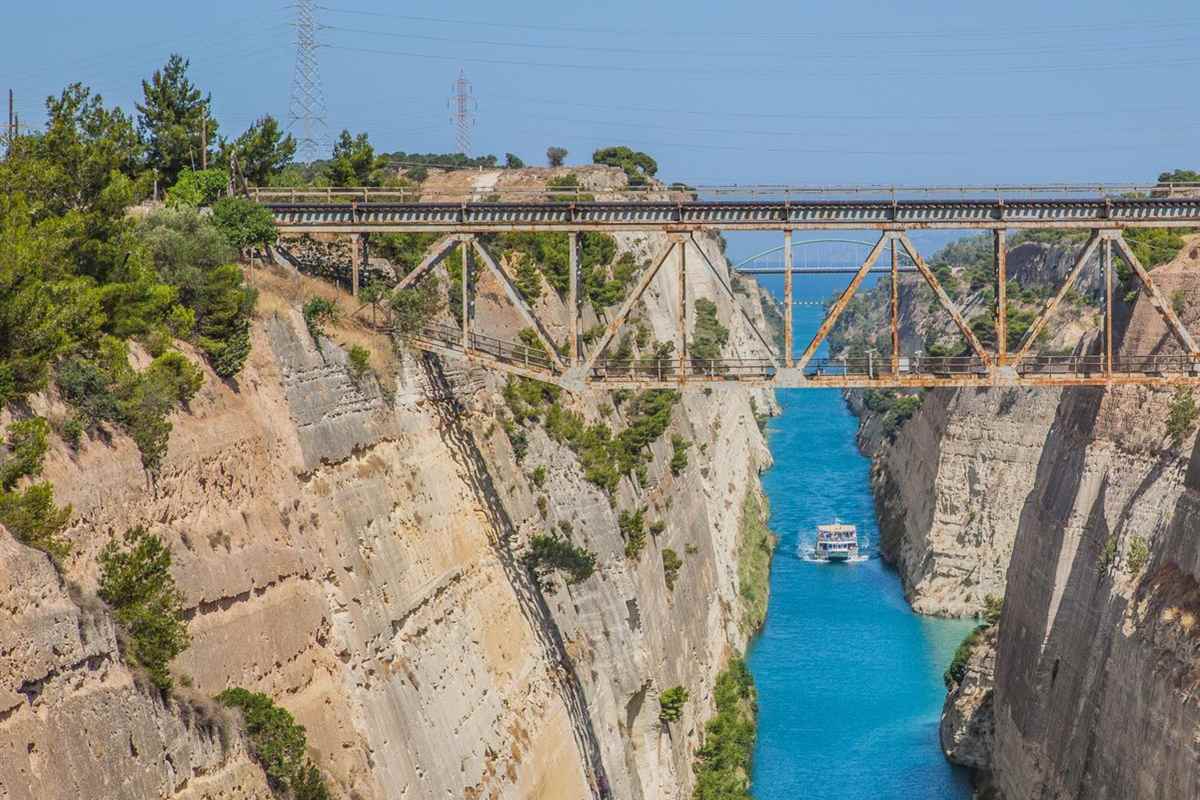
A Corinth canal cruise carries you along a narrow cut through the Isthmus of Corinth, between rock walls that rise on either side of the water. Other sea trips from the Peloponnese are listed on our tours in Greece pages.
This page covers how the passage runs, how long it lasts and where it starts, how the canal was planned and built, what the rock walls look like from the water, the bridges and sights on the way, the season and the light, and the questions travellers ask.
What is a Corinth canal cruise, and how does it work?
A Corinth canal cruise is a short boat ride along the Corinth Canal. The cut connects two seas: the Saronic Gulf on one side and the Gulf of Corinth on the other. Operator pages describe a shared glass-bottom boat that sails the full canal with narration.
Dug across the Isthmus of Corinth, the canal sits on a land bridge 6.3 kilometres wide. On one side lies the Peloponnese, on the other mainland Greece. The engineers completed the cut late in the nineteenth century and dug at sea level, so no locks are needed. Wikipedia adds that it matters little for trade and draws mainly sightseers.
A Corinth canal cruise runs on set schedules while the canal is open for crossings. The boat enters the cut and sails between high limestone walls. One page stresses that the trip is not a quick photo stop. It covers the full canal passage of about 6.4 kilometres.
This kind of boat has clear glass sections under the waterline. From inside, passengers look down into the sea and stay dry. Wikipedia says this view beats peering over the side, because surface ripples no longer get in the way. One page calls the glass area shared.
On a Corinth canal cruise you sit, take photos and listen to the narration. One page lists historical and mythological stories, and another says an English-speaking crew gives the history. Snacks and drinks are available on board, and one page calls the ride calm and easy for all ages.
How long is a Corinth canal cruise, and where does it start?
A Corinth canal cruise takes about one hour on two operator pages. Three others say an hour and a half. The pages that name a start all say Isthmia port, in Corinthia.
Five operator pages give a time. Two say one hour, and three say ninety minutes. Plan for no more than ninety minutes on the water. One page names 10:30 as the standard departure time. It adds that the schedule changes with the date and canal operations.
The start of a Corinth canal cruise is Isthmia, a Corinthia village that Wikipedia places in the Loutraki-Perachora municipal unit. Three operator pages name Isthmia as the start. One adds that the boat waits on the Isthmia side of the canal. Another also lists daily boats to Aegina and Agistri from that port, apart from the canal crossing.
Athens is about one hour away by car, depending on traffic, says one page. Two more pages offer a transfer from Corinth railway station to the port for train passengers. That suits travellers without a car.
A Corinth canal cruise is short. One page fits it into a day trip from Athens, Corinth, Loutraki or Nafplio. It lists Ancient Corinth and Nemea wine tasting as add-ons. Another page offers an Athens pickup, lists 9:00 as the pickup time and gives the cruise as one hour.
How was the canal built, and why does it matter on a Corinth canal cruise?
Builders finished the canal on 25 July in the late nineteenth century, after eleven years of work. They dug it at sea level without locks, so a Corinth canal cruise floats level with both gulfs.
Ancient rulers wanted a waterway across the narrow Isthmus of Corinth. After independence from the Ottomans, the old plan came back. The opening of the Suez Canal gave it fresh impetus, and a Greek law then authorised the work. A new company held a 99-year concession for building and running the canal that a Corinth canal cruise sails today.
King George I of Greece attended the opening ceremony for the works on 23 April. Yet the first company did not last. After eight years of digging, bankruptcy hit the company and its head, István Türr, alike. Geological problems had also slowed the work. Construction resumed when a Greek company took over the project.
The cut matters on a Corinth canal cruise because it turns the Peloponnese into an island. For ships, it saves a journey of 700 kilometres around the peninsula. Today’s canal runs along the line of the Roman dig. The cut is now mainly a tourist attraction, and the boat trips sail its full length.
What do the rock walls look like on a Corinth canal cruise?
The sheer limestone walls climb at an angle of 80 degrees, almost vertical. Between them, a Corinth canal cruise sails a channel with a surface width of 24.6 metres.
Travel writers describe the cliffs as sand-coloured and ochre, and one notes bushes growing on the limestone. The canal company gives the channel a depth of 8 metres and a width of 21 metres at the bottom. The highest ground the cut crosses stands 79 metres above sea level.
An operator page describes the view from the deck. On a Corinth canal cruise, the boat sails between high limestone walls for a close-up look at the rock. The sedimentary rock is full of faults, and the land lies in a seismic zone that is still active. The walls were unstable from the start.
Landslides delayed the first ships. The canal opened formally in July but took traffic only in November of the following year. Ship wakes then undermined the walls and caused more slides. To hold the cliffs back, builders put masonry walls at the water’s edge, 165,000 cubic metres of it.
The masonry runs along over half of the cut. The waterline on a Corinth canal cruise shows built wall and bare rock. In the decades before the Second World War, repair work shut the canal for four years in all. In one early twentieth-century year, a fall of 41,000 cubic metres of material took two years to clear.
Workers of the Roman dig left behind a relief of Hercules. It lies on the north side near the Gulf of Corinth end, beneath an old bridge foundation. Today that cut is the route of a Corinth canal cruise.
What do you see through the glass on a Corinth canal cruise?
Glass panels in the boat’s floor show you the sea water inside the cut on a Corinth canal cruise. Operator pages list a shared glass-bottom viewing area, with underwater scenery below you and high limestone walls on both sides.
The floor of a glass-bottom boat holds panels of glass under the waterline. Passengers peer down into the sea from their seats. The view is clearer than looking down from a deck, because you do not look through surface ripples. The effect is like a diving mask, and you stay dry.
On a Corinth canal cruise the glass looks into a channel with no locks, cut at sea level. The company that runs the canal gives the depth along its axis as eight metres at mean low water. So the panel opens onto a narrow seaway that links two gulfs, one at each end of the cut.
Trips differ on what the glass shows. The one-hour passage is sold with underwater scenery and views both above and below the surface. Longer trips sail on into the Saronic Gulf to a swim stop. Their page lists marine life seen through the floor.
The same one-hour page adds narration with historical and mythological stories, and time for photos between the walls. A Corinth canal cruise therefore splits your attention: down through the glass, then up at the rock and the bridges.
Which bridges and sights does a Corinth canal cruise pass?
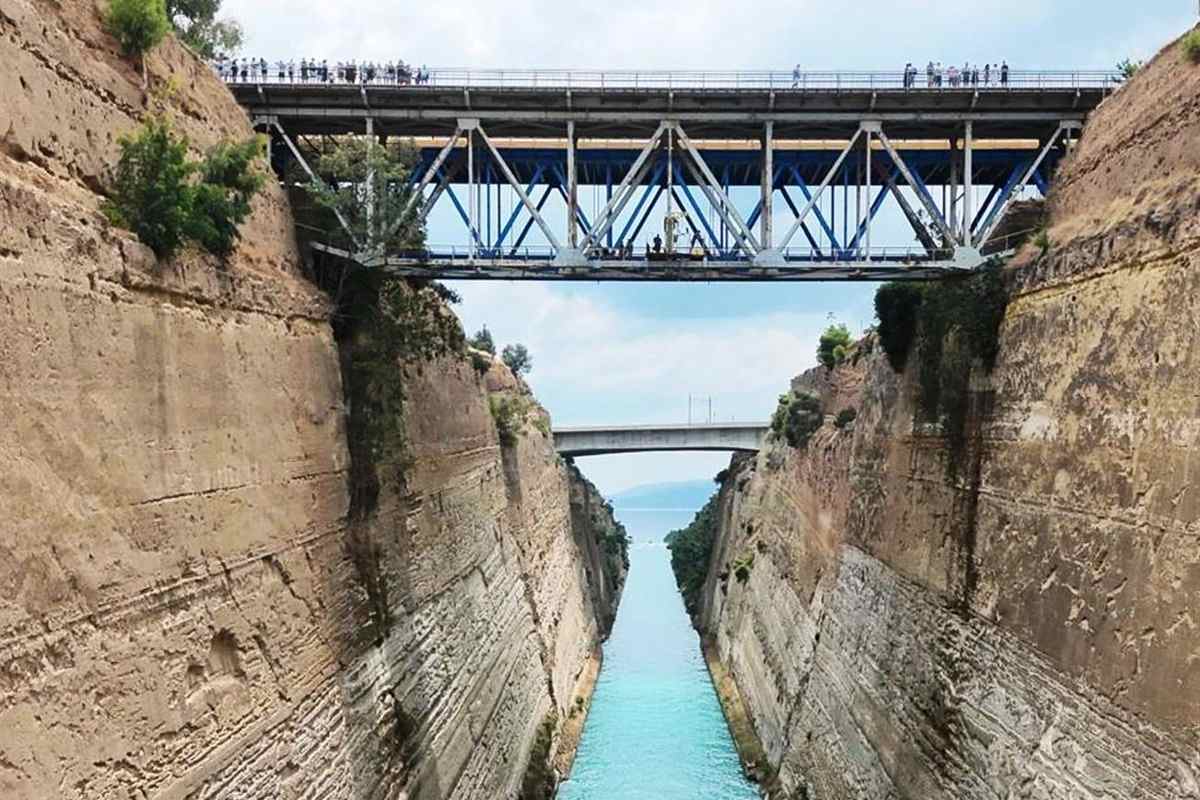
A Corinth canal cruise sails the full length of the cut, so it passes under the road and railway bridges. The Isthmus has two road bridges, two railway bridges and a submersible bridge at each end.
The canal company limits air draft to 52 metres, because of the rail and road bridges. One traveller on a small cruise ship wrote that it passed under rail and road bridges. A Corinth canal cruise follows the same line down the cut. Tourists lined the overpasses, and the writer met visitors who came by bus from Athens.
Bungee jumpers add action to the view. The regional tourism board puts the jump platform on the old national road bridge, at the Loutraki exit. The same traveller saw jumpers bouncing right above the ship at the last bridge. On a Corinth canal cruise, the bridges overhead are busy places.
A submersible bridge stands at Poseidonia and another at Isthmia, one at each end. These bridges do not lift. They sink to the canal floor, and ships pass over them. At Poseidonia the sinking starts 15 minutes before a ship arrives and runs at four metres a minute. A military emergency bridge also stands at the west end.
A terrace at the Isthmia bridge, in the south-east, lets people watch it sink into the water. For a Corinth canal cruise, the one-hour page lists the limestone walls, the narration and the full passage. Longer trips add the ancient port of Kenchreai and the Baths of Helen, then a swim stop at Siderona Beach.
Which season, weather and light suit a Corinth canal cruise?
A Corinth canal cruise suits spring and autumn. One travel page recommends April through June, and again September and October, for pleasant weather and fewer crowds.
The calendar also depends on the canal itself. An operator page says the canal operates seasonally, and availability varies with canal operations, maintenance works and weather. A day-trip page adds that departures depend on the season and demand. The canal company lists Tuesdays from 6:00 to 18:00 as the one break in its round-the-clock service.
Summer brings heat. On a summer Corinth canal cruise, expect 32°C on July and August afternoons, says a weather page. June reaches 29°C and September 28°C. January reaches a daytime maximum of 12°C. December is the wettest month, and July is the driest, with 6 millimetres of rain.
The canal company says the prevailing winds are northwesterly, with occasional north winds that gust hard and change fast. A reference article adds that the steep walls channel the wind down the line of the cut. The canal’s bearing is 131.5 degrees, or 311.5 degrees the other way, and a Corinth canal cruise follows that line.
Light changes the view. A travel page says morning sun lights the eastern wall, and midday sun hits the water directly. Another page says summer midday glare bounces off the cliffs. It names early light before 9 and the late hours from 4 onward as the better times for photos. Check your Corinth canal cruise departure time against both.
How does a Corinth canal cruise compare with looking down from the bridge or crossing on a big ship?
A Corinth canal cruise puts you on the water between the walls. An operator page says seeing the canal from above is impressive, but sailing through it is a completely different experience.
From the bridge, the view runs straight down. A travel page calls it slightly dizzying, and a day-trip page says the bridge is exposed and can be windy. The viewing bridges stay open year-round. If a ship happens to be passing, the same day-trip page calls the effect extraordinary.
A Corinth canal cruise looks up at the walls instead. An operator page says the limestone cliffs fill the view at close range.
A big ship tells a different story. At sea level the canal measures 24.6 metres across, and 21 metres across on the bottom. Only small ships fit. One cruise writer sailed on a ship about 63 feet wide. A tug towed it, and local pilots came aboard as the authorities require.
Ships go through in a single convoy, and the canal runs one way. Passengers watch from the outer decks or through large windows. The writer saw walls mere feet from the sides of the ship. That day had no port stop. Small-ship lines run a handful of such transits each year, mainly to move ships between regions.
A Corinth canal cruise, by contrast, is an outing on its own. An operator page calls it easy to add to a day trip from Athens, Corinth, Loutraki or Nafplio.
What else do travellers ask about a Corinth canal cruise?
Which clothes and gear suit a Corinth canal cruise?
Pack a hat and sunglasses for a Corinth canal cruise, because a booking page for the one-hour passage names both. Carry your booking confirmation, either on screen or printed. One listing asks you to show an electronic voucher.
Meals are not included, but operator pages list toilets, snacks and drinks on board. A longer version of the trip adds a swim stop with snorkelling equipment. A booking page for that version lists swimwear, a towel, a camera and biodegradable sun cream. Check which version you booked before you pack.
Can children and strollers come on a Corinth canal cruise?
Booking pages describe a Corinth canal cruise as suitable for all ages and all fitness levels. One page allows a pushchair for infants and small children, and seats babies on an adult’s knee. Another page calls the cruise calm and comfortable for families and seniors.
Boarding involves steps. One page tells passengers with limited mobility to weigh this before booking. Another asks guests with limited movement to warn the operator beforehand. On one listing, the captain and crew welcome you at the boat and help with boarding. One listing bans pets.
Will a Corinth canal cruise make me seasick?
A Corinth canal cruise runs inside a cut dug at sea level. It has no locks, so the boat stays on one water level. An operator page lists calm waters among the trip’s features. A reviewer on a booking page calls the ride smooth.
Reference texts call the two gulfs that the canal joins relatively sheltered, unlike the gale-prone Peloponnese headlands. Booking pages describe the boat as 17 metres long with 50 seats. None of the pages gives wave heights or seasickness advice. Ask the operator before booking if the sea worries you.
Where do I board, park and check in for a Corinth canal cruise?
For a Corinth canal cruise, the boat is moored on the Isthmia side of the canal. One page asks you to be at the boat by 10:15. Another says to arrive fifteen minutes early to check in. A third lists departures between 10:30 and 11:40.
Two booking pages place a large car park right next to the boat. Without a car, booking pages also list a pick-up at Corinth train station at 10:00. One of them says the pick-up runs on request, so check with the operator first.
What if the canal closes or the weather turns on a Corinth canal cruise?
Operator pages say availability depends on official canal operations, maintenance works and weather. One page promises to tell you as early as possible if the canal is closed and to offer alternatives. Another says poor weather can move a Corinth canal cruise to another day or cancel it.
The canal has closed before, because landslides from its steep walls need repairs. A travel writer reports two years of closure after one landslide, then a second closure for more repairs. To cancel yourself, three booking pages want notice a full day ahead of departure.