
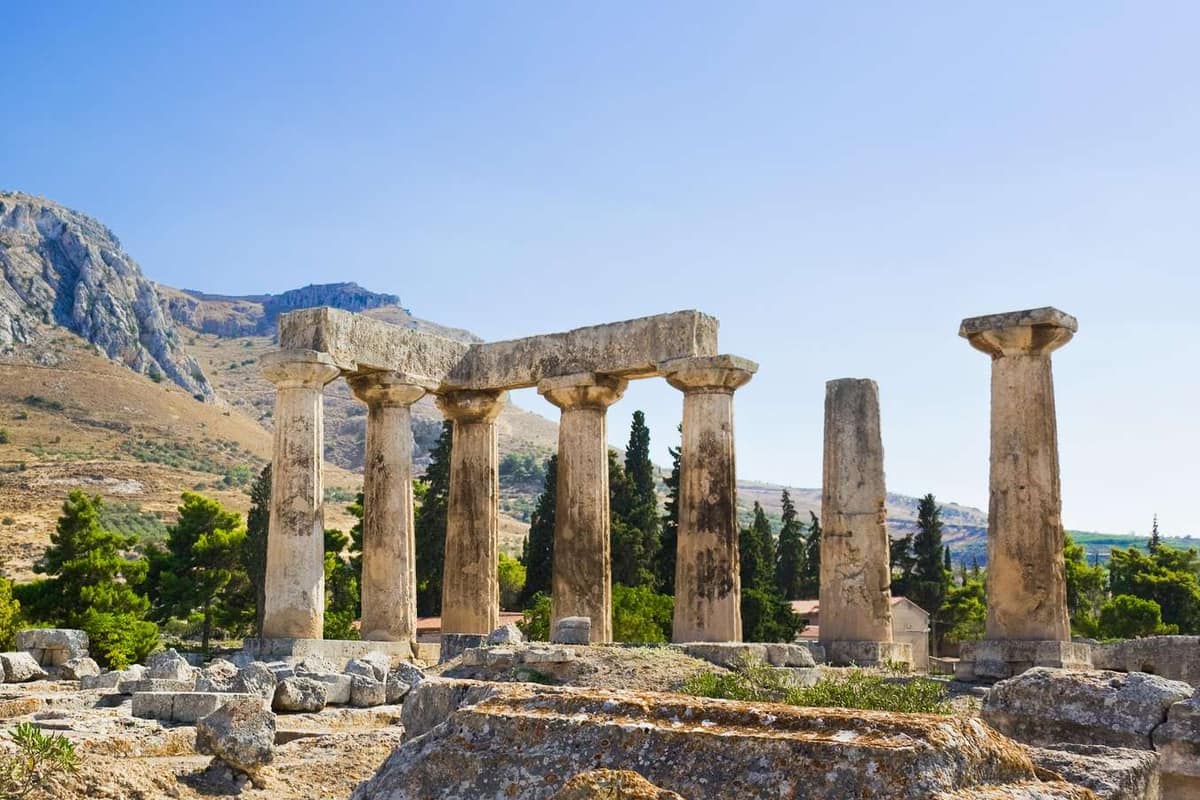
A Corinth ancient tour starts with the ruins of a Greek and Roman city below the rock of Acrocorinth, in the north-east of the Peloponnese. The walk runs from the Temple of Apollo across the Agora to the paved street, the stone platform linked to the Apostle Paul and the museum. To add more stops around the visit, open the tours in Greece and pick a second day.
This page covers how a Corinth ancient tour runs and how long it lasts, where the old city stands and the story it tells, the temple and the Agora, the street and the Bema, the museum and Acrocorinth, the kinds of tour and the roads, the rules and the seasons, and the questions travellers ask.
What is a Corinth ancient tour, and how does it run?
A Corinth ancient tour is a guided walk through what remains of the old city of Corinth, on the Peloponnese. The day runs in five steps: pickup, coast drive, canal stop, site walk and ride back.
A Corinth ancient tour puts you in a city that was once among the largest in Greece. Wikipedia counts 90,000 people in the city in 400 BC. One operator page adds that biblical accounts have the Apostle Paul preaching there for eighteen months.
A Corinth ancient tour from Athens starts at a hotel or at a set meeting point. One page says the group is picked up from hotels in Athens. Another asks guests to be ready at least fifteen minutes before the pickup time. That page also says the meeting point can vary.
The road runs along the Saronic Gulf shore. Two pages say the vehicle is air-conditioned or climate-controlled. The group pages name a coach or a minibus. One private page lists room for four in a car, nine in a minivan and seventeen in a minibus.
The first stop of a Corinth ancient tour is the Corinth Canal, a short break for pictures. Two pages describe it as a short stop for photographs. The canal has its own section further down.
Inside the site, one page walks through the agora, past the fountains and on to the Temple of Apollo. Another page lists the site, the museum, the temple and then Acrocorinth, in that order. Two pages also name the ancient theater. A Corinth ancient tour changes order between pages, yet all four pages name the Temple of Apollo.
A Corinth ancient tour adds Acrocorinth, the rock above the ruins, on two private pages. The two coach pages do not list it. Two pages end at the ancient port of Kehries, where they say the Apostle Paul came ashore.
The ruins on the route come from digs. Wikipedia says recent digs by the Greek Ministry of Culture have brought new finds to light. Archaeologists have worked at the site since the late nineteenth century. Walking the site means walking through the parts those teams have uncovered.
Not every page has a meal stop. A Corinth ancient tour on one private page can add a coffee break or a meal on request. That page places a traditional Greek tavern before the ride back to Athens.
The ride back ends the day. The private page drops guests at the hotel or rental flat. The half-day coach page speaks of a return to Athens.
Language is part of the plan. One half-day page runs the Corinth ancient tour in English only. A private page says tour guides in other languages are available on request.
How long is a Corinth ancient tour, and where does it start?
A Corinth ancient tour from Athens lasts about five to eight hours, as three operator pages state it. The drive alone lasts more than an hour in each direction. The start is in Athens, at a hotel or a meeting point.
One half-day page gives a departure at about 08:45 and a return at about 14:00. That is about five hours and fifteen minutes for the whole Corinth ancient tour. The page adds that the pickup round can take up to about one hour. Each guest gets a pickup time at booking.
A second page says the day ends about six hours after the first pickup. A private page gives six to eight hours and says the route and the times can change on request. So a Corinth ancient tour is a half day on one page and a long day on another.
The time on site is shorter than the day. One private page gives minutes for each stop. It lists 15 at the canal, 30 at the ancient site and 30 in the museum. It lists 10 at the Temple of Apollo and one hour on Acrocorinth.
One travel page says coach visitors from Athens spend fifty minutes among the columns. The same page says the site and the museum alone take half a day. It also says the wider region needs two full days. A private page says the canal, the ancient city and Acrocorinth fit into half a day.
The drive from Athens to the site takes one hour and fifteen minutes on one page. Another page gives about ninety minutes by car or bus. A Corinth ancient tour makes that drive twice, once out and once back.
Three operator pages start the day in Athens. One private page has eight pickup areas, Piraeus among them. It lists a hotel, a port, a cruise terminal or the airport for pickup and for the drop off. So a Corinth ancient tour can start at a cruise terminal as well as a hotel.
The official museum page splits the year into winter, November to March, and summer, April to October. Opening hours are extended in summer, as that page states. None of the operator pages splits the length of a Corinth ancient tour by season.
Where does ancient Corinth stand on a Corinth ancient tour?
A Corinth ancient tour covers the remains of an old Greek city-state at the Isthmus of Corinth. This thin strip of land connects the Peloponnese with the Greek mainland. Wikipedia places the city roughly halfway between Athens and Sparta, below the rock of Acrocorinth.
The isthmus explains the city. Wikipedia gives it a width of 6.3 kilometres. The Gulf of Corinth washes its western side, and the Saronic Gulf its eastern side. Two operator pages reach the isthmus first and the ruins second. A Corinth ancient tour from Athens follows the land bridge the old city controlled.
The ruins sit on two natural terraces. Farmland and natural springs lie along the southern edge. Seasonal streams come down from Mount Ziria and from the Ayios Vasilios valley. Wikipedia says builders used the local limestone for houses and public buildings alike. On a Corinth ancient tour you walk where water, farmland and building stone lay close together.
Wikipedia names the plain of Vocha, the Oneia Mountains and Acrocorinth as natural features near the modern city. Wikivoyage pictures the rock as seen from the excavation area near the temple. So a Corinth ancient tour sees the hill from the ruins.
Wikipedia puts modern Corinth 78 kilometres away from Athens, towards the west. One trip page gives 80 kilometres from Athens to the ruins. The old and new towns are close. The pages give the gap as three, five or seven kilometres. A Corinth ancient tour that starts in the new town travels only a small distance.
The village of Ancient Corinth, called Archaia Korinthos, lies against the site fence. Wikipedia says it sits directly over the ancient city. In the nineteenth century an earthquake wrecked the old settlement. People then founded New Corinth to the north-east. The village limits the digging, so a Corinth ancient tour sees the parts that lie open.
Archaeologists from the American School in Athens began the Corinth Excavations in the late nineteenth century. They still work on the site. They have also dug on the slopes of Acrocorinth, at a sanctuary for Demeter and Kore. Wikipedia says these digs have revealed large parts of the ancient city, which a Corinth ancient tour then walks.
Around the site lies Corinthia, the area of the north-east Peloponnese whose main town is Corinth. Wikipedia lists the thermal springs of Loutraki, the sites of Sicyon and Nemea, and the Heraion of Perachora. A Corinth ancient tour is one visit in a region with more ancient places.
What story of the old city does a Corinth ancient tour tell?
The story of a Corinth ancient tour is one of trade. A city-state on the isthmus grew rich from two harbours and sent out colonies. It held the Isthmian Games and named a column style. Then it rose again as a Roman colony.
People lived on the site long before the city. Wikipedia reports Neolithic pottery from at least 6,500 BC. It believes Dorians settled there around 900 BC. By the eighth century BC the Bacchiadae clan ruled, and Corinth became a unified state with large public buildings. A Corinth ancient tour tells this long past on the spot.
Colonies spread the city’s name. Wikipedia dates colonies at Corcyra and Syracuse to 733 BC. Corcyra is the island of Corfu today. A second page also lists Corfu and Syracuse among the Corinthian colonies. Wikipedia calls the rule of the Cypselids in the seventh century BC the golden age of Corinth.
Two harbours made the money. The western harbour, Lechaion, linked the city with its colonies in Italy and Sicily. The eastern harbour, Kenchreai, received ships from Athens and the eastern Mediterranean. All land traffic into the Peloponnese also passed the isthmus. Wikipedia says Corinth rivalled Athens and Thebes in wealth.
Corinth had 90,000 people around 400 BC, as Wikipedia and a trip page both state. That made it one of the largest cities in the Greek world. A Corinth ancient tour walks over the remains of that large city.
Corinth was a major exporter of black-figure pottery. Local marl clay made light vessels. Wikipedia and a second page agree that Athens took over the market in the sixth century BC.
Silver coins called colts or foals appeared around 570 BC, and the staters carry the winged horse Pegasus. Wikipedia also names a Potters’ Quarter among the dug areas. A Corinth ancient tour tells of these makers.
The Isthmian Games honoured Poseidon at his rural sanctuary on the isthmus. They took place each spring, in the second and the fourth year of an Olympiad. Contests were athletic and musical. Winners first took a wreath of celery and later one of pine. A Corinth ancient tour mentions the games as one thread of the city’s past.
The city also gave its name to the Corinthian order. It is the third main style of classical columns after the Doric and the Ionic. Its capital carries acanthus leaves and scrolls. Wikipedia adds that Athens was probably where it was invented. Its article on the city shows Corinthian order columns in ancient Corinth.
Rome took the city in 146 BC. The site stayed largely empty until 44 BC. Then Julius Caesar founded the city again, as a Roman colony. Roman Achaea, a province covering much of mainland Greece, had Corinth as its capital. Its streets followed a Roman grid. A Corinth ancient tour walks through that Roman city.
Romans, Greeks and Jews all lived in the new city. Farming, herding and trade grew again. One page says the city exported woven cloth, dyed wool, olive oil and honey.
Earthquakes in the fourth century AD damaged the city, and it was rebuilt on a smaller area. In the Byzantine period the main settlement moved up to Acrocorinth. People used that hill until the early nineteenth century. A Corinth ancient tour therefore reads as a layered story.
What does the Temple of Apollo show on a Corinth ancient tour?
The Temple of Apollo shows how a Doric temple built in the sixth century BC looked. On a Corinth ancient tour you see seven stone columns that still stand. Once 38 columns ringed the building, and each shaft is cut from one block.
Wikipedia calls the temple a dominating monument and says it has been visible above ground since antiquity. American archaeologists began excavating Corinth in the final years of the nineteenth century. The dig has focused on the area that surrounds the temple, so a Corinth ancient tour walks beside excavated ground.
The temple was a ring of Doric columns round a stone building. Each short side carried six columns and each long side fifteen, as the Municipality of Corinth states. Wikipedia counts 38 columns in all and says seven are still in place. On a Corinth ancient tour you can count the seven yourself.
The word monolithic means that each shaft was cut from a single block of stone. A tour page says columns like these were rare in the ancient world. A travel publisher adds that earthquakes toppled the other columns. The seven that stand are the survivors of the full ring.
The temple belongs to the sixth century BC. Wikivoyage and a tour page both count it as an early Doric temple of the Greek mainland. It sits on a rocky rise over the ruins of the old market square. Two sources agree on this. That is why the columns rise over the whole site on a Corinth ancient tour.
The municipality also describes the plan. A long inner room, the cella, was divided into two rooms, and extra columns inside held up the roof. A porch at the front and a porch at the back each had two columns between projecting side walls. Today only seven columns remain, so the plan is read from the ground.
Behind the columns rises Acrocorinth, the great rock above the site. Wikivoyage shows the view of the rock from the dig area near the temple. A Greek heritage page says the whole site lies in the shadow of Acrocorinth. From the temple a Corinth ancient tour shows the old city and its high fortress hill in one view.
The temple kept a role for centuries. Wikivoyage lists a Roman restoration, when it was dedicated to the cult of the emperor. Later it served as a church building. In the Ottoman period part of it came down. A house for the local ruler was built on its base. A Corinth ancient tour tells this story at the columns.
Tour pages order the walk in different ways. One private tour page names the market and the Peirene spring first. Next come a Roman mosaic, the Julian Basilica and the Roman baths, then the temple. A half-day tour page puts market place and temple side by side. Both pages name the temple as a stop on a Corinth ancient tour.
What does the Agora show on a Corinth ancient tour?
The Agora shows the market square of ancient Corinth, a rectangle of about 160 by 70 metres. On a Corinth ancient tour you walk past shop foundations, small temples, an altar and fountains round this open square.
The Agora began as a Greek market place. Rome refounded the city as a colony in the first century BC. The square then became a Roman forum, as Wikipedia explains. The Romans kept Greek buildings, such as the South Stoa, in the new plan. A Corinth ancient tour therefore crosses Greek and Roman work in one square.
The municipality gives the size as roughly 160 metres by 70 metres, and one tour page repeats the figures. That page adds that the square held shops in the middle, small temples and an altar. The Bema, the speakers’ platform, stands here too. Its own section follows later.
The southern side held the South Stoa, a row of identical shops, as the municipality describes it. Each had two rooms and a double row of columns in front. The outer row was Doric and the inner row was Ionic. A council building stood between the two rows. This long front tells the market story on a Corinth ancient tour.
The municipality names a central row of shops and a north-western row, with an arched building among them. A travel publisher says the foundations of the shops are still clearly visible in the Agora. A Corinth ancient tour therefore has real stones to point at.
A heritage text says that public buildings and monuments rose round the Roman forum. Scholars think the Roman city followed a grid plan, with streets meeting at right angles. Standing in the middle of the open square, a Corinth ancient tour can show how this plan worked.
Tour pages name the Julian Basilica, the Roman baths and a Roman mosaic near the square. Wikipedia says scholars suggest both Temple E and the Julian Basilica as places linked to the cult of the emperor. A Corinth ancient tour names these buildings as part of the forum.
Fountains stood round the square. One walking-tour page speaks of a route past fountains. The Municipality of Corinth names the Fountain of Peirene and the Fountain of Glauke. It says the Glauke fountain is carved directly into the rock. Wikivoyage places the Glauke fountain near the Temple of Apollo and says the Romans built it.
The municipality also says that the monumental steps of the Propylaea lead down from the market towards Lechaion Street. A travel publisher says the temple sits on a hill looking down on the remains of the Agora. A Corinth ancient tour sees the square from above before it walks across it.
What do the Lechaion Road and the Peirene Fountain show on a Corinth ancient tour?
A Corinth ancient tour shows the Lechaion Road, the main street of the Roman city, and the Peirene Fountain. The road linked the agora with the harbour, about three kilometres north. The fountain beside it was a spring house with arched chambers.
The Lechaion Road was the chief street of the Roman city that ran north and south, its cardo maximus. On a Corinth ancient tour you meet it at the south end, where the agora stops. The official sign says it ended at the harbour on the Corinthian Gulf, three kilometres away.
The road changed over the years. In the time of Augustus it was unpaved and open to wheeled traffic. Limestone slabs covered it under Vespasian, and only people on foot used it. A Corinth ancient tour walks along this paving today.
Narrow pavements ran along both sides, with gutters to carry away rainwater. Shops stood on the east and west sides, with colonnades between the shops and the pavements. On the west side a row of sixteen small shops is clear. The road lost its importance from the tenth century.
The Propylaia stood at the head of the road as the main entrance to the forum. It had three archways, one large and two smaller, and dates from the first century. East of the road lay the Periboios of Apollo, an open courtyard with a marble colonnade. A Corinth ancient tour passes both.
The far end of the street, to the north-east, holds the ruins of a large bathhouse from the second century. The sign links it with the Baths of Eurycles, which Pausanias saw. Shops, a market, baths and a fountain show a Corinth ancient tour the daily life of the city.
Beside the road, near its south end and to the east, you reach the Peirene Fountain. Wikipedia calls Peirene a spring of Greek mythology, a favoured watering place of the winged horse Pegasus. Poets travelled there to drink and find inspiration. A Corinth ancient tour links that story to the ruins.
By the second century BC the fountain had six chambers giving access to three deep draw basins. Conduits dug hundreds of metres under the forum fed the water, and four huge reservoirs stored it. On a Corinth ancient tour you see the arched front and the sunken court.
The fountain was one of the first buildings rebuilt after the Roman colony began. A large rectangular court housed it. Doric half-columns stood between the arches, and the upper storey was a solid wall with Ionic half-columns. The sunken rectangle in the middle is a draw basin reached by a short, broad stair, not a pool.
In the second century AD the traveller Pausanias described the spring. He wrote that white marble adorned it. Chambers like caves let the water flow into an open-air well. He called the water pleasant to drink. A Corinth ancient tour can set his words beside the ruins.
Later builders added apses, and the ground level rose. A small chapel and a cemetery stood in the court. Even when the fountain lay buried, its water still fed the village fountains and wells.
What does the Bema add to a Corinth ancient tour?
The Bema is a raised marble platform in the Roman forum, where the proconsul spoke to the citizens. On a Corinth ancient tour it is the stop tied to the Apostle Paul and to the proconsul Gallio.
The official sign calls the Bema a Rostra. It was a marble structure from the middle of the first century. It stood on a rectangular pedestal of 15.6 by 7.2 metres. On the north side it rose three metres above the lower forum. A Corinth ancient tour can walk the steps beside it.
The front had eight pillars. The three middle gaps were open, and the two pairs at each end were closed with walls and benches. Two open rooms with benches flanked the pedestal. The main shops of the forum stood on both sides, and a Corinth ancient tour can still see their remains.
A bema was a public platform for speakers and magistrates. At Corinth the proconsul used it for public ceremonies and addressed the assembled citizens from it. The sign adds that it dominated the face of the upper forum terrace. A Corinth ancient tour treats it as that landmark.
According to Acts, Paul stayed in Corinth for eighteen months. Wikipedia places his first visit at AD 49 or 50. Gallio, the brother of Seneca, then held the post of proconsul of Achaia. Paul lodged and worked with the tentmakers Aquila and Priscilla. A Corinth ancient tour that follows his story starts from these facts.
The official sign says the synagogue elders brought Paul before Gallio and accused him of teaching against the law. Gallio judged that this was no offence against Roman law. Wikipedia dates the trial to AD 51 or 52. The sign says this Bema is thought to match the Bema named in Acts.
In the Byzantine period a Christian church rose over the remains of the Bema. Its second phase was a three-aisled basilica of the eleventh or twelfth century. Signs in English stand in front of it. A Corinth ancient tour has the story in writing on the spot.
Paul later wrote at least two letters to the church at Corinth, known as First Corinthians and Second Corinthians. Wikipedia says he wrote the first in Ephesus and the second in Macedonia. A Corinth ancient tour of the places linked to Paul gives the Bema a stop of its own.
What does the Archaeological Museum show on a Corinth ancient tour?
The museum of Ancient Corinth sits within the archaeological site, so a Corinth ancient tour visits it on one walk. Its halls hold finds from the prehistoric age up to the Byzantine years, from pottery and sculpture to Roman mosaics.
The official museum page places the building in the archaeological site of ancient Korinthos. The school that ran the digs, the American School of Classical Studies, built it for the finds. The architect was Stuart Thompson. Wikipedia adds that the rooms are arranged round two atriums. A Corinth ancient tour that stops here stays inside the same archaeological site.
The first hall is called Corinth at Prehistoric Times. Wikipedia names three places for the vases and cult figurines: Ancient Corinth, Korakou Hill and Zygouries. Wikipedia calls them proof of settlement in the prehistoric period. A Corinth ancient tour starts the story of the city here.
The next hall is called Corinth, a Powerful City-State. Four ages of the city appear there: Geometric, Archaic, Classical and Hellenistic. The official page names the Twin Kouroi from ancient Tenea as a recent addition. It calls them a sample of archaic sculpture. A Corinth ancient tour finds the Greek city in this hall.
Wikipedia says a second part shows the trade, art, home life, cult beliefs and burial customs of the city. It uses objects and audiovisual material. One travel page also lists black-figure pottery with friezes of panthers, sphinxes, bulls and warriors. A Corinth ancient tour with time for the museum sees that painted ware up close.
The hall named Corinth, a Roman Colony holds finds of the Roman, Byzantine and Frankish city. Wikipedia lists sculptures and mosaics from Roman villas there. Plates with a glaze, from Byzantine and Frankish times, are shown too. A Corinth ancient tour reaches the Roman city in this hall.
A central panel from a Roman villa floor shows Dionysos with fruit and ivy in his hair, Wikivoyage says. Wikipedia places that floor in the second century AD. A Corinth ancient tour finds the Roman houses in such floors.
The gallery named Asklepieion, the Healing Sanctuary shows finds from the Sanctuary of Asklepios and from the early Christian cemetery. Wikipedia says the majority of the pieces are offerings of clay, made in the shape of body parts.
The museum also holds finds from Demeter and Kore’s sanctuary, which lies on the slopes below Acrocorinth. That link ties a Corinth ancient tour at the museum to the hill above.
For access, the official page names four services: a WC for disabled visitors, a ramp, parking and a cafe.
The same page lists Tuesday as the closing day. Its winter hours, from November to March, start at 8:30 and finish at 15:30. Summer hours are longer. Other pages give other hours, so read the official page before a Corinth ancient tour.
What does Acrocorinth add to a Corinth ancient tour?
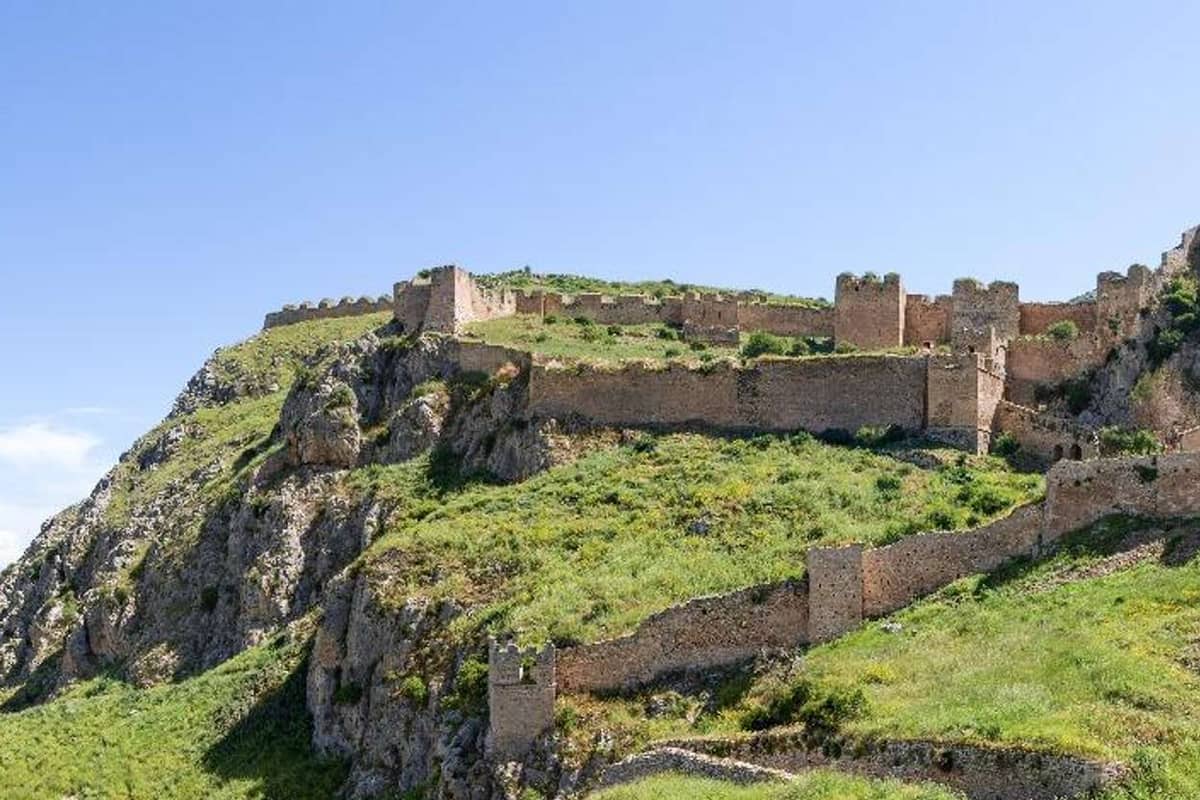
Acrocorinth is a monolithic rock above the ancient city, 575 metres high and ringed by three walls. A Corinth ancient tour that adds it gains a view over two gulfs, castle ruins and a spring.
Wikipedia says Acrocorinth is a monolithic rock above the ancient city. The name means Upper Corinth. A heritage page gives the height as 575 metres, and a private tour page gives the same figure. On a Corinth ancient tour the rock fills the background behind the Temple of Apollo.
Three circuit walls formed the defence of the hill, as Wikipedia states it. The heritage page adds a deep moat on the western side. It gives the walls about 3,000 metres of length and an enclosed area of about 240,000 square metres. The third gate stands between two towers.
The walls were built in successive phases. The heritage page dates the earliest phase to the Archaic period. The Byzantine period, the Ottoman period and the second Venetian rule added more. Wikipedia calls the hill an important medieval castle site of Greece. A Corinth ancient tour that climbs here meets that castle ground.
The Sanctuary of Aphrodite lies at the highest point, the heritage page states. Wikipedia says the temple there changed first into a church, later into a mosque. The page names the Church of Saint Demetrios, two ruined churches, the so-called Frankish tower and a Byzantine cistern. A Corinth ancient tour on the hill passes these buildings.
Within the walls, Wikipedia places a spring called Upper Peirene. The heritage page links it with Pegasus, the winged horse of myth. Drinking water was one reason the hill became the fortified acropolis, the page says. On a Corinth ancient tour, the Sanctuary of Demeter on the slope is for viewing only, one travel page says.
The heritage page says the hill overlooks a large part of the Peloponnese and Central Greece. It also overlooks the Corinthian and Saronic Gulfs. Another page says the fortress gives both gulfs in one view. That view is what a Corinth ancient tour gains from the climb.
The climb takes time on a Corinth ancient tour. The heritage page gives 45 minutes from the settlement of Ancient Corinth. Another page says a road twists from the ancient site to the summit and calls it a stiff climb. A third says a taxi can reach a pavilion, with a 10-minute walk from there to the gate.
One private tour page lists the Acropolis of Ancient Corinth in a tour of six to eight hours. The same page says the route can change on request.
A half-day tour page lists the canal, the ancient site and the old port of Kehries, not the hill. So a Corinth ancient tour takes Acrocorinth as an extra, or leaves it out.
Which kinds of Corinth ancient tour exist?
Tour pages sort into five kinds of Corinth ancient tour. A half-day coach run, a private half-day run, a shore run and a full-day Argolis run are four of them. The fifth follows the Apostle Paul. The time at the site differs in each.
The half-day coach is the fixed-time kind of Corinth ancient tour. One page lists a start at about 8:45 and a return near 14:00. After a canal photo stop, the coach visits the market square and the temple of Apollo. It ends at the old port of Kehries. The hotel round-up lasts up to an hour.
A private half-day Corinth ancient tour runs by car or minivan, and the plan bends to the visitor’s wishes. One page splits the day into minutes. It gives 15 at the canal, 30 at the site, 30 in the museum and 20 at the temple. Acrocorinth adds a full hour. The page then allows 75 minutes to reach Athens again.
The long private Corinth ancient tour runs six to eight hours, as one page states. That plan adds the museum, Acrocorinth and the ancient port. Routes and times can change on request, and a lunch, dinner or coffee break can be arranged on demand.
Guiding differs between these kinds. Two private pages say the driver holds no licence to lead visitors inside sites or museums. A full-day coach page lists a licensed tour guide who speaks English instead. A private Corinth ancient tour suits a group that wants to change the stops.
A shore tour is a private Corinth ancient tour that begins at the Piraeus cruise terminal. One page says the host holds a name sign at the port to meet the visitor. Another page describes a five-hour trip from the cruise port. It passes Salamis, Megara and Eleusis on the Saronic Gulf coast before it reaches the canal.
A full-day tour widens the Corinth ancient tour into the Argolis. One coach page lists about 20 minutes at the canal, then Mycenae, Nafplio and Epidaurus. It names no ancient city. A private full-day page puts Ancient Corinth and its temple before those three. Check the stop list first.
A Paul-linked Corinth ancient tour adds two stops. At the site it adds the step from which Paul spoke to the Corinthians, as one private page states. It also adds the ancient port of Kehries, where two pages say St. Paul came ashore.
How do the Corinth Canal and the roads fit a Corinth ancient tour?
On a Corinth ancient tour the canal is a short photo stop on the road from Athens. One page puts the drive at about ninety minutes on the A8 motorway. Pages give 15 to 20 minutes at the canal.
Corinth lies about 80 kilometres from Athens, as one page states. A Corinth ancient tour from Athens leaves along the Saronic Gulf coast. Two pages call the first stretch a coastal road or a coastal highway. Wikipedia adds that the A7 motorway to Tripoli and Kalamata leaves the A8 at Corinth.
The canal cuts across the Isthmus of Corinth. East of it lies the Saronic Gulf, and west of it the Gulf of Corinth. Wikipedia measures it at 6.4 kilometres between its two ends and 24.6 metres across the surface. No locks interrupt it. The sheer rock sides stand about 90 metres high, and tours view them from the bridge.
Three high crossings span the water, about 45 metres up. Between them they serve the railway, the road and the motorway. A submersible bridge sits at sea level at each end. Wikivoyage names the Isthmia bridge at the eastern end as a place to watch a bridge sink. Wikipedia says tourist ships and smaller boats use the canal today.
The bridge stop on a Corinth ancient tour is short. One private page gives it about 20 minutes and another gives 15. A full-day coach page lists about 20 minutes for photos and refreshments. A traveller on a forum says the bus stopped for a rest break at the canal.
For a Corinth ancient tour from Loutraki, the road crosses the canal. Wikipedia places Loutraki north-west of the canal, so not on the Peloponnese, and 8 kilometres from Corinth. Athens lies 81 kilometres away. One page puts Nafplio 40 minutes south of Corinth.
Group size sets the vehicle for a Corinth ancient tour. The half-day coach page lists an air-conditioned coach. One private page lists limousines for up to 4 passengers. It lists minivans for up to 9 and minibuses for up to 17. Another private page lists an SUV for up to 3 people.
Without a tour, Wikipedia gives about 55 minutes by suburban train between Athens and Corinth. The station sits south of the town centre. One page says a taxi from there to the site takes about ten minutes. It gives the Athens bus ride as 1.5 hours, plus 15 more minutes to the site.
A Corinth ancient tour skips this chain. Pages describe pickup at the airport, a cruise port, a hotel or a station. One private page says the driver collects visitors again to move them to the next site.
What are the visiting rules and the dress for a Corinth ancient tour?
A Corinth ancient tour follows the rules of a state archaeological site. The hours change with the season. A single entry opens the site and the museum. The paths are uneven stone, so comfortable shoes matter.
The hours change with the season, so a Corinth ancient tour is planned around them. The Discover Greece page lists 8:00 to 15:00 from 10 December to 31 March. It lists 8:00 to 20:00 from late spring to 31 August. The pages differ a little in the weeks between, so read the page for your date.
The American School’s visitor page lists the same winter close at 15:00. Its summer block, 1 April to 31 October, runs 8:00 to 20:00 every day. It also lists Tuesday as a closed day in winter, as the Ministry museum page does. A winter Corinth ancient tour avoids Tuesday.
The Ministry museum page names closed days. Among them stand New Year’s Day, 25 March, a late spring holiday, Orthodox Easter Sunday and Christmas days. Christmas Day and the day after are closed too. The Hellenic Heritage page names the same days. Entry stops 20 minutes before closing. Check the Ministry website before a Corinth ancient tour.
One entry opens both places. The Ministry museum page says a full ticket also gives access to the archaeological site. The Discover Greece page calls the ticket a joint one, valid for the museum and for the site. The museum stands inside the site. A Corinth ancient tour therefore needs one gate for the ruins and the halls.
Photography follows a Greek state rule for archaeological sites. A ministerial decision allows a small hand-held amateur camera with no flash. The photographs must not be for professional use. The same decision prohibits flash photography without permission. A Corinth ancient tour therefore keeps the flash off. Ask at the entrance before using other equipment.
The ground is the main thing to dress for. One page names uneven ancient stones across the site. The tour page of a private operator asks for comfortable clothes and shoes. A Corinth ancient tour is a walk on rough stone. Closed shoes with a flat sole and grip suit it better than sandals.
One page calls the site virtually shadeless. In summer, a hat and sunglasses go with a Corinth ancient tour, and so does a bottle of water. The Ministry museum page names parking, a ramp, a cafe and a disabled toilet. The Discover Greece page lists parking for cars and buses near the site.
How do the seasons and the time of day change a Corinth ancient tour?
Wikipedia describes Corinth as dry and hot in summer, wet and cool in winter. A Corinth ancient tour is easiest in the cooler hours of the morning and the late afternoon. The season decides what you carry.
Wikipedia classes the weather of Corinth as Mediterranean with a hot summer. Its warmest month, July, averages 28.7 degrees Celsius. Its coldest, January, averages 9.1 degrees. The year brings about 463 millimetres of rain. On open stone with little shade, a Corinth ancient tour feels the summer heat more than the average shows.
One travel page puts spring at 18 to 25 degrees Celsius, with wildflowers among the stones. The same page calls autumn warm enough to explore without heat stress, with cooler evenings in October. Spring and autumn suit a Corinth ancient tour with a long walk. Carry a light layer for the evenings.
The same page says 40 degrees Celsius is not rare in summer. Another page advises a visit as the gates open or late in the day. The sun is less fierce then, and fewer tourists crowd the paths. The summer gates stay open into the evening. A summer Corinth ancient tour takes sun cream and plenty of water.
The travel page calls winter weather unpredictable, sunny and mild one day, cold and rainy the next. Wikipedia names the winters cool and rainy. The winter gates close at 15:00, so a winter Corinth ancient tour starts in the morning. Take a waterproof coat and a warm layer.
Light changes the look of the stone. One page says the limestone of the Temple of Apollo has a warm honey colour. It turns almost orange in the afternoon light. The same page names the early morning as cooler, with minimal crowds. A Corinth ancient tour for photographs starts when the site opens or ends in the late afternoon.
Coach visits are short. One page says coach visitors from Athens spend about fifty minutes among the columns. Another page says the site sees a small share of the Acropolis crowds. The quiet hours are the first hour after opening and the late afternoon. A Corinth ancient tour at those hours has fewer people on the paths.
Acrocorinth adds heat to the day. The rock rises above the site, and one traveller describes the way up as uphill over slippery cobblestones. One page leaves the climb for mid-morning, when the haze has lifted. A summer Corinth ancient tour that adds the hill takes water for the climb and starts it before noon.
What else do travellers ask about a Corinth ancient tour?
Which Corinth ancient tour suits which traveller?
For one site in one morning, a half-day Corinth ancient tour is the fit. One operator page lists a coach leaving Athens near 8:45 in the morning. It returns near two in the afternoon. The route stops at the canal for pictures, visits Ancient Corinth and ends at the old port of Kehries.
The same coach page states that the pickup round at the hotels lasts up to about one hour. The tour is given in English only. A traveller who needs another language reads the operator page before booking.
A private Corinth ancient tour suits a traveller who wants to set the pace. One private page gives six to eight hours and says the times and the route change on request. It adds that a coffee break or lunch can be arranged. Its vehicles carry up to four, nine or seventeen passengers.
Time on the ruins differs from page to page. One page says the site needs one to two hours. Another says visitors on a coach spend about fifty minutes among the columns. A third page lists a full private day that adds the canal, Acrocorinth and Epidaurus to the same route.
Is a Corinth ancient tour suitable for children and slow walkers?
A Corinth ancient tour is a walk over old stone, so the ground matters more than age. One page names the uneven ancient stones as a limit for travellers with limited mobility. A second page also calls the terrain uneven and recommends sturdy shoes for the paths.
The visit itself is short and has places to rest. On a Corinth ancient tour of the site, one page allows one to two hours. It notes that the trees of the park give a shady place to sit. The museum page lists a ramp and parking, and the museum stands inside the site.
The same page notes that the information boards are sparse. It suggests a guided tour to explain the excavations. A guided Corinth ancient tour fills that gap for a curious child. The explainer steps in where a board is missing.
Acrocorinth is the harder add-on. Two pages describe the uphill cobblestones and the rocky slopes on the hill. One adds that buses do not go up and that the top has no facilities. The lower site and the museum make the shorter day for a young child or a slow walker.
How does a Corinth ancient tour compare with Mycenae and Epidaurus?
The three sites show three different things, as two pages put them. A Corinth ancient tour shows a city, with a forum, a temple and a paved street. Wikivoyage describes Mycenae as a palace on a hill. It ranks the theatre of Epidaurus among the greatest of antiquity.
The three also sit close together. One page places Nafplio forty minutes south of Corinth, with Mycenae and Epidaurus thirty minutes from Nafplio. Wikivoyage calls Nafplio a good base for both. It also says Corinth itself can serve as a base for Mycenae.
For that reason a Corinth ancient tour grows into a full day when it adds a neighbour. One private page lists the canal, Acrocorinth, Ancient Corinth and Epidaurus in one route. A second page lists the canal, Corinth and Epidaurus as an extended full day from Athens.
The first of those pages also lists a licensed tour guide for the visits on site and in the museum.
What do travellers look at and photograph on a Corinth ancient tour?
Start with the view. The Hellenic Heritage page says the rock of Acrocorinth rises on the horizon and the site lies in its shadow. One frame to look for has the temple in front and the mountain behind it. A Wikipedia gallery caption shows the same pairing.
The Odeon and the theatre are easy to miss. One page says they stand on a slightly higher level beside the museum. Its writer saw them only while driving away. Wikivoyage adds that the Roman Odeon dates from the first century and became an arena in the third.
A Corinth ancient tour is worth a short walk up to that level.
The site is also still being dug. Wikipedia dates systematic digging to the late nineteenth century. Recent work of the Ministry of Culture brought new finds to light. An audio guide page says the American School digs continue today. A Corinth ancient tour therefore walks over a working excavation.
Which parts of a Corinth ancient tour are indoors and which are outdoors?
The ruins lie under the open sky, and the museum is the roofed stop. The American School page says the museum sits inside the archaeological site and holds the catalogued finds. The Ministry page lists prehistoric finds and objects up to the Byzantine period. A Corinth ancient tour that adds the museum gives a break from the sun.
Heat is where the vehicle helps. A coach page and a private page both list air conditioning in the vehicle. On foot, one page calls the Greek sun intense and advises shade in the hottest hours. The trees of the archaeological park give a place to rest between the ruins.
The hill is the open part of the day. One page says the top of Acrocorinth has no facilities, and the same page calls the rocky slopes unstable. A second page calls the cobblestones uphill and slippery. A Corinth ancient tour that climbs there needs grippy shoes and a plan for water.