
An Olympia day trip starts early in the morning in Athens and runs west across the Peloponnese to the ancient sanctuary of Olympia in Ilia. The sanctuary lies in a green valley beside the river Alpheios, and it is the place where the ancient Olympic Games took place. A single day gives you the road, the ruins and the museum, and this page walks through all three before you pick one of the tours in Greece.
Read on for how an Olympia day trip is built, how long the day lasts and when the coach leaves, what the sanctuary shows in walking order, what the museum adds and which questions travellers ask. When the plan is clear, choose a date and a departure that fit your week.
What is an Olympia day trip, and how does it run?
Every guided Olympia day trip is a round trip between Athens and the sanctuary at Olympia, made in one day. Operator pages describe a guided tour by coach or private vehicle that returns to Athens the same day.
Wikipedia gives Olympia as a town of Elis, a part of the Peloponnese. Elis also carries the name Ilia. The town stands beside the archaeological site that shares its name. Wikipedia calls that site a Panhellenic sanctuary. The ancient Olympic Games came round every four years at that spot, and an Olympia day trip takes you there.
The day starts in Athens. One private page says the tour begins with a pickup at your hotel in Athens. It adds Piraeus Port and a meeting point at the operator’s terminal. Another private page also lists a hotel pickup. That pickup is the first step of the day.
Then the vehicle heads west across the Peloponnese. On the bus page, the route runs past the Corinth Canal and the Peloponnese landscape. A private page says the canal comes after one hour of driving. There the Olympia day trip stops for photos from the bridge.
Next comes the sanctuary itself. The bus page lists the stadium and the temples of Hera and Zeus. A private page adds the Archaeological Museum of Olympia, plus a second museum on the Olympic Games. These visits form the core of an Olympia day trip.
The walk is on foot. Wikipedia says the whole site takes a long walk to see. Wikivoyage says personal vehicles are not allowed inside the site, so everyone walks. An Olympia day trip therefore continues on foot once you pass the gate.
Pages differ on who explains the site. One private page says the driver leads you to the entrances but does not go inside. The same page offers a licensed guide for the walk inside. The bus page lists an audio and VR application in 10 languages. Check which way your Olympia day trip uses.
Lunch and the return close the day. One private page says the tour has a late lunch. The bus page says tours have lunch in the modern village of Olympia before the drive back. A private page puts the return to Athens in the late afternoon. That ends an Olympia day trip.
How long is an Olympia day trip, and when does it leave?
On the operator pages, an Olympia day trip lasts 9 to 13 hours. It leaves Athens early in the morning, because the drive alone lasts about 3.5 hours in each direction.
The pages differ on the length. One page lists a private trip of about 9 hours and a shared bus tour of about 13 hours. That is four hours less, as the page states. Another private page lists 10 hours. So the length of an Olympia day trip depends on the kind of trip you choose.
On the hour of departure the pages say little. One private page says the trip leaves Athens early in the morning. The bus page says the day starts early either way. The exact pickup time of your Olympia day trip sits on the operator page.
The distance explains the early start. One page puts Olympia about 320 km west of Athens. Another page gives about 340 km by road, through Patras and Pyrgos. An Olympia day trip covers that distance twice in one day.
The drive time is steady across pages. The bus page gives 3 hours 25 minutes each way, and also a range of 3.5 to 4 hours. A travel page puts the same trip by car at about 3.5 hours. So an Olympia day trip holds seven hours or more of driving.
The visit itself is shorter than the drive. The bus page says to plan for about 3 hours at Olympia. A private page lists 1 hour at the site and 1 hour in the Archaeological Museum. It adds 45 minutes in the museum on the Olympic Games. Each Olympia day trip sets its own split.
The canal stop is brief. One private page lists 15 minutes there, and the bus page lists 20 to 30 minutes. Then the group drives back to Athens. One page places the return in the late afternoon.
Add two drives of 3 hours 25 minutes and about 3 hours on site, and you reach nearly 10 hours. With the canal stop and lunch, that is close to the 10-hour day one private page lists. The same page lists the tour as available all year round. That is how long an Olympia day trip runs.
What does the sanctuary show on an Olympia day trip?
On an Olympia day trip, the sanctuary shows a valley of ruins beside the Alpheios River. Walkers pass the temples of Hera and Zeus, the training grounds, a round hall and the stadium.
Down in the Alpheios valley, in the western Peloponnese, an Olympia day trip finds the sanctuary. About 18 kilometres separate the site from the Gulf of Kyparissia today. The sacred ground, the Altis, was an irregular square with sides of more than 183 metres. To cover every part of the site, you walk a long way.
The walk on an Olympia day trip reaches the Temple of Hera in the north of the Altis. No temple at Olympia is older. Hera and Zeus first shared it, then Zeus gained a separate temple. The modern Games were restored in the late nineteenth century, and their flame is lit in front of these ruins.
An Olympia day trip shows where the Temple of Zeus stood. It was complete by 456 BC. A cone-shaped altar of ash, 7 metres high, rose outside it to the east. Silt up to 8 metres deep covered the site until German archaeologists began systematic digging.
Inside the temple sat the statue of Zeus, more than 12 metres tall. Ivory plates and gold panels covered a wooden core. Pausanias says the floor before it was black tile, edged with a raised marble rim to hold olive oil. The statue is lost, and its look survives only in old descriptions and on coins.
West of the sanctuary, an Olympia day trip reaches the palaestra and the gymnasion. Wikipedia calls the palaestra a place devoted to training wrestlers and other athletes. The games it lists include running, boxing, the pankration, the long jump, the javelin and the discus throw.
The round Philippeion stands to the north, and an Olympia day trip passes it on the way. Leochares, a sculptor from Athens, built it from limestone and marble. Its roof held marble tiles with a bronze poppy on top. Philip II and his relatives were shown in ivory and gold statues inside.
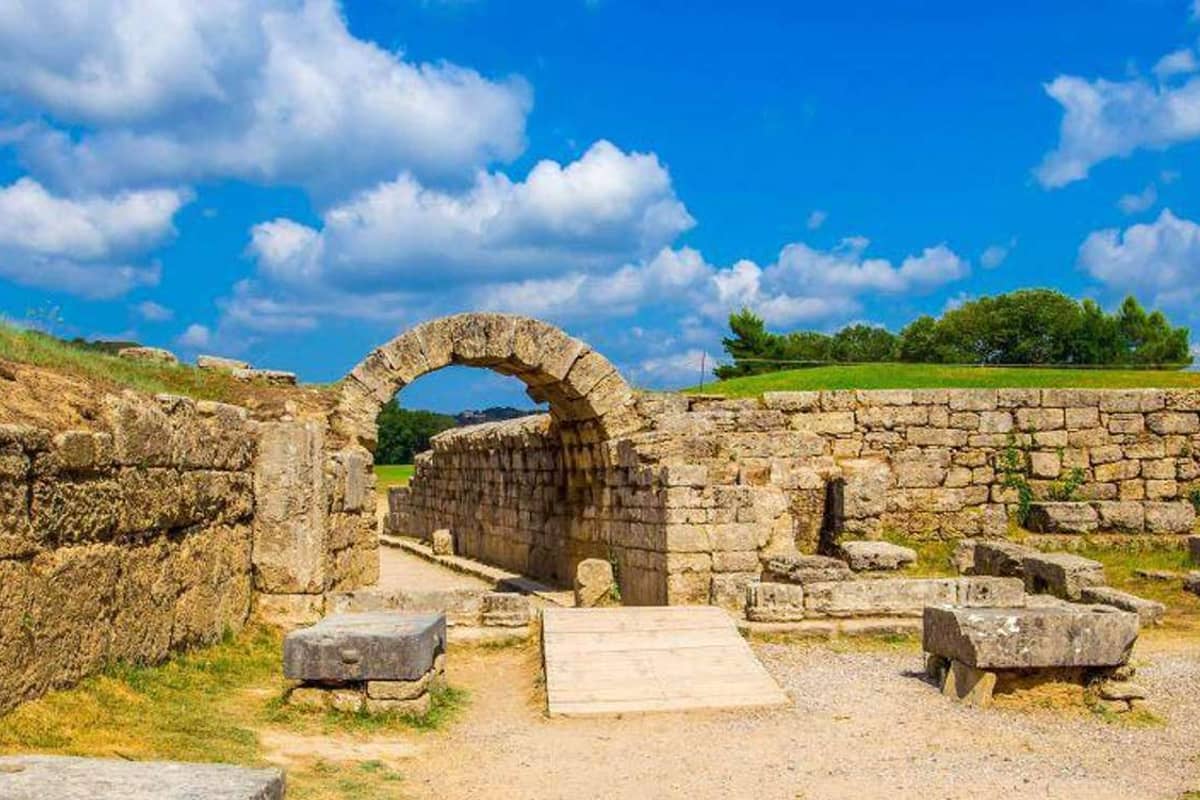
An Olympia day trip walks out to the stadium, beyond the sanctuary of Zeus. Stone curbing across the field marked where each run began and ended. It is 30 to 34 metres wide, and spectators sat on the sloping banks. Athletes entered through a vaulted tunnel, which the site plan calls the Crypt.
What does the Archaeological Museum add to an Olympia day trip?
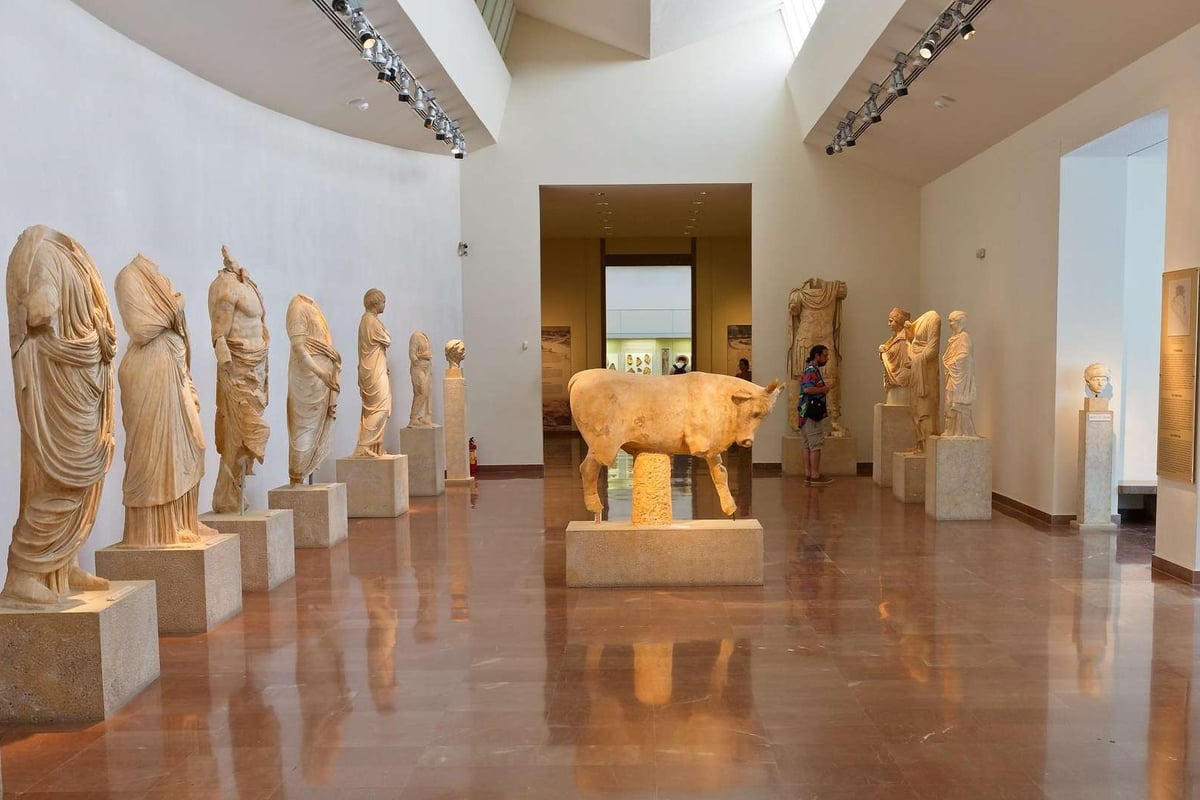
The Archaeological Museum adds the sculptures that once stood in the sanctuary. Visitors on an Olympia day trip meet Hermes, the goddess Nike, the temple pediments and the bronzes.
The museum stands beside the site, and an Olympia day trip pairs the two. The Greek culture ministry oversees it, and Wikipedia lists it among the principal museums of the country. Its first building, opened in the late nineteenth century, was the earliest Greek museum built beyond Athens. Today twelve exhibition rooms fill the main building.
Carvings from the Temple of Zeus are on view, and an Olympia day trip links them to the ruin outside. On the east pediment, Pelops and King Oinomaos prepare for their chariot race. The west pediment has Centaurs and Lapiths in a struggle, with Apollo in the middle. The twelve labours of Heracles appear on the metopes.
The Hermes statue has a hall to itself on an Olympia day trip, as the municipal page states. It came out of the earth at the Temple of Hera, and six later finds completed the group. The marble comes from Paros, and Hermes stands 2.10 metres tall. Tradition names Praxiteles as the sculptor, though art historians debate it.
The Nike of Paionios shows the goddess of victory landing on her left foot, her drapery blown against her body. Workers restored it from fragments. The face, wings and forearms are lost. With its pillar, the figure stood 8 metres high. Below her feet an eagle flies, a bird tied to Zeus.
The bronzes give an Olympia day trip a second reason to enter the museum. Wikipedia says the bronze collection makes the museum important worldwide. The municipal page names tripod cauldrons, helmets and shields that city-states gave to Zeus in thanks for their victories. The Wikipedia gallery adds a bronze griffin head and the Helmet of Miltiades, dated 490 BC.
Plan an Olympia day trip around the hours on the official site and museum page. It states that the museum is open 359 days a year. It lists the closing days, such as Easter Sunday and 25 December. Summer hours run from April to October, winter hours from November to March. The last entry comes 15 minutes before closing.
What else do travellers ask about an Olympia day trip?
Which kind of Olympia day trip suits which traveller?
A shared coach from Athens runs with an escort and driver. One page gives it about three hours on the site. A private car from Nafplio stops for four and a half hours, as another page states. The pace there is yours. A Patras start is shorter, with three hours at the site.
From Zakynthos, a small-group minibus takes the ferry for just over an hour to Kyllini. Then it drives under an hour to the site. One private Olympia day trip calls itself family-friendly with a flexible itinerary. A cruise visit from Katakolo is its own kind of day, with a 45-minute train ride each way.
Which clothes and kit does an Olympia day trip need?
Comfortable walking shoes come first, then water and sun protection, as the operator pages advise. One page notes that the ancient site sells no water. Two pages report strong summer heat and wetter, milder winters on this coast of the Peloponnese. Wikivoyage adds that rain leaves no cover on the open-air ruins.
Tour groups reach the village around mid-morning, one page says. Two pages advise early mornings or late afternoons in summer, so plan your Olympia day trip around those hours. Two pages name spring and early autumn as the milder and quieter seasons.
Does an Olympia day trip work for young children and slower walkers?
A private trip page calls its day family-friendly, and an operator page lists gentle slopes on the site. The walk from the museum to the ruins is part of the visit. Wikipedia notes that a visit to the whole site needs extensive walking. The ground and the distance suit a steady walker.
One page says the larger share of the site can be walked in one to two hours after arrival. A travel page allows at least two hours for the site and one to two more for the museum. On a private Olympia day trip, the length of each stop can be changed on request, as that page states.
Which stops does an Olympia day trip add on the way?
From Athens, the Corinth Canal is the stop that two pages name. A shared coach trip lists it with a photo stop of 20 to 30 minutes. A private trip lists it for 15 minutes before the drive on to Olympia. Wikivoyage notes that bridges cross the narrow canal between the Peloponnese and the mainland.
Nafplio, Epidaurus and Mycenae appear with Olympia in longer tours. An operator page names a four-day group tour that links them. An Olympia day trip that starts in Nafplio drives two hours each way, as another page states. Wikivoyage lists Nafplio as a base for exploring the theatre of Epidaurus and Mycenae.