
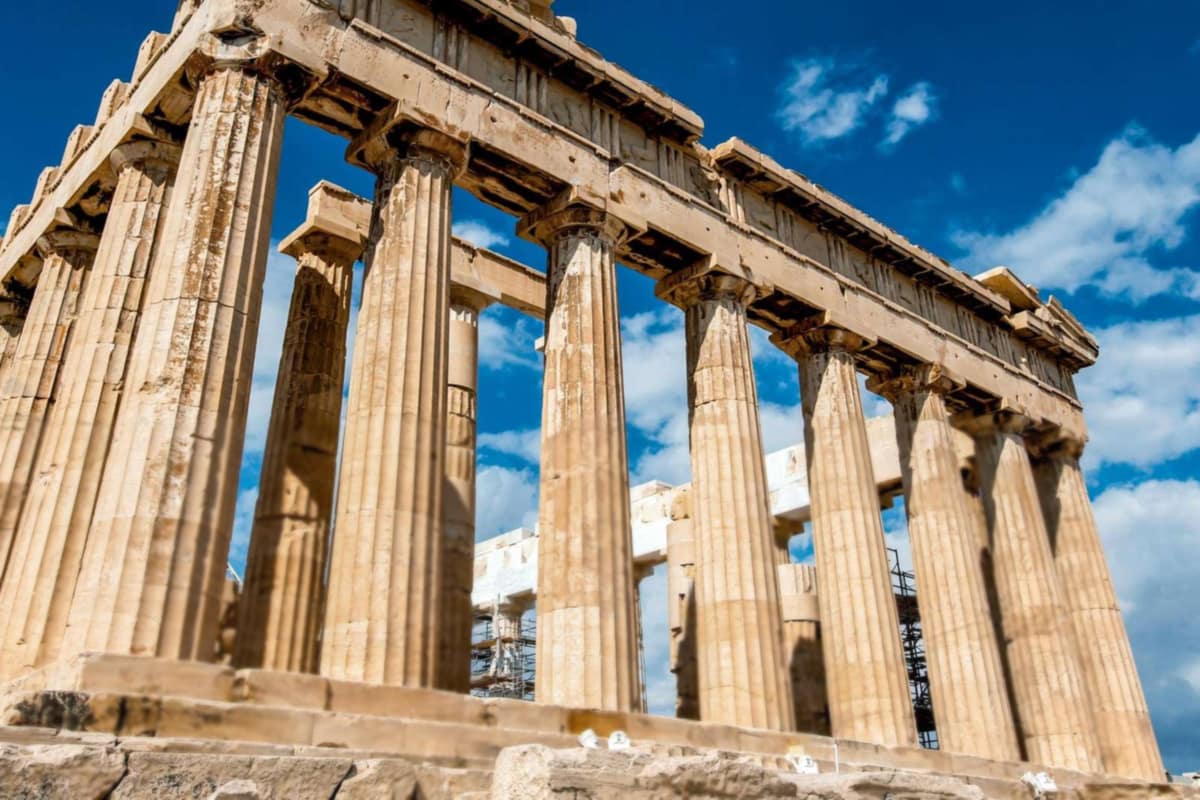
Egypt vs Greece sets a desert country on the Nile against a mountain and island country on the Aegean Sea; both hold ancient sites on the UNESCO World Heritage list. The tours in Greece on the home page cover the Greek side of the choice.
This page compares the map, the ancient sites, the seas, the river and the islands, the food, the culture, the weather and the entry rules; the Cyprus vs Greece page holds a second comparison.
What sets Egypt vs Greece apart for a trip?
Egypt vs Greece starts with the map. Egypt reaches across two continents. Its main body fills the north-east corner of Africa, and the Sinai Peninsula lies in Asia. Greece is a country of south-east Europe, with a mainland on the Balkan peninsula and thousands of islands. The Mediterranean Sea lies between the two.
A trip to Egypt follows a river through desert. A trip to Greece follows mountain roads and sea crossings between islands. Those two shapes explain much of what follows. For a reader weighing Egypt vs Greece, the first question is which shape fits the time available.
Both countries sit where continents meet. Egypt is a transcontinental nation, and the Isthmus of Suez is its land bridge between Africa and Asia. Its article describes Greece as lying where Europe, Asia and Africa meet.
The Suez Canal crosses the Isthmus of Suez. It links the Mediterranean Sea with the Indian Ocean through the Red Sea. Greece has a canal of its own through a narrow neck of land. The canal of the Isthmus of Corinth separates the Peloponnese peninsula from the mainland. In Egypt vs Greece, each country holds one such crossing.
This page weighs Egypt vs Greece on eleven subjects, one after another, and names no winner. The subjects come in this order:
- Size and map
- Ancient sites
- Where the two ancient worlds met
- Beaches and seas
- The Nile and the islands
- Dishes and drinks
- Language and culture
- Weather by month
- Which traveller fits which trip
- Flights and links
- Money, plugs and entry rules
The river trip has one line to follow, the Nile valley, and the old places sit along it. The island trip has no single line. Roads, passes and sea crossings join the places, so the days are built from links. That difference in route is the one to hold on to.
Each subject opens with a bold answer. One Egypt fact and one Greece fact follow, then the plain difference. A reader who likes deserts, temples and a slow river will weigh Egypt vs Greece differently. A reader who likes coves, hill villages and ferries will weigh it another way.
How do size and map compare in Egypt vs Greece?
Egypt vs Greece differs first in area and in people. Egypt covers 1,001,450 square kilometres and has over 107 million inhabitants. Greece covers 131,957 square kilometres and has around 10 million. The country articles state each figure, and the gap in both is wide.
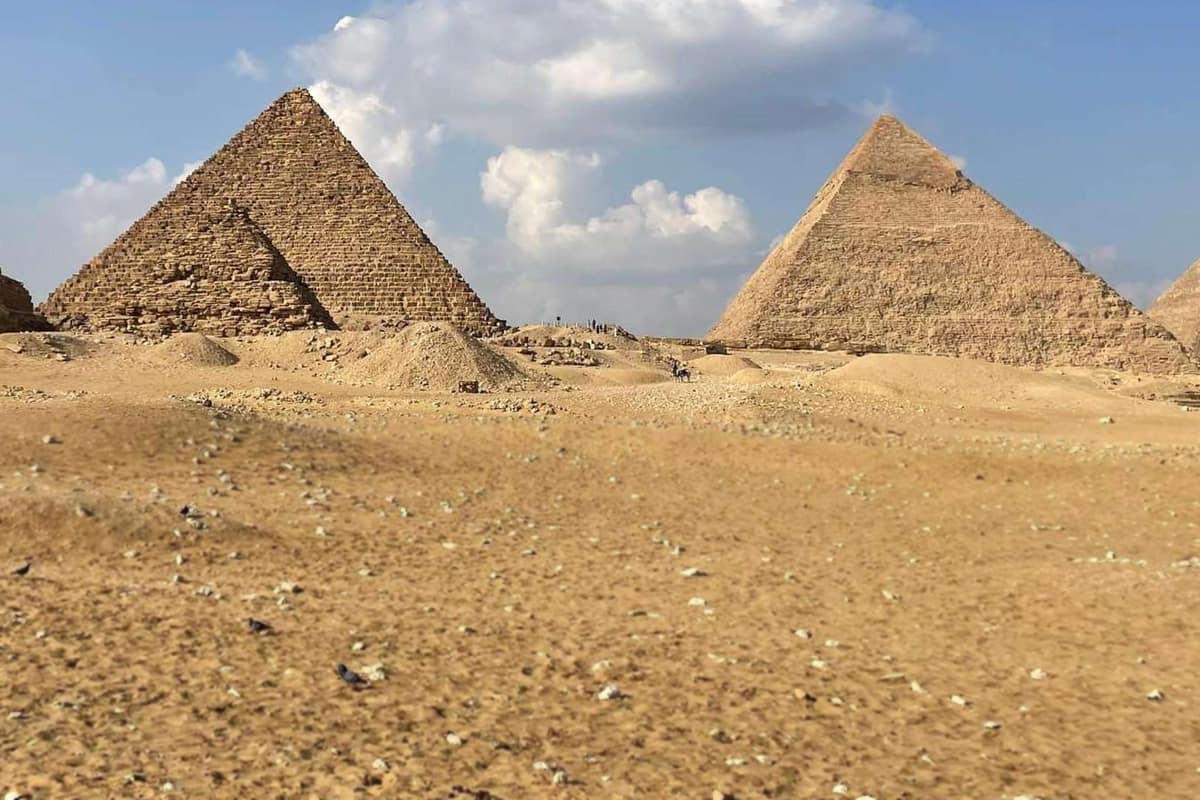
- Capital: Cairo in Egypt and Athens in Greece, each also the largest city of its country.
- Second city: Alexandria in Egypt and Thessaloniki in Greece.
- Latitude: Egypt lies primarily between 22 and 32 degrees north. Greece lies approximately between 34 and 42 degrees north.
- Highest point: Mount Catherine in the Sinai stands at 2,642 metres. Mount Olympus rises to 2,918 metres at Mytikas peak.
The great majority of Egyptians settle along the Nile, within an area of about 40,000 square kilometres. The article says the only arable land is found there. In Egypt vs Greece, that makes a large country with a narrow home for its people.
The article ties this pattern to the arid climate. Population centres gather along the narrow Nile Valley and the Delta. Irrigation from the river sustains 33,600 square kilometres of farmland there.
Four edges frame the Egyptian map. The Mediterranean Sea lies to the north and the Red Sea to the east. Sudan lies to the south and Libya to the west.
Away from the valley, the majority of the landscape is desert. Oases dot it, and the article names Bahariya, Dakhla, Farafra, Kharga and Siwa. Egypt includes parts of the Sahara and of the Libyan Desert. On a map of Egypt vs Greece, the desert is the thinly settled part.
Greece reads the opposite way on a relief map. Approximately four fifths of Greece consists of mountains or hills, the article states. The Pindus range dominates the west, and the article says it has been a barrier to east-west travel in history.
The Greek mainland meets Turkey in the east. To the north and north-west, three countries share its land border: Albania, North Macedonia and Bulgaria.
Islands add a second layer to the Greek map. Depending on the definition, the count runs from 1,200 up to 6,000, and 227 of them are inhabited. The article lists nine traditional regions, among them Macedonia, Epirus, Thessaly and Crete. For Egypt vs Greece, counting is part of the answer.
Put the figures together and the plain difference appears. Egypt has more land and more people, yet its people gather on a narrow strip. Greece has less of both, and four fifths of it is mountain or hill. Egypt vs Greece pairs a desert with a river against a peninsula with islands.
How do the ancient sites compare in Egypt vs Greece?
For ancient sites, Egypt vs Greece starts with two counts. The UNESCO World Heritage list names seven sites in Egypt and twenty-one in Greece. Egypt has one natural site, Wadi al Hitan. Greece has three mixed sites, listed for both nature and culture: Meteora, Mount Athos and Mount Olympus.
Egypt’s first five sites were listed in nineteen seventy-nine. The last two came in two thousand two and two thousand five. The first Greek listing, in nineteen eighty-six, was Bassae, home to a temple of Apollo Epicurius. A year later came Delphi and the Acropolis of Athens. The Greek list is three times as long.
Put Giza beside the Acropolis and Egypt vs Greece becomes a matter of dates. The Great Pyramid belongs to the twenty-sixth century BC. When it was built, it was the tallest architectural structure in the world. In the fifth century BC, Pericles oversaw the work that produced the Parthenon and its neighbours. More than twenty centuries lie between the two.
The Acropolis crowns a rock with a flat summit, 150 metres above sea level. Ictinus and Callicrates, two architects, and the sculptor Phidias carried out the rebuilding that Pericles ordered. In Greek, akron means highest point and polis means city, which together give the word acropolis.
On the Egyptian side of Egypt vs Greece, the Valley of the Kings faces Thebes across the Nile. Above it rises the peak of al-Qurn, whose pyramid shape probably echoed the Old Kingdom pyramids. Karnak’s Great Hypostyle Hall holds 134 columns in 16 rows. Abu Simbel’s two rock temples date from the thirteenth century BC.
On the Greek side of Egypt vs Greece, Delphi’s sacred precinct occupies a slope of Mount Parnassus. The sixth century BC was the site’s period of greatest activity, and the surviving ruins come largely from then. Knossos sits roughly five kilometres from Heraklion’s old centre, on its southern side. The first palace there rose about nineteen hundred BC.
The plain difference is the kind of place. The Egyptian sites above are tombs and temples, while the Greek sites are a citadel, a sanctuary and a palace. In Egypt vs Greece, the two lists also overlap in age. Karnak began under Senusret I, who reigned from about nineteen seventy-one BC. The first Knossos palace followed.
Where did the ancient worlds meet in Egypt vs Greece?
In Egypt vs Greece, the two ancient worlds met on Egyptian soil. Naukratis, a trading town on the Canopic branch of the Nile, was founded in the seventh century BC. It was the first permanent Greek settlement in Egypt and, for much of its early history, the only one.
- Three hundred thirty-two BC: Alexander the Great conquers Egypt and founds Alexandria.
- Three hundred five BC: Ptolemy I, a general of Alexander, founds the Ptolemaic dynasty.
- One hundred ninety-six BC: a decree is carved on the Rosetta Stone in three scripts.
- Thirty BC: Cleopatra VII dies, and the Ptolemaic Kingdom ends.
Naukratis was not the colony of one Greek city. Sources call it an open trading post, and nine eastern Greek cities paid for a walled shrine there, the Hellenion. In Egypt vs Greece, Naukratis was a place of trade. Pottery from the site carries examples among the earliest known Greek writing.
Alexander visited Memphis and then travelled to the oracle of Amun at the Siwa Oasis. The oracle declared him the son of Amun. He founded Alexandria on an isthmus opposite the island of Pharos. Ptolemy’s kingdom later took Alexandria as its capital.
Under the Ptolemies, Egypt vs Greece met on one throne with two titles: the Egyptian pharaoh and the Greek basileus. They had themselves shown on public monuments in Egyptian style and dress. Building at Karnak even continued into their reign. Greek stayed the language of government and trade until the Muslim conquest in the seventh century.
The Library of Alexandria belonged to a research centre called the Mouseion, dedicated to the Muses. Estimates of its scrolls run from 40,000 to 700,000. The Lighthouse of Alexandria was built under Ptolemy II Philadelphus and has been estimated at 100 metres or more. Its last stones went into the Citadel of Qaitbay in fourteen eighty.
The Rosetta Stone puts Egypt vs Greece in one block of stone. Its one decree is written in hieroglyphs, Demotic and Ancient Greek. The three versions differ only slightly, so the stone became key to deciphering the Egyptian scripts. A French army officer found it near Rosetta in July seventeen ninety-nine.
In Egypt vs Greece, the contact also left a living community. The Egyptian Greeks are the Greek community of Egypt, historically concentrated in Alexandria. The article gives about 200,000 for nineteen twenty. Today’s estimates run from 7,000 to 60,000, and a small community remains in Cairo and Alexandria.
How do the beaches and seas compare in Egypt vs Greece?
Egypt vs Greece starts with two different coasts. Egypt is bounded by the Mediterranean Sea in the north and the Red Sea in the east. On the Mediterranean basin, Greece has the longest coastline. The Ionian Sea lies west of the mainland, and the Aegean lies east of it.
The reef coast is where Egypt vs Greece differs first. The Red Sea article states that 2,000 kilometres of coral reef run along the sea’s coastline. It adds that 200 types of soft and hard coral live in the sea. It puts the age of the fringing reefs between 5,000 and 7,000 years.
Hurghada is the Red Sea town in this Egypt vs Greece comparison. Its article describes a small fishing village that grew into one of the largest resort destinations on the Red Sea. The town extends for about 36 kilometres along the shore. The article calls the waters clear and calm for much of the year.
Sharm El Sheikh stands in the far south of the Sinai Peninsula. On a promontory above the Straits of Tiran, the city looks out over the mouth of the Gulf of Aqaba. Its article states that environmental zoning laws limit building heights.
Egypt’s other shore faces the Mediterranean. The tourism article names Alexandria as a main summer resort and gives its beaches as one reason. The Alexandria article puts the Corniche at about 17 kilometres. It runs from the Bahary area in the west to the Mandara area in the east.
In Egypt vs Greece, the Greek side answers with island groups. Wikivoyage lists Corfu, Kefalonia and Zakynthos among the Ionian Islands. In the south of the Aegean lie the Cyclades, which include Delos and Naxos. The Dodecanese lie in the southeast and hold Rhodes, Kos and Patmos.
Beach resorts come next. The tourism article names Zakynthos, Corfu, Rhodes, Crete, Skiathos, Kos and Kefalonia. It notes the Egremnoi sand beach on Lefkada for its blue crystal waters. For boats in Egypt vs Greece, it also counts 51 marinas and 14,661 mooring places.
For sea temperature in Egypt vs Greece, each article gives its own figure. The Red Sea article states an average summer surface temperature in the north of about 26 degrees Celsius. For the south it states 30. The Alexandria article gives 26 degrees for August.
The Aegean article gives 19 to 24 degrees for its summer surface layer. It describes that layer as 40 to 50 metres thick. For winter it gives 8 degrees in the north, rising to 13 at the southern end. The Alexandria figure for February is 17 degrees.
The plain difference in Egypt vs Greece is the shape of the shore. Egypt has a reef coast on the Red Sea and a city beach front on the Mediterranean. Greece spreads its shore across island groups in two seas.
How does a Nile trip compare with island hopping in Egypt vs Greece?
A Nile trip follows one river, and island hopping crosses a sea. In Egypt vs Greece, Luxor lies about 220 kilometres north of Aswan, as the Luxor article states. The Aegean article gives the sea a length of about 670 kilometres and a width of about 390.
- Egypt, the river: from Aswan to the northern end of Egypt, the Nile flows more than 1,200 kilometres with no cataract.
- Egypt, the boats: the felucca, the dahabiya and the cruise ship.
- Greece, the sea: the Aegean island groups include the Cyclades, the Dodecanese, the Sporades and the Saronic islands, with the North Aegean Islands in the north.
- Greece, the links: ferries serve every island, with routes that change by season.
For the river side of Egypt vs Greece, Wikivoyage describes a Nile cruise between Luxor and Aswan. The ship stops at the ancient monuments along the river, Kom Ombo among them.
The dahabiya is a passenger boat of the Nile. Its article describes a shallow-bottomed, barge-like vessel with two or more sails. Until the eighteen-seventies it was the standard way for tourists to travel the river. Modern dahabiyas have no motor-driven propeller, so diesel tugboats tow them.
The felucca is a traditional wooden sailboat that relies on wind and river currents. The felucca page of Wikivoyage names Aswan as the convenient place to start. It says the traditional ride sails for three days and two nights to Kom Ombo.
Greece moves between islands by boat. The Greek Islands page of Wikivoyage states that ferries serve every island. It adds that routes and the number of crossings vary with the season. In Egypt vs Greece, that is the seasonal side of the sea trip.
In the Cyclades article, the islands surround Delos, an island that the article calls sacred to the ancient Greeks. The Greek Islands page lists the Saronic Gulf Islands, Aegina, Poros, Hydra and Spetses, as the group closest to Athens.
The two trips keep different rhythms. A felucca moves with the wind and the river current. A ferry follows a timetable that changes with the season. In Egypt vs Greece, each rhythm suits a different kind of days.
How do food and drink compare in Egypt vs Greece?
For food, Egypt vs Greece starts in the pantry. Egyptian cooking draws on legumes, vegetables and fruit from the Nile Valley and Delta. Koshari, a dish of lentils and pasta, is its national dish. Greek cooking is founded on olive oil, wheat and wine, as its cuisine article states.
The koshari article lists pasta, fried rice, vermicelli and brown lentils. The explorer Richard Burton recorded koshari as a breakfast in Suez in eighteen fifty-three. The name comes from the Hindi word khichri. UNESCO has recognised the dish as intangible cultural heritage.
Ful medames means buried favas. The ful medames article says cooks serve the beans from a large metal jug, with olive oil and cumin. Falafel, called taamiyya in Egypt, means a little piece of food. The falafel article names fava beans for Egypt and chickpeas, or a blend, for the Levant.
Eish baladi, a local pita, is a staple of Egyptian cooking. Molokhiya is a stew of jute leaves, served with rice and chicken. The cuisine article finds jute leaves in ancient Egypt and a recipe in a fourteenth-century cookbook. For bread in Egypt vs Greece, the pita meets wheat bread, which the Greek cuisine article calls ubiquitous.
In Egypt vs Greece, a large part of Egyptian cooking is vegetarian, as the cuisine article states. The banks of the Nile grow crops instead of feeding animals. Christians also follow Lent diets that are close to vegan. Wikivoyage Egypt ties the same habit to Coptic fast days.
In Egypt vs Greece, the Greek table offers its own short list. Moussaka is an oven-baked dish of aubergine, minced meat, tomato and white sauce, as Wikivoyage Greece describes it. Souvlaki is a skewer of grilled meat. Feta traces back to Byzantium, the Greek cuisine article says. Olive oil is both characteristic and ancient in Greek cooking.
Wikivoyage Greece calls fasolada, a stew of dry beans, a dish sometimes considered the national one. The Greek cuisine article says today’s recipe uses white beans and tomatoes, two plants from the New World. So each side keeps a pulse dish close to its national title. That is the plate in Egypt vs Greece.
Tea is the national drink of Egypt, and mint is a popular addition, the cuisine article states. Greece adds the frappe, a cold coffee of instant coffee, water and sugar, frothed over ice. Baqlawa appears among Egyptian desserts, and baklava among Greek ones. Honey and nuts run through both lists, so sweets in Egypt vs Greece overlap.
How do language and culture compare in Egypt vs Greece?
On language and culture, Egypt vs Greece sets two old traditions side by side. Literary Arabic is the sole official language of Egypt, while Egyptian Arabic is the spoken one. Greek is the official national language of Greece, with written records reaching back at least 3,400 years.
- Egypt: Egyptian Arabic in speech, Literary Arabic in print
- Egypt: Coptic heard only in church worship
- Greece: Greek in speech and print, English as the first foreign language studied
- Faith: Islam is the majority religion of Egypt, Eastern Orthodoxy the prevailing one in Greece
Egyptian Arabic began in the Nile Delta, and 84 million people speak it as a first language. The article also calls it Cairene Arabic. Its vocabulary draws on Coptic, Turkish, French, Italian, Greek and English. Egyptian films and music made it widely understood in the Arabic-speaking world.
Wikivoyage Egypt places Sa’idi Arabic in Luxor and Aswan. It names the Siwi language in the Western Desert and a Bedouin dialect in Sinai.
Coptic is the church language of the Copts. The Coptic language article says it has no native speakers. It lives on in the worship of the Coptic Orthodox Church. The word Copt comes from the Greek word Aiguptios, passed on through Arabic. In Egypt vs Greece, that is a Greek thread in an Egyptian word.
The Greek language article calls Greek the Indo-European language with the longest documented history. The European Union has 24 official languages, and Greek is among them. Wikivoyage Greece ranks English as the foreign language studied first, with French, Italian and German behind it. For speech in Egypt vs Greece, it says the vast majority of people speak Greek natively.
On faith, Egypt vs Greece starts from two facts. The Egypt article calls Islam the majority and official religion, with a historic Christian minority. The Greece article records that Eastern Orthodoxy holds the status of prevailing religion in the Greek Constitution. The Church of Greece article credits the Apostle Paul with first bringing Christianity to the area.
The Workweek and weekend article lists Egypt’s working week as Sunday to Thursday. Cover your shoulders and knees at mosques, churches and monasteries, a courtesy that suits both countries. Wikivoyage Egypt adds one rule for mosques: never walk in front of a person who is praying.
For Egypt vs Greece, Wikivoyage Egypt also notes that Egyptians, like Greeks, take pride in their country’s history.
How do the weather and the months compare in Egypt vs Greece?
On weather, Egypt vs Greece starts with the climate type. Essentially all of Egypt has a hot desert climate. Greece is predominantly Mediterranean, and Greek winters are generally wet. Egypt’s winter rain falls only on the northern coast. The months of each country follow from that split.
For rain and sun, Egypt vs Greece begins on the Egyptian side. The narrow Mediterranean coast averages between 20 and 200 millimetres a year. South of Cairo the average drops to nearly nothing. Sunshine runs from 3,300 hours on the north coast to over 4,000 hours inland.
Heat follows distance from the sea. Luxor and Aswan lie in the desert, and their average summer highs can exceed 41 degrees Celsius. The north coast is milder, with average summer highs of 27 to 35 degrees and lows of 22 to 25. Wikivoyage adds that coastal summer air can be humid, while the south is very dry.
High ground changes the pattern. Saint Catherine, in the Sinai mountains, has cooler nights because of its elevation. It rarely snows in those mountains. Height changes Greece too. Above 1,000 metres, as on Mount Parnitha in Attica, the climate is a warm-summer Mediterranean type.
Wikivoyage calls November through March comfortable months for travel in Egypt. It lists Greece’s sunny stretch as April until November. In Egypt vs Greece, the winter sun and the summer season follow each other on one calendar.
Egypt is essentially one climate. Greece holds 11 under the Koppen system, as the climate article counts them. In the north the climate is a transition between continental, Mediterranean and humid subtropical types. That spread is a clear split in Egypt vs Greece.
Greek heat has its own numbers. The climate article counts over 130 warm tropical nights at Monemvasia and close to 160 on Kastellorizo. A hot semi-arid climate reaches Piraeus and the Athens Riviera.
For planning, the sources point two ways. Egypt’s winters are moderate and nearly rainless inland, and its summer heat builds with distance from the sea. Greece swings from a wet winter to a dry summer. In Egypt vs Greece, the month sets the kind of trip as much as the place does.
Which travellers fit Egypt vs Greece?
Travellers fit Egypt vs Greece by aim, not by rank. The aim picks the place. Saqqara or Mycenae suits history, and a Red Sea reef or a Lefkada beach suits the sea. Mount Sinai or the Samaria Gorge suits a walker. Six short lines follow.
- History trip: Saqqara, 30 kilometres south of Cairo, holds the world’s oldest standing step pyramid. In the second millennium BC, Mycenae counted among the major Greek centres.
- Beach week: Ain Sukhna lies about 110 kilometres east of Cairo and has beach resorts. Egremnoi is a sand beach on the Greek island of Lefkada, noted for its blue crystal waters.
- Diver: the Red Sea article names Ras Mohammed, Elphinstone Reef and the Blue Hole at Dahab among its diving sites.
- Walker: Mount Sinai rises 2,285 metres near Saint Catherine. The Samaria Gorge is 16 kilometres long, in southwest Crete.
- Winter sun: Hurghada has a year-round hot and dry climate, with a mean winter daytime temperature in the high teens, at 18 degrees Celsius. Its summer daytime maxima reach over 35 degrees.
- Family: in Egypt vs Greece, one base with a beach keeps the days simple, whether it is a Red Sea resort town or a Greek island.
A history trip in Egypt vs Greece reads as two timelines. Saqqara served as the burial ground of Memphis, the old capital of Egypt. Greek history from about sixteen hundred to about eleven hundred BC is called Mycenaean, after Mycenae.
A walker on Mount Sinai meets two routes. The Mount Sinai article states that the hike must be made with a tour guide. The longer, shallower route is a walk of about 2.5 hours. The steeper route climbs 3,750 steps behind Saint Catherine’s Monastery.
In Egypt vs Greece, the Samaria Gorge in Crete is the Greek walk. A small river formed the gorge, with Mount Volakias on one side and the White Mountains on the other. Greece has protected it as a national park since nineteen sixty-two. The gorge and its village take their names from the old village church, Ossia Maria.
A winter sun break looks to Egypt’s mild winter days. A beach week in the sunny months looks to Greece. Families in Egypt vs Greece choose by the base, not by the country. No side wins here, because the aim of the trip decides.
How do flights and links compare in Egypt vs Greece?
Egypt vs Greece begins with the main gateway of each country. Wikivoyage names Cairo International Airport as the primary entry point of Egypt. Wikipedia gives the title of largest international airport in Greece to Athens International Airport. Each airport’s destination table on Wikipedia also lists the capital of the other country.
On the Egyptian side of Egypt vs Greece, Cairo International Airport is the hub of the national carrier, Wikivoyage notes. It has three runways, of 3,301, 4,000 and 3,999 metres. A photo caption on its Wikipedia page places an obelisk of Ramses II at the airport.
Other Egyptian airports follow a short list. Wikipedia names Hurghada International Airport as the nearest airport of Hurghada. Sharm El Sheikh International Airport is the nearest airport of Sharm El Sheikh. Wikivoyage adds international airports at Aswan, Marsa Alam, Assiut, El Alamein, Marsa Matruh, Sohag and Taba. Borg el Arab International Airport serves all flights into Alexandria.
For Greece, Athens International Airport opened its doors during March, two thousand and one. Wikipedia gives Spata, in Attica, as its location. It carries the name of Eleftherios Venizelos. It replaced Ellinikon International Airport, which had no space for growth.
The Athens runways run parallel, one of 4,000 metres and one of 3,800 metres. The longer one matches the longest runway of Cairo. Wikipedia adds that a third parallel runway at Cairo replaced a crossing runway.
On the islands, Egypt vs Greece shows a different spread. Wikivoyage lists thirteen Greek islands with international airports. They include Kythira, Lemnos, Lesbos, Paros, Samos and Skiathos. Ten others, among them Astypalaia, Kastelorizo and Syros, take domestic flights only.
For the link in Egypt vs Greece, the sources split by mode. Wikipedia’s destination table for Athens lists Cairo and Alexandria. It marks Luxor and Sharm El Sheikh as seasonal. Wikivoyage states that no scheduled passenger ferries run between Europe and Egypt.
On the road, Egypt vs Greece keeps to the right. Wikipedia’s table of countries lists both as right-hand traffic. Its text adds that Egypt’s railways kept the British left-hand design after the roads moved to the right.
How do money, plugs and entry rules compare in Egypt vs Greece?
Egypt vs Greece uses two currencies and one pair of plug types. Egypt has the Egyptian pound, Greece the euro. The mains electricity table on Wikipedia gives both countries Type C and Type F sockets. It lists 220 volts for Egypt, 230 for Greece, and 50 hertz for both.
- Money: the Egyptian pound in Egypt, the euro in Greece.
- Plugs: the same two types, C and F.
- Entry: the e-Visa portal for Egypt, the Schengen Area for Greece.
- Clock: Eastern European Time in both countries.
On money, Egypt vs Greece shares a split into 100 parts but not a name. Wikipedia states that the Egyptian pound, introduced in eighteen thirty-four, divides into 100 piastres. One euro divides into 100 cents, Wikivoyage states, and in Greece the cents are called lepta. The drachma gave way to the euro in January two thousand and two.
For plugs, Egypt vs Greece matches. Wikipedia’s plug article calls Type C the Europlug. It is flat, rated at 2.5 amperes, with two round pins of 4 by 19 millimetres. The Type F plug has pins of 4.8 by 19 millimetres, and its socket has two earthing clips.
Egypt vs Greece splits on entry. For Egypt, the official e-Visa portal states that an applicant signs up with an email address and applies online. It states that the application is created at least seven days before departure. Wikivoyage lists three kinds of visa: tourist, entry and transit.
Wikivoyage also lists a visa on arrival at major points of entry. Its list of citizens includes the UK, the EU, Australia, Canada and the United States. For the Sinai coast, it describes a fourteen-day entry at Sharm el Sheikh airport or the Taba crossing. Leaving that coast for Cairo calls for a full visa.
For Greek entry in Egypt vs Greece, Wikivoyage places Greece inside the Schengen Agreement. EEA and Swiss citizens need only a valid passport or ID card to stay up to ninety days, it adds. Wikipedia states that the Schengen Area joins 29 European countries without border controls at their common borders.
On the clock, Egypt vs Greece shares one zone. Both country pages on Wikipedia place winter clocks at UTC plus two and summer clocks at UTC plus three. It adds that the west of Greece uses UTC plus two although its longitude fits UTC plus one.
What else comes up when readers weigh Egypt vs Greece?
These four answers cover what readers ask next about Egypt vs Greece. A flight joins the two countries on one trip. The northern coast of Egypt has average winter highs of 15 to 20 degrees Celsius. Two of the Seven Wonders stood in each country, and the Coptic script borrows Greek letters.
Is one trip enough for both countries in Egypt vs Greece?
Yes, and the plain link is a flight, with the sea between the two. The Climate of Egypt article says a cold prevailing northwesterly wind from Greece blows over the northern coast. It adds that the wind moderates temperatures there through the year.
For Egypt vs Greece on one trip, the ties reach back far. A Wikipedia article on their relations reports a golden pendant with the head of the Egyptian goddess Hathor. Archaeologists found it in two large tombs at Pylos, and it shows trade links with Egypt around fifteen hundred BC.
Give each country its own stretch of days, and count the flight between Cairo and Athens as a travel day. A Nile stay and an island stay set different paces. Season can settle the order, and the winter answer below helps with that.
In Egypt vs Greece, which is warmer in winter?
The sources use different measures, so read them side by side and not as a score. The Climate of Egypt article gives the northern coast average winter highs of 15 to 20 degrees Celsius. Average lows there run from 9 to 13 degrees.
The Greek half of Egypt vs Greece has its own spread. In the Dodecanese, the Climate of Greece article reports winter averages that locally pass 15 degrees. They fall below minus 3 degrees in mountainous areas. The same article describes the Mediterranean zone as wet in winter, with snow that stays only a short time.
The south of Egypt reads differently. Wikivoyage names December, January and February as the coldest months. It adds that winter days in the south of the Nile Valley are warmer. The nights there are as cool as in the north.
Cairo shows how odd snow is there. The Climate of Egypt article reports a single overnight snowfall in December two thousand thirteen, the first since eighteen ninety-nine. It lists Saint Catherine in Sinai as the place with the coldest winters.
For Egypt vs Greece, the indoor picture differs too. Wikivoyage notes that central heating is not standard in Egyptian homes. The main weather concern there is the heat.
Which of the Seven Wonders stood in each country?
For Egypt vs Greece, the Seven Wonders article counts two wonders in each country by modern borders. The Great Pyramid of Giza and the Lighthouse of Alexandria stood in Egypt. Greece held the Colossus of Rhodes and, at Olympia, the Statue of Zeus.
The article says Alexander the Great’s conquests gave Hellenistic travellers access to the Egyptian civilization. They began to list what they saw. The ancient Greeks called these landmarks theamata, meaning sights.
Only the Great Pyramid remains, and the article calls it by far the oldest. Its white stone facing stayed intact until around thirteen hundred AD. Then local communities removed much of the stonework for building.
The table names Greeks and Ptolemaic Egyptians as the builders of the Lighthouse. Its remains were found underwater in nineteen ninety-four. In Egypt vs Greece, the Colossus was the last wonder completed, after 280 BC. All seven stood together for less than 60 years.
How do the scripts differ in Egypt vs Greece?
For Egypt vs Greece, start with the letters on the signs. Arabic runs right to left in a cursive style with 28 letters, as the Arabic alphabet article states. It is an abjad, so its letters record consonants only. The Greek alphabet has 24 letters and runs left to right.
The Greek alphabet article calls it the earliest known alphabetic script to write vowels systematically. Wikivoyage notes Latin-letter versions of place names on road signs across Greece. It adds that Latin letters match roughly half of the Greek ones in shape.
One script links the two countries. For Egypt vs Greece, the Coptic script rests on the uncial Greek alphabet, with seven letters added from Demotic. It was the first alphabetic script used for the Egyptian language.
Hieroglyphs were different again. They combined ideographic, logographic, syllabic and alphabetic elements, with more than 1,000 distinct characters. The word itself comes from the Greek hieroglyphikos, meaning sacred carving.