
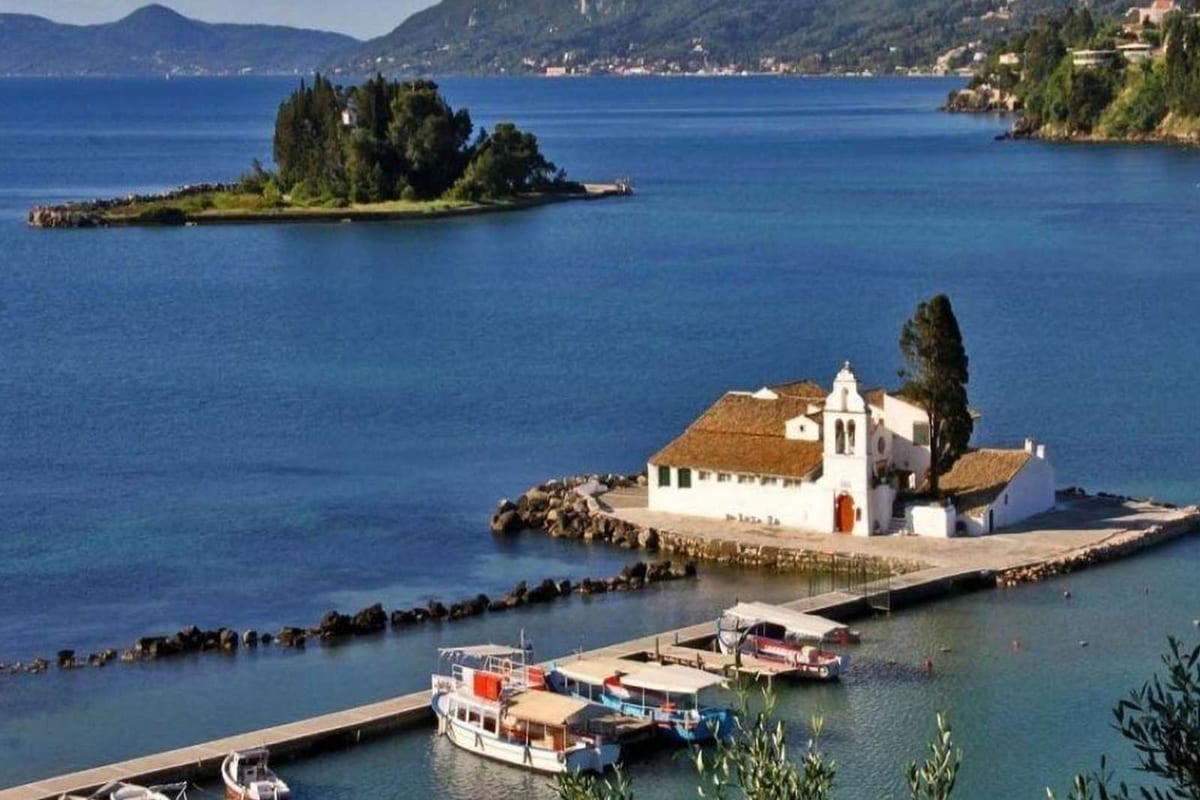
Where to stay in Corfu depends on the coast you pick. Corfu Town and Kanoni sit on the east coast, the green north rises to Mount Pantokrator, the west coast holds Paleokastritsa and the sandy bays, and the flat south runs down to Kavos. The tours in Greece on the home page add the rest of a Greek trip.
This page covers the bases one by one, then the airport, the port, the buses, the months and the day trips. The Corfu island page holds the sights, the Corfu Paxos Antipaxos cruise page holds the boat day south, and the where to stay in Greece page compares the islands.
Which factors settle where to stay in Corfu?
Four points settle where to stay in Corfu: the shore, the nights, the car and the walk to the port. The island measures about 64 km in length, as Wikipedia states. So a base far from the town adds road time to each day of the stay.
The shore comes first. Wikivoyage calls the lodging of the island plentiful and places it mainly in the coastal area. So the base is above all a choice of coast. The same page puts the sandier beaches on the west side and the calmer water on the east.
Nights come second. For where to stay in Corfu over one or two nights, a single base keeps the days simple. Corfu Town suits that plan. Wikivoyage places the airport there and names the town a dock for the cruise ships and the long-distance ferries. A longer stay can use two bases: the town and a beach.
The car is the third point. For where to stay in Corfu, a hire car frees the base to sit in a quiet bay. Without one, pick a town, a resort or a larger village on a bus route. The island buses link such places with the capital.
The walk to the port is the fourth point. It counts for a traveller who arrives or leaves by sea. A base in the town keeps that walk short. A base in a far bay turns the same trip into a longer ride.
Match the trip to the kind of base. For where to stay in Corfu, the town suits a short stay between ferries. A beach village suits sea days, and a quiet bay suits rest. The hill country of the north suits a walker. A longer stay with a car lets one base serve more than one coast.
The sections below follow one route. For where to stay in Corfu, they start in the town and run up the east coast to the north. Then they come down the west coast and end in the south-east and the far south. Each base meets the four points in turn.
How do the areas split where to stay in Corfu?
Where to stay in Corfu splits into three areas: a mountainous north, the capital’s centre and a low south. Wikivoyage uses the same three regions. The three municipalities formed in the local government reform carry matching names: North Corfu, Central Corfu and South Corfu.
- Corfu Town
- Kanoni
- Kontokali
- Gouvia and Dassia
- Ipsos and Barbati
- The north-east coast
- Kassiopi
- Acharavi, Roda and Sidari
- Arillas and Agios Stefanos
- Paleokastritsa
- Pelekas, Glyfada and Agios Gordios
- Benitses, Moraitika and Messonghi
- Lefkimmi, Kavos and Lake Korission
For where to stay in Corfu, the north is the hill country. Wikipedia names Pantokrator as the main range of the two, and its summit reaches 906 metres. Wikivoyage adds that North Corfu is the wider and more mountainous part of the island.
North Corfu, a municipality, keeps its seat in the village of Acharavi. Its four municipal units are Agios Georgios, Esperies, Kassopaia and Thinali. Acharavi gets a section below with Roda and Sidari. Unit names sit one level above the village names that the later sections use.
The centre belongs to the capital. Wikipedia calls the central district undulating. Wikivoyage names the central region as the one with the largest population and places Corfu Town in it. For where to stay in Corfu, this is the region of the old town and the quarters around it.
The municipality of Central Corfu and the Diapontian Islands has its seat in the city of Corfu. Its eight municipal units are Achilleio, Corfu, Ereikoussa, Faiakes, Mathraki, Othonoi, Paleokastritsa and Parelioi. Corfu Town and Paleokastritsa, two of these units, get a section each below.
The south is where the land drops low. Wikivoyage says South Corfu is less wide than the north, with a small span between west and east. For where to stay in Corfu, that makes the south a narrow strip with the sea close on both sides.
South Corfu, a municipality, keeps its seat in the village of Lefkimmi. Its three municipal units are Korissia, Lefkimmi and Meliteieis. Wikivoyage describes the southern region as the one with resorts and beaches. Lefkimmi gets a section below with Kavos and Lake Korission.
The west coast is the third strip. Wikivoyage puts the sandier beaches on the west side. Paleokastritsa on this coast is noted for cliffs and beaches close by, as Wikipedia states. The west coast therefore pairs sand with rock, and that pairing shapes where to stay in Corfu.
The shape explains the map. The ancients likened the island to a sickle, as Wikipedia states. At its widest the island spans around 32 km. Its north-east edge lies off Albania, across straits 3 km to 23 km wide. Its south-east side lies off Thesprotia, on the mainland of Greece.
Pick the area first and the village second. The coast sets the base before a village name does. That order makes where to stay in Corfu easy to read on a map.
Why does Corfu Town lead where to stay in Corfu?
Corfu Town is capital of the island and of the Corfu regional unit. The Ionian Islands region names it capital too. That role is one reason the town leads where to stay in Corfu. The ports, the sights and the offices all sit in one town.
The city proper holds 23,541 residents, against 99,134 on the whole island. The town page calls it both a major tourist attraction and a regional centre of Greece. For where to stay in Corfu, that mix gives a base with town life around it, not a resort strip.
Wikivoyage describes Corfu Town as the island’s largest town, a small and pleasant city. It adds that long-distance ferries and cruise ships dock here, and that the town caters well to travellers. A night in the capital keeps the sailing close, which answers where to stay in Corfu between two ferries.
UNESCO inscribed the Old Town of Corfu on its World Heritage List under cultural criterion four. The evaluation says the layout and the Venetian walls make Corfu a quintessential case of the fortified maritime city. A walker asking where to stay in Corfu starts inside this ground, where the lanes begin at the door.
Wikivoyage names the Spianada as the central square and the meeting point of residents and visitors. The Liston lines the west edge of the square. It is a pedestrian street and district. A room near both keeps the square within steps, and the Old Fortress faces it directly. This side suits a guest who wants the square at hand.
The Gulf of Kerkyra lies north of the Old Fortress, and Garitsa Bay lies south of it. The fortress covers the promontory in between. Saint Mark hill carries the New Fortress, a Venetian work of the sixteenth century, as Wikivoyage states.
The Venetians cleared the suburb of San Rocco, 2,000 homes in all, to make room for the new walls. French and British rulers followed, and each shaped the streets. Where to stay in Corfu is also a choice of era.
Inside the old town, the cobbled lanes called kantounia are narrow, and parts of them take no vehicles. British builders removed parts of the western walls to make room for new residential areas outside the old city. A room in that newer ground sits outside the lanes, while a room inside the walls sits among them.
The town page names quarters that include Spianada-Liston, Aghios Vlasios-Old Port, the New Port, Analipsi, Garitsa, Anemomylos-Aghios Iasson and Kanoni. The first three belong to the old-town side of where to stay in Corfu. The municipal unit around the town counts 40,047 inhabitants. The next section takes up Garitsa, Anemomylos and Kanoni.
How do Garitsa, Anemomylos and Kanoni answer where to stay in Corfu?
The older city, Chersoupolis, took its name, “city on the promontory”, from its place between Garitsa Bay and Kanoni. These two names frame the shore south of the Old Fortress. For where to stay in Corfu, they trade the lanes for a bay promenade and the landmarks of Kanoni.
- Garitsa: the bay south of the Old Fortress, reached along a promenade by the seashore.
- Anemomylos: a quarter of the town, listed together with Agios Iasson.
- Mon Repos: once a royal summer residence, south of the town in the Palaeopolis forest.
- Kanoni: a quarter of the town, whose hills lie close to the airport runway.
A promenade by the seashore leads from the town toward Garitsa Bay, which lies south of the Old Fortress. Where to stay in Corfu can mean a room by this bay, for a guest who wants open water outside. A walk back along the promenade ends at the fortress.
Anemomylos appears on the town page as a quarter, paired with Agios Iasson in the list. Choose it for a room on an ordinary town street, away from the old-town lanes and the bay. This is the choice for a longer stay that wants a base beyond the sights.
Mon Repos once served as a royal summer residence. It stands south of the town, in the forest of Palaeopolis. Public gardens were laid out on its farmland in eighteen thirty-four, and the Greek state kept the property. Rooms near this green ground answer where to stay in Corfu for a guest who wants trees to walk under.
Wikivoyage calls Pontikonisi a small islet that looks like a miniature and has become the landmark of the town. The photograph of central Corfu on the island page shows it beside Vlacherna Monastery. Wikivoyage marks Kanoni as a suburb of the town. A stay near Kanoni puts both landmarks close, and the hills of Kanoni rise beside them.
The airport lies about two kilometres south of the town. Its runway lies close to Pontikonisi and the hills of Kanoni. Kanoni therefore suits a guest with an early flight. For where to stay in Corfu, the old town suits the guest who prefers the lanes beyond the front door.
How do Kontokali, Gouvia and Dassia answer where to stay in Corfu?
For where to stay in Corfu, the coast north of the town offers three bases in a row. Kontokali sits on a headland 6.8 km from the centre. Gouvia lies beside the largest marina of the island. Dassia is 12 km out, and city bus line 7 links all three with the town.
Kontokali is a suburb of Corfu Town and the closest of the three. Its headland divides the gulf from the natural harbour and marina at Gouvia. For where to stay in Corfu with the town near, it is the first stop on line 7.
The east side of the headland looks back toward the town. A narrow sandy beach runs there in front of a row of private villas. Toward the tip you find resort spas, sailing centres and diving centres. The west side merges into Gouvia and its marina.
The suburb takes its name from Christophoros Kontokalis, a sea captain and shipowner. The Venetians awarded him the estate after his part in the Battle of Lepanto. Opposite the suburb lies Lazareto, a small island of 7.1 hectares. In the early sixteenth century, under Venetian rule, the islet received a monastery.
Gouvia is a resort village on a natural harbour, about 8 km north of the town. The Venetians favoured the harbour, and the well-preserved remains of their shipyard, the Venetian Arsenal, survive in Gouvia today. Gouvia fits where to stay in Corfu for a reader who wants harbour views.
Gouvia has two streets that differ. The main road to the town runs through the village past supermarkets, dealerships and large hotels. A smaller old street skirts the marina beside it. That street holds bars, restaurants, tavernas, smaller hotels and self-catering apartments. Larger resort complexes lie to the north.
The bay of the resort holds one small pebble beach at its centre. Across the water, the church of the Hypapante juts out from the village of Limni. For where to stay in Corfu, Gouvia suits a stay around the harbour, with the small beach as an extra.
Dassia lies 12 km from the town, as the official list of Corfu beaches states. For where to stay in Corfu on a bus route, line 7 serves it. The line leaves San Rocco Square and passes Kontokali, Gouvia, Tzavrou and Kommeno before Dassia. The same list gives Dafnilas beach 9 km from the town, on line 7 too.
That single bus line carries the whole stretch from Kontokali to Ipsos. Each step north adds more kilometres. The choice between the three bases is therefore a choice of distance and setting.
How do Ipsos and Barbati answer where to stay in Corfu?
Ipsos and Barbati answer where to stay in Corfu with a shore resort and a community tied to Mount Pantokrator. Ipsos took shape as a resort in the nineteen seventies. Barbati belongs to Spartylas, where the walk to the summit joins the Corfu Trail.
- Ipsos is the seat of the Faiakes community.
- Pyrgi is the last stop of city bus line 7.
- Barbati is a village of the Spartylas community.
- Pantokrator can be reached by winding road or by walking.
For where to stay in Corfu in a resort village, Ipsos has a clear story. The area stayed relatively untouched until the nineteen seventies. Then its long sandy beach and its clear, calm water started the growth of a tourist resort.
Today, for where to stay in Corfu with shops at hand, the village offers holiday accommodation of different types. It has bars, restaurants and bakeries, plus a medical centre, shops and supermarkets. A small fishing port and a marina sit on the same shore. A police station and a local government office serve the community.
The former municipality of Faiakes had its seat at Ipsos. That municipal unit groups seven communities over 53.85 square kilometres. Residents numbered 5,784 at the last count, taken in twenty twenty-one. The figures describe the whole unit, not Ipsos alone, so they say little about the village itself.
City bus line 7 ends at Ipsos-Pyrgi after it passes Dassia. Pyrgi is a village of the Spartylas community, together with Barbati. For where to stay in Corfu, a room on this stretch keeps the town on one bus line.
Barbati belongs to the community of Spartylas, together with Pyrgi. The twenty twenty-one count gave that community 762 inhabitants. The figure covers three places, so Barbati is a small base. For where to stay in Corfu, it suits a stay built around the mountain more than around a resort street.
The walk to Pantokrator from Spartylas forms part of the Corfu Trail. This route crosses the island for about 200 km, from its south to its north. The peak can also be reached by winding roads from the coast. A view of the whole island opens from the summit.
A walker who plans around Pantokrator starts from Spartylas, the community that includes Barbati. A swimmer who wants a long sandy beach, shops and a marina starts from Ipsos. Both choices fit the same island, and line 7 brings the Ipsos side back to the town. That sums up where to stay in Corfu on this stretch of coast.
How does the north-east coast answer where to stay in Corfu?
For where to stay in Corfu, the north-east coast offers calmer water and a view of Albania. It forms the municipal unit of Kassopaia, in the far north-eastern corner of the island. Its four communities are Gimari, Kassiopi, Nisaki and Sini.
The unit covers 33.749 square kilometres, and its census counts 2,281 people. The former municipality was run from the village of Gimari. That community also holds Kalami, with Vlachatika, Kavalleraina, Kentroma, Plagia and Rachi. The map shows small villages, not one large town.
Sini lists Agnitsini, Agios Stefanos Kassiopi, Vingla, Karyotiko and Kokkini among its villages. Nisaki lists Apolysoi, Vinglatouri and Katavolos. These small names make up the map of the shore. Choosing where to stay in Corfu here starts with the four communities.
Nisaki is a small sea-side community and port. Its name means little island in Greek, after the small island in its bay. A jetty links that islet to the mainland, and tavernas were built on it in the twentieth century. The main village grew on the hill above the inlet, where a church, a school and a cafe stand.
The islet and the hill give Nisaki two kinds of room. A room by the inlet keeps the water and the jetty close. A room on the hill keeps the village close. That choice settles where to stay in Corfu for a Nisaki stay.
Kalami has a literary past. In early nineteen thirty-six the writer Lawrence Durrell and his wife Nancy moved into the White House. It was a fisherman’s cottage on the shore. The page on Durrell calls Kalami a tiny fishing village at that time.
The Durrell family had a friend in Theodore Stephanides. He was a doctor, a scientist and a poet, and a frequent guest of the household. For where to stay in Corfu, Kalami is the bay with the Durrell story.
The island article places the north-eastern edge of Corfu off the coast of Sarande in Albania. It gives the width of the straits as three to twenty-three kilometres. So where to stay in Corfu here means a view of the Albanian shore across a strait.
Wikivoyage adds two plain facts. The west side of the island has the sandier beaches, while the east tends to have calmer waters. The north-east coast is also a home of holiday villas. A villa with a pool on a slope suits a group. A room by the shore suits a short stay.
The coast road is narrow in places, so a small car or a taxi suits the bends. A hired boat reaches coves that the road does not. Green buses link Kassiopi with the Green Bus Station in the town, as Wikivoyage lists. For where to stay in Corfu, that split between road and sea matters here.
How does Kassiopi answer where to stay in Corfu?
For where to stay in Corfu, Kassiopi gives a working harbour and old stones in one village. It is a fishing village with roots in Ancient Greece. The castle ruins stand tall above it, and excursions leave the harbour every day.
- Limani, the harbour, where the daily excursions start.
- The castle ruins above the village.
- The church of Panagia Kassopitra, with its dated inscriptions.
- The village square, where the buses stop.
The name raises a map trap. Wikipedia notes a mix-up between Kassiopi on Corfu and Cassope in Epirus on the mainland. A reader who types where to stay in Corfu needs the island village, not the Epirus site.
The village article names its strategic position above the Corfu Channel. That position made it worth fortifying. The defences stood until the Republic of Venice destroyed them. The castle ruins still stand tall above the village and count as archaeologically important.
Boats suit this village. Motor boats are for hire by the day or the week, and they run in the daytime only. Excursions run daily from the harbour to all parts of the island. A harbour base answers where to stay in Corfu when sea days matter.
The church of Panagia Kassopitra was restored between fifteen ninety and fifteen ninety-one. Its inscriptions carry the dates fifteen ninety, sixteen seventy and eighteen thirty-two. For where to stay in Corfu, the church adds old stones to a harbour stay.
The community of Kassiopi covers ten villages. They are Kassiopi, Agios Georgios, Imerolia, Kellia, Lithiasmenos, Pigi, Plateia, Podolakkos, Psyllos dyo and Psyllos ena. The unit also lists four islets: Peristeres, Plateia, Psyllos dyo and Psyllos ena. So the name Kassiopi covers a group of villages on the map.
The main road passes the village square, where the buses stop. The square lies 229 metres from the harbour. The article adds that one or two taxis are based in the village. At Kassiopi, where to stay in Corfu splits in two. A room beside the square keeps the bus stop close. A room by the harbour keeps the boats close.
The pictures on the village article name Limani, Bataria, Kanoni, the church and a cannon at the harbour. Those names make a first list to find on a map before the stay is fixed.
How do Acharavi, Roda and Sidari answer where to stay in Corfu?
For where to stay in Corfu on the north coast, Acharavi, Roda and Sidari give three bases along one shore. North Corfu has its seat at Acharavi, and Roda is a beach centre. Sidari is the village beside the Canal d’Amour rock opening.
Acharavi lies on the northern coast of Corfu, and the area looks across the water to the coast of Albania. The village forms part of the community of Agios Panteleimonas, within the municipal unit of Thinali. That unit lies halfway along the north shore.
Near the sea, the land of Thinali is flat, and the south of the unit is mountainous. For where to stay in Corfu, that gives a level base on the shore with the Pantokrator hills behind. A large part of the olives and kumquats of the island grows in this unit.
The name Acharavi comes from Greek words that mean ungracious life. The older Greek city on this spot was called Hebe, and the Roman emperor Octavian destroyed it. The municipality of North Corfu, which has its seat here, covers 205.3 square kilometres.
Roda is a village resort on the northern coast. Wikivoyage adds that it was a fishing village in the past. The Thinali page calls Roda the beach centre of the north coast. For where to stay in Corfu, Roda gives a small seaside base. The same page places the Antinioti Lagoon at the western edge of Thinali.
In the north of Corfu, Sidari is a resort village within the municipal unit of Esperies. The village is the place of an ancient monastery. The island article lists the Sidari beach among the beaches of Corfu. For where to stay in Corfu with children, look for a roomy studio with a small kitchen.
Wikivoyage lists the Canal d’Amour as the sight of Sidari. At the bay entrance, an opening in the rock runs through to the other side and forms a natural tunnel. The French name, channel of love, comes from that rock channel. For where to stay in Corfu, the bay gives Sidari its landmark.
The Diapontia Islands lie 6 km north-west of Corfu. The only inhabited ones are Othonoi, Ereikoussa and Mathraki. Othonoi marks the westernmost point of Greece. The Italian cape of Santa Maria di Leuca is about 47 nautical miles away. A boat day there can shape where to stay in Corfu for the north.
How do Arillas and Agios Stefanos answer where to stay in Corfu?
For where to stay in Corfu on the north-west coast, Arillas and Agios Stefanos Avliotes face the Diapontia Islands. Arillas is a beach resort with the feel of a village. Agios Stefanos began as a fishing village for the nearby village of Avliotes.
- Arillas: a beach resort in the community of Magoulades, in the municipal unit of Esperies.
- Agios Stefanos Avliotes: a former fishing village, 35 km from Corfu Town.
- Cape Drastis: the tip of the island on its north-western side.
- The Diapontia Islands: in view from both bays.
Esperies sits in the far north-west of Corfu. It covers 54.5 square kilometres and had 6,925 residents at the latest census. Wikivoyage files Arillas under North Corfu. The community of Magoulades holds Arillas with the villages of Gousades, Poulimates and Tsoukalio.
A photo on Wikipedia shows a panoramic view of Arillas with the Diapontia Islands in the frame. For where to stay in Corfu, that means the village looks out to open sea, not the mainland coast. Cape Drastis forms the tip of the island on its north-western side.
Agios Stefanos Avliotes lies on the north-west coast, 35 km from Corfu Town. The page gives the car transfer as one hour and fifteen minutes. Fishing is still part of the local economy, and the village had 260 residents at the latest census.
For where to stay in Corfu, Agios Stefanos suits a stay far from the town. The harbour looks out on four islands: Othonoi, Ereikoussa, Mathraki and Diaplo. The old church gave the village its name. The beach draws visitors each summer, and the regular local bus, a taxi or your own car reaches it.
Check the coast before you choose a room. Another Agios Stefanos, a small fishing village, lies on the north-east coast, far from the north-west one. For where to stay in Corfu, the two names share a map but not a shore. The north-west village belongs to the community of Avliotes.
Boats for the Diapontia Islands sail from Agios Stefanos Avliotes and from Corfu port, as the island pages state. A boat reaches Mathraki from the Corfu coast in 45 minutes. The island lies four nautical miles from Cape Arilas. In legend, Othonoi was the Ogygia of Homer, home of the nymph Calypso.
A shore that faces west looks at the evening sun, so the day ends over the sea. Here the north-west answers where to stay in Corfu for a couple that wants quiet rooms with a sea view. It also answers a family that wants a beach village with a bus link.
How does Paleokastritsa answer where to stay in Corfu?
For where to stay in Corfu, Paleokastritsa is the base of cliffs and coves on the west coast. It lies 23 kilometres westbound from Corfu Town, as the municipal tourism site states. Six coves and beaches share the shore, with rooms on the slopes above them.
Paleokastritsa is on the north-western edge of Corfu, just south of Angelokastro. The name of the village is Greek for Old Little Castle and recalls Angelokastro nearby. The Wikipedia entry singles out its great cliffs and nearby beaches. Anyone asking where to stay in Corfu for a coast of rock and water can start here.
The shore is cut into six coves and beaches, the tourism site of the municipality states. The central one is Agios Spyridon, a protected sandy beach that is organised and has amenities for people with disabilities. Alypa lies next door and has a small harbour. Chomi, a white pebble cove, has sea access only.
The monastery of the village lies at the northern promontory of the Agios Spyridon beach, the same site states. The article dates it to twelve twenty-five and notes that it houses a museum. A room near the central beach keeps it close. For where to stay in Corfu around a single bay, the area behind that beach is the spot.
Lakones lies above the sea at 6 kilometres by road, built on the hillside, the municipal site states. About 3 kilometres beyond it, near the village of Krini, stand the ruins of the Byzantine castle of Angelokastro. For where to stay in Corfu with a view, choose the hill villages and drive down to the coves.
Liapades is the other village base. The Wikipedia entry places it 3 kilometres from Paleokastritsa, on the sides of Kourkouli mountain. It calls the place a medium-sized village with a quiet, farm-based economy in winter. A village feel is what Liapades adds to where to stay in Corfu.
Its main beach, reached by the main road, is Giofyra, a name that means Bridge. Other beaches, among them Rovinia and Limni, are reached by paths, and Chomi only by sea. The tourism site lists Liapades Beach at 21 kilometres from Corfu Town, on the green bus route.
The national tourism organisation identifies Corfu with the island of the Phaeacians from Homer’s Odyssey. In the Wikipedia entry, the bay of Paleokastritsa is the suggested landing spot of Odysseus, who first met Nausicaa there.
A room on the slopes above the bays trades a short climb for a view of the water. A room by the central beach puts the sand at the door. A couple or a family choosing where to stay in Corfu with coves close at hand can pick either.
How do Pelekas, Glyfada and Agios Gordios answer where to stay in Corfu?
For where to stay in Corfu, Pelekas, Glyfada and Agios Gordios cover the central west coast. Pelekas is a hill village. Glyfada is a large beach 15 kilometres from Corfu Town. Agios Gordios is a long sandy bay 20 kilometres out.
- Pelekas: a village in western Corfu, at an average height of 183 metres.
- Glyfada: a large beach, listed in the community of Pelekas.
- Agios Gordios: a coastal village below Sinarades with a long sandy beach.
Parelioi is the municipal unit that holds Pelekas and covers the central west coast. The Wikipedia article gives the unit about 49 square kilometres and 6,751 people at the last census. Five communities make it up, and its economy rests mainly on tourism. For where to stay in Corfu, this is the west coast at village scale.
The community of Pelekas lists six places: Pelekas, Avramis, Agios Onoufrios, Glyfada, Kokkinogeia and Plakoto. Glyfada is therefore part of the village’s own community, not a separate town. German Wikipedia counts seven places and adds a monastery of the Virgin of the Myrtles to the list.
Pelekas stands at an average height of 183 metres, German Wikipedia records. A platform on a nearby hilltop lets visitors watch the sun go down. Kaiser Wilhelm II did the same after he bought the Achilleion. The area is called Kaiser’s Throne for that reason.
Glyfada is the beach of this stretch. The municipal tourism site calls it a large beach, 15 kilometres from Corfu Town, on the green bus route. A room in the village and a room by the beach share one community. Where to stay in Corfu here comes down to a view against sand.
Agios Gordios is the third base. It is a coastal village on the west coast, known locally as Ai Gordis. Its beach lies downhill from Sinarades, the Wikipedia entry states. The tourism site adds a long sandy beach, 20 kilometres from Corfu Town on the green bus route.
Sinarades, the largest village of Parelioi, is home to a folklore and history museum named for Central Corfu. That gives a stay at Agios Gordios a village stop above the beach. This coast answers where to stay in Corfu well for a long beach with a museum village close by.
Parelioi names four beaches: Agios Gordis, Glyfada, Kondogialos and Ermones. Ermones lies in the community of Giannades and Kondogialos in Sinarades. For where to stay in Corfu on this coast, that means one village per beach.
Rooms above the beaches give a view along the coast, while rooms at the shore put the sea first. Two of the beaches sit 15 and 20 kilometres from Corfu Town. The west coast therefore suits day trips to the capital. That is how this side answers where to stay in Corfu.
How do Benitses, Moraitika and Messonghi answer where to stay in Corfu?
Where to stay in Corfu starts at Benitses on the south-east coast. This very old fishing village lies about 12 kilometres south of the town. Moraitika and Messonghi follow further south, side by side, divided by the Messonghi River.
Wikivoyage describes Benitses as a traditional fishing village, with mountains on one side and the Ionian Sea on the other. German Wikivoyage adds that the mountain above the village carries the Achilleion palace. The coast road from the town runs through it.
The Hellenic Ministry of Culture lists a Roman villa with baths at Benitses. A Roman site thus has a say in where to stay in Corfu. The hall for hot baths measures 4.70 by 6 metres. It has a vaulted roof and walls of brick and lime mortar.
The floor of that hall holds a coloured mosaic with geometric patterns. An opening in it leads to an underground space, the hypocaust. A second vaulted hall for cold baths lies to the south-west, and a water tank lies to the north. The Ministry lists access by road, by bus or car.
German Wikivoyage puts the airport less than a quarter of an hour from Benitses. That short transfer counts for where to stay in Corfu before a flight. The small harbour takes excursion boats and private boats but has no ferry link. The beach is narrow, slightly pebbly and shelves gently.
For where to stay in Corfu with road links, Moraitika sits on the coast road from the town to Lefkimmi. German Wikivoyage calls it a former fishing village that grew into a tourist centre. In the village centre a second road leads west to Lake Korission and the beaches on the west side.
The Green bus stops in the centre of Moraitika, on the shore road. The beach is wider and sandier than the beach at Messonghi, although it holds pebbles. The sea floor turns stony, so German Wikivoyage advises water shoes.
Where to stay in Corfu can also mean Messonghi, which lies south of Moraitika and began as a fishing village. The beach is narrow and rather pebbly. The seabed turns to fine sand a short way out, and there is little wave action. The village is compact enough to walk.
The small harbour of Messonghi takes fishing boats and excursion boats, with no ferry link. The airport lies about 20 kilometres to the north, and the Green bus reaches the town in about an hour. Evenings pass in the beach tavernas, and Moraitika next door stays open later.
All three bases answer where to stay in Corfu with a gently shelving shore. A family finds rooms by the shore, with sand a short walk away.
How do Lefkimmi, Kavos and Lake Korission answer where to stay in Corfu?
Where to stay in Corfu at the far south comes down to three places. Lefkimmi ranks as the island’s second-largest settlement. Kavos is the southernmost seaside village. Lake Korission is a protected lagoon in the south, with a beach between it and the sea.
- Lefkimmi: a town in the far south, with a canal and a small ferry port nearby.
- Kavos: the resort on the southern coast of Corfu.
- Lake Korission: the lagoon, the dunes and the long beaches of the south-west.
Wikipedia calls Lefkimmi a town and a former municipality, with a canal through its eastern part. Wikivoyage says the reform of two thousand nineteen split the old municipality of Corfu in three. The southern part, South Corfu, has its seat in Lefkimmi.
Lefkimmi was a fishing village before it grew into a small town, says German Wikivoyage. It adds that the town is not really set up for visitors. Its tavernas serve plain Greek and Corfiot food. The town is compact enough to walk, and the airport lies close to an hour away.
A small ferry port lies near Lefkimmi. Wikipedia places it on Cape Kavos, at the southernmost point of the island, with a ferry service to the mainland. German Wikivoyage names Igoumenitsa and adds that excursion boats leave for Paxos and Antipaxos. For where to stay in Corfu around a boat day, the far south shortens the road to the quay.
At the roundabout in Moraitika, two roads lead to Lefkimmi. German Wikivoyage calls the sea road narrower and the main road through the hills easier to drive. Both are signposted. A Green bus runs frequently between the town and Lefkimmi.
Kavos answers where to stay in Corfu with a resort. Wikivoyage calls it popular with young travellers from Britain and Northern Europe, and Wikipedia adds visitors from Germany and Serbia. The core of the resort is one long strip beside the shore. A large part of the restaurants, shops and rooms stands there. The resort stays open late.
For where to stay in Corfu in the south, Lefkimmi is the calmer choice. Its beach is wide, long and sandy, and Wikivoyage calls it quiet because the south is less busy. The water is very calm and shallow, even far out.
Lake Korission adds a nature stop to where to stay in Corfu. It is a coastal lagoon near the village of Agios Mattheos. Chalikouna Beach holds the water back from the sea, and a channel lets the lagoon drain. The dunes beside it reach more than 15 metres, and Natura protection covers the area, as Wikipedia states.
Issos beach sits beside Chalikounas, also on the south-west coast. High sand hills rise right beside the shore, says Wikivoyage, and give the beach a desert look. For where to stay in Corfu, the road west from Moraitika leads to the lake and the west-coast beaches.
How do the airport, the port and the buses shape where to stay in Corfu?
Corfu Town holds the airport, the ferry port and the bus stations. These links steer where to stay in Corfu from the first hour. The airport article puts the runway around 2 km south of the town. Wikivoyage places the long-distance ferry docks in the town itself.
The island article gives a different distance, around three kilometres, so the two pages differ a little. Either way the run into town is short. Only 0.5 km separates the runway from Pontikonisi. The landing path points northeast. Pontikonisi and the Vlacherna monastery come into view along with the hills of Kanoni.
The airport page dates the field to nineteen thirty-seven. It became international in April of nineteen sixty-five. The page says charter and scheduled flights arrive from European cities, and the island article adds domestic flights. A base in the town is a short ride from the runway.
Buses link the airport with the old town. For where to stay in Corfu without a car, that link counts. City buses also reach the Achilleion, Gouvia, Afra and Pelekas, the island article states. Wikivoyage splits the network by colour. Blue lines cover the town and its surroundings, and green lines run to the villages.
Coaches tie the coast bases to the town, so where to stay in Corfu is not limited to the town. The island article says the main places get about six buses a day. These are Piri, Lefkimmi, Acharavi, Roda, Paleokastritsa, Sidari and Glyfada. Other coaches make up to two trips a day to Athens and Thessaloniki.
The port suits a stay that starts or ends on a ferry. That is a clear case of where to stay in Corfu. The island article lists traditional ferries for Gaios on Paxos and for Patras. High-speed ferries sail to Igoumenitsa. The Igoumenitsa article adds that frequent passenger and car ferries cross to Corfu.
The road from the New Port to the town passes through the fish market. The walls of the New Fortress tower over the route, as the island article describes. A ferry passenger meets the fortress and the market before the old town. Wikivoyage puts the green bus station near the New Port.
Two national roads start at the town. The EO24 runs west toward Paleokastritsa. The EO25 runs south toward the Achilleion and ends in a loop. A hire car widens where to stay in Corfu beyond the bus lines. A base on a bus line removes the need for one. A taxi closes the gap between a stop and the room.
Which months suit where to stay in Corfu?
Month by month, the weather tilts where to stay in Corfu. The island swings from dry summer to very rainy winter. The climate table in the island article gives July 3.3 rainy days and December 16.5. Rain totals 8.7 millimetres in July and 189.9 millimetres in December.
- January: a mean daily high of 13.9 degrees Celsius, 14.8 rainy days and 117.7 hours of sun.
- April: 19.1 degrees Celsius, 12.2 rainy days and 206.5 hours of sun.
- July: 31.2 degrees Celsius, 3.3 rainy days and 364.5 hours of sun.
- October: 23.2 degrees Celsius, 11.4 rainy days and 188.9 hours of sun.
Summer favours a beach base for where to stay in Corfu. The table sources its temperature and rain rows to the Hellenic National Meteorological Service. August has a mean high of 31.5 degrees Celsius and a mean low of 19.3. The nights stay warm. Wikivoyage notes that the mountain areas are cooler.
Winter turns where to stay in Corfu toward the town. Rain in December reaches 189.9 millimetres, and the sun shines for only 110.9 hours. January has a mean daily low of 5.3 degrees Celsius. The island article calls the winters very rainy, wetter than the winters on other Greek islands.
Over a year the table adds up to 1,111.3 millimetres of rain. That rain explains the green of the hills. Olive trees and cypress trees draw the typical landscape, as the island article states. A winter stay trades beach days for green slopes. That is a fair answer to where to stay in Corfu in the wet months.
Between the heat and the rain lie April and October. Wikivoyage calls spring a time of vegetation and colour. It ties autumn to the vintage: the whole island smells of grapes. Where to stay in Corfu in these months is open to both a beach base and a town base.
For Easter, where to stay in Corfu points to the old town. At eleven on Holy Saturday, people throw large clay pots full of water onto the street. They throw them especially in the wider spaces near the Liston, in an organised way. The pots are called botides.
The custom recalls King David’s words about a potter’s vessel. Afterwards the parade crosses streets strewn with clay. The island article adds that the small Catholic community of the city keeps Easter on the Greek Orthodox calendar. Staying in the old town places that morning right outside the room.
Which base suits a couple or a family on where to stay in Corfu?
Where to stay in Corfu depends on who travels. A couple fits the old town or the north coast, and a family fits the calmer east side. A walker fits the rugged north. Each choice below rests on one place fact from Wikivoyage or Wikipedia.
A couple weighing where to stay in Corfu can begin in the old town. The Byzantine Museum fills a small church, Our Lady of Antivouniotissa, with Byzantine and later icons. Wikivoyage lists it among the sights of Corfu Town. A room near it puts an afternoon of icons a short walk away.
A couple that prefers the shore can look north. Wikivoyage calls the north wider and more mountainous than the south. It describes the coastal areas there as well developed, with good pebbly beaches. For where to stay in Corfu, that means a shore base under hills.
A family can read the island by its two sides. On the west side, Wikivoyage reports sandier beaches. On the east side it reports calmer water. Small children favour calm water. For where to stay in Corfu with a family, the east coast comes first.
Families with older children have one more anchor. Central Corfu holds a water park with 51 slides, and Wikivoyage counts it among the biggest in the world. Corfu Town and Benitses both sit in that central region, so either base keeps the park near.
A walker can plan around a single long line. The Corfu Trail is a footpath of 222 kilometres that covers the full length of the island. Wikivoyage calls the route well signed. For where to stay in Corfu on foot, a base along that line spares a daily transfer.
The north is the rugged part of the island. Wikivoyage places Mount Pantokrator there as the highest mountain. The name is Greek for the Almighty, as Wikipedia notes. A walker who wants hill days looks for a base in that north.
For a first visit, where to stay in Corfu can mean two bases. Spend the first nights in Corfu Town, which Wikivoyage calls the largest town of the island. Then move to one beach base from the list above. A first-time visitor joins a long habit, since Wikivoyage puts the tradition of tourism here at 130 years or more.
A short stay, such as a night between ferries or a cruise stop, fits the town base. The docks sit in the town itself, as Wikivoyage states. A second base adds a transfer and nothing else.
How do day trips to Paxos, Antipaxos and the mainland shape where to stay in Corfu?
Day trips shape where to stay in Corfu through distance. Paxos is 15 kilometres from the far south of the island, and Antipaxos lies a short sea-taxi ride beyond it. Boats from Corfu take one to two hours in the tourist season. Each trip below points to a different base.
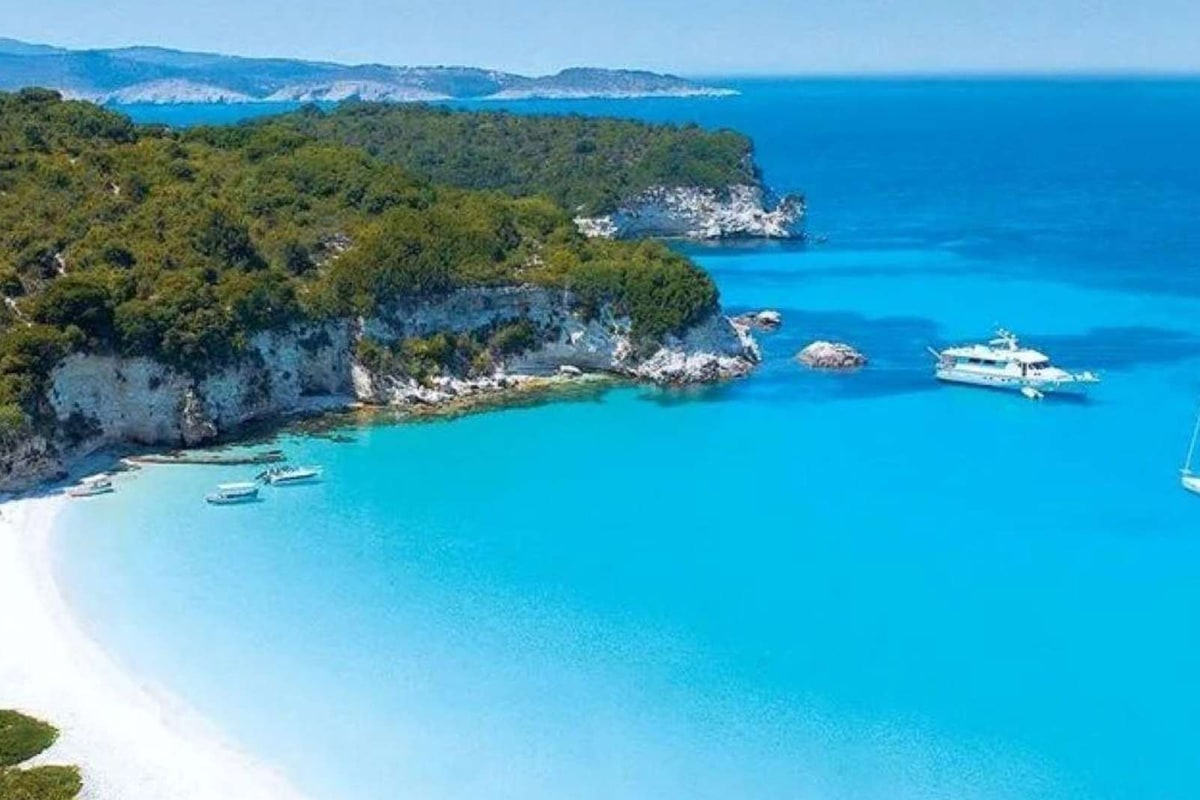
- Paxos: south of Corfu, with the harbour town of Gaios.
- Antipaxos: a small island beyond Paxos, reached by sea-taxi.
- Igoumenitsa: the mainland port with ferries to Corfu.
- Sarande: the Albanian port town with direct ferry links to Corfu.
Paxos keeps its life on the east coast, where Gaios, Lakka and Loggos are the three main settlements. Gaios is both the main town and the municipal seat. Lakka comes second by size, and Loggos comes third. Olive groves cover the hills between Lakka and Gaios, with Magazia on the way.
Steep white cliffs of chalk mark the west coast of Paxos. Wikipedia says they are greatly eroded at sea level and hold the blue caves. A reader who plans that sea trip checks the boat time first. Where to stay in Corfu comes second.
Administratively, Antipaxos forms part of Paxoi, which sits in the regional unit of Corfu. The island has one harbour, Agrapidia, and vineyards largely cover the land. From Gaios, the sea-taxi crossing takes a quarter of an hour.
The tourist season brings hydrofoils, passenger ferries and sea-taxis from Corfu to Paxos. Outside that season, a hydrofoil runs rarely and varies with the weather. A ferry from Igoumenitsa crosses all year and takes 1.5 hours.
A base in the far south of Corfu sits nearest to Paxos on the map. When the island trip comes first, it decides where to stay in Corfu. The town base suits the mainland trips, as the next paragraphs show.
Igoumenitsa lies on the mainland, in Epirus, and it runs two ports, one old and one new. Its article ranks it among the largest passenger ports of Greece. Wikivoyage names a ferry from Igoumenitsa to Corfu Town. For where to stay in Corfu, that makes the town the base for a mainland day.
Parga has Preveza on one side and Igoumenitsa on the other along the Ionian shore. Venice once ruled it as a mainland piece of its Corfu possession. A reform folded the former municipality of Syvota into Igoumenitsa. Both places show how near the mainland sits.
Wikivoyage lists direct ferry links to Corfu from Sarande and Himara in Albania. It calls the island a jumping-off place for Albania and Italy. For where to stay in Corfu, a trip to Albania needs no special base. Wikivoyage also counts 11 Diapontia islands, 9 to 20 kilometres north-northwest of Corfu.
Which questions do readers raise on where to stay in Corfu?
Does a first stay suit the town or a beach in your plan for where to stay in Corfu?
The town suits a first stay built around sights on foot. A beach base suits a stay centred on swimming. Both answers to where to stay in Corfu work. Choose by what fills your first morning, and add the other kind of day later from the same base.
The town keeps its sights close together. A palace stands on the Venetian-era fortress side of the old town. It is named for the Order of Saint Michael and Saint George. Inside it sits the Museum of Asian Art, whose collection began in nineteen twenty-seven. Wikipedia states that it consists largely of donations, and the biggest donation holds 10,500 pieces.
Saint Spyridon is the patron of Corfu, and his tomb lies in his church in the old town. A philharmonic society of the town gave its first public performance at his procession in November, in eighteen ninety. A beach base trades that town life for sand and water. It answers where to stay in Corfu for a swim-first stay.
Even a town stay has a swim. The sea baths lie at the foot of the fortifications that surround the palace gardens, as Wikipedia notes. So the town and the water can share one day. A short stay loses nothing by choosing the old town as its base.
Do you need a hire car once you know where to stay in Corfu?
A car is not needed for a stay in the town. It helps for a stay in the north or the west, where the bays and the villages lie farther apart. The base and the car belong together in where to stay in Corfu. Settle the base first and the wheels second.
A bus can replace the car for a shore resort. Wikivoyage lists line 7, which runs between Corfu Town and Dassia every 20 minutes, and every 30 minutes on Sundays. Timetables change, so read the current one. Such a link suits a shore resort without any driving.
Wikivoyage advises a small hire car because the roads are very narrow in places. A couple or a walker can still answer where to stay in Corfu with no car at all. The base then sits in the town or beside a bus line. The days out go by bus, by taxi or on foot.
What length of stay suits the island, and how does it change where to stay in Corfu?
A short stay of two or three nights fits one base, and a week fits two. Counting nights helps with where to stay in Corfu: one base for the sea and one for the sights. A third base earns its place only after ten days.
Walkers can plan longer around Old Perithia. Wikivoyage calls it the last remaining Heritage Protected Village on the island, with records back to around thirteen fifty. The Corfu Trail, a long footpath along the island, passes through the village, as Wikivoyage states. A walker can build a stay around that section.
A quiet last night suits the north-west. The community of Pagoi joins five villages: Pagoi, Agios Georgios, Prinylas, Roumpatatika and Vatonies. Agios Georgios Pagon grew into a resort in the third quarter of the twentieth century. Wikipedia lists 62 inhabitants for it.
Above the bay stands the village of Prinylas, with a church of Agios Nikolaos from the fourteenth century. Such a bay settles where to stay in Corfu for the end of a week. It follows the days in the town.
Which base fits a ferry day or a cruise stop within where to stay in Corfu?
The town suits a ferry day or a cruise stop, and a bay base suits the nights around it. A room inside the old town keeps the harbour near. Where to stay in Corfu on such a day is a question of minutes, not of beaches.
The sea approach adds a plain place fact. Wikipedia notes that the garden of the palace looks out over the narrow channel by Vido island. Ships pass there on their way to the harbour of Corfu. The old royal garden is now called the Garden of the People.
A crew that arrives in its own boat can moor off at the Old Port, as Wikivoyage states. A bay base farther along the coast puts a bus or a taxi between you and the ship. Allow time for that leg, because the ship waits for no one.
Timetables and rules change, so check the port’s own page first. Then plan where to stay in Corfu around one early start.