
Where to stay in Halkidiki depends on the peninsula you pick. Kassandra, the western leg, holds Afytos, Kallithea, Hanioti and Pefkochori; Sithonia, the middle leg, holds Nikiti, Neos Marmaras, Vourvourou and Sarti; and the coast of the third leg holds Ouranoupoli on the border of Mount Athos. The tours in Greece on the home page add the rest of a Greek trip.
This page covers the bases one by one, then the airport, the roads and the months. The where to stay in Thessaloniki page covers the city at the gate of the region, and the Mount Athos cruise page holds a day on the water along the monastic coast.
Which factors settle where to stay in Halkidiki?
The first factor in where to stay in Halkidiki is size: the regional unit covers 2,918 square kilometres. It lies in coastal Macedonia, and its shore splits into three arms. The arm you choose decides the beach, the road, and how far you drive from Thessaloniki.
The aim of the trip narrows where to stay in Halkidiki before a map is opened. A family wants a gentle beach, a walker wants hills, and a short stay wants a short drive. Each aim points to a different arm of the peninsula. Write the aim down first, then read the areas that fit it.
Distance from Thessaloniki is the next factor. The regional unit of Thessaloniki borders the peninsula on the north. Nea Moudania, the largest town of Halkidiki, stands 60 kilometres south of the city. The bases at the ends of the legs lie further out, so count the drive before the beach days.
Municipal lines follow the legs and help you find official pages on where to stay in Halkidiki. The municipality of Kassandra covers the western leg. The municipality of Sithonia covers the middle leg, and its seat is Nikiti. The municipality of Aristotelis takes in Ouranoupoli and Ierissos. The municipality of Nea Propontida has its seat in Nea Moudania.
Size differs from leg to leg. The municipality of Sithonia covers 516.8 square kilometres. The municipality of Kassandra covers 334.3 square kilometres. Inland, the municipality of Polygyros spreads over 947.4 square kilometres. A larger leg means longer drives between bays, so plan the days around a car on Sithonia.
The kind of stay is the third factor in where to stay in Halkidiki. A resort beach, a quiet bay and a cliff village are three different stays. A family week, a night near the Athos border and a night near the airport add three more. Each one points to a different base.
The sea in front of the base is the fourth factor. The Thermaic Gulf bounds the peninsula on the west. On the east, the Ierissos Gulf and the Strymonian Gulf bound it, parted by the Brostomnitsa peninsula. Inside the legs, two more gulfs add shores of their own.
A short stay changes where to stay in Halkidiki. The airport of Thessaloniki takes the flights, and its article says it serves Chalkidiki too. With one or two nights, a base close to Thessaloniki keeps the drive brief. A longer stay can reach the far ends of the legs.
Put the factors in a short order: the arm, the sea, the drive and the kind of stay. Once the order is set, where to stay in Halkidiki becomes a choice between named bases. The areas below follow the legs from west to east.
How do the three peninsulas split where to stay in Halkidiki?
Kassandra, Sithonia and Athos are the three arms of the peninsula, counted from west to east. Gulfs run in between: one named Toronean, one named Singitic. Each arm answers where to stay in Halkidiki in its own way, from western resorts to the Athos border.
- Kassandra, the western arm: Nea Fokaia, Afytos, Kallithea, Hanioti and Pefkochori
- Sithonia, the middle arm: Nikiti, Neos Marmaras, Vourvourou, Sarti and Toroni
- The Athos side: Ouranoupoli and Ierissos
The picture of a hand helps with where to stay in Halkidiki. English texts call the arms fingers, and Greek calls them legs. The hand sits in the northwest of the Aegean Sea, as Wikipedia describes it. Pick a finger first, then a village on it.
The western arm was called Pallene in ancient times. Today its municipality joins two units, Kassandra and Pallini. Afytos, Kallithea and Nea Fokaia belong to the unit of Kassandra. Hanioti, Pefkochori and Paliouri belong to the unit of Pallini. The municipality has its seat in Kassandreia.
Between Kassandra and Sithonia lies the Toronean Gulf. Between Sithonia and Athos lies the Singitic Gulf. Sithonia thus has one gulf on each side. For where to stay in Halkidiki, its west coast and its east coast make two different stays.
The peaks of Itamos and Dragoudelis stand in the middle of Sithonia. Vineyards, forests, shrubland and grassland cover the rest of the landscape. Two islands lie offshore. Kelyfos faces the west coast, and Diaporos faces the east coast. A base on the coast of Sithonia answers where to stay in Halkidiki for a quiet bay.
The Athos arm is the easternmost, and Mount Athos itself rises to 2,033 metres. Autonomy rests with the monks: their community governs the mountain and the greater part of the peninsula. The municipality of Aristotelis holds the remainder, with the bases of the Athos side.
Behind the three arms lies the mainland part of the peninsula. Its capital, Polygyros, stands north-west of Sithonia. It stands on a plateau of Mount Cholomontas, on its south-west side, built like an amphitheatre. A census counted 7,779 residents there. For where to stay in Halkidiki, it is a town of the hills, not of the shore.
The isthmus that joins Kassandra to the mainland carries the canal of Potidea. After the revolution a new cutting of the canal was made, as the article on Nea Potidaia states. With the arm chosen, where to stay in Halkidiki becomes a choice of villages. The next areas take them one by one.
How does north Kassandra answer where to stay in Halkidiki?
North Kassandra answers where to stay in Halkidiki with a canal, a stone village and a resort. Nea Potidaia is the only land entrance to the peninsula. Afytos lies 73 kilometres south-east of Thessaloniki, and Kallithea follows on the east coast.
The canal gives the north its first base. Nea Potidaia was built where ancient Potidaea once stood, 33 kilometres south-west of Polygyros. In nineteen twenty-two, refugees from Kalolimnos and from Platanos, in Eastern Thrace, re-founded the town. Its place at the gate of the peninsula matters for where to stay in Halkidiki.
Wikivoyage describes the canal itself. The peninsula is so narrow there that the road across the canal shows both gulfs, the Thermaic and the Toronean. At the western end, the remains of the Justinian Wall can still be seen. This sixth-century wall was once 1,200 metres long.
Nea Fokaia is a small coastal village, as Wikivoyage describes it. Its landmark is the Byzantine tower. The church of Saint Paul lies in a cave. The cave is narrow, and the ceiling is low, so visitors move in part only on all fours. The village adds a sight to where to stay in Halkidiki.
Afytos stands 50 metres above sea level and 6 kilometres north-east of Kassandreia. Stone-built houses and narrow streets mark the village, and viewpoints look over the Toroneos Gulf. Wikivoyage adds that the village is high above the beach. The path is steep, so a vehicle helps anyone not good on foot.
Two lookouts add to a walk in Afytos and to where to stay in Halkidiki. Wikivoyage names the Rock, called the Village Balcony, and Koutsomylos, called the Village Acropolis. Both look over the bay of Toroni, with Sithonia and Kassandra in view. The folklore museum has a library on the ground floor and historical exhibits above.
In nineteen ninety-five the villagers set out to rebuild old stone houses and pave the streets, as Wikivoyage tells it. The old stone quarries reopened. Today every new building uses the local stone. That choice shapes where to stay in Halkidiki for a visitor who wants a stone village.
Kallithea has 1,236 residents at the latest census. Refugees from Maltepe in Asia Minor founded the village in nineteen twenty-five. A large Doric temple from the fourth century BC is part of its sanctuary of Ammon Zeus. For a guest who wants a resort that stays open late, Kallithea answers where to stay in Halkidiki.
The east coast reads as one strip. As Wikipedia states, the coast from Kallithea down to Pefkochori became especially built up with resorts. Polychrono, 85 kilometres from Thessaloniki, has a beach and the site of ancient Neapolis. Rooms on the slope give views, and rooms by the sand give the water at the door.
How do Hanioti, Pefkochori and south Kassandra answer where to stay in Halkidiki?
Hanioti and Pefkochori answer where to stay in Halkidiki with flat ground and a large beach. Hanioti lies 89 kilometres south-east of Thessaloniki and Pefkochori 92. Paliouri closes the south-eastern end of Kassandra, near the cape of its own name.
- Hanioti: 3 kilometres north-west of Pefkochori, 938 residents at the latest census
- Pefkochori: 10 metres above sea level, 92 kilometres from Thessaloniki
- Paliouri: 7 kilometres south-east of Pefkochori, 2 kilometres from the sea
- Kassandreia: 3,158 residents at the latest census
Hanioti, also written Chaniotis, lies on the north-eastern coast of Kassandra. Wikivoyage gives it a very large beach and calls the village flat. A flat village changes where to stay in Halkidiki for a guest who wants a short walk to the sand. Polychrono stands 4 kilometres to the north-west.
Pefkochori means pine village in Greek. Before nineteen sixty-five the town was called Kapsochora. The pine trees of the mountains around it gave the new name. The community also includes the villages Lefkes and Panorama.
Wikivoyage calls Pefkochori flat, with an easy way to the beach. On Kassandra, it adds, the way to the beach is difficult without a vehicle where the ground is not flat. So where to stay in Halkidiki on the south-east coast starts with the slope between the room and the sea.
Paliouri lies between low mountains, 2 kilometres from the sea. Its community includes the small villages of Agios Nikolaos and Xyna. Near the modern village was the ancient city of Theramvos, which survived into Roman times. Cape Paliouri, near the south-eastern end of the peninsula, shares the village name.
Wikivoyage treats the far south of Kassandra as a part of its own. Its bays invite a quiet swim in the early and late season. A bus reaches a number of the beaches there, and the rest need a car. The car decides where to stay in Halkidiki on that coast.
Kassandreia stands in the centre of the peninsula. It was called Valta before nineteen fifty-five, a name that means town in the swamps. Cassander enlarged the ancient city, first called Potidaea, and named it after himself. Where to stay in Halkidiki can also mean a town with a market on Tuesdays, as Wikivoyage notes.
Kalandra, a small town on the western side, lies where ancient Mende stood. A temple of Poseidon, its oldest part from the eleventh century BC, belonged to that city. For a week on the beach, a family room by the sand settles where to stay in Halkidiki. A room on the slope trades the walk for the view.
How do Nikiti, Neos Marmaras and Vourvourou answer where to stay in Halkidiki?
Where to stay in Halkidiki on Sithonia, the middle peninsula, comes down to the setting. Nikiti keeps an old hill village above a newer seafront, and Neos Marmaras stands on three shoreline hills. Vourvourou lies on the east coast, between the villages of Ormos Panagia and Sarti.
Nikiti sits 100 kilometres from Thessaloniki. The municipality of Sithonia has its seat there. The old village stands on a hilly area inland from the sea. The church of Saint Nikitas sits at its highest point. The newer part spreads along the shore, where the beach and the marina are.
Old Nikiti answers where to stay in Halkidiki for a traveller who wants narrow cobbled streets and stone-built houses. Wooden balconies and courtyards appear on its buildings. The old part dates to the beginning of the fourteenth century. The church of Saint Nikitas was built in eighteen sixty-seven.
The beaches of Kalogria, Agios Ioannis and Lagomandra lie south of Nikiti. Galypsos, an ancient Greek city, lay by Kastri beach. The ruins of a fifth-century church from the early Byzantine period lie by Agios Georgos beach. For where to stay in Halkidiki by the sand, choose a seafront room; for the lanes, choose the old village.
For where to stay in Halkidiki with a town around you, Neos Marmaras counts 3,038 permanent residents. Two mountains, Itamos and Dragoudeli, rise behind it. The town spreads over three hills along the shore. Thessaloniki is 125 kilometres away and Polygyros 55 kilometres away. The beach of Elia, at Nikiti, is 9 kilometres away.
The name means New Marmara. The settlers of nineteen twenty-five were Greek refugees from the island of Marmara, in the sea of the same name. In nineteen seventy the people of the hill village of Parthenonas moved down to the coast and joined the town. A clear founding story gives this base a place in where to stay in Halkidiki.
Parthenonas is a traditional mountain village, and an asphalt road from Neos Marmaras reaches it. The highest summit of the Itamos range, at 817 metres, lies east of Parthenonas. Beyond the bay of Neos Marmaras lies Kelyfos, the Shield Island. The island is said to resemble a turtle, so it also bears the name Turtle Island.
Vourvourou gives where to stay in Halkidiki a base on the east side of Sithonia. It lies 51 kilometres south-east of Polygyros. Caves, small rock islands and sandy beaches surround it. The ruins of Agios Andreas, a church from before the Byzantine era, lie on Diaporos island. Ormos Panagias, beside it, is thought of as the port of Agios Nikolaos.
How do Sarti, Toroni and south Sithonia answer where to stay in Halkidiki?
Where to stay in Halkidiki on the south of Sithonia comes down to two coasts. Sarti sits on the north-eastern shore, and its beaches look across to Mount Athos. Toroni sits at the south-western edge, beside an ancient Greek city and a curved yellow beach.
- Sarti: a village of 1,054 residents in the municipality of Sithonia.
- Toroni: a former municipality, now a municipal unit of Sithonia.
- Porto Koufo: a natural harbour that belongs to Sithonia.
- Kalamitsi: a village of the Sykia community, with a beach of its own.
The name of Sarti comes from the nearby ancient settlement of Sarta. Greek refugees from the island of Afissia founded the modern village after nineteen twenty-two. Residents worked mainly in fishing and agriculture before tourism became the livelihood of the village.
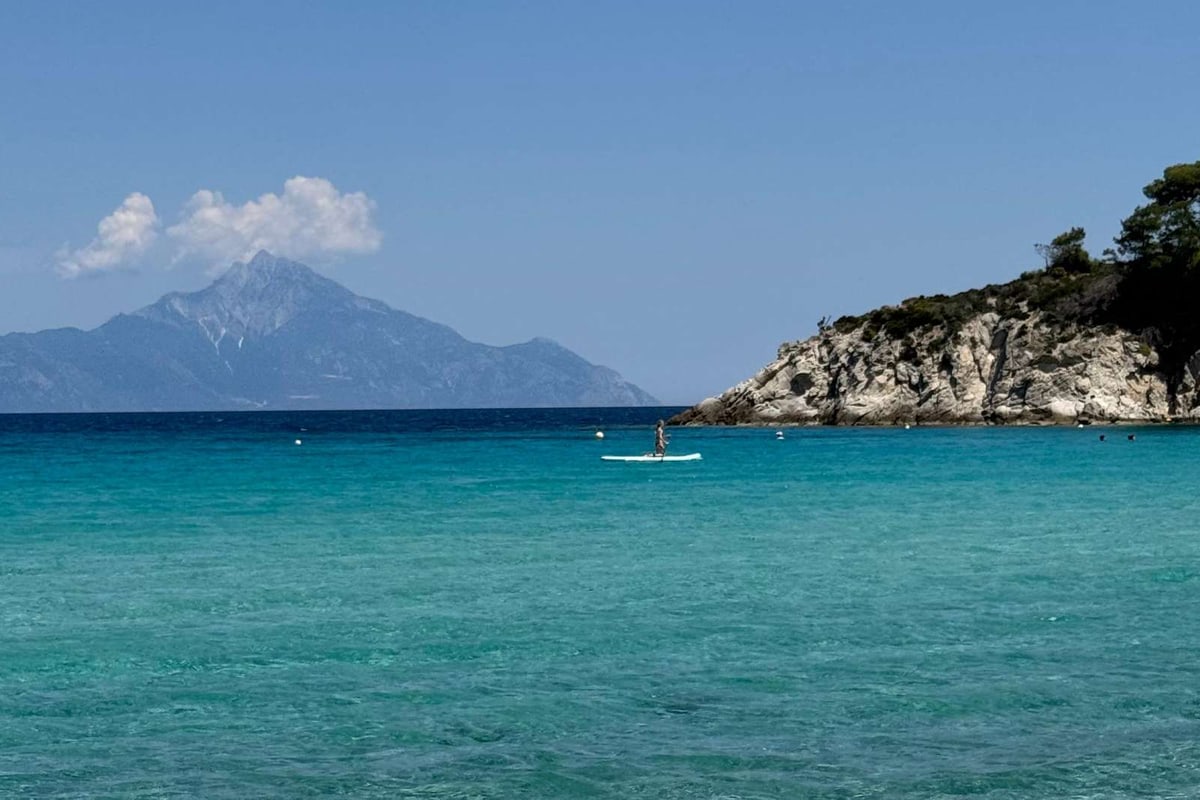
Sarti answers where to stay in Halkidiki for a traveller who wants to see Mount Athos from the beach. The hills around the village give panoramic views of the peninsula and the Aegean Sea. Walks up Mount Itamos begin at Sarti, among other places. The peak of Dragoudeli, 689 metres high, lies west of the village.
Toroni adds history to where to stay in Halkidiki. The Toronean Gulf is named after the town. The gulf forms between the peninsulas of Pallene and Sithonia. The site stayed inhabited until the seventeenth century. The modern town stands 1 kilometre to the north of the old site.
The old city spreads over three areas. These are the acropolis, the main city on the plateau, and the suburb on the neck of land. Parts of the old fortification are still visible on the ground. Excavators found 134 tombs in its Iron Age cemetery. Underwater surveys place parts of the agora and the old harbour below the sea.
Toroni answers where to stay in Halkidiki by the sea. The beach is a curve of thick yellow sand, and it measures 2.5 kilometres. Beside the harbour stands the fort of Lecythus, rebuilt in the Byzantine era. A small early Christian temple and cisterns belong to it. A room near the sand keeps beach and ruins within reach.
Porto Koufo is a natural harbour, and the historian Thucydides mentioned it. The ancient acropolis crowned a rocky hill, set between Lecythus and Porto Koufo. Kalamitsi, with its own beach, belongs to the Sykia community beside Toroni and Koufos. For where to stay in Halkidiki near the harbour, these three names sit close together.
A base in the far south settles where to stay in Halkidiki for a quiet stay with a car. The settlements stand on the coast because of the mountains in the middle. Only Sykia lies about 4 kilometres inland. The drive from the airport is long, so the far south suits a longer stay.
How do Ouranoupoli and the Athos coast answer where to stay in Halkidiki?
Ouranoupoli marks the point where the Athos peninsula begins, and only the monastic border lies beyond it. That position answers where to stay in Halkidiki for a base at the end of the road. A coast walk to old ruins starts at the village.
Walking east from the village along the shore reaches the ruins of Zygou Monastery, near the border. The monastery was left empty in the late twelfth century. Crusaders held it early in the thirteenth. Its other name is Frangokastro, the Castle of the Franks. For a walker, this route settles where to stay in Halkidiki.
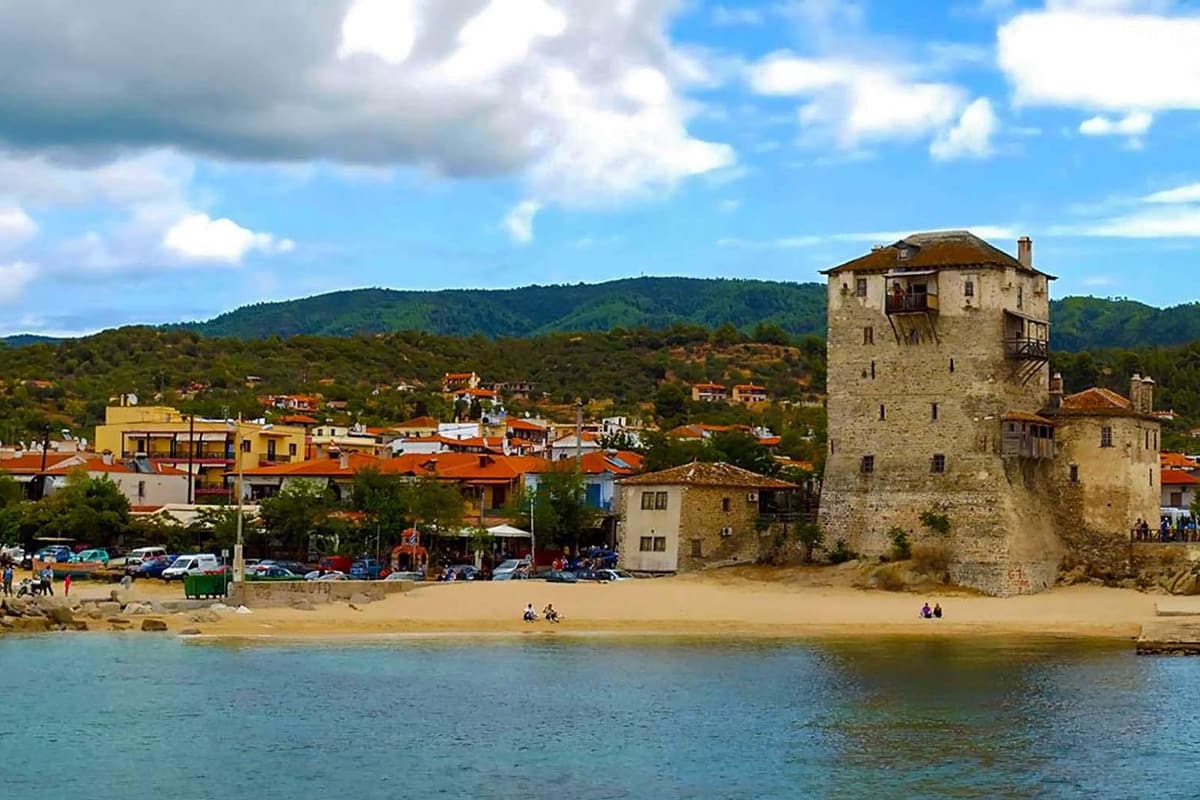
The Byzantine tower of the village stands at the beach. Only one asphalt road runs between Ouranoupoli and Thessaloniki, the article on the village states. The main port serves the daily ferries that carry male pilgrims to Dafni. In summer it also serves sightseeing cruises along the Mount Athos coast. A room by the harbour sits close to the boats.
Mount Athos has its own entry rule. Wikivoyage states it plainly: a permit is required, and only male visitors are allowed. The village lies before that border. For where to stay in Halkidiki on this coast, the choice is about the shore and the walks.
Ammouliani is the island base of the Athos side. It lies in the Singitic Gulf, and the article on it states that frequent transport runs from the mainland. The island was a dependency of Vatopedi Monastery until the early twentieth century. In nineteen twenty-five it was given to refugee families from Propontis, the Sea of Marmara.
On the east coast, Ierissos is a small town of the Akti peninsula, 10 kilometres from the monastic border. It answers where to stay in Halkidiki for a base with its own harbour. Ferries run from Ierissos to the east coast of Mount Athos. Its name comes from Ericius, a Latin word that translated Akanthos, the ancient city.
Ancient Akanthos lies on a ridge of three hills, 0.6 kilometres from the modern town. Andros sent colonists to settle it in the seventh century BC. Its remains include a circuit wall 8 metres high, a citadel and a deserted Byzantine church. The article on the site lists them. Wikivoyage says it can be visited from Ierissos.
Near the village of Nea Roda, the Xerxes Canal of the fifth century BC cut across the isthmus. Its northern mouth lay east of the village, and its southern mouth lay west of Tripiti. Ancient Akanthos lay north-west of the canal, on the isthmus that ties the Athos peninsula to the mainland.
Ancient Stagira stands beside the town of Olympiada, about 18 kilometres from the present-day village of the same name. Stagira dates to the seventh century BC, when Ionian settlers from Andros built it. Aristotle was born there. Walls, houses and public buildings remain visible. On the Athos side, where to stay in Halkidiki can follow the ruins as well as the sea.
How do the airport, the roads and the months shape where to stay in Halkidiki?
Flights land at Thessaloniki Airport, and the peninsulas lie beyond the city by road. The distance from Thessaloniki grows from 35 kilometres at the Petralona cave to about 140 at Ouranoupoli. That spread shapes where to stay in Halkidiki as much as the months do.
- Petralona cave: 35 kilometres from Thessaloniki, towards the south-east
- Ierissos: 115 kilometres from Thessaloniki
- Ammouliani: about 120 kilometres from Thessaloniki
- Ouranoupoli: about 140 kilometres from Thessaloniki
Thessaloniki Airport, officially Makedonia and once called Mikra, stands at Thermi. It opened to civilian traffic in nineteen forty-eight. Arrivals use the ground floor of the first terminal, and departures use the second floor. Car rental desks sit in the departure halls of both terminals. For where to stay in Halkidiki by road, that desk is the first stop.
Wikivoyage names the A24 motorway as the preferred way from Thessaloniki to Kassandra and Sithonia. It describes the road network as mainly rural roads in acceptable condition. Parking near beaches is found on unpaved open ground. A hire car links the bays. So where to stay in Halkidiki can follow the beach, not the bus line.
Wikivoyage lists the Halkidiki station in the Pylaia district as the terminus for buses from the peninsula. City bus line 45 joins it to the main intercity station, and a taxi rank serves it. KTEL buses also link the bases of the peninsula. The departures can be limited, so day trips by bus need planning.
Wikivoyage calls certain routes to Sithonia significantly slower by bus than by car. Where to stay in Halkidiki on Sithonia therefore means a hire car for the far bays. The other choice is a base beside the bus road.
In the article on Halkidiki, summers are hot and relatively dry, and winters are cool and wet. A winter snowfall does not last long. Wikivoyage describes the summers as long and dry. Outside midsummer, where to stay in Halkidiki points to a town with a harbour, such as Ierissos.
The Petralona cave suits any month. It opens at 300 metres, at the foot of Mount Katsika on its west side. A villager found a fossil skull there in nineteen sixty, stuck to the cave wall. The article states that the air inside stays at 17 degrees all year. A cave visit therefore fits the shoulder months as well as midsummer.
Put the three together: fly to Thessaloniki, choose the leg, then fit the base to the calendar. The long drives to Ierissos and Ouranoupoli run 115 to 140 kilometres. They make where to stay in Halkidiki a choice of road as much as beach. The Petralona cave asks for a short one.
Which questions do readers raise on where to stay in Halkidiki?
Four questions shape where to stay in Halkidiki: the first leg, the car, the length of stay and the food. Public pages answer each one. Examples are the mosaics of Olynthos, the roads of Polygyros, the ridge of Akanthos and the honey of Nikiti.
Does Kassandra or Sithonia suit a first stay?
Wikivoyage describes Kassandra as the more developed leg and the middle leg as less developed. On a first visit, that gap settles where to stay in Halkidiki before any village is named. Both legs have the mainland behind them, and the ancient city of Olynthos stands there.
Olynthos stood on two flat-topped hills, 30 to 40 metres high, about 2.5 kilometres from the sea. Wikipedia places it where the Gulf of Torone ends, near the neck of the Pallene peninsula. A day at the ruins adds a first outing to where to stay in Halkidiki on either leg.
The digs uncovered 108 buildings on the North Hill, set out on a grid. Each block held ten houses in two rows of five, with an alley between them. A floor mosaic shows Bellerophon on Pegasus facing the Chimera. Wikivoyage adds that the oldest mosaics found in Greece come from these digs.
On Sithonia, the village of Agios Nikolaos lies 110 kilometres south-east of Thessaloniki. Wikipedia puts it 2 kilometres inland of the Singitic Gulf. The Itamos range behind it is covered with pine forest. A first stay there answers where to stay in Halkidiki for a quiet shore.
Does where to stay in Halkidiki depend on a car?
A car makes where to stay in Halkidiki easier to settle. Wikivoyage says a car makes getting around Chalkidiki easy. It also says Kassandra is better served by buses than the rest of the peninsula. A stay on that leg leans less on the car.
No direct bus routes link Kassandra and Sithonia, Wikivoyage notes. A stay that explores both legs therefore leans on a car. A stay on one beach, with the village shops at hand, can go without one.
The inland towns have their own roads. Polygyros sits where the EO16a road ends in the south. That road meets the EO16, which runs from Thessaloniki to Arnaia, at Agios Prodromos.
The same article places Polygyros north-east of Nea Moudania and south-west of Arnaia. A day inland starts from the base you pick. The drive therefore belongs in where to stay in Halkidiki from the start.
What length of stay suits where to stay in Halkidiki?
Three nights fit one leg, and a week fits one leg plus a day inland. A longer stay adds a second base. The sights below lie away from the beach, so each one adds a day to where to stay in Halkidiki.
Polygyros keeps two museums. The Folklore Museum opened in nineteen ninety-eight. The Archaeological Museum shows finds from all over the peninsula, from the Paleolithic age to the Roman period.
Polygyros also holds carnival celebrations, as Wikipedia notes. A nearby place called Panagia is the setting of a religious celebration on the fifteenth of August.
Akanthos was a colony of Andros, founded in the seventh century BC. Its ridge of three hills lies south-east of modern Ierissos. Walls 8 metres high, a citadel and Hellenistic buildings show in the ground. The name comes from the acanthus, a plant that served as the model for the design on Corinthian capitals.
Olympiada had 638 inhabitants at the latest census. The village dates from nineteen twenty-three, when refugees from Asia Minor settled it. Its name honours Olympias, mother of Alexander the Great. Ierissos lies 35 kilometres away, and Thessaloniki lies 90.
Arnaia counts 5,564 residents, and its History and Folklore Museum stands in the town. Wikivoyage lists woven woollen articles of Arnea among the local goods.
Which food does the region keep?
Honey comes first. Wikivoyage lists Nikiti and Arnea as the two largest centres of honey in Greece, with flower and pine honey. Wikipedia adds beekeeping and olive growing to the work of Nikiti, besides tourism. A base near Nikiti answers where to stay in Halkidiki for a honey table.
Olives come next. Wikipedia calls the peninsula notable for olive oil and green olives. Wikivoyage lists Olynthos, Ormylia and Polygyros among the growing areas. It adds Nea Moudania, Mount Meliton, the Pallini peninsula and the Holomon foothills. At Agios Nikolaos, olive trees are the main crop of the plains.
Wine and tsipouro follow. Wikivoyage ties the wine to mild winters, long dry summers and mineral-rich soil. It names wine production in the Neos Marmaras area of Sithonia. Tsipouro is a strong spirit like ouzo, made by local villagers.
Fish belongs to the shore. Wikipedia lists tourism and fishing as the main occupations of Olympiada. The traditional fishery of Agios Nikolaos stayed within the waters of the Singitic Gulf. For where to stay in Halkidiki, a base in a fishing village keeps the catch close.