
Where to stay in Thessaloniki comes down to the quarter. The centre runs from the port to the White Tower along the Thermaic Gulf, Ladadika sits by the port, and Ano Poli climbs the hill under the old walls. The tours in Greece on the home page add the rest of a Greek trip.
This page covers the quarters one by one, then the airport, the station, the metro, the months and the day trips. The where to stay in Greece page compares the cities and islands, and the Vergina and Pella day trip and the Meteora day trip from Thessaloniki pages hold two days out of the city.
Which factors settle where to stay in Thessaloniki?
A stay in Thessaloniki starts with the quarter. The second-largest city of Greece spreads over a coast, a grid of streets and a hill above the sea. Where to stay in Thessaloniki comes down to four choices: the centre, the port, the upper town or the waterfront.
Thessaloniki is the capital of Macedonia. Only the municipality of Athens is larger by population, and Thessaloniki counted 319,045 people at the twenty twenty-one census. For where to stay in Thessaloniki, that size matters. Each quarter sits at a different height and a different distance from the sea.
Cassander founded the city in three hundred and fifteen BC. He named it for Thessalonike, his wife and a sister of Alexander the Great. Greeks also call the city the Symprotevousa, which means the co-capital, after its place beside Constantinople in the Byzantine Empire. Northern Greece has no larger city.
A short city break suits the centre. Wikivoyage says the commercial, entertainment and educational facilities of the city gather there. It also remains a densely populated residential area. Where to stay in Thessaloniki for a weekend therefore begins with the centre.
A room near the port or the station suits anyone arriving or leaving by ferry, train or coach. The waterfront suits a walker who wants the sea at the door. The upper town suits a quiet evening on old stone lanes, with a climb back after dinner.
Who travels matters as well. A first-time visitor fits the centre. A couple fits the waterfront or the upper town, and a family fits a base near the sea. Each answer to where to stay in Thessaloniki follows from who walks the streets.
Sights pull the base too. The city holds Roman, Byzantine and Ottoman buildings, and its Paleochristian and Byzantine monuments carry World Heritage status. A room close to the monuments you plan to visit shortens the walk back. That is a simple rule for where to stay in Thessaloniki.
A first night before the beaches of Chalkidiki suits a base near the southern edge of town. The urban area stretches 30 kilometres, from Oraiokastro at its northern end to Thermi at its southern end. The airport lies south of the centre, on the same gulf.
The length of the stay settles the rest. One night keeps close to the train, the coach or the ferry. Three nights give time for the sea, the centre and the hill. A central base then answers where to stay in Thessaloniki.
How do the quarters split where to stay in Thessaloniki?
The city centre is a grid of streets that run parallel and perpendicular to the coast. Where to stay in Thessaloniki follows that slope, from the waterfront at the foot to Ano Poli on the hill. The centre itself sits between them, around Aristotelous Square.
- The centre and Aristotelous Square
- Ladadika
- The port quarter
- Ano Poli, the upper town
- The White Tower waterfront
- Kalamaria, in the south-east
The delta of the Axios bounds the city on the west. The Thermaic Gulf lies to the south of it. The city rises from the shore to a height of 250 metres, so the slope shapes each choice. Every quarter is measured from the water.
Wikivoyage describes a seafront promenade 12 kilometres long. That single line of shore gives the city a waterfront quarter of its own. The White Tower stands on it. A room on the waterfront keeps the sea beside the door.
Five long streets run parallel to the shore. From the hill down to the sea, they are Kassandrou, Agiou Dimitriou, Egnatia, Tsimiski and Leoforos Nikis. Dragoumi, Venizelou, Agias Sofias and Ethnikis Aminis cross them. Every street that drops toward the sea ends at the waterfront.
The centre has a west side and an east side. The west holds the law courts, the railway station and the port. The east holds the two universities, the exhibition grounds and the central parks. The archaeological and Byzantine museums and the new city hall stand there too. Each side suits a different errand.
For where to stay in Thessaloniki, the municipality counts six municipal districts. The first holds the historical centre, the site of the Thessaloniki International Fair and the university. The second holds Vardari and Xirokrini, the third holds Eptapyrgio and Ano Poli, and the fourth holds Toumba.
The fifth district holds Charilaou and Analipsi, and the former municipality of Triandria completes the list. The municipality covers about one third of the Thessaloniki Urban Area. Kalamaria, Neapoli-Sykies, Pavlos Melas, Kordelio-Evosmos and Ampelokipoi-Menemeni are the other municipalities.
The surviving stretches of the old walls ring Ano Poli, which stands higher than any other quarter. Old squares and stone-paved lanes climb the hillside toward Mount Chortiatis. The Seich Sou forest park lies 3.5 kilometres from the centre and is reached through this quarter. A base in this quarter answers where to stay in Thessaloniki for quiet lanes.
Southeast of the centre, avenues and suburbs run along the gulf, and Kalamaria sits on that side. The airport lies further out on the same coast. A base there answers where to stay in Thessaloniki for a longer stay with the sea close by.
How does the centre around Aristotelous Square answer where to stay in Thessaloniki?
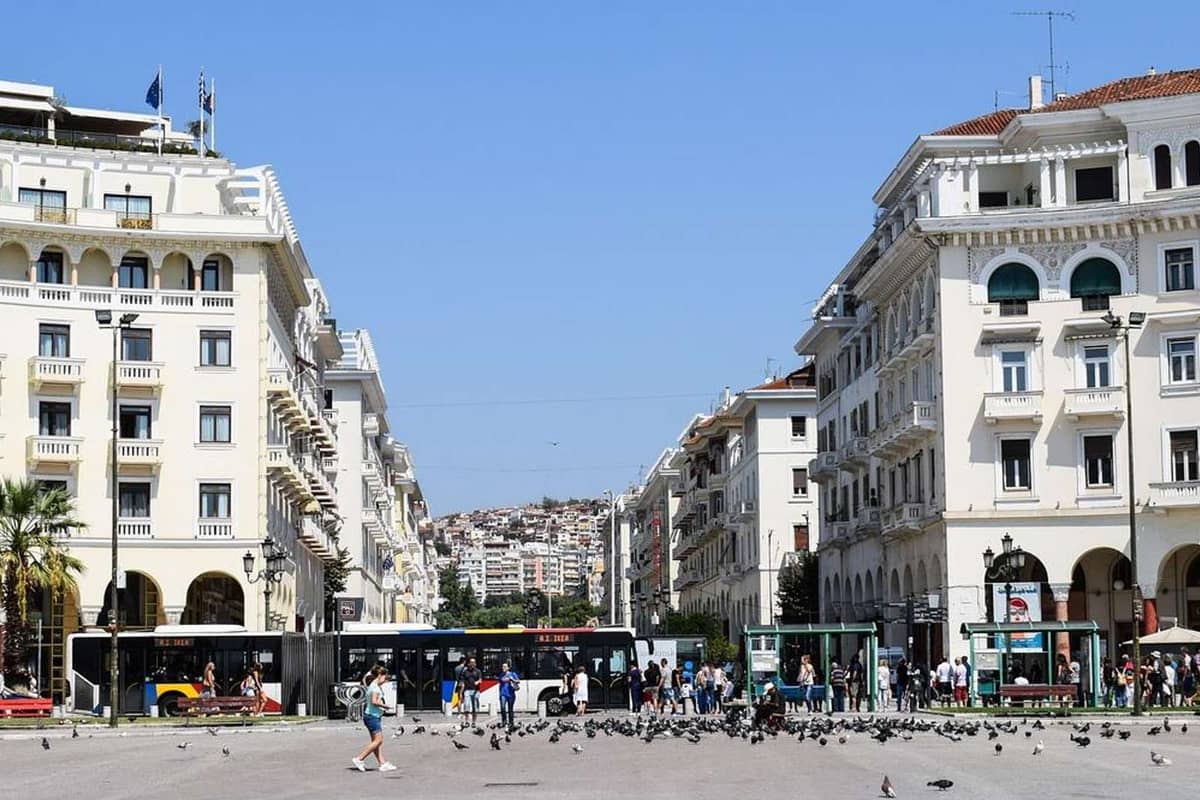
Wikipedia names Aristotelous Square as the central square of the city, set on Nikis Avenue along the waterfront. The streets around it answer where to stay in Thessaloniki with markets, shops, cafes and the sea close together. The square is the point where the grid of the centre meets the sea.
Ernest Hebrard, a French architect, drew the square in the year after the great fire of nineteen seventeen. His plan ran an axis from the sea up to Dikastirion Square and the Roman Forum. A room on this axis answers where to stay in Thessaloniki with the sea at one end.
The state lists the twelve buildings that frame the square, and the listing dates from nineteen fifty. The faces built in the nineteen fifties are plainer than Hebrard’s first drawings, as Wikipedia states. The square has two quarter-circle sides, and Mitropoleos Street cuts it in half.
Wikipedia groups the districts of the historic centre around the square. They include Kapani, Diagonios, Agia Sofia and Hippodromio. Each district has its own streets, so the choice of district settles the daily walk. This is the city-centre side of where to stay in Thessaloniki.
Kapani is the district where the central Modiano market stands. The oldest central market of the city is Kapani, which Wikipedia also calls Agora Vlali. Fish, meat, vegetables, fruit, olives, sweets, nuts and spices are on sale in its shops.
Modiano Market is an enclosed market of 70.6 by 35.4 metres. Builders raised it between nineteen twenty-two and nineteen twenty-five, and the architect Eli Modiano gave it his name. The restored hall reopened in December twenty twenty-two. A flat nearby answers where to stay in Thessaloniki for a guest who shops for food.
Wikipedia lists commercial stoas around the square. They carry the names of historic figures of the city, among them Hirsch, Colombou, Levi and Morpurgo. Modiano belongs to the same group of names.
Two churches of the UNESCO list add to the city. Saint Demetrius, the patron saint of Thessaloniki, has his main sanctuary in the Church of Saint Demetrius. Its crypt became an exhibition space in nineteen eighty-eight. Hagia Sophia holds an Ascension mosaic in its dome, ringed by the twelve apostles.
Wikipedia names Tsimiski Avenue, Mitropoleos Avenue and Proxenou Koromila Street as the shopping streets of the city. A city flat or a room on this grid keeps the shop doors, the cafes and the waterfront near. For a first visit and a short city break, the centre is where to stay in Thessaloniki.
How do Ladadika and the port quarter answer where to stay in Thessaloniki?
Ladadika is a landmark area of old trading streets near the Port of Thessaloniki, as Wikipedia describes it. Former oil stores and merchant warehouses now line its pedestrian lanes. For where to stay in Thessaloniki, the quarter pairs the harbour with evenings out.
- Ladadika: the old oil-store district, with pedestrian lanes and small squares.
- The Frankish quarter: beside Ladadika, home to French and Italian merchants from the late nineteenth century.
- The Port of Thessaloniki: 155 hectares on the Thermaic Gulf, with a passenger terminal.
- Warehouse A: the harbour address of the Museum of Photography and the Museum of Cinematography.
Four streets ring the core of Ladadika in the text that Wikipedia quotes: Tsimiski, Salaminas, Kountourioti and I. Dragoumi. The same text says the district kept much of its first street plan and building form. A room inside this block answers where to stay in Thessaloniki for a guest who walks.
The quarter stays open late in the evening. Its tavernas serve traditional meze, as Wikipedia describes the cooking of the city. A room above the lanes suits a guest who wants to be out late. A room two streets away suits a guest who wants an early night.
The Frankish quarter lies beside Ladadika, as Wikipedia states. French and Italian merchants settled there from the late nineteenth century. The Catholic church designed by Vitaliano Poselli stands in it. This quarter adds a second old district to where to stay in Thessaloniki near the port.
Boats leave the port for the Sporades, and Wikipedia names Skiathos, Skopelos and Alonissos. For a guest who sails on an early boat, a room near the quays answers where to stay in Thessaloniki. Timetables change, so check the current official lists.
A guest with a hire car can use the port too. Wikipedia counts two car parks, at Piers 1 and 2, with room for 595 vehicles. Ladadika sits near the port, so this side of the city keeps the quays and the car park in reach.
Wikivoyage places the Museum of Photography and the Museum of Cinematography in Warehouse A at the harbour. Wikipedia adds that the photography museum stands in the old port. Wikivoyage also puts a museum of Greek and Byzantine musical instruments on Katouni Street in Ladadika.
Rooms near the port and the railway station suit a guest with an early boat or train. In the words of Wikivoyage, Ladadika lies to the west of the city centre. That is where to stay in Thessaloniki for a night between two journeys.
How does Ano Poli answer where to stay in Thessaloniki?
For where to stay in Thessaloniki, Ano Poli is the upper town, the old hillside quarter above the centre. It occupies the highest ground in the city, under the acropolis. Its stone lanes and old Greek and Ottoman houses make it the base for a quiet stay with a view.
Where to stay in Thessaloniki for old streets starts here. The great fire of nineteen seventeen did not engulf the upper town. The hillside kept its narrow stone-paved lanes, small squares and houses in Greek and Ottoman style.
Byzantine walls from the end of the fourth century stand here, and their northern part adjoins the acropolis. In the Middle Ages they circled the city for four kilometres. The Ottoman authorities demolished the sea-facing section in the late nineteenth century. The surviving walls are on the UNESCO list with other Paleochristian and Byzantine monuments.
The Trigonio tower, called the Triangle Tower, has an observation deck just outside it. The Heptapyrgion, or Yedi Kule, occupies the north-east end of the acropolis. Its name means Fortress of Seven Towers, yet it counts ten. It served as a prison from the late nineteenth century until nineteen eighty-nine.
The Vlatades Monastery dates from the fourteenth century, the late years of the Byzantine Empire. UNESCO lists it with fourteen other monuments of the city. Where to stay in Thessaloniki near Byzantine sites has a short answer here. The monastery, the walls and the fort all stand in the quarter.
The top lanes look down on the gulf, so the hill answers where to stay in Thessaloniki with a view. Across the water, Mount Olympus shows on the horizon in clear air. Wikivoyage points to the late afternoon for the view over the bay. The quarter also gives access to the Seich Sou Forest National Park.
Lower down, the Arch of Galerius beside the Rotunda forms a pair of monuments from the early fourth century. The Rotunda is twenty-four and a half metres wide, and its walls are over six metres thick. Its dome reaches thirty metres. A minaret remains from the Rotunda’s use as a mosque.
A room on the hill asks for a climb back after a day in the centre. Where to stay in Thessaloniki for old stone and calm leads a couple or a walker to this hill. A short taxi ride takes the effort out of a late return.
How do the White Tower waterfront and Kalamaria answer where to stay in Thessaloniki?
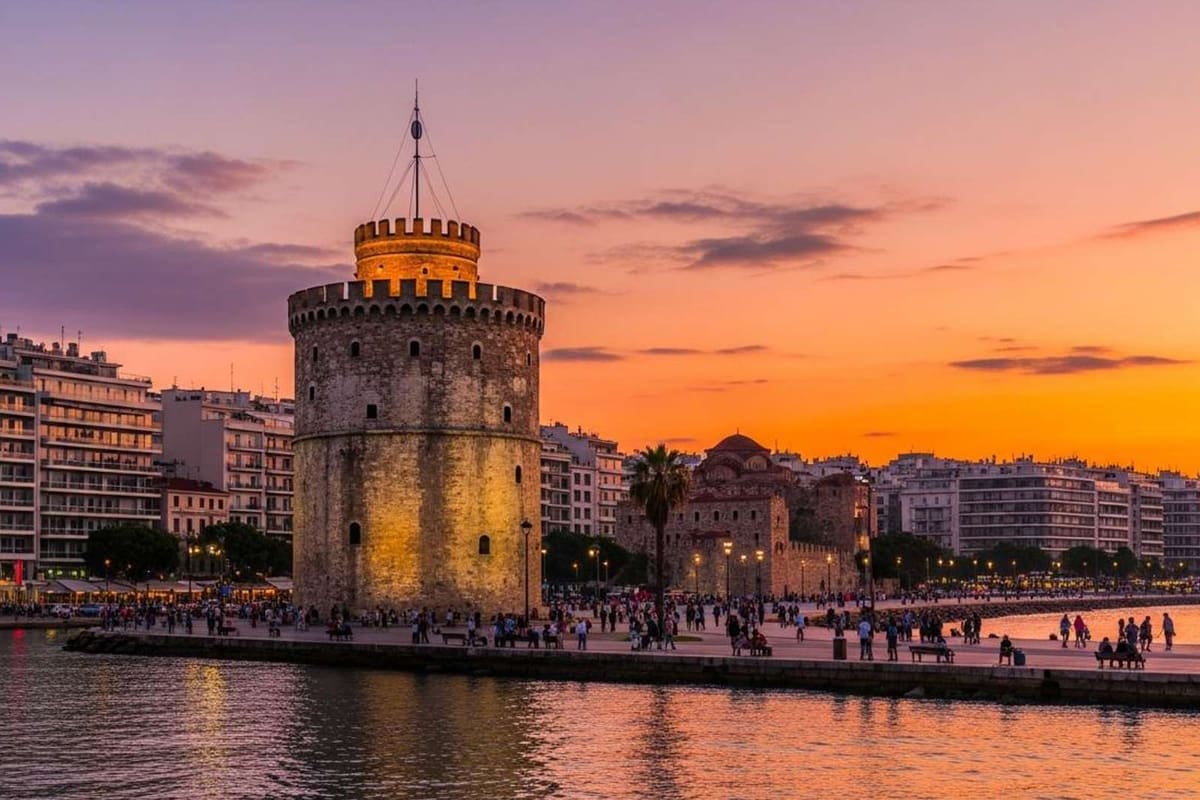
For where to stay in Thessaloniki by the sea, the White Tower waterfront has a museum tower and long parks. Its promenade holds an equestrian statue and runs for three kilometres. Kalamaria is the suburb to the south-east, with a coast of its own. The first suits a short city break, the second a longer stay.
- The White Tower stands about thirty-four metres high.
- Nea Paralia, the rebuilt promenade, runs from the tower to the concert hall.
- An equestrian statue of Alexander the Great, placed in nineteen seventy-three, stands on the promenade.
- The Museum of Byzantine Culture dates from September of nineteen ninety-four.
- The Thessaloniki Concert Hall opened in the year two thousand.
Where to stay in Thessaloniki on the waterfront starts with the tower itself. Its drum is twenty-three metres wide, with a smaller turret on top and six floors inside. A spiral ramp and a central room on each floor lead to the openings in the outer wall.
The tower has carried other names. It was the Lions Tower in the sixteenth century and the Fortress of Kalamaria in the eighteenth. The top of the tower has viewpoints, and the exhibition inside covers the history of the city.
Where to stay in Thessaloniki for evening walks is easy to answer here. The waterfront holds twelve thematic gardens and parks, and cafes line the front. The evening stroll, called the volta, belongs to the habits of the city. A statue of Philip II of Macedon faces the tower.
The Museum of Byzantine Culture, which organises the exhibition in the tower, has its own building on Leoforos Stratou. Its rooms follow Byzantine life from early Christian churches to the years after the fall of the empire. The collection holds about thirty thousand coins.
Where to stay in Thessaloniki for an evening of music points to the far end of the promenade. There the Thessaloniki Concert Hall has a main auditorium of 1,400 seats. A second building, in a more modern style, was designed by a Japanese architect.
Where to stay in Thessaloniki away from the centre leads to Kalamaria. It lies about seven kilometres south-east of downtown and has 92,248 residents. Its name first appears in the eleventh century. It comes from a phrase meaning port side, not from the Greek word for squid.
The suburb has ten districts, among them Nea Krini, Karabournaki and Finikas. Its coast measures six and a half kilometres, about two thirds of its border. Taki Ekonomidi Avenue links Nea Krini with the city centre. The old royal palace, called Palataki, stands at the western point of the Mikro Emvolo cape.
A room facing the gulf suits both choices. For where to stay in Thessaloniki on a longer visit, Kalamaria offers a dense residential suburb. The White Tower side keeps the sights close.
How do the airport, the station and the metro shape where to stay in Thessaloniki?
Where to stay in Thessaloniki depends on three fixed places. Thermi holds the airport, 13 kilometres from the city towards the south-east. The main railway station stands in the quarter of Xirokrini on Monastiriou Street. The metro links that station with the centre and the eastern suburbs.
For where to stay in Thessaloniki, the airport comes first. A T-shaped layout joins the two terminals, and the control tower sits where they meet. The second terminal opened at the start of twenty twenty-one. Two offices of the Greek National Tourism Organisation give information inside the terminals, as Wikipedia states.
Wikivoyage puts the flight to Athens at around fifty minutes. The airport has two runways, and a luggage storage room stands on the arrival floor.
A bus numbered 02X links the airport with the Nea Elvetia metro station. There the metro carries on toward the centre. The bus runs every twenty minutes through the day and hourly late in the evening. Bus 01X reaches the railway station and runs as 01N at night.
A licensed taxi wears dark blue paint and carries a taxi light. Hail one on the street or find one at a rank. At the airport, the parking area beside the first terminal serves taxis and tourist buses. After a late landing, a taxi settles where to stay in Thessaloniki for that first night.
The railway station opened in nineteen sixty-one to a modernist design by the architect Hans Kleinschmidt. It is the largest railway station in Greece, as its article states. Long-distance trains run from it to Athens, Alexandroupolis, Larissa and Florina. Wikivoyage counts up to six daily trains from Athens.
The station replaced an older and much smaller passenger station, which now handles cargo trains. A suburban railway links it with Larissa through Katerini and stops in the smaller towns that the intercity trains pass. A room near the station settles where to stay in Thessaloniki for a trip along that line.
Trains on the metro run without drivers, and Greece had no such system before. Line 1 starts at the New Railway Station and ends at Nea Elvetia, 9.6 kilometres on, with 13 stations. It opened on the last day of November in twenty twenty-four. With the second line, the system counts 18 stations.
The KTEL coach station for the main intercity network stands on Giannitson Street, on the western side. A base beside a metro stop suits a short stay. A base beside the railway station suits a morning train. Along this line, where to stay in Thessaloniki turns on the nearest stop.
Which months and day trips suit where to stay in Thessaloniki?
The climate sets the months for where to stay in Thessaloniki. Winters are cool, and summers are hot and moderately dry. September brings the Thessaloniki International Fair, and Chalkidiki, Vergina, Pella and Mount Olympus make the day trips. Each month and each trip points to a different quarter.
- Chalkidiki: Kassandra, Sithonia and Athos are its three peninsulas.
- Vergina: ancient Aigai, the first Macedonian capital, now holds UNESCO World Heritage status.
- Pella: the old capital of Macedon, with Thessaloniki founded 40 kilometres to its south-east.
- Mount Olympus: a massif near the Thermaic Gulf, about 80 kilometres from Thessaloniki towards the south-west, with Litochoro in its eastern foothills.
The article on the city calls its climate transitional. Winter nights are cold, and morning frost is common. The winter months are also quite windy there. In winter, where to stay in Thessaloniki favours a room near a metro stop or in the centre.
Rain falls now and then in summer. Fog appears on roughly 17 days of the year, chiefly in autumn and winter. In summer, where to stay in Thessaloniki leans toward rooms with a short walk to the sea.
The Thessaloniki International Fair has filled the first week of September since nineteen twenty-six. Its grounds hold 17 pavilions, and Sintrivani station stands next to them. Wikivoyage counts the fair grounds among the south-east limits of the city centre. At fair time, where to stay in Thessaloniki leans to the east of the centre.
November brings the film festival. The city keeps Saint Demetrius as its patron saint, and his day falls on the twenty-sixth of October. Both dates fall in autumn. In the shoulder months, the choice of quarter rests on the walk to the sea, not on the weather.
The regional unit of Thessaloniki touches Chalkidiki along its northern side. Buses toward it leave from a station in the east, not the main coach station. Wikivoyage times the bus to Toroni on Sithonia at three hours. By car it takes ninety minutes to two hours. For a Chalkidiki trip, where to stay in Thessaloniki follows the car.
Vergina, Pella and Mount Olympus are day trips that start early. A room near the railway station suits a train. A room near the coach station suits a coach. For a day away, where to stay in Thessaloniki means the quarter nearest the departure.
Which questions do readers raise on where to stay in Thessaloniki?
Four things shape where to stay in Thessaloniki: the first base, the nights, the car and the food. The centre suits a first stay: a Roman forum, a church and an Ottoman bath stand beside each other. Public pages supply the facts behind each answer below.
Does the centre or the waterfront suit a first stay?
The centre suits a first stay, because the old sights sit at the door. The sea stays near, as the city carries the nickname the Nymph of the Thermaic Gulf, which Wikipedia lists. A waterfront room then works as a second base on a longer visit. That split settles where to stay in Thessaloniki for a first trip.
The church of Panagia Chalkeon stands at Dikastirion Square, north of Egnatia Street. The Roman forum lies northeast of it, as Wikipedia states. The square keeps a courthouse name, because a court building was planned there until the ruins appeared. Its official name is Ancient Agora.
Bey Hamam lies along Egnatia Street, east of the church. Sultan Murad II built it in fourteen forty-four, and Wikipedia calls it the first Ottoman bath in Thessaloniki. It is a double bath, with separate parts for men and women. Each part runs through a cold, a tepid and a hot room.
Today the bath hosts cultural events and short exhibitions. A base in the centre answers where to stay in Thessaloniki for a visitor on foot.
Which length of stay fits where to stay in Thessaloniki?
Two nights cover the centre. Three or four nights add the museums and the streets around Navarinou Square. The count shapes where to stay in Thessaloniki. A short stay keeps one base, and a longer stay adds a second quarter.
Navarinou Square is named for the Battle of Navarino. Wikipedia dates the square to the Roman period and places the ruins of the palace of Galerius inside it. Hippodromus Square, the ancient site of the Hippodrome, lies beside it. Students meet there, and Wikivoyage lists crepe shops on nearby Gounari Street.
The Church of the Acheiropoietos stands on Agias Sofias Street, opposite Makedonomachon Square. Wikipedia dates its bricks and mosaics to the years from about 450 to 470. The basilica has three aisles, a wooden roof and green Thessalian marble columns in its tribelon. It measures 28 metres wide and 36.5 metres long.
The Jewish Museum stands at 13 Agiou Mina Street and opened in two thousand and one, as Wikipedia states. Its rooms follow Sephardic Jewish history and daily life in Thessaloniki. The Archaeological Museum on Andronikou Street shows The Gold of Macedon, with finds from cemeteries including Sindos and Derveni. Both museums fit a third day.
Does a hire car change where to stay in Thessaloniki?
The centre works without a car. Wikivoyage states that a parking space in the city takes time to find. So where to stay in Thessaloniki can rest on walking, the bus and the bicycle.
A cultural bus line, numbered 50, loops in a figure of eight past the major sights. It leaves the White Tower on the hour, and the whole route takes 50 minutes. An English-speaking tour guide aboard provides maps and information, as Wikivoyage describes.
Wikivoyage describes a bicycle lane along the seafront. It adds that the other roads are narrow and that main roads can lack a bicycle lane. A bike therefore suits the front, and the bus suits the rest.
A day on the Chalkidiki peninsulas changes the answer. On the Chalkidiki peninsulas Wikivoyage rates the car easier than the bus. No direct bus runs between Kassandra and Sithonia. A hire car earns its place only on such a day. Where to stay in Thessaloniki stays a city question.
Which food shapes where to stay in Thessaloniki?
A base near the bakeries puts the specialities on foot. Wikivoyage calls bougatsa a classic Thessaloniki breakfast and suggests cacao milk or coffee beside it. That one pastry already answers where to stay in Thessaloniki for a food-led stay.
Wikipedia describes bougatsa as a filling wrapped in phyllo. It bakes for about 30 to 35 minutes, then the cook cuts it small and serves it hot. The fillings are semolina custard, feta cheese, mizithra cheese or chocolate cream. The names bougatsadika and bougatsopolia mark shops that sell nothing but bougatsa.
Wikivoyage names two small breads. Koulouri is a sesame ring sold in bakeries and from carts, and stafidopsomo holds raisins. It describes trigona as triangles of thin phyllo filled with cream. Sweet shops fit where to stay in Thessaloniki, since any Greek expects a gift of sweets from Salonica.
The evening moves to the ouzeri. Wikivoyage pairs ouzo or tsipouro with small dishes such as fava beans, octopus and mussels. It also states that the frappe, an iced coffee, was invented in nineteen fifty-seven at the Thessaloniki International Fair. The central ouzeri keep that evening close to a room in the centre.