
Where to stay in Naxos depends on the part of the island you pick. Naxos Town and the Portara face Paros on the west coast, the long sandy beaches run south from Agios Prokopios to Pyrgaki, and the marble villages of the interior sit below Mount Zas. The tours in Greece on the home page add the rest of a Greek trip.
This page covers the bases one by one, then the port, the airport, the buses, the months and the day trips. The where to stay in Paros page covers the island across the strait, the Naxos catamaran cruise page holds a day at sea, and the island hopping page links Naxos with the other Cyclades.
Which factors settle where to stay in Naxos?
Where to stay in Naxos turns on one thing first: how far you want to be from the sea. Naxos tops the Cyclades in size, so the town, the sand and the hill villages sit well apart. Each base brings its own kind of day.
Wikipedia gives Naxos 124 people per square kilometre. Those people live in a town, a line of beach communities and a string of hill villages. For where to stay in Naxos, the choice lies between settlements that differ in kind. It is not a choice between streets of one big town.
Match the base to the trip. A first visit points to the town. A beach week points to a sandy bay south of it. A walker points to a mountain village. A quiet week points to a small bay off the main road. Each pick answers where to stay in Naxos in its own way.
Length of stay matters as well. A short stay between ferries needs a base a short walk from the port. A week or more with a car opens the whole island. Wikivoyage calls the villages of the interior easily reachable by a well-maintained road system. Where to stay in Naxos for a week can then be two bases.
Room kinds follow the base. A room with a sea view or a studio with a kitchenette fits the beach communities. A stone village house fits the interior. A villa with a pool fits a family that stays longer and has a car. Where to stay in Naxos also means choosing the room that the base can offer.
The evening plan counts as well. A base in the town puts shops and cafes at the door. A beach base keeps a short row of them near the sand. A village base trades them for quiet and a slow walk before dinner.
These nine bases run from the town down the west coast, then inland, then to the north and the east. Together they cover where to stay in Naxos on this page. Each one has its own section, and each section gives the place facts first.
- Naxos Town
- Grotta and Agios Georgios
- Agios Prokopios and Agia Anna
- Plaka and Orkos
- Mikri Vigla, Kastraki and Pyrgaki
- Chalki and Filoti
- Apiranthos and Koronos
- Apollonas
- Moutsouna
Two fixed points shape every pick: the harbour in Naxos Town and the airport near Agios Prokopios. The airport article puts the airport 3 kilometres from the city. Where to stay in Naxos begins at the point where you arrive.
How do the areas split where to stay in Naxos?
Where to stay in Naxos splits along one line: the coast against the mountains. The town and the beach communities hug the west coast. The centre climbs to Mount Zas, whose summit stands 1,001 metres above the sea, the highest in the Cyclades.
- The west coast: Naxos Town and the beach communities south of it
- The south-west: the long beaches from Plaka to Mikri Vigla and Pyrgaki
- The centre: the valleys of Chalki, Damarionas and Filoti
- The mountain villages: Apiranthos and Koronos
- The north and the east: Apollonas, Lionas and Moutsouna
According to the city article, the town stands on Naxos’s west side. Wikivoyage says a number of beach communities extend south along the coast from it. That makes the west strip the one place where the harbour, the town and the sand join. Where to stay in Naxos with the least travel starts here.
The island article lists Plaka, Mikri Vigla, Kastraki, Aliko, Agios Prokopios, Agia Anna and Agios Georgios as beaches. It says the greater part of them sit near Chora, on the west. For a stay built around sand, where to stay in Naxos means picking one name from that list.
Ten kilometres inland, Wikivoyage finds green mountain valleys in place of the flat land around the town. Olive and lemon groves surround the small villages there, and two chains of mountains rise above them. Where to stay in Naxos changes character here: a footpath and a stone village replace the beach.
The valleys feed a farming island. The Cyclades article names Naxos as the exception, where the soil of the other islands is not very fertile. The island article adds that Naxos is known within Greece for its cheese, its potatoes and its citron spirit.
The villages of the centre are older than those around the coast, Wikivoyage states. They stand high in the hills on steep narrow streets. For where to stay in Naxos, that brings walking, views and cooler air, with the sea a drive away.
The north and the east are the far coasts. Wikivoyage places a beach below the village of Apollonas in the north. It puts the tiny harbours of Lionas and Moutsouna on the east coast. Where to stay in Naxos on these shores means a base far from the town.
Use the five zones as a rule of thumb to narrow the list. Sand and the harbour point west. Groves and stone houses point to the centre, and quiet points to the north and the east. Each zone trades distance to the town for something else. That trade decides where to stay in Naxos.
Why does Naxos Town lead where to stay in Naxos?
Naxos Town, called Chora, leads where to stay in Naxos. The harbour, the castle quarter and a town beach all sit together on the island’s western shore. Wikipedia gives 8,897 residents for the town. Wikivoyage adds that the shops and restaurants used by visitors gather here.
Where to stay in Naxos begins at the castle gates. A round fortress crowns the hilltop of the ancient city’s acropolis, with a whole medieval town inside. Wikipedia names the main gate Trani Porta, meaning Great Gate, and the secondary gate Paraporti, meaning side gate. Large houses with family crests above the doors stand inside.
The round Crispi tower, also called the Glezos tower, stands beside the main gate. It is the only tower of the castle that survives, and it now houses a museum. Of the Sanudo tower in the central square, only remains are left. Its height is thought to have exceeded 30 metres.
Where to stay in Naxos on foot depends on the quarter. Bourgos lies north of the castle, and all its roads lead to the castle or to the sea. Nio Chorio lies south and south-west of the Kastro. Wikipedia says its streets are wider and less sloped than those of Bourgos, so residents drive on parts of them.
Beyond the old quarters the town grew in the twentieth century. The new area lies south of the Old Town. Agios Georgios Beach bounds it on the west, and the road to the villages bounds it on the east. Its asphalt streets form a grid. Local building rules keep new houses close to the traditional style.
In the north-west corner, the Port of Naxos has a breakwater and piers. The Paralia is a promenade with a walking street lined by shops and restaurants. In summer its car lane shuts at night, and walkers take over. A room near the Paralia answers where to stay in Naxos with the quay and shops at the door.
The Archaeological Museum of Naxos is among the landmarks the town article lists. Wikivoyage adds a folklore museum on Old Market Street. It also lists a theatre museum named for Iakovos Kambanelis, a writer born in Naxos in nineteen twenty-two. All three sit under the Chora heading, so where to stay in Naxos can mean a base in town.
Rooms inside the old lanes put arched passageways and white houses at the door. Rooms on the edge of the town sit near the beach and on wider streets. Bourgos has narrow, winding streets, so light bags help there. For where to stay in Naxos, either type keeps the walk to the port short.
How do Grotta and Agios Georgios answer where to stay in Naxos?
Grotta and Agios Georgios answer where to stay in Naxos with a town beach at either end of the centre. Grotta is the beach on the north side, and Agios Georgios bounds the new quarter on the west. Both belong to Naxos Town itself.
- Grotta: the beach on the north side, named from the Venetian word for a cave.
- Palatia: the small islet that carries the Portara, linked by a causeway.
- Agios Georgios: the beach on the western edge of the new quarter.
- The new quarter: grid streets lying south of the old lanes.
Grotta takes its name from Grota, a Venetian word for cave. Small caves lie under the cliff at Aplomata, which is also called New Grotta. Where to stay in Naxos on the north side means a room near that cliff and the northern beach. Wikipedia names Grotta as both the beach and the nearby part of the town.
The area holds old churches and the oldest primary school of the town, which has worked since eighteen thirty-five. Finds from the Cycladic and Mycenaean civilisations come from this area too. Grotta counts as one of the four parts of the Old Town, so the castle and the lanes lie close.
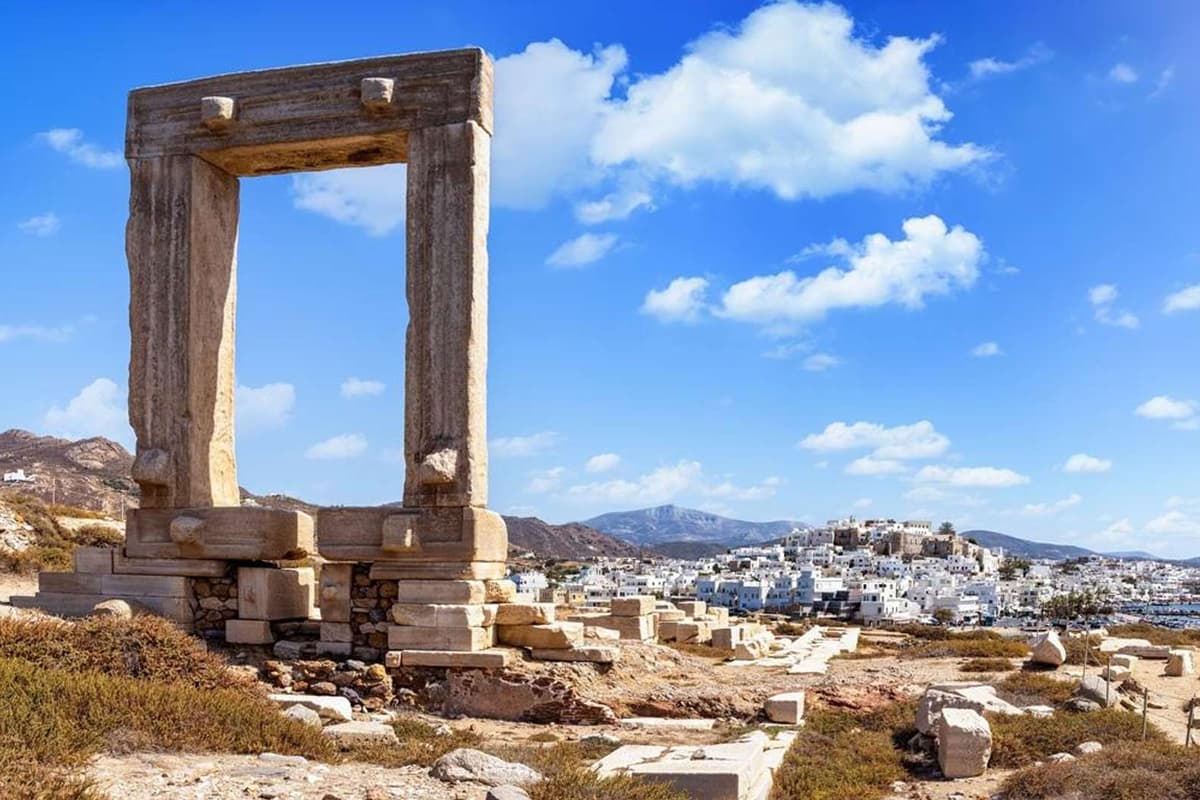
Where to stay in Naxos near the Portara needs no boat. The gate belongs to the small islet of Palatia. A causeway from nineteen nineteen links the islet and the town. The islet marks the northern limit of the harbour.
Wikipedia calls the temple a landmark of the town and an emblem of the whole island. Its entrance lies on the north-west side. In the ninth century a church of Saints Nicholas and Constantine was added to the ruins.
Agios Georgios is the beach of the town itself. The town article counts the beach as a landmark and as the western limit of the newer streets. Where to stay in Naxos by this beach means a room on the grid streets south of the old lanes.
Families and water sports share this sand. Wikivoyage lists a water sports club on St George Beach with windsurfing, catamaran sailing, beach sports and mountain bikes. The national tourism organisation of Greece describes the long beaches of the island as ideal for families and water sports.
Family rooms by the sand suit where to stay in Naxos for a short stay, since the harbour is near. A first visit can use Grotta for the northern beach and Agios Georgios for the southern one.
How do Agios Prokopios and Agia Anna answer where to stay in Naxos?
For where to stay in Naxos, Agios Prokopios and Agia Anna give one run of sand on the west coast. The municipal page puts Agios Prokopios five kilometres from Chora and Agia Anna six. A bus runs every half hour from morning until late at night.
Wikipedia calls Agios Prokopios a seaside village and gives it 182 residents, from the census count it cites. The village is small, so the beach is the reason to choose it. That makes Agios Prokopios a direct answer to where to stay in Naxos for a week of sand.
The municipal page describes coarse sand and dunes, with water that runs through blue, deep blue and turquoise. Umbrellas and sunbeds cover the greater part of the beach. The western edge is quieter, and the chapel of the same name stands there. The two ends differ, so pick the end before the room.
Shops, taverns, cafes and rental agencies for cars and motorbikes stand at the eastern flank, the page states. Rooms for rent and hotel accommodation are on offer across the wider area. A room at that end keeps daily needs close, which suits where to stay in Naxos on a short visit.
The page lists windsurfing, beach volleyball and sea bicycles as water sports here. It adds that the saltpan called kokkini limni, the red lake, is worth a visit and frequently attracts herons. Parking space is set at points along the beach. The village itself keeps one small church.
A resort place called Stelida lies not far from the village. The Naxos article adds a Stelida quarry south-west of Chora, with Mousterian stone tools of the Middle Paleolithic. It ties those tools to Neanderthal activity on Naxos. For where to stay in Naxos, that gives a beach week an older story.
Agia Anna continues the sand of Agios Prokopios. The municipal page adds a juniper forest that gives natural shade beside the golden sand. A little port with fishing boats ends the stretch, which gives where to stay in Naxos a small harbour option. The same half-hourly bus serves it.
Sunbeds stand in front of beach bars and tavernas along the greater part of the beach. The segment by the chapel holds small, windless bays. A ramp of wood, fit for prams and bicycles, climbs to the chapel, and its yard offers a view. The page recalls young tourists camping on this beach through the nineteen seventies and eighties.
For the Greek National Tourism Organisation, the long beaches of Naxos are ideal for families and water sports. Wikivoyage describes the west side of the island as sheltered and flat, with sea breezes along the coast. Read together, the two lines describe a gentle west coast.
How do Plaka and Orkos answer where to stay in Naxos?
Plaka and Orkos answer where to stay in Naxos with long sand and small inlets along the west coast. The municipal page calls Plaka an endless stretch of golden sand that continues Agia Anna. It calls Orkos a series of small inlets between Plaka and Mikri Vigla.
- Plaka beach: golden sand, dunes and junipers by the water.
- Plaka dunes: sea lilies adorn them after August, as the municipal page notes.
- Plaka, Agia Anna end: a group of rocks and small coves, hidden from the road by trees.
- Orkos: shady, isolated inlets with coarse sand and clear blue water.
The Greek National Tourism Organisation pairs endless sandy beaches with quiet bays. Its beach list starts with Agios Prokopios and Agia Anna, passes Plaka and goes further on. Wikivoyage names Plaka and Orkos side by side in its own list of sandy stretches.
The municipal page recalls Plaka as a favourite of the hippies during the sixties and seventies. It is now an organised beach with umbrellas and sunbeds, and junipers give natural shade near the water. Cafes, beach bars and tavernas stand along its length. Plaka is the long-beach answer to where to stay in Naxos.
Wikivoyage mentions sand dunes at Plaka that block the view from the access road. It places rocks and small coves at the end of the beach nearest Agia Anna. Trees hide them from the road. A room near that end answers where to stay in Naxos for a cove day.
The sand continues from Agia Anna, which the municipal page puts six kilometres from Chora. Parking is possible along the entire length of Plaka. Bus connections from Chora run throughout the summer months. Outside those months, check the timetable before you book a room.
Orkos sits on the south-western side, between Plaka and Mikri Vigla. The municipal page calls it shady and isolated, with coarse sand and clear blue water. It names families, couples and nature lovers as the visitors it suits. For peace by the water, Orkos answers where to stay in Naxos.
A studio with a kitchenette fits a week on this coast, where the sand sets the plan for each day. The beaches face west, so the evening light falls on the sea. That makes a studio here a calm answer to where to stay in Naxos.
Agios Prokopios and Agia Anna keep the shops and the half-hourly bus close. Plaka and Orkos carry the same coast on, with junipers, dunes and small inlets. Where to stay in Naxos then depends on how far from Chora you want to sleep.
How do Mikri Vigla, Kastraki and Pyrgaki answer where to stay in Naxos?
For where to stay in Naxos on the south-west shore, Mikri Vigla puts two beaches beside one small village. Wikipedia places it about 18 kilometres south of Naxos city. Parthena, 600 metres long, lies to the north, and Limanaki, 3,200 metres long, lies to the west up to Kastraki.
The Greek name Mikri Vigla means little lookout, Wikipedia explains. The article describes a small village noted for the beaches near it. A stay here is a choice of beach: the shorter Parthena or the long Limanaki. Where to stay in Naxos on this shore starts with that choice.
Limanaki ends at Kastraki village, so the two bases share one long beach. The Filoti article names Kastraki among the coastal settlements with the greatest activity in the Neolithic and Archaic periods. A stay here sits on ground that people used in those early periods.
Wikipedia describes Naxos as a windy island that suits windsurfing and kitesurfing. Wikivoyage adds that a number of its beaches have winds that favour both sports. Both pages treat the wind as a trait of the island, not of one beach. Where to stay in Naxos for a water-sports week starts with a question about the wind.
Wikivoyage places Aliko and Pyrgaki in its list of other beaches. It sets Aliko beach next to a cedar forest it calls unique, on the road from Hora to Pyrgaki. Pyrgaki therefore marks the other end of that road.
Eighteen kilometres is a long way for a daily walk to the harbour. A base here suits a hire car, a scooter or the island bus. For where to stay in Naxos, the south-west answers readers who accept that drive for beach days and quiet evenings.
Rooms here come as a villa with a pool, a studio with a kitchenette, or a sea-view room. A couple or a family that wants one beach for a week fits the pattern. Where to stay in Naxos then shifts from the town to the sand. A trip to the town becomes a ride, not a stroll.
Wikivoyage writes that the majority of visitors from abroad stay in the beach towns close to Chora. It adds that it is easy to leave them behind in the rural centre or further along the coast. Kastraki and Pyrgaki lie further along that coast. Where to stay in Naxos for quiet can end at either village.
How do Chalki, Filoti and the Tragea answer where to stay in Naxos?
For where to stay in Naxos in the centre, Chalki and Filoti sit in a secluded valley below Mount Zas. Filoti stands 400 metres above the sea, 18.2 kilometres from Naxos city. Its census of two thousand twenty-one counted 1,617 residents. Tragaia, the former municipality, had its base in Chalki.
- Chalki: neo-classical architecture and red roofs, as Wikivoyage describes them
- Filoti: three settlements spread over two hills
- Gefira: the village square, with its old plane tree
- Cave of Zas: on the western slope of the mountain, with finds from the Neolithic period
Wikipedia ties Chalki to the centre in two ways. Chalkeio, at the centre of the island, was the seat of the old Drymalia municipality. In eighteen forty, the Filoti article says, Filoti joined the municipality of Tragaia, based in Chalkeio. Where to stay in Naxos at Chalki means a village that was a local centre.
Wikivoyage calls Halki a good example of Greek neo-classical architecture, with a cluster of red roofs. The national tourism site lists it among the traditional villages around Zas and calls it warm-coloured. The island article shows the church of Panagia Damiotissa at Chalki in its gallery.
Wikipedia dates the first kitron distillery to eighteen ninety-six, in the village of Halki. Wikivoyage adds that the production of the liqueur can be viewed at the old distillery there, with tastings. A stay in Chalki puts that visit in the same village. That is one more answer to where to stay in Naxos.
For the villages around Zas, the national tourism site mentions stone towers that bear witness to the Venetian presence. It also mentions scattered Byzantine churches with frescoes. Where to stay in Naxos can then mean a stone village house among those sights.
Wikipedia counts Filoti as the largest village of the island by population. Its economy rests on livestock products first, with farming and tourism after them. The village has a primary school, a post office, a regional doctor and a pharmacy. For where to stay in Naxos, that means a working village.
Filoti spreads over two hills as three settlements: Rachidi, Klefaros and Lioiri. The old parts hold paved lanes laid out like a maze, plus arches and covered passages, the article notes. Its status as a traditional settlement dates from nineteen eighty-eight. Gefira, the village square, is named for a bridge and a stream that once stood there.
Mount Zas overlooks Filoti, and Zeus’s cave lies about 628 metres up its western slope. Excavations in the nineteen eighties and nineties found human presence in the cave from the later Neolithic period onward. The Filoti article places the cave near the village.
The climb to the top has a pair of main routes, Wikipedia counts. The Agia Marina chapel is the trailhead of the easier one. Zeus’s cave sits on the harder one, which begins at the nearby Aria Spring. Wikivoyage puts that spring near Filoti. A walker who weighs where to stay in Naxos can settle on Filoti.
How do Apiranthos and Koronos answer where to stay in Naxos?
For where to stay in Naxos, Apiranthos and Koronos give a stone-village base in the mountains. The Municipality of Naxos and Small Cyclades places Apiranthos at the foot of Mount Fanari, 28 kilometres from Chora. Koronos lies the same distance away, reached by the island’s main road network.
The municipality puts Apiranthos at 600 metres above sea level. Wikivoyage finds the air cooler inland, among the mountains and valleys, than on the coast. Where to stay in Naxos with that height means a village stay away from the beach. A bus or a car covers the sand.
Slabs of marble pave the lanes of Apiranthos, and arches span them, the municipality states. At the village entrance stands the Zevgolis Tower of the seventeenth century, built on a rock. The Church of Panagia Aperathitissa, of the eighteenth century, rises on the main street.
Wikipedia counts four museums in the village. Their subjects run from digs to rocks, folk art and wildlife. The municipality adds a small children’s art museum and a library that it calls the largest in the Cyclades. For where to stay in Naxos, those museums fill a slow afternoon without a drive.
The Geological Museum holds about 2,000 exhibits, the municipality says. The Natural History Museum shows the area’s fauna and flora and a small aquarium. Wikivoyage describes the Folk Art Museum as three rooms. They look like a village house of the eighteenth or nineteenth century.
The dialect and customs of Apiranthos set it apart from other Naxos villages, the municipality states. Wikipedia notes a likeness to the mountain villages on Crete. Where to stay in Naxos here means living inside a village with its own voice. A regular bus links it with Chora.
Koronos stands on the slopes of Mount Koronion in the north-east, the second tallest mountain of the island. The same Wikipedia page puts Koronos at 630 metres, the second highest altitude among the island’s villages. For where to stay in Naxos, Koronos adds a ravine setting between Mount Amomaxis and Mount Koronos.
Apiranthos, Koronos and Keramoti share the name Smiridohoria, which Wikipedia explains as the emery villages of Naxos. On where to stay in Naxos, that gives the mountain base a working past. The municipality adds that Koronos prospered from emery mining before World War II. Its houses keep their traditional architecture, and a regular bus serves the village.
A short way from Moni, on the road to Chalki, stands the Church of Panagia Drossiani, the municipality states. It belongs to an old monastery and has bare stone walls. Its three-part attic carries a dome, and three chapels adjoin the north side. Wikivoyage calls it the island’s chief Byzantine monument.
A group of the saved frescoes dates to the sixth century and is considered among the oldest in the Balkans. The rest belong to the eleventh to the fourteenth centuries. The name comes from Drossia, the word for coolness. On where to stay in Naxos, a house at Moni puts this church close by.
How do Apollonas and the north answer where to stay in Naxos?
For where to stay in Naxos, Apollonas is the port village of Komiaki. It sits on the north-east coast, near an ancient marble quarry. The municipality describes white houses behind a sandy beach, rooms to let and a public bus. The unfinished kouros lies very near the village.
- Apollonas: the port village of Komiaki, on the north-east coast.
- Kouros: an unfinished marble statue longer than ten metres, reached by a footpath.
- Engares: a farming village on the western road, 6 kilometres from Chora.
- Roads: the western road through Engares, or the central road to Stavros Keramotis.
Apollonas has been inhabited since antiquity because of the marble quarry to the north and west, the municipality states. The port shipped Naxos marble for as long as the ancient quarry worked. Remains of the old port lie at the place called Marmara. Where to stay in Naxos here puts that marble story at the door.
Wikipedia gives the Kouros of Apollonas as 10.7 metres tall. Light grey Naxian marble forms the block, and the weight is about 80 tonnes. The same page places it in the Archaic period, at the change from the seventh century BC to the sixth. An unpaved track leads up to the quarry where the statue lies, not far from the village.
The beard led scholars to read the figure as Dionysus rather than Apollo. The same page lists the name Colossus of Dionysus. Two more unfinished kouroi, the Kouroi of Flerio, lie in a village garden at Melanes. For where to stay in Naxos, Apollonas is the base closest to the largest one.
Two roads lead north from Chora, the municipality states. One is the main western road through Engares. The other is the central main road to Stavros Keramotis. A public bus serves Apollonas with daily connections, especially in the summer season. Rooms by the small harbour keep the walk to the sand short.
Engares, which the municipality spells Eggares, lies 6 kilometres from Chora on the western road toward Apollonas. It calls the place a small farming village in a fertile plain with plentiful waters. On where to stay in Naxos, Engares is a village stop on the way north.
Two restored olive mills stand in the village. The older press is dated eighteen eighty-four, and the other mill now houses the municipal office and the clinic. Two streams cross the village, and the Lagada area holds seven listed watermills that worked until the nineteen sixties.
The north-east coast between Apollonas and Koronos is almost uninhabited, the municipality’s route page states. It has small bays and vineyards, and sheep and goats graze there. A long uphill track climbs from the harbour to Koronos. For where to stay in Naxos, Apollonas pairs the harbour with this quiet coast.
How do Moutsouna and the east coast answer where to stay in Naxos?
Where to stay in Naxos on the east coast starts at Moutsouna, a small seaside village. The village article puts it about 39 kilometres from the capital of the island. The article calls the bay relatively open and the port facilities limited. It suits slow days far from the town.
The village has a working past. The article says boats loaded emery there until the early nineteen eighties. The emery came from mines high on the mountain and reached the port by cableway. What is left of that cableway and its transfer station is still visible. Where to stay in Naxos here means a room beside an old port.
Moutsouna stays small. The article counts 84 inhabitants at the last census it cites, against 65 in nineteen sixty. The village lies 11 kilometres from Apiranthos and belongs to the Apiranthos area, joined by road. Where to stay in Naxos at this scale means a quiet village with the capital far down the coast.
The Municipality of Naxos and Small Cyclades describes two beaches in the cove. Ai Giannis lies in front of the tavernas inside the village. Tigani lies a little further south. Both have fine sand and clear shallow water. For where to stay in Naxos with young children, the page calls the cove ideal.
Public transport runs daily to Moutsouna in the summer months, the same page states. Parking space lies next to Ai Giannis beach. A detour once past the village leads to Tigani, with parking metres from the sand. The coast beyond the village is easier by car. Where to stay in Naxos on this side suits a driver.
From Moutsouna a seaside road runs on to two more beaches. Panermos sits in a gulf on the south-eastern coast. The municipal page calls it almost always windless. A small pier serves it. Psili Ammos has fine sand and shallow water before a juniper forest, with Koufonissi in view.
The southernmost point of Naxos holds Kalantos. A 24 kilometre rural road joins it to Filoti and is mostly asphalt. The page lists private transport and taxi only. Lionas lies on the north-east coast, 8 kilometres by asphalt from Koronos. It has white pebbles, rooms to let and fish tavernas.
The long road from the town defines this side of the island. Rooms here come in plain kinds: a studio with a kitchenette, a family room or a stone house. Where to stay in Naxos on the east coast means a stay of its own, not a day trip.
How do the port, the airport and the buses shape where to stay in Naxos?
Where to stay in Naxos follows the port first. The island bus headquarters stand just metres from the main port, as the Municipality of Naxos and Small Cyclades states. A room by the quay puts the ferry, the coaches and the taxi stand within one short walk.
- The ferry port: Naxos Town, with the quay in the harbour
- Piraeus: five and a half to six hours by ferry, three and a half to four by high-speed hydrofoil
- Rafina: a second port in the summer months
- The airport: near Agios Prokopios, about one hour by air from Athens
- The buses: headquarters beside the port, coaches leaving from Chora
Cruise ships do not fit the small port at Chora, Wikivoyage states. Ticket offices for ferries in all directions line the quay there. Rooms inside the old lanes lie close to those offices. Where to stay in Naxos near the port keeps a travel day simple.
The municipal page puts Rafina 30 to 45 minutes by car from Athens airport. It notes that no direct express bus links the two. Boats leave Rafina for the Cyclades in the summer months. Where to stay in Naxos on that route starts at the same quay.
The airports closest to Naxos serve Mykonos and Santorini, the municipal page says, and the last leg is by sea. Ferries and catamarans run frequently from both. In the off-season only Santorini keeps a ferry link. Crete sends boats in the peak season. Where to stay in Naxos for a hop between islands means the harbour town.
Naxos Island National Airport lies near Agios Prokopios, and the airport article puts Naxos City 3 kilometres away. The municipal page gives the flight from Athens as about one hour. The article lists a runway of 900 metres. Where to stay in Naxos after landing can be the beach beside the airport.
The municipal page says coaches leave from Chora, across the street from the ticket office. The stop lies just before the port entrance. In summer it lists buses to Apollonas, Moutsouna, Apiranthos, Filoti, Agios Prokopios and Plaka. Destinations and frequency change with the season. Where to stay in Naxos without a car needs a village on that list.
The main taxi stand sits just outside the main port, beside the bus terminal. Taxis also wait at both the airport and the port on arrival, the page states. A hire car suits the mountain roads and the far coasts. Where to stay in Naxos in a small village is a choice between the bus timetable and a car.
Which months suit where to stay in Naxos?
The Municipality of Naxos and Small Cyclades calls Naxos an all-year destination. Where to stay in Naxos still shifts with the season. The same page puts the high season for summer fun from late spring to early autumn. Beach bases belong to that span, while the other months favour the town.
In spring, the Municipality describes an island in blossom, which shapes where to stay in Naxos. It counts over 20 species of orchids and calls the temperatures comfortable for hiking. Greek Orthodox Easter adds island celebrations, and the page pairs the season with trips to the Small Cyclades.
A village base answers where to stay in Naxos at Easter. In Kourounochori and Myli, a litany follows the icon of the Resurrection. It begins after the Vespers of Love on Easter Sunday afternoon. On the first Friday after Easter, the largest pilgrimage of Naxos takes place at the monastery of Panagia Argokiliotissa.
The Hellenic National Meteorological Service keeps a weather table for Naxos town. It shows the summer plainly for anyone who weighs where to stay in Naxos. The mean daily maximum is 27.1 degrees Celsius in July and 27.0 in August. July gets 0.9 millimetres of rain, and August 1.6.
The same table gives 14.4 degrees Celsius as the January mean daily maximum. December brings 12.6 rainy days and 69.0 millimetres of rain. The Municipality calls the mild winters a bit chilly for water sports. It points winter stays to mountain air, village life, cheese making and citron liqueur distillation.
Autumn changes where to stay in Naxos once more. The Municipality describes warm and sunny temperatures in September and frequently in October, which suit swimming and water sports. Cooler November weather suits hiking, mountain biking and horse riding. The wine harvest falls in September, and the olive oil harvest begins in November.
Summer fills the calendar with feasts. The Municipality says visitors can attend them especially in the summer months, where religious feeling meets music and dance. Naxos honours its patron saint, Agios Nikodemos, in Chora on July 14. The village of Glynado holds a folk feast on the same day.
Evening music has its own months. The Venetian Museum is a mansion towards the north-west of the Kastro. It puts on performances of jazz, classical guitar and piano. They run between April and October. The Ministry of Culture adds full moon concerts in July and August, as Wikivoyage states. They take place at the temple of Dionysus below Glynado.
August adds the feast of the Assumption on the fifteenth. The Municipality lists it for Filoti and across the island. The Greek National Tourism Organisation names Filoti for its traditional costumes and its violin, lute and bagpipe. For where to stay in Naxos in August, Agia Anna adds a potato feast, with thousands of people.
Which base suits a couple, a family or a day trip on where to stay in Naxos?
Where to stay in Naxos splits by traveller. The Municipality of Naxos and Small Cyclades sorts its visitors the same way. It lists families, couples, solo travellers and island hoppers, each with their own months. Each pairing below rests on one place fact. A day trip then follows the sea link.
- A couple: the town or a quiet beach, from late spring to early autumn.
- A family: a sandy beach near the town, with playgrounds in Chora.
- A walker: a village on the trails, with seven proposed routes set on a map.
- A first visit: the town plus one beach, because the island alone takes weeks to explore.
- A day trip: the town, where the sea links to the Small Cyclades and Paros begin.
A couple has a myth to lean on when weighing where to stay in Naxos. The island article and the Municipality both tell how Dionysus met Ariadne here. Its traveller page sends couples to sunsets, sandy walks and secluded beaches. Their months span late spring and early autumn.
A family can follow the Municipality’s own list when it asks where to stay in Naxos. It names family facilities and sandy beaches. It also names archaeological sites, where children meet the figures of Greek myth. It gives late spring and summer as the months. Its pages for children add playgrounds in Chora and swimming and sailing lessons in summer.
Footpaths decide the walker’s choice of where to stay in Naxos. The Municipality’s network measures hundreds of kilometres in total length. They once served as the main way between villages until the late nineteen sixties. Seven proposed routes are set on a map. A village on a route is the base.
A first visit asks for two bases, not one. The Municipality says Naxos alone takes weeks to explore. It describes the island as a rhombus, a diamond on the Aegean, with four smaller isles beside it. The town and one beach together answer where to stay in Naxos for the first days.
Where to stay in Naxos also depends on day trips, and they start with the four Small Cyclades. The Municipality says they are reached by sea. Iraklia lies closest and is the largest. The local ferry needs about ninety minutes to reach it, daily except Sundays.
Schinoussa follows at about one hour and fifty minutes. Koufonissia takes about two hours and thirty-five minutes by the local ferry. The hydrofoils of the peak season need forty to fifty minutes. Donoussa lies farthest, at about four hours by the local ferry, three days a week.
Paros lies across the strait, and Wikipedia gives it 21 kilometres at its greatest length. Wikivoyage lists daily cruises to Paros and the Small Cyclades. A yacht tour it names also reaches Delos, which lies close to Mykonos.
The harbour in the town starts each of these trips. For a week of day trips, where to stay in Naxos points to the town. A beach base then suits the days between the boats.
Which questions do readers raise on where to stay in Naxos?
Where to stay in Naxos draws four questions: the town or a beach, the car, the nights and the food. Each reply rests on plain place facts from Wikipedia, Wikivoyage and the national tourism site. Each one ends on the choice of base.
Which first base fits a first visit: Naxos Town or a beach?
On where to stay in Naxos, a first visit can start in the town or on a beach. The town keeps the port, the lanes and the museums within one walk. A beach base keeps the sand at the door and the town a bus ride away. The pace of the days settles it.
The town holds stops for a slow indoor hour. Wikivoyage calls the Greek Orthodox cathedral rich in marble ornamentation. The town article places a museum below the square in front of it, showing remains of the ancient city. Pedestrian-only ground in the town, Wikivoyage adds, keeps the walk between these stops easy.
A beach base brings another rhythm. A small supermarket is the minimum in every village, Wikivoyage notes. A studio with a kitchenette is then easy to run. On where to stay in Naxos, a longer visit can try the other base next. Both sit on the same west coast, a short ride apart.
Does where to stay in Naxos depend on a car?
The base decides it. Wikivoyage points riders to the flatter ground around the town. Routes run on to Agia Anna, then Plaka, then Mikri Vigla and Alyko. A base on the west strip works with a bike or the bus. A car only widens the days. Where to stay in Naxos here is a matter of reach.
A village base in the hills or on the east side asks for wheels. Wikivoyage states that every village has a petrol station. For drivers bound for Moutsouna or Panermos, the final fuel stop sits near Filoti, it notes. A driver fills the tank before that run to the east.
Parking follows the same map. The article on the town states that it runs municipal car parks open to residents and visitors. Road cyclists have their own routes, Wikivoyage adds: the climb to Apeiranthos and the loop of the island past Apollonas. For where to stay in Naxos, a car, a bike and a bus each suit a different base.
How long a stay suits where to stay in Naxos?
Count the stops before the nights. Two nights cover the town and one beach. Three nights add a village in the hills. A week leaves room for the sites on the roads inland. Nights stack up one place at a time, and that stacking is the heart of where to stay in Naxos.
One site on the road inland is the Bazeos tower. Wikivoyage places it at the twelfth kilometre of the main road that links the town with the inland villages. It dates the renovated tower to around the year sixteen hundred. The tower now serves as a space for cultural activities.
Sangri holds the second stop, the Temple of Demeter. Wikivoyage lists it as an early Ionic temple, raised around five hundred and thirty BC from Naxian marble alone. It links the building to Demeter or Kore. Its remains count among the works of Naxian marble, the marble article records.
By the sixth century AD the temple had been largely taken down. Its stone then raised a three-naved Christian basilica on the spot. The same article notes that the island uses the stone for window and door frames. A longer stay on where to stay in Naxos has room for both stops, the tower and the temple.
Which cheese and food does the island keep?
The fertile plains set the table, whatever the base. The national tourism site credits the plains with potatoes, citrons, local wines and distinctive cheeses. So the food on where to stay in Naxos is the same from the town to the hill villages. Bakeries in the villages add spanakopita, baklava and loukoumi, Wikivoyage states.
Graviera is a hard cheese, and its article lists Naxos among the four main varieties. That article states that the graviera of Naxos is mostly made of cow’s milk. Graviera Naxou carries the EU label of protected designation of origin, as do two other graviera.
Kitron, the liqueur of the island, draws on citron leaf and citron fruit. Kitron has a citrusy aroma and taste. Three varieties exist. The green one is sweeter, the yellow one is stronger and the colourless one sits between. Local custom serves it after the meal, as a digestif.
Wikivoyage adds raki, a brandy made from pomace, served hot with honey in winter as rakomelo. Naxian honey draws largely on thyme nectar, the island article says. Both close the table on where to stay in Naxos with a note of honey.