
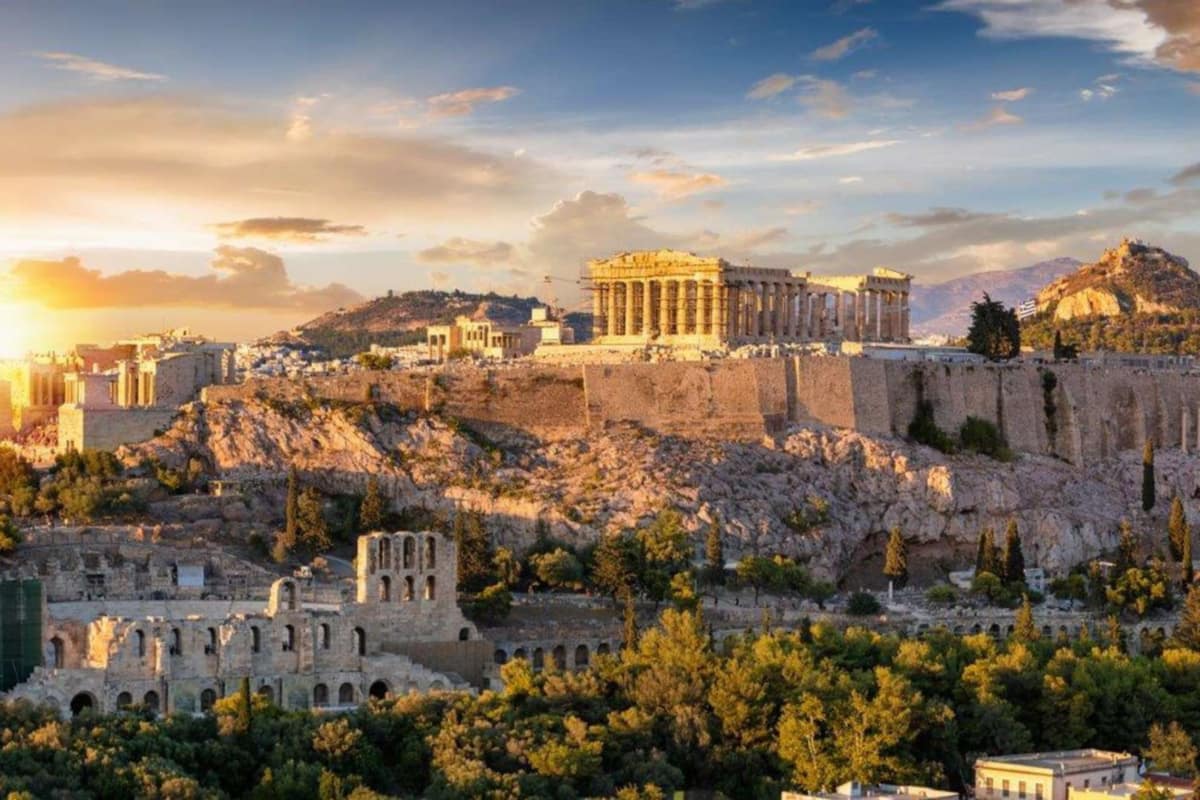
Where to stay in Athens comes down to three things: how far the Acropolis and the old centre lie on foot, which metro or tram stop sits near the door, and the feel of the streets after dark. The home page lists the tours in Greece, and the greece travel tips page covers the practical side of the trip.
This page walks the city district by district, from Plaka and the squares to the slopes south of the Acropolis, Kolonaki, the port of Piraeus and the coast. The 5 day athens tour plans the days, and the athens history page tells the story of the city.
What decides where to stay in Athens?
Three choices decide where to stay in Athens. The factors are the walk to the sights, the metro or tram stop and the evening feel of the streets. The metropolitan area holds 3,638,281 people, so a base in the right place saves hours of travel across the city.
Athens holds two titles in Greece: capital and largest city. Among capitals on the European mainland, Wikipedia lists it as the one furthest south. The metropolitan area spreads over 2,928.717 square kilometres, while the municipality itself has 643,452 residents. For where to stay in Athens, only a small part of that sprawl counts.
Walking distance to the sights is the opening test in where to stay in Athens. Of the five regions Wikivoyage lists, Central Athens is where ancient sites and museums mainly lie. From a base in Plaka, below the Acropolis, every sight is a short walk.
Transport is the second test. Wikivoyage ties South Athens to the beaches that public transport reaches, and lists Piraeus as the city’s main harbour. A base near a metro or tram stop keeps both within reach. A ship departure or a beach day gives that reach real weight in where to stay in Athens.
Street feel is the third test for where to stay in Athens. Wikivoyage describes North Athens as a mainly residential area and West Athens as residential. The old centre is different. The unification of the archaeological sites links its ruins through a network of pedestrianised streets. The same facelift restored the neoclassical houses of Plaka and Thiseio.
The rest of this page sorts the city into ten groups, each an answer to where to stay in Athens. Each group gets its own part, with the place facts of its districts.
- The old centre below the Acropolis: Plaka and Anafiotika
- The squares: Syntagma, Monastiraki and Omonia
- The slopes south of the Acropolis: Koukaki and Makrygianni
- Kolonaki and the hills: the slopes of Lycabettus
- The east side: Pangrati and Mets
- The west side: Psyrri, Thiseio, Gazi and Kerameikos
- The port: Piraeus
- The coast: Glyfada and Vouliagmeni
- The north: Kifisia and Marousi
- The airport side: Spata and Rafina
How does the centre fit together for where to stay in Athens?
The Acropolis is the fixed point of the centre. The Grand Promenade, a pedestrian walkway, runs around its foot. For where to stay in Athens, a base near that route keeps the old districts a short walk apart.
The Grand Promenade begins at the Panathenaic Stadium and continues along Dionysiou Areopagitou and Agiou Pavlou streets. It ends on the western part of Ermou Street, near the Kerameikos site. Read as a map for where to stay in Athens, it strings the old districts along one route.
Dionysiou Areopagitou Street marks the south side of the hill when you choose where to stay in Athens. Its line begins by the Temple of Olympian Zeus, then skirts the Acropolis to the south. It ends in Thiseio, a little beyond the Temple of Hephaestus. Wikivoyage adds that the street is pedestrianised and offers views of the Parthenon.
Joined to Apostolou Pavlou Street, it forms the main pedestrian route from Thiseio past the Agora to the Acropolis. A base on that walkway answers where to stay in Athens for anyone who wants fewer cars on the street.
Two squares mark the old edges of the downtown that nineteenth-century city plans defined. Syntagma stood on what were then the eastern boundaries of the city, and Omonia marks the northern corner. Both matter for where to stay in Athens.
Wikivoyage describes Omonia as a square with surrounding streets, open areas and grand buildings that include banks and offices. To the west lies Monastiraki, a flea market neighbourhood of the old town, as the third point. Together these points frame the walkable centre.
Ermou Street ties Syntagma to Monastiraki on its way to Kerameikos, and it is one and a half kilometres long. Inside that frame you walk to a sight, return for a rest and walk out again. That saves the time a taxi or a bus takes. It is the plain reason a base in the centre works.
Why does Plaka come up first in where to stay in Athens?
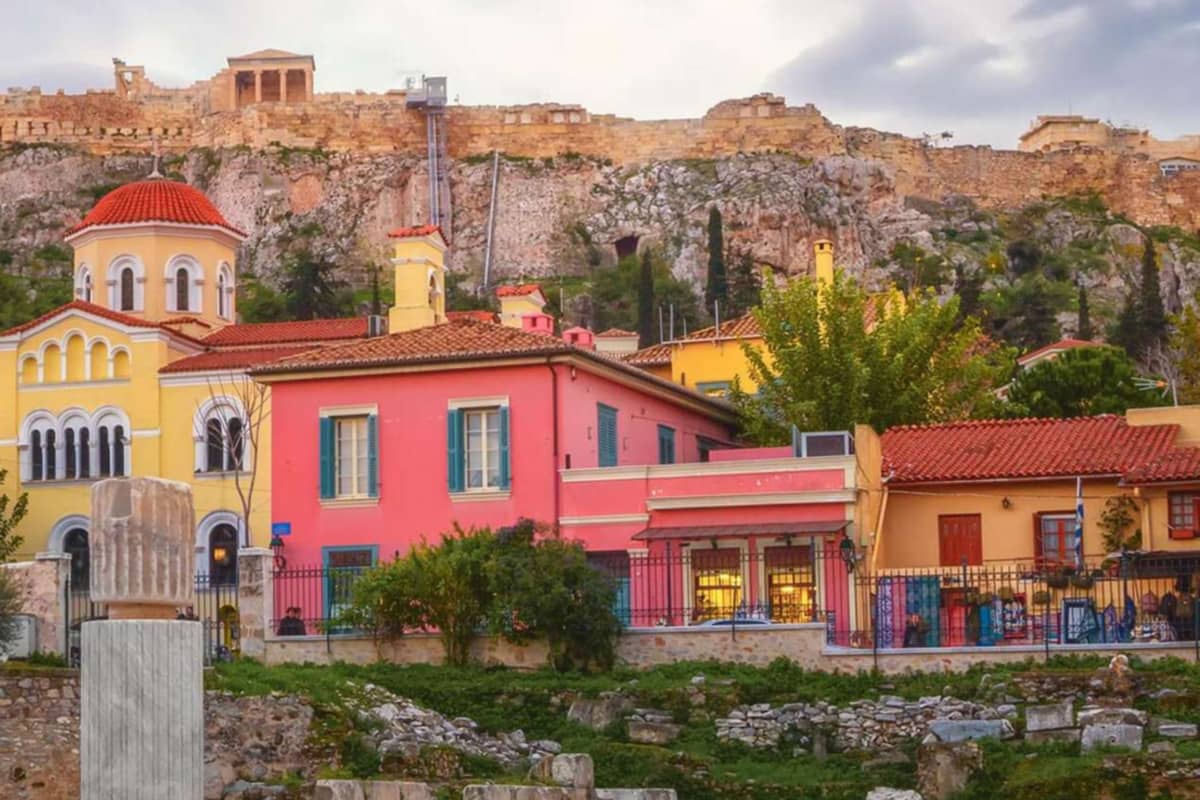
For where to stay in Athens, Plaka comes up first. Between Syntagma Square and Monastiraki Square, its lanes rise up the Acropolis hill from the north-east. Wikivoyage says the primary question for the majority of tourists is Plaka or not Plaka. That choice shapes every other base on this page.
Wikivoyage also names the northern and eastern edges, a help when weighing where to stay in Athens. The west part of Mitropoleos Street runs up to the cathedral. Mitropoleos Street and Amalias Avenue bound the district, but Wikivoyage counts them outside it, with a modern atmosphere. Wikivoyage says Plaka’s feel carries on to Apollonos Street and Nikis Street.
Choosing where to stay in Athens here means sleeping on old ground. Plaka took shape around the Ancient Agora ruins, says Wikipedia. The name spread in the nineteenth century until it covered the whole area between Makrygianni Street and the Agora. Earlier, Athenians pointed to the area through the names of its local churches.
Wikipedia describes a maze of streets and neoclassical architecture. During the Ottoman years the quarter was the home of the Benizelos family, from which Saint Philothei came. Agios Nikolaos Ragava, a Byzantine church, appears in the gallery of that article. Wikipedia says Plaka took its present form in the nineteenth century and the early decades of the twentieth.
For where to stay in Athens with museums close, Wikivoyage places two in Plaka. The Museum of Greek Folk Art is on Panos Street. The Museum of Greek Popular Musical Instruments is on Diogenous Street. Wikivoyage calls the folk art museum particularly strong on costume and embroidery. Wikipedia also lists the Jewish Museum of Greece among the small museums.
A base outside Plaka, Wikivoyage notes, adds the journey into Plaka and out again for sightseeing. That matters for where to stay in Athens on a short visit. Both squares at its edges have metro stations, and Wikivoyage names Syntagma and Acropolis among the three major stations. Plaka suits a traveller who plans to reach the old sites on foot.
What do Anafiotika and the Acropolis slopes add to where to stay in Athens?
For where to stay in Athens, Anafiotika adds a tiny island-style corner high in Plaka, just under the Acropolis rock. Wikipedia counts only 45 houses left, so the quarter is for walking through. The slopes around it add the Areopagus rock and Philopappos Hill.
Anafi, an Aegean island, sent the builders who raised the first houses here. They had come to Athens to refurbish the palace of King Otto. Workers from other Cycladic islands followed as carpenters and as stone and marble workers. Wikipedia says they found work in later rebuilding too, after the end of Otto’s reign.
For where to stay in Athens, the lanes bring an island feel inside the capital. Wikipedia describes small, mostly cubic houses in Cycladic style, with bougainvillea flowers. The little streets from Stratonos Street up to the rock stay unnamed. Steps and terraces close the small streets, and Wikipedia says a visitor can sit there for the night view.
Wikivoyage points to Anafiotika for where to stay in Athens in a calmer corner of the centre. It calls the quarter an oasis of calm and quietness. Its green spaces belong to the green area of the Acropolis. A tourism study quoted by Wikipedia calls the whitewashed houses steep and says they reflect the architecture of the Aegean.
The Areopagus bounds the Ancient Agora on its south side, says Wikipedia. After the ancient council closed, houses stood on the hill under Byzantine rule. A church and a monastery of Dionysius the Areopagite stood there too. Nearby, the Roman Catholic Church raised its cathedral of St Dionysius the Areopagite in the mid-nineteenth century.
Southwest of the Acropolis rises Philopappos Hill, the Mouseion Hill that Wikipedia also names Muses Hill. For where to stay in Athens on the slopes, expect steps, because the lanes climb. Wikivoyage names the upper reaches of Plaka as the part for pleasant walking.
How does Syntagma Square answer where to stay in Athens?
For where to stay in Athens, Syntagma Square works as the central hub of the city. Its name means Constitution Square. The red and blue metro lines cross beneath it. The northern end of the Athens Tram line stands at its side. On its east side, the former royal palace now houses the Hellenic Parliament.
In the nineteenth century, Greece’s first king, Otto, had to give the country a constitution. The old Palace Square then took its new name. It was planned as one of two central squares of the new capital. Back then it lay at the eastern edge. That makes it an easy anchor for where to stay in Athens.
King George I Street borders the north side, Otto Street the south and Amalia Avenue the east. Marble steps climb toward Amalia Avenue, above the metro station. In the centre stands a large fountain of the mid-nineteenth century, between two green areas planted with shade trees. Shade nearby counts when you choose where to stay in Athens in warm weather.
The Old Royal Palace stands across Amalia Avenue, ringed by the National Gardens. Visitors cannot enter the Parliament itself, but the gardens stay open. Hourly, the Presidential Guard swaps the sentries at the memorial tomb in front of Parliament. On certain days the ceremony grows, with an army band and the greater part of the 120 Evzones.
Metro lines 2 and 3 connect at Syntagma station. Line 3 runs on to the airport. Bus line X95 also links the square and the airport. Buses and trolleybuses start here, and bus routes reach the suburbs in the north and the Olympic Complex in Marousi. For where to stay in Athens after a flight, they matter.
Ermou Street links Syntagma Square with Monastiraki and runs on to the Kerameikos site. The eastern stretch is a pedestrian shopping street of about 700 metres, running from Filellinon Street to Aiolou Street. Wikivoyage names the bordering districts as Omonia north, Kolonaki east, Plaka south and Monastiraki west.
For where to stay in Athens on a first visit, Syntagma suits a traveller who wants easy transfers. Wikipedia counts the Arch of Hadrian among the nearby sights, as well as the Temple of Olympian Zeus.
What does Monastiraki add to where to stay in Athens?
Monastiraki adds a flea market quarter and a rail junction to where to stay in Athens. The quarter takes a name meaning little monastery from the square, which took it from the Pantanassa church. The square’s station serves two metro lines, 1 and 3. The quarter lies in the old town, near Plaka.
The quarter’s chief streets are Pandrossou and Adrianou. Both streets hold boutiques for clothing, souvenir shops and specialty stores. Wikivoyage lists antiques, cookware, arts and crafts and movie posters among the goods. That mix shapes where to stay in Athens for a traveller who likes to wander.
The Tzistarakis Mosque stands on the square. An Ottoman governor built it in the eighteenth century. The local town elders used it as their assembly hall in the Greek War of Independence. Afterwards it worked as barracks, then as a prison, then as a storehouse. The Museum of Greek Folk Art now uses the building as an annex.
The station stands beneath the Acropolis, beside the Ancient Agora site. Hadrian’s Library, a Roman ruin of the second century AD, lists this station as its public access. For where to stay in Athens, that ties the quarter closely to the ancient sites.
Line 1 opened with steam trains from Piraeus to Thiseio, then went electric early in the twentieth century. Its station here opened in the nineteenth century under the name Monastirion. Wikivoyage notes that the airport trip from Piraeus by metro changes at Monastiraki. That matters for where to stay in Athens before a ferry.
The line 1 platforms are half underground and half in an open cut. Green iron columns hold the two roofs over the open part. The line 3 station followed over a century later. Its two island platforms are the longest in the whole metro network.
A flea market and a metro junction share the square, so the quarter draws people through the day. A traveller who wants a quiet night checks which side of the quarter a room faces. For where to stay in Athens with the sights on foot, Monastiraki suits a first visit.
How do Psyrri and Thiseio fit where to stay in Athens?
For where to stay in Athens, Psyrri and Thiseio are two old quarters west of Monastiraki. Live-music tavernas, bars and restaurants mark Psyrri, a gentrified quarter. Thiseio is a traditional quarter of ancient sites, pedestrian streets and Acropolis views, with a stop on metro Line 1.
Wikivoyage puts Psyrri north of Ermou Street, with the Monastiraki stop on one side and Thissio on the other. Psyrri is one of the city’s oldest quarters. Its name probably comes from a word for an inhabitant of Psara. When evening life drives the choice of where to stay in Athens, Psyrri is the place to begin.
The central square is Heroes Square, in Greek Plateia Iroon. Streets leading to it honour Karaiskakis and Miaoulis, two heroes from the Greek War of Independence. That is how the square got its name. Agii Anargiri Square also lies in Psyrri, as Wikivoyage lists it. Wikipedia adds that the quarter has a small number of hotels.
During his stay in Athens, Lord Byron lodged in Psyrri, where he wrote the poem Maid of Athens. Alexandros Papadiamantis spent more than twenty years living in the area. Both names add history to the old quarter. For where to stay in Athens with evenings out in mind, Psyrri puts the tavernas at the door.
North-west of the Acropolis lies Thiseio. Its name points to the Temple of Hephaestus, once wrongly called the Theseion. Theseus was the mythical king of Athens. Three ancient sites ring the quarter: the Pnyx, the Kerameikos and the Agora. For where to stay in Athens close to ancient stones, Thiseio keeps them within walking distance.
Among the stops on Line 1, Thiseio is one of the oldest. From that stop, Wikivoyage’s walk to the main Acropolis entrance runs west to Apostolou Pavlou Street, then south. The street is pedestrian and has Acropolis views. The National Observatory stands nearby, on the Hill of the Nymphs. A base here answers where to stay in Athens for views.
What do Koukaki and Makrygianni offer for where to stay in Athens?
For where to stay in Athens, look south of the Acropolis, where Koukaki and Makrygianni sit. The Acropolis Museum stands in Makrygianni. The Acropolis metro stop on Line 2 serves both quarters, and Koukaki adds a second stop, Syngrou-Fix. A base here offers everyday city streets close to the sights.
Ioannis Makrygiannis, a general in the Greek War of Independence, gave the quarter its name. He once owned a house and fields here. Dionysiou Areopagitou Avenue and Syngrou Avenue bound the quarter, which lies south of the Acropolis. The quarter suits a traveller who wants the rock and the museum close.
The Acropolis metro stop lies beneath Makrygianni Street. The museum stands to its west, and Dionysiou Areopagitou Street to its north. The stop serves Plaka, Koukaki and Makrygianni. The Temple of Olympian Zeus gave the station its first planned name, Olympieion. For where to stay in Athens near the metro, that stop ties the three quarters to Line 2.
Koukaki lies south-east of the Acropolis. Makrygianni and Plaka lie to its north, Neos Kosmos to the east, Filopappou and Thisio to the west. Veikou Street runs north to south through it, and Dimitrakopoulou Street crosses it from south to north. A traveller who studies where to stay in Athens on a map can follow those two streets.
The second metro stop, Syngrou-Fix, stands on Andrea Syngrou Avenue, the border with Neos Kosmos. For where to stay in Athens with a second museum close by, Koukaki offers the National Museum of Contemporary Art. It stands in the ruins of an old brewery. A neoclassical house at Veikou 6, the John Palaiologos residence, is open to visitors.
Philopappos Hill lies west of Koukaki. Mouseion Hill carries the Philopappos Monument, a two-storey Roman tomb, to the south-west of the Acropolis. A lower frieze depicts a chariot ride, with Philopappos as consul. Its two sides run 9.80 and 9.30 metres. That western edge answers where to stay in Athens for a short hill walk.
Why does Kolonaki come up in where to stay in Athens?
Kolonaki climbs the lower south side of Mount Lycabettus, one base to weigh in where to stay in Athens. Its name means “Little Column”, Wikipedia explains. A column two metres tall in Kolonaki Square marked the area before the streets were built. Its metro stop is Evangelismos, on Line 3.
Wikivoyage says the borders of the district are not sharply defined. It covers the south and south-east slopes of the hill, north of Vasilissis Sofias Avenue. The square has an official name, Plateia Filikis Etaireias, but Wikivoyage says no one uses it. For where to stay in Athens, that avenue works as a rough southern line on the map.
For where to stay in Athens, five museums lie in or beside Kolonaki. The Benaki Museum sits inside a preserved neoclassical manor house. The Goulandris Museum of Cycladic Art joins them. The National Gallery of Greece stands on Vasileos Konstantinou Avenue. Across Vasilissis Sofias Avenue you find the War Museum of Athens and the Byzantine and Christian Museum.
Mount Lycabettus rises behind the quarter. At 277 metres it is the high point of Central Athens, built of Cretaceous limestone. Aristippou Street in Kolonaki holds the lower funicular station. Its track measures 210 metres and runs wholly in tunnel to the Chapel of St George. The Greek Tourist Organisation built the line in the nineteen-sixties.
You can also walk up. Wikivoyage says the path starts 15 minutes’ walk from Evangelismos metro stop and takes 30 minutes to climb. It calls the path winding, paved and not steep. On a clear day the top shows Aegina and the Peloponnese. That makes the metro stop the anchor for where to stay in Athens here.
Wikivoyage calls the area small and good for wandering. Skoufa, Anagnostopoulou and the pedestrian Tsakaloff Street run north of the square. The streets rise toward the hill, because the quarter sits on a slope. For where to stay in Athens, this quarter suits a traveller who plans museum days and one hill walk.
How do Pangrati and Mets fit where to stay in Athens?
For where to stay in Athens, Pangrati lies a short walk from the National Gardens and has about 35,173 residents. The quarter takes its name from an ancient shrine of Hercules as Pancrates, the All Powerful. Evangelismos is the metro station that serves it. Mets, beside the First Cemetery of Athens, follows below.
For where to stay in Athens, Pangrati counts as a city quarter, the article stresses, not as a separate suburb. Vasilissis Sofias Avenue forms its front, and Vasileos Konstantinou and Vassileos Alexandrou avenues follow. The quarter includes the Ilissos river valley. Hymettus slopes once marked its east edge. Today Nikiforidi Street and Iliados Street do.
The article lists eight squares, among them Plastira, Pangratiou and Varnava. Spirou Merkouri Street runs from Pangrati Square toward Evangelismos station. All three trolley networks and the local buses stop at Plastira Square. A Pangrati and Kaisariani station on Imittou Street appears only as a proposal for Line 4. For where to stay in Athens, Evangelismos is the metro link.
In the Panathinaiko Stadium the modern Olympics began. Behind the stadium lies the First Cemetery of Athens, the city’s official cemetery and the first to be built. Pines and cypresses fill the green space, and it is a historical monument. For where to stay in Athens, both mark the southern edge of Pangrati.
The article says Pangrati drew poets, writers, painters and composers. The Nobel Prize poet Giorgos Seferis lived here, as did the composer Manos Hatzidakis. Agios Spyridon Square holds Saint Spyridon Church and the Goulandris Museum of Contemporary Art. A traveller who wants squares, churches and a gallery near the National Gardens fits here.
Mets sits between Ardettos Hill, the First Cemetery and the Olympian Zeus temple. A beer brewery, opened by the Bavarian brewer Karl Fuchs, gave it its name. Beer was unknown in Greece then and came through the influence of King Otto. For where to stay in Athens, those landmarks place Mets on the map.
How do Gazi and Kerameikos fit where to stay in Athens?
Gazi and Kerameikos wrap around the old gasworks, north-west of the Acropolis, and answer where to stay in Athens. The Kerameikos metro stop on line 3 stands beside the Technopolis cultural centre. A base here trades the old lanes of the centre for a former factory district and an ancient site.
At this end of town, the old gasworks greet a traveller who is deciding where to stay in Athens. Gazi surrounds them, and Wikivoyage translates the name as gas. Earlier names were Gazochori and Fotaerio. The works date from eighteen fifty-seven. Technopolis now fills the site, a cultural centre of about 30,000 square metres.
For where to stay in Athens at night, Wikivoyage lists Gazi for dozens of bars, cafes and clubs. It adds that the galleries and clubs sit in remodelled factories with an industrial look. Small theatre stages lie to the north-east, towards Metaxourgeio. Footpaths along Ermou Street join Gazi with Thiseio, so the two quarters link on foot.
Kerameikos adds an older layer to where to stay in Athens. The name comes from the kerameis, the potters, and from keramos, the word for pottery clay. The English word ceramic comes from it. The Eridanos River carried clay to this ground, which drew the potters. Gazi also has a weather station of the National Observatory.
The Dipylon Gate had a double arch, and Wikivoyage names it as the start of the Panathenaic procession. To enter the site, walk to the end of Ermou Street, by Peiraios Street. A small neoclassical building houses the Kerameikos museum. It shows burial finds from large marble sculpture to funerary urns, jewellery and toys.
For where to stay in Athens, this side suits travellers who want evenings out and an ancient site close by. Wikivoyage adds that more than twenty tortoises live on the site. Metaxourgeio, meaning silk mill, lies just north. Theatres and an art gallery are found at Avdi Square, the quarter’s centre, and metro line 2 serves it.
What do Omonia and the market streets add to where to stay in Athens?
Omonia Square closes the north end of the nineteenth-century city plan, a mark for where to stay in Athens. Six streets meet there, and the metro station below is a major hub. Athinas Street runs south from the square and passes the central market with its fish, meat and vegetable halls.
The name means Concord Square. Completed in eighteen forty-six, it was first called Palace Square, because a palace was meant to rise there. It was renamed in eighteen sixty-two, when leaders of opposing groups swore an oath of peace there. Where Athinas Street meets the square, it runs between two old neoclassical buildings.
Six streets meet at the square, among them Panepistimiou, Stadiou, Athinas and Peiraios. For where to stay in Athens, the metro station below joins lines 1 and 2 at one stop. It carries the same number of passengers as the station at Syntagma. The National Archaeological Museum, entered from Patission Street, counts Omonia as its metro stop.
The square has changed shape over time. The Piraeus railway went underground here from nineteen twenty-five to thirty, and the square took a round form. A later rebuild restored the fountain of nineteen fifty-eight and chose new paving to lower its thermal footprint. For where to stay in Athens, a base here sits beside a rebuilt square.
Athena, goddess of wisdom, gave her name to Athinas Street. Its length is nearly one kilometre, from Ermou Street up to Omonia Square, and metro line 1 runs below it. The oldest market in Athens, the Varvakeios municipal market, sits halfway along the street. The market takes up a large block, edged by Aiolou, Euripidou, Sofokleous and Athinas Streets.
The official visitor pages state that the fish market sits at the centre of that block. Meat and vegetable markets line both sides of Athinas Street. Evripidou Street, from Aiolou Street to Sokratous Street, sells spices, nuts and dried fruit. For where to stay in Athens, Omonia suits travellers who want food streets and a museum of antiquities close by.
How does Piraeus answer where to stay in Athens before a ferry?
Piraeus is the base for where to stay in Athens when a ship leaves early. The metro station stands beside the port. A traveller wakes close to the quay instead of crossing the whole city first. The district also holds a hill of old mansions and two small marinas.
Wikipedia ranks Piraeus as the twenty-fourth largest passenger port in the world. The Greater Piraeus area, which joins the city to four other suburban municipalities, holds 448,051 people. A port of that size has its own gates, and Wikivoyage asks travellers to learn the right gate first. That is the core of where to stay in Athens before a ferry.
Wikivoyage reports air-conditioned tents at the departure points and free wifi. The metro station sits by the gates. Saronic Gulf boats are a short walk away, and the central Cyclades quays lie across from the station. Wikivoyage warns that summer makes the port hectic, so leave a wide margin. A nearby bed gives where to stay in Athens that margin.
The green Line 1 links Piraeus with Kifissia. Tram Line 7 and the suburban railway also serve the port. Wikivoyage calls the antiquities of the centre an easy day trip by metro. A bed here keeps the ship and the old city in reach. That settles where to stay in Athens for a short sea trip.
Kastella is the district’s hill. The hill has neoclassical mansions and a view over the Athens basin to the Saronic Gulf. The open-air Veakeio Theater hosts concerts in summer. Along Mikrolimano and Piraiki, the coastline carries tavernas that serve seafood. For where to stay in Athens, these corners add a hill view and a shore to eat by.
The Archaeological Museum of Piraeus, which Wikivoyage calls small, holds funerary stelae. The Municipal Theatre faces the Neo-Byzantine cathedral and serves as a popular meeting place. For where to stay in Athens, Piraeus suits a traveller with a morning ship or a late arrival by sea. A visitor who wants the Acropolis at the door looks to the centre.
What does the Athens Riviera add to where to stay in Athens?
The Athens Riviera adds sea and sand to where to stay in Athens. The article on the coast puts it about sixteen kilometres from downtown and gives it a length of seventy kilometres. Palaio Faliro, Glyfada and Vouliagmeni are bases along the shore, and a tram line runs beside the sea.
The coast road is Poseidonos Avenue, and Glyfada is also linked to the centre by Vouliagmenis Avenue. From Syntagma Square, tram Line 6 runs to Pikrodafni. Line 7 follows the coast between Voula and Piraeus, and from Pikrodafni both lines use the same tracks. This tram answers where to stay in Athens for a base by the sea.
Palaio Faliro holds the Riviera’s northwestern end, 6 km to the southwest of the centre. Museum ships lie at the Naval Tradition Park, beside a marina and a seafront promenade. The Stavros Niarchos Foundation Cultural Center park stands on the old Hippodrome track. For where to stay in Athens, it puts the sea within reach of the centre.
Between the foot of Mount Hymettus and the Saronic Gulf lies Glyfada. Two streets carry the shopping district: Metaxa Avenue and Grigoriou Labraki Street. A marina sits on the waterfront. The name comes from salt-water wells. The town lay close to an American air base until the early nineteen-nineties. Glyfada fits where to stay in Athens for a beach stay.
Voula sits between Glyfada and Vouliagmeni, and tram Line 7 ends there. The name Vouliagmeni means sunken. Lake Vouliagmeni formed when a large cavern roof collapsed in an earthquake, and it works as a spa. Two peninsulas, Megalo and Mikro Kavouri, carry pines and beaches. For where to stay in Athens, Vouliagmeni adds the lake and the pines.
A tram line and two avenues link Glyfada with the centre. The ride takes time, so plan each day around it. The Riviera suits a traveller who wants a beach after the city or a longer stay. For where to stay in Athens, a short first visit stays in the old centre instead.
How do Kifisia and the northern suburbs fit where to stay in Athens?
For where to stay in Athens, Kifisia is the green suburb in the north. Metro Line 1 ends at its station, 12 kilometres out from the centre towards the north-east. The middle of the suburb stands 290 metres above sea level, a little higher than the city.
In the north, a suburb with its own centre gives a different reply to where to stay in Athens. Kifisia spreads over the north end of the Athenian plain, between the ridges of Mount Penteli and the Kifisos river. Its quarters include Kato Kifisia, Kefalari, Alonia and Politeia. Politeia climbs to 330 metres, the highest ground in the urban area.
The village grew into a holiday place for Athenians in the nineteenth century. Wikipedia says the railway arrived in the eighteen-eighties, and families from the city then built country houses there. The villas came in ever more exotic styles and shaped a unique architectural environment. That history answers where to stay in Athens for a traveller who likes villa streets.
Kifisia answers where to stay in Athens for a cooler base. Higher ground and thicker foliage give it a lower mean yearly temperature than downtown Athens. Every spring a flower festival fills Kifisia Grove, which dates from the early twentieth century. The Goulandris Museum of Natural History, in the heart of the suburb, shows Greek fossils and wildlife.
Where to stay in Athens near the Olympic grounds? Marousi, next to Kifisia and 13 kilometres from the centre. Its south-west holds the Athens Olympic Sports Complex, the largest in Greece, with the Olympic Stadium. Three Line 1 stations serve the town: Nerantziotissa, Irini and Marousi. The forest of Dasos Syngrou, the biggest in urban Athens, grows within its borders.
Kifisia suits a long stay, a family that wants shade, or a traveller who has seen the centre. Line 1 crosses the centre on its way to Piraeus, so the trip south needs no change of train. The trade-off is time: the Acropolis lies a full metro ride away, and the green streets repay it.
Where to stay in Athens near the airport for an early flight?
Where to stay in Athens near the airport comes down to Spata, a town 20 kilometres east of downtown Athens. Athens International Airport takes up the eastern part of Spata, so a base there is close to the terminal. At the heart of the Mesogeia plain stands the town.
The Mesogeia, which means “Midlands”, has Spata as its main settlement. The region is the inland middle of East Attica. Mount Penteli marks its northern edge, while Mount Hymettus stands between it and the Athens basin. Where to stay in Athens on this side of the mountain means a plain of farms and residential towns.
Around Spata, vineyards and olive groves fill the farmland between the homes. The town itself is a set of residential neighbourhoods. Finds from small ancient settlements, dug up during the airport works, are on show in the main airport building. For where to stay in Athens before a dawn flight, these quiet neighbourhoods keep the ride to the terminal short.
The station beside the terminal belongs to the airport operator, and Metro Line 3 reaches it. A base on that line in the centre also answers where to stay in Athens for an early flight. Express buses run through the night, unlike the metro. A kiosk at the Syntagma stop sells their tickets before the metro opens, as Wikivoyage states.
Regional buses link the terminal with Markopoulo, Kalyvia and Keratea, as Wikipedia states. Wikivoyage adds a regional bus from the airport to Koropi metro station, a ride of 15 minutes. From Koropi, the metro runs on to the city centre. That link gives a base in the Mesogeia a second way back to the centre.
Ferries leave Rafina for southern Euboea and the Cyclades, and the port is 25 kilometres east of the centre. For where to stay in Athens near the airport, Wikivoyage points to the listings of Spata and Rafina. This side of Attica suits a late arrival or a dawn departure, not a first look at the sights.
Where to stay in Athens for a first visit of two or three days?
For where to stay in Athens on a first visit of two or three days, Plaka, Koukaki and Syntagma suit. Each one reaches the old sites on foot and lies near a metro stop. The first days need no long rides, and the last day can head for the coast or the port.
The walking map for two days is a loop around the Acropolis hill. Plaka sits on its north-eastern flank. Koukaki lies south of Plaka and Makrygianni, and Syntagma marks the edge of the old centre. Every sight inside that loop is a short walk from the next. That keeps the choice of where to stay in Athens simple.
Day one can end at the Roman Agora, which lies at the western end of Plaka, as Wikivoyage states. The official entrance faces the end of Pikilis. Wikivoyage adds that the ticket office stands around the corner on Epaminonda Street, not at the gate. For where to stay in Athens, a Plaka base puts that walk at your door.
Day two can start in the National Garden. Wikipedia notes that the park was the Royal Garden until nineteen seventy-four. Its southern end reaches the Zappeion area. In nineteen thirty-eight the Athens Radio Station, the first national broadcaster of Greece, began operating in that hall. A Syntagma base lies across Amalias Avenue from the Parliament, which the garden surrounds.
For the coast, Wikivoyage names the tram from Syntagma. It also lists the buses A2, B2 and E22 from the Syngrou-Fix metro stop. The page tells riders to step off wherever a stretch of sea appeals. For where to stay in Athens over three days, that makes a beach day a ride from Syntagma or Koukaki.
Day three can reach Piraeus on the metro. Five stations of the metro let riders change lines, as Wikipedia lists them: Monastiraki, Syntagma, Omonia, Attiki and Piraeus. Plaka lies between two of them, Syntagma and Monastiraki. For where to stay in Athens on a short trip, a Plaka base starts where lines meet.
Where to stay in Athens with children?
For where to stay in Athens with children, choose a base near a park. Inside the National Garden, Wikipedia places a playground and a Children’s Library, with a Botanical Museum and a duck pond. Syntagma and Pangrati both lie close to that garden, and each has a metro stop within reach.
Wikivoyage adds turtle ponds as well as duck ponds, and it mentions resident tortoises exploring the paths. The Parliament stands at one end of the garden and the Zappeion at the other. For where to stay in Athens, that gives a family a green morning close to the room.
Wikipedia names a gate that connects the National Garden with the Zappeion park area. The Zappeion article adds that statues stand in the gardens around the hall. A family can join the two open spaces in one outing. The hall itself serves for meetings and exhibitions, so the gardens are the part for children.
The Stavros Niarchos Park lies in Kallithea. Wikipedia gives it 210,000 square metres and describes an artificial hill built there. Wikivoyage lists a shuttle bus from Syntagma Square. It also says the terrace looks to the Acropolis on one side and the coast on the other. For where to stay in Athens, a Syntagma base starts that trip.
The Hellenic Children’s Museum is the indoor choice. As Wikipedia states, the Municipality of Athens helped create it. Today it fills the ground floor of a landmark building of the city.
The tram carries a family to the beaches of the south. Wikipedia’s tram article states that children under six travel free. Underground currents feed Lake Vouliagmeni, a small lake of brackish water on that southern coast, as Wikipedia describes it. For where to stay in Athens with children, a Syntagma base starts the tram ride from the first stop.
Hills and steps shape a family day. A pushchair rolls well on the flat avenues, while the steps of the old lanes suit children on foot. The funicular lifts tired legs up Lycabettus. Wikivoyage describes the marble at old sites as soft and slippery and advises shoes with good traction.
For where to stay in Athens with children, quiet streets point to Koukaki, Pangrati and Kifisia. Koukaki is a south-eastern neighbourhood, and Pangrati lies minutes on foot from the National Garden. Kifisia stands at the end of metro Line 1.
Where to stay in Athens for evenings out and food markets?
For where to stay in Athens with evenings out in mind, the choice runs between Psyrri, Gazi, Monastiraki and Koukaki. Each answers a different kind of night. Street markets then add a daytime rhythm, because each one opens on the same weekday every week.
Wikipedia calls Gazi and Psyrri especially busy with nightclubs and bars. It places Koukaki, Kolonaki and Pangrati in the cafe and restaurant group instead. Wikivoyage lists Monastiraki and Thiseio among the nightlife areas and keeps traditional Greek evenings for Plaka. Where to stay in Athens for a night out starts with the kind of evening you want.
Wikivoyage says an evening starts late in Athens. Dinner begins after ten at night, and bars and clubs fill after midnight. Metro service starts at half past five and ends at half past midnight. On Friday and Saturday nights, and the night before a public holiday, the metro runs until around two. That timing shapes where to stay in Athens.
Summer adds screens and stages under the open sky. Wikipedia lists open-air theatres and cinemas among the entertainment of Thiseio. Wikivoyage says Hadrian’s Reservoir, the end of a Roman-era aqueduct, now holds a summertime outdoor cinema. After dark the Acropolis rock stands lit above the old streets, so even a short walk home has a view.
The Athens Festival has its main stage in the Odeon of Herodes Atticus. The theatre’s site is the Acropolis’s south-west slope. Its season spans late spring to October. Wikivoyage also points to the ancient theatre of Epidaurus for a performance. Wikipedia notes that the Odeon is to close for restoration for at least three years.
Food markets follow the week, not the season. Wikipedia describes the laiki agora, or people’s market, as a farmers’ market that Eleutherios Venizelos founded. It counts 44 of them in downtown Athens. Each neighbourhood holds its own on the same weekday every week. For where to stay in Athens on a market morning, find that weekday first.
At a laiki, the producers work their own farms or beehives in nearby towns. The professionals resell food bought from other sources. Every stall displays a card giving the seller’s name and kind. Wikivoyage lists a market at Divaki Pindou and Ioanni Theologou. That is a fixed point for where to stay in Athens near a market.
How do the summer heat and the seasons change where to stay in Athens?
The climate, in Wikipedia’s terms, is hot-summer Mediterranean, which shapes where to stay in Athens. Its downtown figures give July and August the same daily high, 34.3 degrees Celsius. A room with air conditioning and a base near a metro stop ease the hot weeks.
January brings a daily maximum of 13.3 degrees Celsius and a daily minimum of 7.1, a mild winter. Rain is light in summer and heavier in winter. The downtown table shows 5.4 millimetres in August and 76.3 in December. So where to stay in Athens in August turns on heat, not on rain.
Sunshine at coastal Elliniko totals 362.7 hours in July, against 127.1 hours in December, in Wikipedia’s table. The year adds up to 2,773.4 hours. With that much sun, a shaded window or air conditioning helps where to stay in Athens in July.
Wikipedia links part of the summer heat to a strong urban heat island. The same article reports 47.5 degrees Celsius and above in the metropolitan area. Wikivoyage notes that the metro’s air conditioning is not very efficient in summer. For where to stay in Athens, a short walk to a station keeps platform time brief.
The metropolitan area is not one climate. Wikipedia explains that the Saronic Gulf moderates the southern coast, so its temperatures vary less. Kifissia in the north has a higher elevation and moderately lower temperatures. For where to stay in Athens on a hot week, that separates the sea from the northern hills.
April reaches a daily maximum of 21.1 degrees Celsius and October 24.4. In the city centre fog is rare, though the page says spring can bring advection fog along the coastline. In Athens, snowfall counts as relatively uncommon. That mild range suits where to stay in Athens in spring and autumn.
Easter Monday and Good Friday, both on the Orthodox calendar, are the two holidays whose dates shift. It also lists the Dormition on the fifteenth of August as a fixed one. Wikivoyage describes the candlelit Easter Vigil procession down a hill on Holy Saturday night. Check the Easter date before you settle where to stay in Athens.
How do the metro, tram and buses shape where to stay in Athens?
For where to stay in Athens, pick a base near metro line 2 or line 3. Together they reach the old centre and the airport without a taxi. The lines meet at Syntagma, where the tram to the coast starts. Buses and trolleybuses fill the gaps.
Three metro lines serve the city. Wikivoyage places Line 1 between Piraeus and Kifissia and Line 2 between Anthoupoli and Elliniko. Line 3 starts at Dimotiko Theatro and reaches the airport by way of Doukissis Plakentias. For where to stay in Athens, the central stops between the ends matter more.
Wikipedia names five interchange stations: Attiki, Monastiraki, Omonia, Piraeus and Syntagma. Monastiraki, Omonia and Syntagma sit in the centre, so a base near one changes lines fast. Stations at Monastiraki, Akropoli and Syntagma also show artifacts or replicas from the tunnel digs. That helps where to stay in Athens for a traveller who rides daily.
From Syntagma, the tram heads for the seaside suburb of Palaio Faliro. There the line divides into two branches. Koukaki has tram stops at Fix and L. Vouliagmenis. The older tram began with horse tramways and gave way to trolleybuses and buses in the nineteen-sixties. A tram stop adds a sea link to where to stay in Athens.
Koukaki also has trolleybus routes 1, 5 and 15 along Veikou and Dimitrakopoulou streets. On Andrea Syngrou Avenue, buses serve the quarter too. In Piraeus, Wikivoyage names trolleybus 20 for the run from the port to Passalimani. It ends at Faliro metro station. For where to stay in Athens, a base on such a line adds a second link.
One ticket covers metro, tram and buses for 90 minutes, as Wikivoyage states. The airport trains and buses sit outside it. Tickets are validated at the metro gates on entry and exit, and on buses and trams when you board. For where to stay in Athens, a base beside a stop saves the walk.
Taxis are the last link, and Wikivoyage calls the canary yellow cars a common sight. An occupied taxi shows a lit sign, and the driver asks where you go before you join the others. A taxi covers the last stretch from a stop to the door.
Which kinds of lodging answer where to stay in Athens?
Athens offers lodging from camping and hostels up to five-star hotels, as Wikivoyage lists. Official portals also list furnished rooms and apartments for rent. For where to stay in Athens, the building shapes a stay as much as the district does. This part starts with the buildings.
When Athens became the national capital, planners built a new city beside the classical ruins, with grand neoclassical homes. Wikivoyage adds that neoclassical buildings were pulled down in the nineteen-sixties and seventies for offices. Later works restored the survivors. For where to stay in Athens, a restored neoclassical house is a surviving piece of that plan.
Wikipedia explains that polykatoikia, literally multiresidence, is the Greek word for every apartment building. An early example went up next to Syntagma Square, at Philellinon and Othonos streets. Because it was built in reinforced concrete, it stood higher than its neighbours. Two royal decrees then tied building height to street width. The limit on wide streets was 26 metres.
Wikipedia describes the blocks of the nineteen-thirties by their bay windows and wide entrance halls. Such blocks can carry permanent decorative pergolas on the top-floor terraces. Kolonaki, Exarcheia and Kypseli saw a building spree in that decade. For where to stay in Athens, a top-floor terrace belongs to this kind of block.
Wikivoyage lists three choices once Plaka is ruled out. One is just outside Plaka. Another is a main route to the coast, such as Andrea Syngrou Avenue. The third is a coastal suburb like Glyfada or Piraeus. The last two offer more modern hotels or a coastal view. This choice sorts where to stay in Athens by kind of building.
Official portals state that hotels, camping sites and youth hostels file a notification before opening. A second one covers furnished rooms and apartments for rent, and tourist furnished residences and villas. The Ministry of Tourism handles it, and each notification receives a unique electronic number. For where to stay in Athens, that is the official step behind a rental.
Which other questions do travellers ask about where to stay in Athens?
How long does the centre need before the islands?
The answer depends on the island that comes next. In the Saronic Gulf lie the nearest islands, and Wikivoyage treats them as a day trip out of Piraeus. For where to stay in Athens, a traveller bound for those islands plans the centre first and the sea afterwards.
Islands further out ask for more time. Wikivoyage lists Paros, Naxos, Ios and Santorini, and says their distance from the mainland calls for extra days. The same page lists a flight as another route to the farther islands. Ships leave from Piraeus and Rafina, the page says, so both ports shape where to stay in Athens.
The ancient sites of the centre close in the afternoon. Wikivoyage lists the Ancient Agora until half past three, with a ten o’clock start on Monday. The Roman Agora and the Kerameikos close at four. Those hours fill the morning, so the evening streets shape where to stay in Athens.
Does one night in Piraeus suit where to stay in Athens before an early ferry?
One night near the port suits an early ship. Wikivoyage says the port is wide. A drive from end to end of the port lasts 15 minutes, and a walk lasts 30. Treat that spread as part of the plan for where to stay in Athens before a sailing.
Four gates serve the Aegean island ferries and catamarans, Wikivoyage says: E6, E7, E9 and E10. The main bus terminal, Karaiskaki Square, holds the Coast Guard building, and the sailings are posted outside it. Inside the port, free shuttle buses start opposite the metro station. Those buses reach the ships bound for Crete, the Dodecanese and the Eastern Aegean.
Finished in nineteen twenty-nine, the metro station stands where Piraeus had its first conventional train station. The Electric Railway Museum has its home inside the same building. Sotiros Dios Street, mostly pedestrian, climbs from the port and drops toward the marina. A night here answers where to stay in Athens for a morning ship.
How far does the centre lie from the airport by metro?
By Wikipedia’s figure, the airport stands about 20 km to the east of the centre. Hills intervene, so the road runs 30 km. Wikivoyage gives 27 km. For where to stay in Athens before a flight, line 3 of the metro closes that gap via Syntagma Square.
Wikipedia gives the direct train between Piraeus and the airport a journey of up to 59 minutes. It leaves once every 36 minutes. Syntagma lies on that route, so the ride from the square is shorter. That timing is a practical test of where to stay in Athens for an early flight.
Not every line 3 train goes all the way. Wikivoyage says the trains in between turn back at Doukissis Plakentias. Airport trains carry an aeroplane logo on the front. Beyond that stop, Wikipedia states, the line shares track with the suburban railway in the median of two motorways. At the airport, both services use the same platform.
Which parts of Athens lay inside the walls of the classical city?
The Themistoclean Wall of the fifth century BC drew the line of the classical city. Wikipedia gives it a length of 8,500 metres, a height of 8 to 10 metres and at least 13 gates. Ask where to stay in Athens in the classical sense, and the answer is inside that wall.
The wall cut through the Kerameikos. Wikipedia places the Inner Kerameikos, the potters’ quarter, inside the city and the public graveyard just outside. The Pompeion stood inside the walls, between the Sacred Gate and the Dipylon Gate. The highest remaining section of the wall now stands in the Kerameikos site.
Other traces survive. Wikipedia lists foundations on the Pnyx. It also lists a section in a house basement on Erysichthonos Street, just north of the Peiraic Gate. A much smaller circuit of the late third century AD enclosed the centre of the ancient city.
A later wall of the eighteenth century ran along Amalias Avenue to Syntagma Square and Stadiou Street. It had a gate in Plaka. A traveller picking where to stay in Athens finds Syntagma and Plaka on that same course.