
Where to stay in Kos depends on the coast you pick. Kos Town holds the harbour and the castle in the north-east, Psalidi and Agios Fokas run south-east of it, Tigaki, Marmari and Mastichari line the sandy north coast, Kardamena faces the south, and Kefalos sits above its bay in the south-west. The tours in Greece on the home page add the rest of a Greek trip.
This page covers the bases one by one, then the old sites, the airport, the port, the buses, the months and the day trips. The Kos island information page holds the history of the island, the Nisyros day trip from Kos page covers the volcano island to the south, and the where to stay in Rhodes page covers the largest of the Dodecanese.
Which factors settle where to stay in Kos?
Distance from Kos Town settles where to stay in Kos, because the resorts lie far apart. Kefalos, the westernmost town, stands 43 kilometres from Kos Town. A car needs about 40 minutes for that road, as Wikivoyage states. The island is long, and the gap between its ends is real.
Start with the length of the stay. For where to stay in Kos on a short break, a base in Kos Town keeps things close. The castle dominates the harbour, as Wikivoyage states. A longer stay leaves room for a beach village. The Dodecanese chain of the south-eastern Aegean holds Kos, which counts 37,089 residents.
The beach comes next. The official beaches page lists golden sand, pebbled bays and rocky coves along 112 kilometres of coast. Sand with shallow water suits a family. A pebbled bay suits a swimmer who wants a quieter shore. The same page counts dozens of shores, so the choice takes thought.
Movement is the third factor. For where to stay in Kos without a car, the bus matters. The official tourism page names a central stop in Kos Town and routes to the airport. It also lists Tigaki, Marmari, Kefalos, Kardamena and Pyli among the routes. A base on one of those lines keeps the island within reach.
The land helps a rider. The official tourism page calls the island flat. It adds that a car, a motorbike or a bicycle gives easy access to the settlements. A visitor with a bicycle can live in a village and still reach the next bay. A visitor on foot does better near a beach and a bus stop.
Arrival adds one more point. The harbour of Mandraki sits in the town centre, as the official page states. The airport lies inland, and the section on arrival below gives the road from it to each base. Both points matter for where to stay in Kos on a first night. A short transfer eases that night.
Last, the trip itself decides where to stay in Kos. A visitor who loves ruins fits Kos Town. A swimmer fits a long beach of the north coast, and a walker fits a mountain village. A short stay between ferries fits the harbour. A longer stay with a car or a bicycle fits a quiet coast.
How do the areas split where to stay in Kos?
Coast, hill and harbour split where to stay in Kos along one long strip. Kos Town stands at one end and Kefalos at the other. Between them lie a north coast, a south coast and a mountain slope. This page covers eleven bases, listed below in the order of its sections.
- Kos Town
- Psalidi
- Agios Fokas
- Tigaki
- Marmari
- Mastichari
- Kardamena
- Kefalos
- Kamari
- Zia
- Pyli
On the map, Kos is a long strip of land. Wikipedia gives its size as 11.5 kilometres wide and 42.1 long. The official tourism page adds that the island lies right opposite the coast of Turkey. That shape explains the choice of a coast: the north, the south and the west each hold their own bases.
For where to stay in Kos with a swim in mind, the north coast holds sandy beaches. Mastichari lies in the north-west, according to Wikivoyage, and its main beach is sandy. Tigaki stands about ten kilometres from Kos Town, to the west. The road that links Kos with Kefalos passes 1.5 kilometres from it.
The south coast has its own base. Kardamena stands midway along that shore and lies 7 kilometres from the airport. The airport itself stands near Antimachia. Wikivoyage lists Antimachia among eight main villages, with Kos Town, Kardamena, Kefalos, Tigaki, Mastichari, Marmari and Pyli. Asfendiou, Lagoudi, Platani, Zipari and Zia are the smaller ones.
Inland, the mountain called Dikaios reaches 846 metres. The official tourism page names it the highest mountain of Kos. Oromedon, Orion and Dikaion were its ancient names. Zia sits on its slopes. Pyli lies south-west of Tigaki. These two villages answer where to stay in Kos for a visitor who wants hills and a coast view.
Kefalos is the westernmost town of the island. The town occupies the Kefalos peninsula, on the south-west side. This is where to stay in Kos for the quiet west, far from the town. The official page puts Kefalos 16 kilometres from the airport. Wikivoyage adds a public bus from the airport to Kefalos.
The island lies 338 kilometres from Athens, as the official tourism page states. That fact counts on the day of arrival only. After that, where to stay in Kos follows the beach, the road and the pace of the place. The next sections take the bases one by one, with their harbours, castles, beaches and roads.
Why does Kos Town lead where to stay in Kos?
Kos Town leads where to stay in Kos because its harbour, castle, plane tree square and agora lie close together. It is the largest town of the island, and Greek Wikipedia counts 19,432 residents there in the twenty eleven census. A visitor reaches all four on foot.
The layout of the town is the first thing that shapes where to stay in Kos. The national tourism organisation describes wide streets, ample squares, parks and tree-lined avenues. A visitor on foot meets the old squares and the ruins without a car. The Loggia mosque stands beside the plane tree, and Mandraki, the main harbour, lies in the centre.
Neratzia, the fortress of the Knights, stands at the harbour entrance on ground that was once an island. An arched stone bridge still joins it to Platanos square. Phoinikon Street runs beneath that bridge, with palms on both sides. The castle towers and the castle of Agios Petros on the opposite coast covered the sea passage.
The Tree of Hippocrates grows in Platanos square, opposite the castle. A base nearby answers where to stay in Kos for a walker. Two fountains flank it. The northern one sits in an ancient marble urn with an Arabic inscription. The eastern one has a dome on seven arches. The tree has been a protected natural monument since nineteen eighty-five.
The Ancient Agora lies next to the square, close to the port. The Italian School of Archaeology excavated it during the rebuilding of the town, right after the nineteen thirty-three earthquake. The visible zone is 152 metres long and 82 metres wide. It holds sanctuaries of Aphrodite and Hercules, part of the city fortification and part of the old port.
The Casa Romana, a Roman house in the heart of the town, is built round three atriums. Two of them have Rhodian-type colonnades on two floors. The Roman Odeon keeps fourteen rows of marble seats, nine of them restored, behind a path lined with cypress trees. The municipal tourism pages call both easy to reach on foot or by bicycle.
Where to stay in Kos splits in two here. Rooms in the old lanes keep the squares, the agora and the harbour within easy walking distance. Rooms along the town beaches, which run from Averof street to the marina, trade that for sea at the door. The town bus also serves Lambi.
Kos has been called the island of bicycles for decades, so either base reaches the ruins by pedal. The larger part of the agora lies beneath the present town. That answers where to stay in Kos for a first visit: the ruins are part of the street.
How do Psalidi, Agios Fokas and Therma answer where to stay in Kos?
Psalidi, Agios Fokas and Therma answer where to stay in Kos with a run of shore south-east of the town. Psalidi begins where the town beaches end at the marina. Agios Fokas lies about eight kilometres out, and Therma follows right after it.
- Psalidi: mostly shingle beaches, water sports, a bike lane of about four kilometres and a protected wetland.
- Agios Fokas: a mostly pebbly shore with deep water, good for snorkelling, and views towards the Turkish coast.
- Therma: black pebbles, stony coves and a volcanic hot spring that reaches the sea.
A long bike lane of about four kilometres leads to Psalidi, as the municipal page on the beach states. The town bus also reaches Psalidi, Agios Fokas and Lambi. For where to stay in Kos with the town still within reach, this stretch of coast is a sound answer.
The beaches of Psalidi are mostly shingle. Hotels, taverns and beach bars line the shore, and the municipal page calls the area a hub for water sports. Family rooms here put the sea at the door and the old town a short ride away.
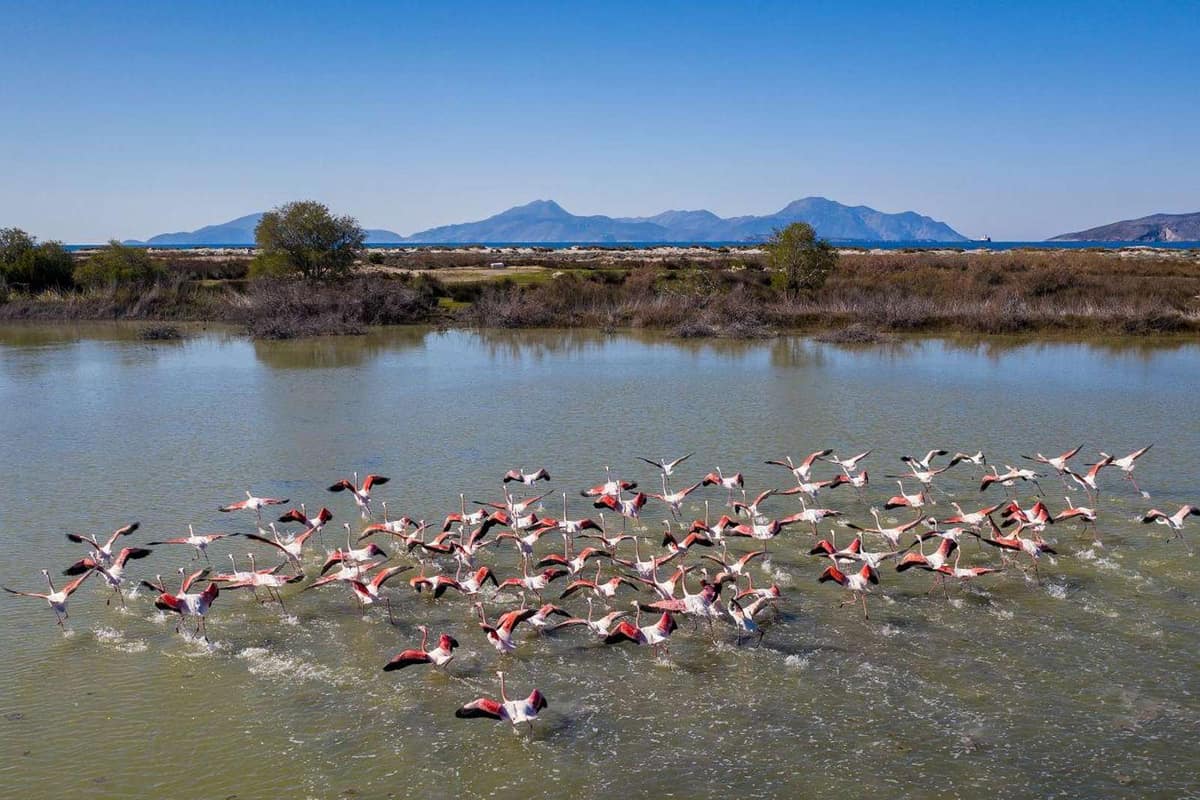
Among the tourist buildings, two streams feed a brackish marsh that a natural channel links to the sea. The Italian period used the marsh for salt production. The wetland is now a protected habitat, the Agios Fokas Wildlife Sanctuary. Reeds and migrating flamingos suit a bird watcher weighing where to stay in Kos.
From the town, Agios Fokas is about eight kilometres away by a drive or bike ride through Psalidi. The municipal page calls the coast mostly pebbly, with deep water that suits snorkelling. Wikivoyage lists the beach among the peaceful ones and gives it dark sand. From the water the view runs towards the Turkish coast.
Therma follows right after Agios Fokas, about three kilometres on. A hot spring runs down the beach. A ring of stones holds its warm water in a pool beside the sea. Volcanic activity left the black pebbles and the stony coves. For where to stay in Kos, Therma works as a day stop, with the view reaching Nisyros.
The coast road runs south-east from the town. Each base here is a bus, bike or car ride from the ruins. The stay then trades the old lanes for open shore. For where to stay in Kos, that is the choice this stretch puts on the table.
How do Tigaki and Marmari answer where to stay in Kos?
For where to stay in Kos, Tigaki offers a village base about 400 metres from the Alykes salt lake. Wikipedia gives that distance from the village centre. Tigaki stands 1.5 kilometres off the road that links Kos with Kefalos. The lake is a short walk away, and that road is a short drive.
Buses join Tigaki to Kos, to Kefalos and to the villages between them, as Wikipedia states. The same page puts the airport about 12 kilometres away by air. For where to stay in Kos, those two lines make a plain test of access. The village has a bus link, and the airport lies within reach.
The official island site calls the Tigaki salt lake, Alykes in Greek, a Natura location between Tigaki and Marmari. Reedbeds and marshy ground cover its edge, with wild canes, rushes and tamarisks. The lake was a sea salt works until nineteen eighty-nine, and the abandoned buildings still stand. Today it is a protected area.
Birds draw readers to the lake. The official site names pelicans and herons, and it reports flamingos and ruddy shelducks in the autumn and spring migrations. The area also holds water turtles and water snakes. For a week of bird-watching, where to stay in Kos is answered by a base within walking distance.
During summer the lake dries, and a white salt surface remains. The official site compares the dry bed to a lunar landscape, with feathers and branches scattered over it. When the lagoon is full of water, it looks like a heart from above. Visitors reach the shore on foot, by bicycle, by car or by motorbike.
Marmari is the lake’s other neighbour. The official island site lists horseback riding on Marmari beach among its outdoor options. Its riding page adds rides around the salt lake of Tigaki and pony rides for little riders. A family reads that as open ground and sea in one place. It answers where to stay in Kos with children.
The island site’s water sports page names organised resorts that offer water sports at Tigaki and Marmari. It lists Psalidi, Lambi, Kardamena, Kefalos and Mastichari beside them. Kos Town lies a short bus journey or drive from both. For a reader who wants sea, wind and open ground first, where to stay in Kos is Tigaki or Marmari.
How does Mastichari answer where to stay in Kos?
For where to stay in Kos, Mastichari joins a fishing harbour to a holiday resort, as Wikipedia describes it. The same page puts it 7 kilometres from Kos Airport, and Wikivoyage places it in the island’s north-west. This base suits a reader who wants a short road from the plane and a harbour close by.
- Age: people have lived in the village only since nineteen thirty-three, as Wikipedia states.
- Sand: Wikivoyage calls the main beach sandy, with beach furniture on the stretch beside the village in summer.
- Wind: Wikivoyage names the north-west, with Mastichari and the Kohilari beach, for kiteboarding.
- Water: the island site lists the organised resorts of Mastichari among those that offer water sports on the island.
A taxi ride from the airport to Mastichari takes about five minutes, per Wikivoyage. The airport bus to Kos Town also calls at the village, as that page notes. A short visit makes where to stay in Kos a question of closeness, and Mastichari keeps the road brief. The first evening stays free.
The port gives Mastichari a sea link of its own. Wikipedia states that boats leave it regularly for Kalymnos, the island to the north. A reader who likes to watch a working harbour finds one here. A quiet room close to the quay puts the boats and the fishing village at the door.
The sand is the second answer. A beach day points to where to stay in Kos: a room near that sand. The walk to the water stays short. The beach belongs to the village rather than to a trip away from it. A bicycle or a short stroll then covers the day.
Rooms by the harbour and rooms by the sand answer different days. The harbour side puts the quay and the fishing boats at hand. The sand side puts the beach at hand. Anyone picking where to stay in Kos at Mastichari starts with the day and ends with the room.
Put the lines together, and the profile for where to stay in Kos at Mastichari is plain. The village offers a harbour, a sandy beach, a bus link and an airport close by. The castle and the old streets belong to Kos Town, which this page covers above.
Two plans fit this coast. One is a quiet harbour room at Mastichari with a bus ride into Kos Town. The other is a base at Tigaki, covered above, with the salt lake at hand. Sea, sand and a short road from the plane settle where to stay in Kos at Mastichari.
How does Kardamena answer where to stay in Kos?
Kardamena answers where to stay in Kos with a long sandy shore and its own harbour. The village lies midway along the south coast, about 30 kilometres from Kos Town. The Greek-language article on Kardamena gives the shore six kilometres of sand, so the base is a beach stay first.
The people of Kardamena settled the present site in eighteen sixty-five, as that article states. The English-language article adds that the small fishing village became a summer destination in the nineteen sixties. For where to stay in Kos, then, this is a harbour that grew with its visitors.
The shore changes along its length. The article describes organised and open beaches. Along them the water is deep and cold with pebbles in places, and shallow and warm over golden sand elsewhere. It adds beach volleyball and water sports such as diving and fishing at the organised beaches. A family with young swimmers can look for the shallow sand.
Kardamena stands on the site of Alasarna, one of the six ancient districts of the island. The article calls Alasarna an important religious centre, with a temple of Apollo. Digs by the University of Athens have taken place there each summer. A reader who plans where to stay in Kos around ruins finds them in the village itself.
The article lists a settlement, a cemetery and four basilicas from the first Christian centuries. It reads them as a thriving town with workshops and active trade. Everyday stone objects such as millstones, tools and vases came out of the digs. Remains from the New Stone Age onward show that people lived on the site without a break.
The town hall holds two permanent exhibitions. One covers folk life with a traditional Kardamena house, the other the maritime tradition. Summer brings theatre, art shows and music. The feast of the Birth of the Virgin falls on the eighth of September. These dates help a reader who is choosing where to stay in Kos by month.
A boat sails from the harbour to Nisyros each day in summer, as Wikivoyage lists. Short trips also run to Agia Irini beach. The resort stays open late, so rooms at the shore ends suit early nights. The airport stands near Antimachia and its Byzantine castle. For where to stay in Kos with the sea first, the shore settles it.
How do Kefalos and Kamari answer where to stay in Kos?
Kefalos and Kamari answer where to stay in Kos with two levels. The old village stands on a stone height, and the harbour bay lies below it. The village is about 16 kilometres from the airport, out on the far south-western corner of Kos. The base suits a stay centred on the west.
- Kefalos village: the traditional settlement on the hilltop, with narrow lanes and houses built side by side.
- Kamari: the shore part of the village and its harbour, with a promenade that runs east from the harbour.
- Kampos and Onia: the other two beach settlements on the curve of the bay.
- Limnionas: a cove with a small harbour and a quiet beach, about five kilometres north of the village.
The Greek-language article on Kefalos gives two readings of the name. One says it was the chief village in ancient times. The other, the stronger reading, ties it to the shape of the area, like a bearded vulture’s head. A traveller who is choosing where to stay in Kos can read that as a headland base.
Mount Zini, a volcanic dome with steep cliffs, towers over the deep-water harbour at the western end of Kamari Bay. Between the cliffs and the harbour lies a sandy beach. A steep road leads up from the harbour to the village’s western edge. Local restaurants buy the catch of the fishing boats that work from the harbour.
The Kamari Bay article on Wikipedia describes the bay as a quieter resort than Kardamena. The bay fills in the summer season, and in the off-season locals retreat to Kefalos. Buses link the bay and Kos Town via Paradise Beach and the airport. A reader who plans where to stay in Kos outside summer can try the hill village.
The ancient town of Astypalaea lay near Kefalos, and its people left it to build the town of Cos. The cave of Aspri Petra holds the first signs of life on the island, from the New Stone Age. For where to stay in Kos, the west holds older layers than the resort.
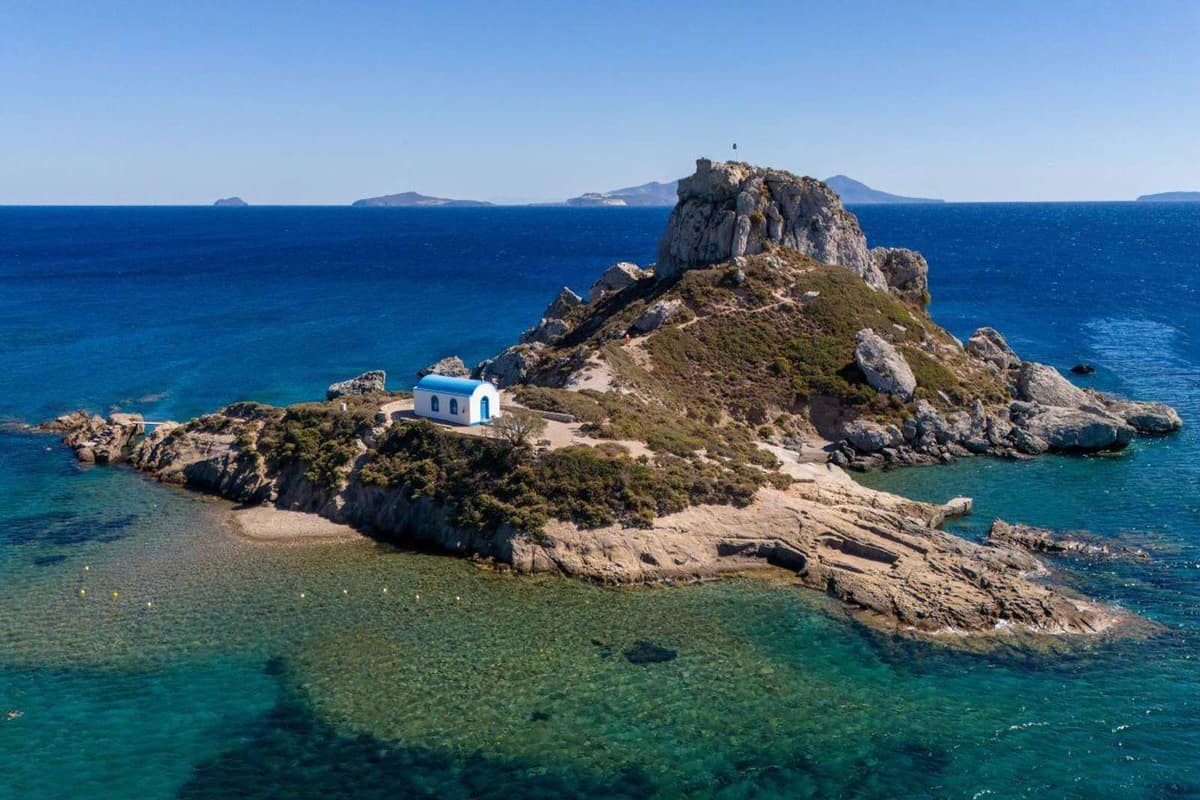
Close to Kamari lies the small volcanic islet of Kastri, also called Palaiokastro, with a church of Agios Nikolaos. The ruins of Agios Stefanos keep mosaic floors inside the remnants of their walls and columns. The Greek-language article dates the churches to the fifth and sixth centuries. For ruins at the sea, this bay answers where to stay in Kos.
Village feasts fall on the twenty-sixth of July for Agia Paraskevi and on the twenty-ninth of August for Agios Ioannis. A large feast marks the fifteenth of August. For where to stay in Kos with the whole west in view, a traveller can settle here for the visit. The drive from Kos Town to the west is long.
How do Zia, Pyli and the Dikaios villages answer where to stay in Kos?
For where to stay in Kos, the villages of the Dikaios range lie about 15 kilometres from Kos Town. The municipal page puts Pyli that far south-west, and German Wikipedia gives Zia the same distance. Both suit a quiet stay on the hill slopes, away from the sand.
The slopes of Mount Dikeos carry Zia, the municipal tourism page states. It links the village with its sunsets and says olive groves, pines, cypresses and oaks circle it. Springs run down from the mountain. A stay here answers where to stay in Kos for a visitor who wants green slopes and cobbled alleys.
From the cobbled trails the view reaches the island’s coast. The page names Kalymnos and Pserimos among the islands in sight. Two old watermills, one on the road to the village, are listed as preserved monuments. For where to stay in Kos, German Wikipedia adds a marked path from Zia to the main summit.
The Natural Park of Zia lies in the pine forest. The page lists paths, a playground and a rest point for a coffee. Tavernas, cafes and small shops fill the lanes of the village. A hire car or a bus links both villages with the north-coast beaches. That link counts for where to stay in Kos.
Olive trees and grassy fields surround Pyli, a village within the central countryside of Kos. In ancient times the village was called Peli. The municipal page names its square, with stone-built houses and old coffee houses, as the highlight. For where to stay in Kos with a village feel, that square is the answer.
About 100 metres from St Nicholas square, a stone fountain pours cold water from 6 spouts. An inscription on its south side records a restoration in the sixteenth century. The page also describes an old house of Pyli with three rooms: a kitchen, a hall and a bedroom. Its furniture stands as the owners left it.
The tomb of Harmylus, a king of Kos, lies 300 metres east of the square, under the chapel of Stavros. The page calls it a burial complex of the Hellenistic period, with a stone chamber of 12 graves. The ruins of the medieval settlement and castle of Palio Pyli give a view over the Aegean.
How do the Asklepieion and the old sites shape where to stay in Kos?
From Kos Town the Asklepieion is reached over 3.4 kilometres to the south-west, as the municipal page states. The page names the car, the motorbike and the bicycle as ways to reach it. For where to stay in Kos with the old sites in mind, a base in town keeps the ride short.
- The Asklepieion, on a hillside with sea views
- The Casa Romana, a short walk from the old lanes
- The Roman Odeon, reached on foot or by bicycle
- The Archaeological Museum, on Eleftherias square
- The Castle of Antimachia, with cisterns and two churches inside
The municipal page gives the road as Asklipiou Street and then Agiou Dimitriou Street, with a parking area. The Greek National Tourism Organisation page counts the steps. Legend places the school of Hippocrates on the lowest tier, marked by four columns and 24 steps. A larger staircase of roughly 60 steps then leads to the Doric temple.
In the post-Byzantine era a church of Panagia Tarsou rose over the Apollo temple, and one capital survives. The Knights Hospitaller later used stone from the site to build a medieval castle. Both facts come from the national tourism page. So for where to stay in Kos, a town base puts the hillside a short ride away.
The Casa Romana sits at the centre of Kos Town, within walking distance, the municipal page says. The villa is built around three atriums. Two of them form peristyles of the Rhodian type, courtyards ringed by two-storey porticos. The page calls its drainage system outstanding. A seabed mosaic from one courtyard is now on display in the museum.
Eleftherias square, the central square of the island, holds the Archaeological Museum, as the municipal page says. Its finds come mainly from the Ancient Agora and the Western Archaeological Zone. A statue of Hippocrates from the fourth century BC stands in its northwest hall. A room near that square answers where to stay in Kos for a museum morning.
The municipal pages list the Casa Romana and the museum from eight in the morning to half past seven. They list the Roman Odeon, entered along a cypress path, from half past eight until three in the afternoon. All three close on Tuesdays. For where to stay in Kos, a town base keeps all three on foot.
The Castle of Antimachia lies 4 kilometres from Antimachia village, the municipal page says. The Knights Hospitaller raised it on a plateau south-east of the village, with a view to the south coast. The page names the car and the motorbike as the ways there. For where to stay in Kos, it is a road trip from any base.
How do the airport, the port and the buses shape where to stay in Kos?
Kos Island International Airport “Hippocrates” stands near Antimachia, as Wikipedia states. It lies about 24 kilometres from Kos Town, on the provincial road to Kefalos. The airport, the harbour and the central bus stop are the three arrival points. Each of them frames where to stay in Kos.
The airport sits 125 metres above sea level, its infobox shows. The national tourism page lists the flight from Athens as one hour of travel. From Thessaloniki it lists one hour and forty minutes. The stay then starts with a drive, whose length counts first for where to stay in Kos.
The airport entry notes that the airport mainly serves charter airlines and peaks in summer. A metered taxi service waits outside the terminal at all hours. The entry also names the Kos-Kefalos provincial road as the route by car. A base near the airport keeps a late first night short.
Wikivoyage names daily links with Piraeus, Rhodes, Patmos and Leros. It also lists the Kalymnos boat more than once a day. It adds Santorini about four times a week and Astypalaia twice a week in summer. For a ferry day, where to stay in Kos starts within a walk of the harbour.
The official island page puts the marina one mile south-east of the harbour. It adds a further set of berths at Mandraki itself. The same page names catamaran links to Kalymnos, Leros, Patmos, Leipsoi, Symi and Rhodes. Whatever the plan, the harbour town is the sea base for where to stay in Kos.
The island buses leave from the central stop at 7 Kleopatras street, the official island page says. The town buses are a separate service, with an address at 27 Akti Kountouriotou street. Their lines link the centre with Platani, Alikarnassos, Lambi, Psalidi and Agios Fokas. A room near the town serves the beaches on either side without a car.
On Wikivoyage, Kos is a fairly small island with a public bus to every part. The same page lists scooters, ATVs and cars for hire. It reports the roads as good. The official page adds bicycles and buggies, and taxis in the town. A hire car opens more bases for where to stay in Kos.
Which months and day trips suit where to stay in Kos?
The weather table of the island lists highs of 25 degrees Celsius or more from late spring to October. That warm run comes first in where to stay in Kos. Day trips by boat come next, and each boat leaves from its own port.
- Kos Town harbour: the boat day to Kalymnos, Plati and Pserimos, plus the catamarans to the farther islands.
- Mastichari: the boat to Kalymnos.
- Kardamena: the boat to Nisyros and its volcano crater.
- Kos Town: the sea crossing to the Turkish coast.
The same table lists an April high of 20 degrees Celsius and a June high of 28.5. September matches June at 28.5, and November still reaches 21.1. The winter highs are 14.3 in January and 17.4 in December. The table shows no rain in July and August.
In the weeks of the meltemi, where to stay in Kos can follow the wind. The entry on the meltemi names the north as its direction and the Aegean as its sea. The wind belongs to the months from late spring until mid-September. Its strongest hours fall in the afternoon.
The official wind-sport page names June to September as the months for the sport and August as the windiest month. It speaks of steady side-shore winds that blow for days in a row. It names Psalidi, Mastichari, Tigaki, Kefalos and Kohilari as the places that host the wind-sport centres.
A day on Nisyros starts at Kardamena, where the official island page says the boat takes less than an hour. The page speaks of walking onto the crater of the volcano. The entry on Nisyros calls the caldera three to four kilometres wide. For where to stay in Kos on a Nisyros day, Kardamena keeps the harbour close.
Day trips begin at nine and finish at five in the afternoon or later, the official island page says. It places the Kalymnos boat at Mastichari and the three-island trip at Kos Town. Wikivoyage puts sailings from Mastichari to Kalymnos about two hours apart. So where to stay in Kos follows the harbour the day starts from.
The official island page says Rhodes takes about three hours, so it suits a weekend, not a day. It names Patmos for trips of two days or more. It puts the Turkish coast about thirty to forty minutes away. A room by the harbour fits these trips, and so it settles where to stay in Kos for them.
Which questions do readers raise on where to stay in Kos?
One test settles where to stay in Kos: sights on foot, or the sea at the door. The harbour town wins the first test, and a coast village wins the second. Below, four answers cover the first base, the hire car, the number of nights and the island food.
For a first visit, which fits where to stay in Kos: the harbour town or a beach village?
On where to stay in Kos, the town suits a first visit because its old sights sit close together. Take the two fountains at the plane tree of Hippocrates. The Municipality of Kos tourism page says the north one stands in an ancient engraved urn of white marble.
Its Arabic inscription describes the water as water from the tree of Hippocrates. The east fountain is round, with fourteen sides and a dome. The dome rests on seven arches, and the arches stand on columns with Corinthian capitals.
The town page of the same site names the shopping area. It spreads around Konitsis square and along Ippokratous, Venizelou and Vasileos Pavlou streets. A room in the centre keeps those streets and the fountains close.
For where to stay in Kos, the coast offers another start. A village there swaps the squares for sand, with buses running to the town. A split stay also works, with the town for the first nights and a village for the last.
Does where to stay in Kos call for a hire car?
The base decides the car. In the town and the north-coast villages, a bicycle takes over the daily trips. The Municipality of Kos tourism page says Kos has been known for decades as the island of bicycles. It ties the habit to the shape of the island.
One backroad shows the point. The town page names the broad road of Faros in Lambi, also written Aigaiou Street. From there a backroad reaches Tigaki in about 7 kilometres. The Tigaki page calls that backroad flat to cycle.
A car earns its place on a base far from the town, or on a week of far-apart bays. Wikivoyage puts Kefalos about 40 minutes from Kos Town by car. There the hire car or a bus does the daily work.
For where to stay in Kos without a car, pick the town or a north-coast village. Let the bicycle carry the day. Book the car for the inland days alone.
Which trip length goes with where to stay in Kos?
For where to stay in Kos, three nights cover the harbour town and one day trip. Five nights add the middle of the island. A week adds the hills and a second stretch of coast.
The pine forest of Plaka fills the middle-of-the-island day. The tourism page says a paved road of 2.5 kilometres runs to it from the road west of Antimachia. Dozens of peacocks walk among the trees.
The page adds that the tall pines give coolness there in the warmest months. Benches stand along the paths, and the page invites visitors to look for a single all-white peacock. On the south side of the forest stands the chapel of Agios Ioannis Prodromos.
The International Hippocratic Foundation fills a second half day. The tourism page places it east of the Asklepieion. Its grounds hold a botanical garden of medicinal herbs that Hippocratic texts mention. The opening days and hours are the ones the official page gives: Monday to Saturday, from nine to four.
Wikivoyage says the foundation lies between the Asklepieion and Kos Town. A town base keeps it close. That answers where to stay in Kos for a day of Hippocrates.
Which local food belongs to a week on Kos?
For where to stay in Kos, food adds a reason to know the town. The municipal market stands in Eleftherias square above the port, as the Municipality of Kos tourism page states. A room near that square keeps the market and the port a short walk away.
The wine cheese of Kos, called krasotyri, takes its shape from long narrow moulds. It comes out cylindrical and ridged. It is white inside and reddish outside. The redness grows with the time the cheese spends in the wine lees.
The page pairs it with watermelon, melon, grapes or wheat bread. The honey page adds that Kos honey tops loukoumades, the dough fritters, and goes into baklava and handmade cheese pies. The fruit and vegetable page says a Greek salad there can use entirely local produce.
Herbs belong to the table too. The same page lists rosemary, lavender, oregano, thyme, sage and mint among the native herbs. It says people have used them since the time of Hippocrates. In nineteen sixty, tomatoes were the main export crop of the island.
The tomato spoon sweet of the island is on sale in bakeries, grocery stores, organic shops and the local market. Every base reaches it, so food never decides where to stay in Kos.