
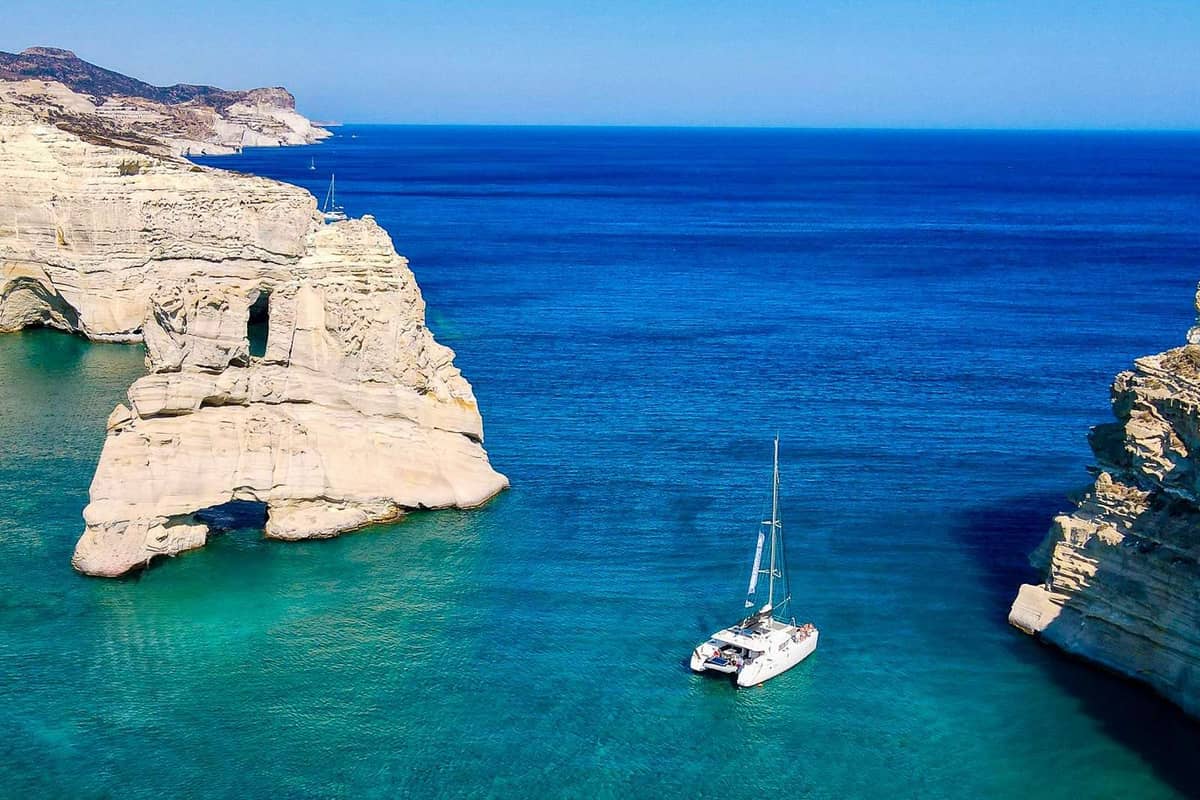
Where to stay in Milos depends on the part of the island you pick. Adamas holds the port inside the great bay, Plaka and Trypiti sit on the hill above it, Klima and Mandrakia keep their boat houses by the water, Pollonia faces Kimolos in the north-east, and Paleochori and Provatas line the south coast. The tours in Greece on the home page add the rest of a Greek trip.
This page covers the bases one by one, then the mines, the ancient sites, the port, the airport, the roads, the months and the day trips. The Milos Kleftiko cruise page holds a day at sea, and the where to stay in Paros and where to stay in Naxos pages cover two more islands of the Cyclades.
Which factors settle where to stay in Milos?
Where to stay in Milos starts with the shape of the island. A bay opens to the north-west and splits the land into two nearly equal halves. The harbour town sits on that shore, so the trip you plan, not one town, picks the base.
Volcanic rock makes up Milos. It stands north of the Sea of Crete, further south-west than any other Cyclades island. The Greek National Tourism Organisation sets it at the halfway point between Crete and the port of Piraeus. North to south it spans about 13 kilometres, and from its eastern to its western end about 23.
That makes a compact island, so where to stay in Milos is a choice between corners, not between distant regions. The same official page counts over 70 beaches, so the sea alone does not settle the base.
Wikipedia lists the traditional architecture, the varied coastline and the beaches among the draws for visitors. Each draw points to a different kind of base. Five questions sort them, and none of them needs a ranking of towns.
The first question is how you arrive. A night between two ferries asks for a bed near the quay. A week asks for a base you want to wake up in. Where to stay in Milos for a long stay can sit well away from the port.
The second question is how you move. A hire car frees a hill village or a far bay. Without one, the harbour town or a village on the bus route keeps each day simple. Wikivoyage calls the island small enough that even a slow vehicle covers it quickly.
The third question is the water. A swimmer wants sand or a flat rock near the room, and a diver wants a cove close by. Where to stay in Milos for the sea depends on which of those two you picture.
The fourth question is the evening. A harbour front and a village lane end a day in different ways. The first has boats and a walk along the quay. The second has white houses and a sunset from a hill, as Wikivoyage describes for Trypiti and Plaka.
The fifth question is the length of the stay. One night asks for the port. A week lets you try a hill village, then a bay. Where to stay in Milos can therefore mean two bases, not one. A split stay suits an island of this size.
This page covers eleven bases, and every base has a section of its own later on. For where to stay in Milos, the names are:
- Adamas
- Plaka
- Triovasalos
- Trypiti
- Klima
- Mandrakia
- Firopotamos
- Pollonia
- Paleochori
- Provatas
- Achivadolimni
The ferry port of Adamas and the airport get a section of their own later. As Wikipedia places it, the airport stands five kilometres to the south-east of the port.
How do the areas split where to stay in Milos?
Where to stay in Milos splits along the bay. The eastern half holds the harbour town and the villages. The western half is uninhabited and rises to Profitis Elias at 748 metres. The isthmus between the halves is never broader than 2.2 kilometres.
- The bay is a hollow in the principal crater, and it reaches in from the north-west.
- The water in the bay is between 55 and 130 metres deep.
- From Adamas, the harbour town, the land climbs to a plateau with Plaka, the chief town, and the Kastro on the hill above it.
- Zefyria, known as Kampos, Triovasalos, Pera Triovasalos and Pollonia complete the village list in Wikipedia.
- Rugged hills cover the larger share of the island.
- The western region is uninhabited.
The east gives three heights of stay. The port stands at the water. Plaka rises on the plateau above it. Pollonia lies in the north-east corner. Where to stay in Milos in the east is a choice of height as much as of village.
Wikivoyage reports that paved roads and smooth unpaved stretches lead to the larger share of the popular places. That favours an eastern base, since Adamas, Plaka, Trypiti and Pollonia all stand on that side. With little planning, the east is the plain choice for where to stay in Milos.
The west asks for another plan. Wikivoyage names the west as the part with places that ordinary vehicles cannot reach. No base on this page lies there. The west is a day out from an eastern base such as Adamas or Plaka. Where to stay in Milos ends at the edge of the villages.
The coasts add one more clue. One cave of the southern shore still holds the heat of the volcano, the island article notes. In the north-east, Pollonia is a seaside village, as Wikivoyage states. Both coasts shape where to stay in Milos for a beach lover or a diver.
A first visit fits the harbour town or Plaka, since both lie close to the port. A second visit can try a fishing hamlet or a far bay. Either way, where to stay in Milos is easier to judge with the bay in mind.
Read the sections that follow with that map in your head. Each base is told through its places: the lane, the church, the beach, the old mine or a ruin nearby. That is a plain way to compare where to stay in Milos before the trip is fixed.
Why does Adamas lead where to stay in Milos?
Adamas leads where to stay in Milos as the island’s harbour town and its cultural and commercial centre. The town has 1,268 residents. The quay, three museums and a shaded beach all lie in or near the town. A base here keeps the port and the sights within reach.
The name Adamas comes from the Greek word for diamond, as Wikipedia notes. The Mining Museum names Adamas as the main port of Milos. Where to stay in Milos near the port starts here, since a room in town sits at the arrival point.
Refugees from Crete founded Adamas in eighteen forty-one, according to an encyclopedia article on the island. Milos had become a refuge for people from the islands, particularly Crete. The newcomers built the port town. That story frames where to stay in Milos at the harbour: the town began as a place of arrival.
From Adamas an ascent leads up to a plateau over the port. There stands Plaka, the chief town of Milos, and a hill above it carries the Kastro. Wikivoyage describes Plaka as a small village lying north of Adamas, close by.
Lagada lies near Adamas, and the official tourism site of Greece mentions the natural shade of its tamarisk trees. A room in the town keeps that shade close. Where to stay in Milos with a beach near the port points to Lagada.
The room itself splits into two kinds inside the town. A harbour-front room has the quay and the town streets at the door. A room on the slope above trades that for a wider view over the bay. Wikivoyage notes the views of Plaka, which sits higher on the mountain.
A short stay between two ferries suits the harbour front, since the quay is the first and last stop. A longer stay suits the slope, with a hire car to reach the other bases. That choice is the first step of where to stay in Milos for a traveller arriving by sea.
An encyclopedia article calls Milos a popular summer destination. In the busy months the harbour front is where the arrivals and departures of the island meet. A room one street back keeps the quay in reach. Where to stay in Milos then follows the plan for that day.
How do the museums and churches of Adamas shape where to stay in Milos?
The museums and churches of Adamas shape where to stay in Milos because three museums stand there. The Mining Museum, the Marine Museum and the Ecclesiastical Museum all stand in or around the harbour town. One of them sits inside the Church of the Holy Trinity.
- The Mining Museum, in Adamas, with maps, tools and mineral samples.
- The Marine Museum, above the port, with rare maps and a wooden boat.
- The Ecclesiastical Museum, inside the Church of the Holy Trinity near the port.
- The parish church of the town that honours the Assumption of the Virgin.
The Mining Museum stands in Adamas, as the museum’s own site states. Its ground floor shows photographs, paintings, old and new maps of the island and authentic tools. The first floor shows mineral samples in window cases, with an interactive touch unit. Where to stay in Milos near this museum means a base in the harbour town.
The same floor holds a collection of obsidian artefacts. The pieces come from Milos quarries such as Nychia and Demenegaki. Those quarries were the main source of obsidian for prehistoric settlements around the Aegean for seven millennia. Obsidian is an igneous rock that is characteristic of Milos.
The museum offers an audio guide in five languages: Greek, English, French, German and Italian. The municipal visitor portal adds that films on the extraction and production of minerals play there. A screening room tells the stories of the old miners. Wikivoyage describes the exhibits as a mining history of 11,000 years.
The Marine Museum is housed above the port, in the building of the old Community of the island. The municipal portal adds that its exhibits begin with prehistoric obsidian tools and run to recent years. It also holds rare maps and a wooden boat. A room by the harbour answers where to stay in Milos for this museum.
The Church of the Holy Trinity stands very close to the port, as the municipal page states. The church is a thousand years old. Its plan is a basilica with three aisles, a dome and a cross-shaped roof. The page calls the type very rare and names only one other church of it, in Levidi in Arcadia.
The building began as a monastery named Panagia Theofani. Refugees from Crete bought it and made it their village church. The bell tower shows Gothic influence, and a mosaic in the courtyard shows a dragon in the shape of Milos. Where to stay in Milos within a short walk of this church starts at the port.
The Ecclesiastical Museum shows images from the fourteenth century, works of the Cretan school, epitaphs and wood carvings. A seventeenth-century iconostasis, silver goblets and incense burners belong to the same collection. The municipal page also lists rings, necklaces and earrings among the exhibits.
The parish church that honours the Assumption of the Virgin completes the list for Adamas, as the municipal portal records. For where to stay in Milos on foot among museums and churches, the harbour town is the clear answer.
Why does Plaka suit where to stay in Milos?
Plaka suits where to stay in Milos as the current capital of the island. It stands at an altitude of 220 metres, and car traffic is prohibited there. A Venetian castle of the thirteenth century crowns its hill, says the visitors portal of the Municipality of Milos.
The portal ties the name of Plaka to flat ground. The first inhabitants built their houses on it once the Castle was too small for everyone. Where to stay in Milos therefore starts with an old choice of level ground.
Wikipedia notes that the official name of Plaka is Milos, the same as the island. It gives Plaka 902 residents in the twenty twenty-one count. The portal describes the architecture as Cycladic, with island colour in every wall. Its church list names the parish of the Nativity of the Virgin in the village.
Cobbled alleys wind through the village, and the portal says they were first built for protection from pirates. Small traditional shops, restaurants and cafes stand along them. The bay of Milos opens below, with views the portal calls magnificent. Where to stay in Milos on foot starts in these lanes.
At the top of the hill stands the Venetian Castle of the thirteenth century. The portal praises its sunsets, with rich colours and panoramic views of the bay and the neighbouring Cycladic islands. Wikivoyage describes a path that climbs from the village to the castle.
Wikivoyage names two churches along the way. The Church of Panagia Thalassitra stands beside the path up. The Church of Panagia Korfiatissa has a balcony over the sea. Wikivoyage points to it for the sunset as well. A room near these churches answers where to stay in Milos for an evening walk.
The Archaeological Museum has its home on the main square of Plaka. Its neoclassical building dates from eighteen seventy and has housed the museum since nineteen eighty-five. The national tourism page puts it at the crest of the village. It gives the drive from Adamas as ten to fifteen minutes, then a short walk.
The porch and the courtyard of the museum hold torsos from late antiquity. They form the lapidary of the museum. Where to stay in Milos near the main square keeps that corner within a stroll.
The summer hours start at half past eight and end at half past three, as the same page states. The museum is closed on Tuesdays and Thursdays. Behind the church of Panagia Korfiatissa stands the Folklore and History Museum. The portal says it was founded in nineteen sixty-seven. It shows a nineteenth-century household with a loom, a kitchen and old photos.
A room in the lanes keeps the Castle path, the main square and both museums on foot. A room at the port keeps the quay at the door instead. Where to stay in Milos then comes down to a hill or a harbour, and Plaka answers the hill.
How do Triovasalos and the hill villages answer where to stay in Milos?
Triovasalos answers where to stay in Milos as a village on the road from the port up to Plaka. Triovasalos had 1,379 residents in the twenty twenty-one count, more than Plaka itself. Pera Triovasalos stands next door, and the two villages together fill two neighbouring cliffs.
- Pera Triovasalos is the first village on the road from the port, as the visitors portal states.
- Triovasalos follows it, densely populated and built like an amphitheatre.
- Plakes lies between Plaka and Triovasalos, at the foot of the Castle.
- Tripiti is almost united with Plaka, with the church of Agios Nikolaos in its centre.
The portal names Karodromos as a central point of the island, with public services, cafes and shops. A stay in Triovasalos therefore sits among them. Where to stay in Milos here means a base at a central point of the island.
The main sights of Triovasalos are two churches. Saint Spyridon dates to the start of the nineteenth century. Saint George dates to eighteen forty-nine. The visitors portal lists a parish of Saint Spyridon in Triovasalos and a parish of Saint George in Pera Triovasalos. A walk between the two villages links both parishes.
Plakes is a small village of white houses and alleys between Plaka and Triovasalos. It rose at the foot of the Castle. Its name, which means straightening, comes from the flat ground. Where to stay in Milos in a small village below the Castle points to Plakes.
The church of Agios Charalambos in Plakes holds one of the oldest icons of the island, Panagia Akradiotissa. The portal adds that the beach of Plathiena lies an easy, quick trip away. A base here pairs a village lane with a day by the sea.
The portal names panoramic views of Adamas Bay from Tripiti. Windmills that once ground grain are still preserved in the village. Tripiti and Plakes both lie close to the capital. Where to stay in Milos near Plaka, without its car-free lanes, includes them.
Plaka counts 902 residents, fewer than Triovasalos, yet it is the capital. The two bases split the slope between them. Triovasalos has its central point, and Plaka has its Castle. Each answers a different plan for the evening.
The hill villages sit above the sea, so a beach day begins with a drive down. A village house suits a longer stay, with white lanes at the door. Where to stay in Milos for a quiet evening in a village points to this slope.
How do Trypiti and the catacombs answer where to stay in Milos?
Where to stay in Milos can start in Trypiti, a traditional village 150 metres above the sea. It lies 5 kilometres north-west of the port of Adamas. The Catacombs of Milos and the ancient theatre lie next to it. A base here is a stay among old stones.
The name Trypiti points to holes. Volcanic rock full of openings carries the village, and the Greek Wikipedia page says erosion or people cut those holes. That soft rock let the islanders dig an underground cemetery here. Caves around the village still serve as storerooms and stables.
The Catacombs of Milos are an old Christian burial ground below the surface. They date between the first century AD and the fifth. They lie near Trypiti, beside the old agora of ancient Melos. Anyone weighing where to stay in Milos around ancient sites finds them next to the Trypiti base.
Width inside runs from 1 metre to 5 metres, and height from 1.6 metres to 2.5 metres. Graves cut into the walls sit beside graves cut into the floor, which unworked stones of uneven size cover. On the road to the catacombs stands the small church of Panagia Faneromeni, with two arched tombs inside.
Windmills add a second kind of room. Wikivoyage lists windmills in Trypiti as places to sleep. The Greek page adds that the restored mills once ground grain. A share of them now offer beds to visitors. Where to stay in Milos can mean a windmill, for a traveller who likes old buildings.
In the village centre rises the church of Saint Nicholas. Builders raised it in eighteen eighty-eight on the plan of the church of Saint Nicholas in Syros. Inside are a marble altar screen and icons of the Cretan School.
The ancient theatre of Milos stands on a hill slope between Trypiti and Klima. The Ministry of Culture dates this work to the Roman era, the first to the fourth century AD. Builders worked in stages, and the theatre looks over the gulf of Milos.
After the restoration works ended, the theatre can host around 700 people, as the Ministry of Culture states. Near the ancient town, where to stay in Milos splits two ways. Trypiti lies on one side of the theatre, and Klima on the other.
Wikivoyage notes that little else survives of the ancient city. It adds that a farmer unearthed the Venus de Milo near here in eighteen twenty. A history lover finds a case for Trypiti in that story. Where to stay in Milos has a clear option here.
The Greek farmer found the statue on the eighth of April, then under Ottoman rule. A French sailor who knew archaeology watched and urged him to dig further. Among the finds was a marble hand that held an apple. The Louvre has shown the Venus de Milo since eighteen twenty-one.
How do Klima and its boat houses answer where to stay in Milos?
Klima answers where to stay in Milos with syrmata, the two-storey fishermen’s houses of a seaside village. The family lived on the upper floor, and the boat rested on the lower floor in winter. Today houses of this kind also serve as tourist rooms.
- Klima is a seaside village of Milos with 8 residents at the latest Greek census.
- Klima stands where the bay of Milos meets the sea, below Trypiti.
- Since nineteen seventy-eight, the village has counted as a traditional settlement.
- Strong colours paint the doors and windows.
- The word syrmata means wires in Greek.
A syrmata house sets the plan of a stay. The living rooms sit on the upper level, and the boat level sits below, at the edge of the water. In a converted house, a guest takes the family level. For where to stay in Milos beside the water, that plan is the heart of Klima.
Klima keeps a village feel. The Greek page lists eating places in the village, yet only 8 residents live there. Inside the village stands the cave church of Agia Paraskevi. Evenings in Klima stay quiet in a village of this size.
The village beach suits a swim, and so does the nearby beach of Schinopi, as the Greek page states. The sea is at the door here. Where to stay in Milos can mean a room whose first dip starts in the village itself. No drive is needed.
A day in Klima can run on foot. The beach, the cave church, the eating places and the lanes of the syrmata sit in one small village. That is where to stay in Milos for a visitor who wants a slow day by the water.
Ancient Milos stood close to Klima, and the village sits below Trypiti. The two places split the area into a sea level and a hill level. A visitor can sleep at one and walk the lanes of the other.
Trypiti is 5 kilometres from Adamas, and Klima is 6 kilometres, as the Greek pages give it. Both are short hops from the port. Hill or water is the choice, then, when where to stay in Milos falls on this side of the bay.
A hill stay in Trypiti means windmills, a village church and the catacombs. A water stay in Klima means a boat house, a small beach and the sea at the door. Each answers where to stay in Milos for a different kind of visitor. The two villages sit close enough to be seen together.
How do Mandrakia and Firopotamos answer where to stay in Milos?
Mandrakia and Firopotamos answer where to stay in Milos with two fishing villages on the north coast. Each has a cove, a small harbour and a row of syrmata. A Greek-language article puts Mandrakia about four kilometres north of Adamas and Firopotamos three kilometres north of Plaka.
Mandrakia is a settlement, a beach and a small harbour. The article calls it a traditional fishing village. Syrmata line the harbour, and these buildings hold the boats and the fishing gear. Fishermen also use them as temporary homes, so where to stay in Milos here means living beside the boats.
A church of Zoodochos Pigi rises above the syrmata. In front of the houses lies a small sandy beach. It is about 150 metres long, and tamarisk trees stand behind fine pebbles of a dark grey. The same article lists rooms to rent and a traditional restaurant with a view of the Aegean.
The village is tiny. Thirteen residents lived in Mandrakia at the latest count, in two thousand twenty-one. The counts of nineteen ninety-one, two thousand one and two thousand eleven show two. It first appears as a separate settlement in nineteen sixty-one, inside the community of Triovasalos. For where to stay in Milos, that count describes a hamlet, not a town.
Firopotamos is a fishing village on the northern edge of Milos. It lies on a small bay, and its harbour is small and built round a natural cove. Wikivoyage includes Firopotamos Beach in its beach list for Milos. The village therefore gives the sand and the boats in one place.
Syrmata stand in this cove too. Boats rest in the small houses through the winter, and in summer the owners use them as holiday homes. A boat house is a room kind of its own. Where to stay in Milos in one puts the water at the door.
Firopotamos is smaller than Mandrakia. The article counts two residents in two thousand twenty-one and four in two thousand eleven. It records the place as a separate settlement from nineteen twenty, when it joined the then community of Milos.
Two more villages keep the same trade. Wikivoyage names Schinopi, Areti and Fourkovouni as places that still have syrmata and lie almost untouched by tourism.
Areti sits on low ground at the eastern entrance of the large bay, near Fourkovouni. Its average height is eighty metres. The Greek article records it as a settlement from nineteen eighty-one and lists its beach as the one sight. The permanent count shows sixteen residents in nineteen ninety-one and none in two thousand eleven.
Both coves lie a short drive from Plaka and Adamas by the figures above. A base at either cove keeps the hill village and the port in reach. Where to stay in Milos at the water and near the capital is therefore one plan, not two.
Why does Pollonia suit where to stay in Milos?
Pollonia suits where to stay in Milos as a village by the sea at the north-east end of Milos. It stands ten metres above the water. The Greek-language article calls it the second harbour of Milos after Adamas. It gives the village a sandy main beach and two smaller ones.
- Position: the north-eastern end of Milos, at a height of ten metres.
- Beaches: a sandy main beach, Polychroni’s beach and Piso thalassa, the back sea.
- Community: Triovasalos, in the municipality of Milos.
- Population: 268 residents at the count of two thousand twenty-one.
- Sea link: a regular small boat to Kimolos.
The ten-metre height tells you the village stands at the shore, not on a hill. Plaka, by contrast, is perched above the port. Where to stay in Milos at sea level in the north-east therefore means Pollonia.
The name is also written Apollonia. The English Wikipedia entry ties it to a temple of Apollo east of the village. The Greek article places that temple at the Pelekouda lighthouse and says the name probably comes from it.
Three beaches sit by the village. The main one is sandy and popular with summer visitors. Polychroni’s beach is the organised one, and Piso thalassa completes the set. For where to stay in Milos with sand near the room, the village offers three shores.
Pollonia has a short paper history. The Greek article notes it first as a settlement in nineteen forty, part of the then community of Pera Triovasalos. Today it belongs to the community of Triovasalos. At the count of two thousand twenty-one Pollonia had 268 residents, against thirteen in Mandrakia and two in Firopotamos.
The same article gives the counts of the people present. They rise from 152 in nineteen sixty-one, through 233 in nineteen eighty-one, to 276 in two thousand eleven. A village of this size answers where to stay in Milos with a harbour and a beach, not a town.
Pollonia is also where the small boat to Kimolos leaves. Wikivoyage and the Greek article both mention the regular link. A day on Kimolos fits where to stay in Milos at this harbour. The link starts in the village itself.
Rooms near the harbour keep the beach, the quay and the village within a short walk. A reader who puts the water ahead of everything else finds Pollonia a plain base. That is the whole case for where to stay in Milos in the north-east.
How does Kimolos across the strait answer where to stay in Milos?
Where to stay in Milos gains a second island in Kimolos, and the sea link is short. Kimolos lies to the north-east, and a channel 1 km wide divides it from Milos. The municipal page says the trip from Psathi to Apollonia takes 10 to 25 minutes, depending on the vessel.
As Wikipedia gives it, Kimolos covers 36 square kilometres of land and holds 810 inhabitants. Mount Paleokastro, at 364 metres, is the top of the island. The pace of a trip shifts with a night there. For where to stay in Milos, a visitor who likes narrow lanes can add Kimolos as a second base.
The municipal page names the two ends of the route: Psathi, the harbour of Kimolos, and Apollonia on Milos. Wikivoyage names that Milos village Pollonia and lists a small ferry from it, three to five times a day. As the municipal page states, an inter-island ship makes two or three calls a week.
Chorio, the one town of Kimolos, stands on a hill toward the south-east of the island. The national tourism page says it has two parts, Mesa Kastro and Exo Kastro. Mesa Kastro is built around the original core of the medieval castle. A room here settles where to stay in Milos for a visitor who wants a village base.
The municipal page lists hotels, rooms to let and apartments at Chorio, Psathi, Aliki, Kalamitsi, Bonatsa and Prasa. It adds that a bus covers the route between Chorio, the port and the beaches. For where to stay in Milos on a night away, that link keeps the sand within reach.
Wikivoyage describes Chorio as whitewashed houses, narrow lanes and covered passages around a fortified Kastro. The municipal page puts the Archaeological Museum opposite the church of Odigitria and the Folklore Museum inside the Castle. Kimolian Earth, called Kimolia Gi, came from the rocky lands of the southern coast and was traded.
The municipal page calls Kimolos ideal for walking, with dozens of rural paths. Wikivoyage adds a marked route from the Chorio area to Skiadi, a mushroom-shaped rock. It allows 70 to 90 minutes on foot in total. For where to stay in Milos, a walker can pair a night in Chorio with that route.
Wikivoyage names Prassa as a beach of thick white sand that a road reaches. Aliki is a sandy-pebbly beach near a small salt pan that draws birds in spring and autumn. For where to stay in Milos, a day on Kimolos starts with a ferry. Wikivoyage says Kimolos has no car or bike rental: rent one on Milos.
East of Chorio lies Goupa, a small fishing settlement known for its colourful sirmata. The sirmata are boat shelters carved into the soft coastal rock. On the south-west coast, Ellinika holds traces of ancient Kimolos. Wikivoyage adds that parts of the old settlement lie submerged or on the islet of Agios Andreas.
How do Sarakiniko and the north coast answer where to stay in Milos?
Sarakiniko answers where to stay in Milos for a visitor who wants the north coast. There, wind and waves have worn greyish-white volcanic rock into smooth shapes. Beach sand takes up little of the area, and a couple of trees give it shade. Thin white sand lies between the rock formations.
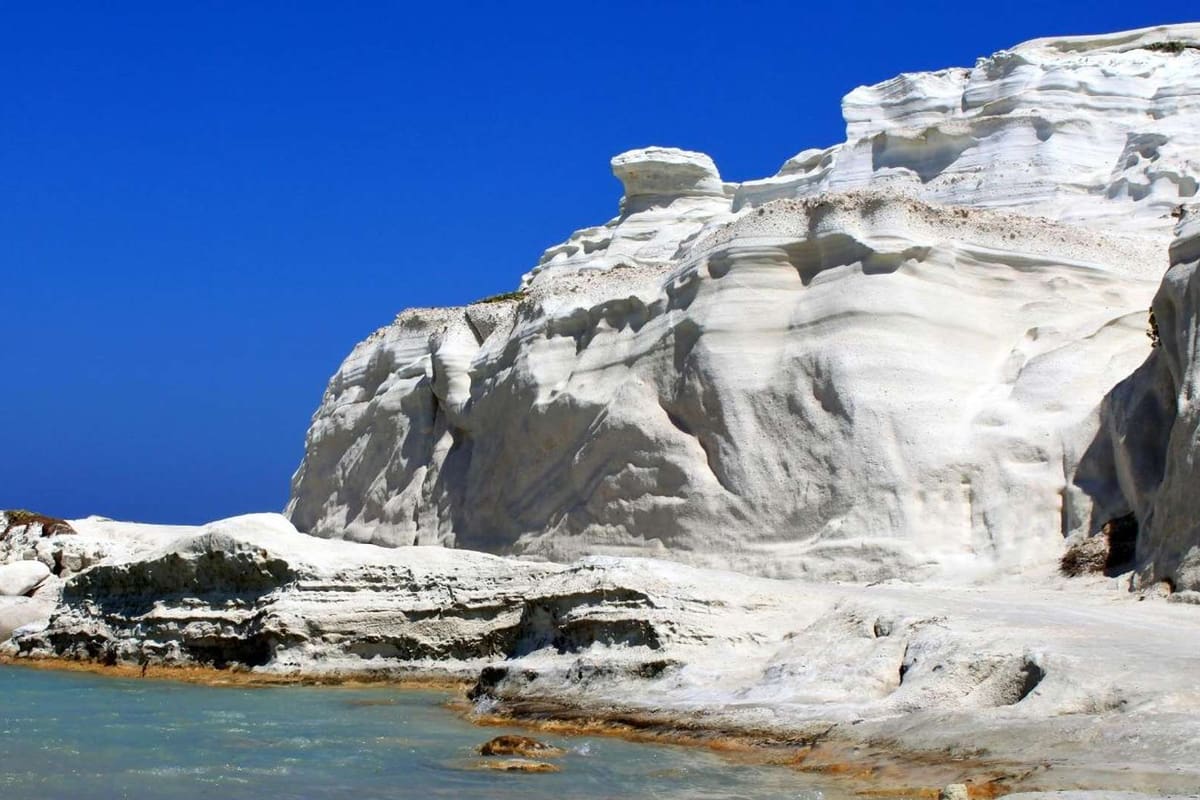
- Sarakiniko: white volcanic rock, a small beach and caves cut by the sea.
- Papafragas: a volcanic ravine in the cliffs with a tiny sand beach.
- Phylakopi: a Bronze Age site on the same coast.
- The two harbour towns, Adamas and Pollonia, at either end of the coast.
The Greek National Tourism Organisation describes caves and fissures that the sea has cut, leading to natural pools. A legend on that page ties the bay to pirates who once sought refuge there. For where to stay in Milos, a base near this coast keeps the white rock within a short drive.
The way in is a car or motorcycle, then a walk of 200 metres from the parking area. German Wikivoyage names calm days and a south wind as the time the north beaches suit a visit. The same page describes water that shifts from emerald to azure. A room on this side lets the day follow the weather.
Papafragas is a volcanic ravine cut deep into the cliffs, with a tiny sand beach. German Wikivoyage adds natural cave tunnels. For where to stay in Milos, the ravine is a fixed point on the north side. The same page says visitors see it from the viewpoints or from a boat at sea.
Papafragka Cave is listed close to Apollonia, the village Wikivoyage calls Pollonia, in a Wikipedia list of Greek caves. German Wikivoyage adds a path from the viewpoint by the road to caves that people once lived in. The ruins of Phylakopi, a Bronze Age site, stand on the same coast.
Sarakiniko and Papafragas are separate stops, so a day on the north coast links them by road. The two harbour towns of the island stand at either end of this coast. For where to stay in Milos, that gives a plain choice between Adamas and Pollonia.
A stay in Adamas or Pollonia keeps the north coast in reach: the rock, the ravine and the ruins. Either harbour suits a visitor who puts the north coast ahead of every other shore. For where to stay in Milos on a short trip, that one choice covers the days by the white rock.
How do Paleochori and Zefyria answer where to stay in Milos?
Where to stay in Milos on the south-east side starts with Paleochori, a beach almost 2 kilometres long. Zefyria lies in the centre of east Milos, 5.5 kilometres from Adamas. Passing through the village leads on to the Paleochori sand, so the two places work as one stretch of coast.
Paleochori is almost 2 kilometres long, as the Municipality of Milos describes the beach. The shore is made of colourful pebbles and coarse sand, with clear, deep water off it. For where to stay in Milos beside the sand, a room near this shore puts the sea at the door.
The rock at Paleochori shows tones of white-grey, yellow, pink and red. The Municipality of Milos calls them a result of volcanic energy. Warm waters gush there too, the same page notes. A bather who likes colour and warm shallows finds both here.
Wikivoyage says that volcanic activity under the seabed creates warm patches in the shallow water. The same heat is used for traditional sand-cooked meals. That suits a reader who wants the volcano at the shoreline.
Where to stay in Milos for days that follow the sea points to the Paleochori sand. The day runs from an early swim to a long lunch and a walk on the pebbles. The beach of Agia Kyriaki lies on the same road past Zefyria.
Where to stay in Milos inland starts with Zefyria, which lies in the centre of east Milos. The Municipality of Milos gives the distance as 5.5 kilometres from Adamas and 9 from Plaka. About 150 inhabitants live in the rural settlement today.
Where to stay in Milos with history at hand starts with the Venetians, who created Zefyria in the thirteenth century. It grew into the capital of Milos. In seventeen sixty-seven the village was abandoned, and its inhabitants had to relocate. A walled church of Agios Nikolaos also stands there.
In the centre of the village stands Panagia Portiani, which the municipal page calls the old metropolis of the island. It is joined to the nearby church of Agios Charalambos. It is the only church that survives from the Old Town of Zefyria.
The municipal page says the name Portiani probably comes from the castle gate that stood near the church. In eighteen sixty-four the icon of the Virgin of Portiani went to the new church in Adamas. Old frescoes remain inside, and the Ministry of Culture protects the building as a monument.
Where to stay in Milos in an inland village that keeps the old diocese points to Zefyria. A stay there trades the sea at the door for a rural setting. The beaches of Agia Kyriaki and Paleochori lie on the road past it.
How do Provatas and Kipos answer where to stay in Milos?
Provatas offers sand of a golden red tone, and the water stays very shallow. Where to stay in Milos with children points to this south-coast bay, 7 kilometres from Adamas by paved road. The Municipality of Milos calls the beach suitable for children to play.
- Provatas: a golden red tone from iron oxides.
- Provatas: sunbeds, umbrellas, rooms to let and taverns.
- Provatas: a paved road with good signage.
- Kipos: a sandy beach with a small port.
- Kipos: boats leave the port towards Kleftiko.
- Panagia tou Kipou: the oldest church on Milos.
The Greek National Tourism Organisation says that Provatas, with its golden reddish sand and shallow waters, is ideal for families. The Municipality of Milos credits the colour to iron oxides. For where to stay in Milos with young children, the bay gives shallow water by the sand.
The beach is organised with sunbeds and umbrellas. It has rooms to let and taverns, the municipal page adds. Access is easy on the paved road, which carries good signage, and the bus serves the bay frequently.
That bus link helps a stay that skips the hire car, and the port is 7 kilometres away. Where to stay in Milos with a family and no car therefore includes this bay. A base here keeps the drive to Adamas short.
Kipos lies on the same south coast. The municipal page calls the place the Garden and describes a sandy beach there. A small port there sends boats towards Kleftiko, and rooms for rent stand close by.
A boat day can start at Kipos. The boats towards Kleftiko leave from its small port. That suits a reader who wants a morning on the water, with a sandy beach at the same place.
The church of Panagia tou Kipou belongs to the south of Milos, in the area of Kipos. The municipal page calls it the oldest church on the island. The Byzantine builders raised it in the fifth century.
The church is well preserved and has excellent architecture. It also holds one of the two baptisteries on the island. Where to stay in Milos with old stones in reach points to this corner of the south coast.
Wikipedia notes strong volcanic heat inside a cave on the south shore. The same shore holds the warm waters of Paleochori, which the municipal page notes.
Where to stay in Milos for a quiet family week comes down to this stretch. It offers shallow sand at Provatas, a garden bay at Kipos and the road back to Adamas.
How do Agia Kyriaki, Fyriplaka and Tsigrado answer where to stay in Milos?
Where to stay in Milos on the south coast comes down to three beaches: Agia Kyriaki, Fyriplaka and Tsigrado. The Municipality of Milos describes each one on its visitor portal. Agia Kyriaki is organised, Fyriplaka has shallow turquoise water, and Tsigrado is embraced by rocks and white sand.
Agia Kyriaki is a large, organised beach, the Municipality of Milos says. Its waters are cool, its pebbles are colourful, and the sandy stretch is wide. Rooms for rent and a restaurant lie a short walk from the beach. Where to stay in Milos on foot from the beach starts here.
A Greek-language Wikipedia article adds a volcanic detail. It names Agia Kyriaki among the places on the island with active steam vents, known as fumaroles. Paleochori and Adamas appear in the same list. The south coast therefore shows the volcano in its steam as well as in its rock colours.
The same article lists 21 beaches on the south side, from east to west. Agia Kyriaki is second in that list, after Psarovolada. Tsigrado, Fyriplaka and Provatas follow one another in the middle of it. Where to stay in Milos along this coast means choosing a point on one long line.
English Wikipedia sets Fyriplaka on the southern side of Milos. Provatas is its western neighbour and Tsigrado its eastern one. The Municipality of Milos calls the beach extensive, with imposing volcanic rocks, white-grey fine sand and white pebbles. Where to stay in Milos for gentle swimming points to this bay, since the water is shallow and turquoise.
English Wikipedia adds a large rock with a cave beneath it, standing in the water near the shore. It says the beach can be reached by car, taxi, bus or a boat from the port of Adamas. The last stretch of the road is gravel.
The municipal page points to two quieter stretches beyond the first, organised beach. You reach them by walking parallel to the sea, beside the volcanic rocks. A base near Fyriplaka answers where to stay in Milos for a reader who wants services first, then quiet sand.
Tsigrado has white sand and emerald water, and rocks embrace the beach, the Municipality of Milos writes. The Greek National Tourism Organisation adds towering cliffs. The beach is not organised, but the essentials come from nearby Fyriplaka. If Tsigrado is the goal, that link settles where to stay in Milos: near Fyriplaka.
A relatively easy dirt road leads to Tsigrado, the municipal page says. To enjoy the cove, you go down the hill on a steep path covered with sand. Wikivoyage in German describes a steep wooden ladder with a rope and adds that boats are the other way in.
Gerontas is the farthest south beach, and a car can reach it. A dirt road and a ten-minute walk lead to a cove of white rocks, caves, dark sand and turquoise water. A rock shaped like a bridge joins sea and land. Where to stay in Milos here follows the beach you want.
How do Achivadolimni and the inner bay answer where to stay in Milos?
Achivadolimni answers where to stay in Milos on the inner bay. The Greek National Tourism Organisation calls it the largest beach of the island, with white sand and a serviced campsite. Rivari, Fatourena and Empourios lie along the same inner shore, and each one has its own character.
- Achivadolimni: the largest beach of the island, with white sand and a bus link.
- Achivadolimni: organised camping and a pond full of clams opposite the beach.
- Rivari: a natural lagoon and a refuge for migratory birds.
- Fatourena: a quiet blue beach reached by a dirt road down to the sea.
- Empourios: a former trading harbour with a beach and a traditional tavern.
- The gulf as a whole: 25 beaches, as the Greek article counts them.
The name Achivadolimni comes from the pond opposite the beach, which the Municipality of Milos calls full of clams. The Greek article places the area inside a Natura site. It calls the wetland the largest natural wetland of the Cyclades and a stop for migratory birds.
The beach itself splits into two sandy parts. The first is quieter and secluded, while the second is organised, with restaurants on the shore. The municipal page recommends the beach to surf and kite-surf lovers. Where to stay in Milos with a board is named directly there.
Camping is organised here, and a bus reaches the beach, the municipal page adds. The national tourism body says the campsite is serviced. Where to stay in Milos in a tent or a camper van therefore points to this shore. Both official pages agree on it.
Rivari is a natural lagoon and a refuge for migratory birds, the municipal page states. Small plants and low hills surround the beach. The page says the west side of Milos has not developed much for tourism. Where to stay in Milos near Rivari is therefore a choice for privacy.
Fatourena comes next along the shore. From Achivadolimni, the main road passes Agia Marina, and a dirt road then drops to the sea. The municipal page describes a quiet, blue beach there, with a view over the whole port.
Empourios is a former trading harbour, the municipal page says, and it has a beach. It has rooms for rent and a traditional tavern. The portal names it among the small fishing-port settlements dug into soft rock, where syrmata are the special feature. Where to stay in Milos at a small port can mean Empourios.
The Greek article counts 25 beaches inside the gulf, against 21 on the south side. Its gulf list opens with Empourios, Fatourena and Achivadolimni. The inner shore is therefore a chain of small stops. Where to stay in Milos on it depends on how far from Adamas you want to be.
How do Kleftiko and the south-west shape where to stay in Milos?
Where to stay in Milos for Kleftiko comes down to the boat. The Municipality of Milos advises coming to the rocks by boat or sailboat. So the harbour matters more than the view. The base that counts is the one close to where the daily boats leave.
Kleftiko is a set of rocks in strange shapes, grey and white in colour. Air and sea cut the caves and pits in them over the centuries, as the municipal visitor portal describes. The same portal gives a second name, Thalassina Meteora, which means the sea Meteora in plain English.
The south side has its own list. The Greek Wikipedia article names its beaches from east to west, and Kleftiko is the last name on that list. So the rocks lie in the south-western corner of Milos.
The beaches page of the Greek National Tourism Organisation pictures enormous greyish-white rocks. The sea surrounds them, with labyrinthine caves and sheltered coves for anchoring. Coves for anchoring belong to boats. Where to stay in Milos for this coast is therefore a matter of the quay. The rooms stand on land, in the villages.
The name carries a past. The municipal portal says Kleftiko was a shelter and a base for pirates, and the name comes from that use. Wikivoyage also records the pirate hideout, with white caves and tall rock arches. It calls the place reachable mainly by boat.
The municipal sea excursions page names the ports of Adamas and Pollonia as the daily departure points. Where to stay in Milos for a day at Kleftiko starts at one of those two harbours. A room in either village keeps the departure close.
The page adds that a boat trip reaches beaches that no land route serves. It also lets a swimmer explore caves and call at the neighbouring islands. Where to stay in Milos for these trips follows the departure, not the shore. Wikivoyage describes the water at Kleftiko as vivid blue.
Sykia, on the municipal list of western beaches, asks for a boat too. The portal calls it a cave of unique natural beauty, reached only from the sea. No roof covers the cave, so the sun enters and lights its emerald water.
A visitor who plans both stops needs a base by the water, because both stops are reached by boat. For where to stay in Milos on the south-west side, the quay comes first and the view second.
The south-west holds one more fact. The same article says this side of the island is a habitat of the Mediterranean monk seal. That is a sea setting, not a village one, so it plays no part in where to stay in Milos.
How does Chalakas, the wild west, answer where to stay in Milos?
The west answers where to stay in Milos with a day visit, not a bed. The Greek article calls the western half the wilder part of the island. It holds no villages, only the smallest settlements and old mines. The Municipality of Milos lists these western beaches:
- Sykia, the sea cave described above.
- Agios Ioannis, a white-gold beach in three parts joined by paths.
- Ammoudaraki, blonde sand next to Triades.
- Triades, three sandy beaches set one after the other.
- Agkathia, a sheltered bay with shallow blue water and a long sandy shore.
- Kalogries, a secluded beach in the north-west where calm water forms a natural pool.
The English article says the uninhabited western region lies almost entirely inside the Natura network of protected sites. It counts more than 800 taxa there, which are groups of living things, among them 35 endemic to Greece. So where to stay in Milos is a question for the east, and the west is a place to visit.
The Greek article adds a forest of horizontal-branched cypress trees, a rare habitat with centuries-old trees. It also names the Mavropetritis, a rare migratory falcon, and a wealth of plants, herbs and wildflowers. The isolated beaches, it says, repay the distance.
Ralaki Chalakos is a settlement in the west, set inland at 160 metres, as its Greek article states. The twenty twenty-one census recorded one resident. For where to stay in Milos, that settles the point. The west holds a place on the map, not a village.
Profitis Ilias, the highest peak, is one of the volcanic domes of Milos, as the Greek article puts it. The castle hill of Chora is another. These domes are lava that set before it flowed out, and they are mainly andesite. Chondro Vouno, at 636 metres, comes next in height, also in the west.
The municipal portal puts the beach of Agios Ioannis at the end of a dirt road of about 12 kilometres. The monastery of Agios Ioannis Siderianos gave the beach its name.
Where to stay in Milos for this beach is a question of the road. Only the first of its three parts is open to a car. The other two ask for a walk down the rocks.
The directions for Ammoudaraki pass Agia Marina and the monastery of Agios Ioannis Siderianos. A right turn follows onto the dirt road. For Agkathia, they pass the monastery of Agia Marina and turn right at the second crossroads. Either route is a day from an eastern base, so where to stay in Milos stays an eastern question.
Triades gives that day a plan. The portal describes three sandy, secluded beaches with deep blue shallow water, one after the other. Blonde sand lies enclosed between rocks. Where to stay in Milos after such a day is a room back in the east. A village or the harbour town fits.
How do the mines and the volcanic rock shape where to stay in Milos?
Where to stay in Milos starts with the volcano. The island is volcanic, and its activity goes back to the Pliocene, two to three million years ago. Its last eruption was ninety thousand years ago, so the rocks, the mines and the springs share one source.
The ordinary rocks of the island include tuff, trachyte and obsidian. Obsidian is a glass-like black volcanic stone. The Milos Mining Museum places the start of its mining at the dawn of the Neolithic age. Tools made of Milos obsidian have been found in the Peloponnese, in Crete and in Egypt.
The first miners did not settle. They came by boat, landed in a cove and cut pieces of volcanic glass from the quarries. Their trips did not lead to a permanent home on the island. A geology trip then raises where to stay in Milos, and a stay by the sea keeps that story close.
The museum’s page names the minerals mined today: bentonite, perlite, pozzolan, siliceous stones, kaolin and small quantities of baryte. Its history page calls Milos the largest bentonite and perlite production and processing centre in the European Union. The same page says the mining story of Milos began ten thousand years ago and goes on.
Wikipedia adds that bentonite, perlite, pozzolana and kaolin come from strip mines and open pits and are sold worldwide. In the past the island also gave baryte, sulphur, millstones and gypsum. Ancient artists used Melian earth as a pigment, and in ancient times Milos alum was reckoned next to Egyptian alum.
The museum’s history page dates the first mine concession, for sulphur, to eighteen sixty-two. That year starts modern mining on Milos. Its chronology names the working sites: Paliorema for sulphur, Vani for manganese, Voudia for baryte and Xylokeratia for pozzolan. Those names suit a mining day once you settle where to stay in Milos.
The sulphur works at Paliorema were interrupted in nineteen fifty-eight. The manganese works at Vani stopped in nineteen twenty-eight. Wikivoyage describes the bay of Paliorema in Theiafes: ruins of the quarry works and a beach of yellow pebbles. It also lists Thiorichia beach as the site of the old sulphur mines.
The volcano also left heat behind. Sulphurous hot springs lie along the east edge of the bay. One cave on the south coast still holds great heat. A visit to either is a day out from any base, so neither one settles where to stay in Milos.
The old sites also suit a slow day on foot, with any base as the start. A walker who wants the mining museum first can choose Adamas when deciding where to stay in Milos.
How do the ancient sites shape where to stay in Milos?
The ancient sites shape where to stay in Milos through their places. Phylakopi, a Bronze Age town, lies on the north coast, on the road to Pollonia. The ancient town covered the slope between Trypiti and Klima. The Archaeological Museum is in Plaka, on its main square.
- Phylakopi: the Bronze Age town, with its wall, its Pillar room and its shrine.
- Ancient Melos: the town of the Dorians, with remains of walls and a mosaic.
- The Archaeological Museum: a neo-classical building on Plaka’s main square.
People lived at Phylakopi from the mid-third millennium BC to the twelfth century BC. The first settlers were tuna fishermen. The sea has taken away part of the Phylakopi site.
A British team first dug the site between eighteen ninety-six and eighteen ninety-nine. The digs found a town wall and the Pillar room, whose wall paintings include a fresco of a flying fish. Work in nineteen seventy-four, after a gap of sixty-three years, uncovered a shrine with figurines.
The Archaeological Museum of Milos keeps the Lady of Phylakopi, a figurine forty-five centimetres tall. The museum is in Plaka, so a room there answers where to stay in Milos for the Bronze Age finds.
The ruins lie on the north coast, and Wikivoyage puts them on the road to Pollonia. A base in or near Pollonia keeps them close. That is a simple answer to where to stay in Milos on a day of ruins.
Ancient Melos covered the ground between Klima, its landing place, and the village of Trypiti. Remains of town walls and of buildings, one with a mosaic, have been found there. The museum’s history page adds that a wall went up as soon as the new town was built. Traces of that wall survive today.
For where to stay in Milos with the ancient town in mind, look at Klima and Trypiti. The site lies between them.
Ancient Melos issued coins of its own from the sixth century BC. An apple on the coins played on the island’s name, since the Greek word for apple sounds like it. The siege of Melos belongs to the fifth century BC and to the war between Athens and Sparta.
Coins and old walls fill a day of ruins without changing where to stay in Milos.
The Archaeological Museum has used a neo-classical building from eighteen seventy since nineteen eighty-five. The first room has obsidian tools and large pottery vessels. It also shows a copy of the Venus de Milo, made in modern times. Other finds from the island, among them the original statue, are kept in Paris and Athens.
The fourth room holds sculptures of the Greek and Roman periods. Its carved texts use the island’s own form of the alphabet. The second room holds the Bronze Age finds from Phylakopi. Both rooms are a reason to plan where to stay in Milos with Plaka in mind.
Where to stay in Milos for a culture day therefore splits three ways. Adamas keeps the Mining Museum close, Plaka keeps the Archaeological Museum on its square, and Pollonia keeps the Phylakopi road. Pick whichever base fits the day you plan, and add a second base for a longer stay.
How do the port, the airport and the buses shape where to stay in Milos?
Where to stay in Milos starts with the arrival leg. The Municipality of Milos runs a tourist portal. It puts the airport about four kilometres from Adamas port, five minutes by car. A base near the harbour therefore keeps the plane and the ferry within an easy ride.
Ferries come from the port of Piraeus. The tourist portal says a conventional ferry runs direct to the port of Milos, and that trip lasts five hours. Other sailings first call at Kythnos, Serifos and Sifnos, and sometimes at Kimolos. The trip then takes seven to eight hours.
A night after a crossing of that length asks for a bed near the quay. Where to stay in Milos on a ferry day therefore shrinks to the harbour town. A longer stay can trade the quay for a village, because the crossing happens only once.
In summer, the portal lists frequent links to islands such as Syros, Paros, Naxos, Tinos, Ios, Santorini, Crete and Rhodes. Those links suit a hopper. For a hopping trip, where to stay in Milos means a base by the harbour. That base gives the shortest walk to the boat.
Flights come from Athens airport two or three times a day, the portal states. It describes a flight of only thirty minutes on a fifty-seat aircraft. The Greek National Tourism Organisation gives forty minutes for the trip from Athens airport to Milos airport.
Travellers from Thessaloniki connect through Athens airport. The same page counts two hours and forty minutes for that trip. That long day makes a short last leg welcome. Where to stay in Milos then favours the harbour town, five minutes from the airport by car.
The airport opened in nineteen seventy-three, and a new terminal came into use in October nineteen ninety-five, as Wikipedia states. The portal adds that no bus services run to or from the airport. The portal names the port and the airport as places to find a taxi.
So where to stay in Milos on a late landing depends on the taxi. The portal counts fifteen taxis on the island and lists taxi contacts for Adamas and for Triovasalos. With so small a fleet, a far village asks for an early call to a taxi before a morning flight.
The urban buses serve certain areas of Milos, the portal says. In the summer months the schedules are quite frequent, and you buy the ticket inside the bus. For where to stay in Milos without a car, a village on a bus line keeps each day simple. A base off the line asks for a taxi.
Short stays and flight days point to the harbour, where the quay and the taxi stand sit close together. Longer stays can trade that for a bay or a hill village. Where to stay in Milos then follows the time you have. The sections after this one cover each base.
How does a car, a quad or a boat change where to stay in Milos?
Once the bus line ends, a hire car, a quad bike or a boat changes where to stay in Milos. The motorcycling page of the municipal tourist portal says the island has the largest dirt road network in the Cyclades. Those roads lead to beachside spots, chapels and mines.
- A hire car opens up the hill villages and the far bays.
- A scooter keeps two travellers on the paved roads and parks in a narrow lane.
- A quad bike takes the dirt roads to a quiet beach.
- A boat reaches the coves that no road reaches.
One route on that page starts at Plaka and heads toward Firopotamos. Just before Firopotamos, the road climbs to the left and joins a passable dirt road. That road ends at the secluded Trachilas beach. For where to stay in Milos with a car or a quad, Plaka puts that beach within reach.
A second route starts at Emporio and passes Agios Stylianos to a central dirt road. At the junction, the road toward Vani has excellent views. A last left turn ends at the old mines of Thiorichia for a swim. It works as a day trip from any base, so where to stay in Milos need not follow it.
Wikivoyage lists the buggy as a rarer rental that can leave the paved road. It says a quad can be slow and limited. Even so, the island is small, so a quad still gets round it quickly. Where to stay in Milos then matters less than the day plan.
A boat changes the map more than a car does. The portal says boat days stop at beaches that have no access from land. It names the harbour of Adamas and Pollonia as the main daily departure harbours. Where to stay in Milos for a boat day means a base at one of those two.
Your own boat adds more choices. The portal says a boat can moor at the Adamas marina or at Pollonia. At the Adamas marina a boat can refuel and take water and electricity. Other coves suit mooring, depending on wind direction, such as Provatas, Kleftiko and Paliochori. So where to stay in Milos can mean the boat itself.
Without any vehicle, the nearest bases cluster at the harbour. Wikivoyage describes Plaka as a small village close to the north of Adamas. An ascent leads from the harbour up to the plateau where Plaka and the Kastro stand. A taxi or a bus bridges that climb, and a walker can take it on foot.
So the choice runs in three steps. With no vehicle, stay at the harbour or on the plateau above it. With a car or a quad, a village or a far bay opens up. With a boat, the harbours of Adamas and Pollonia lead. That is how a vehicle settles where to stay in Milos.
Which months suit where to stay in Milos?
The winters of Milos bring mild weather with rain, and the summers stay dry, from warm to hot. Wikipedia calls this a Mediterranean climate. The split decides the month that suits where to stay in Milos. The same base meets a very different sky in July and in January.
The climate table in that article cites the climate normals of the National Oceanic and Atmospheric Administration. July averages a daily high of 28.1 degrees Celsius and August 27.6. January averages a daily high of 12.9 and a daily low of 8.5.
Rain follows the same split. The table lists 90.3 millimetres for December and 0.3 for July. A rain day means one millimetre or more. The table counts 9.0 of them in December and 0.1 in July. Midsummer is the dry stretch, so where to stay in Milos in July is not a question of rain.
The meltemi is the other summer fact. The article on the etesian winds describes the meltemi as dry and strong, with a northerly direction over the Aegean. The winds start about the end of spring and fade by mid-September. Afternoon is when they blow hardest.
Wikivoyage names July and August for the constant meltemi of the Cyclades and says it mitigates the heat a bit. The article on the winds adds that the northerly breeze eases the summer heat. For where to stay in Milos in those weeks, the wind belongs in the plan.
The municipal portal ties the choice of beach to the wind. In meltemi and north winds it names the beaches inside the bay, or better the south side. For the opposite case it points to the north side. That rule about beaches also shapes where to stay in Milos.
The sea has its own numbers for where to stay in Milos. Summer readings of the Aegean surface water run from 19 up to 24 degrees Celsius, as its article gives them. In winter the same layer measures 8 degrees in the northern Aegean and 13 in the far south. They cover the whole sea, not one bay.
The table also covers the shoulder months. April averages a daily high of 18.4 degrees and 20.5 millimetres of rain. Late spring brings 22.8 degrees and 13.1 millimetres, and June brings 27.1 degrees and 3.3 millimetres. Where to stay in Milos for these weeks sits between the rainy winter and the dry summer.
September averages a daily high of 25.2 degrees and 5.8 millimetres of rain. October brings 21.3 degrees and 42.9 millimetres. Wikivoyage names September through mid-October as the post season of the Cyclades. It places the turn of the weather in October, when rain begins. It also notes reduced ferry timetables outside the main season.
Wikipedia gives the fifteenth of August for the Dormition feast of the Orthodox churches. That date falls in August, one of the two months Wikivoyage names for the meltemi. For where to stay in Milos in mid-August, keep both facts in view.
Which base suits a couple or a family on where to stay in Milos?
For where to stay in Milos as a couple, the municipal portal names Agios Konstantinos. It is a quiet sandy beach in a harbour ringed by rocks. A family finds windless sand at Tourkothalassa. A first visit starts at Papikinou, a large beach 1 km east of Adamas.
- Agios Konstantinos: a quiet sandy beach in a harbour surrounded by rocks.
- Patrikia: three isolated white sand beaches in the bay, a dirt road and a walk away.
- Tourkothalassa: windless sand and pebbles beside clear blue water.
- Kapros: a small cove between white rocks, with fine sand and blue water.
- Papikinou: a large beach 1 km east of Adamas.
A couple looks for a quiet corner first. The portal lists Agios Konstantinos among the small traditional fishing ports of the island. It calls the beach there quiet and sandy, with a harbour set in rocks. A couple who weigh where to stay in Milos by calm start with that name.
Patrikia suits a couple who want solitude. The portal says you drive on a dirt road and then cover a distance on foot. It describes three isolated beaches there, with white sand and clear water. The capital, Plaka, stands in view across the bay.
A family looks first for gentle water. The portal describes Tourkothalassa as a beach of windless sand, pebbles and clear blue water. That word matters beside the wind rule above. For where to stay in Milos with children, it is a stated fact, not a promise for every day.
Kapros is a small cove between white rocks, with fine sand and blue water. For where to stay in Milos with a short way to the sand, a family can note Kapros. The portal says cars and transport reach it easily. It adds that the main road to Pollonia passes in view of it.
A first visit begins near the port. The portal says the large beach of Papikinou lies 1 km east of Adamas. That distance is the stated fact. Where to stay in Milos on a first visit then rests on how near the port you want to sleep.
A longer stay can split between two bases, and the wind rule gives a reason. A week inside the bay suits the days of north wind. A week on the north coast is the portal’s pick for the opposite case.
In short, the portal gives a couple a quiet harbour beach and an isolated bay. A family gets windless sand and an easy cove, and a first visit starts 1 km from the port. Where to stay in Milos then follows the month. Pick the dry, windy July and August, or the shoulder weeks around them.
Which base suits a walker or a diver on where to stay in Milos?
The Milos Mining Museum shows seven numbered route maps, named Vani, Volcano, Sulfur Mines, Aggeria, Kimolos, Sarakiniko and Nychia. A walker who asks where to stay in Milos can read those names first. Each map comes with a short text, so the base can follow the route.
The museum page says geologists, mining engineers, foresters, cartographers and historians combined their knowledge for these maps. The text beside the routes covers the rock, the mining past and the natural setting of Milos and Kimolos. Where to stay in Milos then starts with a map and a chosen route.
The page gives no length, no start point and no walking time for any route. Read each map before you set out. Plan the first hour from the map. For a long day on foot, where to stay in Milos means a base with an easy start.
The same museum describes the scrub of the island. The common brushwood includes cistus, thorny burnet and thyme, with French lavender and three-leaved sage growing among them. The mastic tree grows as a low bush or a small tree up to three metres high. A walker deciding where to stay in Milos can expect this scrub on the island.
The museum also names Eleonora’s falcon, a rare bird of prey. It lives and breeds on the Aegean islands and Crete, and Milos is its home. Small wetlands serve as rest places for migrating birds, which pass in spring and autumn. A bird watcher plans where to stay in Milos around those two seasons.
The sea gives a diver and a snorkeller their own facts. Wikipedia describes a wrecked ship on the east side of Sarakiniko, which visitors see when the waves pull back. The island article adds that volcanic heat remains great in one cave of the south coast.
The same article says the depth of the large bay falls from 130 to 55 metres. It names Adamantas as the harbour town. A snorkeller or a diver can read the island from the water outwards.
This page names no dive site and no dive centre. A diver asks a licensed local centre about sites and sea conditions. Two harbours serve a stay by boat, as Wikivoyage lists them: Adamantas first, then Pollonia in the north-east. A base at either port keeps the water near, and that settles where to stay in Milos for a diver.
Which day trips suit where to stay in Milos?
Two uninhabited islands lie near Milos. Antimilos is 21 kilometres off towards the north-west, and Polyaigos is 6.2 kilometres off to the east. Sifnos, Folegandros and Serifos are inhabited islands with ferry links from Milos. Each trip begins at your base, so where to stay in Milos sets the first leg.
- Polyaigos: an uninhabited island 6 kilometres long; Psilo Vouno, at 370 metres, is the higher of its two peaks, and Stroggylo reaches 330 metres.
- Antimilos: an uninhabited volcanic island, 671 metres high, whose crater is still plain to see.
- Sifnos: an island 15 kilometres long and 7.5 kilometres wide, with Apollonia as the main town.
- Folegandros: a small island of the southern Cyclades, with its capital, Chora, along a cliff edge.
- Serifos: an island of the western Cyclades, with a hilltop Chora as the main town.
The name Polyaigos points to goats, its only inhabitants. Wikipedia places the beaches mainly on the southern part and adds sea-surface caves that shelter Mediterranean monk seals. The museum notes that the Milos wall lizard lives only on Milos, Kimolos, Antimilos and Polyaigos. A day on the water is one way to read where to stay in Milos.
Antimilos belongs to the municipality of Milos. It was once called Ephyra or Ephora, meaning watchtower, because the sea can be watched far from its highest point. Walls and obsidian arrowheads point to early settlement. One reading of the Odyssey names it as the island of the sun god Helios. Where to stay in Milos does not change that story.
Sifnos lies between Serifos and Milos. Apollonia, the main town, has 918 inhabitants and holds the folklore museum and the library. Kastro was the capital until eighteen thirty-six. Its cliff site above the east shore keeps medieval remains and houses the archaeological museum. A Sifnos day is a change of scene for anyone weighing where to stay in Milos.
Together with Santorini, Anafi, Ios and Sikinos, Folegandros makes up the south of the Cyclades. The island holds 719 inhabitants on about 32 square kilometres. The capital, Chora, sits on a cliff edge that stands 200 metres high. Folegandros adds a cliff-top capital to the list while you weigh where to stay in Milos.
Serifos has Kythnos to its north and Sifnos to its south-east. Piraeus is about 170 kilometres away. Wikipedia places it in the Milos regional unit. A medieval castle crowns Chora, and the Archaeological Collection stands in the town. The Hellenistic watchtower Aspros Pyrgos rises on a hilltop east of the road from Chora to Mega Livadi.
Wikivoyage lists ferries from Milos to Folegandros, Serifos, Sifnos and Kimolos, among other islands. Timetables change, so read the official page before you plan a day or a night away. A harbour base in Adamas or Pollonia shortens the walk to the boat. That keeps where to stay in Milos tied to the sea.
Which questions do readers raise on where to stay in Milos?
Four short answers follow on where to stay in Milos. They cover the harbour or hill town, a car, the length of a stay and the food. Each rests on facts that official pages, Wikipedia and Wikivoyage state. No hotel, shop or restaurant is named in any answer.
Does Adamas or Plaka suit a first visit if you are choosing where to stay in Milos?
A first visit begins at the harbour, because the ferries land at Adamas. That makes the port the easy first base. A hill base can follow on a later night.
Plaka answers where to stay in Milos from higher ground. The church of Panagia Skiniotissa stands up in the Venetian castle, where the path ends. A reader who likes a walk before dinner enjoys that climb. A reader who wants the quay at the door stays below.
Language matters little on a first visit. Wikivoyage notes that English, French and Italian are spoken on the island besides Greek. A reader who knows only English can ask the way in either town.
A split stay suits a first visit. The first night in the port keeps the arrival simple. The second night in the hill town adds a wider view over the bay.
A late landing on a ferry day points to the port for the first night. A rested morning lets you go straight up to the hill town. Either choice keeps where to stay in Milos open for the second night.
Is a car needed after you pick where to stay in Milos?
Whether a car is needed depends on the base. The trip you plan settles where to stay in Milos on that point. A room in the port keeps the quay and the shops in one place. A hill village or a far beach asks for more planning.
Wikivoyage describes the car as the choice for a group. It adds that parking can be hard at certain places. The walk from the parking space then grows. A base near the lane keeps that walk short.
Mobile coverage is mainly good, as Wikivoyage states, but certain places have no signal. It recommends offline maps for that reason. A reader who stores a map before leaving the room can still find the way back to the base.
A short stay between two ferries needs no car at all. A week with a different bay each day asks for wheels, and the room can then sit on any slope. A taxi or the island bus can bridge the gap between a village base and the port.
How long a stay fits once you settle where to stay in Milos?
The length of a stay follows the sights. Two nights fit the harbour and one hill village. A long weekend adds a boat day. A week adds a second base and a beach day.
Wikivoyage lists windsurfing at certain beaches and horseback riding on a beach among the things to do. Each activity fills a day on land, so the stay grows past a single night. A split week suits the island, with a port base first and a hill base second.
Two sights show why a boat day adds a night to where to stay in Milos. The Arkoudes are rocky islets near Plathenia beach, at the entrance of the bay. Their rocks appear to show an opening mouth, a nose, eyes and ears, much like bears.
The Arkoudes rocks stand about twenty feet high. The only way to see them is on a boat tour that goes round the island. Their Greek name means bears. A tour that goes round the island starts from a harbour. The port is the natural place to begin that day.
Glaronisia is an islet north of Milos. Its columns of dacite lava date from the late Pliocene. Both islets suit one boat day from the harbour. A port base therefore answers where to stay in Milos for that day.
Does local food change where to stay in Milos?
The Municipality of Milos names pitarakia, karpouzopita and glyko koufeto as representative dishes of the island kitchen. The filling of the pitarakia is a peppery dry cheese, or mizithra mixed with mint.
Karpouzopita is a traditional sweet pie made from watermelon. Glyko koufeto is made from sweet pumpkin pulp with honey and almonds. The bride’s mother traditionally serves it at weddings and engagements. The honey stands for the sweet life of the couple, as the page puts it.
The same page adds ladenia, a savoury pie of oil, tomato and onion. It also lists octopus, fresh fish, rooster in red sauce and oven lamb with tomato paste. Restaurants of the island offer everything from fresh fish to international cooking.
Olive, orange, cypress, tamarisk and juniper trees grow across Milos, and grapes, cotton and barley are the main crops. Wikivoyage lists restaurants in Adamas, Trypiti and Pollonia that serve local delicacies. Food therefore counts only a little in where to stay in Milos.