
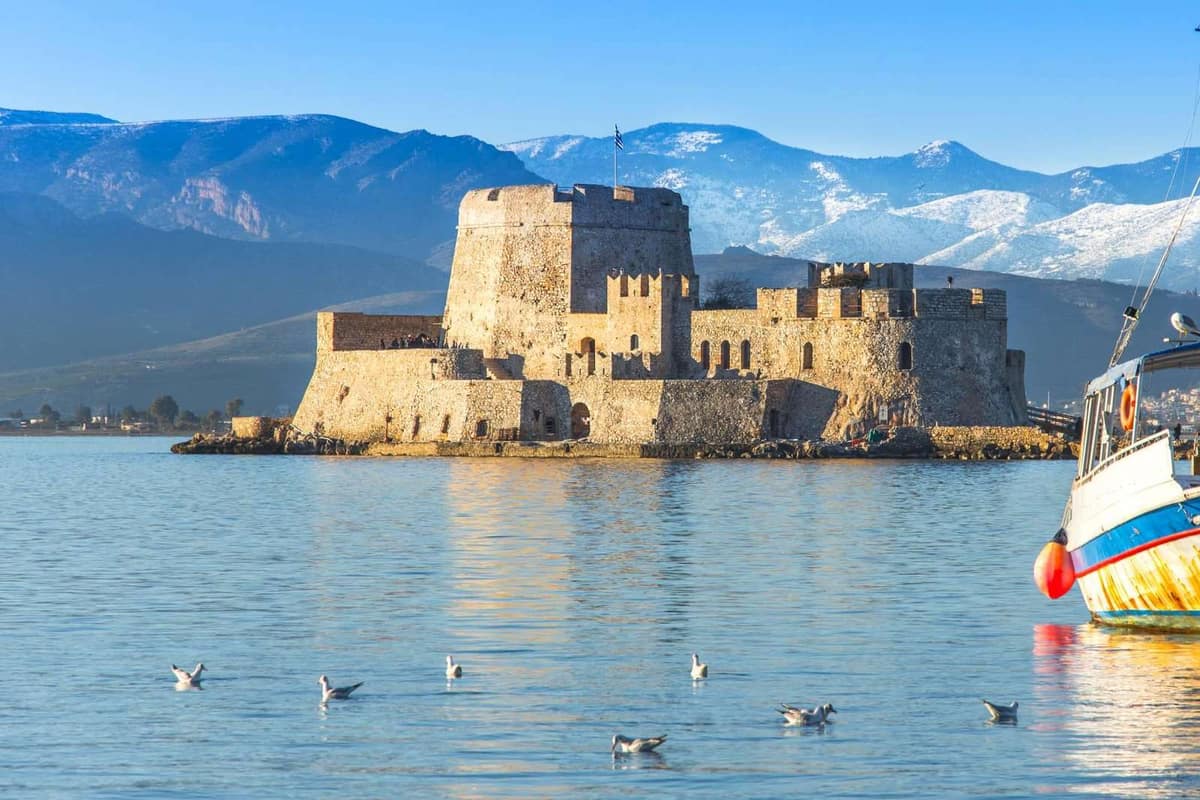
Where to stay in Peloponnese depends on the base town you pick. Nafplio holds the old town under its fortress in the east, Monemvasia sits on its rock in the south-east, the Mani runs down the southern peninsula with its tower villages, Kalamata, Pylos and Methoni face the south-west, and Olympia lies inland in the west. The tours in Greece on the home page add the rest of a Greek trip.
This page covers the bases one by one, then the airports, the roads, the buses, the months and the routes. The Greece mainland tours page covers the wider mainland, the where to stay in Athens page covers the capital and its airport, and the hiking in Greece page covers the paths of the mountains.
Which factors settle where to stay in Peloponnese?
Three factors settle where to stay in Peloponnese. They are the kind of place, the length of the drives and the sights within reach. The peninsula holds old towns, a rock town, tower villages, sandy bays and gorge villages. A stay here is a choice between bases, not between islands.
The Peloponnese is a peninsula of southern Greece. A land bridge between two gulfs, the Isthmus of Corinth, ties the peninsula to the central mainland. Its area is 21,549.6 square kilometres. That is wide enough for two replies to where to stay in Peloponnese. One is a single base for the week. The other is a loop of three bases.
The first step for where to stay in Peloponnese is the kind of trip. A walker of old lanes looks for an old town under a fortress. A beach lover looks for a sandy bay. A history lover looks for a base near an ancient site. A road trip joins two or three of these.
Since antiquity the peninsula has split into seven regions. Messenia holds the south-west and Laconia the south-east. Argolis lies in the east and Arcadia in the centre. Elis holds the west, Achaea the north and Corinthia the north-east. Each base here lies in one of them. The region is the first filter for where to stay in Peloponnese.
Gulfs shape the coast. Three gulfs, the Messenian, the Laconian and the Argolic, separate four peninsulas. These are the Mani, the Messenian peninsula, the Argolid and Cape Malea.
The wider lowlands sit in the west, along the Evrotas Valley and around the Argolid. Mountains fill the rest of the middle, and the official page calls mountainous Arcadia the traditional heart of the peninsula. Where to stay in Peloponnese therefore starts with one stretch of coast.
The thirteen bases below answer where to stay in Peloponnese for each kind of trip. Each one appears in the sections that follow.
- Nafplio
- Tolo
- Monemvasia
- Gytheio
- Kardamyli
- Stoupa
- Areopoli
- Kalamata
- Pylos
- Methoni
- Olympia
- Dimitsana
- Stemnitsa
Athens is the first way in on the Wikivoyage list, by car or bus. Kalamata International Airport in the south-west receives flights mainly in summer. The section on airports, roads and buses gives the details.
Why does Nafplio lead where to stay in Peloponnese?
Nafplio leads where to stay in Peloponnese with an old town on a peninsula of the Argolic Gulf. Two hill castles stand above its stone-paved lanes. The town stands in a naturally fortified position, as the Greek National Tourism Organisation puts it. Wikivoyage puts the major sights in the old town.
- Anapli: the old town of stone-paved lanes and mansions
- Akronafplia: the peninsula that crowns the old town
- Palamidi: the castle on the highest point
- Bourtzi: the sea fortress on its own islet
- Tolo: the village on its own bay
Residents number 14,532 in the community of Nafplio and 32,625 in the whole municipality, as counted in twenty twenty-one. Nafplio is also the seat of Argolis, the regional unit around it. The newly established Greek state placed its first capital in Nafplio in eighteen twenty-seven, keeping it there until eighteen thirty-four.
A base in Nafplio answers where to stay in Peloponnese for a first visit with lanes, sea and ancient sites. Mycenae and Epidaurus lie in the same region of Argolis. Wikivoyage calls Argolis easy to travel by car, because the villages and towns stand a short distance apart.
Anapli is the name of the old town below the two castles. The official page lists narrow stone-paved streets, bougainvilleas on the balconies and well-preserved mansions. Wikivoyage places a theatre on Syntagma Square, which stages plays all year. A mansion room puts those lanes at the door, and that is one reply for where to stay in Peloponnese.
Wikivoyage says the whole town was once fortified, in two parts. The seaside merchant quarter is today’s old town. The barracks quarter uphill is now an open archaeological site. Only a stretch of the old fortifications remains, at the east edge of the old town.
Palamidi stands at the highest point and is carved into the slope. The official page says its view takes in the sea and the red roofs of the city. Akronafplia lies a little lower and crowns the old town. Its Turkish name is Its Kale. Both hills belong to a stay in Nafplio.
The name Bourtzi comes from an Ottoman Turkish and Arabic word for tower. The sea fortress stands on the islet of Agioi Theodoroi, just off the coast. The official page calls it the trademark of the town. Small boats for the islet leave from the port promenade, as Wikivoyage states.
Wikipedia lists four quarters beside the old town: Gyalos, Kourti, Psaromachalas and Pronoia. The official page adds a modern city of neoclassical buildings, parks and squares. For where to stay in Peloponnese, those quarters swap stone lanes for parks and squares.
Tolo is a village of Argolis on the bay of Tolon, which belongs to the Argolic Gulf. A frequent KTEL bus links it with Nafplio every day, as its article states. The bay holds the ruins of a fortress on the island of Daskaleio.
A room at Tolo puts the sea first. A mansion room in Nafplio puts the lanes first. Both answer where to stay in Peloponnese, and the daily bus joins the two.
How do Monemvasia and the Laconia coast answer where to stay in Peloponnese?
Monemvasia answers where to stay in Peloponnese with a walled lower town on a rock off the Laconia coast. The rock reaches the mainland by a causeway. Gytheio, Elafonisos and Leonidio add a port town, an island and a river town along the same coast.
Monemvasia lies in Laconia on a tied island of the Myrtoan Sea. Wikivoyage calls the lower town a living settlement of stone houses, churches and small squares. The upper town, by the same page, is largely abandoned. For where to stay in Peloponnese on this rock, the lower town is the base.
In Byzantine times the main street of the lower town was the Middle Street. It crosses the road from the upper town at Elkomenos Christos square. There stand the metropolitan church and the bishop’s old residence. The former mosque on the square now holds the Archaeological Collection. A lion relief above its door is the sign of Venice.
A path climbs from the lower town to a fortified gate of the upper town. The church of Agia Sofia stands near the cliff edge and follows the Byzantine style of the twelfth century. Its dome spans 7 metres and has 16 windows. A stone house inside the walls answers where to stay in Peloponnese for a walker.
Gytheio stands on the Laconian Gulf as a port, with its centre built around the harbour. Ancient Gytheio was the seaport of Sparta, 40 kilometres to the north. A causeway joins the islet of Marathonisi to the shore. A tower on the islet is now a museum of the Mani, and the lighthouse is of solid marble.
Elafonisos is a small island of 19 square kilometres between the Peloponnese and Kythira. Of the islands of the Peloponnese archipelago, it is the largest with residents. Sarakiniko and Panagias Nissia are two of its sandy beaches. A beach week here answers where to stay in Peloponnese, with Neapoli about 6.5 kilometres away on the mainland.
Mystras, above ancient Sparta, is a UNESCO site whose churches were covered in frescoes and known for their libraries. Leonidio, on the Arcadian coast, has three old windmills above the town. Three bridges link the banks of the River Dafnon. The long drive between these bases is why where to stay in Peloponnese suits one base and day trips.
How does the Mani answer where to stay in Peloponnese?
The Mani answers where to stay in Peloponnese with stone tower houses on the middle one of three southern peninsulas. The article on the peninsula names three traditional parts: Outer, Lower and Inner Mani. West Mani, seated at Kardamyli, lies in Messenia, and East Mani, seated at Gytheio, lies in Laconia.
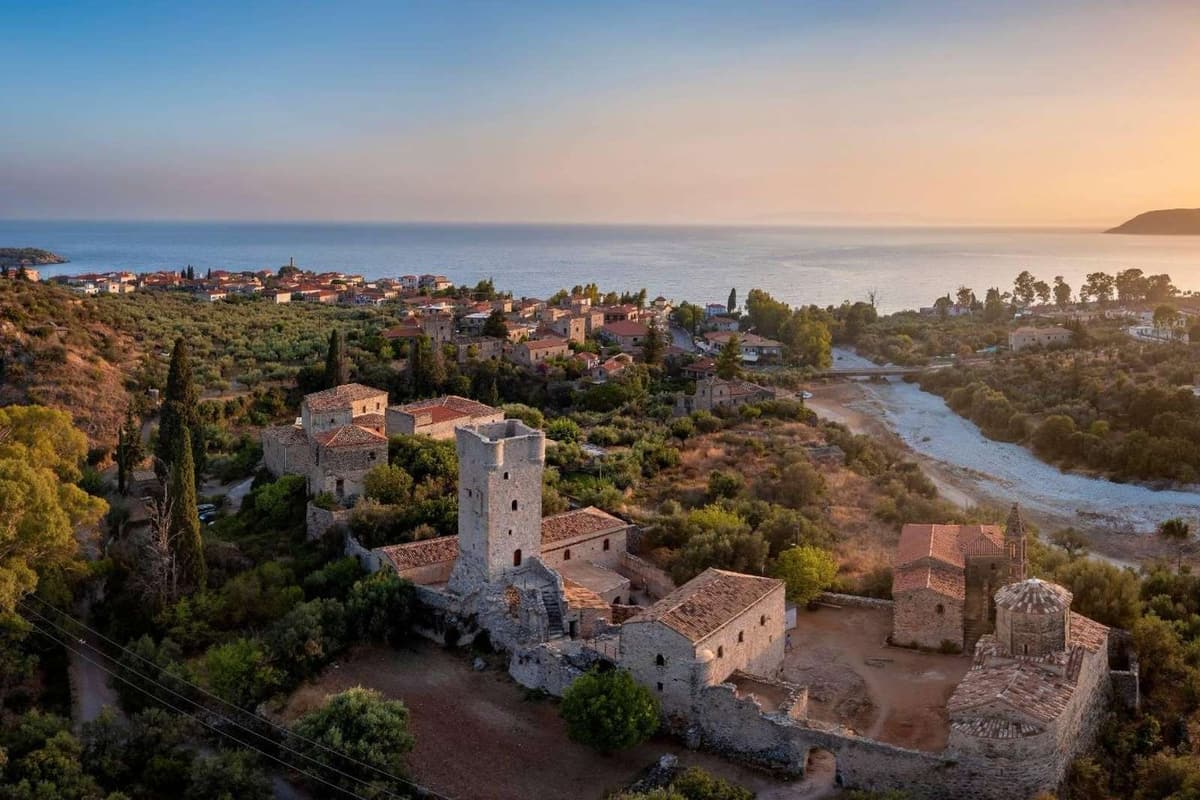
- Kardamyli: a village of West Mani below the Taygetus mountains.
- Stoupa: a village of Outer Mani with two beaches, Stoupa and Kalogria.
- Areopoli: a town of tower houses, 20 kilometres south-west of Gytheio.
- Gerolimenas: a village on the southern edge of the Mani, reached mainly by boat until the nineteen seventies.
- Vathia: a largely abandoned village of hillside tower houses.
A tower house of the Mani is built with thick dry-stone walls. The family tower stood in a fortified group of houses and a church, called a xemoni. Since nineteen seventy-eight the state has listed such settlements as traditional, with limits on building. A tower room answers where to stay in Peloponnese for a couple who want stone.
Kardamyli faces the Messenian Gulf from the coast. The church of Saint Spyridon, built in the eighteenth century, rises in a fortified compound of the old town. The writer Patrick Leigh Fermor lived in the nearby village of Kalamitsi in his later years. Kardamyli fits where to stay in Peloponnese for a long walk by the sea.
Stoupa lies in Outer Mani, and its economy rests on tourism. Both beaches, Stoupa and Kalogria, have underground springs of fresh water, and the springs show on the sea surface. Agios Nikolaos, 4 kilometres from Stoupa, is a fishing village that still works. A hill in Stoupa carries the Leuktron castle of the Frankish period.
Wikivoyage calls Areopoli the traditional capital of the Mani. The Greek War of Independence began at Areopoli on seventeenth March, eighteen twenty-one. A flag rose in Taxiarchon Square. South of the town lie the Diros Caves, with a boat route through lakes and chambers. For a base near the caves, Areopoli settles where to stay in Peloponnese.
Gerolimenas means Old Harbour, and the article traces the name to the ancient Hieros Limen, the Sacred Harbour. A road links Vathia to Cape Tainaron, where mainland Greece ends. A lighthouse stands there with the ruins of an ancient sanctuary, listed as that of Poseidon. A quiet week answers where to stay in Peloponnese for a driver.
How do Kalamata, Pylos and Methoni answer where to stay in Peloponnese?
Kalamata, Pylos and Methoni answer where to stay in Peloponnese for the south-west. Messenia offers a city on a gulf, a harbour town on a bay and a village beside a castle. The city proper has 58,816 residents, as the census counted it, and Pylos has 2,568.
Where to stay in Peloponnese with a city base starts at Kalamata, the second largest city after Patras. Wikivoyage places it at the apex of the Messinian Bay, below Mount Taygetos at 2,404 metres. The same page calls the city central for Messenia, with its sights reached by car. Messenia has Kalamata as its capital and as its chief port.
Aristomenous is the main street of Kalamata, with a large square, and the coast lies below the centre. The old town holds the Church of the Holy Apostles, which has a twelfth-century Byzantine core. A pine-covered hill carries the castle above the sea. Crops of Messenia include figs, black raisins, olive oil and the table olives of Kalamata.
Navarino Bay has its main harbour at Pylos, a town of 2,568 residents. Where to stay in Peloponnese on a small harbour bay points to this town. The Palace of Nestor stands 17 kilometres north of it. The two-storey building had workshops, baths, light wells and a sewage system. The naval battle of Navarino took place in the bay.
Voidokilia lies on the Ionian Sea in Messenia, shaped like the Greek letter omega. Its sand forms a semicircular strip of dunes. The beach lies within the Natura network of protected areas. Nestor’s Cave and the tomb of Thrasymedes, a son of Nestor, rise above the beach. A round bay suits a family stay by the sand.
Methoni stands 11 kilometres to the south of Pylos. Where to stay in Peloponnese with a castle as the main sight points to this village. The Venetian castle fills the whole cape, and the sea guards it on three sides. Fourteen arches carry the stone bridge over the moat. The octagonal Bourtzi tower stands on a small islet.
Ancient Messene lies 25 kilometres north of Kalamata, with a theatre, a stadium and an Asclepeion. Where to stay in Peloponnese for old stones in Messenia can therefore start in the city. Koroni, a town of 1,193 residents, lies 56 kilometres by road from Kalamata, with a Venetian castle above it.
How do Olympia and the mountain villages answer where to stay in Peloponnese?
Olympia and the mountain villages answer where to stay in Peloponnese for the west and the mountains. Olympia sits in Elis, a small town beside an ancient site. Dimitsana stands at 950 metres in Arcadia, and Stemnitsa at about 1,050 metres above the river Lousios.
- Olympia: the archaeological site lies next to the village, on its south-east side.
- Dimitsana: a mountain village 31 kilometres north-west of Tripoli.
- Stemnitsa: a mountain village 6 kilometres south-east of Dimitsana.
- Kalavryta: a mountain town 62 kilometres north-west of Tripoli.
Where to stay in Peloponnese near the ancient games starts in Olympia, out west in the Alfeios valley. The games came round once in four years, from the eighth century BC into the fourth century AD. People appear to have lived on the village site since ancient times. Wikipedia adds that walking the full site takes time.
The World Heritage List of UNESCO carries the Archaeological Site of Olympia. The Olympia article places it in the Peloponnese by geography, and in the Region of Western Greece by administration. Wikivoyage puts Olympia almost two hours from Kalamata by car. A night in the town puts the site next to the room.
Where to stay in Peloponnese in the hills starts with Dimitsana, a village of stone houses on a mountain slope. From its southern side the view reaches over the Megalopolis plain to Taygetos. In the library, about 35,000 items are kept: books, manuscripts and documents. A statue of Patriarch Gregory V stands in the central square.
The Open-air Water Power Museum lies not far from Dimitsana. It restores old water-powered works: a flour mill, a cauldron, a tannery and a tanner’s house. The Old and the New Philosophou Monastery and Prodromou Monastery stand inside the Lousios gorge. A base in Dimitsana keeps these stops close.
Where to stay in Peloponnese among old churches points to Stemnitsa, on the western side of the Mainalo range. The folklore museum shows how candles were made, and it holds a jeweller’s workshop and a shoe repair shop. The name Stemnitsa has Slavic roots and means woodland. The church of Bafero dates to the twelfth century.
Where to stay in Peloponnese for a mountain temple includes Bassae, at 1,131 metres on Cotylion Mountain. The temple of Apollo Epicurius is built of grey Arcadian limestone, except for its marble frieze.
The Vouraikos runs past Kalavryta, which stands on its right bank. The rack railway from Diakopto has its southern terminus there, built by Italian engineers in the late nineteenth century. Where to stay in Peloponnese in a stone village house of the mountains gives cool summer nights.
How do the airports, roads and buses shape where to stay in Peloponnese?
Where to stay in Peloponnese starts with the drive from Athens. Wikivoyage lists the times by town. Nafplio takes about two hours and Patras about two and a half. Kalamata takes about three hours forty-five minutes, and Sparta about four hours.
Athens International Airport is the main gateway. Wikivoyage Greece calls it the largest airport and the main hub of the country. From there the road reaches the region over the Corinth Canal. Wikivoyage Peloponnese says bridges span the cut and join the Peloponnese to Attica, so the trip stays on the road.
For where to stay in Peloponnese by air, Kalamata International Airport lies on the EO82 road between Kalamata and Messini. It mainly receives flights in summer, as its article states. Wikivoyage lists seasonal links from cities such as Amsterdam, Vienna and Zurich, and a regular link from Thessaloniki. A bus stop stands right outside the terminal.
Roads shape the far south. The Laconia article names the A71 as the only motorway there. Its southern end joins a bypass around Sparta. The Messenia article lists six main roads, among them the A7 motorway toward Tripoli and Corinth. A winding pass over Taygetus links Messenia with Laconia, and a second road goes round the mountain through the Mani.
For where to stay in Peloponnese by bus, the starting point is the Kifissos station in Athens. Wikivoyage says the buses of KTEL for Nafplio leave from Terminal A. The ride takes about two hours, with twelve to fourteen buses a day. An arrival at the airport takes the X93 bus to its last stop first.
Where to stay in Peloponnese without a car leans on Nafplio. Wikivoyage says buses link it with Athens, Thessaloniki and the major cities of the region. A second line runs from the bus terminal at the Corinth Canal to Nafplio by way of Argos.
Kalamata has its own line from Athens. Wikivoyage gives about four hours with a twenty-minute stop in Tripoli, and about three hours on the non-stop express. In the north, boats from Italy and the Ionian islands arrive at the port of Patras. The Rio-Antirrio bridge joins its eastern suburb of Rio to Antirrio.
For where to stay in Peloponnese with a hire car, the base decides where the car rests. In Nafplio, Wikivoyage says a large parking area stands at the harbour. The same page puts an old-town room at a walk of ten to fifteen minutes. The major sights stay inside the old town, so a guest walks.
Which months and routes suit where to stay in Peloponnese?
Where to stay in Peloponnese follows the weather of the coast. Wikipedia gives the peninsula a hot-summer Mediterranean climate, with higher rainfall on the west coast. The east is significantly drier. A west-coast base and an east-coast base meet different skies in the same month.
- East, south and lowlands below 1,000 metres: hot summers and mild winters, as Wikivoyage states.
- Monemvasia: mild winters and very hot summers, as its article states.
- Methoni and Koroni: winters that are mild and rainy, and summers that are hot and dry.
- Kardamyli: snow is almost unknown in the town, while the peak above stays snow capped into early June.
Wikivoyage Greece counts a seven-month stretch of near-constant sunshine across the coasts, generally from April until November. Its rainy months begin in November and end in late March or early April. For where to stay in Peloponnese by the sea, the sunny stretch is the one to plan around.
A coast base at the foot of Taygetus has its own summer. The Kardamyli article states that the mountains largely block the meltemi there. Until the sea breeze starts, the morning sea can look like a lake. The Messenia article puts snow on the mountains, above all Taygetus, and rain and clouds inland.
The festival of ancient drama at the Epidaurus theatre takes place in the summer months, according to its article. Around a performance, where to stay in Peloponnese turns on the road east of Nafplio. Wikivoyage names Asklepeou street as the road east to Epidaurus and Porto Heli. It meets the road from Athens at a junction called endekate.
For where to stay in Peloponnese on a loop, one order starts in Nafplio. Monemvasia or the Mani follows, then Messenia and Olympia. Wikivoyage puts Ancient Olympia almost two hours from Kalamata by car. The road from Kalamata toward Sparta enters the Taygetus mountains and passes the villages of Artemissia and Trypi.
For where to stay in Peloponnese on a short loop, two nights per base give time for one drive out. Three nights add a slow day. The loop can end at the port of Kyllini in the north-west, where Wikivoyage says ferries serve Kefalonia and Zakynthos.
Which questions do readers raise on where to stay in Peloponnese?
Four questions settle where to stay in Peloponnese for a first trip. They cover the base, the hire car, the beach town and the local food, in that order. Each answer below rests on one place fact drawn from the Argolid, Messenia, Laconia or Arcadia.
For a first trip, does where to stay in Peloponnese mean one base or a loop?
For where to stay in Peloponnese on a first trip, one base fits the Argolid. The sights lie close together. Argos sits 11 kilometres from Nafplio, which served as its historic harbour. The ancient theatre of Argos seated 20,000 spectators and replaced an older theatre of the fifth century BC.
Tiryns adds a walled hill fort to the same base. The bases of its walls survive along the full length, and in places they stand 7 metres high. The article estimates the original height at 9 to 10 metres. UNESCO lists Tiryns together with Mycenae.
Homer praised those walls, and the town took the epithet mighty walled Tiryns. Wikivoyage lists the site under the sights of Nafplio and marks it as a walk from the town. A room in Nafplio therefore reaches Argos and Tiryns without a change of base.
A loop starts only when the route leaves the Argolid. For where to stay in Peloponnese across a week, one base per region keeps each drive short. The order runs from the Argolid to Messenia or the Mani.
Does where to stay in Peloponnese depend on a hire car?
The base you pick settles the car question. A town on a rail or bus line works without one. Wikivoyage describes a suburban railway that leaves Athens International Airport on the northern route. It serves Kiato and Aigio, and a bus link carries the same ticket on to Patras.
The sea offers another way in. Wikivoyage lists the ferries from Piraeus to Poros, Hydra and Spetses, three Saronic islands. It adds that the same boat lets a traveller step ashore at Methana or at Galatas through Poros town. It also notes car hire agencies there.
Wikivoyage also lists a bus from the Corinth Canal bus terminal to Nafplio by way of Argos. It adds that train services to Nafplio were suspended when the page was updated. It names Corinth as the nearest city with passenger trains.
For where to stay in Peloponnese without a car, pick Nafplio or another town with a bus stop. A car opens the Mani and the mountain villages, where the bases sit far apart.
For a beach week, which base fits where to stay in Peloponnese?
Porto Heli belongs to the municipality of Ermionida, in the southeast of Argolis. The article measures 7 kilometres to Kranidi and 40 kilometres to Nafplio. Spetses lies 6 kilometres to the south, and the ancient city of Halieis stood near the town.
Ermioni, a port of the Argolid peninsula, looks out to Hydra and Dokos. The article places it 44 kilometres from Nafplio and about 17 kilometres from Porto Heli. Boats link it with Piraeus. The two bays form a pair on the Argolid coast, one short drive apart. That pair answers where to stay in Peloponnese for a beach week.
In Messenia, Finikounda is a seaside village 9 kilometres east of Methoni and 37 kilometres from Kalamata. Its community holds three long sandy beaches and the island of Schiza. Agriculture and tourism are the main resources of the inhabitants, as the article states.
Kyparissia stands on a gulf of the Ionian Sea, 38 kilometres north of Pylos. The gulf holds breeding grounds of the loggerhead sea turtle, as its article states. East of the town centre, a hill carries a fortress of the Frankish period.
Does food change where to stay in Peloponnese?
Oranges tie the table to the Argolid. In Argolis, the regional article lists oranges and olives as the primary farm resources. The Nafplio article adds lemons, peaches, apricots and almonds from the irrigated plain around the town.
In Laconia, the Evrotas Valley carries olive groves, pasture and citrus groves. Its article places the largest orange production of the Peloponnese there. Wikivoyage lists loukaniko, a regional sausage made with orange, among the dishes of the south.
On the Arcadian coast, Leonidio grows the Tsakonian aubergine. The town article calls its taste sweet and says the European Union protects the product. Every August the port of Plaka, 4 kilometres from the town, hosts an aubergine festival.
For where to stay in Peloponnese with food in mind, pick the farm plain. Nafplio suits the oranges, a Laconia base suits the citrus groves, and Leonidio or Plaka suits the aubergine.