
Where to stay in Sifnos depends on the village or the bay you pick. Apollonia, Artemonas and Kastro hold the hill villages of the middle, Kamares is the port bay in the west, Platys Gialos and Vathy open onto sandy bays in the south, Faros sits in the south-east, and Cheronissos closes the north. The tours in Greece on the home page add the rest of a Greek trip.
This page covers the bases one by one, then the beaches, the paths, the towers, the history, the monasteries, the pottery, the food, the feasts, the port, the buses and the months. The where to stay in Milos page covers the next island to the south-east, the where to stay in Paros page covers the ferry hub to the north-east, and the island hopping tours page ties the Cyclades together.
Which factors settle where to stay in Sifnos?
The kind of trip decides where to stay in Sifnos. As Wikipedia states, the island runs 15 kilometres in length and 7.5 kilometres in width. The choice is therefore about the character of a base, not about a long journey between bases.
For where to stay in Sifnos, size is the first fact. Wikivoyage calls it a small island of the Western Cyclades. The census of twenty twenty-one gave Greek Wikipedia a total of 2,777 permanent residents. Within that space sit hill villages, a medieval village on a cliff, a port and a ring of bays.
Start with the trip, because where to stay in Sifnos follows from it. A hill village of the middle suits evening walks along stone lanes. A village on a cliff suits a traveller who likes old stone and sea views. The port bay suits a stay of a night or two between ferries.
A long sandy bay of the south suits a family that wants a week by the water. A fishing harbour suits a slow stay. A far bay of the north suits a couple who want distance from the lanes. Each of these kinds of place has a base on this page.
Where to stay in Sifnos also turns on the length of the stay and on how you move. A longer stay lets a traveller shift from a village to a bay by car or on foot. Wikivoyage calls the island small enough for walking to cover a good deal, if the hills are no trouble.
The Greek article on the island sorts its settlements into villages and coastal settlements. The ten bases below run from the hill villages to the harbours. Together these ten answer where to stay in Sifnos on this page.
- Apollonia
- Artemonas
- Kastro
- Exambela
- Katavati
- Kamares
- Platys Gialos
- Faros
- Vathy
- Cheronissos
On the west coast lies Kamares, the island port, as Wikipedia states. Wikivoyage adds that Sifnos has no airport. A later section covers the boats in full. A traveller arrives by sea and then picks a base from the list above.
Wikivoyage makes one plain remark on where to stay in Sifnos. There is little in Kamares to tempt a visitor to linger. It points instead to the hill villages, to rooms in Kastro and to the settlements of the south. That view is one more reason to weigh each base on its own, as the sections that follow do.
How do the areas split where to stay in Sifnos?
Wikivoyage splits Sifnos into two halves: a bare and rugged west, where the port lies, and a greener, gentler east. That split gives where to stay in Sifnos its first map. Each base then sits on it by its bay, its hill or its harbour.
- West coast: Kamares, the port village on a natural harbour.
- Middle of the island: Apollonia, with Artemonas as the second-largest town.
- East shore: Kastro on its high cliff, and the bay of Faros.
- South-west: Vathy, on a bay of its own.
- South-east: Platys Gialos, on the bay of the south-east.
- North: Cheronissos, a fishing village in the barren north, as Wikivoyage states.
Wikipedia gives Sifnos a shoreline of about 70 kilometres around a land area of nearly 74 square kilometres. That long coast carries a ring of bays. For where to stay in Sifnos, each bay can anchor a base. Each base on a bay then has its own stretch of water.
Greek Wikipedia adds that four parallel ranges cross the island. Profitis Ilias, the highest peak, stands at 682 metres in the middle, according to the same article. A walker finds that high ground close to the hill villages. A beach lover finds the sea close to the bays.
The same article lists the bays by compass point. Kamares lies in the west and Vathy in the south-west. Platys Gialos faces the south-east, and Faros lies in the east. Each name is a base in its own right. Where to stay in Sifnos can start from any of these bays.
The national tourism site describes a rugged relief with terraces and ancient cobbled paths. A base in the hills puts that landscape at the door. A base on a bay puts the sea at the door instead. The two kinds of base give two different mornings.
Wikivoyage describes Apollonia as one of a cluster of villages on a hillside that merge into one another. It names Artemonas as the other major village of the cluster. Wikipedia calls Artemonas the second-largest town. The middle therefore offers two linked villages for where to stay in Sifnos.
Wikipedia also divides the municipality into two districts. The Apollonia district takes in the capital with Kamares, Kastro, Platys Gialos, Faros and Vathy, among others. The Artemonas district takes in Artemonas and Cheronissos, with two more places. The official split adds a second view of where to stay in Sifnos.
Serifos lies north-west of Sifnos, as the Serifos article states. The Sifnos article places the island between Serifos and Milos, and Kimolos lies close to Milos. These neighbours shape the boat links. The island itself offers its own set of bases for where to stay in Sifnos.
Why does Apollonia lead where to stay in Sifnos?
Apollonia is the capital and the largest village of Sifnos. It stands on top of three hills at the heart of the island. That central seat is the first reason Apollonia leads where to stay in Sifnos. Lanes, squares and shops all lie within walking distance.
The god Apollo gives the village its name, and a second name in use is Stavri. Wikipedia links the name to an ancient temple of Apollo. The temple is thought to have stood where the church of Panagia Ouranofora stands now. The church gives anyone comparing where to stay in Sifnos a fixed point in the capital.
The national tourism organisation describes Apollonia as an amphitheatre of houses spread across three hills at the centre of Sifnos. It names stone-paved alleys full of bougainvilleas. Wikipedia puts the village at 200 metres above the sea and shows steps up to its centre. That hill setting belongs in every plan for where to stay in Sifnos.
Wikipedia states that traditional Cycladic architecture dominates the village. Greek Wikipedia describes the houses of the island as whitewashed blocks of rectangular shapes set around paved lanes. It adds that the joints between the paving stones are carefully limewashed. A house in these lanes is the traditional village stay.
Greek Wikipedia places the folklore museum of the island in Heroon Square. Wikivoyage states that the museum opens daily from April to October, and hours can change. Wikipedia adds the library of the island to Apollonia. A museum and a library nearby suit a stay of slow days.
Wikivoyage lists the banks and the post office of the island in Apollonia. It also places the two pharmacies of the island in the capital. A stay here keeps daily errands on foot. That detail counts for where to stay in Sifnos on a longer visit.
Wikivoyage names the main street of Apollonia the Steno and places restaurants along it. The same page describes summer evenings with locals and visitors moving between tavernas and cafes. The tourism organisation adds that the capital fills with life in the evening hours.
A room in the lanes sits beside the squares and the shops. A room on the edge of the village trades that closeness for a wider view over the hills. Both fit where to stay in Sifnos, and the choice is between company and calm.
Greek Wikipedia dates the role of Apollonia as island capital to eighteen thirty-six. The twenty twenty-one count gives the village itself 918 inhabitants. The wider community adds Vathy, Kamares, Kastro, Platys Gialos, Kato Petali, Faros and Chrysopigi, with 1,898 residents in all. For where to stay in Sifnos, the capital is the seat of seven other villages.
How does Artemonas answer where to stay in Sifnos?
Artemonas is the second largest village of Sifnos and stands at 260 metres, higher than Apollonia. That hillside seat shapes where to stay in Sifnos for a visitor who wants a calmer base. The capital is a walk away.
- Place: about two kilometres north-east of Apollonia, on the east side of Sifnos.
- Height: 260 metres above the sea.
- Community: Artemonas, Agia Marina, Troulaki and Cheronissos, with 879 residents, counted in twenty twenty-one.
- Status: a traditional settlement since nineteen seventy-eight, as Greek Wikipedia records it.
The name comes from the goddess Artemis, the sister of Apollo. Wikipedia links the name to an ancient temple of Artemis at the church of Panagia Kochi. The two villages therefore carry a pair of names from Greek myth. That pair is a handy frame for where to stay in Sifnos as a double base.
Greek Wikipedia records that the settlement was recognised in eighteen thirty-five. Its own community, with Artemonas as the seat, dates from nineteen twelve. The island once had two communities, Apollonia and Artemonas, which formed one municipality. The two villages still work together as one base pair for where to stay in Sifnos.
Greek Wikipedia explains the listing: the village holds a large number of neoclassical buildings. Wikivoyage finds Artemonas less busy than Apollonia but more atmospheric, with cubic Cycladic architecture. A house in these lanes suits where to stay in Sifnos for a calm week.
Greek Wikipedia calls Artemonas a semi-mountainous village and says the spot looks over the Aegean. Two windmills of the village are listed monuments, according to the same article. That outlook is what a hillside stay adds to where to stay in Sifnos.
Greek Wikipedia lists the church of Panagia Kochi with its marble icon screen. It also lists the church of Agios Konstantinos, a three-aisled barrel-vaulted basilica that the article calls unique on Sifnos. Both stand in the village itself.
Greek Wikipedia puts Artemonas about two kilometres from Apollonia. Wikivoyage lists Artemonas as the village farther up the hill and calls the walk between the two steep. For where to stay in Sifnos, a base here suits a walker. That walker accepts a climb back after an evening in the capital.
Wikivoyage notes that Kamares, Apollonia and Artemonas all have grocers and bakeries. A village house here keeps basic shopping in the same village. For where to stay in Sifnos, that suits a quiet week of short walks.
How does Kastro answer where to stay in Sifnos?
Kastro answers where to stay in Sifnos as the old capital, standing on a high cliff by the east shore. The Ministry of Culture places it in a naturally fortified position, where the ancient city of Siphnos once stood. It stayed the capital of the island until eighteen thirty-six.
The Ministry explains how the village was built. Houses stood packed in rings, and their outer walls formed the wall of the settlement. They faced inward and showed only small openings. Entry was through gates with iron-clad doors, or through two loggias on the ground floors. A room here sits inside that old plan.
Where to stay in Sifnos for a night in a compact village starts with its size. The Greek article on Kastro gives it 124 residents at the latest count it lists. It gives a height of 80 metres. A small bay below served as the harbour. The lanes are narrow, so each door lies near the next.
The Ministry gives the plan as an oval whose long axis points north-west and south-east. The middle ring crowns the hilltop, and no formal square seems to have existed. Panagia Eleousa is the main Orthodox church of the village, once a metropolis.
The history shows in the stone. The Da Corogna family settled on the island in thirteen hundred and seven, says the Ministry. Latin rule ended in sixteen seventeen. The Archbishopric of Sifnos was founded here in sixteen forty-six. Where to stay in Sifnos with a history walk in mind can start in these lanes.
Where to stay in Sifnos with a morning for culture keeps the museum near. It stands in the medieval core of the village, in a traditional building, and has operated since nineteen eighty-six. Its halls hold sculptures from the sixth to the first century BC, and clay vessels from the digs at Kastro.
The ancient acropolis wall is built of marble, says the Ministry. Parts of it stand over four and a half metres high. Wikivoyage adds Roman sarcophagi, ancient columns built into houses and a section of Classical wall. Where to stay in Sifnos with a taste for ruins can mean a night among these stones.
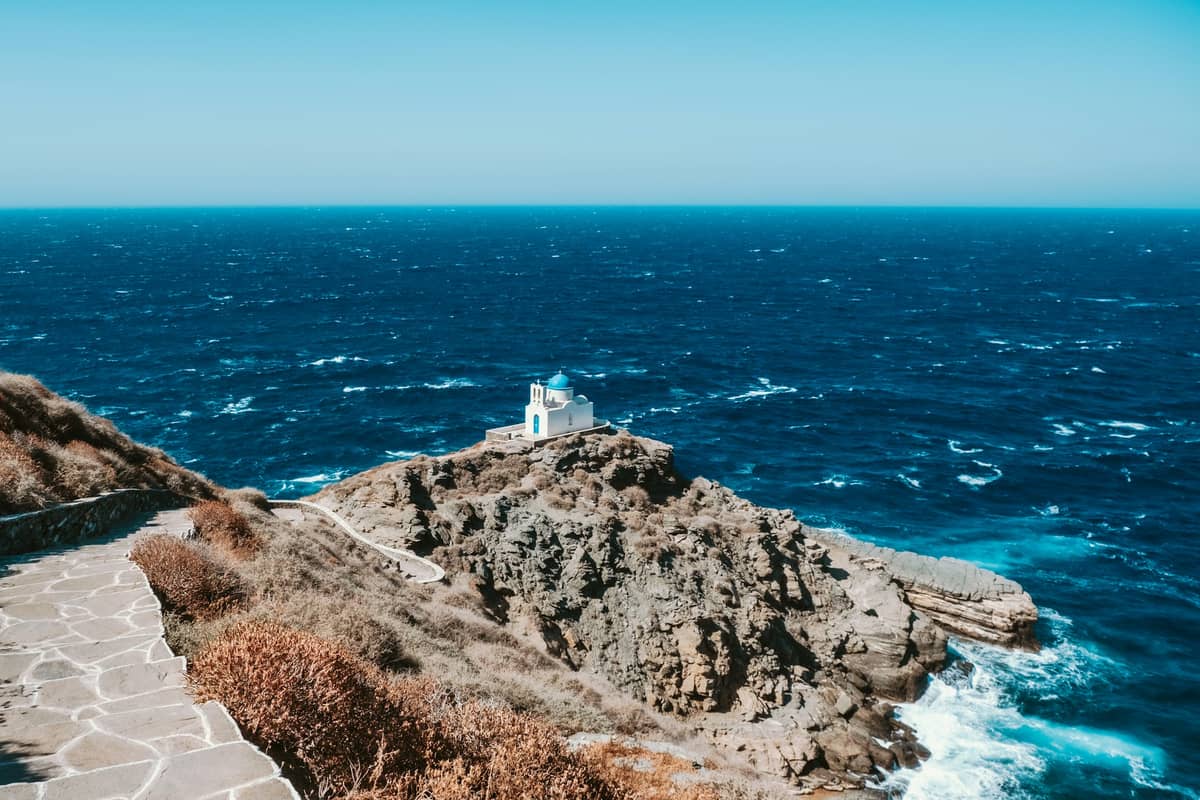
The small church of the Seven Martyrs stands on top of a rock beside the village. Couples choose it for weddings, as the English article on the island notes. Seralia, to the south, was the harbour of the old trade and is the beach of Kastro. Wikivoyage lists rooms in Kastro among the places to stay.
How do Exambela, Katavati and Petali answer where to stay in Sifnos?
Exambela, Katavati, Ano Petali and Kato Petali answer where to stay in Sifnos as four villages of the island. The Greek article lists them with Apollonia, Artemonas and Kastro. Katavati and the two Petali lie within sight of Apollonia, as photo captions show. Each offers rooms among village houses.
- Exambela: a poet and playwright was born there in eighteen fifty, says the Greek article.
- Katavati: a photo shows it beside Apollonia, seen from Ano Petali, spelled Katavathi.
- Ano Petali: steps lead to it from Apollonia, as a photo caption states.
- Kato Petali: 121 residents are listed there in the municipal table.
Exambela has a tie to the island’s past. The Greek article says the family of the cook Nikolaos Tselementes came from this village. A room in Exambela answers where to stay in Sifnos with a village house and a quiet lane. The bays lie elsewhere, so the days run on foot between the lanes.
Katavati has the same place in the Greek list of villages. The English article spells it Katavathi, in a caption that shows Apollonia and Katavathi from Ano Petali. The two lie side by side in that view. A base in Katavati answers where to stay in Sifnos with the capital in sight and the evenings calm.
Ano Petali looks out over Apollonia and Katavati, as the English photo captions show. Wikivoyage describes a hillside in Ano Petali on the footpath halfway between Apollonia and Artemonas. Cars reach it by a roundabout road. Where to stay in Sifnos on a hillside with a view points to this village.
Kato Petali belongs to the Apollonia community, as the English article on Apollonia states. The municipal table lists 121 residents there, against 918 in Apollonia itself. A photo caption shows Kato Petali as a view from the capital. It is a small village, so the lanes stay calm.
Greek Wikipedia also names the Holy Monastery of Vrysi in its Sifnos entry. The monastery owned the land for the island’s new school complex and gave it free of charge. Where to stay in Sifnos with a quiet week in mind can start in any of these four villages.
A base among these villages suits a visitor who wants quiet rooms, a village square and the capital on foot. It does not put the sea at the door. Apollonia holds the shops and services, as Wikivoyage states. Where to stay in Sifnos by the sea belongs to the bays covered in other parts of this page.
How does Kamares answer where to stay in Sifnos?
Kamares answers where to stay in Sifnos for a short stay by the boat or a week by the sand. It is the main port, set on a natural harbour of the west coast. A large beach fills the inner end of the bay, and the village counts 319 residents.
For where to stay in Sifnos, Kamares has one plain job: it is the port. The English article names it a village and the main port, with its natural harbour on the west side. Wikivoyage states that almost all arrivals by boat land here. So the village is the first place a visitor sees on the island.
The houses follow the shape of the bay. The English article says the buildings form a U around the water, with restaurants and shops directly on the water. The hotels and houses stand on the hill above. A room on that hill looks down on the harbour, while a room by the quay sits beside the shops.
The beach is the second reason to choose the village. The article describes a large beach with restaurants and hotels along it. Families deciding what suits them can spend the days on this sand. A shop and a table stay close to the room. That makes where to stay in Sifnos an easy call for a short family trip.
The name comes from the caves of the area, as the Greek-language article explains. The same article places the sandy beach in the innermost corner of the bay. It lists grocery shops and offices that hire vehicles. Basics like these weigh in whenever a visitor asks where to stay in Sifnos.
A base across the water changes the view. The church of Agia Marina stands on the opposite shore, called Pera Panta, as the Greek article states. A photo gallery on the English page shows Kamares from that church. For where to stay in Sifnos, the far shore gives a calm look back at the port.
The village is older than its hotels. The Greek-language article dates the church of Agios Georgios and Agia Varvara to seventeen eighty-five. It also records the remains of a landing stage from eighteen eighty-three. Both stand in the village, so a walk along the quay holds a little history.
Wikivoyage adds a plain note: the village gives little reason to linger. It sends longer stays to Apollonia, Artemonas, Kastro or the south. It still lists Kamares as a base for evening meals and the nearby ferry. That suits where to stay in Sifnos for one or two nights. In summer, buses link the port with the other villages.
How does Platys Gialos answer where to stay in Sifnos?
Platys Gialos answers where to stay in Sifnos for a week by the sea. The south-east bay holds a long sandy beach, 8 kilometres south of Apollonia, as the Greek-language article states. Wikivoyage says the beach has a reputation for being longer than any other in the Cyclades.
- The beach: sandy and organised, with activities and water sports, as the Greek article states.
- The islet of Kitriani: uninhabited, at the south, about 350 metres from the coast.
- Panagia Kitriani: a church on the islet, from the tenth or eleventh century.
- Panagia tou Vounou: a church on the north-east side, with a view over the bay.
Distance settles this base. The Greek-language article gives 8 kilometres from Apollonia and 14 kilometres from Kamares. The village lies at 6 metres above the sea, so the shore is near. A reader who plans a sea day and asks where to stay in Sifnos finds the sand by the room.
The article calls the beach a popular spot for the whole island. It describes sand, organised services, activities and water sports. Wikivoyage calls the bay built up and popular with families, with restaurants of a family atmosphere along the shore. It notes places to stay here too, so the bay fits readers asking where to stay in Sifnos.
Off the bay lies Kitriani, an uninhabited islet. The English article on Sifnos puts it about 350 metres from the coast. The Greek article places it at the south, at the mouth of the bay. Where to stay in Sifnos at this bay keeps the islet in view from the sand.
Only one building stands on the islet: the church called Panagia Kitriani. The Greek article on the islet calls it a domed church of the Middle Byzantine period. It names it the oldest church monument of Sifnos. The text on the bay dates it to either the tenth century or the eleventh.
Boats serve the islet, and the small harbours of Platys Gialos and Vathy lie close, the Greek article says. A room at the bay puts the landing within reach. A reader who wants the islet and its old church finds where to stay in Sifnos settled by this bay.
On the north-east side stands the church of Panagia tou Vounou, dated to eighteen thirteen. The Greek article says it was built on a site with a view of the Aegean, Kitriani and the bay. From that spot the sand and the islet lie in one view.
The Greek article counts 192 residents in the village, so the bay stays a small settlement. Wikivoyage adds that working potteries here sell their work to visitors. Rooms near the sand suit a family, since the bay is popular with families. That is the short answer to where to stay in Sifnos with children.
How do Faros and Glyfo answer where to stay in Sifnos?
Faros answers where to stay in Sifnos with an old fishing harbour on the east coast. The Greek article on the village says it was the official port of the island until eighteen eighty-three. Three small sandy beaches belong to the village, and Glyfo is one of them.
Where to stay in Sifnos reads differently from a harbour than from a hill village. Faros lies on the east coast, toward the south of the island, 17 metres above sea level. The Greek article reports 145 residents for the village at the count of twenty twenty-one. That makes it a small base, close to the water.
The name comes from the lighthouse that led ships into the bay, as the same article explains. A fishing village of long standing, Faros is recorded in the article as a traditional settlement since nineteen eighty-eight. Today the port of the island is Kamares, on the west coast.
The central beach has the places to eat. Glyfo is the beach where the path to Chrysopigi and Apokofto begins. Fasolou has the monastery of the Holy Cross a little further on. A room near any of the three keeps the sand a short walk away. That suits a family or a couple on a slow week.
Wikivoyage lists Faros among the fishing villages with good seafood places for a long part of the year. It also says the beach of Faros can be a bit windy. Where to stay in Sifnos at Faros suits a driver, since Wikivoyage puts Fasolou beach off the bus route.
The municipality’s own site notes steps to the ancient mines beside the beach, with the remains of old ore-loading works. They belong to the mining past of the island, which a later section covers. The harbour therefore has a working history behind its fishing boats.
From Glyfo a coast path runs on to Chrysopigi and Apokofto, which a later section covers. A walker at Faros starts that walk from the village itself, with no car and no timetable. Where to stay in Sifnos for a morning on foot along the shore can begin at this harbour.
A traveller can look for a room with a sea view above the water. Another kind is a studio with a small kitchen close to the beach. When sand, boats and a slow pace matter, Faros gives a firm answer to where to stay in Sifnos. The hill villages lie a drive or a bus ride away.
How does Vathy answer where to stay in Sifnos?
Vathy answers where to stay in Sifnos with one long sandy beach, found on the south-west coast. The sand lies deep inside an enclosed bay, and Wikivoyage says the bay keeps the water calm. Its strip of fine sand is very long, though narrow in parts.
- Setting: a seaside village inside the bay that carries its name.
- Height: 10 metres above the sea, as the Greek article on the village gives it.
- By road: 10 kilometres south-west of Apollonia, the capital of the island.
- Nearest village: Platys Gialos, three kilometres to the east in a straight line.
- Bus: Vathy is the last stop, as the official trail pages list it.
Wikivoyage places the hill of Agios Andreas, with its ancient citadel, beside the main road to Vathi. It lies about two kilometres south of central Apollonia. The drive to the bay therefore passes that hill early on. Where to stay in Sifnos at Vathy means a drive or a bus ride down from the capital.
The municipality’s own site calls Vathi the largest of the sandy beaches on the island. A church of the Archangels, the Taxiarches, stands on the beach. The same site dates that church to the sixteenth century. Kimolos lies across the water from the bay, as the Greek article states.
Pottery workshops in Vathy kept working to the close of the twentieth century, says the Greek article. Wikivoyage lists a working pottery there that sells to visitors. For a craft lover, that adds a reason to pick this bay when weighing where to stay in Sifnos. It gives the day something besides sand and sea.
The official trail pages list a marked walk from Apollonia to Vathy of 9 kilometres. They time it at three hours fifty minutes. They name the last bus stop at Vathy as the other start. Where to stay in Sifnos for a walker can therefore include this bay, with a bus on one leg.
Wikivoyage describes Vathi as popular with young families. For where to stay in Sifnos with small children, a calm enclosed bay makes the plain case for this base. The beach is long, so a family can spread along the sand and still keep the water in sight.
Vathy is a base for a long, slow stay. Mornings go to the beach, afternoons to the village beside the bay, and evenings to the water’s edge. Where to stay in Sifnos for a week of rest can end here. The lanes of the hill villages lie a drive away, so the plan needs a little care.
Choose Faros for an old harbour with three small coves. Choose Vathy for one long beach on a closed bay. Both answer where to stay in Sifnos for a slow week by the water. The next section turns to Chrysopigi and Apokofto.
How do Chrysopigi and Apokofto shape where to stay in Sifnos?
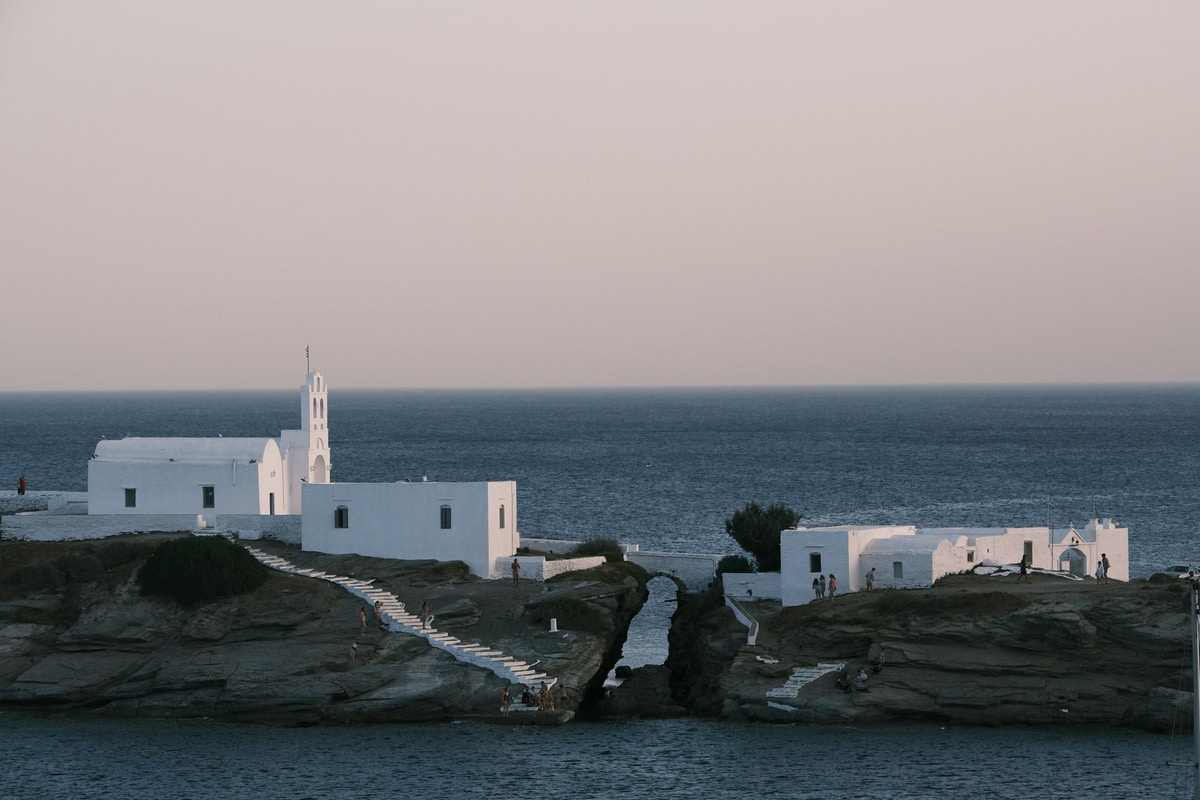
For where to stay in Sifnos, Chrysopigi and Apokofto form a south-east corner built around one church on a cape. The church of Panagia Chrysopigi stands on a small promontory near the fishing settlement of Faros. A room in a nearby village reaches both the church and its sandy bay.
The cape is 400 metres long and 100 metres wide. A narrow gap cuts it off, and a bridge ties it to the island. Where to stay in Sifnos for a seaside church starts with that shape. The church is the centre and the beach lies beside it.
The church is a former monastery, and its first written mention is a manuscript of the seventeenth century. A wall inscription dates the present building to seventeen fifty-seven. In nineteen sixty-four the church was named patron of Sifnos. The buildings around it are all small and built of stone.
No wall surrounds the buildings, and they stand at different levels on the slope. The fissure splits the complex in two. The church and two cell buildings stand on the islet. The refectory and the other cells stand on land, at a lower level, with a stair between them.
The manuscript tells of miracles, such as the splitting of the rock. The Greek National Tourism Organisation retells a legend that the rock opened to shelter a nun. A yearly festival adds a procession of the icon, candles on the steps, shared food and songs. Where to stay in Sifnos for that day is a room near the cape.
Apokofto lies east of the church, and Greek Wikipedia calls its beach sandy. The national tourism organisation describes the water of the bay as green. Wikivoyage files the traditional tavernas of the bay under places off the bus route, reached by car. That note matters for where to stay in Sifnos with a bay day in mind.
A paved footpath joins Apokofto with Glyfo beach at Faros, as Greek Wikipedia describes it. English Wikipedia lists six beaches for the island, and Apokofto and Chrysopigi are both on that list. Where to stay in Sifnos on foot, with the cape as the goal, points to a room at Faros.
Chrysopigi is itself a very small coastal settlement, and Greek Wikipedia lists four residents for it in twenty twenty-one. So the stay is a room in a nearby village. Rooms in the stretch between Platys Gialos and Faros sit nearest to the cape. A room in Apollonia leaves the cape as a trip of its own.
How do Cheronissos and the north answer where to stay in Sifnos?
Cheronissos answers where to stay in Sifnos for a stay at the far north. Greek Wikipedia calls it the northernmost settlement and beach of the island, a fishing village in a closed bay. The same page puts it about 14 kilometres from Apollonia, far from the centre of the island.
- Cheronissos: the fishing village on the closed bay, with a small beach.
- Troullaki: the farming village near the road to the north, 290 metres up.
- Vroulidia: a pebble beach close to Cheronissos, named on the list of six beaches.
- Agios Georgios: the church on the hill above Cheronissos.
The provincial road runs from Artemonas in the south-east to Cheronissos in the north-west. Greek Wikipedia places Cheronissos in the community of Artemonas, together with Agia Marina and Troullaki. For where to stay in Sifnos, the north is therefore one district with one road.
For where to stay in Sifnos, Troullaki stands 290 metres up, close to that road. Greek Wikipedia puts it 8 kilometres north-west of Apollonia and 9 kilometres north of Kamares. It calls the place a farming village known for its sunset. The old church of the Panagia is held to protect the farmers and herders of the area.
Wikivoyage describes Cheronissos as a fishing village in the barren north, with a very small beach. It counts two tavernas there and lists the seafood of the village as seasonal. Where to stay in Sifnos here means a simple shore, a small harbour and a short list of tavernas.
Greek Wikipedia adds that Cheronissos once held a large number of traditional pottery workshops. The same page lists 22 residents for twenty twenty-one, so the village is a hamlet. The bay is closed and the beach is small. For where to stay in Sifnos, that fits a reader after a still, simple stay.
The municipality’s page places the small pebble beach of Vroulidia close to Cheronissos. English Wikipedia names Vroulidia among the six beaches of the island. The hill above Cheronissos holds a church, Agios Georgios, and the remains of an ancient beacon tower. For where to stay in Sifnos, they mark the northernmost buildings of the island.
A room in Cheronissos puts the beach at the door and every other base far down the road. A room in Artemonas shortens that road and keeps the north as a day out. Where to stay in Sifnos for the north asks one question: how far from Apollonia is too far?
How do the beaches by road and by path shape where to stay in Sifnos?
Where to stay in Sifnos for a quiet beach starts with one split. The bus line ends at a bay, and a marked path carries on to the remote ones. Fykiada and Poulati are reached on foot, while Lazarou lies a short walk over the hill from Platys Gialos.
Fykiada is the first path beach. Greek Wikipedia lists it among the bays of the south coast. The municipal trail site calls it a remote bay. The loop to it starts at the last bus stop of Platys Gialos. For where to stay in Sifnos, that stop makes Platys Gialos the natural base for this bay.
The loop climbs a juniper slope to a chapel on the ridge. It then drops to the bay and runs through an old olive grove to an abandoned mansion called Moussia. A coast walk over coloured volcanic rock follows. A branch path links the loop to Vathy, so Vathy also serves where to stay in Sifnos for this walk.
Poulati is the second path beach, listed among the main beaches in the same article. From Kastro, a path follows the coast to the church of Panagia Poulati. A junction east of the church leads to a rocky bay with clear water. A base in Kastro or Artemonas shortens the way for where to stay in Sifnos.
From the church, an uphill path leads to the village of Agios Loukas. Artemonas lies a short stretch farther, as the trail site states. Wikivoyage adds that neither path along this coast has much shade. It also lists a bus between Kastro and Artemonas, so a walker can end the day without retracing the route.
Lazarou lies a bit further south than Platys Gialos, as Wikivoyage states. A short walk over the hill, past the bus terminal, reaches it. A narrow paved road also reaches it. The shore is rocky and slopes gently into the water. Platys Gialos therefore answers where to stay in Sifnos for both Lazarou and Fykiada.
The list below pairs each base with the beaches that the sources place nearest to it.
- Apollonia: Platys Gialos
- Artemonas: Poulati
- Kastro: Seralia and Poulati
- Kamares: Kamares beach
- Platys Gialos: Lazarou and Fykiada
- Faros: Glyfo and Fasolou
- Vathy: the bay of Vathy
Wikivoyage calls the roads of Sifnos good and the bus system frequent. It adds that the trails lead to beaches as well as villages. A base on the bus line gives easy days by the water. A base near a trailhead gives walks to the quiet bays. That split sets where to stay in Sifnos for a beach week.
How do the walking paths shape where to stay in Sifnos?
Where to stay in Sifnos can follow the trailheads of the island. The municipality renewed the way-marking, and Sifnos now holds more than 100 kilometres of designed trails. Apollonia, Artemonas, Kastro, Kamares, Platys Gialos and Vathy each start marked routes for a walking stay.
- Apollonia: the main square and post office start the walks to Platys Gialos, Vathy and Kamares.
- Artemonas: the main square starts marked routes, among them the long path down to Poulati and Kastro.
- Kastro: the village starts the long route through olive terraces to Faros.
- Kamares: the bus stop by the car park starts the old donkey route up to Apollonia.
- Platys Gialos: the last bus stop starts the loop to Fykiada and the walk up to Apollonia.
- Vathy: the last bus stop starts the walk up to Apollonia through the valley of Skafi.
The trail site calls the network a project of the municipality of Sifnos. Old way-marks were removed and new ones set, so the signs follow one design. The site numbers ten routes and adds short branch paths. Each route has a grade on a five-level scale. That grade helps with where to stay in Sifnos for walking.
Two routes follow old working paths. The walk between Apollonia and Kamares is the old donkey route that linked the two. Walking it downhill is easy, and the church of Panagia Platanissa stands about halfway. The path from Apollonia to Kato Petali used to be the main road between those two villages.
Wikivoyage gives the path from Kastro to Apollonia as about three kilometres, with a hilly stretch. A bus links the same two places. A walker can therefore go one way on foot and return by bus. Either village then works for where to stay in Sifnos with a long morning walk in mind.
Profitis Ilias tops the island, and the climb to it leaves from Fyrogia. The trail from Apollonia to Vathy reaches Fyrogia by way of the Steno and Katavati. The trail site calls the ascent not hard but constant, and says it takes hours. The summit view runs all around. That start shapes where to stay in Sifnos.
The trail site says a walker can hike on Sifnos all year. Spring and autumn are the walking seasons for where to stay in Sifnos, with mild air and coloured land. July and August are too hot, and the site rules out walking between noon and four. Wikivoyage adds that shade is scarce, so take water.
Apollonia gathers the routes to the south and the west at one square, and Artemonas adds the path to Kastro. A beach base such as Platys Gialos keeps one loop on its doorstep. For walkers, where to stay in Sifnos is a question of which start suits the plan.
How do the ancient towers and the acropolis shape where to stay in Sifnos?
Where to stay in Sifnos can follow the ancient towers. The Ministry of Culture, through its Cyclades Ephorate of Antiquities, has identified 76 of them. That is more than one for every square kilometre. Together with the acropolis of Agios Andreas they formed one signalling network across the island.
The Ephorate describes the towers as round, four to thirteen and a half metres across. As a rule they are built from local stone. Each had at least two floors, joined by a spiral stair fixed to the inner wall. The page adds that the larger share stand in remote places.
The towers went up gradually from the sixth to the third century BC, as the page reads the finds. Towers among the oldest rise beside the mines, late in the sixth century BC. For where to stay in Sifnos, that ties the oldest ones to the mine zones, not to the villages.
The page counts the towers, the acropolises and the forts as the first systematic signalling network on the island. Smoke was the main signal. The acropolis of Agios Andreas keeps direct sight of Kastro and Prophet Elias, and of 17 towers in the north. Where to stay in Sifnos can therefore follow the lines of sight.
News from the mines went from the local towers to the hub at Aspros Pyrgos, then to Agios Andreas. From there it spread to the fortress of Agios Nikitas and to Kamares. Kastro sits on that old route, which suits where to stay in Sifnos for a history lover.
Greek Wikipedia places Aspros Pyrgos, the White Tower, north-east of Platys Gialos village. It calls the tower a landmark of the island. A base at Platys Gialos answers where to stay in Sifnos for this tower. The Ephorate also names the Tower at Flambouro, dated to the late fourth and early third century BC.
For a history walk, Agios Andreas decides where to stay in Sifnos. The Ministry places the acropolis, the only organised archaeological site on Sifnos, on the hill of Kamalafka. People were active on the hilltop from at least the late fourth millennium BC. The fortified acropolis dates to the turn from the thirteenth to the twelfth century BC.
Apollonia answers where to stay in Sifnos for this site, about two kilometres off, says Wikivoyage. The South Aegean tourism portal adds that a road reaches the entrance and a stepped path climbs in twenty minutes. The Mycenaean wall had eight rectangular towers. An exhibition hall shows finds from the dig and material on Kastro, the mines and the towers.
How do the old mines and the island history shape where to stay in Sifnos?
Where to stay in Sifnos also follows the old mines. Gold, silver and lead were being mined on the island by the third millennium BC, as Wikipedia states. Remains of those workings can still be seen on the island, notably at Agios Sostis.
- Third millennium BC: gold, silver and lead are mined on the island.
- About six hundred BC: Sifnos mints coins, among the first places in Greece to do so.
- Sixth century BC: the Siphnians build their treasury at Delphi.
- Early thirteenth century: Venetian nobles take the island.
- Early fourteenth century to sixteen seventeen: the Da Corogna family and then the Gozzadini family rule it.
- From sixteen seventeen: Ottoman rule, which Wikipedia calls fairly loose, with the islanders largely running their own affairs.
- From eighteen twenty-one: the Greek War of Independence, in which the island plays an important role.
The Ministry page on metals names two zones, and where to stay in Sifnos can read them as a map. The first stretches across the island from north-east to south-west, passing Agios Sostis, Voreini and Xeroxylo, and holds silver-lead ore. The second holds gold at Agios Ioannis, Apokofto and Aspros Pyrgos, on the south-east coast near Platys Gialos.
In or near the mines, the same page says, ancient galleries, shafts, ventilation ducts, lamps and tool marks were found. Greek Wikipedia puts the ruins of the ancient mines mostly near Agios Sostis. Wikivoyage adds that the silver mines there are thought to be among the earliest workings known in Greece.
The Ministry page ties the wealth to Delphi. There the Siphnians built a treasury from a tenth of their income, in the later sixth century BC. It was the only all-marble treasury of its time in the Sanctuary of Apollo. The building won them the right of promanteia, a place at the head of the queue for the oracle.
The Ministry page offers a link between the island name and the mines. The name, it suggests, comes from a word for empty, because mining galleries hollowed out the subsoil. Greek Wikipedia adds ancient quarries of Siphnian stone, which gave tableware such as the Siphnian cups.
A history lover weighing where to stay in Sifnos meets a legend from Pausanias about the lost gold mines. In Wikivoyage’s telling the islanders sent Delphi a gilded egg, not the solid gold one sent before. Modern scholars, Wikipedia adds, note that galleries dug below sea level filled with water. The mines far from the sea were probably worked out.
For a history lover, where to stay in Sifnos comes down to three bases. Apollonia serves Agios Andreas, Platys Gialos serves Aspros Pyrgos and Kastro serves the old Asty. The Ministry identifies the City of the Sifnians with Kastro. Wikivoyage notes that remains of the mines appear on certain maps.
How do the monasteries and chapels shape where to stay in Sifnos?
Churches draw a second map for where to stay in Sifnos. Wikipedia counts 237 of them on this small island of the Cyclades. A summit monastery, a chapel above the port and country churches in the fields each point toward a different base.
Wikipedia adds that a number of the churches and monasteries are historical sites of religious and architectural interest. The tourism portal of the South Aegean Region calls them historical monuments as well.
The monastery of Profitis Ilias at Apsilos suits a walker who wants a long morning. For that walker, where to stay in Sifnos points to Apollonia. The portal puts the monastery 678 metres high, and the walk from Apollonia takes ninety minutes. It dates to the mid-seventeenth century.
The portal states that the monastery rests on the remains of an ancient building. The small chapel of Agios Eliseos stands beside it. The view reaches the Peloponnese and Ikaria. A walker who sleeps in Apollonia starts the climb early. That settles where to stay in Sifnos for this trip.
Agios Symeon answers where to stay in Sifnos for a traveller who arrives at the port. The chapel rises above Kamares and dates from sixteen sixty-seven, as the portal states. Its forecourt looks over the port and the bay. A road from there turns left toward Cheronissos.
Fyrogia is a monastery that the portal considers a building of the sixteenth century. A society for the protection of the environment and cultural heritage restored it in the nineteen-seventies. The signposted old path to the summit begins from Fyrogia.
Country churches stand in the Natura area of the island. The portal lists Ai Stathis, Panagia tou Iliou, Ai Nikolas T’Aerina and Agia Ekaterini Kapfari there. It adds Agia Marina and Agios Konstantinos at Flambouro and Ai Giannis at Mavro Chorio. For where to stay in Sifnos, a base beside a trail suits these walks.
The Chrysostomos monastery stands in Kato Petali. According to tradition, it housed the first Greek school of the island. The portal gives sixteen fifty as the date. The School of Agios Tafos worked there from eighteen thirty-five. That story lets a history lover sort where to stay in Sifnos by village.
Look at how the churches sit among the houses. The portal notes that a church is joined to its neighbouring houses, even by a common yard. White domes and bell towers rise between the roofs. Inside, respectful dress suits every church. A village base keeps the church at the door, so where to stay in Sifnos can follow the village.
How do the pottery workshops shape where to stay in Sifnos?
Pottery shapes where to stay in Sifnos because the craft left workshops in old inland villages and on the bays. Wikipedia names Sifnos a pottery centre of the Aegean, a result of its veins of rich clay. That map still leads a craft lover.
- Artemonas and Ano Petali: the oldest pottery centres, set inland.
- Platys Gialos: a working pottery that sells to visitors.
- Vathy: a working pottery that sells to visitors.
- Cheronissos: a traditional pottery in the fishing village of the north.
- Apollonia and Kamares: shops that sell pottery.
- Fyrogia: a small museum of modern pottery, open in summer.
The clay is the first reason. The Greek article on the island says its clay-rich soil was an excellent raw material for the trade. English Wikipedia names the jars and pots a trademark of the island. Locally, a Sifnios was a word for a potter.
Greek Wikipedia says the craft reaches back centuries and had its greatest flowering in the nineteenth century. Potters of Sifnos sent their goods all over Greece. Potters also settled in the Cyclades, on Chios, on Crete and on the Argosaronic islands, and in Amarousion in Athens.
The workshops moved over time. In Artemonas and Ano Petali the oldest pottery centres lay inland, set back from the sea because of pirates. Once piracy ended, the Greek article adds, workshops moved to the beaches, where caiques carried the pots away.
On the beaches today there are settlements, while in the past there were only the potteries. A number of those workshops survive and still work, as the Greek article describes. They make the old useful vessels and also decorative pieces. Where to stay in Sifnos on a bay therefore means living near a craft that is still alive.
Wikivoyage names working potteries at Platys Gialos and Vathy that sell their work to the visitor directly. Either bay answers where to stay in Sifnos for a craft lover. The visitor buys a piece straight from the maker.
Wikivoyage also describes a traditional pottery in Cheronissos, the fishing village of the barren north. The craftsman there makes trick pots: a jug pours until it seems empty, rests a moment, and then pours again. A stay in the north adds that visit to a quiet day by the sea.
In summer a small museum of modern pottery opens at the monastery of Fyrogia, the portal states. It works under the care of the municipal enterprise and the potters’ association. Wikivoyage adds that shops in Apollonia and Kamares sell pottery. Apollonia therefore answers where to stay in Sifnos for a craft lover who likes shops and a museum.
Two clay pots of the island kitchen carry their own names, the mastelo and the skepastaria, as Wikipedia states. The portal also records that potters and fishermen built houses in the countryside. These were small complexes of home and workshop, not villages. Where to stay in Sifnos for a craft week follows these homes and bays.
How does the island cooking shape where to stay in Sifnos?
Where to stay in Sifnos for a food lover starts with clay-pot cooking. Wikivoyage states that the island has long had a reputation in Greece for its cuisine. The chef Nikolaos Tselementes was born in Exambela. Revithada and mastelo are the two dishes cooked in pots made on the island.
Nikolaos Tselementes was born in Exambela, a village of Sifnos, and grew up in Athens, as English Wikipedia states. His recipe book was the first complete cookbook in Greek and saw over fifteen reprints. A room in Exambela ties where to stay in Sifnos to his story.
In Greece the surname Tselementes is a synonym of the word cookbook. It is also used in jest for a person who cooks very well. Greek Wikipedia adds that his origin in Exambela gave the island a culture of cooking.
Revithada, the island chickpea soup, stays in a wood-fired oven all night. The clay pots are called skepastaria, and the soup is served after Sunday church services, as English Wikipedia states. A village base keeps that Sunday table close. For the dish itself, where to stay in Sifnos comes down to the village.
English Wikipedia describes mastelo as goat or lamb steeped in red wine with dill. It cooks in a wood-fired oven, in a clay pot that is also called a mastelo. Greek Wikipedia explains that the dish took its name from that vessel. The national tourism organisation adds olive oil and oregano.
Greek Wikipedia names manoura and myzithra among the cheeses of Sifnos. The national tourism organisation calls manoura a spicy cheese kept in red wine lees. It calls xynomyzithra a soft, tangy cheese. For where to stay in Sifnos, Wikivoyage names grocers and bakeries in Kamares, Apollonia and Artemonas.
Amygdalota are almond sweets, as the national tourism organisation lists them. Greek Wikipedia names melopites, the honey pies, and pastelia among the island dishes. It also lists thyme honey among the island products. Caper salad and chickpea fritters stand on the same list.
Early September brings the Cycladic Gastronomy Festival to Sifnos, as Greek Wikipedia states. Delegations from the Cyclades and beyond gather there and show their traditional recipes. The festival carries the name of Tselementes. For where to stay in Sifnos in that week, a food lover can plan around the date.
For where to stay in Sifnos, the base that suits a food lover depends on the kitchen. A village house with a kitchen suits a traveller who cooks island produce. A room in Apollonia or Artemonas keeps grocers and cafes close. A room on the coast suits a traveller who eats by the water.
How do the feast days shape where to stay in Sifnos?
Feast days answer where to stay in Sifnos with a church and a village. English Wikipedia counts 237 churches on the island and adds that festivals fall there almost every month. Its list of summer feasts runs from the fifteenth to the thirty-first of the month. A traveller who wants to see one picks the village first.
- The Holy Virgin: the fifteenth, with events on the days that follow.
- Panagia tou Nigiou: the evening of the sixteenth.
- Panagia Platanissa: the evening of the sixteenth.
- Panagia to Toso Nero: the evening of the seventeenth.
- St Marina at Flabouro: the evening of the seventeenth.
- Prophet Helias: two events on the evening of the nineteenth, one on the summit of the highest mountain and one at Troullaki.
- St Symeon: the evening of the thirty-first.
The Sifnos article lists these as days of the month in summer. The article on the Dormition places the feast of the Virgin on the fifteenth of August. The article on the prophet Elijah gives the twentieth of July for his feast day. For where to stay in Sifnos, the calendar points to July and August.
The Holy Virgin feast on the fifteenth brings events on the days that follow. On the Friday after the Assumption, the Greek National Tourism Organisation sets the Chrysopigi festival. So a stay across the fifteenth of August holds more than one day of feasts. Where to stay in Sifnos then follows the church of the day.
Two names on the list also stand on the marked trails: Panagia Toso Nero and Agios Symeon. The trail site calls Panagia Toso Nero remote. It says the trail to Agios Symeon ends where no bus runs, so a taxi or a walk back follows. The trails start at the main squares of Apollonia and Artemonas.
That start shapes where to stay in Sifnos for these two feasts. Apollonia is the village of the trail to Panagia Toso Nero. Artemonas is the village of the trail to Agios Symeon. A room in the village of the trail puts the start of the walk at the door.
The national tourism organisation says food is shared as an act of community at panigyria, homes and church courtyards. A feast therefore means a table at the church. A village base keeps that table close, and a room away from the village keeps it a drive away.
Easter brings its own dish. English Wikipedia states that mastelo is served on Holy Saturday evening during Orthodox Easter. For where to stay in Sifnos at Holy Saturday, a traveller picks the village first and the room second.
To time a stay to a feast, choose the church first and the base second. Each feast belongs to a place, so the route from the room to the church sets the plan. Confirm the day with the municipality before the trip, because dates and events change. Where to stay in Sifnos then follows the date and the village.
How do the port and the ferries shape where to stay in Sifnos?
Where to stay in Sifnos starts at the quay. Kamares is the main port, and almost all boats leave from it. Crossings from Piraeus run from two hours and thirty minutes to about five hours. The length of the crossing sets how early or late a first night begins.
Begin with the distance. The English article on Sifnos puts Piraeus about 130 kilometres away, which equals 80 nautical miles. Every plan for where to stay in Sifnos therefore opens with a sea crossing. The island has no runway of its own, so a boat is the way in from the mainland.
The national tourism organisation lists two crossings from Piraeus, both calling at Serifos. One takes two hours and thirty minutes. The other takes five hours and fifteen to five hours and thirty minutes. Wikivoyage gives the same spread: about five hours by steamship, and about half that by fast catamaran. That spread matters for where to stay in Sifnos.
Wikivoyage says fast boats and steamship ferries link Piraeus and Sifnos daily or almost daily in the high season. The trail site of the municipality also speaks of daily connections. It gives two to five hours, by type of boat. Where to stay in Sifnos can follow the hour of the boat.
The line does not stop at Sifnos. The article describes a ferry chain from Piraeus through Kythnos, Serifos, Sifnos and Milos to Kimolos. A second link runs via Naxos. It adds that sailings to other Cyclades islands are infrequent. Where to stay in Sifnos for a traveller who plans to move on follows that chain.
On its Serifos page, Wikivoyage notes that the larger share of the Piraeus boats to Sifnos stop at Serifos. The trail site names Milos, Serifos, Santorini and Mykonos as islands joined by boat. Wikipedia notes a frequent local ferry boat between Milos and Kimolos.
Wikivoyage writes in its Go next section that almost all boats leave from Kamares. The English article on the village says visitors arrive via the ferry terminal in the harbour. A room by the quay shortens the walk to an early boat. That suits where to stay in Sifnos on the night before a sailing.
No airport serves Sifnos. Wikivoyage sends air travellers to nearby Milos, then onto the ferry. Wikipedia locates the airport of Milos 5 kilometres from the island harbour, towards the south-east. Wikivoyage adds that a place to stay can offer a transfer from the port, so ask when you reserve.
How do the buses, cars and taxis shape where to stay in Sifnos?
Wikivoyage says a visitor gets around Sifnos with or without a car. That keeps where to stay in Sifnos open for a visitor with no hire car. Buses link Kamares with the other villages. A car or a taxi then widens the map.
- Bus: links Kamares with the other villages, as the English article on Kamares states.
- Taxi: waits at the port when the ferries arrive, as Wikivoyage states.
- Hire car or scooter: opens the bays and the roads between the bus stops.
- On foot: the stone-paved alleys of Apollonia, as the national tourism site states.
The bus is the backbone of the island. In summer, Wikivoyage reports a bus every hour or two from Kamares to the greater part of the island. A base on one of those stops keeps the port within reach. Where to stay in Sifnos can then turn on the stop, not on the car.
Wikivoyage calls the bus system frequent and reliable. The municipal trail site points readers to the updated bus timetable on the municipal site. It keeps a taxi section too. A traveller reads that timetable before the trip. A room beside a stop then makes the plan plain.
Wikivoyage places a bus terminal at Kastro and a bus stop at Apollonia. The municipal trail site lists bus connections at Kastro, Artemonas and Apollonia for its first route. A room near one of these stops keeps the bus close. Where to stay in Sifnos by bus is a choice of stop.
Wikivoyage says taxis wait when the ferries arrive, though they can fill up. It adds that taxis are easy to find for trips between the towns. With a taxi in reach, a late boat need not tie a traveller to a room at the port. That widens where to stay in Sifnos after dark.
A scooter or a hire car adds the bays off the bus line to where to stay in Sifnos. Wikivoyage describes the roads as generally good. A car lets a traveller shift from a hill village to a beach at any hour. A scooter suits a couple on a short stay.
The national tourism site describes Apollonia with traditional houses and stone-paved alleys. A base in such a village puts the daily walks at the door, and the car matters less. For a stay on foot, the lanes decide more than the road does.
For a stay without a car, Kamares joins the quay, a large beach and the bus in one place. Apollonia and Artemonas give lanes and a bus link. Kastro, on its cliff, has a bus terminal of its own. Each of these answers where to stay in Sifnos with no hire car.
Which months suit where to stay in Sifnos?
Where to stay in Sifnos follows a dry, mild climate. Wikipedia cites the Climate Atlas of Greece. In that atlas, the greater part of the Cyclades sits in a hot semi-arid zone. The Cyclades article calls the group dry and mild. The month then decides which base fits.
The Greek article on Sifnos calls the climate of the island temperate, like that of all the Cyclades. Wikivoyage adds that the permanent population of about 2,200 grows greatly in summer. So the month changes the pace of a village and shapes where to stay in Sifnos.
In its summer notes on Greek weather, Wikipedia names the Cyclades for very windy days. The picture is sunny and dry weather, with hot days and pleasantly warm nights. That sets the tone of July and August on every base.
Wikipedia calls the etesians, or meltemia, strong, dry north winds across the Aegean. They set in during late spring, blow hardest in the afternoon and fade near the middle of September. The entry on Greek climate adds that July and August carry the highest frequency. So where to stay in Sifnos in high summer includes a wind.
The sea has its own season. In summer the Aegean entry gives the water 19 to 24 degrees Celsius. Its winter figure runs from 8 degrees in the north up to 13 in the far south. These are readings for the whole Aegean, so no bay of Sifnos is named.
The walking site of the municipality says a winter walk brings showers, strong and cold winds and muddy trails. Wikivoyage calls the seafood places of Seralia very seasonal, while Faros keeps its own open over a longer stretch. Where to stay in Sifnos in winter then calls for a base with a short daily walk.
In general words, the shoulder months are late spring and early autumn. The wind sits outside its July and August peak, and the hills carry spring flowers. Where to stay in Sifnos in these months suits a traveller who wants a village base.
Wikipedia notes in its Cyclades entry that higher elevations register lower temperatures. The hill villages of the middle stand higher than the bays on the coast. So a village and a bay can give two different evenings.
A short plan follows from this. July and August suit a base by the water, where the sea is the point of each day. A hill village and its lanes suit the shoulder months. Winter suits a village with daily needs close by. So the calendar settles where to stay in Sifnos.
Which day trips suit where to stay in Sifnos?
Where to stay in Sifnos can include a day on a neighbour. Sifnos lies between Serifos and Milos, as Wikipedia states, and Kimolos lies near Milos. Each neighbour differs: a hilltop town on Serifos, white rock on Milos and a round island, Kimolos. The base by the port starts each trip.
- Milos: a volcanic island with the white rock coast of Sarakiniko and the hill town of Plaka.
- Serifos: a hilltop Chora with a medieval castle, above the port of Livadi.
- Kimolos: a round island with silver-coloured rocks on its south coast.
- Round Sifnos: a day on a boat along its bays.
For where to stay in Sifnos, a day on Milos suits a traveller who wants a coast. Milos is a volcanic island of the Aegean, lying above the Sea of Crete, as Wikipedia states. The article gives the municipality 160.147 square kilometres of land and 5,193 inhabitants in the twenty twenty-one census.
Wikipedia ties the white rock of Sarakiniko to wind and water erosion on the coast. Wikivoyage sets Plaka, also called Chora, on a rock over Adamantas, the harbour town. A path climbs from the town to a Venetian castle at the top.
Wikipedia gives Kimolos a medieval name, Argentiera, from the silver tone of rock along its south coast. It adds that no more than 600 residents remain in winter. Where to stay in Sifnos can reach as far as Kimolos for a traveller who wants a small island.
Wikipedia gives Serifos a land area of 75.207 square kilometres and 1,241 inhabitants in the twenty twenty-one census. Worked marble blocks in the walls of the medieval castle crowning Chora show that the ancient capital stood there too. The Archaeological Collection in Chora is open Tuesday to Sunday, as the article says.
Wikivoyage places Chora about a mile up the hillside from the port of Livadi. A bus links the two, and a steep walk leads up an old donkey path. It suggests the bus up and the walk back down. For where to stay in Sifnos, this day needs only a boat, a bus and comfortable shoes.
Wikivoyage’s page on the Cyclades notes that sea and weather conditions can cancel a ferry. It adds that the night sea is calmer, which helps the late sailings and the early ones. A traveller who weighs a day return against a night away can read a timetable with that note in mind.
A boat round Sifnos is a different kind of day, with the coast seen from the water. Where to stay in Sifnos for any boat day points to the port. The early boat is a short walk away, and the return ends at the door.
Which kinds of rooms answer where to stay in Sifnos?
Five kinds of room answer where to stay in Sifnos, and each one suits another corner of the island. A village house, a bay-view room, a beach studio, a family room and a villa cover the range. The island is small, so the choice is about setting, not distance.
A whitewashed house with a courtyard is the first kind. The Greek article on the island says Sifnos is known for the architecture of its settlements. It singles out Kastro for its medieval building. For where to stay in Sifnos in the hill villages, this house puts the lanes and squares at the door.
A villa with a pool belongs to the countryside. The Greek article describes dry-stone walls that run with the lie of the land and make flat strips for crops. A villa in that setting sits among those walls and fields. It suits a family with a car, since the bays lie a drive away.
A room with a sea view trades the lanes for the water. It sits above a bay or on the edge of a village. Wikivoyage lists places to stay at Kamares, Platys Gialos and Vathy. For where to stay in Sifnos with the sea in the window, a bay is the base to pick.
A studio with its own kitchenette is the kind that carries a week by the sand. Wikivoyage mentions studio hotels at Vathy. The Greek article adds that the beaches carry settlements today, where only pottery workshops stood in the past. The kitchenette handles breakfast, so the days on the beach keep no fixed meal time.
A family room near the sand keeps the beds and the beach close, which suits a week with children. A camp site is one more kind of stay. Wikivoyage lists one at Kamares and one at Platys Gialos. Where to stay in Sifnos with a tent starts at those two bays.
A room in Kastro is a kind of its own. Wikivoyage places the village on a rocky hilltop right on the sea. It also mentions rooms for rent outside Kastro, with patios and shared kitchens among their features. That gives where to stay in Sifnos a further answer.
Wikivoyage says the population of the island rises greatly in summer. The rooms follow that rhythm, so the quiet months offer a smaller choice. The same page adds that much of the traditional atmosphere has stayed despite more visitors. A traveller outside summer checks which rooms are open before settling where to stay in Sifnos.
How does a split stay answer where to stay in Sifnos?
Pairing a hill village with a beach bay gives a split stay and answers where to stay in Sifnos. One base gives lanes and evening walks, and the other gives sand and water. A bus ride or a short drive joins the two, so one move gives the trip a second setting.
- Short stay: one hill village, then one night at the port before the boat.
- Week: three nights in the hills and four by a bay.
- Ten days: a hill village, a beach bay and a calm shore on the east coast.
- Walker: Apollonia first, then a bay with a trailhead, such as Platys Gialos.
The first pair puts lanes first and sand second. Apollonia or Artemonas gives the lanes, the squares and the evening walks. Platys Gialos or Vathy gives the water. Over a week, three nights in the hills and four by the bay settle where to stay in Sifnos.
The order of the pair follows the mood of the trip. A trip that opens with energy starts in the hills and ends at the bay. A trip that opens with rest does the reverse. For where to stay in Sifnos, the first night matters less than the plan for the days.
A night at the port is a split of its own. Wikivoyage says a transfer from the port can come with a room and advises asking when you reserve. For where to stay in Sifnos before an early boat, pick a room by the quay. The hill village or the bay follows the next day.
The hill and the port link by bus and by path. The official trail pages give the marked walk from Apollonia down to Kamares as one hour fifty minutes. Bus stops stand at both ends. For where to stay in Sifnos, that makes the move from hill to port a walk or a ride.
Between the other bases the choice is the bus or the car. A base on the bus line moves by bus. A base at the end of a road moves by car or taxi. The distances are short, so a move fills a morning, not a day.
On ten days a third base fits between the other two. Apollonia gives the lanes, and Platys Gialos or Vathy gives the sand. Kastro or Faros then gives a calm end on the east coast. For where to stay in Sifnos, three bases mean two moves.
Two nights make a base worth the move, and one night makes a stop. Three nights let the lanes or the shore become familiar. A week with two bases moves once. Ten days with three bases move twice. The stay then reads as one plan, not as a chain of one-night stops.
The luggage decides the shape of a move. A small bag rides the bus between bases without trouble. A large case suits a drive or a taxi. A traveller who packs light moves freely. For where to stay in Sifnos, a hill village and a bay then suit both kinds of bag.
The weather decides the order, too. A calm, clear day suits the bay. A windy day suits the lanes of the hill village. A traveller with two bases keeps both choices open and spends each day where the weather helps. The second base then feels like a plan that fits the island.
Which questions do readers raise on where to stay in Sifnos?
Readers raise four matters about where to stay in Sifnos. They compare a hill village with a beach and a car with the bus. They ask how long to stay, and which plan fits a family or a walker. One place fact from a named source backs each answer.
On a first visit, does a hill village or a bay decide where to stay in Sifnos?
A hill village answers where to stay in Sifnos when evenings on foot matter. A first-time visitor can walk the lanes of Apollonia from the first evening. No bus and no car need arranging. The island trail site starts its route five in the main square and leads south to Katavati.
In Katavati the route passes the church of Angeloktisti. The trail site translates the name as built by Angels. A short walk from a village room can therefore end at a church with a story in its name.
A bay suits a first visit when the sea comes first. The trail site calls part of route four A a beach walk on the bay of Vathy. The same route links the bay to route four and to the start of route five. A stay by the sand still opens paths on later days.
The choice rests on the first evening. Where to stay in Sifnos for lanes and old walls points to a hill village. For sand at the door it points to a bay. A couple on a short trip leans to the lanes. A family on a long week leans to the sand.
Can a visitor without a car still pick where to stay in Sifnos?
For where to stay in Sifnos, the car changes the plan less than the base does. The trail site adds bus junctions to its route notes. North of the chapel of Profitis Ilias Kondou, a marked junction leaves route four. It leads to a bus stop on the line between Apollonia and Vathy.
A walker can leave the loop at that stop and ride back, with no car. The far north shows the same plan. The trail site says the bus stop of Cheronissos lies uphill from the beach. The pole by the water marks the way to it.
A visitor on foot therefore reads the bus line before the room. A base on a bus line keeps the day simple. A far base off the bus line needs a taxi or a hire car. The trail pages show where each stop stands.
For this walk, where to stay in Sifnos can point to a village on the Vathy line. The bus then serves both ends of the day. A visitor without wheels reaches the trailhead on foot from the room.
Do two nights or a week suit where to stay in Sifnos?
The nights follow the sights. For where to stay in Sifnos, small water sights show how a stay can grow. The trail site follows the Erkies creek on the walk down to Kastro. It places the creek among the important creeks of the island.
Not far past the creek crossing, the ruins of an old watermill stand on the left. The site notes that its water-tower is well preserved. It adds that the crossing can carry running water, above all in winter.
A second water sight lies in the south. On the last descent to Platys Gialos, the trail site points out small irrigation canals. They bring water from the Vryssiana spring to the fields of the bay. A third sits at the lowest point of route seven, a source called Tris Piges, which means the three sources.
Two nights fit one village and one bay. Three or four nights add a path day with a mill or a spring. A longer week lets a visitor change base once. That plan answers where to stay in Sifnos by the number of nights.
Which family or walker stay answers where to stay in Sifnos?
A family can start with a bay. Rooms near a long beach keep the sand, the beds and the bus stop close together. That suits a week with children, because each day then starts and ends in one place.
A walker can start with a loop. Route seven A climbs from the main square of Apollonia to Pano Petali and Trava Vounia. The trail site says it joins route ten A and route ten in a circular walk, ideal for an afternoon.
The site adds a small comfort for longer routes. A cell beside the church of Agios Lefteris is open to the public. Walkers can make a coffee there, and the site asks them to leave it as clean as they found it.
A family looks at sand, and a walker looks at squares and bus stops. Where to stay in Sifnos for either one follows that short list. Apollonia serves the walker with its square and its loop, and a bay serves the family.